Moussaieff Red Diamond
Open FREE Unlimited Store Join Our Newsletter
Origin of Name
The diamond which was acquired and processed by the William Goldberg Corporation of New York in the 1990s, was originally named the "Red Shield", but subsequently after its sale to Moussaieff Jewelers Ltd. in the year 2001, the diamond came to be known as the "Moussaieff Red"diamond.
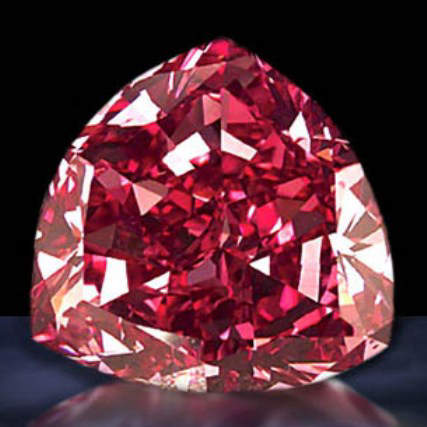
The Moussaiff Red Diamond

Characteristics of the diamond
The Moussaieff Red is a triangular brilliant-cut or trilliant-cut, fancy red (ruby red), internally flawless diamond, weighing 5.11 carats. It is the largest red diamond in the world today, and its estimated cost in the year 2002 was $ 8 million. The G.I.A. states that it is the largest fancy red natural color diamond, that it has ever graded as of the date the report was issued.
Being a red diamond, the Moussaieff Red is a type IIa diamond, whose frequency of occurrence is much less than 0.1 % of all naturally occurring diamonds.
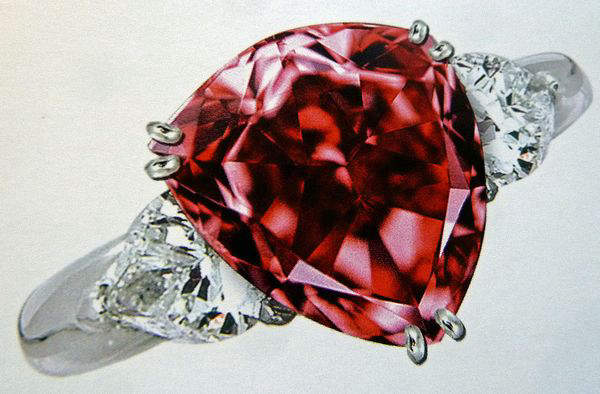
The Moussaiff Red Diamond
History
The Moussaieff Red was discovered by a farmer in Brazil in the mid-1990s. As such the diamond must have originated in the alluvial deposits of the diamond mining areas of Brazil. In the rough state the stone weighed 13.90 carats.
The diamond was acquired by the William Goldberg Diamond Corporation of New York. The master cutters of the Goldberg Corporation transformed the stone into a spectacular triangular brilliant-cut, also known as a trilliant-cut, deep-red diamond, weighing 5.11 carats. The diamond was given the name Red Shield by the Goldberg Corporation.
The Red Shield diamond was sold to Moussaieff Jewelers Ltd. in the year 2001 or 2002, for a rumored $ 8,000,000, and after this transaction the diamond was referred to as the Moussaieff Red.
The Moussaieff Red was displayed at the Natural History Museum of the Smithsonian Institution on two recent occasions in the years 2003 and 2005.
In the year 2003, it was part of the "Splendor of Diamonds"Exhibition, held between June 27th and September 30th, at the Smithsonian Institution, Washington D.C., that also featured other famous diamonds such as the Millennium Star, the Alnatt diamond, the Pumpkin diamond, the Heart of Eternity, the Steinmetz Pink, and the Ocean Dream.
In the year 2005, the Moussaieff Red was part of the "Diamonds"Exhibition held between 8th July, 2005 and 26th February, 2006, that featured a star line-up of eight of the world's most incredible diamonds, displayed together for the first time. This included the De Beers Millennium Star, The Steinmetz Pink, The Incomparable, the Ocean Dream, the Moussaieff Red, the Heart of Eternity, the Alnatt, the 616 diamond (an uncut, unnamed diamond). The exhibition also included the Eureka, the Shah Jahaan and the Aurora Collection, a set of 296 naturally colored diamonds, totaling a staggering 267.45 carats.
The second largest red diamond in the world, was discovered in South Africa in 1927, and after cutting and polishing weighed 5.05 carats. The cut employed was emerald cut. This diamond had no particular name and was simply known as the "Red diamond". The diamond was believed to have been purchased by an anonymous diamond connoisseur for his private collection. The present whereabouts of the diamond is not known.
The third largest red diamond is the "De Young Red", having a weight of 5.03 carats, and cut as a round brilliant. The red color of this stone has a slightly brownish hue, giving it the appearance of a Rhodolite or Allamandine garnet. In fact the stone was mistakenly sold as a red garnet at the beginning, but later identified to be a red diamond. The "De Young Red"is now the property of the Natural History Museum, of the Smithsonian Institution, in Washington D.C.
In the 19th century, Edwin Streeter, a diamond dealer in Paris, purchased a 0.95-carat, deep ruby-red diamond known as the Halphen Red. The stone disappeared from public view and was never seen again. Almost a century later a collector in England purchased a 0.95-carat red diamond, which came to be known as the Hancock Red, after it's owner Warren Hancock. While there is no proof the two diamonds are in fact the same, the rarity of the red diamonds makes it likely they are. The extraordinarily deep ruby-red color makes the Hancock Red exceptional among the red diamonds, even though it has a carat weight of only 0.95 carats. The exceptional red diamond, sold for a record price of $ 926,000 per carat at a Sotheby's auction in 1987.
Occurrence and chemistry of red color diamonds
Colorless diamonds are the well known and most popular diamonds in the jewelry trade. However, diamonds also occur in different colors in nature, in almost all the colors of the rainbow. Colored diamonds are gradually becoming more popular and are increasingly used in jewelry settings. The large production of brown diamonds in the Argyle mines of Western Australia, are set in jewelry and popularized as Cognac and Champagne diamonds.
Contrary to public perception colored diamonds are more common in nature than colorless diamonds. The commonest colors in diamonds are yellow and brown, which account for almost 98% of all natural diamonds. These colors are imparted by the presence of nitrogen impurities in the diamond crystals, and are known as type I diamonds. Near colorless diamonds with a slightly yellowish tinge also come under type I diamonds. The next commonest are the absolutely colorless diamonds, which constitute about 1-2 % of all naturally occurring diamonds. These diamonds are nitrogen-free, and are known as type IIa diamonds. The remaining fancy colors blue, green, pink, red, purple and orange are all extremely rare. It is difficult to quantify the frequency of their occurrence, but they are much less than 0.1 %. A statistical estimate at the Argyle mines in Australia, has shown that only one carat of pink diamond is produced for every one million carats of rough diamonds. This works out to an extremely low percentage of 0.0001 %. The red diamonds produced in these mines are even scarcer than pink diamonds. Therefore the frequency of occurrence of red diamonds must be less than 0.0001 %. Thus red diamonds are extremely rare in occurrence.
Red diamonds are type IIa diamonds. In the absence of nitrogen type IIa diamonds are usually absolutely colorless, but, a small percentage of these diamonds have undergone plastic deformation in their crystal structure as they rose from deep inside the earth, from the mantle to the surface, during volcanic eruptions. The deformed areas in the crystal absorb light in different regions of the spectrum imparting rare fancy colors to the diamond, such as red, pink, purple, etc. Thus red diamonds are plastically deformed type IIa diamonds.
The Phenomenon of red diamonds is extremely rare, so much so, that if one says that only a very small number of natural red diamonds exist in the world today, it is not an exaggeration. Actually the number of diamonds certified as red, existing in the world today, is less than twenty. Therefore, seeing a red diamond in public is an extremely rare event, let alone being available for sale. The recorded sales of red diamonds are few and far between. After the 1987 sale of the 0.95-carat Hancock Red diamond for $ 880,000, the next recorded sale is that of the 5.11-carat Moussaieff Red in 2001 for $ 8 million. This is an indisputable statistical evidence for the rarity of the diamond.
The combined characteristics of rarity and beauty make red diamonds the most expensive of all diamonds, and several of them are among the most famous diamonds in the world.
Another important aspect of red diamonds is their restricted size when compared to other colored diamonds and the colorless D-color diamonds. The world's 1st, 2nd and 3rd largest D-color diamonds, the Cullinan I, the Cullinan II and the the Centenary, have weights of 530.20 carats, 317.40 carats and 273.85 carats respectively. In comparison the world's 1st, 2nd and 3rd largest red diamonds, the Moussaieff Red, the Red Diamond and the De Young Red, have weights of 5.11 carats, 5.05 carats, and 5.03 carats respectively. In terms of size, the Moussaieff Red would not get anywhere near the list of the world's largest diamonds, yet, it is famous for the fact that it is red, one of the rarest colors in diamonds.
Back to Famous Diamonds,Gemstones and Pearls
 Home
Security & Guarantee
How it Works
Technology Partners
Updated Tables
Famous Diamonds
More Famous Diamonds
Famous Pearls
Famous Gemstones
Contact Dr Shihaan Larif
Contact Senior Editor
Famous Jewelry
Reference Database
Forums
Learning Center
Gemstone Gallery
e-mail Notifications
Advertise
Press Release
About Us
Privacy Policy
Contact Us
FAQ'S
Site Map
Staff Mail Login
Staff Documents
Birthstones
History
Minerals
Shows
Live Metal Prices
Jewellery Gallery
News
Marketplace
Marketplace Support
Open Store
Online Auctions
Join Us & Contribute
Directory
Classifieds
List your products
Wholesale Trading
Post Buy Request
Go Green Policy
Site Updates
Upcoming-ToDo List
Latest News
Latest Articles
Latest Blog Updates
Chat Rooms
Job Board
User Gallery
Videos
New Newsletter Archive
Old Newsletter Archive
Jewelry & Mineral Blog
User Blogs & Social Network
Search
Answers (Q & A)
Valuation
Help me find a diamond/jewelry
pin.internetstones.com- Social Pinboard- Sart yours & connect with millions
Invite Friends From Yahoo, Gmail etc-One Click
Home
Security & Guarantee
How it Works
Technology Partners
Updated Tables
Famous Diamonds
More Famous Diamonds
Famous Pearls
Famous Gemstones
Contact Dr Shihaan Larif
Contact Senior Editor
Famous Jewelry
Reference Database
Forums
Learning Center
Gemstone Gallery
e-mail Notifications
Advertise
Press Release
About Us
Privacy Policy
Contact Us
FAQ'S
Site Map
Staff Mail Login
Staff Documents
Birthstones
History
Minerals
Shows
Live Metal Prices
Jewellery Gallery
News
Marketplace
Marketplace Support
Open Store
Online Auctions
Join Us & Contribute
Directory
Classifieds
List your products
Wholesale Trading
Post Buy Request
Go Green Policy
Site Updates
Upcoming-ToDo List
Latest News
Latest Articles
Latest Blog Updates
Chat Rooms
Job Board
User Gallery
Videos
New Newsletter Archive
Old Newsletter Archive
Jewelry & Mineral Blog
User Blogs & Social Network
Search
Answers (Q & A)
Valuation
Help me find a diamond/jewelry
pin.internetstones.com- Social Pinboard- Sart yours & connect with millions
Invite Friends From Yahoo, Gmail etc-One Click




Our Global Jewelry Industry Job Network


Buy & Sell in our Marketplace

Subscribe to our Newsletter

List in our Classifieds

List in our Directory

User Uploaded Gallery

Powered by Ultra Secure
Amazon (USA) Cloud Network

Founder Internet Stones.COM
Register in our Forums

| Featured In
|
|
|
|
|
|
|
|







Blog & Education Feed
Articles Feed
 |
 |
 |

Copyright © .Internet Stones.COM. All rights reserved.