Akbar Shah/Jahangir Shah Diamond-Shepherd's Stone
Open FREE Unlimited Store Join Our Newsletter
Origin of Name
The Akbar Shah diamond is a historic diamond of the early 17th century associated with the great Mogul Emperor Akbar the Great and his successors Jehangir Shah and Shah Jahaan. The diamond gets its name from Emperor Akbar (1556-1605), whose name is inscribed on the diamond in Arabic, even though the process of inscribing did not take place during his reign, but subsequently during the period of his son and successor, Emperor Jahangir Shah. The English translation of this inscription reads as follows :- Shah Akbar, Shah of the world, 1028 A.H. (1619 A.D.).

1619 A.D. corresponds with the period of rule of Emperor Jahangir Shah, who ruled for 22 years from 1605 to 1627. Thus, even though the diamond bears the name of Emperor Akbar, it appears to have been cut and polished, and inscribed in the year 1619, during the reign of Jahangir Shah, who perhaps gave specific instructions to his master cutters and polishers, after personally approving the text of the inscription, with a view of perpetuating the memory of his great father, Akbar the Great, the architect of the modern secular state.
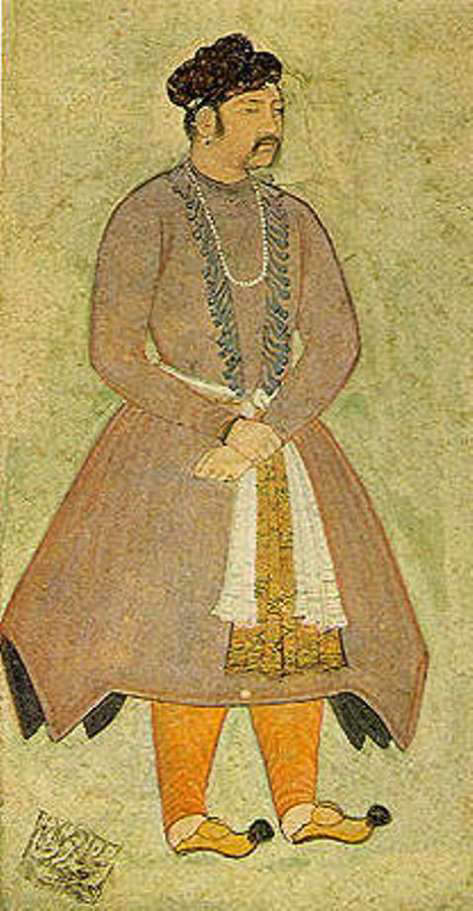
Mughal Padishah Akbar the Great - Portrait by Manohar
Emperor Akbar's greatest achievement was the propounding of the concept of the Unity of All Religions. He said that all religions had been founded for the greater good of the human kind, and ultimately aimed at the same goal. Akbar's court was the most enlightened in the history of all monarchies in the world. He started a dialogue between all great religions of the world, such as Islam, Christianity, Hinduism, Sikhism, Jainism, Buddhism, Zoroastrianism etc. and invited their priests to his court, to put forward their points of view and gave all of them a patient hearing. The Jesuits who came with the Portuguese colonialists to Asia, made use of this opportunity to present the Christian point of view, and were given the freedom to build their churches, where ever they wished. By encouraging such dialogue, the Emperor's ultimate aim, was to drive home the point to his millions of subjects, to respect one another's religious beliefs and live together as good neighbours, in perfect peace and harmony. Unintentionlly, Akbar was at the same time laying the foundations of the modern secular state. All this developments were taking place in India in the 16th-century, during his period of rule from 1556 to 1605, at a time when Europe was embroiled in religious conflicts, and wars were waged in the name of religion, and thousands of innocent lives lost, such as during the Spanish Inquisition (1480-1834). It was religious intolerance in Europe, that generated anti-jewish feelings, culminating in the holocaust of World War II.
Thus, the diamond has been named for one of the greatest emperors in the History of India, Emperor Akbar Shah, and the name Jahangir Shah has been added to the name of the diamond, as he was the architect of the first inscription, and the diamond was cut and polished during his rule.
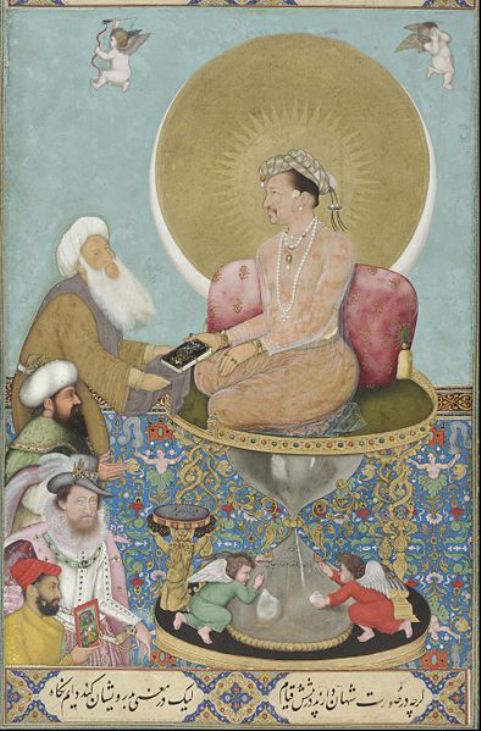
Jahangir Shah - Mogul Emperor
A second inscription on the diamond, celebrates the name of Emperor Shah Jahaan and reads as follows :- To the Lord of the Two Worlds - 1039 A. H. - Shah Jahan. The architect of this inscription is Emperor Shah Jahan, son and successor to Emperor Jahangir Shah, as the year 1039 A.H. corresponds to 1630 A.D. the third year of Shah Jahan's rule (1627-1658). However, his name has not been added to the name of the diamond, because the diamond did not originate during his period.
The third name Shepherd's Stone, appears to have been derived from the name of the person who first acquired the stone in Turkey, where it appeared, after it was lost in 1749, following the dismantling of the Peacock Throne, after the assassination of Nadir Shah, the mighty conqueror of Iran. The Shepherd's Stone was eventually purchased by a business-minded George Blogg in 1866, whose acquisition of the historic diamond was most unfortunate, as he carried the diamond to London, and disregarding its historic credentials, vandalized it, by recutting it from its original table-cut form, weighing 116 carats to a drop-shaped diamond weighing approximately 71 carats. Both inscriptions on the diamond were destroyed, but fortunately George Blogg had the presence of mind to take fascimile copies of the inscriptions befor destroying them, and these copies are the main sources of our information about the diamond.
Characteristics of the diamond
The information available on the historic Akbar Shah/Jahangir Shah diamond, comes mainly from Edwin Streeter's book "The Great Diamonds of the World, Their History and Romance" published in 1882, in which the diamond is said to have possessed a weight of 120 Arabic carats or 116 English carats. It is also said to have adorned one of the eyes of the peacock in the renowned peacock throne of Shah Jahaan. Besides this nothing is said about the color, clarity or the shape/cut of the diamond. However, the fact that the diamond is a rare inscribed diamond belonging to the classic period of the Mughal empire, we can make some plausible inferences, by comparing with other inscribed diamonds of this period, such as the Shah diamond and the Taj Mahal/Nur Jahan diamond. The Shah diamond with three inscriptions by three different rulers of different periods and kingdoms, is a table-cut, light yellow diamond with good clarity and transparency. The Taj Mahal/Nur Jahan diamond is a heart-shaped, table-cut, white or colorless diamond. Accordingly it is seen that only white/colorless diamonds or light-colored diamonds, with good clarity are usually selected for inscribing, and the cut chosen for the diamond, before inscribing, is usually the simple cut, known as the table-cut or lasque, that has few large facets, providing the required surface for the inscription. Hence, the Akbar Shah/Jahangir Shah diamond was undoubtedly a table-cut diamond, with two of its large facets inscribed in Arabic characters. The color of the diamond must have been white or colorless, the usual color of diamonds selected for engraving. Even Edwin Streeter has failed to mention the color of the diamond, in his account of the diamond in Chapter XXV of his book. The clarity of the diamond must also have been exceptional, going by the clarity of other inscribed diamonds.
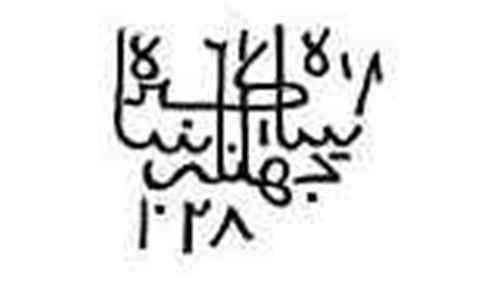
Facsimile copy of the first inscription on the diamond - Shah Akbar, Shah of the World. 1028 A.H.
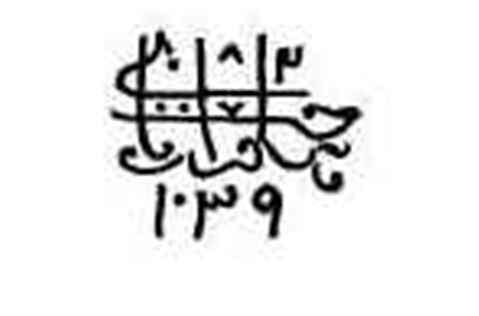
Facsimile copy of the second inscription on the diamond - To the Lord of the Two Worlds, 1039 A.H. Shah Jahan
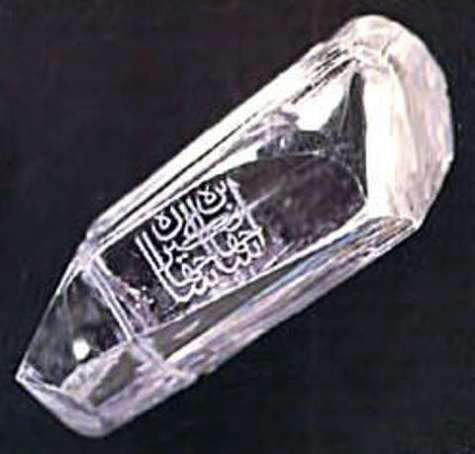
Shah diamond inscribed in Arabic with the names of three rulers
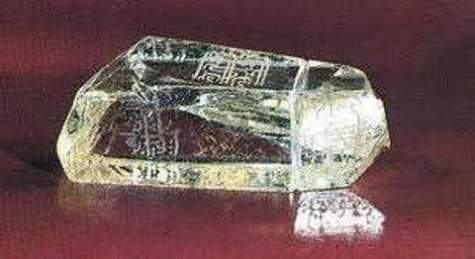
Another view of the yellow-colored Shah diamond in the Kremlin Diamond Fund, showing two inscribed facets
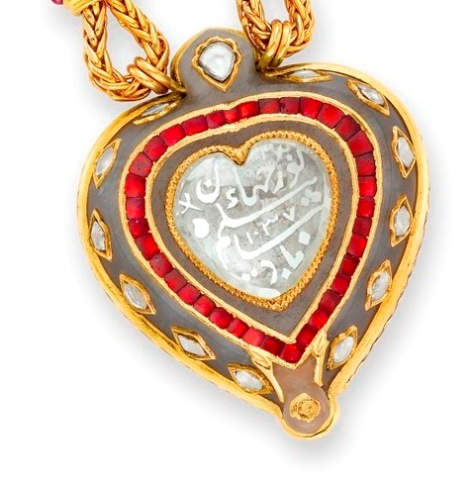
Close-up of the inscribed Taj Mahal/Nur Jahan diamond pendant
© Christies
History
Early History of the diamond
Chapter XXV of Edwin Streeter's book,"The Great Diamonds of the World, Their History and Romance," deals with the Akbar Shah/Jahanjir Shah diamond. The following is an excerpt from that chapter :-
In every respect a very remarkable stone the "Akbar Shah" entirely disappeared about the close of the seventeenth century, but it has again recently come to light. Thanks to information courteously communicated to us by Messrs George Blogg & Co. of London, we are enabled to trace its history back to the famous Mogul Emperor Akbar Shah, apparently its first owner. It remained in the Mogul's treasury till the time of Shah Jahaan, by whom it was beautifully engraved in Arabic characters on both sides. After its long disappearance it suddenly came to light again a few years ago in Turkey, where it was known by the name of "Shepherd Stone." But the two inscriptions left no doubt as to its true origin. Mr. George Blogg who purchased it at Constantinople, in February 1866, was told at the time that according to the tradition, it formed one of the eyes of the Peacock Throne, destroyed by Nadir Shah. By him it was brought to London, where it was re-cut to a drop as the most advantageous form by the late Mr. L. M. Auerhaan. It was then sold by Messrs Blogg to the notorious Gaekwar of Baroda, in 1867 for 3 ½ lacs of rupees ( £35,000), and now lies hidden away with the other treasures accumulated by that prince during his oppressive reign.
The stone weighed originally 120 Arabic or 116 English carats. But in the hands of the cutter it was reduced to about 71 or 72 carats, and during the process the two inscriptions were totally destroyed. Facsimile copies however were first taken and are here appended with the English Translations :-
1) Shah Akbar -Shah of the world - 1028 A. H.
2) To the Lord of the Two Worlds - 1039 A. H. - Shah Jahan
The date on No 1, 1028 A. H. corresponds to 1650 A. D. But Akbar who succeeded Humayun in 1556, died in 1605. Hence the Inscription could not have been engraved by Akbar himself. The date obviously indicates the year when Shah Jahaan caused it to be made, while the terms of the inscription record the fact that the stone had belonged to Akbar. The second inscription was evidently added eleven years later on, also by Shah Jahaan, the then owner who reigned from 1627 to 1666, his reign thus covering both dates.
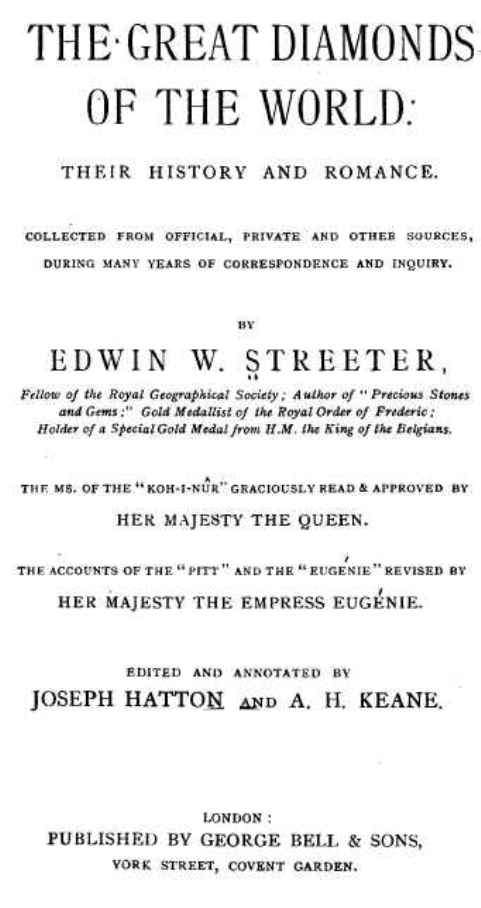
Title Page of Edwin Streeter's book, Great Diamonds of the World
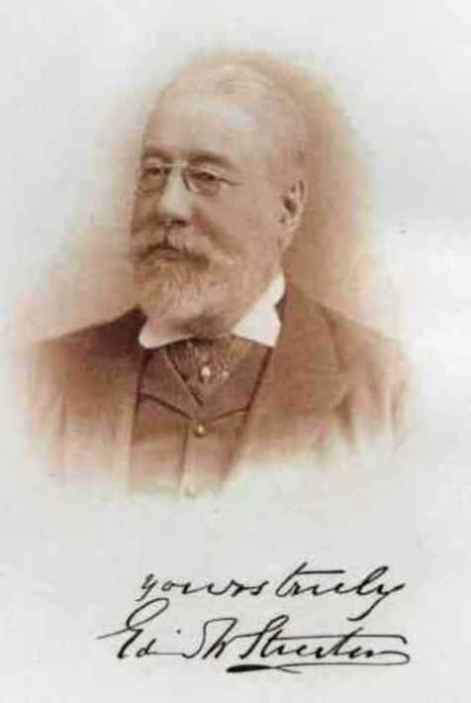
Edwin Streeter - Photograph taken from his book, Precious Stones and Gems published in 1898
There are several glaring errors in the last paragraph of Edwin Streeter's account of the diamond.
1) The year 1028 A. H. he says corresponds to 1650 A. D. which is not correct. It actually corresponds to 1619 A. D. according to the calculations shown below.
2) He says that Shah Jahaan reigned from 1627 to 1666, which is also factually incorrect. Shah Jahaan's period of rule was from 1627 to 1658. 1658 was the year, when Shah Jahan was placed under house arrest by his son and successor, Emperor Aurangzeb. Shah Jahan remained under house arrest until his death in 1666.
3) The second inscription was added eleven years later (1039-1028). Thus, if according to Streeter the first inscription was done in 1650, the second inscription must have been carried out in 1661, which is highly improbable as Shah Jahan was already under house arrest.
4) His assumption that both inscriptions were executed by the same Emperor Shah Jahan, one in 1650 and the other eleven years later in 1661 is also misplaced. Both of these dates have now been proved to be wrong, and the second 1661 is highly unlikely as Shah Jahan was already under house arrest. Moreover, even in the case of the Shah diamond, it has been shown that the three entries had been made at three different periods, by monarchs of three different kingdoms.
Hodgson's formula gives the relationship between the Gregorian calendar and the Islamic Hijra calendar
The relationship between the Gregorian Calendar and the Islamic Hijra Calendar is given by the following mathematical formula developed by M. G. S. Hodgson :-
G = H - H/33 + 622
where G represents the Gregorian year and H the Hijra year.
By substituting for H in the above formula, we can calculate the corresponding Gregorian Year.
Test of the formula
The current year (2007) in the Islamic calendar is 1428 A. H. Calculate the corresponding Gregorian year equivlent to 1428 A. H.
G = H - H/33 + 622
G = 1428 - 1428/33 + 622
G = 1428 - 43 + 622
G = 1385 + 622
G = 2007
Therefore 1428 A. H. is equivalent to year 2007 A. D., the year this webpage was written, which shows that the Hodgson's formula is correct.
a) Conversion of 1028 A. H. to Gregorian year :-
G = H - H/33 + 622
G = 1028 - 1028/33 + 622
G = 1028 - 31 + 622
G = 997 + 622
G = 1619 A. D.
Thus 1028 A. H. is equivalent to 1619 A. D.
b) Conversion of 1039 A. H. to Gregorian year :-
G = H - H/33 + 622
G = 1039 - 1039/33 + 622
G = 1039 - 31 + 622
G = 1008 + 622
G = 1630 A. D.
Thus 1039 A. H. is equivalent to 1630 A. D.
The period of reign of the Mogul Emperors involved according to the Encyclopaedia Britannica :-
1) Akbar Shah or Emperor Akbar the Great :- 1556 -1605
2) Jahangir Shah or Emperor Jahangir :- 1605 - 1627
3) Emperor Shah Jahaan :- 1627 - 1658
Interpretation of the first inscription
Thus the year 1028 A. H. in the first inscription which is equivalent to 1619 A. D. actually corresponds with the period of rule of Jahangir Shah, 14 years after the death of Akbar the Great. Hence, it is more likely that the first inscription must have been engraved under the instructions of Emperor Jahangir Shah himself, who perhaps would have been keen in perpetuating the memory of his great father.
Interpretation of the second inscription
The year 1039 A. H. in the second inscription is equivalent to 1630 A. D. This corresponds with the period of rule of Emperor Shah Jahaan, just three years after he ascended the throne. Shah Jahaan had a penchant for inscribing his name on diamonds, and his name appears on another famous diamond of the Mogul period, the Shah diamond. See photograph above.
How the diamond belonging to the Moghul Emperors eventfully reached the west ?
The next question is how the diamond belonging to the Moghul Emperors eventfully reached the west. If as stated in Edwin Streeter's account the Akbar Shah diamond formed one of the eyes of the renowned Peacock Throne of Shah Jahaan which was dismantled by Nadir Shah of Persia, then after Shah Jahan, the diamond must have descended down the line of the following Moghul Emperors, until it reached Muhammad Shah in 1719.
1) Emperor Aurangzeb - 1658 to 1707.
2) Bahadur Shah - 1707 to 1712.
3) Jahandar Shah - 1712 to 1713.
4) Farruk Siyar - 1713 to 1719.
5) Muhammad Shah - 1719 to 1748.
It was during the reign of Muhammad Shah in February 1739, that Nadir Shah, the ruler and conqueror of neighboring Persia, who was successful in creating a vast empire that stretched from the Indus river to the Caucasus mountains, invaded Northern India and captured Delhi and Agra after defeating the forces of Muhammad Shah. Nadir Shah's forces sacked Delhi and Agra, and eventually when his army left in May 1739, carried with them a booty estimated at 70 crores (700 million rupees), which helped him to exempt all Iranians from taxes for the next three years. His plunder included most of the crown jewels of the Moghul Emperors which consisted of the Koh-i-Noor, the Darya-i-Noor, Nur-ul-Ain, and the renowned Peacock Throne of Shah Jahaan.
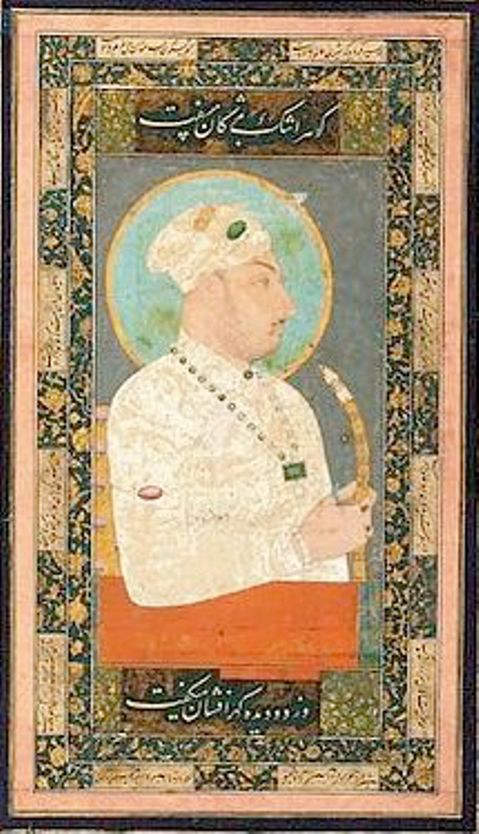
Portrait of Mughal Emperor Muhammad Shah (1719-1748)
After Nadir Shah's assassination by his own bodyguards in 1749, most of his treasures were stolen by his close associates and commanders. Some of them were lost forever, but some were recovered later by the founder of the Qajar dynasty Agha Muhammad Khan Qajar. The Peacock throne was also dismantled after Nadir Shah's death and the jewels in the throne were stolen. The Akbar Shah diamond, which according to Streeter was mounted on one of the eyes of the peaock, was also lost in the process, perhaps stolen by an unknown soldier of Nadir Shah's Afghan bodyguard.
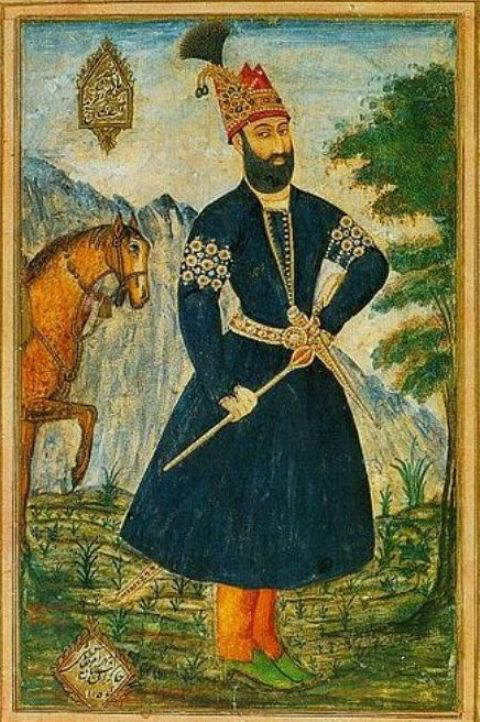
Portrait of Persian Conqueror Nadir Shah
Modern History of the diamond
The lost Akbar Shah/Jahangir Shah diamond resurfaces in Istanbul (Constantinople) over hundred years later as the Shepherd's Stone
The diamond that was stolen in the 1740s eventually appeared in Istanbul in Turkey in 1866, over a hundred years after its disappearance, and was known as the Shepherd's Stone. This was probably a reference to the first European who came to acquire the diamond after it surfaced in Istanbul, presumably some years before 1866. It is well known that Turkey was a transit point for many famous diamonds that left India in the past, either legally or illegaly. European dealers visited Istanbul from time to time, looking for Indian diamonds that must have reached overland via Isfahan in Iran or Baghdad in Iraq.
Mr. George Blogg of Messrs George Blogg & Co, London purchases the diamond and carries it to London
Mr. George Blogg, proprietor of Messrs George Blogg & Co. of London, visited Istanbul in 1866, where he was shown the historic table-cut inscribed diamond, which was then known as the "Shepherd's Stone." Mr. Blogg was impressed by the color and clarity of the stone, despite its inscriptions. He was made aware of the historic significance of the stone, believed to have been mounted on one eye of the peacock, in the renowned Peacock Throne of Shah Jahaan, dismantled after the death of Nadir Shah. Mr. Blogg was convinced of the historic credentials of the diamond, due to the presence of the Arabic inscriptions on it, though he was actually not aware of the message the inscriptions were trying to convey. He decided to purchase the diamond for an unspecified amount, and carried the diamond to London.
Mr. Blogg's decision to re-cut the Akbar Shah/Jahangir Shah diamond destroying the inscriptions though tantamount to an act of Vandalism provided some consolation to concerned historians as facsimile copies of the inscriptions were taken before re-cutting
Having reached London, he gave the stone to his master cutter, Mr. L.M. Auerhaan, who studied the stone carefully before deciding on the most appropriate cut to be adopted, maximizing for both quality and quantity. But, before going ahead with the cutting of the stone, Mr. Auerhaan had to get clearance from Mr. Blogg, as the operation was undoubtedly going to destroy the two inscriptions on the diamond. Mr. Blogg and Mr. Auerhaan finally decided to go ahead with the cutting, but decided to make facsimile copies of the two inscriptions for purposes of future studies, before starting work on the diamond. In retrospect, their decision to go ahead with the cutting, though short-sighted and motivated by short-term profit, and can be characterized as an act of vandalism, yet provided some consolation to concerned historians as facsimile copies of the inscriptions were preserved, and forwarded to Edwin Streeter, who revealed the hidden secrets of the diamond to the entire world.
The 116-carat, table-cut Akbar Shah/Jahangir Shah diamond is re-cut to a 71.5-carat pear-shaped or drop-shaped diamond and sold to the Gaekwar of Baroda in 1867
The 116-carat, table-cut Akbar Shah/Jahangir Shah diamond was re-cut by Mr. L.M. Auerhaan to an approximately 71.5-carat pear-shaped or drop-shaped diamond. This was the most advantageous shape that could be cut from the diamond, maximizing for both quality and quantity. Thus, 44.5 carats of the original diamond was lost during the re-cutting. Messrs George Blogg & Co subsequently sold the diamond in 1867 to the Gaekwar of Baroda, Khande Rao Gaekwad, who ruled from 1856 to 1870, for £35,000, equivalent to 350,000 Indian Rupees at that time. Thus, the diamond was actually sold to Khande Rao Gaekwad who ruled between 1856 to 1870, and not to his successor, the notorious Malhar Rao Gaekwad (1870-1875) as suggested by Edwin Streeter.
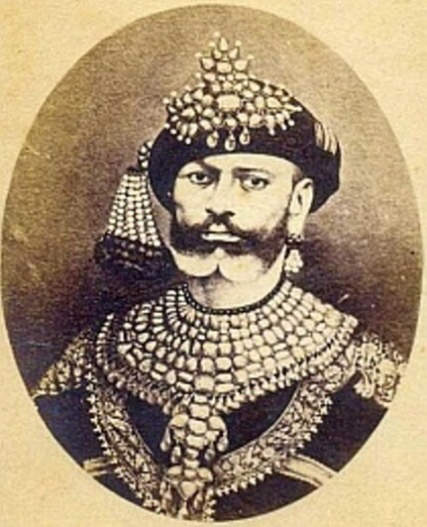
Gaekwad Khande Rao - A great collector and connoisseur of jewels and jewelry in the 19th-century
Khande Rao Gaekwad who purchased the Akbar Shah/Jahangir Shah diamond was a great connoisseur and collector of jewels and jewelry in the 19th-century
Khande Rao Gaekwad, the 10th Gaekwad of Baroda who ruled from 1856 to 1870, became internationally renowned for his lavish spending and extravagant tastes and also as a great collector and connoisseur of jewels and jewelry in the 19th-century. Among his remarkable acquisitions during this period, were the 128.48-carat, cushion-cut "Star of the South Diamond" the first top quality Brazilian diamond to acquire internationl fame, which he purchased for £80,000 in 1867; another Brazilian diamond, the 76.5-carat, pear-shaped "English Dresden Diamond" purchased for £40,000 in 1868; and the 71.5-carat drop-shaped Akbar Shah diamond also purchased in 1867 for £35,000. The Maharajah got his court jewellers to incorporate both the "Star of the South" diamond and the "English Dresden" diamond as the centerpiece of a triple-tiered diamond necklace, that came to be known as the "Baroda Diamond Necklace. Other historic pieces of jewelry designed and created during his period, include the seven-stranded diamond and emerald necklace known as the "Hindu Necklace," and the legendary seven-stranded natural pearl necklace, which came to be known as the "Baroda Pearl Necklace." Gaekwad Khande Rao is also reputed to have purchased several pieces of jewelry that once belonged to Empress Eugenie, empress consort of Napoleon III. Please click here for webpages on the Star of the South Diamond, English Dresden Diamond,and the Baroda Pearl Necklace.
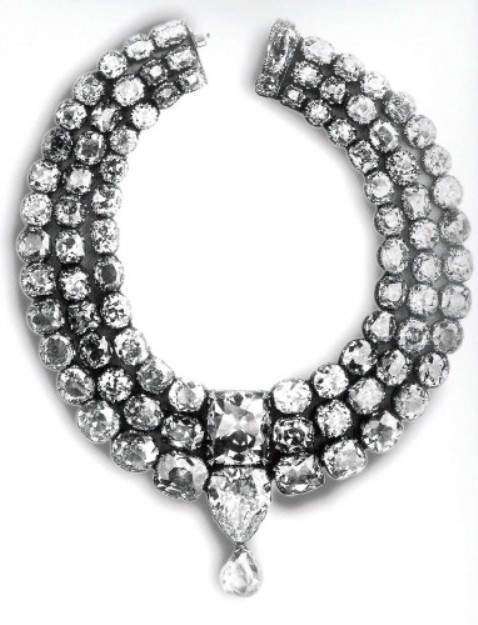
Gaekwad Khande Rao's three-tiered diamond necklace incorporating the cushion-cut "Star of the South" diamond and the pear-shaped "English Dresden" diamond as its centerpiece
However, undoubtedly the most extravagant creation during his period, was the renowned "Pearl Carpet of Baroda" the most extravagant carpet and perhaps the most wonderful piece of embroidery, ever created in the history of mankind. The carpet was commissioned by the Gaekwad Khande Rao in 1860 and completed in 1865, incorporating 1.5-2.0 million natural seed pearls, and hundreds or perhaps thousands of diamonds, rubies, emeralds and sapphires. The purpose of commissioning such an extravagant carpet was to fulfill a vow Gaekwad Khande Rao had made,to cover the tomb of the Holy Prophet of Islam, Prophet Muhammad at Medina, the hallowed sanctuary, revered by Muslims all over the world. Please click here for the webage on the Pearl carpet of Baroda.
The Akbar Shah/Jahangir Shah diamond still remains as a family heirloom of the Gaekwad family of Baroda
The Akbar Shah/Jahangir Shah diamond remained as part of the family heirloom of the Gaekwad Maharajahs of Baroda until as recently as 1988, when Fatehsinhrao Gaekwad and his wife Shantadevi had declared the diamond together with the Star of the South diamond, and Empress Eugenie diamond, as part of their valuables in the wealth tax returns for 1988. It is believed that the diamond still remains with the family, and is now the proud possession Ranjitsingh Pratapsingh Gaekwad, the current Gaekwad Maharajah of Baroda (Vadodara).
You are welcome to discuss this post/related topics with Dr Shihaan and other experts from around the world in our FORUMS (forums.internetstones.com)
Related :-
References :-
1) Famous Diamonds - by Ian Balfour.
2) The Great Diamonds of the World - Edwin W. Streeter
3) Precious Stones and Gems, Their History, Sources and Characteristics - Edwin W. Streeter
4) Gaekwad Dynasty - From Wikipedia, the free encyclopedia
5) Muhammad Shah - From Wikipedia, the free encyclopedia.
6) Akbar - From Wikipedia, the free encyclopedia.
 Home
Security & Guarantee
How it Works
Technology Partners
Updated Tables
Famous Diamonds
More Famous Diamonds
Famous Pearls
Famous Gemstones
Contact Dr Shihaan Larif
Contact Senior Editor
Famous Jewelry
Reference Database
Forums
Learning Center
Gemstone Gallery
e-mail Notifications
Advertise
Press Release
About Us
Privacy Policy
Contact Us
FAQ'S
Site Map
Staff Mail Login
Staff Documents
Birthstones
History
Minerals
Shows
Live Metal Prices
Jewellery Gallery
News
Marketplace
Marketplace Support
Open Store
Online Auctions
Join Us & Contribute
Directory
Classifieds
List your products
Wholesale Trading
Post Buy Request
Go Green Policy
Site Updates
Upcoming-ToDo List
Latest News
Latest Articles
Latest Blog Updates
Chat Rooms
Job Board
User Gallery
Videos
New Newsletter Archive
Old Newsletter Archive
Jewelry & Mineral Blog
User Blogs & Social Network
Search
Answers (Q & A)
Valuation
Help me find a diamond/jewelry
pin.internetstones.com- Social Pinboard- Sart yours & connect with millions
Invite Friends From Yahoo, Gmail etc-One Click
Home
Security & Guarantee
How it Works
Technology Partners
Updated Tables
Famous Diamonds
More Famous Diamonds
Famous Pearls
Famous Gemstones
Contact Dr Shihaan Larif
Contact Senior Editor
Famous Jewelry
Reference Database
Forums
Learning Center
Gemstone Gallery
e-mail Notifications
Advertise
Press Release
About Us
Privacy Policy
Contact Us
FAQ'S
Site Map
Staff Mail Login
Staff Documents
Birthstones
History
Minerals
Shows
Live Metal Prices
Jewellery Gallery
News
Marketplace
Marketplace Support
Open Store
Online Auctions
Join Us & Contribute
Directory
Classifieds
List your products
Wholesale Trading
Post Buy Request
Go Green Policy
Site Updates
Upcoming-ToDo List
Latest News
Latest Articles
Latest Blog Updates
Chat Rooms
Job Board
User Gallery
Videos
New Newsletter Archive
Old Newsletter Archive
Jewelry & Mineral Blog
User Blogs & Social Network
Search
Answers (Q & A)
Valuation
Help me find a diamond/jewelry
pin.internetstones.com- Social Pinboard- Sart yours & connect with millions
Invite Friends From Yahoo, Gmail etc-One Click




Our Global Jewelry Industry Job Network


Buy & Sell in our Marketplace

Subscribe to our Newsletter

List in our Classifieds

List in our Directory

User Uploaded Gallery

Powered by Ultra Secure
Amazon (USA) Cloud Network

Founder Internet Stones.COM
Register in our Forums

| Featured In
|
|
|
|
|
|
|
|







Blog & Education Feed
Articles Feed
 |
 |
 |

Copyright © .Internet Stones.COM. All rights reserved.