Ancient technology utilized to manufacture Sri Lankan gemstone beads and carvings
Open FREE Unlimited Store Join Our Newsletter
|
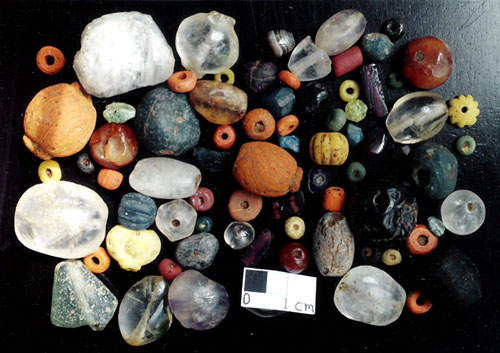
Various types of beads found at several archaeological sites in Sri Lanka |
This article is reproduced with kind permission from the National Gem and Jewellery Authority Sri Lanka.
Gems have been defined as objects of great beauty or worth and as “precious stones, specially, when those are cut and polished for ornamental use. Over the centuries, however, the term gemstone had meant a naturally occurring Mineral desirable for its beauty, valuable in its rarity and sufficiently durable to give lasting pleasure.

From the time immemorial, Sri Lanka had an immense reputation for many varieties of gems. Legend has it that King Solomon wooed Queen of Sheba offering precious stones of Sri Lanka. Many years later, Prince Charles mesmerized Lady Diana with an engagement ring adorned with a priceless blue sapphire from Sri Lanka.
|
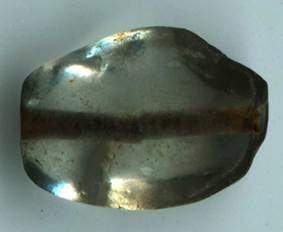
Drill hole through a bead showing slight disorientation in the middle. |
The Great Chronicle of the Island Nation, which covers its history for over 2000 years, refers to the singular fame of the island for its gems. The archaeology department excavated several burial grounds of Sri Lanka some of which were tentatively dated to 1000 BC (Ibbankatuwa) and some were dated even earlier than that. In most of these sites many verities of gems (polished as it is) and number of varieties of gem beads were unearthed; these are believed to be the jewellery worn at the time. Since this jewellery was found among the corpses, one could suggest that they are as old as the corpses (Seneviratna, 1984).
|
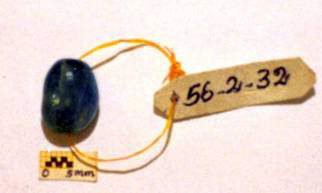
Corundum bead (Exhibit in the National Museum of Sri Lanka, No. 56-2-32). |
Many verities of gem beads were often discovered in Sri Lankan archaeological sites. The excavation of Citadel of Anuradhpura and of areas where Mukkaru people lived / worked, unearthed many varieties of gem beads and other kinds of beads (Fig.1). Many archaeologists are under the impression that these beads were not produced in Sri Lanka, but were exported from countries like India (Gujarat). The study unravel that the material for making these beads and the technology were freely available throughout the country during that time.
|
Spinel showing several drill holes occurred as a result of testing the gauges of drill bits |
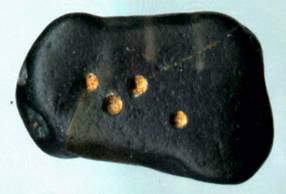
Almost all the beads exhibited how they were drilled. Evidence shows that they were drilled from either end to join in the middle resulting in a slight disorientation at the joint (Fig 2). Uncertainty arises as to how they managed to drill tiny holes through these very hard substances. Some are of the opinion that emery powder and iron drill bits were used to drill these stones. If it is so, how were the hard materials like sapphires were drilled (Fig. 3)? And even for other stones the above method could have taken a very long time to drill a single bead. Large number of beads found in the areas suggests that ancient artisan had been much quicker in drilling these beads. Hypothesis is weather they could have used diamond drill bits exported from India for the purpose of drilling. According to Henry Parker the bow driven drill was familiar to locals from second century BC onwards (Parker, 1981). So the suggestion is that they had used this type of drill along with diamond drill bits to drill large quantities of beads at ease as well as to cope up with harder stones like sapphire. Stones of hard materials such as sapphire and spinel exhibiting drill holes of equivalent or different sizes, which had been used to test the gauges of drill bits had been found in the area (Fig.4).
|
Several cameos and intaglios made of carnelian and rock crystal |
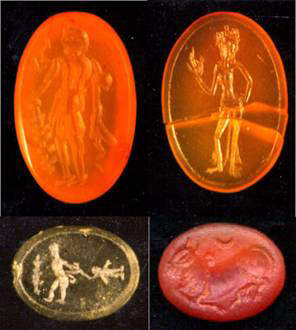
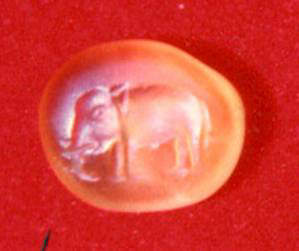
The most fanciful material found in these places is neither the beads nor the gems, polished as it is, but the most intricate rock carvings of very small sizes generally called cameos and intaglios. These carvings were made out of materials such as carnelian, rock crystal and colored glasses (Fig.5). Very rarely found in other materials, such as chrysoberyl (Fig 6). The carvings depicted in the cameos and intaglios are very beautiful and illustrate most intricate details of natural figures. Even with the modern tools it is difficult to carve such intricate figures on small gem pieces such as those.
|
Chrysoberyl carving showing the figure of an elephant |
It is a fair assumption that they have used diamond tools to carve these things (Fig. 5). For polishing they must have used the finely ground corundum powder. For stones with less hardness they may have used burned rice husks, which is still mainly used in Down South to polish moonstones. According to the evidence found, these people had used number of wooden laps for polishing various types of stones. Bamboo was also very popular in ancient times and it needed no abrasive powder as the abrasive material present naturally on the surface was enough to give a fine polish for certain varieties of stones.
The conclusion is that these beads and other carvings were manufactured in Sri Lanka using our own material and our own technology. According to the experts the materials could be dated to periods within the first to twelfth century AD. Therefore the suggestion is that the Mukkaru people (nationality of craftsmen) lived and worked in many areas in the country in large numbers. The artifacts are of very good craftsmanship, although they were made by the most primitive methods and instruments. The most intricate carvings in the cameos and drill holes in the sapphires are not second to today standards. They are remarkable in esthetic and technological aspects.
Related
Sri Lanka-An introduction
Madagascar and Sri Lanka gemstones-Common geological origin
Geography of Sri Lanka-Climate-relief and distribution of the population
Back to Reference Database
References
1. Seneviratne, S., 1984. The archaeology of the Megalithic-black and red ware complex in Sri Lanka. Journal of the Archaeological Survey Dept. of Sri Lanka, No.5, pp. 237-307.
2. Parker, H, 1981. Ancient Ceylon. J. Jetley for Asian Educational Services, New Delhi (ISBN 8120602080), pp. 558-559
 Home
Security & Guarantee
How it Works
Technology Partners
Updated Tables
Famous Diamonds
More Famous Diamonds
Famous Pearls
Famous Gemstones
Contact Dr Shihaan Larif
Contact Senior Editor
Famous Jewelry
Reference Database
Forums
Learning Center
Gemstone Gallery
e-mail Notifications
Advertise
Press Release
About Us
Privacy Policy
Contact Us
FAQ'S
Site Map
Staff Mail Login
Staff Documents
Birthstones
History
Minerals
Shows
Live Metal Prices
Jewellery Gallery
News
Marketplace
Marketplace Support
Open Store
Online Auctions
Join Us & Contribute
Directory
Classifieds
List your products
Wholesale Trading
Post Buy Request
Go Green Policy
Site Updates
Upcoming-ToDo List
Latest News
Latest Articles
Latest Blog Updates
Chat Rooms
Job Board
User Gallery
Videos
New Newsletter Archive
Old Newsletter Archive
Jewelry & Mineral Blog
User Blogs & Social Network
Search
Answers (Q & A)
Valuation
Help me find a diamond/jewelry
pin.internetstones.com- Social Pinboard- Sart yours & connect with millions
Invite Friends From Yahoo, Gmail etc-One Click
Home
Security & Guarantee
How it Works
Technology Partners
Updated Tables
Famous Diamonds
More Famous Diamonds
Famous Pearls
Famous Gemstones
Contact Dr Shihaan Larif
Contact Senior Editor
Famous Jewelry
Reference Database
Forums
Learning Center
Gemstone Gallery
e-mail Notifications
Advertise
Press Release
About Us
Privacy Policy
Contact Us
FAQ'S
Site Map
Staff Mail Login
Staff Documents
Birthstones
History
Minerals
Shows
Live Metal Prices
Jewellery Gallery
News
Marketplace
Marketplace Support
Open Store
Online Auctions
Join Us & Contribute
Directory
Classifieds
List your products
Wholesale Trading
Post Buy Request
Go Green Policy
Site Updates
Upcoming-ToDo List
Latest News
Latest Articles
Latest Blog Updates
Chat Rooms
Job Board
User Gallery
Videos
New Newsletter Archive
Old Newsletter Archive
Jewelry & Mineral Blog
User Blogs & Social Network
Search
Answers (Q & A)
Valuation
Help me find a diamond/jewelry
pin.internetstones.com- Social Pinboard- Sart yours & connect with millions
Invite Friends From Yahoo, Gmail etc-One Click




Our Global Jewelry Industry Job Network


Buy & Sell in our Marketplace

Subscribe to our Newsletter

List in our Classifieds

List in our Directory

User Uploaded Gallery

Powered by Ultra Secure
Amazon (USA) Cloud Network

Founder Internet Stones.COM
Register in our Forums

| Featured In
|
|
|
|
|
|
|
|







Blog & Education Feed
Articles Feed
 |
 |
 |

Copyright © .Internet Stones.COM. All rights reserved.