Anne Boleyn's Pearl Necklace
Open FREE Unlimited Store Join Our Newsletter
Lareef A. Samad B. Sc. (Hons)
Origin of Name
Anne Boleyn's Pearls refer to a signature piece of jewelry worn by the 16th-century Queen of England as seen in her famous portrait, consisting of a single strand of pearls with a gold "B" pendant hanging from the center, and three tear-drop pearls suspended from under the letter "B." The queen is seen wearing this pearl necklace in most of her portraits painted during this period. During her short period of rule that lasted from 1533 to 1536, she presided over a magnificent court, renowned for its extravagance, with large sums of money being spent on gowns, jewels, head-dresses, ostrich- feather fans, riding equipment, furniture and upholstery, to maintain the ostentatious life-style required by her status. The wearing of pearl-studded gowns became fashionable during this period and reached a climax during the period of rule of Anne Boleyn's daughter Queen Elizabeth I (1558-1603), who is reported to have owned over 3,000 pearl embroidered dresses.

Characteristics of Anne Boleyn's Pearl Necklace
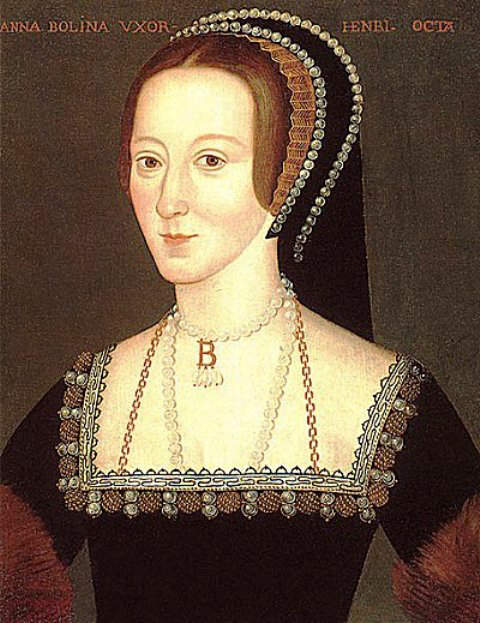
Anne Boleyn's Portrait- Queen of England- 2nd wife of Henry VIII
The length of the necklace
The pearl necklace as seen in the photograph undoubtedly falls under the category of "rope" in the modern classification of pearl necklaces introduced by Mikimoto.
Mikimoto's classification of pearl necklaces according to the length of the strand
S/N |
Length of strand in inches |
Category |
| 1 |
10"-13" |
Collar |
| 2 |
14"-16" |
Choker |
| 3 |
18"-20" |
Princess |
| 4 |
20"-24" |
Matinee |
| 5 |
28"-34" |
Opera |
6 |
>37' |
Rope |
This is because part of the long necklace is wound around the neck like a choker. The combined length of both parts of the necklace undoubtedly exceeds 37 inches, and hence the necklace can be considered as a "rope" under this system of classification.
The gold "B" pendant
The gold "B" pendant hangs from the choker-like portion of the necklace. The letter "B" is believed by many historians to refer to her surname "Boleyn." Three almost identical tear-drop pearls are suspended from below the letter "B." It is the gold "B" pendant that makes this necklace unique, and a signature piece associated with the unfortunate queen.
The shape, size and color of the pearls
Most of the individual pearls in the necklace appear to be spherical or near-spherical, and of uniform size as in modern graduated pearl necklaces. The pearls appear to be of average size. Given the uniformity of the shape and size of the pearls in the necklace, we can assume the color of the pearls must also have been uniform, and most probably white, the most sought after color in pearls. It must be remembered however that the appearance of the necklace is an artist's impression, and how the artist had seen and perceived it at the time he made the portrait. As such much importance cannot be attached to what is seen in the portrait, except for making some generalized and intelligent guesses.
Other pearls in the portrait
Apart from the pearls in the necklace, there are also other pearls in Queen Anne Boleyn's portrait. 16 pairs of almost identical, spherical-shaped pearls are fixed to the queen's gown along the lower neckline of her dress. What looks like two rows of uniform pearls on her head-dress perfectly matches with the pearls on the necklace and the neckline of the gown. It is not known exactly whether these are natural pearls, glass beads or other artificial beads forming part of the head-dress. The Armada Portrait of Queen Elizabeth I, however shows natural drop-shaped pearls in pairs, incorporated into her elaborate hair-dress.
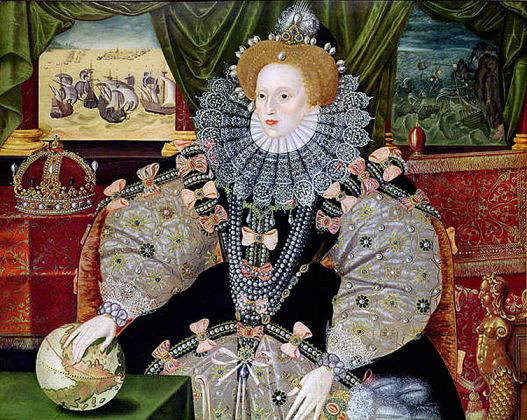
Armada Portrait of Queen Elizabeth I (1558-1603), daughter of Anne Boleyn
Are the pearls in Queen Anne Boleyn's necklace saltwater or freshwater pearls ?
Britain had an ancient natural pearl industry based on freshwater pearls dating back to over 2000 years
The next question that arises is whether the pearls in the Anne Boleyn's necklace are freshwater or saltwater pearls. Britain had an ancient natural pearl industry based on the freshwater mussel Margaritifera margaritifera dating back to over 2,000 years to the pre-Roman period. One of the main reasons given by Julius Caesar for invading Britain in 55 BC, was taking control of the trade in Scottish freshwater pearls, which together with gold underpinned the Roman monetary system. Scottish pearls were traded in the pearl markets of Europe in the 12th-century, and the commercial exploitation of freshwater mussels in Britain and Ireland had developed into a large scale industry in the 16th-century. The government employed river bailiffs to supervise the exploitation of freshwater mussels and to make sure that all valuable pearls reached the king's treasury. Scottish pearls of exceptional quality entered the crown jewels of both England and Scotland during this period.
Can the pearls in the necklace be freshwater Scottish pearls ?
Queen Anne Boleyn's period of rule from 1533 to 1536 corresponds with the height of the Scottish pearl industry in the 16th-century. Can the pearls in Queen Anne Boleyn's necklace be freshwater pearls of Scottish origin ?
The GIA classifies pearl shapes into three categories :-1) Spherical 2) Symmetrical and 3) Baroque. Round and near-round shapes come under spherical category with a uniform or nearly uniform diameter all round, and several lines of symmetry through which the pearl can be divided into two equal halves. Symmetrical shapes have a single median line of symmetry through which the pearl can be divided into two equal halves and include oval, button and drop shapes. Baroque category includes irregular shapes such as semi-baroque and baroque, without a line of symmetry. In natural freshwater pearls the commonest shape is the baroque or irregular shape. Symmetrical shapes are rare in freshwater pearls, but the rarest of all shapes in natural freshwater pearls is the spherical shape, both the round and near round shapes. Given the fact that almost all the pearls in Queen Anne Boleyn's necklace are spherical or near-spherical in shape, it is highly unlikely that the pearls in this necklace are freshwater pearls.
If the pearls are saltwater pearls what are the possible sources of these pearls ?
If the pearls in the necklace are saltwater pearls, the possible sources of these pearls can be either the Persian Gulf, the Red Sea or the Gulf of Mannar, the hub of the international pearl trade since very ancient times. However, in 1498 soon after the discovery of pearls in Venezuela, by Christopher Columbus, on his third voyage to the New World, a new source of pearls became available to the world's pearl markets in addition to the traditional sources in Asia. Subsequently, pearl banks were also discovered off the coast of Columbia in the Caribbean, the Pacific coast of Panama and in the Gulf of California in Mexico. Large quantities of saltwater pearls exploited by the Spanish from these new sources, eventually entered the pearl markets of Europe, via Madrid in Spain, to the extent that emphasis in the international pearl trade shifted from the traditional pearl-producing countries of Asia to the New World.
A short biography of Queen Anne Boleyn
Anne Boleyn, the most influential and important queen consort England has ever had
Often referred to as "the most influential and important queen consort England has ever had" Queen Anne Boleyn was a key figure in the political and religious upheaval that was the start of the English reformation. Her marriage to King Henry VIII as his second wife, after his marriage to the first wife, Catherine of Aragon, was annulled, amidst strong disapproval by Pope Clement VII, led to the permanent break between the Church of England and the Catholic Church, with the former coming under the King's sole control. Ironically, Queen Anne Boleyn paid the supreme price for getting involved knowingly or unknowingly with a king, whose sexual drive could not be satisfied by just one woman, and who was prepared to break with accepted norms and traditions, to marry or take as his mistress any woman he desired.
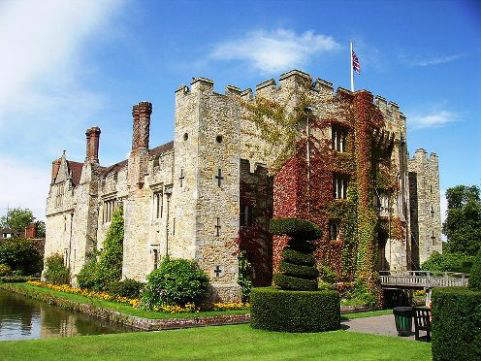
Hever Castle, childhood home of Anne Boleyn
Her early life and education in the royal courts of Netherlands and France
Anne Boleyn who was born between 1501 and 1507 was the daughter of Sir Thomas Boleyn and his wife Lady Elizabeth Howard. Sir Thomas Boleyn was a respected diplomat, with a gift for languages, and served both King Henry VII and King Henry VIII. Thomas Boleyn's fame and influence as a diplomat helped his young daughter Anne to be offered a place in the household of Archduchess Margaret of Austria, daughter of Maximilian I, the Holy Roman Emperor, on whose behalf she ruled Netherlands. She had early education in Netherlands from 1513 to 1514, while under the care of the Archduchess. Later Thomas Boleyn took Anne to France, where she first became a maid-of-honor to Queen Mary wife of King Louis XII, and then to Queen Claude of France, with whom he stayed for nearly seven years. While serving in the Queen's household she studied French, and also acquired knowledge on French culture and etiquette. She also developed an interest in fashion and religious philosophy. Her upbringing and experience in France made her a devout Christian in the new tradition of Renaissance humanism. In 1521, Anne was summoned back to England by her father, and must have been around 15-20 years when she arrived in England.
Her return to England, where she became one of the most stylish and accomplished women in the English court
Anne was now a young woman full of energy and vitality, moderately beautiful. Whatever shortcomings she might have had in her beauty was more than compensated by her educational and culturing upbringing in the court of the king of France, that made her one of the most stylish and accomplished women in the English court. Her carriage was graceful; her French clothes were pleasing and stylish; she danced with ease; had a pleasant singing voice; she could play the lute and several other musical instruments and spoke French very fluently. Her intelligence and quick wit attracted people to her, and she became the center of attention in any social gathering. Anne became a lady-in-waiting to Queen Catherine of Aragon. Anne was soon courted by Sir Henry Percy, the eldest son of the Earl of Northumberland and soon they became engaged to be married. However, Percy's father objected to the marriage, and the young couple were separated. Anne was sent away from court to her family's countryside estate, and Sir Henry was forced to marry Lady Mary Talbot, daughter of Edward Talbot. Anne returned to the service of Queen Catherine of Aragon, after Henry's marriage.
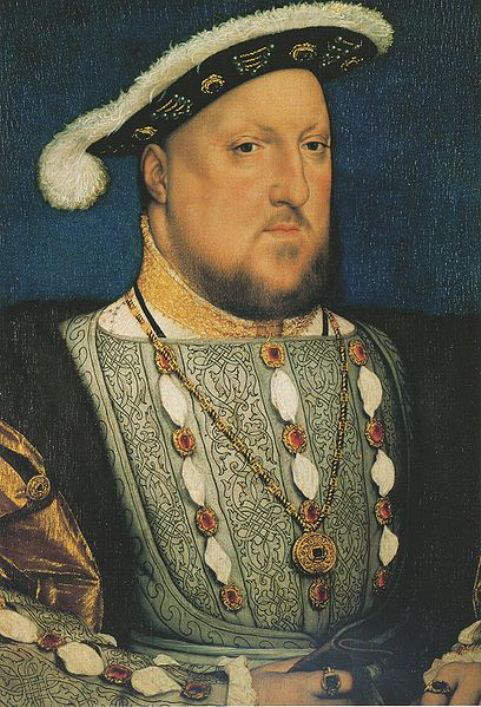
1536-portrait of King Henry VIII by Hans Holbein
Anne's refusal to become King Henry VIII's mistress and its significance
In 1526, King Henry VIII became enamored with her and began her pursuit. Anne resisted all attempts by the king to seduce her, and refused to become his mistress, as her sister Mary Boleyn had done earlier, and had been later abandoned. She left the court quite often for the seclusion of the Hever Castle to escape the advances of the king. Anne was determined not to have any relationship with the king outside of a legal marriage. This attitude of Anne was a crucial factor in shaping the religious and political history of Britain and the rest of the world. Had Anne consented to become Henry VIII's mistress, the king would not have divorced Catherine of Aragon, and the breakup with the Catholic Church would not have materialized, and history would have taken an entirely different course. It was in this context that Anne became a key figure in the political and religious upheaval that followed.
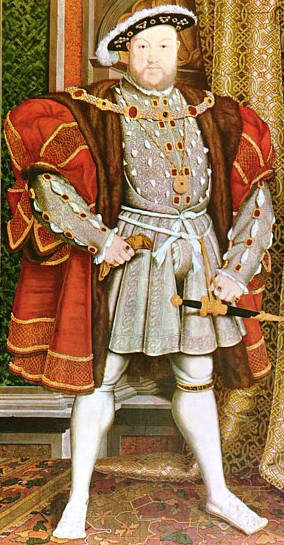
Henry VIII, 2nd Tudor King of England
Henry VIII proposes marriage to Anne Boleyn which she accepted
In the mean time the king was desperate for a male heir to the throne, that would ensure a smooth transition of power after him, and his first wife Queen Catherine of Aragon was not able to give him a male heir despite nearly two decades of marital relationship. Catherine only bore him a daughter in 1516, who subsequently became Mary I. Thus, Henry VIII decided that by making Anne his legal wife and queen consort, would achieve the dual purpose of not only satisfying his desires, but also increasing the prospect of having a male heir. Within an year since he began pursuing his desires, he proposed marriage to Anne and she accepted. However, several hurdles had to be surmounted before the duo was declared man and wife
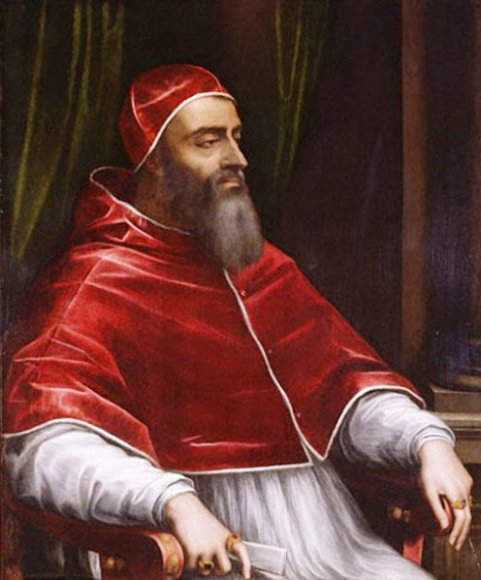
Pope Clement VII (1523 to 1534)
Henry VIII appeals to Pope Clement to annul his marriage to Catherine of Aragon, which is rejected
The first major hurdle was getting papal approval for a divorce or annulment of marriage with the queen consort Catherine of Aragon, something that is forbidden in the Catholic Church. Henry VIII had a readymade excuse to seek for divorce, as his marriage to Catherine of Aragon in the first place, following her first husband's death, who happened to be Henry VIII's own brother, had to be sanctioned by Pope Julius II, because the Book of Leviticus in the Bible, forbade the marriage of a man to his brother's widow. This provided the pretext for Henry VIII, to appeal to the new Pope Clement VII, that the previous Pope had erred by sanctioning the marriage, and that no Pope had the right to overrule a Biblical book. He appealed to Pope Clement VII, to declare that the previous Pope had made a grave error, and that his marriage to Catherine of Aragon be annulled. By doing so the king implicitly admitted that he had been living in sin with Catherine of Aragon all these years, and his daughter Mary was a bastard. The Pope who was a virtual prisoner of Charles V, the Holy Roman Emperor, who was the nephew of Catherine of Aragon, was powerless to grant Henry VIII's request, in spite of Cardinal Wolsely interceding with the Pope on his behalf. The Pope forbade Henry from contracting a new marriage until a decision was reached in Rome, and not in England.
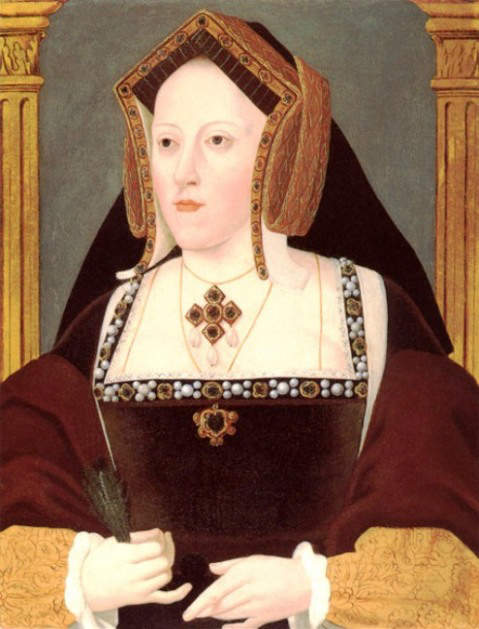
Catherine of Aragon- 1st Queen consort of King Henry VIII
Henry VIII's reaction to the Pope's rejection - the beginning of the English Reformation
Immediately after the Pope's rejection of Henry's appeal, the king took a series of measures that set the stage for the English Reformation, by which the Church of England broke away from the authority of the Pope and the Roman Catholic Church. In 1529, Henry VIII dismissed Cardinal Wolsely from public office and placed him under arrest. He died the following year of illness, while still in custody. In 1531, Queen Catherine of Aragon was banished from court, and her living quarters given to Anne Boleyn. In 1532, when the Archbishop of Canterbury William Warham died, the Boleyn family chaplain, Thomas Cranmer was appointed as successor with papal approval. In 1532, Thomas Cromwell brought before Parliament several acts, that recognized royal supremacy over the Church. In the winter of 1532, Anne was able to use her excellent relationship with the French court of King Francis I, to arrange for a meeting of King Henry and King Francis at Calais, in which Henry was able to get the support of the French government for his re-marriage to Anne, even though the French continued to maintain good relations with the Pope and respected his authority. Soon after this meeting, Henry and Anne got married in a secret ceremony. On May 23, 1533, the Archbishop of Canterbury, Thomas Cranmer sat in judgment at a special court to rule on the validity of the king's marriage to Catherine of Aragon. At the end of the hearings of this court, the Archbishop ruled that the marriage of Henry and Catherine was null and void. This was followed by a second ruling five days later on May 28, 1533, that declared the marriage of Henry and Anne good and valid. The Vatican retaliated by excommunicating the king and the Archbishop of Canterbury from the Catholic Church.
The crowning of Anne as the queen consort of England
Anne Boleyn had unofficially acted as queen consort of England, since he came into residence at the palace, following Catherine's banishment from court in 1531. She played her role as queen consort quite efficiently, acting independently of her future husband, granting petitions, receiving diplomats, presiding over patronage appointments and foreign policy. She adopted a foreign policy that moved England closer to France, and solidifying an alliance between the two countries. In September 1532, Anne's rank was elevated by the king, who gave her the title Marquess of Pembroke, the king himself performing the investiture. Anne's father who was Viscount Rochford, was created Earl of Wiltshire. On June 1, 1533, after Catherine was formally stripped of her title as queen, Anne was crowned as Queen Consort of England, at an elaborate ceremony held at the Westminster Abbey, followed by a sumptuous banquet. A unique feature of this coronation was the use of the St. Edward's Crown for the coronation, which had hitherto been used only for crowning reigning monarchs.
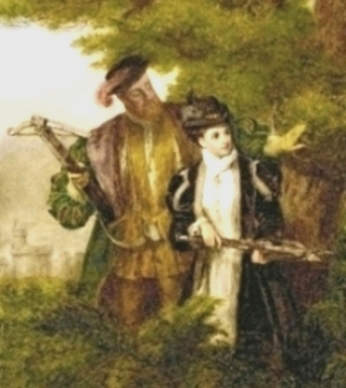
King Henry VIII and Anne Boleyn deer shooting in the Windsor Forest
Anne's initial period of reign as the Queen Consort of England and the birth of her baby Elizabeth
At the time of her coronation Anne was almost six months pregnant, and soon after the coronation she left her official duties and retired to the Greenwich Palace, to prepare for the birth of her baby. To the disappointment of both Anne and Henry, she gave birth to a baby girl on September 7, 1533, and the baby was christened Elizabeth. The baby was eventually sent to Hatfield House in the countryside, where she was brought up by a staff of servants, visited by Anne frequently. Queen Anne had a staff of over 250 servants, to attend to all her personal needs, from priests to stable boys, and consisted of over 60 maids-of-honor who served her and accompanied her to social events. The king and queen led a happy married life at the beginning, with Anne Boleyn presiding over a magnificent court noted for its extravagance, with large sums of money being spent on royal gowns, jewels, headdresses, furniture and upholstery, in keeping with her status as the queen consort of England. Several places were renovated to suit the extravagant tastes of the King and Queen.
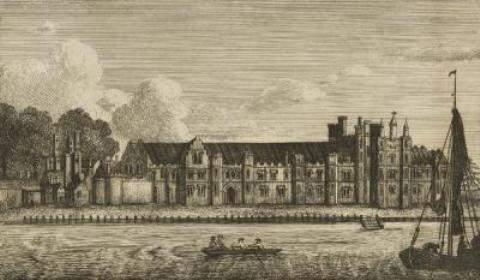
Greenwich Palace where Anne Boleyn gave birth to her first baby, Elizabeth
Anne's unpopularity with the general public
Anne was unpopular with the general public for several reasons, including the manner in which she stepped into the shoes of Catherine of Aragon, the popular belief that she was responsible for her husband's tyranny, and later for her failure to produce a son. and the execution of her enemies Sir Thomas More and Bishop John Fisher.
Anne' downfall caused by her inability to deliver a male heir
After the birth of her first child, Anne was pregnant again, but unfortunately the second pregnancy ended with a miscarriage or still birth in December 1534, causing a lot of anxiety and worry for both Anne and Henry. The first signs of discontent appeared in their relationship, soon after this incident, but the couple were soon reconciled, and Anne was pregnant again by October 1535. Catherine of Aragon died of natural causes on January 8, 1536. Her death was a cause of joy for the king, as it had opened the way for the king to leave Anne, without having to return to Catherine. Her death was a cause of anxiety to Anne, as she became aware that if she failed to give birth to a son, Henry would be free to leave her and marry a third time without any taint of illegality. During her third pregnancy, the King fell off from a horse during a tournament, and was knocked unconscious for nearly two hours. The shock and anxiety caused by this incident led to the miscarriage of her third child in late January 1536, believed to be a male, after three and a half months of pregnancy. This unfortunate incident appeared to herald the beginning of the end of the second royal marriage, that was contracted at the expense of so much of religious and political upheavals.
Queen Anne is accused of adultery, incest and high treason and sentenced to death
Soon after Anne recovered from her miscarriage, Henry declared that he had been seduced into the marriage with Anne by deception or the power of spells. Anne like her predecessor Catherine was banished from the royal quarters, and Henry's new mistress Jane Seymour was quickly moved into the royal quarters. On May 2, 1536 Anne was arrested and taken to the Tower of London. Anne was accused of the charges of adultery, incest and high treason. She was accused of committing adultery with four men, a Flemish musician, Mark Smeaton, Henry Norris, an aristocrat, Sir Francis Weston and William Brereton, a groom of the King's privy chamber. The second charge against Queen Anne was committing incest with her own brother, George Boleyn on two occasions. The third charge of high treason was framed according to the Treason Act of Edward III, which stated that adultery on the part of a queen was a form of treason. The five men accused of adultery and incest with the queen, pleaded not guilty to the charges, except for Mark Smeaton, who was tortured. During the trial it transpired that none of the dates of Anne's alleged encounters, coincided with her whereabouts, and some were alleged to have occurred when she was late in pregnancy. Thus, in spite of the fact that the evidence against the accused was overwhelmingly unconvincing, the accused were found guilty and condemned to death, by the judges who were under orders from the king to do so. The accused men including George Boleyn were executed on May 17, 1536. Queen Anne was executed two days later, on Friday, May 19, 1536.
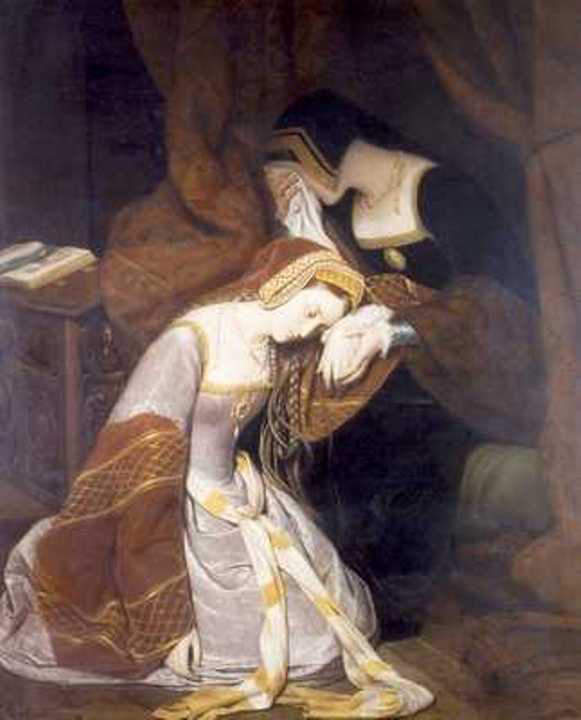
Anne Boleyn imprisoned in the London Tower before her execution - 1835-portrait by Musee Rolin
Historical verdict on Queen Anne's death
It is now believed that Anne Boleyn's downfall and execution was actually engineered by Thomas Cromwell, who had fallen out with Anne over the redistribution of Church revenues and over foreign policy. But, many historians believe the charges of adultery, incest and high treason was actually an invention of Henry himself, who had no valid grounds for divorcing Anne Boleyn as he did for Catherine of Aragon, and believed that the seriousness of the charges would eliminate her forever, paving the way for his next marriage with Jane Seymour.
Henry VIII's 3rd-wife Jane Seymour gives him the much-desired male heir
Jane Seymour, who was Henry VIII's third wife, finally gave him the male heir, he so much desired, and later succeeded him as Edward VI, but less than two weeks after Edward's birth, she died of postnatal complications. Had Jane Seymour survived after the child birth, none could have predicted what lay in store for her in the future, given the capricious behavior of the king.
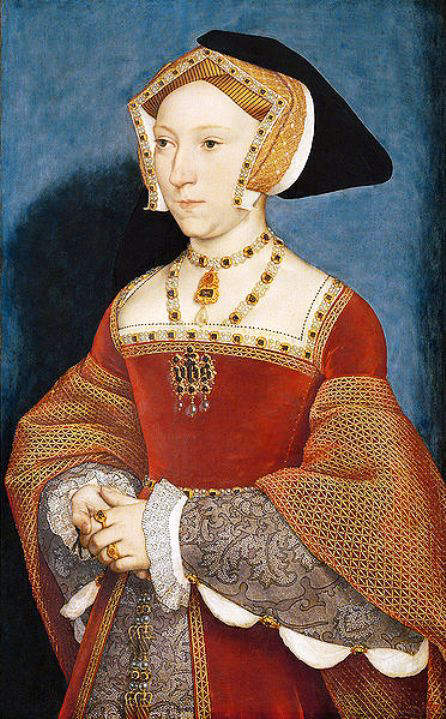
Jane Seymour- 3rd Queen consort of Henry VIII
Henry VIII's other wives
Jane Seymour died in October 1537. After her death Henry remained unmarried for around two years, but in January 1540, contracted his 4th marriage. His 4th wife was Anne of Cleves, a German princess. This marriage however lasted only six months, after which he sued for divorce, citing her pre-contract of marriage with Francis I, Duke of Lorraine, as grounds for annulment. Strangely, the king gave her a generous settlement, that included Hever Castle, the former home of his previous in-laws the Boleyns. She remained a friend of the royal family and Henry's children. and was known as the "King's Sister"
Henry contracted a 5th marriage in 1540, and his 5th wife was Catherine Howard, sometimes known as "the rose without a thorn." She suffered the same fate as Anne Boleyn, and was beheaded after charges of adultery in February 1542. Coincidentally, Catherine Howard was a cousin to Anne Boleyn, and both died by beheading accused of the same charges.
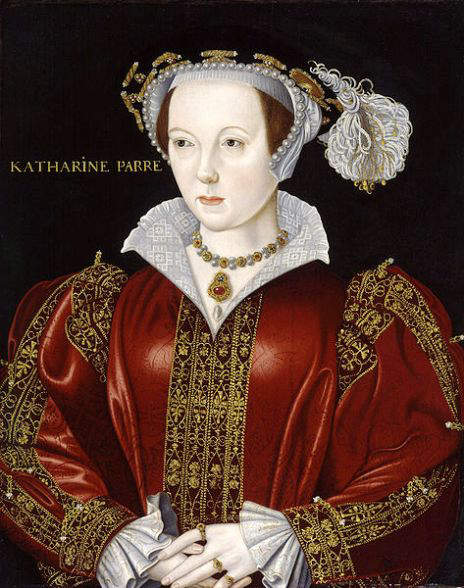
Catherine Parr, last Queen consort of Henry VIII
Henry VIII, married his 6th and last wife, Catherine Parr in 1543. She became famous as the most married queen of England, having married four times, and Henry was her 3rd husband. It was while Henry VIII was married to Catherine Parr, he died in the Palace of Whitehall on January 28, 1547.
Edward VI succeeds Henry VIII as king but dies during his regency. Edward VI is England's first Protestant ruler.
Henry VIII, who was the second monarch of the Tudor dynasty, was succeeded by his only surviving legitimate son Edward, who took the formal title Edward VI, and became the 3rd monarch of the dynasty. Edward VI was only nine years old at the time of his succession. A Council of Regency was formed with the Ist Earl of Hertford, Edward Seymour as the "Lord Protector of the Realm" until Edward VI reached the age of 18. But, unfortunately at the age of 15 years the young king contracted tuberculosis and died on July 6, 1553. During the regency of Edward VI the Anglican Church was transformed into a Protestant body and Edward VI became England's first protestant ruler. Even though Henry VIII was responsible for severing the links between the Church of England and Rome, he still remained an advocate for traditional Catholic ceremony and doctrine throughout his life, even after he was ex-communicated from the Roman Catholic Church.
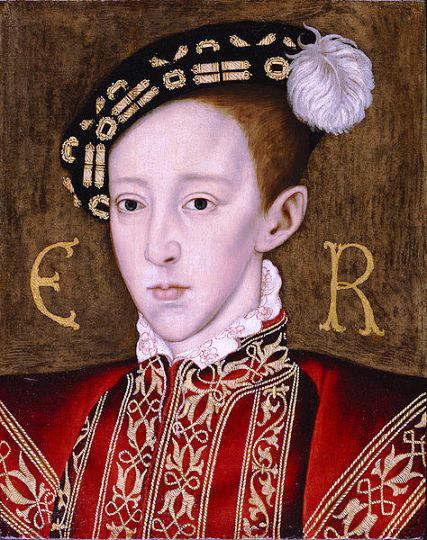
Edward VI 3rd Tudor King of England
Edward VI is succeeded by Mary I, daughter of Catherine of Aragon, and Henry VIII's eldest daughter.
Before Edward VI died he and his regency council drew up a "Devise for Succession" that excluded his two half-sisters, the Catholic Mary and Protestant Elizabeth, and instead named his cousin Lady Jane Grey as his heir. In fact Lady Jane succeeded as queen of England soon after his death, but remained queen only for nine days, as the Privy Council set aside Edward VI's will and proclaimed Mary, daughter of Catherine of Aragon and the eldest daughter of Henry VIII, as queen, following popular uprising in support of her. Mary, thus became the 4th monarch of the Tudor dynasty, and assumed the title Mary I. Mary, who was a devout Roman Catholic was queen of England for a little over 5 years, from July 19, 1553 to November 17, 1558. However, during this period she restored England to Roman Catholicism, suppressing Protestants in the process and burning around 300 religious dissenters including the Archbishop of Canterbury, Thomas Cranmer, at the stake. Hence, Mary earned the sobriquet "Bloody Mary." Mary married Philip II of Spain, a marriage that was unpopular with her subjects. The marriage did not produce any issues, and when Mary died at the age of 42, on November 17, 1558, she was succeeded by her half sister, Elizabeth, the daughter of Queen Anne Boleyn and Henry VIII.
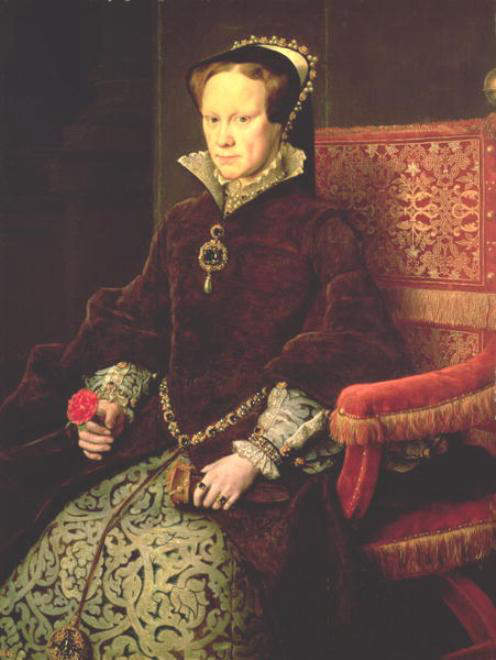
Mary I, 4th Tudor Monarch of England
Mary I is succeeded by Elizabeth I, daughter of Queen Anne Boleyn, and Henry VIII's second daughter. Queen Anne Boleyn is elevated to the status of a martyr and heroine of the English reformation.
Elizabeth I was the fifth, the last and greatest monarch of the Tudor dynasty. Elizabeth I reversed the re-establishment of Roman Catholicism in England by her predecessor, and supported the establishment of an English Protestant Church, of which she became the Supreme Governor. After Elizabeth I ascended the throne, her mother Queen Anne Boleyn , who was unjustly executed by her father Henry VIII, after framing false charges against her, was elevated to the status of a martyr and heroine of the English Reformation. John Foxe wrote, that Anne Boleyn had saved England from the evils of Roman Catholicism and that God had provided proof of her innocence and virtue, by making sure her daughter Elizabeth I, later became Queen regnant.
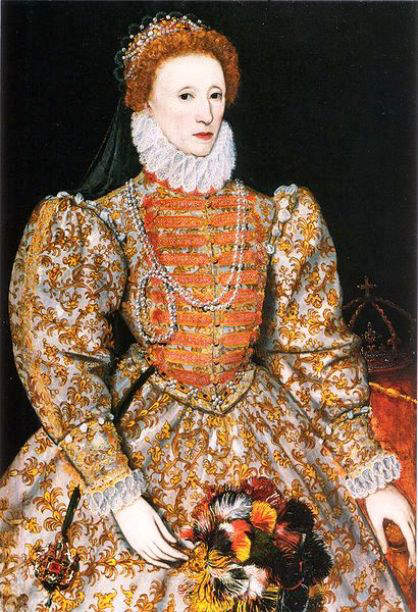
Elizabeth I, 5th and last Tudor Monarch of England
Elizabeth was the first Tudor monarch to recognize that a monarch ruled by popular consent, and she always worked with parliament and with advisers whom she could trust to tell her the truth. Thus her 44-year period of rule came to be known as a golden era in English history, during which English drama led by playwrights such as William Shakespeare and Christopher Marlowe flourished, and England became famous for its sea-faring prowess led by English adventurers such as Francis Drake. The defeat of the Spanish Armada in 1588, immortalized her name for one of the greatest victories in English history. Her preoccupation with governance never gave her the chance to get married and raise a family, and she remain unmarried for the rest of her life, and came to be known as the Virgin Queen. Thus all of Henry VIII's children died without issue, and the Tudor dynasty ended with Elizabeth I.
You are welcome to discuss this post/related topics with Dr Shihaan and other experts from around the world in our FORUMS (forums.internetstones.com)
Related :-
References :-
1) Pearl Jewelry Throughout History - www.hubpages.com
2) Anne Boleyn - From Wikipedia, the free encyclopedia.
3) Wives of Henry VIII - From Wikipedia, the free encyclopedia.
4) English Reformation - From Wikipedia, the free encyclopedia.
5) Edward VI - From Wikipedia, the free encyclopedia.
6) Mary I of England - From Wikipedia, the free encyclopedia.
7) Elizabeth I of England - From Wikipedia, the free encyclopedia.
 Home
Security & Guarantee
How it Works
Technology Partners
Updated Tables
Famous Diamonds
More Famous Diamonds
Famous Pearls
Famous Gemstones
Contact Dr Shihaan Larif
Contact Senior Editor
Famous Jewelry
Reference Database
Forums
Learning Center
Gemstone Gallery
e-mail Notifications
Advertise
Press Release
About Us
Privacy Policy
Contact Us
FAQ'S
Site Map
Staff Mail Login
Staff Documents
Birthstones
History
Minerals
Shows
Live Metal Prices
Jewellery Gallery
News
Marketplace
Marketplace Support
Open Store
Online Auctions
Join Us & Contribute
Directory
Classifieds
List your products
Wholesale Trading
Post Buy Request
Go Green Policy
Site Updates
Upcoming-ToDo List
Latest News
Latest Articles
Latest Blog Updates
Chat Rooms
Job Board
User Gallery
Videos
New Newsletter Archive
Old Newsletter Archive
Jewelry & Mineral Blog
User Blogs & Social Network
Search
Answers (Q & A)
Valuation
Help me find a diamond/jewelry
pin.internetstones.com- Social Pinboard- Sart yours & connect with millions
Invite Friends From Yahoo, Gmail etc-One Click
Home
Security & Guarantee
How it Works
Technology Partners
Updated Tables
Famous Diamonds
More Famous Diamonds
Famous Pearls
Famous Gemstones
Contact Dr Shihaan Larif
Contact Senior Editor
Famous Jewelry
Reference Database
Forums
Learning Center
Gemstone Gallery
e-mail Notifications
Advertise
Press Release
About Us
Privacy Policy
Contact Us
FAQ'S
Site Map
Staff Mail Login
Staff Documents
Birthstones
History
Minerals
Shows
Live Metal Prices
Jewellery Gallery
News
Marketplace
Marketplace Support
Open Store
Online Auctions
Join Us & Contribute
Directory
Classifieds
List your products
Wholesale Trading
Post Buy Request
Go Green Policy
Site Updates
Upcoming-ToDo List
Latest News
Latest Articles
Latest Blog Updates
Chat Rooms
Job Board
User Gallery
Videos
New Newsletter Archive
Old Newsletter Archive
Jewelry & Mineral Blog
User Blogs & Social Network
Search
Answers (Q & A)
Valuation
Help me find a diamond/jewelry
pin.internetstones.com- Social Pinboard- Sart yours & connect with millions
Invite Friends From Yahoo, Gmail etc-One Click




Our Global Jewelry Industry Job Network


Buy & Sell in our Marketplace

Subscribe to our Newsletter

List in our Classifieds

List in our Directory

User Uploaded Gallery

Powered by Ultra Secure
Amazon (USA) Cloud Network

Founder Internet Stones.COM
Register in our Forums

| Featured In
|
|
|
|
|
|
|
|







Blog & Education Feed
Articles Feed
 |
 |
 |

Copyright © .Internet Stones.COM. All rights reserved.