The Ashberg/Aschberg Diamond
Open FREE Unlimited Store Join Our Newsletter
Lareef A. Samad B.Sc. (Hons)
Origin of Name
The Ashberg diamond gets its name from Olof Aschberg, a Swedish banker and businessman, who was also a leftist sympathizer, and helped finance the Bolsheviks in Russia, before and after the October 1917 revolution. Aschberg provided financial assistance to the Bolsheviks through his Stockholm-based bank "Nya Banken" the first Swedish bank for trade unions and co-operatives, founded in 1912. The Bolshevik government led by Vladimir Lenin allowed Aschberg to do business with the Soviet Union, during the 1920s, and when the fledgeling Soviet State set up its first international bank in 1922, known as the "Ruskombank" Olof Aschberg was appointed as its first head.
The Ashberg diamond apparently was not part of the Russian crown jewels sold in 1927 to a British-American consortium, or pledged to Ireland around the same period and returned to Russia in 1950. The diamond was undoubtedly among the 3rd part of the crown jewels retained and preserved in the Kremlin Diamond Fund, due to their immense historic and cultural value. However, the diamond was later released for sale in 1934, probably because of its later addition to the crown jewels, after the discovery of diamonds in South Africa in the 1860s, and hence its lower historic and cultural value. The diamond was reported to have been acquired by Olof Aschberg in 1934, when a Russian trade delegation visited Stockholm during that year. The sale of crown jewels by the Soviet Union in its early years was necessitated due to a serious lack of foreign exchange to make essential payments abroad, and Olof Aschberg's Stockholm-based "Nya Banken" and the Guarantee and Credit Bank for the East, established in Berlin in the 1920s assisted in no small measure in relieving the situation.
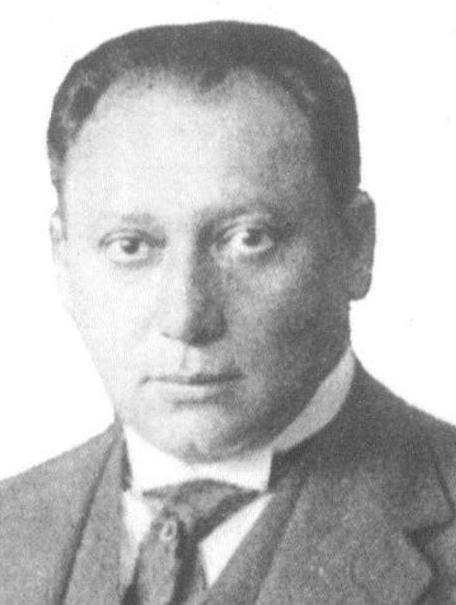
Olof Aschberg, Swedish banker and businessman and Bolveshevik sympathizer, from whom the Aschberg diamond gets its name

Characteristics of the diamond
Only the cut and carat weight of the diamond are known for certain but not the color and clarity grades
The Ashberg diamond is a 102.48-carat, amber-colored, cushion antique modified brilliant cut diamond. The exact color and clarity grades of the diamond are not known. Amber color is a vague term. It's a variable color which could mean anything between yellow, orange and brown, i. e. a combination of any two of these colors. Thus the term is not suitable to describe a diamond. However going by the photographs of the diamond, the Ashberg appears to be a dark brownish yellow diamond.
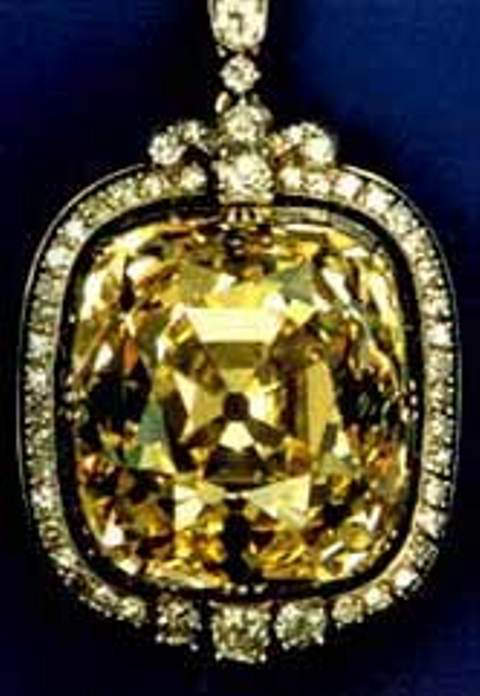
Aschberg diamond mounted as the centerpiece of a pendant surrounded by a single layer of smaller diamonds
The Ashberg diamond is most probably a Type Ib diamond
If the diamond is a dark brownish yellow diamond, it must be a Type Ib diamond, as intense yellow colors are associated with the distribution of nitrogen as single atoms, scattered all over the crystal. These atoms absorb visible light in the blue region of the spectrum, causing the complementary color yellow to manifest itself. If the nitrogen atoms are found as groups of atoms the colors imparted will be pale to medium yellow, as found in Type Ia diamonds. The brown color is possibly caused by plastic distortion of the crystal in certain areas.
Ashberg diamond occupies the 27th position in the list of famous yellow diamonds greater than 100 carats in weight
In the list of famous yellow diamonds greater than 100 carats in weight, the Ashberg diamond occupies the 27th position. See table below. There are only three brownish-yellow diamonds in this list. They are, the 407.48-carat, shield-shaped Incomparable diamond, the 170.49-carat, pear-shaped Star of Peace diamond and the 102.48-carat, cushion-shaped Ashberg diamond.
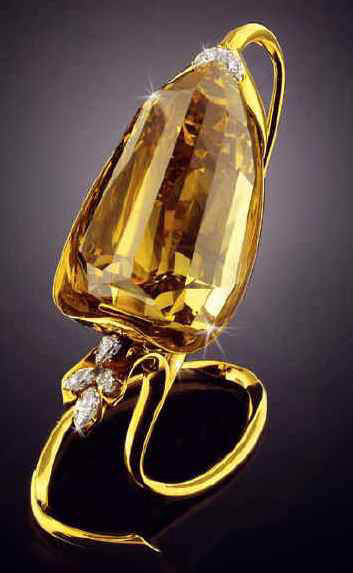
407.48-carat fancy brownish yellow Incomparable diamond
List of famous yellow diamonds greater than 100 carats in weight
S/N |
Name | Carat Weight | Shape/Cut | Color |
| 1 | Incomparable | 407.48 | shield shaped | fancy brownish yellow |
| 2 | Oppenheimer-uncut | 253.70 | natural octahedral | yellow |
| 3 | De Beers | 234.65 | cushion | light yellow |
| 4 | Red Cross | 205.07 | cushion | canary yellow |
| 5 | Unnamed | 200.87 | pear | yellow |
| 6 | Moon | 183.00 | round | pale yellow |
| 7 | Unnamed | 180.85 | briolette | yellow |
| 8 | Star of Peace | 170.49 | pear | brownish yellow |
| 9 | Hope of Africa | 151.91 | cushion | fancy yellow |
| 10 | Unnamed | 150.00 | emerald | yellow |
| 11 | Florentine | 137.27 | double rose cut | light yellow |
| 12 | Algeiba Star | 135.03 | square brilliant | yellow |
| 13 | Sarah | 132.43 | cushion | fancy vivid yellow |
| 14 | Golden Hue | 132.42 | cushion | yellow |
| 15 | Tiffany Yellow | 128.54 | cushion | canary yellow |
| 16 | Stewart | 123.00 | brilliant | yellow |
| 17 | Meister | 118.00 | cushion | yellow |
| 18 | Vainer Briolette | 116.60 | briolette | fancy light yellow |
| 19 | Unnamed | 114.64 | briolette | yellow |
| 20 | Unnamed | 114.03 | cushion | yellow |
| 21 | Mouna | 112.50 | cushion | fancy intense yellow |
| 22 | African Yellow | 112.00 | - | yellow |
| 23 | Anon | 108.04 | emerald | yellow |
| 24 | Rojtman | 107.46 | cushion | yellow |
| 25 | Golden Sun | 105.54 | emerald | yellow |
| 26 | Golden Door | 104.95 | pear | yellow |
| 27 | Ashberg | 102.48 | cushion | fancy brownish yellow |
| 28 | Alnatt | 101.29 | cushion | fancy vivid yellow |
| 29 | Sunrise | 100.52 | emerald | yellow |
© internetstones.com
Please do not copy our tables without our permission. We may be compelled to inform the search engines if our content and tables are plagiarised.
History
Early history of the diamond
The Ashberg diamond was formerly a part of the Russian Crown Jewels, a magnificent collection of jewels and jewelry, started during the time of Emperor Peter the Great of Russia in 1719. The collection was subsequently enriched by successive Czars and Czarinas of the Romanov dynasty, who ruled Russia until the Bolshevik revolution of 1917.
The early history of the diamond, such as the mine of origin, date of discovery, the country where the diamond was cut and processed, etc. are not known. However, the diamond appears to be of South African origin, as it bears all the characteristics of diamonds originating in South Africa. It is no doubt a stone of the Cape series of diamonds. Thus the Ashberg diamond must have been a late addition to the Russian Crown Jewels, as diamonds were first discovered in South Africa only in the mid 1860s
The possible mine of origin of the Ashberg diamond
In the early years of diamond production in South Africa, starting from the 1860s to the 1890s, the diamonds produced were mainly of different shades of yellow and brown or a combination of the two, and were known as the Cape series of diamonds. These diamonds were initially considered to be inferior in quality and fetched lower prices than conventional white or colorless diamonds, in the diamond markets across the world. The popularity of these diamonds received a boost in 1889, when the Iranian monarch Nasser-ed-Din Shah (1848-96) visiting Europe, purchased large quantities of these hitherto under-rated diamonds. The diamonds of the Cape series originated mainly in the first two deep diamond mines dug on the farm that previously belonged to Nicolas and Diederick de Beer, known as the Kimberley and De Beers diamond mines, which were at one time the world's most productive mines. Hence the Ashberg diamond too, most probably originated in one of these diamond mines in the Kimberley region. Other deep diamond mines that were also opened in the Kimberley region, include the Dutoitspan, Koffiefontein, Bultfontein and Wesselton mines.
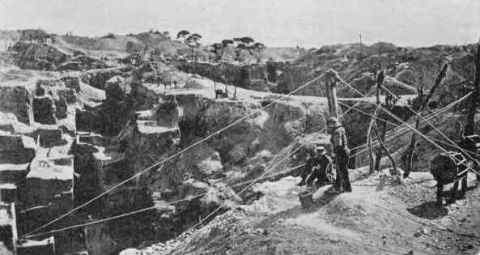
Photograph of the old De Beers mine taken in February 1873
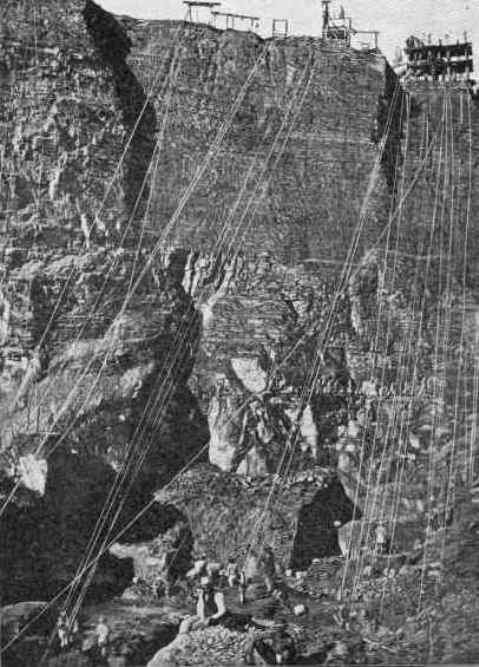
Section of the De Beers mine in 1874
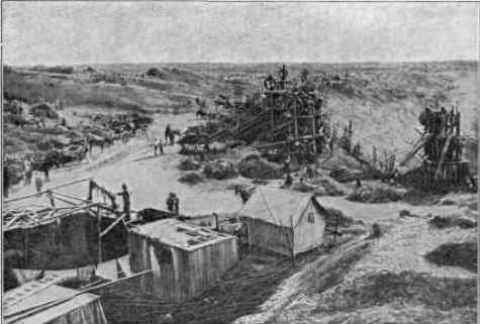
1873-Photograph of the Kimberley mine
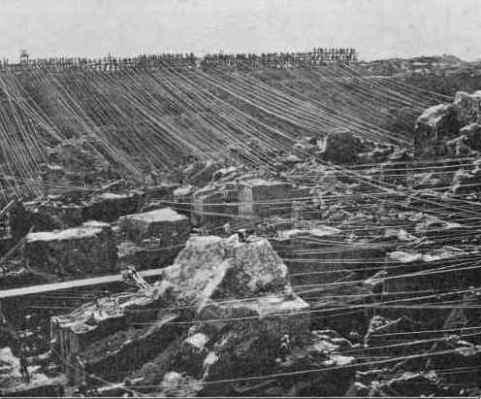
September 1873 photograph of the interior of Kimberley mine showing tramway cables
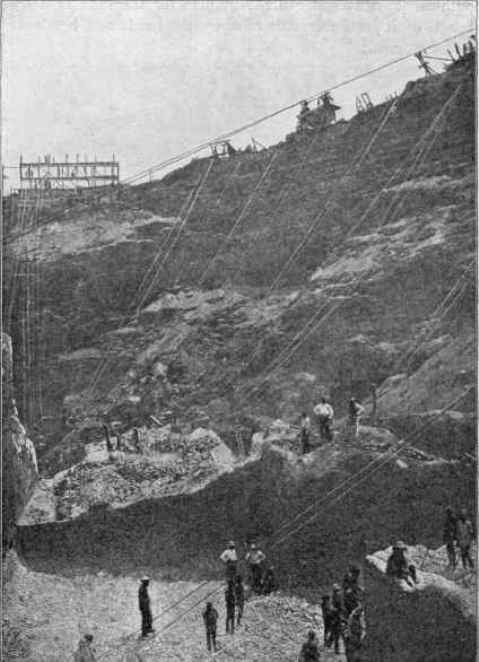
A section of the Kimberley mine in 1874
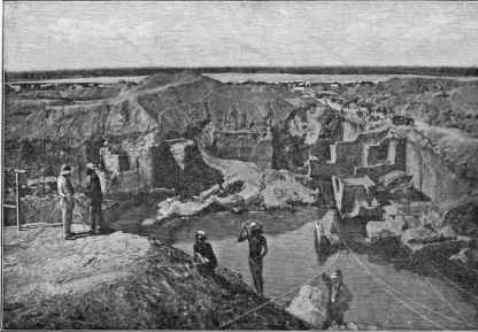
Dutoitspan mine in 1874
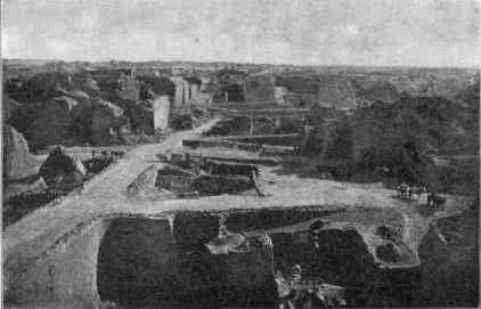
Bultfontein mine in 1879
The possible country where the Ashberg diamond was cut and processed
The main diamond cutting center in Europe at the time the Ashberg diamond was discovered in the late 19th-century in the diamond mines of South Africa, was the city of Amsterdam in the Netherlands, a pre-eminent position enjoyed by this city since the 17th-century, when the Dutch East India Company was in control of the diamond producing areas of the Indonesian archipelago, and subsequently after the discovery of diamonds in Brazil in the early 18th-century and in South Africa in the 1860s. Large quantities of rough diamonds discovered from the newly opened mines in South Africa in the late 19th-century, reached Amsterdam, where they were cut and processed by the thousands of highly skilled Jewish diamantaires settled in the city, before they were dispatched to the international diamond markets around the world. Hence, in all probability the Ashberg rough diamond too was cut, polished and transformed into a cushion-brilliant by the diamantaires of Amsterdam, before it was purchased by the agents of the Tsar of Russia, either in Amsterdam or another European capital such as London, Paris or Rome. Amsterdam lost its pre-eminent position as the main diamond cutting center of the world, after world war ii, due to the deportation of thousands of Jews to Hitler's concentration camps, including over 2,000 diamantaires, who lost their lives during the holocaust. Antwerp in Belgium replaced Amsterdam as the main diamond cutting center after world war ii.
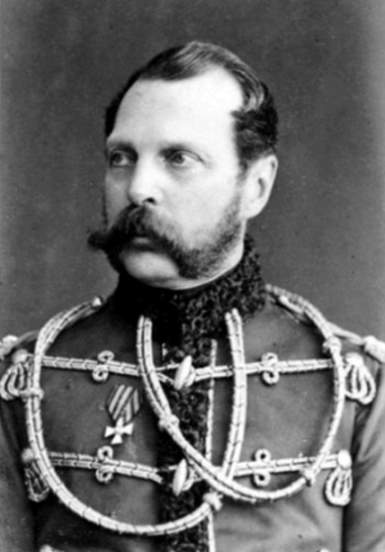
1870-photograph of Tsar Alexander II by Sergei Levitsky
The possible period during which the Ashberg diamond entered the "Russian Crown Treasury" the forerunner of the "Russian Diamond Fund"
The Ashberg diamond could have entered the Russian crown jewels anytime between the 1860s, when diamonds were first discovered in South Africa and the 1917 Russian revolution when the last Tsar of Russia, Czar Nicholas II was overthrown, the monarchy abolished and replaced by a government led by the Bolshevik party, headed by V.I. Lenin. During this period, the Russian empire was ruled by three emperors, Tsar Alexander II, who ruled from 1855 until he was assassinated in 1881; Tsar Alexander III, son and successor to Alexander II, who ruled from 1881 until his death by natural causes in 1894; and Tsar Nicholas II, son and successor to Alexander III, who ruled from 1894 until his abdication following the February revolution of 1917. Hence, the Ashberg diamond could have entered the "Russian Crown Treasury" the forerunner of the "Russian Diamond Fund" housed in the Diamond Chamber of the Winter Palace, at St. Petersburg, during the period of rule of anyone of the last three Romanov Tsars who ruled the Russian empire, Tsar Alexander II (1855-1881), Tsar Alexander III (1881-1894) or Tsar Nicholas II (1894-1917).
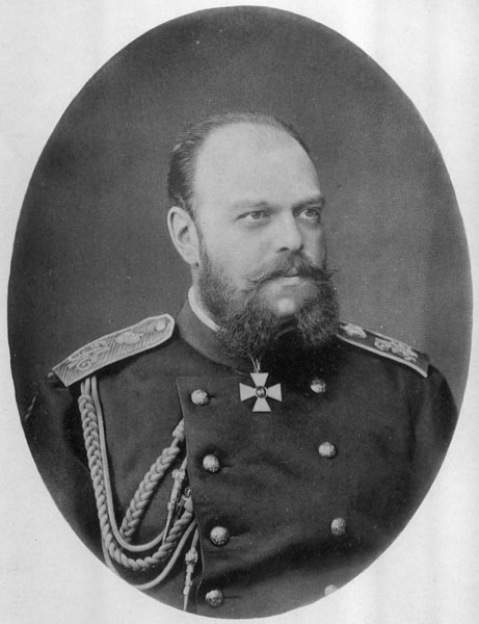
Photograph of Tsar Alexander III by Sergei Levitsky
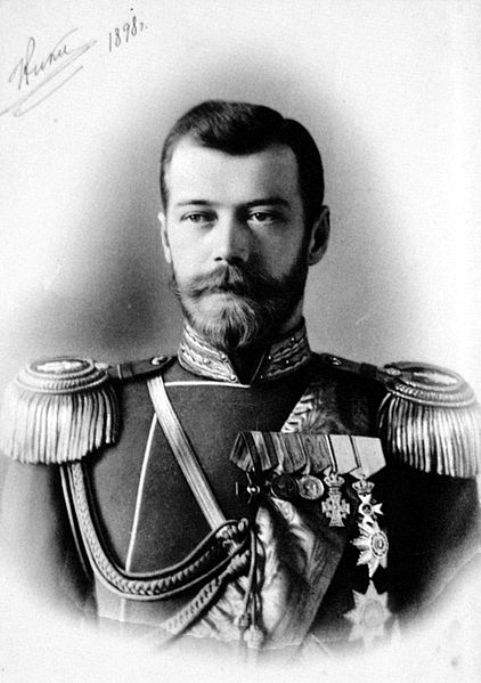
Photograph of Tsar Nicholas II around the age of 30 years taken in 1898
Tsar Nicholas II orders the transfer of the treasures in the "Russian Crown Treasury" from St. Petersburg to Moscow during the outbreak of World War I
With the outbreak of World War I in July 1914, Tsar Nicholas II, the last of the Romanov rulers of the Russian empire, ordered that the treasurers in the "Russian Crown Treasury" be immediately transferred from St. Petersburg to Moscow for safe keeping. Accordingly, the treasures that were housed in the "Diamond Chamber" of the Winter Palace at St. Petersburg, were securely packed in crates and taken to Moscow, where they were hidden in the underground vaults of the Kremlin Armoury. During World War I, Russia fought on the side of the Allied Powers, that included France, Britain, Italy, Serbia, Romania, Japan, Belgium, Greece, Portugal and later the United States, against the Central Powers consisting of Germany, the Austro-Hungarian empire and the Ottoman empire. When Russia suffered heavy military setbacks as the war progressed, and much of the army was left in a state of mutiny, leading to a state of chaos all over the country, fuelled mainly by the Bolsheviks, the Duma took control of the country in February 1917 forming the Russian Provisional Governmet, and Tsar Nicholas II abdicated. The decision of the Provisional Government to continue with the war, was strongly opposed by the Bolshevik party led by Vladimir Lenin, who with the help of his national network of worker's soviets and worker's militia's known as the Red Guards, overthrew the Provisional Government in St. Petersburg and seized power in October 1917. During the upheavals that followed after the communist takeover, Tsar Nicholas and his familly were killed on July 16, 1918, in the city of Yekaterinburg, a Bolshevik stronghold where the family were incarcerated.
The Russian Crown treasures were rediscovered in 1922, and handed over to the custody of the the newly created body known as the Russian State Diamond Fund.
During the upheavals of the October 1917 revolution, and the civil war that followed in 1918, the treasures of the "Russian Crown Treasury" lay hidden in the underground vaults of the Kremlin Armoury, unknown to the external world. The treasures that were totally forgotten were rediscovered only in 1922. When Vladimir Lenin, the leader of the Communist Party, and the Head-of-State of the Union of Soviet Socialist Republics, was informed of the discovery of the treasures, he ordered the photographing and cataloguing of every single piece in the collection, which was subsequently handed over to the custody of a specially created body, known as the Russian State Diamond Fund, under the Ministry of Finance.
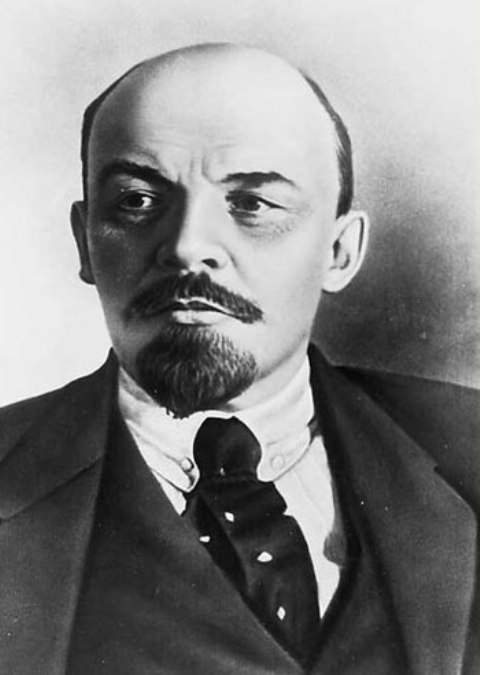
Vladimir Lenin, Head of the Communist Party and first president of the Soviet Union, who created the Russian State Diamond Fund, the custodian of the Russian Crown Jewels
Part of the Russian Crown Jewels are sold to a consortium of British and American buyers in early 1927
After V.I. Lenin died in 1924, the young Soviet Socialist Republic had financial difficulties in making payments abroad, and was forced to sell part of the crown jewels, and pledge another part of it, while preserving the most important items that had a historical value and were part of Russia's great cultural heritage. The first part of the Russian crown jewels was sold to a consortium of British and American buyers in early 1927, a transaction no doubt assisted by Olof Aschberg, former head of the Ruskombank. The Consortium in turn offered the items for sale at a Christie's auction held in London on March 16, 1927.
A second part of the Russian Crown Jewels are used as collateral to obtain a loan from Ireland, and returned to Moscow only in 1950
A second part of the Russian crown jewels was used as collateral to obtain a loan of US$ 25,000 from the Ireland, arranged by its Finance Minister, Michael Collins. The transaction involving the exchange of jewels and cash took place in New York, between the Soviet ambassador in the U.S. Ladvig Martens and the Irish Ambassador in the U.S. Harry Boland. The pledged jewels were not redeemed until 1950, when the Irish government headed by John A. Costello decided to sell the jewels at a public auction in London, but later rescinded the decision to sell, considering the historic and cultural importance of the jewels. After negotiations with the Soviet ambassador in Ireland, the pledged crown jewels were returned to Moscow in 1950, after the amount of US$ 25,000 intially borrowed in 1920 was repaid, sans interest and adjustment for inflation.
A third part of the Russian Crown Jewels that included items of great historic and cultural value were preserved in the Russian State Diamond Fund
A third part of the Russian Crown Jewels were preserved in the Russian State Diamond Fund, because they were irreplaceable and represented the great cultural heritage of the Russian nation. This undoubtedly included the many gem-studded crowns, coronation regalia, and the famous diamonds and gemstones received either as gifts from foreign monarchs, or purchased by the Tsars during the 18th and early 19th-centuries.
The Ashberg diamond sold to Olof Ashberg in 1934, was not part of the crown jewels sold in 1927 or pledged to Ireland around the same period, but was initially preserved in the State Diamond Fund
Since the Ashberg diamond was sold by a Russian trade delegation to Olof Aschberg in 1934, this diamond was not part of the crown jewels sold to a British-American consortium in 1927, or pledged to the Irish Government around the same period. Hence, the Ashberg diamond appears to have been preserved initially in the Russian State Diamond Fund, together with other irreplaceable items of historic and cultural value, probably because of the large size of the diamond and its potential monetary value. However, the diamond was subsequently released for sale from the Diamond Fund, because it was a later addition to the crown jewels, and did not have much historic significance. This explains the appearance and sale of the diamond in Stockholm, Sweden in 1934.
The Ashberg diamond is set as the centerpiece of a pendant surrounded by a single layer of smaller brilliant-cut diamonds
After purchasing the diamond Olof Aschberg entrusted the Swedish jewelry firm of Bolin, former Crown Jewelers to the court of St. Petersburg, to mount the diamond as the centerpiece of a pendant to a diamond necklace. The necklace became part of the jewelry collection of Mrs. Siri Ashberg, wife of Olof Aschberg. In 1949, Olof Aschberg lent the diamond necklace with the pendant, to the organizers of a diamond jewelry exhibition at Amsterdam, reported to have been organized with a view of reviving the war-shattered diamond industry of Amsterdam, and attracting diamantaires to fill the void created by the tragic loss of skilled craftsmen during the holocaust.
The Ashberg diamond is sold to an unidentified private buyer by Olof Aschberg, in a negotiated deal in 1959, after an attempt to sell it by public auction failed
Ten years later in 1959, an auction house in Stockholm, Sweden, the Bukowski auction house, put up the Ashberg diamond for sale, but had to withdraw it later, as it failed to reach it's reserve. However, the owner of the diamond, Olof Aschberg succeeded in negotiating a profitable deal, with a private buyer, but the name of the buyer was not disclosed.
The new owner of the Ashberg diamond puts up the diamond for sale at a Christie's auction in Geneva in May 1981
Finally in May 1981,the Ashberg diamond came up for sale, at a Christie's auction in Geneva, where once again it failed to reach it's reserve, and was withdrawn.
The Kremlin Diamond Fund
The Kremlin Diamond Fund was established by Vladimir Lenin in 1922 in line with its forerunner the Russian Crown Treasury established by Peter the Great in 1719
The Kremlin Diamond Fund is a magnificent and unique collection of gems, jewelry, natural nuggets and other treasures belonging to the Romanov rulers of Russia. The fund was officially established in 1922, after the Bolshevik Revolution, probably with the blessings of Vladimir Lenin, the founder of the Russian Communist Party, inspirer and leader of the Bolshevik Revolution, and the first Head-of-State of the Soviet Union, who died in 1924. However, the forerunner of the Kremlin Diamond Fund, the Russian Crown Treasury, was established as far back as 1719, by Emperor Peter I of Russia who was also known as Peter the Great. The primary intention of inaugurating the collection, according to Peter the Great, was to house a collection of jewels which belonged not to the Romanov family, but to the Russian State. Peter placed all state regalia in this fund, and declared that the state holdings were inviolate and could not be altered, sold or given away, and he also declared that each subsequent Emperor or Empress should leave a certain number of pieces acquired during their reign to the state for the permanent glory of the Russian Empire.
Notable treasures in the collection
The treasure was first exhibited to the public in November 1967, as a short- term show, but in 1968 it became a permanent exhibition. Among the notable treasures in the collection are the Crown of Monomakh and other crowns used by early Russian Czars, the Great Imperial Crown used by Catherine the Great and others Czars who followed her, and the Royal Scepter of Catherine the Great, with the Orlov diamond set at the top, with it's dome shaped crown facing forwards.
The seven celebrated diamonds and colored stones in the collection
There are seven celebrated and historical gems in the Kremlin Diamond Fund. They are :-
1) The Orlov diamond - 189.62-carat, rose-cut, colorless diamond presented to Empress Catherine the Great by her former lover Count Grigory Grigoryevich Orlov.
2) The Shah diamond - 88.7-carat, table-cut, yellow colored diamond inscribed with the name of three former rulers of India and Persia, and presented to Czar Nicholas I, in 1829 by Fath Ali Shah, the Qajar ruler of Iran.
3) Flat Portrait diamond - 25 carats.
4) Red spinel - 398.72 carats, attached to the Great Imperial Crown of Catherine the Great.
5) Sapphire - 260.37 carats.
6) Columbian emerald - 136.25 carats.
7) Olive green chrysolite -192.6 carats.
Jewelry and gold nuggets in the collection
Among the jewelry in the Kremlin Diamond Fund, the most outstanding items are the Daffodil Bouquet and the Blue Fountain.
Out of the nuggets in the collection the most famous are :-
1) The Great Triangle - gold, 36.2 Kg.
2) The Camel - gold, 9.28 Kg.
3) Mephisto - gold, 20.25 grams.
Recent notable additions to the Kremlin Diamond Fund
Among the recent additions to the Kremlin Diamond Fund are the following :-
1) The Creator diamond - 298.48-carat rough diamond, the third largest rough diamond in the fund, mined in 2004 in Yakutia.
2) Golden Nugget - 33 kg.
3) Alexander Pushkin - 320.65-carat rough diamond, second largest in the fund.
4) XXVI Congress of CPSU - 342.50-carat rough diamond, the largest rough diamond in the collection.
The 1999 preidential decree regulating the diamond industry in Russia
Russia is today one of the world's largest producers of diamonds, but mining is a state monopoly. According to the 1999 presidential decree, regulating the diamond fund operations, the following categories of items automatically becomes the property of the state.
1) All raw diamond exceeding 50 carats.
2) All cut diamonds exceeding 20 carats, and cut diamonds of exceptional quality exceeding 6 carats.
3) All raw emeralds, rubies, and sapphires, exceeding 30 carats raw or 20 carats cut.
4) Unique nuggets, amber, pearl, and jewelry.
The public exhibits in the Kremlin at Moscow, are only a fraction of the diamond treasures, handpicked by the Ministry of Finance.
Olof Aschberg - A short biography
Olof Aschberg the successful businessman and banker who earned the nickname "Bolshevik Banker"
Born in 1877 in Sweden, Olof Aschberg became a successful businessman and banker, who became internationally renowned for his leftist sympthies, and for his crucial role in helping finance the Bolsheviks in Russia, before and after the October 1917 revolution, earning the sobriquet of "Bolshevik banker." He came under the influence of socialists like Hjalmar Branting, the first socialist prime minister to be elected to office in Sweden and Europe, and Willi Munzenberg, a communist political activisit and propagandist for the Communist Party of Germany, who became the first head of the Young Communist International in 1919/1920.
His socialist leanings and assistance given to the Bolsheviks before and after the October 1917 revolution
In 1912, Aschberg founded in Stockholm, the first Swedish bank for trade unions and co-operatives, known as "Nya Banken." His co-directors in the bank included prominent Swedish socialists and members of Swedish co-operatives, such as G.W. Dahl, K.G. Rosling, and C. Gerhard Magnusson. Ironically, in spite of his socialist leanings Olof Aschberg undertook a trip to New York in 1916, on behalf of Pierre Bark, the Tsarist minister of finance, to negotiate a $50 million loan for Russia with an American banking syndicate, headed by Stillman's National City Bank, which was successfully concluded on June 5, 1916. However, while the Tsarist loan operation was being floated in New York, Olof Aschberg's "Nya Banken" was at the same time secretly channelling funds from the German government to the Russian revolutionaries, in the guise of payment for goods shipped. The support of the German Government to the anti-war Bolveshiks was intensified in order to force the Russian Government to withdraw from the war.
In 1918, when Nya Banken's dealings with the Germans caused him troubles with the Allies of World War I, Olof Aschberg renamed his bank as "Svensk Ekonomiebolaget" In an effort by the new Soviet Government to beat the international boycott on gold "robbed" by the Bolsheviks during the revolution, Aschberg became the chief facilitator, who offered the gold on the Stockholm market after melting the metal and giving new markings. Aschberg also co-operated with Willi Munzenberg who set up the organization known as Workers International Relief in 1921, that floated the so-called "workers' loan" into which money confiscated from the rich and the Church in Russia was secrety chanelled, and the laundered money was then used for buying machinery and other essential goods in the West, required by the Russian industries.
His appointment as the Head of the Ruskombank, the first international bank set up by the Soviets
In 1922, the Soviets set up their first international bank known as the Ruskombank, consisting of a syndicate of former Russian tsarist private bankers, and German, Swedish, American and British bankers. The Soviet leadership appointed their trusted Swedish partner, Olof Aschberg as the head of this bank, whose board consisted of representatives of Tsarist private bankers, and German, Swedish, American and British banks, and also representatives of the Soviet government. The bulk of the investment in the Ruskombank came mainly from the British banks, and the bank had a share capital of 10 million gold roubles. The bank had its headquarters in the former Siberian Bank building in Petrograd (St. Petersburg). The objectives of the bank were to raise short-term loans in foreign countries, to introduce foreign capital into the Soviet Union, and to facilitate Russian overseas trade. At the time of opening the bank, Olof Aschberg said, "The new bank will look after the purchasing of machinery and raw material from England and the United States and it will give guarantees for the completion of contracts. The question of purchases in Sweden has not yet arisen, but it is hoped that such will be the case later on."
Olof Aschberg had access to large sums of money for the purpose of meeting payments on goods ordered by the Soviets in Europe. These sums were placed in Aschberg's own bank in Sweden, Svensk Ekonomiebolaget, agents for the Ruskombank in Sweden, through whom payments were made in Europe. It is alleged that part of these funds were diverted by Aschberg for making investments for his personal account, that resulted in a charge of misuse of funds against him and his eventual removal in 1924, from his position as head of the Ruskombank. It might also be possible that the removal of Olof Aschberg was part of the reorganization of state institutions initiated by Joseph Stalin after he consolidated state power in his hands as the General Secretary of the Communist Party, after the death of Vladimir Lenin.
His emigration to France in the late 1920s where he purchases a Chateau and a Paris townhouse
By the end of 1920s Aschberg and his family moved to France, where he purchased the Château du Bois du Rocher at Jouy-en-Josas and a Paris townhouse on the Place Casimir-Périer. The collection of Russian icon paintings which Aschberg built up over the years and other paintings from renowned artists were exhibited in the Chateau du Bois du Rocher. The collection of Russian icons consisting of 245 pieces was subsequently donated by Olof Aschberg to the Swedish National Museum at Stockholm in 1933.
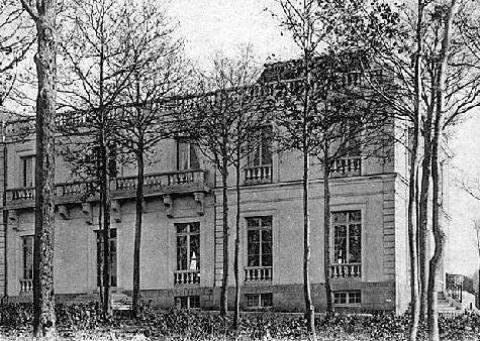
Château du Bois du Rocher at Jouy-en-Josas purchased by Olof Aschberg in the late 1920s
The renewal of his acquaintance with Willi Münzenberg who became the leader of the German anti-fascist and anti-Stalinist community in Paris.
After settling in France, Olof Aschberg renewed his acquaintance with Willi Münzenberg, who too had settled down in Paris, after Joseph Stalin's Great Purge of the 1930s, in which he was condemned by Stalin to be purged and arrested for treason. Willi Münzenberg became a leader of the German anti-fascist and anti-Stalinist community in Paris. Münzenberg was often invited to Ashberg's Paris townhouse, which became a sort of all-purpose Münzenberg salon. Aschberg also funded the launching of the weekly political broadsheet "Die Zukunft" (The Future) by Willi Münzenberg.
His escape to the USA when the Nazis invaded France
With the outbreak of World War II, Aschberg was interned in Camp Vernet, which was used by the French authorities to house "all foreigners considered suspect or dangerous to the public order." However, when France was invaded by Nazi Germany in 1940, the French authorities who knew of Aschberg's Jewish background set him free as his life would be endangered. Aschberg took the opportunity to escape with his family to Portugal, from where they fled to the USA via Lisbon. After the end of the war, Aschberg went back to Sweden from the USA, and in 1946 started the publishing of his memoirs.
The gifting of Château du Bois-du-Rocher to UNESCO in 1956
On December 28, 1956, Olof Aschberg and his wife Siri Aschberg, gifted their residence in France, the Château du Bois-du-Rocher, fully furnished and containing valuable paintings, located at Jouy-en-Josas, near Versailles, with 11 hectares of grounds surrounding it, to the UNESCO, to be used so as to help UNESCO attain the goals it pursues and fulfil its function. Accordingly, UNESCO with its headquarters located on the Place de Fontenoy in Paris, used Château du Bois-du-Rocher, to hold expert meetings and training seminars for newly appointed headquarters and field staff, for nearly three decades, until 1984.
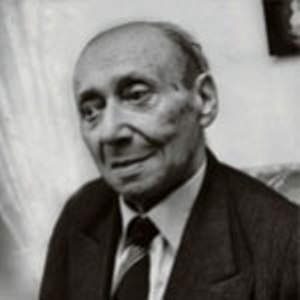
Olof Aschberg in later life
The sale of Château du Bois-du-Rocher by UNESCO to Conseil General de l'Essonne who installed the Bievres Museum of Photography in the Chateau.
After 1984, the use of the Chateau was abandoned by UNESCO, but the Organization had to continue paying the domestic staff on a full-time basis, as well as meeting the cost of running and maintaining the property. After several studies were conducted by the UNESCO on the alternative uses of the valuable Château du Bois-du-Rocher property, including an offer to the International Olympic Committee to use the property as a permanent premises for the education and training of officials, sports managers, managers and administrators of sports associations, and the like, which was turned down by the IOC, it was decided to sell the property, with the consent of the heirs of the donors, and use the proceeds to attain the objectives mentioned in the deed of gift. The heir of Mr. and Mrs. Olof Aschberg, Dr. Sven Aschberg gave his consent for the sale on February 10, 1989. Accordingly, the Director General of UNESCO ordered the sale of the Château du Bois-du-Rocher property and furniture by public auction in 1991. The furniture was sold by public auction on April 10 and 11, 1992, realizing a sum of 2.5 million francs. Bids were invited for the building itself which was sold to the highest bidder, the Conseil General de l'Essonne, a regional authority, for 13.3 million francs. The Conseil General de l'Essonne were planning to install the Bievres Museum of Photography in the Chateau.
Olof Aschberg died on April 21, 1960, at the age of 83 years.
You are welcome to discuss this post/related topics with Dr Shihaan and other experts from around the world in our FORUMS (forums.internetstones.com)
Related :-
Anna Thomson Dodge/ Catherine The Great Pearl Necklace
References :-
1) Famous Diamonds - by Ian Balfour
2) Ashberg Diamond - www.diamond-talk.com
3) The Diamond Mines of South Africa - by Gardner F. Williams M.A. published in 1905, by B.F. Buck & Company, New York.
4) The Russian Revolution - From Wikipedia, the free encyclopedia.
5) The Soviet Union - From Wikipedia, the free encyclopedia.
6) World War I - From Wikipedia, the free encyclopedia.
7) Olof Aschberg - From Wikipedia, the free encyclopedia.
8) Vladimir Lenin - From Wikipedia, the free encyclopedia.
9) Wall Street and World Revolution - Modern History Project - www.modernhistoryproject.org
10) PROPOSALS CONCERNING THE CHATEAU DU BOIS DU ROCHER - UNESCO PDF document.
11) A History of the UNESCO - Fernando Valderrama, UNESCO PDF document
12) UNESCO Headquarters Committee, 106th-Session, Paris, 30th April 1993. Minutes of Discussions and Decisions. UNESCO PDF document
 Home
Security & Guarantee
How it Works
Technology Partners
Updated Tables
Famous Diamonds
More Famous Diamonds
Famous Pearls
Famous Gemstones
Contact Dr Shihaan Larif
Contact Senior Editor
Famous Jewelry
Reference Database
Forums
Learning Center
Gemstone Gallery
e-mail Notifications
Advertise
Press Release
About Us
Privacy Policy
Contact Us
FAQ'S
Site Map
Staff Mail Login
Staff Documents
Birthstones
History
Minerals
Shows
Live Metal Prices
Jewellery Gallery
News
Marketplace
Marketplace Support
Open Store
Online Auctions
Join Us & Contribute
Directory
Classifieds
List your products
Wholesale Trading
Post Buy Request
Go Green Policy
Site Updates
Upcoming-ToDo List
Latest News
Latest Articles
Latest Blog Updates
Chat Rooms
Job Board
User Gallery
Videos
New Newsletter Archive
Old Newsletter Archive
Jewelry & Mineral Blog
User Blogs & Social Network
Search
Answers (Q & A)
Valuation
Help me find a diamond/jewelry
pin.internetstones.com- Social Pinboard- Sart yours & connect with millions
Invite Friends From Yahoo, Gmail etc-One Click
Home
Security & Guarantee
How it Works
Technology Partners
Updated Tables
Famous Diamonds
More Famous Diamonds
Famous Pearls
Famous Gemstones
Contact Dr Shihaan Larif
Contact Senior Editor
Famous Jewelry
Reference Database
Forums
Learning Center
Gemstone Gallery
e-mail Notifications
Advertise
Press Release
About Us
Privacy Policy
Contact Us
FAQ'S
Site Map
Staff Mail Login
Staff Documents
Birthstones
History
Minerals
Shows
Live Metal Prices
Jewellery Gallery
News
Marketplace
Marketplace Support
Open Store
Online Auctions
Join Us & Contribute
Directory
Classifieds
List your products
Wholesale Trading
Post Buy Request
Go Green Policy
Site Updates
Upcoming-ToDo List
Latest News
Latest Articles
Latest Blog Updates
Chat Rooms
Job Board
User Gallery
Videos
New Newsletter Archive
Old Newsletter Archive
Jewelry & Mineral Blog
User Blogs & Social Network
Search
Answers (Q & A)
Valuation
Help me find a diamond/jewelry
pin.internetstones.com- Social Pinboard- Sart yours & connect with millions
Invite Friends From Yahoo, Gmail etc-One Click




Our Global Jewelry Industry Job Network


Buy & Sell in our Marketplace

Subscribe to our Newsletter

List in our Classifieds

List in our Directory

User Uploaded Gallery

Powered by Ultra Secure
Amazon (USA) Cloud Network
Founder Internet Stones.COM
Register in our Forums

| Featured In
|
|
|
|
|
|
|
|







Blog & Education Feed
Articles Feed
 |
 |
 |

Copyright © .Internet Stones.COM. All rights reserved.