The Atocha Emeralds
Open FREE Unlimited Store Join Our Newsletter
Origin of name
The Atocha Emeralds refer to the Emeralds originally of Muzo and Chivor origins in Colombia, which were re-discovered from the high profile shipwreck of the Spanish treasure galleon, the "Nuestra Senora de Atocha" which sank in a hurricane off the coast of Florida on September 6, 1622, about 35 miles (56 km) west of Key West. The ship derived its name from the Parish of "Atocha" in Madrid, Spain. In fact, the "Atocha" was only, one of 28 ships that constituted the Spanish treasure fleet, Tierra Firme, that left Havana for Spain on September 4th, 1622. The holds of the ships carried the wealth of an Empire, consisting of gold and emeralds from Colombia, silver from Peru and Mexico, pearls from Venezuela, and gemstones from Brazil. However, the most richly laden of all the ships was the "Atocha" whose astonishing cargo consisted of 125 gold bars and discs, 24 tons of silver bullion in the form of 1038 ingots, 180,000 pesos of silver coins, and dozens of chests of emeralds and other gemstones. The main reason for this extraordinarily rich cargo in the Atocha, was because the ship was actually a military escort vessel, that carried a company of 82 infantry men, whose main duty was to defend the fleet from attack by pirates, both private and enemy-government (British) sponsored, so common in the Caribbean, making it the ship of choice for wealthy passengers as well as their precious cargo. Among the passengers in the ship were not only Spanish sailors and soldiers, but also statesman, clergy, wealthy citizens, and some slaves.
Characteristics of the Atocha Emeralds
The total weight of emeralds carried by the "Nuestra Senora de Atocha" in several chests was estimated to be around 60-70 pounds (27-32 kg), equivalent to 135,000-160,000 carats. Out of this only around 6 pounds (2.7 kg) of emeralds have been re-discovered, equivalent to about 13,500 carats. This represents about 6,000 uncut rough emeralds. Thus a vast quantity of rough emeralds yet remain to be recovered from the shipwreck. The difficulty in recovering the emeralds was due to the disintegration of the original chests that contained the gemstones, that was responsible for scattering them over a wide area of the ocean bed. This necessitated the compulsory dredging of the ocean floor, bringing out the sand, shells and other muck, on to the deck, where a careful search had to be made for the green emeralds.
The largest emerald recovered on display at the Mel Fisher Maritime Heritage Museum in Florida
The largest emerald recovered so far weighed 78 carats, and is on display at the non-profit Mel Fisher Maritime Heritage Museum, in Key West, Florida. This is an exceptional hexagonal emerald crystal, having a herbal green color that has been traced by experts to the Muzo mine in Colombia. An "Atocha" emerald was subjected to scientific analysis determining the oxygen isotope value, that corresponded with oxygen isotope values of Colombian emeralds, confirming their Colombian origin.
A 12.72-carat cut and polished emerald valued at $250,000
Another remarkable emerald that was recovered was the 26-carat rough emerald, that was cut and polished by master gem-cutter and polisher Meg Berry, a champion bicyclist and former employee at Pala International, who is now a full time gem cutter, polisher and carver. Meg Berry, who had won several awards at gem-cutting competitions, and has over 18 years experience in gem-cutting and polishing, transformed the 26-carat rough emerald into a 12.72-carat glittering gem, loosing only about 50% of the original rough stone, whereas in cutting emeralds the usual weigh loss is around 60%. The cut and polished emerald is said to be worth around $250,000, and is the property of Deo Fisher, the wife of treasure hunter Mel Fisher, whose Salvors Inc. was responsible for locating the site of the 363-year old "Atocha" shipwreck in 1985, after a search of 16 long years.
A 6.79-carat hexagonal emerald crystal transformed into a 2.08-carat exceptional quality emerald
Yet another hexagonal-shaped short emerald crystal weighing 6.79 carats, was transformed by the cutters and polishers of Pala Gems International, into a 2.08-carat exceptional quality cut and polished emerald, with good clarity and transparency and dimensions of 7.92 x 7.66 x 5.47 mm.
The Emerald Cross recovered from the Atocha shipwreck on display at the Mel Fisher Maritime Heritage Museum in Florida
Another outstanding recovery from the "Atocha" shipwreck was the Spanish style elaborate emerald cross, set with seven cut and polished emeralds, which is now on display at the Mel Fisher Maritime Heritage Museum, in Key West, Florida. The largest emerald on this cross is the hexagonal-cut emerald at the bottom of the cross. Just above this is a pear-shaped emerald, followed by the longest rectangular-shaped emerald. The center of the cross is occupied by a square-shaped emerald, followed by the smallest emerald in the cross, a rectangular-shaped emerald, at the top. On either side of the central square-shaped emerald are two similar rectangular-shaped emeralds of equal dimensions, on the horizontal arm of the cross.
The source of the Atocha Emeralds
Most of the Atocha Emeralds seem to have originated from the ancient Muzo mines, situated at the northwestern end of the NW-SE emerald belt, in the "Cordillera Oriental" region of the Colombian Andes mountains, as revealed by the latest oxygen isotopic studies on samples of the retrieved emeralds. After conquering the Chibchan Indians in 1537, which led to the discovery of the Somondoco (Chivor) mines, the Spanish tried to subdue the warlike Muzo Indian tribe living further northwest from the Chibchan valley, but failed miserably due to strong resistance by the Muzo Indians, which thwarted any attempts at conquering for the next 20 years. In 1555 the Spanish managed to subdue the Muzo Indians partially, but it took them several decades more to subjugate them completely. Attempts to trace the ancient emerald mines of Muzo proved unsuccessful as the Indians had covered up any evidence of mining activity and adopted a policy of non co-operation towards the Spanish. Only in the year 1594, were the Spanish finally successful in locating the original Indian workings, close to the site of the present day Muzo mines.
The Spanish started mining operations immediately and during the first 15 years large quantities of high quality Muzo emeralds were discovered from these mines. Subsequently, due to the combined effect of a multitude of unfavorable factors, such as cruelty and maltreatment of workers, long working hours and imposition of compulsory labor, which led to a rapid depopulation of the area, production declined rapidly. But production at the Muzo mines never came to complete halt in the 17th century, like the Somondoco (Chivor) mines, which were closed down by royal decree in 1675, due to unbearable cruelty inflicted on the indigenous Indian workers. Only in the mid-18th century production in the Muzo mines did come to a complete standstill, due to a disastrous fire, and the mine was totally abandoned and resumed production only after Colombia gained independence from the Spanish in 1819.
In the year 1622, when the Atocha was loaded with emeralds and gold from Colombia, and the period immediately preceding that year, the Muzo mines were in active production, and this explains the provenance of the emeralds recovered from the 363-year old shipwreck.
Characteristics of Muzo emeralds
1) Muzo emeralds have a deep herbal-green color.
2) The clarity and transparency of Muzo emeralds is quite good due to the scarce presence of gardens and inclusions.
3)They contain three phase inclusions with gas, fluids and crystals of halite.
4) They also contain inclusions of calcite and yellow-brown needles of parisite.
5) Muzo emeralds have a slightly higher specific gravity (2.71) than Chivor emeralds (2.69).
6) They also have a slightly higher refractive index for the extraordinary and ordinary rays than Chivor emeralds. For Muzo emeralds R. I.e = 1.578 and R. I.o = 1.584. For Chivor emeralds R. I.e= 1.571 and R. I.o= 1.577.
7) Muzo emeralds are found in calcite veins that invade black shale, but Chivor emeralds are found in quartz, albite or apatite veins that invade a gray calcareous shale.
History of the Atocha emeralds
Spanish colonization of the New World
Christopher Columbus discovers the New World
Christopher Columbus' first journey to discover a westward route to India, the land of spices, which he hypothesized would be shorter and direct than the overland route through Arabia, was sponsored by King Ferdinand II and Queen Isabella of Spain. Columbus started his voyage from the small town of Palos in southwestern Spain, on August 3, 1492, with a small fleet of only three ships, a larger carrack (three or four-masted sailing ship) called the Santa Maria, and two smaller caravels ( two or three masted-lateen rigged-ship). After a five week long journey, he first set foot on the Islands of Bahamas, on October 12, 1492. He then landed on the northeast coast of Cuba on October 28, 1492, and reached the northern coast of Hispaniola (Haiti) on December 5, 1492, where his ship Santa Maria ran aground and had to be abandoned. Columbus left some of his men in Haiti and returned to Spain with some native Indians on March 15, 1493. He reported the discovery of new lands to the king and queen of Spain, and presented the natives at the royal court. The news of the discovery of new lands rapidly spread across Europe, and sparked off a land rush of unparalleled proportions in the history of mankind, mainly among the Europeans powers of Spain, Portugal, Britain and to a lesser extent France.

Christopher Columbus
Subsequent trips by Christopher Columbus and the colonization of new lands by the Spanish
Subsequent to this successful maiden voyage, Columbus took part in three more voyages, each time the number of ships in the fleet increasing in number, carrying thousands of Spaniards across to the newly discovered lands and colonizing them. Initially, Columbus colonized the Caribbean islands of Haiti (Hispaniola), Cuba, the Dominican Republic, Puerto Rico, Jamaica, Cayman Islands, Trinidad and the Bay Islands, new territories discovered by him during his voyages. Columbus was appointed as the governor of these newly discovered territories. Using the Caribbean Islands as a springboard, the Spanish then sent expeditionary forces under the command of different Spanish Conquistadores, to mainland North, Central and South America, to colonize these lands. Eventually, lands colonized by the Spanish Empire in the American mainland, included the whole of Central America, most of South America, and a significant part of North America, which included Mexico and central and southern parts of present United States. Being the first country in Europe to discover the New World, and the first European power to send hundreds of thousands of its citizens across to the New World, the Spanish eventually ended up as the European power that controlled the largest extent of territory in the New World.
Economic benefits of the colonization
The economic benefits of the colonization of the New World by the Spanish, was overwhelming, propelling the nation to a super power status in the 16th to 18th centuries. This was largely due to the valuable natural resources of this region such as gold, silver, copper, emeralds, pearls and other gemstones, being exploited by the Spanish, using forced Indian labor, and sending them to Spain across the Atlantic in large fleets of ships. Besides, the Spanish also utilized the vast extent of lands available in countries under their control, to cultivate cash and food crops, such as tobacco, coffee etc. that were in demand back home in Spain and other European countries.
With large scale mining and agricultural activities and exports to Spain, large urban centers and port cities also developed very rapidly. Some of the major cities that were founded by the Spanish, included Portobello in 1502, Havana in 1515, Vera Cruz and Panama City in 1519, Mexico City in 1521, Cartagena in 1533, Lima in 1535, Bogota in 1538, and Potosi in 1545. The establishment of these cities preceded the main cities of Boston, Philadelphia and New York of colonial North America by at least 50 years.
The ill-effects of colonization
Colonization throughout the ages had been disadvantages and produced serious ill-effects on the indigenous populations, be it in Africa, Asia or the Americas. The colonialists whose main motive for colonization was the plunder of the natural resources of a country, stopped short at nothing in achieving their aims, including the enslaving of people, inflicting cruel punishment on the people such as the cutting off of parts of the human body, such as hands, legs, noses and ears, and sometimes even committing mass murders, in order to instill fear into the indigenous populations, to make them subservient to their commands. All colonialists whether they were Spanish, British, French or other Europeans had been guilty of such inhuman practices in the past during the colonial domination of countries of Africa, Asia or the Americas. Among the Spanish conquistadors who undertook expeditions to subjugate land of the New World on behalf of the Spanish Crown, everyone of them including Christopher Columbus himself had been guilty of committing large scale atrocities against the indigenous populations.
Besides the enslaving of peoples, inflicting inhuman punishment, and plundering the natural resources, the colonialists were also responsible for the destruction of ancient civilizations in the countries which they colonized. Thus the Spanish were responsible for the destruction of the ancient Maya, Aztec and Inca civilizations of Mesoamerica and South America, by forcing the indigenous populations to adopt western ways of life and their religion.
How resources from far-flung colonies reached Spain?
Valuable resources produced by the Spanish colonies
Spain had far flung colonies in the Caribbean, Central, North and South America, and the Philippines in the far east (administered as a province of Mexico aka New Spain). Some of the valuable products produced by these colonies include, silver and gold produced at the world's richest silver mine in the mountains above Potosi in Peru, Emeralds from the Muzo and Chivor mines, high up in the Andes in Colombia, in addition to gold also from Colombia, pearls from Venezuela, gold and silver from Mexico, China silk and porcelain were brought from Manila in Philippines, Indigo and other agricultural products came from Honduras and other Central American countries. The Spanish also set up mints for producing silver coins in four major cities. These are Mexico City, Lima, Santa Fe de Bogota, and Potosi, and the coins produced in these mines were also transported to Spain.
Havana, the nerve center of the maritime transport system
Havana in Cuba became the nerve centre of the maritime transport system devised by the Spanish colonialists, through which all products originating from their far flung colonies were channeled, before reaching the shores of Spain. China silk and porcelain were transported by the Manila fleet across the Pacific ocean and reached Acapulco on the Pacific coast of Mexico, where the goods were off loaded, for transport by land to Veracruz on the Gulf coast. Gold and silver including minted silver coins from Mexico City, were also sent to Veracruz. Goods from Manila and Mexico were then picked up by the "Nueva Espana Fleet" (New Spain Fleet), which came to Veracruz from Spain bringing in supplies to the colonists. The "Nueva Espana Fleet" then sailed to Havana in Cuba, where it waited for the "Tierra Firme Fleet" to return from Portobello in Panama.
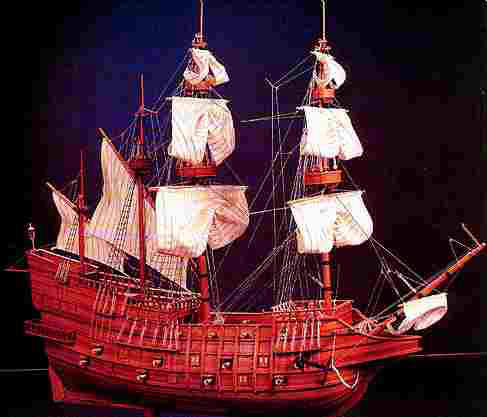
A Spanish Galleon
Gold and silver, and minted silver coins from Potosi and Lima in Peru, were transported by the South Seas fleet to Panama City on the Pacific coast, where they were unloaded and carried by mule trains across the Isthmus to Portobello in Panama. The "Tierra Firme Fleet" carrying supplies from Spain, picked up the gold and silver from Peru, after unloading the supplies at Portebello, and returned to Havana, via Cartagena to meet the "Nueva Espana Fleet" returning from Veracruz. At Cartagena the fleet picked up gold and emeralds produced in Colombia. The two Main fleets assembled in Havana, before their return journey to Spain. The Honduras fleet carrying indigo and other agricultural products also called at Havana, and transferred their cargo to the ships of the main fleet.
Obstacles that had to be overcome by the Spanish treasure fleets on their homeward bound journey
The fully assembled treasure fleet that was due to return to Spain with their precious cargo, had to overcome two main obstacles during their return journey to Spain. These obstacles were the weather and the pirates. The captains of all merchant ships were well aware that th hurricane season in the Caribbean began in late July of every year and continued till early October, and therefore they planned their departure from Havana weeks before the end of July. If there was a delay in the departure they had to wait till the end of September to resume their journey. The menace of pirates in the Caribbean and the Atlantic was another serious obstacle the Spanish treasure fleets had to overcome, before they reached their destination safely. It was well known that Spanish treasure fleets were well laden with valuables such as gold and silver, and thus became the prime target of pirates. Some of these pirates operated on their own, but others were sponsored by governments who were enemies to the Spanish, such as the British. To overcome this problem the treasure fleet was escorted by two heavily armed ships, one leading the fleet known as the "Capitana" and the other bringing up the rear known as the "Amaranth." But, in spite of all these precautions there had been instances when the fleet had been attacked and robbed by the pirates.
The returning fleet left Havana in Cuba, and navigated through the straits of Florida, and then along the coast of Florida, entered the Gulf Stream, a powerful warm and swift Atlantic current that originates in the Gulf of Mexico and then exits through the straits of Florida, and follows the eastern coastline of the United States and Newfoundland, before crossing the Atlantic Ocean. The fleet moving northwards along the stream, left the stream and moved eastwards when they were on the same latitude as Spain.
The story of the "Nuestra Senora de Atocha"
The journey from Spain to the Caribbean, the "Nueva Espana Fleet"
The "Nuestra Senora de Atocha" was a newly constructed 110 foot galleon, that was designated as the "Amaranth" of Tierra Firme Fleet. The fleet that consisted of 28 ships left Spain on March 23, 1622, and when it reached the Caribbean somewhere near Hispaniola, it split up into two. One fleet known as the "Nueva Espana Fleet" (New Spain Fleet) sailed through the Straits of Florida, and across the Gulf of Mexico, reached the port city of Veracruz, where it off loaded supplies brought from Spain to the Spanish colonial residents, and loaded gold and silver from Mexico City, including silver coins minted in Mexico, and silk and porcelain brought in from Manila, Philippines, by the Manila Fleet to Acapulco on the Pacific coast, and transported overland to Veracruz from Acapulco. The "Nueva Espana Fleet" then sailed back across the Gulf of Mexico, and reached the port city of Havana, in Cuba.
The "Tierra Firme Fleet"
The other fleet known as the "Tierra Firme Fleet" of which "Nuestra Senora de Atocha," "Santa Margarita," and "Nuestra Senora del Rosairo" were three constituent ships, stopped briefly at the Caribbean Island of Dominica, and then proceeded to the port city of Portobello in the Panama, arriving in Portobello on May 24th, 1622, where it off loaded supplies from Spain. Around this time treasures from Lima and Potosi consisting of gold and silver, including silver coins, were still arriving from Panama City on the Pacific coast, by mule train, after the consignment was transported to Panama City by the "South Seas Fleet" from Lima and Potosi in Peru. It took almost two months to record and load the "Atocha" and other ships with the consignment bound for Spain. Eventually, on July 22, the "Tierra Firme Fleet" set sail for Havana from Portobello, via Cartagena, in Colombia. At Cartagena, the "Atocha" was loaded with gold and emeralds from Colombia, and also silver coins minted at Santa Fe de Bogota. When the "Tierra Firme Fleet" finally reached Havana, to join the "Nueva Espana Fleet" it was almost the end of August, entering the peak of the hurricane season.
"Nuestra Senora de Atocha" the ship of choice for loading valuable treasures
The 110-foot newly constructed rear guard galleon or "Amaranth" of the combined fleet, the "Nuestra Senora de Atocha" became the ship of choice for loading the most valuable treasures belonging to the Spanish government, as well as the nobility and wealthy merchants, as the ship was fully armed with 20 bronze canons and 82 infantry men on board. Apart from the security of her armaments, her modern accommodation was also an attraction for the nobility, government officials, and wealthy merchants to board the "Atocha" for the homeward bound journey. Altogether 265 passengers and crew boarded the ship for the return journey. The extraordinarily rich cargo in the ship consisted of 125 gold bars and discs, 24 tons of silver bullion in the form of 1038 ingots, 180,000 pesos of silver coins, 582 copper ingots, 350 chests of indigo, 525 bales of tobacco, 1200 pounds of worked silverware and dozens of chests of emeralds and other gemstones.
The Santa Margarita, which was also a new ship purchased in 1621 in Cadiz, Spain, was carrying fewer wealthy passengers than the "Atocha," and therefore less personal treasures. But, the ship contained substantial quantities of government treasures in the form of gold and silver bullion.
The homeward bound journey
The fleet of 28 ships fully loaded with treasures and assembled at Havana, Cuba, were forced to wait until the end of the hurricane season in order to start the homeward journey backwards. The fleet which should have left in early July before the onset of the hurricane season, was already two months behind schedule. Therefore, on September 4th, 1622, when the weather appeared to be perfect, the decision was made by the captains of the ships in consultation with the Spanish governor of Cuba, to set sail for Spain, as the chances of a hurricane developing in the Caribbean appeared to be very remote. But, what the captains did not know at that time was that the peak season for hurricanes in the Caribbean was actually between the 1st and 15th of September, within the normal hurricane period that extended from late July to early October.
The 28 ships of the fleet raised anchor and set sail from the port of Havana, almost in single file, led by the fully armed "Capitana" of the fleet, followed one after another by 26 other ships, and ending with the fully armed "Amaranth" the "Nuestra Senora de Atocha" that brought up the rear guard of the fleet. The course of the ships in the Straits of Florida was due north towards the Florida Keys, in order to enter the strong Gulf Stream current that would take them northwards along the eastern coastline of the United States.
The fleet is hit by a hurricane, and the Atocha sinks on September 6, 1622
In the evening a northeasterly wind was blowing across the Straits of Florida, growing stronger and stronger throughout the night, and attaining the status of a hurricane in the morning. The seas became rough and stormy, and the waves were mountainous. The fleet of ships were thus caught in the midst of a severe Caribbean hurricane. Suddenly the violent winds changed direction blowing from the south, and most of the ships were driven past the Dry Tortugas, a small group of islands located at the end of the Florida Keys, and into the relative safety of the Gulf of Mexico. However, unfortunately on Tuesday, September 6, 1622, five ships at the tail end of the convoy, which included the "Atocha," Santa Margarita, del Rosairo and two smaller vessels, were exposed to the full impact of the hurricane, causing extensive damage to the masts and tillers and tearing the sails and rigging to shreds. The ships drifted helplessly towards the reefs, and the "Atocha" was mercilessly lifted by a high wave and smashed violently on a coral reef. The "Atocha" went down immediately, pulled down by her heavy cargo of treasures and bronze cannons, and drowning almost all the passengers on board. Three of the other ships were also grounded and wrecked and lost in the violent storm.
The passengers and crew of the Santa Margarita however, were very fortunate, as the ship that was drifting out of control following damages to its masts, was grounded on a sandbar, just 3 miles from the spot where the "Atocha" sank. As the raging hurricane continued to pound the area, and before the ship broke up, 68 of the crew and passengers of the "Santa Margarita" were rescued
The immediate aftermath of the hurricane, and attempts to salvage the lost ships
The next day (September 7th) when the hurricane had moved away from the Straits of Florida, and the sea became calmer, the 23 ships that escaped damage, returned to Havana, and decides to wait till next year for the return journey. A small merchant ship that happened to pass through the area where the five ships were lost, detected five "Atocha" survivors still clinging to the ship's mizzenmast, and were able to rescue them. These were the only survivors of the 265 passengers and crew on board the "Atocha." Out of the five survivors three were seamen and two black slaves.
The loss of the five ships, and particularly the "Atocha," with its invaluable load of treasures was a terrible blow to the Spanish government, which could have had serious repercussions on the economy of the country, which was in the midst of the thirty-years war (1618-48). Therefore the Spanish Governor of Cuba ordered an immediate salvage operation, to retrieve as much as possible of the lost treasures. Salvage teams were sent out to the area to locate the shipwrecks and commence salvage operations. The "Atocha" was located in waters about 55 feet deep. Divers holding their breath, went down again and again, but were unable to break into the hatches. Their attempts had only limited impact as time spent under water was very limited, due to difficulty in holding the breath for a long time. The divers marked the site of the Atocha's wreck and continued searching for the other lost ships. They then discovered the "Nuestra Senora del Rosairo" in relatively shallow waters, and succeeded in salvaging the ship and its lost cargo. However the other three ships could not be located at all.
The divers returned to Havana to look for additional equipment to salvage the treasures of the "Atocha," but during this period a second hurricane hit the area, tearing the upper hull structure and the masts of the ship. On their return to the site, the divers were not able to locate the "Atocha" anymore, and attempts made from time to time to locate the wreck for the next 60 years proved unsuccessful. The other treasure vessel the "Santa Margarita" was however discovered in 1626, and part of its valuable cargo salvaged within a few years. Among the items recovered from the wreckage of the Santa Margarita were 64,000 silver coins, hundreds of silver ingots, eight bronze canons, and other valuable items.
The loss of the Atocha forgotten for the next three centuries
As time passed by Spain lost most of its colonies in the North, Central and South America, after a series of independence movements that began in the early 19th century, culminating in independence to most of these colonies by 1825. After the Spanish-American war of 1898, the United States occupied the remaining Spanish colonies of Cuba, Puerto Rico, Guam and the Philippines, and with the dawn of the 20th century Spain had no more overseas colonies except for its African territory of Spanish Sahara which it ruled from 1884 to 1975.
As time passed by the loss of the treasure ship "Atocha" was totally forgotten, and the documents relating to the event, such as the ship's register and other relevant entries found their way to the Archives of the Indies in Seville, Spain. The documents were also forgotten and laid in obscurity until re-discovered centuries later.
Events that led to interest in recovering the wreckage of Atocha in the 20th century
The dawn of the 20th century resulted in unprecedented advancement in science and technology, and the tremendous improvement of the quality of life of peoples around the world. All fields of human endeavor such as agriculture, industry, transport, communications, health care, education, entertainment etc. showed phenomenal improvement never witnessed in the history of mankind. Hundreds of thousands of scientific discoveries and inventions had benefited mankind and helped to raise the standard of living of all human beings, and increase his life expectancy.
Among one such invention was the SCUBA which stands for Self-Contained Underwater Breathing Apparatus, developed by French naval lieutenant Jacques-Ives Cousteau, in 1942. The use of the scuba allowed divers to remain and work underwater for long periods of time, and this opened the door for divers to search the bottom of the seas for wrecked ships and other lost treasures. In the 1960s a salvage operation was carried out by the Real Eight Corporation, that led to the discovery and salvaging of 10 wrecks belonging to the Spanish treasure fleet of 1715, near Vero Beach, Florida. This salvage operation that received worldwide press coverage, sparked off an enormous interest in the salvaging of ancient shipwrecks of all nations and particularly the treasure-laden ships of the Spanish in Atlantic and the Caribbean. Mel Fisher who participated in the 1715 Spanish treasure fleet salvage operation, formed a company of his own known as the Treasure Salvors Inc. and undertook salvage operations, the most significant of which was the search for the "Atocha" wreckage off the Florida coast, which he began in 1969.
Mel Fisher's relentless search for the Atocha for sixteen years
Treasure Salvaors Inc. undertakes the search and salvage operation in 1969
The "Nuestra Senora de Atocha" was the richest Spanish treasure galleon ever lost in the western hemisphere, lost off the coast of Florida and forgotten for nearly 350 years, whose treasures are worth hundreds of millions of dollars by today's standards. After the successful salvaging operation of the shipwrecks of the 1715 Spanish treasure fleet, Mel Fisher formed the Treasure Salvors Inc. which undertook the search and salvage operation of the treasures of the long lost "Atocha," in 1969, a joint venture that was funded by Mel Fisher and other investors.
Given the fact that the treasures would have been scattered over a vast area by the action of turbulent weather and rough seas during the annual hurricane seasons over a period of about three and a half centuries, the task ahead was indeed a challenging one and Mel Fisher had to go into partnership with several sub-contracting companies in order to carry out a comprehensive search of the suspected areas, and their joint effort finally bore fruit only after a long, frustrating, painful and costly search of 16 long years. The credit for the successful search which had eluded the Spanish salvage teams for a period of 80 years after the incident, undoubtedly goes to the treasure hunter and archaeological enthusiast Mel Fisher, whose perseverance, determination and courage finally prevailed in spite of several odds that went against his efforts, during this long period. Mel fisher lost his son, daughter-in-law and another diver when their salvage ship capsized in 1975, and the Florida State Government attempted to claim the whole wreckage after an initial identification of the wreckage site in 1971. Subsequently legal action had to be instituted against the United States Government and the Florida State Government to claim full legal rights for the wreckage discovered by the company.
Mel Fisher studies the historical documents in the Archives of the Indies in Spain, designs and produces special equipment for the operation
Before undertaking the actual operation Mel Fisher and his Spanish translator Eugene Lyon studied all historical documents relating to the incident preserved in the Archives of the Indies, in Seville, Spain. A study of the manifest of the ship gave a full list of the passengers and treasures on board the ship, including the range of serial numbers on the silver coins minted in different mints set up in its colonies that produced the precious metal. Such information was vital in identifying the wreckage from which various artifacts, gold bars, silver coins and ingots originated, and eventually locating the "mother lode" of the wrecked "Atocha."
He then embarked on the designing and production of special equipment, needed for his salvage operation, such as sand-clearing prop wash deflectors, known as "mailboxes" and special proton magnetometers.
An initial set back in the operation
An initial set back suffered in the early days of the search operation was the searching of an area, based on centuries old reports, that the wreckage of this famous galleon was lying off the last "Key of Matecumbe" which was misleading. Presently the "Key of Matecumbe" lies half way up the Florida Keys, far from where the "Atocha" actually sank. Searches for the wreckage in this area was a waste of time, energy and money, and became a vain effort. Eventually Mel Fisher's research consultant, Eugene Lyon, gathered evidence that showed that the "Atocha" had actually sunk near the Marqueses Keys, about 20 miles southwest of Key West. Intensive search operations then began in the newly identified area.
Difficulties encountered in the search operation
The availability of GPS (Global Positioning System) today makes it easy to locate and report one's position on the surface of the earth, whether on the land or the vast ocean. Modern salvage operations in the open ocean is relatively easy today because of this, as one could record the position in the open sea, where searches had already been conducted. This enables him to return to the same spot after a period of time, and leaving the areas where searches had already been conducted, he could now explore new areas where searches have not been conducted previously. This enables one to conduct a systematic search operation in the open sea, without performing duplicate searches, that could save a lot of time and money. Such facilities were not available to Mel Fisher and his team when search operations were conducted 39 years ago.
In the absence of landmarks in the ocean to take bearings, Mel Fisher set up small ranging towers manned by men with a theodolite and radio, to stay in contact with the mag boat as it ran its courses. They covered each area fairly exhaustively, by keeping the boat on course, yet it appeared that they had missed the Atocha's "mother lode" in spite of the fact that the area in question was covered in 1973.
The first major breakthrough comes in 1971
The first major breakthrough in the search came in 1971 when an anchor of the 'Atocha" was discovered, together with some silver coins, lead musket balls, and a gold chain in its immediate surroundings. The discovery seemed to be consistent with the opinion that this was the area where the Atocha came ashore initially. It was 14 years after this, when the "mother lode" of the "Atocha" was discovered, that it became clear, that this area actually represented a bounce spot of the top decks of the "Atocha," that was separated by the second hurricane also in September 1622.
Salvage operations from 1971 to 1984. Discovery of a range of artifacts
During the 14-year period from 1971 to 1984, salvage efforts were concentrated mainly around this area, that led to the recovery of some fabulous artifacts, which included gold jewelry, gold chains, a gold cup, silver ewers, candleabras, muskets, rapiers and even 1622 passenger's baggage. Besides, over 2,000 silver coins and several gold bars were also recovered from this region. Three silver bars found matched the weights and tally numbers found on the Atocha's manifest preserved in Seville. The sandy area just 200 yards of the anchor location, and 22 feet deep, from where over 2,000 silver coins were recovered, over a period of months, was nicknamed the "Bank of Spain." Another significant artifact that was recovered from this area was a gold belt with 28 sections, each set with a precious stone or pearl. In 1975, Mel Fisher's son Dirk, found nine bronze cannons from the same area, to the east of the "Bank of Spain" in 40 feet of water. The markings on the cannons positively identified that they belonged to the wrecked "Atocha." This was a major discovery, but unfortunately just days after this discovery, Dirk and his wife Angel, and a diver Rick Gage, were killed when their salvage boat capsized. The death of Dirk and his wife was a severe personal loss to Mel Fisher and his family, yet the family was more united than ever, and determined to see through this project that had consumed their time, energy and resources for more than six years.
Change of strategy in 1984
In 1984, two more bronze cannons and an anchor were discovered in a region northwest of the primary area, which led to a serious rethinking of the scatter pattern of the various artifacts, cannons, silver coins and other treasures hitherto salvaged from the sea. It then became obvious to everyone, that the hurricane had actually carried the wreckage of the Atocha in a curved path. Following this curved path one entered the Hawk Channel, which was 54 feet deep, corresponding to the depth reported by Gaspar de Vargas, the head of the Spanish salvage team that located the wreckage in 1626. Excavations carried out along this curved path led to a significant discovery on May 27, 1985. Emerald jewelry, five pieces of gold, 12 gold bars, and some gold chains were recovered. The discovery led to the realization that exploration was now finally on the right track. Mel Fisher's son, Kane Fisher then moved his salvage ship "Dauntless" along this selected path, and then setting up a string of buoys along the path, several miles long, began explorations at regular intervals of 100 yards. He reached the end of the string of buoys, but found nothing significant. He then extended the string of buoys by another mile and kept going, and on July 19. 1985, made a significant discovery - A large section of olive jar and barrel hoop with four silver coins attached.
Discovery of the "mother lode" in 1985
Kane Fisher and his colleagues rested for the night and then started work again in the morning of July 20, 1985. The divers who went down at the first exploratory site that morning, were spellbound and could not believe what they saw on the sea bed. They saw a "reef" of silver bars, consisting of hundreds of bars stacked in rows, one on top of the other. The "reef" was 20 feet long, 3 feet wide and 3 feet high, and consisted of 980 bars. Scattered around the "reef' were several intact redwood boxes of coins and artifacts. Over seventy gold bars were recovered from a single hole on the western side of the ballast pile. A jubilant Kane Fisher radioed the news of the discovery to Treasure Salvors headquarters on the Florida coast from his salvage ship the "Dauntless." "Put away the charts; we have found the main pile."
After some days the shippers marks on the bars of silver and gold were compared with Atocha's cargo manifest, and it was confirmed that the bars were part of the cargo carried by the "Atocha' on that fateful day. At long last, after 16 years of searching, the "mother lode" of the "Atocha" had been discovered. However, experts believe that the sterncastle, the part of the ship that would hold most of the gold and the Muzo emeralds, have not yet been discovered.
The "Atocha motherlode" which included 40 tons of gold and silver, 100,000 Spanish silver coins, gold coins, Colombian emeralds, 1,000 silver bars and golden and silver artifacts, was estimated to have a value of $450 million according to 1985 estimates. This enormous cache yet represented only about half of the treasures that went down with the Atocha.
Discovery of the "Santa Margarita"
The Spanish salvage team sent to the site of the wreckages in 1625, headed by Francisco Melian, was successful in locating the wreckage of the "Santa Margarita" and undertook a salvage operation that retrieved eight bronze cannons, 68,622 silver coins, 392 silver ingots and other valuable items. However, due to some reason they were not able to salvage the entire haul of treasures stored in the holds of the ship, and the wreckage was abandoned. This fact became evident after comparison of the cargo salvaged in 1626 with the manifest of the cargo on board the "Santa Margarita" preserved in the archives at Seville, in Spain. The discrepancy between the two convinced Mel Fisher that the wreckage of the "Santa Margarita" still held large quantities of undiscovered treasures.
The wreckage of the "Santa Margarita" too were lost for 363 years and shifted from its original site by the forces of nature, like the wreckage of the "Atocha.' At the time of the incident 68 survivors on board the "Santa Margarita" were fortunate enough to be rescued, and thus there were many eye witness accounts of what transpired at the crucial final moments of both the "Atocha" and the "Santa Margarita." According to one of the survivors, the Gunnery Captain of the "Santa Margarita," "the Atocha rose up, struck a reef, and sank shortly thereafter. The "Santa Margarita" then parted her anchor lines and struck the sandbanks in eighteen feet of water, where she came apart." According to this evidence, the two ships must have been at visible distance from one another during their crucial last moments.
In parallel with the search for the "Atocha" Mel Fisher had been sending out salvage teams to the areas west of the suspected wreckage site of the Atocha, in the Quicksands, within the primary search area, to look for the wreckage of the "Santa Margarita," but without any success. Then magnetometer surveys conducted in 1980, along the three-fathom curve, that connected the Quicksands to the Marquesa Keys, revealed a "hit" four miles from the Marquesa Keys and 6 miles from the Quicksands. Salvage boats from the neighborhood were called in to the site, and investigations revealed a wreckage of a ship, which eventually turned out to be the "Santa Margarita." Salvage operations carried out on the wreckage brought out two bronze cannons, 56 gold bars, 18 silver bars, 10,000 silver coins, 180 feet of gold chains, and a nine-inch gold plate. The discovery was the greatest and most significant since exploratory activities started on the quest for the lost "Atocha" in 1969, and provided the much-needed boost to carry on with the eleven-year quest for the elusive "Atocha." However, it turned out that eight bronze cannons, 76 silver bars, and 34,378 silver coins were still unaccounted for, according to the ship's manifest, even after taking into account what was salvaged by Francisco Melian in 1625. Thus more treasures still remain at the bottom of the ocean for future prospectors.
Mel Fisher Maritime Heritage Society and Museum
Mel Fisher's great human qualities
The characterization of Mel Fisher by some as "the world's greatest treasure hunter" is undoubtedly true, but may not be appropriate, as it may covey the wrong impression of a gold digger whose actions were motivated purely by profit and the urge to get rich quick. On the contrary, the way Mel Fisher went about his quest for lost treasures, with due respect to the laws of the nation, overcoming all odds and taking special precautions to preserve anything of historical and archeological importance, for the sake of posterity, irrespective of their enormous monetary value, eventually setting up the non-profit initiative known as the Mel Fisher Maritime Heritage Society and Museum, to display the rare artifacts retrieved from a salt water grave, are qualities of a great human being who wanted to use his God given talents for the benefit of all humanity and create a lasting legacy touching the lives of the ordinary people.
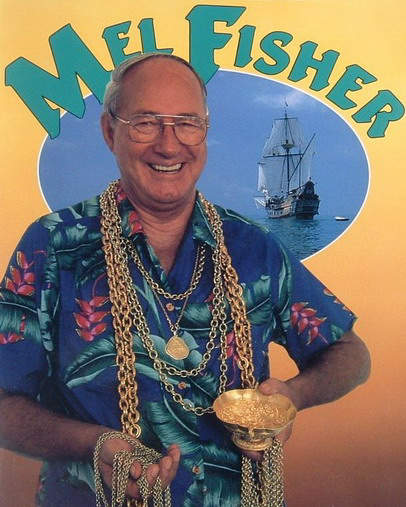
Mel Fisher's good intentions and great vision for the conservation of underwater artifacts
Mel Fisher obtains a search contract and salvage permits for his operation
According to the laws of the State of Florida, prospective salvage companies planning to search and salvage shipwrecks from the waters off the coast of Florida, had to obtain a search contract and salvage permit for every site discovered, and sign a bond, under which 25% of the finds become the property of the state and the remaining 75% goes to the salvaging company. In keeping with this law Mel Fisher obtained a search contract for the area far to the west of the Florida Keys, the suspected site of the wreckage of the "Nuestra Senora de Atocha.
Mel Fisher trains state agents to dive and also feeds them
Florida State law also required that the salvage company should allow a state agent to be present on each salvage boat. Mel Fisher not only complied with this requirement by allowing six state agents to operate on his boats, but also showed his good intentions by purchasing diving equipment for these agents, teaching them how to dive and also feeding them.
Mel Fisher hires an archaeologist for his salvage team
His good intentions and that he was not merely another gold digger looking for quick profits, but had a broader vision for his salvage operation, was clearly demonstrated when he hired an archaeologist by the name of Duncan Mathewson, to be on board during his operations. Given the antiquity of the wreckage, being around 350 years old, Mel Fisher wanted to make sure that anything of archeological value brought out was properly listed, tagged and preserved for posterity for the future generations. In fact Treasure Salvors Inc. eventually became experts in the proper recovery and conservation of underwater artifacts, recognized internationally, thanks to the pioneering efforts of Mel Fisher.
Mel Fisher looks after both private and public interests in his exploratory activities
Besides this Mel Fisher also became a pioneer in blending private and public interests in the exploitation and protection of underwater cultural resources, now referred to as Underwater Cultural Heritage. Protection of underwater cultural heritage does not mean total prohibition of salvage operations at an underwater cultural heritage site, allowing the total deterioration and disintegration of any cultural artifacts such sites might hold. It means the planned exploitation of these sites under proper supervision and care, and the conservation of the artifacts so recovered after appropriate scientific treatment, to prevent further deterioration of the salvaged artifacts. In the case of the "Atocha Underwater Cultural Heritage" Mel Fisher as the operator of a private salvage company, together with the participation of other private investors, had carried out a salvage and recovery operation which the Florida State Government on its own could not achieve, and thus prevented the further deterioration and destruction of these submerged artifacts. In that sense, the Florida State Government and its people should forever be indebted to Mel Fisher, for the successful recovery and conservation of the submerged artifacts from the wreckages of the "Atocha" and the "Santa Margarita."
Mel Fisher purchases the Key West Naval Station building with his share of the Atocha treasure, and sets up the Mel Fisher Maritime Heritage Society Museum
The final and indisputable evidence about his good intentions, and great commitment to the conservation of the artifacts of the Atocha, Santa Margarita and other wreckages, was provided in the late 1980s, when Mel Fisher with the proceeds of the sale of his part of the share of the Atocha treasure, purchased a huge former Key West Naval Station building, to permanently house the non-profit Mel Fisher Maritime Heritage Society Museum founded by him. The building also houses a research center and conservation laboratories. The Mel Fisher Maritime Heritage Society is a government accredited non-profit organization, whose laudable objectives include accumulation and dissemination of information, providing educational services to the public, on maritime and colonial activity in the New World, and preserving maritime cultural resources.
Artifacts on display at the Mel Fisher Maritime Museum
Duncan Mathewson, the Archaeological Director of Treasures Salvors Inc. and a team of dedicated archaeologists, were involved in the conservation of the artifacts brought out from the "mother lode" site. As the artifacts had lain on the ocean bed for almost three and a half centuries, they were in an extremely unstable state, requiring immediate preservation treatment to prevent its further deterioration after it left its saltwater tomb. The artifacts and treasures so preserved, form the main components of the Mel Fisher Maritime Heritage Society Museum's collection. Among the items on exhibit at the museum are gold and silver bars and coins, a solid gold belt, gold necklace set with gems, a gold chalice believed to be a protection against poisoning, an intricately designed gold plate, a gold chain weighing more than 7 pounds, a large number of emeralds including a 77.76-carat uncut hexagonal crystal, religious and secular jewelry, and silver ware. Among the artifacts on display include rare navigational instruments, military armaments, native American artifacts, tools of different trades, ceramic vessels, galley wares, and even seeds and insects. Every year around 200,000 people visit the Mel Fisher Museum at Key West, Florida, and marvel at the extraordinary artifacts recovered from the ocean floor, that represent the glory of a nation, Spain, in a bye gone era, while appreciating the dedication and determination of the human spirit, that was responsible for retrieving these objects from the dark depths of the ocean.
A short biography of Mel Fisher
Birth, education and service in the U.S. Army
Mel Fisher was born in Glen Park, Indiana, on August 21, 1922, to Earl Fisher and Grace Sprencel Fisher. He studied at Lew Wallace High School, at Glen Park, Indiana. He attended Purdue University, where he studied engineering. While his father taught him carpentry skills, his mother taught him music and dance skills. He formed his first dance band while at high school, and led his own 21-piece band while at the university. He joined the U.S. Army during World War II, and was attached to the U.S. Army Corps of Engineers, and followed a course at the University of Alabama, before being sent overseas to Europe, with the Army Engineers.
Mel Fisher pursues his main interest in life, diving, at Florida
After the war, Mel moved to Chicago, and Denver and then to Florida, where he had the opportunity of pursuing his primary interest in life, diving. The engineering skills he acquired in the university and the army, helped him develop his own equipment for his underwater adventures and exploration, such as, the spear guns, underwater cameras etc. While at Florida, Mel saw his first real treasure from a sunken ship. His interest in diving caused him to drive all the way from Florida to California, to purchase one of the first Scuba units perfected by Jacques Cousteau, the French inventor. The use of the Scuba boosted his diving and exploratory activities, as it prolonged the time spent underwater.
Mel Fisher moves to California with his parents, meets his life time partner
In 1950, he moved with his parents to California, where he assisted them in operating a chicken ranch at Torrance, and acquired knowledge on animal husbandry at the El Camino College, which helped him to run the ranch more effectively. Even during this period he continued to pursue his interest in diving, and opened his first "dive shop" on the ranch, that sold compressed air and scuba kits and spares. It was here that he met his life time partner and constant companion in diving, and al his future endeavors Dolores Horton, whose mother and uncle purchased the chicken ranch. He taught Dolores the technique of scuba diving, and during their honeymoon in Florida, the young couple went diving and exploring the shipwrecks off the Florida keys. It was then the couple decided to build their entire future based on this most exciting and rewarding profession.
Mel Fisher set up a diving-shop-cum-school at California
They planned to set up a full-fledged diving shop in California, but lacked the financial resources. In order to raise the necessary funds they undertook commercial diving for spiny lobsters, a very lucrative but difficult work. Eventually they succeeded in opening the first ever "dive shop cum school" in the world, the Mel's Aqua Shop, in Redondo Beach, California, which turned out to be a very successful venture. As part of the services offered by this shop, Mel and Dolores also provided training for would-be scuba divers, training more than 65,000 novices in the technique of scuba diving, a service that was recognized by the community, by giving Mel a prestigious award for his contribution to education in diving.
Mel Fisher pioneers the making of underwater films and movies
A pioneer in underwater exploration, Mel also pioneered the making of underwater films and movies, for training, advertising, entertainment and educational purposes. His underwater adventure films aired on television became very popular among millions of viewers on the West Coast of the United States. His wife Dolores appeared in underwater commercials made by Mel for swimwear manufacturers. Dolores also set the world's underwater endurance record for women, at 55 hours and 35 minutes, that has continued to stand through the years.
The children follow in the footsteps of the parents
Mel and Dolores were blessed with four children, three sons Dirk, Kim and Kane and one daughter Taffi. The children also followed in the foot steps of the parents, becoming professional divers, and helping to build up the family diving enterprise.
The greatest breakthrough in the lives of the Fishers
The greatest breakthrough in their lives came in 1963, when in Florida Mel had a meeting with Kip Wagner, that led to a partnership on a 50-50 basis to salvage the wrecks of the 1715 Spanish treasure fleet, lost off the east coast of Florida. The greatest challenge faced by Mel and other divers who took part in the salvage operation, was the murkiness of the water closer to the shore, where the ships had gone down. The proton magnetometer developed by one of the members of the team Fay Field, went a long way in locating the shipwrecks in the murky water, but the lack of visibility was a serious limitation for further exploratory activities. To overcome this problem Mel Fisher developed a device known as the "mailbox," which lowered from the vessel stern over the propellers, sent a layer of clear water from the surface downward to the bottom, improving the divers visibility. The use of the "mailbox" in the spring of 1964, led to the discovery of 1,033 gold coins on the ocean floor at the site of a shipwreck. Using these two important pieces of equipment, the Fisher-Wagner team successfully recovered more than $20 million worth of treasures from the the 1715 shipwrecks.
Mel Fisher set up his own company the "Treasure Salvors"
The success of the salvage operation of the 1715 fleet, led Mel Fisher to form his own salvage company known as "Treasure Salvors" in 1969, and embark on his next major project the search and recovery of the treasures of the Spanish galleon the Atocha, which is the subject of this entire webpage. The services rendered by Mel Fisher and his family to their community, the people of Florida in particular, and the world community at large, is dealt with elsewhere on this page.
Mel Fisher's death at the age of 76
Mel Fisher, the engineer, the farmer, the scientist, pioneer scuba diver and underwater film and movie maker, the teacher, the inventor, the treasure hunter, the archaeological enthusiast, the protector and conservator of underwater cultural heritage sites, the founder of the Mel Fisher Maritime Heritage Society and Museum, the unofficial king of the underwater world and above all a great humanist, died on Saturday, December 19, 1998, after a long battle with cancer. At the time of his death he was 76 years old. He was survived by his wife Dolores, sons Kim and Kane and daughter Taffi.
The celebrated court case that gave Mel Fisher the right of ownership of the Atocha wreckage and treasures
Mel Fisher's Treasure Salvors Inc. begin search operations in 1969
The Florida State Government granted Mel Fisher's Treasure Salvors Inc. search permits in 1969 for the search and location of the wreckage of the Nuestra Senora de Atocha, a Spanish galleon carrying a cargo of New World treasure, that sank in 1622, 40 nautical miles west of what is today Key West, Florida.
After years of searching the ocean floor, Treasures Salvaors was successful in locating the suspected wreck site in the Spring of 1971, at a spot known as the "Quicksands" 9½ nautical miles west of the Marquesas Keys. The initial disoveries were an anchor of the Atocha, some silver, coins, lead musket balls, and a gold chain.
The State of Florida Claims that the Atocha belongs to the State
The State of Florida immediately claimed that the Atocha belonged to the State, under the provisions of the laws of the State:- "It is further declared to be the public policy of the state that all treasure trove, artifacts and such objects having intrinsic or historical and archaeological value which have been abandoned on state-owned lands or state-owned sovereignty submerged lands shall belong to the state with the title thereto vested in the division, history and records management of the department of state for the purpose of administration and protection."
Mel Fisher enters into a salvage contract with Florida State
Officials of the Florida division of archives threatened to arrest Mel Fisher, the president of Treasure Salvors Inc. and to confiscate their boats and equipment, if they commenced salvage operations on the Atocha, without a salvage contract from the state. Accordingly, Treasures Salvors Inc. signed a one-year contract with the state, that permitted them to conduct salvage operations on the vessel for one year. Subsequently the contracts were renewed for three successive years. The contracts were executed on the assumption that the Atocha was the property of the State of Florida as it was found on submerged lands within the boundaries of the State.
The contract specifies 75% award of the materials recovered to Treasure Salvors
The contract laid out that "In payment for the Salvager's satisfactory performance and compliance with this agreement, the Division will award to the Salvager seventy five percent (75%) of the total appraised value of all material recovered hereunder, and shall be made at the time of division of such material by the parties hereto. Said payment may be made in either recovered material or fair market value, or the combination of both at the option of the Division's director."
Treasure Salvors also agreed to pay the Division, $1,200 every year to post a performance bond, and to perform its work in a specified manner, in exchange for the Division's agreement to transfer ownership of 75% of the proceeds of the operation to Treasure Salvors. The contract did not purport to transfer ownership of any property to the Division of Archives, as the property belonged to the State anyway according to the provisions of the state laws.
Artifacts salvaged partly held by Treasure Salvors and partly by Division of Archives in Tallahassee
As the salvage operation got underway considerable amounts of artifacts were salvaged by Treasure Salvors, and some of these artifacts were held by the salvager at its headquarters in Key West, while the others were held by Division of Archives in Tallahassee. However all properties belonged to the state until their division according to the provisions of the contract.
Litigation between the United States Government and the State of Florida to determine the seaward boundary in the Atlantic and the Gulf of Mexico. Florida State Government loses all claims to the Atocha Wreckage.
In a dramatic development related to the salvage operation, the United States and the State of Florida were engaged in litigation to determine the seaward boundary of submerged lands in the Atlantic ocean and the Gulf of Mexico in which the State had rights to natural resources. Then in February 1974, a Special Master filed a report that defined Florida's boundary, which dramatically was landward of the site of the wreck of the Atocha. The State's objection to the report were overruled. According to a final decree that was entered in 1976, it was the United States Government and not the State of Florida that was entitled to the lands, minerals, and other natural resources in the area, in which the remains of the Atocha had come to rest. This was indeed a dramatic development for Mel Fisher and his company as the Florida State Government lost all claims to the wreckage of the Atocha and other similar wreckages that lay in the waters off the coast of Florida.
Treasure Salvors file action in the Federal District Court to be given possession of the Atocha wreckage.
Immediately after this ruling, lawyers to the Treasure Salvors filed a complaint in the Federal District Court for the Southern District of Florida demanding that the "Plaintiffs be put into possession of the Atocha and other property, and that all other persons, firms, and corporations or government agencies be enjoined from interfering with the Plaintiff"s title, possession and property, and that the Plaintiff's title be confirmed against all claimants and all the world." The complaint invoked the court's admiralty and maritime jurisdiction, and as admiralty action in rem, named the Atocha as defendant. Under this action items recovered from the Atocha in Treasure Salvor's possession were surrendered to court, pending the determination of the court. Other artifacts recovered were with the Division of Archives in Tallahassee, but no attempts were made immediately to bring them into the court's custody. Most of the wreck and its valuable cargo still lay buried under the sand in international waters.
The United States Government files counter claim seeking ownership of Atocha
The United States Government intervened in the action as a party-defendant and filed a counter claim seeking a declaratory judgment that the United States was the proper owner of the Atocha.
The District Court enters judgment in favor of Treasure Salvors
The District Court rejected the Government's claim of ownership and held that "possession and title are rightfully conferred upon the finder of the res derelictae." The court entered judgment in favor of Treasure Salvors Inc. against the United States of America and all other claimants. (1976)
The United States Government appeals against the judgment of the Federal District Court
The Court of Appeals affirmed the judgment of the District Court, as against the United States Govenment (1978)
Treasure Salvors file motion in District Court for an order for a US Marshal to take custody of the Artifacts in Tallahassee
Immediately after the decision of the Court of Appeals , Treasure Salvors file a motion in the District Court for an order commanding a United States Marshal to arrest and take custody of the artifacts held by the Division of Archives in Tallahassee, and bring them within the jurisdiction of the court. The District Court issued a warrant to two officers of the Division of Archives. The State filed a motion in the District Court to quash the warrant, and also sought and obtained an emergency stay order from the Court of Appeals. The District Court denied the motion to quash, and issued an order to show cause why the state should not deliver the artifacts into the custody of the Marshal. The State then argued that the eleventh amendment barred exercise of the District Court's jurisdiction, but the Distict Court rejected this argument, holding that the State had waived the eleventh amendment as to any claim to the property, and apart from any such claim, the Eleventh Amendment did not bar the seizure of the artifacts and subsequent transfer to the Marshal's custody. The court also rejected the State's claim to the property based on the salvage contracts with respondents.
The State appeals against the judgment of the District Court
The State appealed against the judgment of the District Court, and after lengthy arguments held that the District Court properly held that the Eleventh Amendment did not bar execution of the warrant of arrest. The Court of Appeal however affirmed the States rights to the artifacts.
Treasure Salvors appeal against the findings of the Court of Appeal to the Supreme Court
Treasure Salvors appealed against the findings of the Court of Appeal to the Supreme Court, which after a hearing in 1982, affirmed in part and reversed in part the judgment of the Court of Appeals. The bench of three Supreme Court Judges delivering the judgment said, to the extent that the Court of Appeal held that the Eleventh Amendment did not prohibit an execution of the warrant and transfer of the artifacts to Treasure Salvors, its judgment is affirmed. To the extent that the court determined the State's ownership of the artifacts as part of its Eleventh Amendment analysis, its judgment is reversed.
Treasure Salvors get full legal title to the wreckage of Atocha
Thus the Treasure Salvors Inc. after a process of litigation started in 1976, finally obtained full legal ownership in 1982, of the wreckage of the abandoned historic Spanish galleon, the Nuestra Senora de Atocha, which sank in international waters in 1622. It was three years after this judgment that the "mother lode" of Atocha was finally discovered, after a search that lasted 16 years.
Related :-
External Links :-
Mel Fisher Maritime Heritage Society & Historical Museum, Key West FL
References
1.Treasure Atocha - A $400 million Archeological Adventure - R. Duncan Mathewson III, Archaeological Director of the Treasure Salvors Inc.
2.Website of the Mel Fisher Maritime Heritage Society and Museum
3.Mel Fisher - From Wikipedia, the free encyclopedia.
4.The Mel Fisher Story - by Bleth Mchaley and Wendy Tucker.
5.Website of vLex United States - Florida Department of State vs. Treasure Salvors Inc.
6.Spanish Colonization of the Americas - From Wikipedia, the free encyclopedia.
7.Christopher Columbus - From Wikipedia, the free encyclopedia.

 Home
Security & Guarantee
How it Works
Technology Partners
Updated Tables
Famous Diamonds
More Famous Diamonds
Famous Pearls
Famous Gemstones
Contact Dr Shihaan Larif
Contact Senior Editor
Famous Jewelry
Reference Database
Forums
Learning Center
Gemstone Gallery
e-mail Notifications
Advertise
Press Release
About Us
Privacy Policy
Contact Us
FAQ'S
Site Map
Staff Mail Login
Staff Documents
Birthstones
History
Minerals
Shows
Live Metal Prices
Jewellery Gallery
News
Marketplace
Marketplace Support
Open Store
Online Auctions
Join Us & Contribute
Directory
Classifieds
List your products
Wholesale Trading
Post Buy Request
Go Green Policy
Site Updates
Upcoming-ToDo List
Latest News
Latest Articles
Latest Blog Updates
Chat Rooms
Job Board
User Gallery
Videos
New Newsletter Archive
Old Newsletter Archive
Jewelry & Mineral Blog
User Blogs & Social Network
Search
Answers (Q & A)
Valuation
Help me find a diamond/jewelry
pin.internetstones.com- Social Pinboard- Sart yours & connect with millions
Invite Friends From Yahoo, Gmail etc-One Click
Home
Security & Guarantee
How it Works
Technology Partners
Updated Tables
Famous Diamonds
More Famous Diamonds
Famous Pearls
Famous Gemstones
Contact Dr Shihaan Larif
Contact Senior Editor
Famous Jewelry
Reference Database
Forums
Learning Center
Gemstone Gallery
e-mail Notifications
Advertise
Press Release
About Us
Privacy Policy
Contact Us
FAQ'S
Site Map
Staff Mail Login
Staff Documents
Birthstones
History
Minerals
Shows
Live Metal Prices
Jewellery Gallery
News
Marketplace
Marketplace Support
Open Store
Online Auctions
Join Us & Contribute
Directory
Classifieds
List your products
Wholesale Trading
Post Buy Request
Go Green Policy
Site Updates
Upcoming-ToDo List
Latest News
Latest Articles
Latest Blog Updates
Chat Rooms
Job Board
User Gallery
Videos
New Newsletter Archive
Old Newsletter Archive
Jewelry & Mineral Blog
User Blogs & Social Network
Search
Answers (Q & A)
Valuation
Help me find a diamond/jewelry
pin.internetstones.com- Social Pinboard- Sart yours & connect with millions
Invite Friends From Yahoo, Gmail etc-One Click




Our Global Jewelry Industry Job Network


Buy & Sell in our Marketplace

Subscribe to our Newsletter

List in our Classifieds

List in our Directory

User Uploaded Gallery

Powered by Ultra Secure
Amazon (USA) Cloud Network

Founder Internet Stones.COM
Register in our Forums

| Featured In
|
|
|
|
|
|
|
|







Blog & Education Feed
Articles Feed
 |
 |
 |

Copyright © .Internet Stones.COM. All rights reserved.