Bao Dai/Sunrise Pearl - The World's Largest and Roundest Melo Melo Pearl
Open FREE Unlimited Store Join Our Newsletter
Dr Larif. M. S
Origin of Name
The Bao Dai/Sunrise Pearl that has achieved international fame as the world's largest and roundest melo-melo pearl, is believed to have been part of the collection of Bao Dai, the last emperor of Vietnam, who like his predecessors was an ardent admirer and collector of melo-melo pearls, in keeping with age old tradition of reverence for these natural "fireballs" of nature, believed to be a symbol of perfection in Buddhist thought and was considered as one of the eight precious emblems of the Buddha, and as such became an object of veneration by Buddhists. Melo Melo pearls eventually became a symbol of sovereignty, and was highly valued by emperors who sent their ships in search of these rare beauties, in the waters of the Halong Bay and the South China Sea. Being sacred objects melo-melo pearls were never drilled or strung as beads, but preserved and treated with respect, as objects of devotion. Thus the pearl gets its name from the name of the emperor to whose sacred collection it is believed to have belonged.
The name "Sunrise Pearl" was given to the pearl, by its new owner, after it changed hands in the late 1990s. It is not difficult to comprehend why the pearl was named "Sunrise Pearl" given the fiery intense orange or reddish-orange color of the pearl, reminiscent of the colors of the rising (or setting) sun, the pearl itself resembling the ball of fire, popping up above the horizon at sunrise, or about to disappear below the horizon at the time of sunset in the evening. The pearl with a diameter of 37.97 x 37.58 mm and a weight of 397.52 carats has gone down on record as the largest and roundest melo-melo pearl in the world.
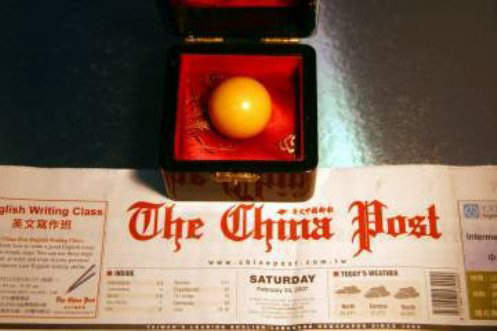
The Bao Dai Sunrise Pearl- The world's largest and roundest Melo Melo Pearl
Photo above, courtsey Mr Ray Chen

Characteristics of the Pearl Necklace
Can the Bao Dai/Sunrise Pearl be considered as a perfectly round or spherical pearl ?
The Bao Dai/Sunrise Pearl considered as the largest and roundest pearl in the world, has been compared in size to a ping-pong ball or a golf ball. The longest and shortest diameter of the pearl are 37.97 mm and 37.58 mm respectively. Using these two diameters we can calculate whether the pearl qualifies to be characterized as a perfectly round or spherical pearl. The definition of a perfectly round pearl is a pearl having the same diameter all round when measured with a vernier calipers or has a variation in diameter of less than 2% between its shortest and longest diameters. The variation in diameter can be calculated using the formula :-
(1 - shortest diameter/longest diameter) x 100.
= (1-37.58/37.97) x 100
= (1-0.99) x 100
= 0.01 x 100
= 1%
The variation in diameter of the pearl is 1%. Thus according to the definition, the pearl having a variation of less than 2%, is still considered as a perfectly round pearl. Therefore, the Bao Dai/Sunrise Pearl qualifies to be characterized as a perfectly round or spherical pearl.
Another way of looking at this problem is by calculating the roundness of the pearl. The ratio shortest diameter/longest diameter x 100 is known as the roundness of the pearl. A perfectly round or spherical pearl is defined as a pearl having a roundness of 98% to 100%.
Roundness of pearl = shortest diam./longest diam. x 100%
= 37.58/37.97 x 100%
= 0.99 x 100%
= 99%
Therefore the roundness of the pearl is 99%, which falls within the range of 98% to 100% for perfectly round pearls. Thus, the Bao Dai/Sunrise Pearl having a roundness of 99% qualifies to be characterized as a perfectly round or spherical pearl.
The weight of the Bao Dai/Sunrise pearl compared with the weight of famous single pearls
The weight of the pearl is 397.52 carats, which converted to grains, the usual units in which the weight of pearls are expressed is equal to 397.52 x 4 grains = 1,590 grains. This is an enormous weight when compared to the weights of some well known single pearls both nacreous and non-nacreous.
Famous Nacreous and Non-Nacreous Single Pearls arranged in descending order of weights (N.B. The Paspaley pearl is a cultured nacreous spherical pearl)
| S/N | Name of Pearl | Type of Pearl | Source of Pearl | Shape of Pearl | Weight in carats and grains |
| 1 | Pearl of Allah -blister pearl | White, saltwater, non-nacreous, porcellaneous, giant clam pearl | Tridacna gigas (giant clam) | Baroque | 6 kg or 6,000g or30,000 carats, 120,000 grains |
| 2 | Palawan Princess - blister pearl | White, saltwater, non-nacreous, porcellaneous, giant clam pearl | Tridacna gigas (giant clam) | Baroque shaped (resemblance to the human brain) | 2.27 kg or 2,270g or 11,350 carats, 45,400 grains |
| 3 | Pearl of Asia - Nacreous | White, saltwater, nacreous, oyster pearl | Pinctada radiata | Baroque, garden egg shaped | 600 carats, 2400 grains |
| 4 | Arco-Valley pearl-blister pearl | White, saltwater, nacreous, oyster pearl | Pinctada maxima | Baroque | 575 carats, 2,300 grains |
| 5 | Big Pink
Pearl |
Pink, saltwater, nacreous, abalone pearl | Abalone snail, Haliotis corrugata | Baroque | 470 carats, 1,880 grains |
| 6 | Hope Pearl | White, saltwater, nacreous, oyster pearl | Pinctada radiata | Baroque | 450 carats, 1,800 grains |
| 7 | Bao Dai/Sunrise Pearl | Intense orange, saltwater, non-nacreous, melo-melo pearl | Melo melo gastropod sea-snail | Perfectly round or spherical | 397.52 carats. 1,590 grains |
| 8 | Christopher Walling Abalone Pearl | Saltwater, nacreous, abalone pearl with a mixture of green, blue, orange, pink and silver colors | Abalone snail, Haliotis corrugata | Horn shaped | 187.50 carats, 750 grains |
| 9 | Imperial Hong Kong Pearl | White, saltwater, nacreous, oyster pearl | Pinctada maxima | Baroque, irregular-drop | 127.5 carats, 510 grains |
| 10 | Gogibus Pearl | White, saltwater, nacreous, oyster pearl | Pinctada imbricata - Atlantic pearl oyster | Pear-shaped drop | 126 carats, 504 grains |
| 11 | Shah Sofi Pearl | White, saltwater, nacreous, oyster pearl | Pinctada radiata | Pear-shaped drop | 125 carats. 500 grains |
| 12 | Survival Pearl | Lavendar pink, freshwater, nacreous, mussel pearl | Freshwater mussel | Baroque (snail-shaped) | 90.35 carats, 361.40 grains |
| 13 | La Regente | White, saltwater, nacreous, oyster pearl | Pinctada radiata | Pear-shaped | 75.67 carats, 302.68 grains |
| 14 | Pearl of Kuwait | White, saltwater, nacreous, oyster pearl | Pinctada radiata | Asymmetrical drop-shaped | 64.35 carats, 257.40 grains |
| 15 | Paspaley Pearl | White, saltwater, nacreous, cultured, South-Sea Pearl | Pinctada maxima | Perfectly round | 60.94 carat, 243.76 grains |
| 16 | Large natural freshwater nacreous pearl, that appeared at Christie's sale 7664 at Dubai | Yellowish- orange to pinkish-orange Freshwater nacreous pearl |
Margaritifera margaritifera- Freshwater Unionoidae mussel | Near-Spherical | 60.36 carats, 241.44 grains |
| 17 | Natural Grey/Brown Pearl | Grey/Brown Saltwater, nacreous pearl | Pinctada margaritifera- black-lipped pearl oyster | Symmetrical drop-shape | 56.81 carats, 227.24 grains |
| 18 | La Peregrina | White, saltwater, nacreous, oyster pearl | Pinctada imbricata (Atlantic oyster) | Pear-shaped | 55.95 carats, 223.8 grains |
| 19 | Sara/Tavernier/Shaista Khan Pearl | Gray Saltwater, nacreous pearl | Pinctada imbricata (Atlantic oyster) | Drop-shaped | 55.0 carats, 220 grains |
| 20 | Peacock Throne Pearl | Yellow Saltwater nacreous pearl | Pinctada radiata | Pear-shaped drop | 50 carats, 200 grains |
| 21 | Mancini Pearls | White, saltwater, nacreous, oyster pearl | Pinctada radiata | Drop-shaped pearls | 50 carats, 200 grains. 50 carats, 200 grains |
| 22 | Moghul Pearls | White, saltwater, nacreous, oyster pearl | Pinctada radiata | Pear-shaped drop | 45.5 carats, 182 grains. 45.5 carats, 182 grains |
| 23 | Drexel Pearl | Black, saltwater, nacreous, Tahitian, oyster pearl | Pinctada margaritifera | Symmetrical drop-shaped | 33.8 carats, 135.2 grains |
| 24 | La Pelegrina -1 Nacreous | White, saltwater, nacreous, oyster pearl | Pinctada imbricata (Atlantic oyster) | Pear-shaped | 33.29 carats, 133.16 grains |
| 25 | Charles II Pearl | White, saltwater, nacreous, oyster pearl | Pinctada radiata | Pear-shaped drop | 32.5 carats, 130 grains |
| 26 | Tararequi Pearls | White, saltwater, nacreous, oyster pearl | Pinctada radiata | Pear-shaped drop | 31 carats, 124 grains |
| 27 | Bapst Pearls | White, saltwater, nacreous, oyster pearl | Pinctada radiata | Perfectly spherical pearls | 113.75 grains, 113.25 grains |
| 28 | La Pelegrina -2 | White, saltwater, nacreous, oyster pearl | Pinctada radiata | Perfectly spherical pearl | 27.88 carats, 111.5 grains |
| 29 | La Reine De Pearls | White, saltwater, nacreous, oyster pearl | Pinctada radiata | Perfectly spherical pearls | 27.5 carats, 110 grains |
| 30 | Oviedo Pearl | White, saltwater, nacreous, oyster pearl | Pinctada radiata | Perfectly spherical pearls | 26 carats, 104 grains |
| 31 | Queen Pearl/Patterson Pearl | White, freshwater, nacreous, mussel pearl | Freshwater mussel | Baroque | 23.25 carats, 93 grains |
| 32 | Susan Hendrickson Conch Pearls | Deep-pink, saltwater, non-nacreous, conch pearl | Strombus gigas - gastropod sea-snail | Oval shaped | 22.4 carats, 89.6 grains. 17.19 carats, 71.6 grains |
| 33 | Paspaley Drop-Shaped Pearls | White, saltwater, natural, nacreous, South-Sea Pearls | Pinctada maxima | Pear-shaped | 18.75 carats, 75 grains 18.75 carats, 75 grains |
| 34 | Golash Quahog pearl - Pearl of Venus | Purple, saltwater, non-nacreous, quahog pearl | Saltwater, quahog clam, Mercenaria mercenaria | Button shaped | 13.5 carats, 54 grains |
| 35 | Finest black pearl in Europe in 1900 that sold for US$ 40,000 | Black pearl with green overtone Saltwater, nacreous pearl | Pinctada margritifera | Pear-shaped drop pearl | 12.25 carats, 49 grains |
| 36 | Abernethy pearl | White, freshwater, nacreous, mussel pearl | frehwater mussel | Spherical | 11 carats 44 grains |
| 37 | Black Beauty | Black, saltwater, nacreous, oyster pearl | Pinctada margaritifera | Spherical | 6.53 carats, 26.12 grains |
© internetstones.com
Please do not copy our tables without our permission. We may be compelled to inform the search engines if our content and tables are plagiarised.
The Bao Dai/Sunrise Pearl is not only the world's largest and roundest melo-melo pearl, but also the world's largest and most perfectly round spherical pearl out of all nacreous and non-nacreous pearls
In the above table, there are only seven pearls with a weight of over 1,000 grains. These pearls are :- The Arco-Valley Pearl (2,300 grains), Bao Dai/Sunrise Pearl (1,590 grains), Big Pink Pearl (1,880 grains), Hope Pearl (1,800 grains), Palawan Princess (45,400 grains), Pearl of Allah (120,000 grains), and Pearl of Asia (2,400 grains).
Out of the seven the largest is the Pearl of Allah (120,000 grains) and smallest the Bao Dai/Sunrise Pearl (1,590 grains). The Bao Dai/Sunrise Pearl is the seventh largest pearl in the above list.
Out of these, two of the pearls are the world's first and second largest non-nacreous pearls, the Pearl of Allah (120,000 grains) and the Palawan Princess (45,400 grains), that originated from the giant clam, Tridacna gigas.
The Big Pink Pearl (1,880 grains) is the world's largest abalone pearl.
There are three nacreous oyster pearls in the list :- The Arco-Valley Pearl (2,300 grains) Hope Pearl (1,800 grains) and Pearl of Asia (2,400 grains). All three pearls are baroque pearls. Thus the world's largest nacreous oyster pearl is the Pearl of Asia. The world's largest nacreous baroque pearl is also the Pearl of Asia.
The world's largest melo-melo pearl is the Bao Dai/Sunrise Pearl (1,590 grains). It is not only the largest but also the roundest melo-melo pearl in the world. Besides this, the Bao Dai/Sunrise Pearl also acquires the rare distinction as the largest and most perfectly round or spherical pearl out of all non-nacreous and nacreous pearls in the world.
The Color of the Pearl
The color of the pearl is an intense orange or reddish-orange, one of the most sought-after colors in melo-melo pearls. Three of the most basic colors in melo-melo pearls are yellow, orange and brown. In practice we come across different shades of these three colors, or a mixture of two of these colors. Light, medium and dark orange and light. medium and dark yellowish-orange are the most sought after colors. The pigments or biochromes associated with these colors are secreted by special secretory cells in the mantle of the Melo melo sea-snail and incorporated into the conchiolin layers of the non-nacreous pearl. The body color of melo-melo pearls, like that of the external shell of the snail, is caused by true pigments or biochromes. Some pigments that cause colors in shells and their pearls are black melanins, green porphyrins, orange carotenoids, and blue and red indigoids. Thus the orange color of melo-melo pearls may perhaps be associated with orange caroteoids. The pigments that impart color to melo-melo pearls, however are not stable, and are slowly altered by ultra-violet light, the color fading gradually after prolonged exposure.
The Luster of the Pearl
The pearl is a non-nacreous pearl, in which the pearl-forming substance is made up of calcite and conchiolin. Calcite micro-crystals are needle-like and form bundles of fibers. The calcite fibers cannot scatter light like hexagonal aragonite platelets, and therefore cannot cause iridescence. Thus, the pearl forming substance in non-nacreous pearls, lack the iridescence and luster of nacreous pearls. Yet, the calcite containing pearl-forming substance has a luster of its own, like the luster of porcelain, known as a porcellaneous luster.
The "Flame Structure" of the Pearl
The arrangement and alignment of bundles of micro-crystalline fibers, causes a type of chatoyancy, known as "flame structure," which is a unique flame-like shimmering effect on the surface of the pearl. This is an optical effect caused by the interaction of light rays with the micro-crystalline fibers on the surface of the pearl. Sometimes, the chatoyancy produces a mottling effect on the surface of the pearl, commonly seen in yellow melo-melo pearls. The "flame structure" more than compensates for the lack of luster and iridescence of these pearls, and sometimes even surpasses the beauty of nacreous pearls.
Why the Bao Dai/Sunrise Pearl deserves to be included in the list of famous pearls of the world ?
The Bao Dai/Sunrise pearl undoubtedly qualifies to be included in the list of famous pearls in the world, due to the following reasons :-
1) The historic provenance of the pearl, believed to have belonged to the sacred collection of melo-melo pearls of the last emperor of Vietnam Bao Dai.
2) The enormous size of the pearl, with a diameter of 37.97/37.58 mm and weight of 397.52 carats.
3) The pearl earning the twin distinction as the largest and roundest melo-melo pearl in the world, as well as the largest perfectly spherical pearl in the world out of all nacreous and non-nacreous pearls.
4) The intense-orange color and spectacular "flame structure" of the pearl.
5) The extreme rarity of the pearl.
6) The time taken for the formation of the pearl, perhaps extending to several decades.
7) The natural provenance of the pearl
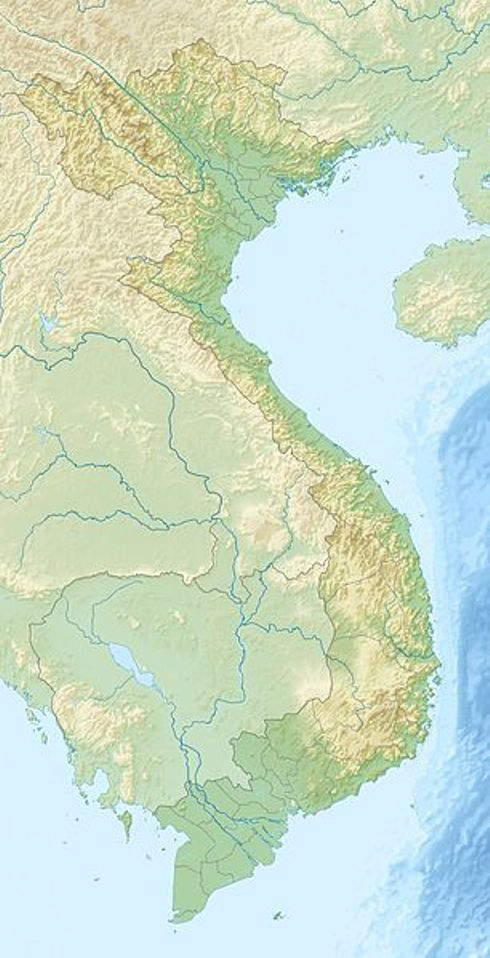
Map of Vietnam showing location of Halong Bay
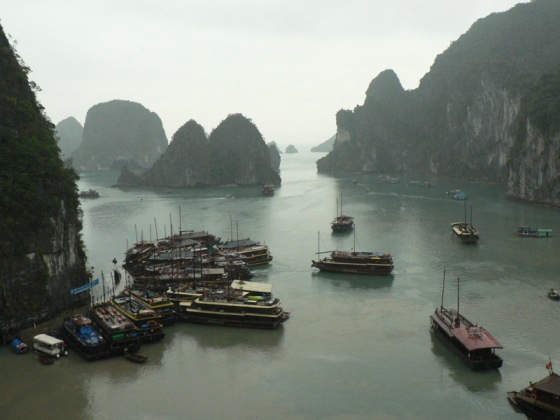
Gulf of Tonkin in the Halong Bay in Vietnam
History of the Pearl
The source of the pearl
The source of the pearl is the Melo melo sea-snail, that was once found in abundance in the Ha Long Bay known as the "Bay of Dragons," in the northeastern coast of Vietnam. Previously, the sea-snails were found even in the shallow waters of the bay, but today they are found only in deeper waters at depths of 20-30 meters, sometimes extending to depths of over 50-70 meters in the South China Sea. Some of the snail-rich areas in Vietnam today, are the area around the Bach Long Vi Islands in the Ha Long Bay, the Spartly and Paracel Islands in the South China Sea, and the Phu Quoc Island near the Cambodian border. Melo melo sea-snail are mainly found in the sandy and muddy bottoms of the algae-rich infra-littoral sub-zone and the animal-dominated circa-littoral sub-zone of the sub-littoral zone.
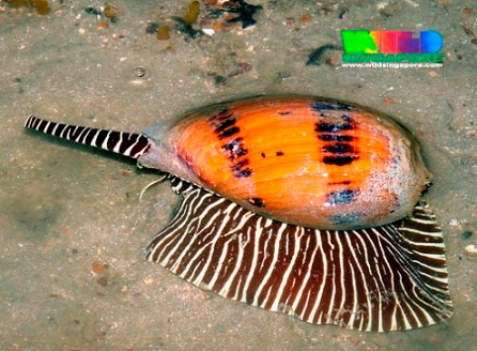
Melo melo sea snail at Beting Bronok, Singapore
© Wild singapore .COM
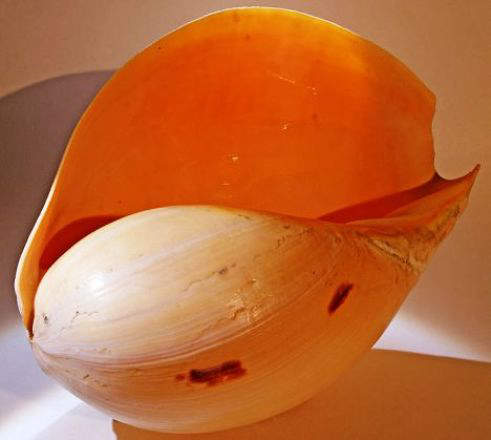
Shell of melo-melo sea snail
The historic circumstances under which the last emperor of Vietnam came to own a collection of melo-melo pearls
The melo-melo pearls and the sea-snail known as the bailer-volute had been known and appreciated by the people of Southeast Asia, since very ancient times. The large, round, intense-orange, fiery pearls of the sea-snails had captured the imagination of the people of these ancient civilizations, who were amazed by the beauty and perfection of these marvels of nature, that they associated supernatural beliefs with these pearls, which were believed to have originated from drops of water falling on the ocean, from the dragons in the heavens, that entered the snails and grew into pearls, nourished by the moonlight. Thus, the dragon and the flaming melo-melo pearl became a common motif of the decorative arts of the Chinese and Vietnamese, used in paintings, textiles and ceramics. The dragon symbolized the emperor, who was pursuing the pearl, the symbol of perfection in Buddhist thought, the goal of every emperor. The naturally beautiful melo-melo pearls, that did not require man's intervention to bring out its beauty like other gemstones, became a symbol of perfection in Buddhist thought, and one of the eight sacred emblems of the Buddha. Thus the shell of the bailer volute and the fiery pearl became objects of veneration by Buddhists. The pearls were not drilled or strung as beads due to the sanctity associated with them, and were preserved as objects of devotion. The emperors of Vietnam attached a special significance to these pearls, which became not only objects of veneration, but symbols of sovereignty. They valued the pearls so highly, that they sent their ships and sailors in search of these pearls in the Ha Long Bay and the South China Sea. These were the historic circumstances under which the last emperor of Vietnam came to own a sacred collection of melo-melo pearls, some inherited and some acquired during his period of rule, out of which, the Bao Dai/Sunrise Pearl is the largest and most perfect melo-melo pearl.
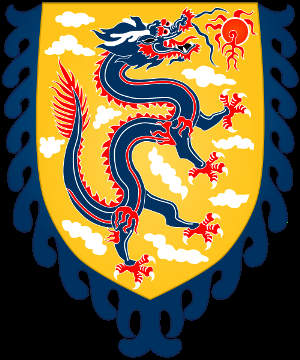
Chinese Dragon and Flaming Pearl Motif on a banner
Some aspects of history relevant to Bao Dai's rule as the last emperor of Vietnam - 1926-1945
Bao Dai was the last emperor of Vietnam of the Nguyen dynasty, who ruled from 1926 to 1945. He was actually the king of Annam, which was part of French Indochina, and received the protection of the French. Bao Dai, who was a minor at the time he succeeded his father in 1926, ascended the throne in 1932 at the age of 19 years. The French-educated, young king ruled his kingdom peacefully with the help of the French, until 1940, when Japan invaded Indochina, with the outbreak of World War II. The Japanese did not interfere with the court at Hue, the seat of government of Annam, and maintained Bao Dai as king, through whom they ruled the region. In 1945, the Japanese forced Bao Dai to declare his kingdom independent from France, and renamed his country "Vietnam." In August 1945, when Japan surrendered after the bombing of Hiroshima and Nagasaki, Ho Chi Minh persuaded Bao Dai to abdicate on August 25, 1945, and handover power to the Vietminh, led by him. Bao Dai was appointed as "supreme advisor" to the Government of the Democratic Republic of Vietnam based in Hanoi, which declared itself an independent republic on September 2, 1945. Ex-colonial power France, ironically the pioneer of the republican model of government in the world, ousted the one-year old, fledgling republican government of Ho Chi Minh in November 1946, re-colonizing the country again and de-stabilizing the entire Indochina region, setting the stage for the bloodshed and enormous human suffering that followed, that ended only three decades later after the defeat of the United States and its lackey, the South Vietnamese regime, by the Ho Chi Minh's Vietcong in 1975.
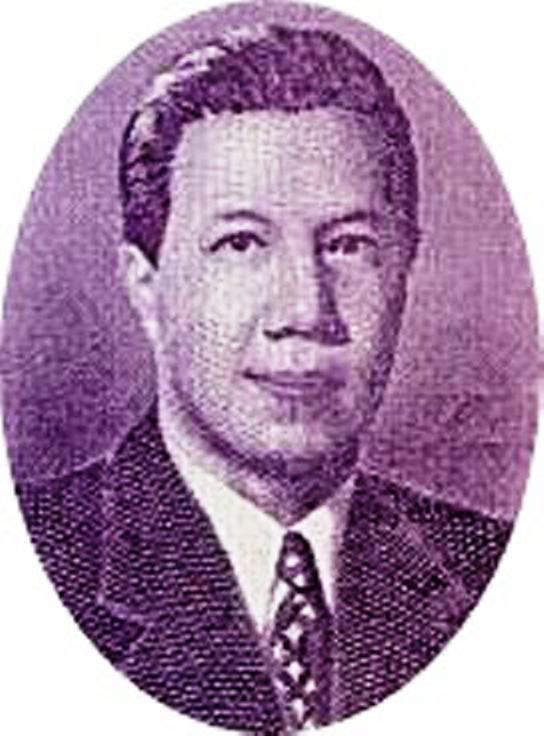
Bao Dai- Last Emperor of Vietnam
The re-installation of Bao Dai as Head-of-State by the French in 1949, and his second abdication after Ngo Din Diem installed himself as president following a fraudulent referendum
With the French re-colonization, Vietnam descended into a state of chaos and anarchy, with Ho Chi Minh's forces entering the jungles and adopting guerilla tactics against the French occupying forces. In the uncertain conditions in his country Bao Dai left Vietnam, and sought asylum in Hong Kong and later China, where he lived until 1949. The French consolidating their hold on the country, invited Bao Dai back to Vietnam, to takeover as Head-of-State, which he did in 1949. The victory of communism in China in 1949, gave fresh hopes to Ho Chi Minh in Vietnam, who too was a committed socialist. China and Russia recognized Ho Chi Minh's government in Vietnam in early 1950, which was followed immediately by the United States extending diplomatic recognition to Bao Dai's government, supported by the French. With the outbreak of the Korean war in June 1950, in which the United States was one the belligerents, trying to prevent the supposed expansion of communism, the French were considered as allies in this common effort, and granted active support including military aid, to further their war efforts in Indochina. The French however learnt a bitter lesson in 1954, with their disastrous defeat, at the Battle of Dien Bien Phu, by Ho Chi Minh's forces. The 1954 peace treaty that was signed by the French and the Viet Minh in Geneva, that came to be known as the "Geneva Accord" saw the division of Vietnam into Northern Vietnam ruled by the Viet Minh and Southern Vietnam, ruled by Bao Dai's government. Vietnam, Laos and Cambodia were granted independence, and the French disengaged themselves completely from Indochina. Feeling insecure about staying in Vietnam, Bao Dai moved to Paris, but continued to remain as Head-of-State of South Vietnam. He then took the most unwise step in his life, by appointing the Roman Catholic nationalist and anti-communist, Ngo Din Diem as prime minister, in a predominantly Buddhist country. Din Diem as prime minister called for a referendum to abolish Bao Dai's rule and establish a republic, with him as president. With an overwhelming victory at the referendum believed to be a fraudulent exercise, Din Diem became the president of South Vietnam in 1955. Bao Dai once again abdicated, and remained in exile for the rest of his life in Paris.
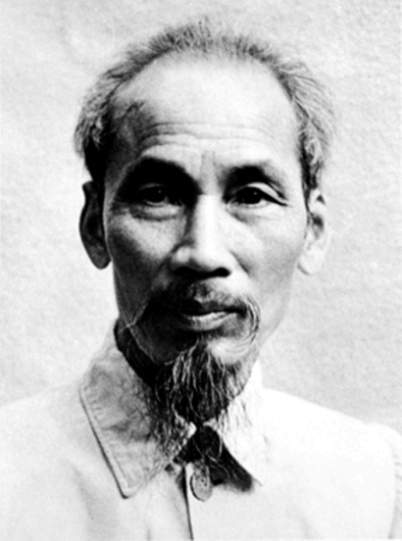
Ho Chi Minh - Marxist-Leninist Revolutionary and President of the Democratic Republic of Vietnam (1945-1969)
Bao Dai's life in exile in Paris, from where he watched with anguish the suffering of his people, who had become the unintentional victims of the international power-play of politics
While in exile in Paris, Bao Dai followed the dramatic developments in his country with anguish, that led to the long fratricidal war between the North and the South, the intervention of the United States on behalf of the unpopular and repressive military regime in the South in 1965, and the relentless bombing campaign of North Vietnam, aimed at forcing the North Vietnamese to cease its support for the National Liberation Front (NLF) of South Vietnam. The sustained aerial bombing, that literally deluged the entire area of North Vietnam, with over millions of tons of missiles, rockets and bombs, caused unprecedented human suffering to the people of the North, but achieved nothing militarily. It only prolonged the suffering of the Vietnamese people, and prevented an early resolution of the conflict. The situation prompted Bao Dai as the ex-monarch of Vietnam, to make a public appeal from exile to the Vietnamese people for national reconciliation. He said, " The time has come to put an end to the fratricidal war and to recover at last peace and accord". Following this appeal the Government of North Vietnam sent representatives to Paris, to appraise the ex-monarch of the ground situation in Vietnam, and to explore the possibility of his joining a coalition government, that might reunite Vietnam. Soon after these contacts with the communist North Vietnamese Government, Bao Dai spoke out publicly against the presence of American troops in South Vietnam, and severely criticized Nguyen Van Thieu's regime in South Vietnam.
The signing of the Paris Peace Accords on January 27, 1973, for ending the war and restoring peace in Vietnam, gave the ex-monarch a lot of mental relief, as the prospect of the prolonged suffering of his people coming to an end seemed to be real. The accord marked the end of direct U.S. involvement in the Vietnam war, the declaration of a ceasefire across North and South Vietnam, the release of US prisoners-of-war, the guaranteeing of the territorial integrity of Vietnam, setting a 60-day time period for the total withdrawal of US troops, and a call for national elections to be held in the North and South. The signing of the Paris Peace Accords, the overwhelming anti-war feelings that spread across the United States, and the cutting of funds by the Congress for the war effort in Vietnam, sealed the fate of the South Vietnamese regime, who were left alone to defend themselves. Although, initially the South Vietnamese forces went on the offensive aided by the massive shipments of arms received just before the ceasefire came into effect, eventually the better-trained and motivated Vietcong forces prevailed. The human cost of the meaningless military conflict in Indochina that brought enormous suffering to the people of the region, who were unintentional victims of the international power-play of politics, were two million civilian deaths, out of which an estimated 52,000 to 182,000 were caused by indiscriminate American bombing; 1.1 million North Vietnamese soldiers dead and 600,000 wounded; 200,000 to 250,000 South Vietnamese soldiers dead; 58,236 American soldiers dead, 153,452 wounded, and 1,740 missing-in-action.
His role as Head of the Nguyen Dynasty after the war, and his death in 1997 at the age of 84 years
After the war ended Bao Dai and the other members of the former imperial family of Vietnam continued to live in Paris. The ex-monarch was still respected by his people, and particularly by Vietnamese of the Diaspora, who considered him as a father-figure, and spiritual head of their community. In 1982, Bao Dai, his wife Vinh Thuy and the other members of the former imperial family of Vietnam, visited the United States. They were invited by the Vietnamese American community living in California and Texas, and during his visit he attended several Buddhist and Caodaiist religious ceremonies blessing the assembled congregation. Emperor Bao Dai died in a military hospital in Paris, in 1997 at the age of 84 years, and was interred in the Cimetière de Passy. He was succeeded by his eldest son Crown Prince Bao Long, as the head of the Nguyen Dynasty.
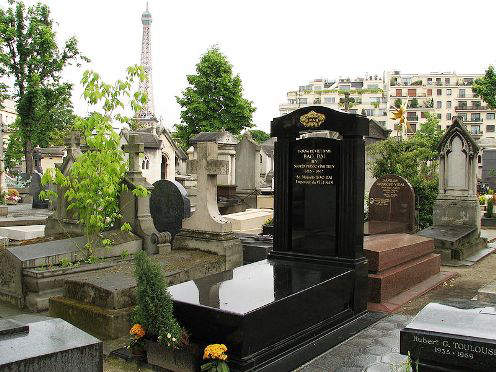
The Grave Yard of Bao Dai in Paris, France
How Bao Dai's collection of melo-melo pearls came into the limelight ?
A collection of 23 deep-orange melo-melo pearls appear in New York in 1993
Melo-Melo pearls well-known and appreciated in Southeast Asia since ancient times, was unknown in the West until recently. In fact the most authoritative compendium on pearls written by George Frederick Kunz and published in 1909, has no reference at all to these rare natural beauties of Southeast Asia, originating from a large gastropod sea-snail known as the Melo melo sea-snail. These natural pearls of the orient, of extraordinary size, much-desired spherical shape, and a glowing and shimmering orange color, was thrust into the spotlight in the west in 1993, when a collection of 23 deep-orange melo-melo pearls suddenly made their appearance, at a jewelers shop in New York, owned by the gem-dealer and writer Benjamin Zucker. The pearls were brought in by a Swiss dealer for assessment and evaluation by Zucker, and were left with him for further intensive studies. Zucker got in touch with gemologist Kenneth Scarratt of GIA, an authority on pearls and author of the book "Pearl and the Dragon" who identified the unknown pearls immediately as melo-melo pearls of Vietnamese origin.
Benjamin Zucker's exploratory trip to Vietnam and subsequent publication of an article on melo-melo pearls in the July 1997 issue of the Smithsonian Magazine. The photographs of melo-melo pearls that accompanied this publication are believed to be from Bao Dai's collection
His interest kindled, Zucker put together a small team of gemologists, scholars and writers, to visit Vietnam on an exploratory trip, to document all available facts about these pearls, such as identifying the mollusk in which it is produced, the habitat and distribution of the mollusk in the Vietnamese waters, the history of usage and appreciation of these pearls in Vietnam and identifying and interviewing dealers, who deal with these rare pearls in Vietnam. The historic visit of Zucker's team to Vietnam, became the inspiration for an article on melo-melo pearls, published in the July 1997 issue of the reputed Smithsonian Magazine, that provided the crucial publicity required for the popularization of these pearls. The photographs of melo-melo pearls that accompanied this publication, was widely believed to be from the Bao Dai's collection of melo-melo pearls. It is then not far-fetched to assume that these photographs actually represented melo-melo pearls from the collection of 23 deep-orange melo-melo pearls brought in by the Swiss dealer, which necessarily means, what the Swiss dealer brought for Zucker's assessment and evaluation was none other than the Bao Dai's collection of pearls. It is also possible that some of the photographs that appeared in this publication, were taken during Zucker's exploratory visit to Vietnam.
The fact that the collection of melo-melo pearls were entrusted to a Swiss dealer for sale, adds credence to this story, as Switzerland is not far away from Paris, where Emperor Bao Dai lived in exile. Moreover, the fact that the collection first made its appearance in 1993, four years before the death of the ex-monarch, raises the possibility that the exploratory contacts made for the evaluation and possible sale of the pearls, were done perhaps to overcome some financial constraints. Whatever may be the provenance of these 23 melo-melo pearls, the fate of this collection after it made its appearance in Zucker's office in New York, is not known exactly.
A melo-melo pearl sets a record price of USD 488,311 at a Christie's auction in Hong Kong in November 1999
In November 1999, two years after the publication of the Smithsonian article, melo-melo pearls were once again brought into the limelight, when a near-spherical fiery-orange melo-melo pearl, with long and short diameters of 23.0 and 19.35 mm respectively, fetched an unprecedented record price for a single pearl, USD 488,311, 16 times more than the upper pre-sale estimate of USD 30,000, at a Christie's auction held in Hong Kong. This unexpectedly strong showing of the pearl at the auction was attributed to Zucker's work on the pearl and the subsequent Smithsonian article published in 1997, where photographs of the Bao Dai's collection appeared. Soon after this record-breaking auction in 1999, melo-melo pearls appeared from nowhere in the pearl markets, apparently belonging to collectors trying to cash-in on this unexpected popularity, and prices of pearls dropped to the tens of thousands of dollars, in keeping with the increase in supply.
How the present anonymous owner of the Bao Dai/Sunrise Pearl, the largest pearl in the Bao Dai's Collection, acquire the pearl between 1993 and 1996 ?
The 397.52-carat Bao Dai/Sunrise Pearl with dimensions of 37.97 x 37.58 mm is believed to be the largest melo-melo pearl in Bao Dai's collection. This obviously means that the present anonymous owner of the pearl, purchased it either from the Swiss dealer or another dealer authorized by the ex-monarch or his heirs to dispose of the pearl. However, according to Mr. Ray Chen, the Melo Pearl Agent based in Taichung, Taiwan, who has been assigned the task of selling the World's No.1, natural melo pearl, by its anonymous owner, the pearl was purchased by its current owner over 10 years ago, from a Vietnamese, who looked like some disappointed noble. He does not specify, however, where the transaction took place, whether it was in Vietnam, Paris or Switzerland! The year of transaction can be estimated from the known facts. The year the Bao Dai's Collection first appeared in New York was in 1993, and the date appearing on the AIGS certificate issued in respect of the pearl, signed by Dr. Kenneth Scarrett, is December 26, 1996. Assuming that the certificate was issued just prior to the transaction, in which the present owner acquired the pearl, the transaction obviously would have taken place either in 1996 or 1997. If however, the certificate was issued on the request of the current owner of the pearl in anticipation of disposing the pearl, after he had purchased it earlier without a certificate, the transaction would have taken place somewhere between 1993 and 1996.
Is the Bao Dai/Sunrise melo-melo pearl one of two almost similar melo-melo pearls that arose in the same Melo melo sea-snail ?
According to Mr. Ray Chen, the Vietnamese seller of the pearl had told the current owner at the time of purchase, that the Bao Dai/Sunrise Pearl was one of almost similar twin pearls, that originated from the same Melo melo sea-snail. While one of the twins had a diameter of approximately 38 mm, the other twin pearl had a diameter of 32.0 mm. Thus according to this story, the World's first and second largest melo-melo pearls having diameters of approximately 38 and 32 mm respectively, originated in one and the same Melo melo sea-snail. This information was provided in the Smithsonian Magazine article. Christie's auction house had attempted to sell the second largest Melo melo pearl at one of their auctions in Hong Kong, around the year 2000. The results of that auction are not known, but the second largest and roundest melo-melo pearl appeared at a Jewelry Show held in Thailand in September 2006. The occurrence of more than one pearl in the same gastropod mollusk is quite possible, given the enormous size of the melo-melo sea-snail, and the well-documented instances of multiple pearls occurring in the same bivalve mollusks such as oysters like Pinctada radiata, that produce seed pearls.
The rarity of Bao Dai/Sunrise melo-melo pearl
Evidences for the rarity of melo-melo pearls
Melo-Melo pearls are among the rarest natural pearls in the world, but their exact frequency of occurrence is not known, save for the vague reports of fisherman that their occurrence is one in several thousand sea-snails. Thus evidence for their rarity come only from the experiences of sea-snail fisherman, workers involved in cleaning and cooking sea-snails, dealers in melo-melo pearls, and historical evidences. An interesting evidence of their rarity was reported in Vietnam by a cook who had processed and cooked sea-snails for almost 50 years, but never found a melo-melo pearl. Please go to our page Melo Melo Pearls for the full story. Another evidence came from a Vietnamese navy diver who during his lifetime had seen thousands of sea-snails, but only one melo-melo pearl. Among the historical evidences of their rarity is the lack of reference to these pearls in the most comprehensive compendium of pearls, written at the turn of the twentieth century, the "Book of the Pearl" by G. F. Kunz, in which pearls produced in different parts of the world, such as the traditional hub of the pearl industry, the Persian Gulf, the Red Sea, and the Gulf of Mannar; the pearl industry of the New World, such as Venezuela, Panama and Colombia; the South Sea pearls of Australia etc. are extensively treated. Had melo-melo pearls been quite common and reached the pearl markets of the world, like other pearls, they would not have undoubtedly missed the attention of G. F. Kunz, the world authority on pearls at that time. However, the practical evidence of their reality comes mainly from the dealers themselves, who are well aware of their rarity and scarcity in the pearl markets. In ancient times due to the religious significance attached to these pearls, and their association with the monarchy, the few pearls that were discovered either by the king's subjects or his agents were surrendered to the king, and entered his sacred collection. The 23 pearls in Bao Dai's Collection are believed to have been built up in this manner.
Causes for the recent increase in the number of melo-melo pearls in the pearl markets
Thus, it is an accepted fact that melo-melo pearls are indeed very rare. However, recent increase in the number of melo-melo pearls in the pearl markets, are attributed to two factors. 1) Pearls from private collections entering the markets, to take advantage of the surge in popularity of the pearls, particularly after the record-breaking price of USD 488,311 fetched by a fiery-orange melo-melo pearl at a Christie's auction in Hong Kong in 1997. 2) An increase in production of melo-melo pearls in Vietnam and Burma, after extensive trawler fishing of Melo melo sea-snails in deep waters beginning in the 1990's.
The Bao Dai/Sunrise Pearl known as the "Mysterious Pearl" can also be characterized as the "Rarest of the Rare Pearls." It is also the "roundest of the world's biggest pearls," and the "largest of the world's round or spherical pearls."
Given the rarity of these pearls it is believed that only several hundreds of these pearls exist today including the pearls discovered in ancient times. According to a CNN iReport given by Ray Chen, the agent for selling the Bao Dai/Sunrise Pearl, there may be only around 200 to 300 pieces of gem-quality melo-melo pearls in the world. This estimate may not be far from the truth given the extreme rarity of these pearls. Among these extremely rare pearls, the Bao Dai/Sunrise Pearl occupies a unique position, and may be characterized as a "rarest of the rare pearls." The intense-orange color, the perfectly spherical shape, the large diameter and weight of the pearl, has made the Bao Dai/Sunrise Pearl the "largest, roundest and most perfect natural melo-melo pearl in the world." It is also the "roundest of the world's biggest pearls," and the "largest of the world's round or spherical pearls." Taking into consideration the rare distinctions the Bao Dai/Sunrise Pearl has earned, we can truly say that the pearl is indeed extremely rare. This was undoubtedly the reason that led the National Museum of Natural History to call this pearl the "mysterious pearl."
What causes the formation of larger and spherical pearls ?
As much as the larger size of melo-melo pearls, near-spherical and spherical shapes are also quite common among these pearls. The larger size and spherical shape are clearly associated with the enormous size of the Melo melo sea-snails. The unusually large size of the sea-snail enables the growth of larger pearls inside the viscera of the snail. The soft tissues in the visceral mass enable equal expansion of the pearl on all sides during its growth, resulting in a large spherical pearl. It is not known exactly what tissues in the visceral mass are involved in pearl formation. If it was the outer mantle tissues as in other pearl forming mollusks, the external shell is too close to this tissue, that it might interfere with the expansion of the pearl. Thus some smaller pearls may yet originate from the mantle tissues. However, larger spherical pearls may have a deeper origin within the visceral mass of the snail, possibly the large gonads, where it can grow and expand freely on all sides.
How long does it take for the development of a pearl like the Bao Dai/Sunrise Pearl ?
Time taken for pearls to develop is associated with the lifespan. Largest life span in mollusks are found in the Bivalvia.
As for the time taken for the large melo-melo pearls to develop, it is closely associated with the lifespan of the sea-snail. Under the Phylum Mollusca, the three main classes are the Bivalvia, Gastropoda and Cephalopoda. Among these three classes, the greatest lifespan has been reported from the Bivalvia. The Bivalvia include species such as oysters, mussels, clams, quahogs, scallops etc. One of the longest lifespan in animals has been reported from an ocean quahog known as the Icelandic Cyprine (Arctica islandica) which was found by scientists to have lived for a period of 405 to 410 years. Another specimen of Arctica islandica had previously been found to have lived up to 374 years. The third highest recorded lifespan for mollusks comes from a species of saltwater clam native to the Puget Sound in northwestern Washington, known as Geoduck, known to have lived for over 160 years. Several freshwater mussels of the family Unionoidae are known to survive for over a hundred years.
The lifespan of Cephalopod mollusks
The Cephalopoda include squids, giant squids, cuttlefish, octopus and giant octopus. Smaller squids have a lifespan of not more than one year. Cuttlefish can have a lifespan of 18 months. Small octopus species have a short life expectancy, some species as little as six months. Among smaller squids and octopuses reproduction is a cause of death. Males live only for a few months after mating. Females die shortly after their eggs hatch. The life expectancy of most of the large oceanic squids and octopuses are not known, but the Giant Squid Architeuthis are known to attain their bulk after a period of 4 to 5 years. The Pacific Giant Octopus has a life expectancy of up to 5 years.
The life span of Gastropod mollusks
The three main sub-classes of Gastropoda are Prosobranchia, Opisthobranchia and Pulmonata. A majority of gastropods are Prosobranchs and includes periwinkles, limpets, conchs, volutes, abalones, whelks, cones, murexes and cowries. The Pulmonata include the lung-breathing garden snails and slugs. The Opisthobranchs are marine gastropods in which the shell is reduced or absent and the bodies are very colorful. In Opisthobranchs and many Pulmonates, the lifespan in only about an year, but there are some notable exceptions. The apple snail, an aquatic variety that does not generally live for more than a year, has been found to live as long as 12 years in captivity. The Achatinidae snail can live as long as 7 years. Among the family Helicidae, the average lifespan of different species of Helix, in the wild is about 2 to 3 years. Some Helicidae, such as Helix pomatia (Roman snail, Escargot, Burgundy snail or edible snail), have been found to survive up to 30 years or more.
The Prosobranchs, to which the bailer volute or Melo melo sea-snail belong, have a much longer life-span. Some freshwater Prosobranchs like Vivipara sp. have lived up to 20 years in captivity. Some Sonoran desert snails from California may have a lifespan of 20 to 50 years. The limpet, Patella vulgate can live 5 to 16 years. The periwinkle, Littorina littorea can live up to 4 to 10 years. Among the whelks, researches in Japan have determined that five whelk species from the Buccinidae family have lifespans varying from 9 to 16 years. The queen conch (Strombus gigas) belonging to the family Strombidae, attain their maximum growth when they are about 3 to 5 years old and can grow to a maximum length of about 30 cm (12 inches), attaining a weight of about 2.3 kg (5 lbs). If left undisturbed in their natural habitat, queen conches can have a lifespan of about 20 to 30 years. Haliotis corrugata (pink abalone), belonging to the family Haliotidae, reach maturity at the age of 3 to 4 years, when the diameter of the shell is only 3.5 cm, but continue to feed on kelps and grow to a maximum size of 25 cm, having a lifespan of about 30 years.
What is the lifespan of a Melo-melo sea-snail ?
Unfortunately, in the case of the bailer volute - Melo melo sea-snail - nothing much is known about its lifespan. The snail is known to be carnivorous feeding on other predatory gastropods, reaching an average length of 15 to 27.5 cm with a maximum reported size of 36.2 cm. The large size of Melo melo sea-snails can be due to faster growth or longer lifespan or both. In comparison to the Strombidae and Haliotidae in which the sea-snails can have a life span of about 30 years, the maximum lifespan of Melo melo sea-snails may be several decades, but cannot be over a hundred years as speculated in some websites. Only thick-shelled freshwater mussels among Mollusks can have a lifespan of over hundred years. Such long lifespans have never been reported for gastropod mollusks. The maximum lifespan reported for gastropod snails is around 50 years for Sonoran desert snails. A lifespan of around 50 years (five decades) for a Melo melo sea-snail may be a reasonable estimate, not far from the actual lifespan, yet to be revealed by scientific research.
A melo-melo pearl like the Bao Dai/Sunrise Pearl may take several decades for its development
An observation that has been made in melo-melo pearls, is that the largest pearls are always found in the largest sea-snails. This is obvious, because the largest sea-snails are fully grown, and any pearls that developed inside are also fully developed and have the largest size. In keeping with a lifespan of around 50 years for the Melo melo sea-snail, some of the larger pearls discovered from these snails, including the Bao Dai/Sunrise Pearl may have been around 40-45 years old at the time they were discovered, assuming that the lodging of irritant that started pearl formation took place after the sea-snail had attained maturity around 5 years of age.
Failure to culture melo-melo pearls have significantly raised their profile as one of the true natural pearls in the world today
After melo-melo pearls received attractive prices in the international pearl markets several Southeast Asian countries invested heavily on research to culture these rare beauties of nature in Melo melo sea-snails. Such research activities had met with only limited success. Chulalongkorn University in Bangkok, Thailand, had been a pioneer in this field.
Conch pearls have been successfully cultured inside Strombus gigas (Queen conch) in 2009, by a team of research scientists from the Florida Atlantic University's Harbor Branch Oceanographic Institute, after several attempts before by other scientists, that lasted almost 25 years. It is believed that it is only a matter of time, before melo pearls too are successfully cultured by scientists, by applying the same techniques developed for conch pearls or a modification of this technique.
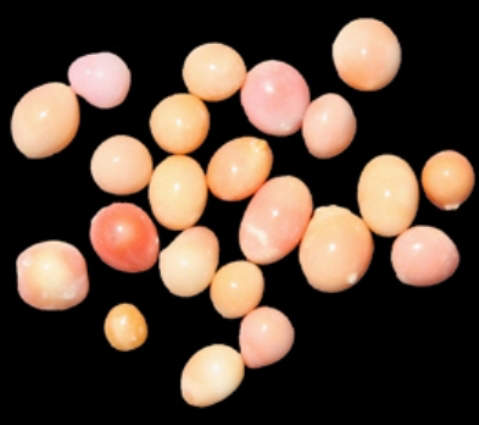
Some cultured conch pearls produced by scientists from Florida Atlantic University's Harbor Branch Oceanographic Institute
Mr Ray Chen's attempts to sell the Bao Dai/Sunrise Pearl
Attempts made by Mr. Ray Chen of Taiwan, the representative assigned by the anonymous owner of the Bao Dai/Sunrise Pearl, to sell it on his behalf, has not yet been successful. According to Mr. Chen, the former Yugoslavian Prince, Dmitri Karageorge, had offered USD 5 million for the pearl, at the Taiwan Sotheby's about 5 years ago, suggesting that he should not sell it by public auction. After the prince got back to USA from Taiwan, he offered about USD 7 million for the pearl, and yet the owner of the pearl did not accept the offer. Mr. Ray Chen and the owner of the pearl, are yet waiting for better offers than this.
You are welcome to discuss this post/related topics with Dr Shihaan and other experts from around the world in our FORUMS (forums.internetstones.com)
Related :-
2) Queen Mary Conch Pearl Brooch
3) Susan Hendrickson Conch Pearls
External Links :-
Largest, Roundest, Most Perfect Melo Pearl in the World- Kari Pearls
References :-
1) Largest, Roundest, Most Perfect Melo Pearl in the World - www.karipearls.com
2) Bao Dai - From Wikipedia, the free encyclopedia.
3) Vietnam War - From Wikipedia, the free encyclopedia.
4) The Worldly No.1 Perfect Natural Pearl Found - CNN iReport
5) Facebook - Ray Chen
6) List of Long-Living Organisms - From Wikipedia, the free encyclopedia.
7) Gastropoda - www.manandmollusc.net
8) Helix (Gastropod) - From Wikipedia, the free encyclopedia.
 Home
Security & Guarantee
How it Works
Technology Partners
Updated Tables
Famous Diamonds
More Famous Diamonds
Famous Pearls
Famous Gemstones
Contact Dr Shihaan Larif
Contact Senior Editor
Famous Jewelry
Reference Database
Forums
Learning Center
Gemstone Gallery
e-mail Notifications
Advertise
Press Release
About Us
Privacy Policy
Contact Us
FAQ'S
Site Map
Staff Mail Login
Staff Documents
Birthstones
History
Minerals
Shows
Live Metal Prices
Jewellery Gallery
News
Marketplace
Marketplace Support
Open Store
Online Auctions
Join Us & Contribute
Directory
Classifieds
List your products
Wholesale Trading
Post Buy Request
Go Green Policy
Site Updates
Upcoming-ToDo List
Latest News
Latest Articles
Latest Blog Updates
Chat Rooms
Job Board
User Gallery
Videos
New Newsletter Archive
Old Newsletter Archive
Jewelry & Mineral Blog
User Blogs & Social Network
Search
Answers (Q & A)
Valuation
Help me find a diamond/jewelry
pin.internetstones.com- Social Pinboard- Sart yours & connect with millions
Invite Friends From Yahoo, Gmail etc-One Click
Home
Security & Guarantee
How it Works
Technology Partners
Updated Tables
Famous Diamonds
More Famous Diamonds
Famous Pearls
Famous Gemstones
Contact Dr Shihaan Larif
Contact Senior Editor
Famous Jewelry
Reference Database
Forums
Learning Center
Gemstone Gallery
e-mail Notifications
Advertise
Press Release
About Us
Privacy Policy
Contact Us
FAQ'S
Site Map
Staff Mail Login
Staff Documents
Birthstones
History
Minerals
Shows
Live Metal Prices
Jewellery Gallery
News
Marketplace
Marketplace Support
Open Store
Online Auctions
Join Us & Contribute
Directory
Classifieds
List your products
Wholesale Trading
Post Buy Request
Go Green Policy
Site Updates
Upcoming-ToDo List
Latest News
Latest Articles
Latest Blog Updates
Chat Rooms
Job Board
User Gallery
Videos
New Newsletter Archive
Old Newsletter Archive
Jewelry & Mineral Blog
User Blogs & Social Network
Search
Answers (Q & A)
Valuation
Help me find a diamond/jewelry
pin.internetstones.com- Social Pinboard- Sart yours & connect with millions
Invite Friends From Yahoo, Gmail etc-One Click




Our Global Jewelry Industry Job Network


Buy & Sell in our Marketplace

Subscribe to our Newsletter

List in our Classifieds

List in our Directory

User Uploaded Gallery

Powered by Ultra Secure
Amazon (USA) Cloud Network

Founder Internet Stones.COM
Register in our Forums

| Featured In
|
|
|
|
|
|
|
|







Blog & Education Feed
Articles Feed
 |
 |
 |

Copyright © .Internet Stones.COM. All rights reserved.