Baroda Pearl Necklace
Open FREE Unlimited Store Join Our Newsletter
Lareef A. Samad B.Sc.(Hons)
Origin of Name
The seven-stranded Baroda Pearl Necklace, one of the most extravagant pearl necklaces ever created, was the most expensive piece of jewelry in the fabulous collection of jewels and jewelry that once belonged to Maharajah Khande Rao Gaekwad of Baroda, the 9th in the line of succession of 13 Gaekwad Maharajahs who ruled the Maratha Kingdom of Baroda, situated in the mid-west of the Indian sub-continent, 250 miles (400 km) from Mumbai. The Maharajah Khande Rao Gaekwad has gone down in history as the greatest collector of jewels and jewelry in the 19th century, and some of the extraordinary pieces ascribed to his period of rule include, the famous seed pearl and jewel-encrusted carpet known as the "Pearl Carpet of Baroda," an ornamental belt of one hundred rows of pearls, a triple-tiered diamond necklace incorporating the 129-carat "Star of the South" diamond and the 78.53-carat "English Dresden diamond, as its centerpiece, known as the "Baroda Diamond Necklace," and the seven-stranded diamond and emerald necklace known as the "Hindu Necklace." The seven-stranded pearl necklace also created during this period became internationally famous when a photograph of the 12th Gaekwad Maharajah Sayaji Rao III, the most enlightened of all the Gaekwad Maharajahs, wearing the pearl necklace appeared in the "Book of the Pearl" published in 1908 by George Frederick Kunz, and came to be known as the "Baroda Pearl Necklace." Again during the period of the 13th and the last Gaekwad Maharajah, at the time India became an Independent republic, Maharajah Pratapsingh Rao Gaekwad, who ruled between 1939 and 1951, the necklace again gained international attention, when the Maharajah was photographed by Henri Cartier Bresson wearing the renowned necklace.
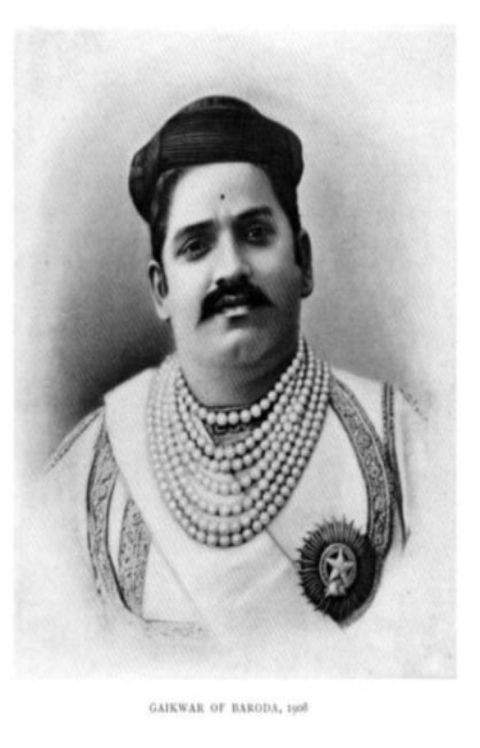
Sayaji Rao III , 12th Gaekwad of Baroda, wearing the seven-strand Baroda Pearl Neklace

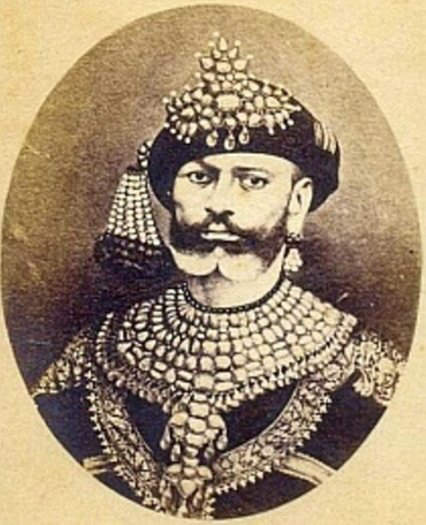
Maharajah Gaekwad Khande Rao (1856-1870), during whose reign the original Baroda Pearl Necklace was commissioned
Characteristics of the Baroda Pearl Necklace
The original seven-strand Baroda Pearl Necklace
The original Baroda Pearl Necklace that was commissioned by Maharajah Khande Rao Gaekwad during the early years of his 14-year rule, between 1856 and 1870, was made up of seven strands of matching pearls in terms of size, shape, color, luster and surface quality. The shape of the pearls were spherical or near-spherical and the color was white. The pearls were apparently blemish-free, or contained minor blemishes not visible to the naked eye. The luster of the pearls were extraordinary in keeping with the good quality nacre that was thick and translucent. Little wonder that the luster of these pearls had remained undiminished during the last 150 years.
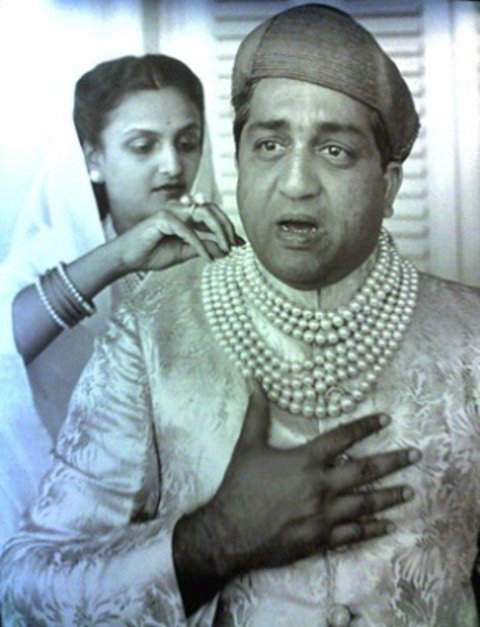
Maharajah Pratapsingh Rao Gaekwad wearing the Baroda pearl necklace. Maharani Sita Devi is in the background making adjustments to her husband's necklace.
An approximate computation of the total number of pearls in the necklace
An approximation of the number of pearls in each of the strands of the necklace can be made by counting the number of pearls in the visible section of each strand in the photographs of Sayaji Rao III Gaekwad and Pratapsingh Rao Gaekwad. Adding 15 pearls to the lowest three strands and 10 pearls to the remaining four upper strands, representing the approximate number of pearls on the rear side of the neck, we arrive at the approximate number of pearls in each strand, numbered from the lowest to the upper most strand.
Strand No 1 (lowest strand) - approximately 50 pearls + 15 pearls=65 pearls
Strand No 2 -approximately 45 pearls + 15 pearls=60 pearls
Strand No 3 -approximately 35 pearls + 15 pearls=50 pearls
Strand No 4 -approximately 30 pearls + 10 pearls=40 pearls
Strand No 5 -approximately 30 oearls + 10 pearls=40 pearls
Strand No 6 -approximately 30 pearls + 10 pearls=40 pearls
Strand No7(upper most strand)-approximately 25 pearls+10 pearls=35 pearls
Total number of pearls (approximate) in the necklace =330 pearls
Thus the approximate range of the total number of pearls in the original Baroda Necklace = 300 to 350 pearls.
The seven-stranded pearl necklace is reduced to six strands
Most of the Baroda Crown Jewels were carried to the Monaco residence of Maharajah Pratapsingh Rao before India gained independence from the British in 1947. When the Government of India, issued an ultimatum to the Maharajah to return the crown jewels to the Baroda treasury or be removed from his position and consequently loose all princely privileges given by the government, the Maharajah did indeed return some of the more expensive pieces in the collection such as the Baroda three-tiered diamond necklace, containing the "Star of the South" diamond and the "English Dresden" diamond, and the Baroda Pearl Necklace. However, the Baroda Pearl Necklace was now reduced to six strands, from its original seven. It is not known whether it was the shortest or longest strand of the necklace that was missing.
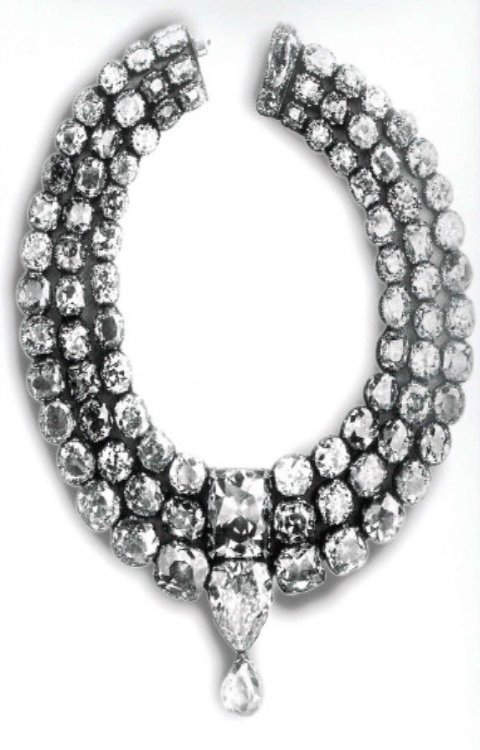
Maharajah Khande Rao Gaekwad's three-tiered diamond necklace, incorporating the cushion-cut "Star of the South" diamond and the pear-shaped "English Dresden" diamond below it, as the centerpiece of the necklace.
Part of the missing Baroda Pearl Necklace appears at a Christie's auction in New York in April 2007
The renowned Baroda Pearl Necklace thus became part of the crown jewels of Baroda again and was kept in the Lakshmi Vilas Palace, the official residence of the royal family of Baroda. The fate of the Baroda Pearl Necklace since then is not known, but a two-stranded pearl necklace reconstituted from selected pearls of the original Baroda Pearl Necklace, suddenly made it appearance at a Christie's auction in New York in April 2007, and set a world record price of $7.1 million, the highest ever realized by a pearl necklace at an auction.
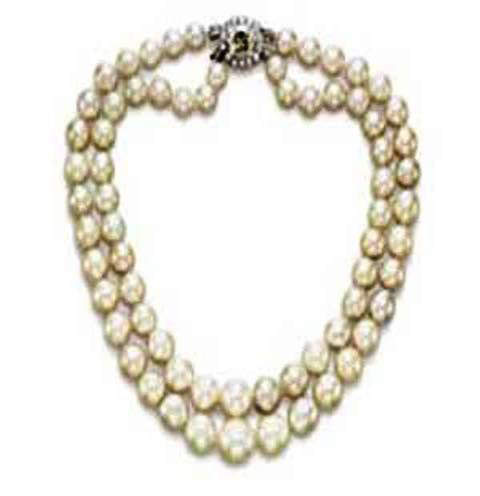
The reconstituted two strand Baroda pearl necklace
The reconstituted two-stranded Baroda Pearl Necklace
The original seven-stranded pearl necklace was made up of approximately 300 to 350 matching pearls of extraordinary quality, in terms of size, shape, color, luster and surface quality. The anonymous owner of the original Baroda Pearl Necklace got his jewelry designers, most probably Cartier's to select 68 of the finest and largest pearls from the original necklace, and reconstitute them as a two-stranded or two-tiered pearl necklace. The pearls were selected from the 4th, 5th, 6th and 7th strands (It is not certain whether this numbering is from bottom to top as above or vice versa) of the original pearl necklace, and their sizes varied from 9.47 mm to 16.04 mm. The two-tiered pearl necklace consists of 33 pearls in the inner row and 35 pearls in the outer row, and the two rows are joined by a cushion-cut diamond Cartier clasp. The pearls are all perfectly spherical, and each of the two rows as seen in the photograph, has the largest pearl placed at its lowest point along the median line, and pearls of matching size placed at symmetrical positions from the median line. The pearls progressively decrease in size as we move from the front towards the rear of the necklace, with the clasp. Thus the reconstituted two-stranded Baroda Pearl Necklace is made up of the most perfect of perfect spherical pearls from the original Baroda Pearl necklace, and is also matched perfectly for size and shape, making it one of the most perfectly designed pearl necklaces in the world. It is a combination of perfect quality, designing and historical provenance that has made the reconstituted Baroda Pearl Necklace, one of the most expensive pearl necklaces in the world today. See table below.
Table of some famous natural pearls/pearl jewelry sold at public auctions conducted by international auction houses, giving the date of auction and the prices realized, during the period 1970 to 2011
| S/N | Name of pearl/pearl jewelry | Probable period of origin | weight |
date of auction | Price realized |
| 1 | La Peregrina | 1513 | 203.84 grains | 1969 Dec 2011 |
USD 37,000 USD 11,000,000 |
| 2 | Mancini pearls | 1500-1600 | 400 grains | Oct.1979 | USD 253,000 |
| 3 | Mona Bismarck 2-strand pearl necklace | 1920-1930 | Double-strand of 70 pearls | May 1986 | USD 410,000 |
| 4 | Duchess of Windsor pearl necklace | 1910-1936 | Single-strand of 28 natural pearls. Total weight 1266.33 grains | April 1987
Dec 2007 |
USD 733,333
3,625,000 |
| 5 | Empress Eugenie tiara | 1853 | 212 pearls, 2,520 grains | Nov 1992 | USD 650,000 |
| 6 | Nina Dyer black pearl necklace | 1950s | 151 natural black pearls | Nov 1997 | USD 913,320 |
| 7 | Barbara Hutton pearls | 1600-1666 | 44 natural pearls, total weight of 1,816.68 grains | May 1992
Nov 1999 |
USD 580,000
USD 1,470,000 |
| 8 | Unidentified natural pearl necklace by Cartier | Historical provenance not revealed | Double-strand necklace with 88 natural pearls | Nov 2004 | USD 3,100,000 |
| 9 | La Regente | 1811 | 302.68 grains | Nov 2005 | USD 2,483,968 |
| 10 | Gulf pearl parure designed by Harry Winston | 1932-1978 | Nov 2006 | USD 4,100,000 | |
| 11 | Baroda pearl necklace | 1856-1870 | Double-strand with 68 natural pearls from the original 7-strand necklace | April 2007 | USD 7,096,000 |
| 12 | Umm Kulthum pearl necklace | 1880 | nine-stranded necklace with 1,888 pearls | April 2008 | USD 1,390,000 |
| 13 | Pearl necklace from an unidentified notable collection | Historical provenance not revealed | Single-strand necklace with 41 natural pearls | Nov 2008 | USD 1,321,110 |
| 14 | Unidentified pearl and diamond festoon necklace | Historical provenance not revealed | Nine-strand pearl and diamond festoon necklace. Length 645mm to 1060mm | Nov 2008 | USD 946,610 |
| 15 | Pearl Carpet of Baroda | 1860 | 1.5-2.0 million natural seed pearls | March 2009 | USD 5,500,000 |
© internetstones.com
Please do not copy our tables without our permission. We may be compelled to inform the search engines if our content and tables are plagiarised.
History
The source of the pearls in the Baroda Pearl Necklace
The Persian Gulf, the Red Sea and the Gulf of Mannar
Given the fact that the necklace originated in the mid-19th century, the most possible sources of the Baroda Pearls are the Persian Gulf, the Red Sea and the Gulf of Mannar, the hub of the international pearl trade since ancient times, save for a short period in the 16th and 17th centuries when the emphasis shifted to the lands of the New World colonized by the Spanish Conquistadors, such as Venezuela, Colombia, Panama and Mexico. Due to intensive exploitation by the Spanish the pearl oyster beds of Venezuela and Panama were totally exhausted in the mid-17th century barely a century and a half after they were first discovered by Christopher Columbus in 1498 in Venezuela. From the mid-17th century onwards, the Persian Gulf, the Red Sea and the Gulf of Mannar once again regained their prominence as the center of the international pearl industry.
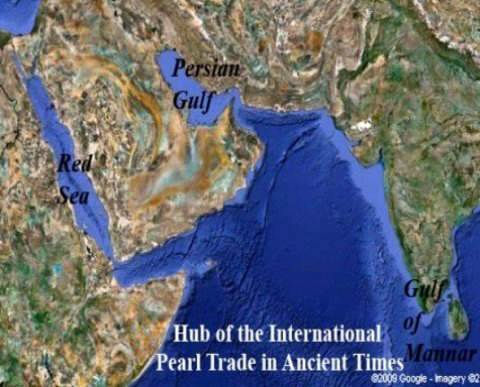
The Persian Gulf, the Red Sea and the Gulf of Mannar - Hub of the international pearl trade in ancient times
Sustainable exploitation of pearl oyster resources in the Persian Gulf
In this part of the world the Spanish colonialists did not make much headway, but yet the region came under the sway of the Portuguese, Dutch and the British colonialists. However, the Portuguese, Dutch and British did not have a free hand in exploiting the pearl resources of this region, as the Spanish had in the New World. All aspects of the pearl industry, such as diving, processing and marketing were in the hand of indigenous people of the region, who had been practicing sustainable exploitation of the resources, for thousands of years, without any threat of decimation of the pearl oyster beds in the region. The colonialists exerted an indirect control over the trade, by imposing taxes, collecting license fees or taking a share of the harvest. Thus the Persian Gulf pearl industry survived up to the early 20th century, without any significant decline in production, until Mikimoto's cultured pearls that entered the international pearl markets in the 1920s-1930s, caused the unfortunate death of this ancient industry, bringing untold misery and hardship to thousands of people engaged in this traditional industry.
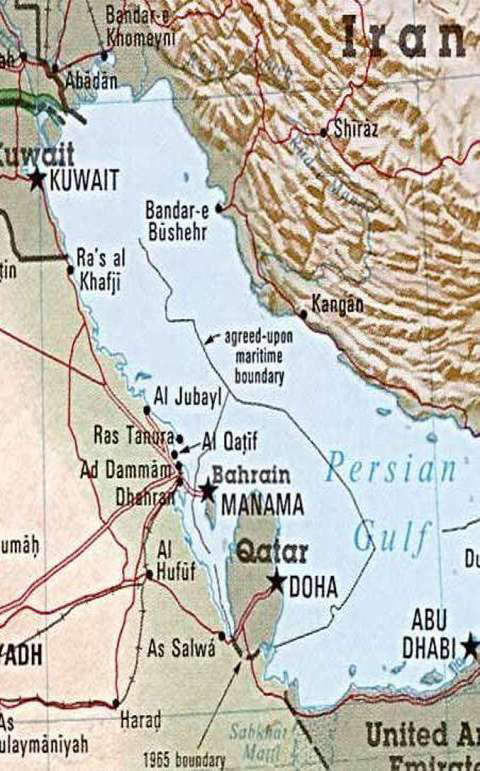
Map of the Persian Gulf, showing the pearling centers of Kuwait, Al-Qatif, Bahrain, Abu Dhabi on the Arabian side of the gulf and Bushehr on the Persian side of the gulf.
Exploitation of pearl oyster resources in the Gulf of Mannar during the colonial period
In the Gulf of Mannar, the situation fluctuated during the period of rule of different colonialists. When the Portuguese were at the helm of the affairs in this region, in the 16th century, they exerted a more direct control on the pearl trade. However, they were more successful only on the Indian side of the Gulf of Mannar, where the Portuguese evangelists led by St. Francis Xavier successfully converted an entire ethnic group of the South Indian coast to Roman Catholicism, known as the "Parawas" who were traditionally employed in the pearl fishing trade on the Indian side of the Gulf of Mannar. On the Sri Lankan side of the Gulf of Mannar, the Portuguese policies were a dismal failure, as the policy of evangelization was bitterly resisted by the indigenous population, especially the Tamil Hindus of the Jaffna Kingdom, under whose domain the lucrative pearl banks were situated, whose mighty ruler King Sankili I (1519-1561) massacred 600-700 Parawa Catholics brought by the Portuguese from the Indian side of the Gulf, to exploit the pearl resources on the Sri Lankan side of the Gulf. Sankili I, successfully resisted Portuguese colonization till his death in 1561. Even during the time of Sankili I's successors the Portuguese could not make much headway, until the year 1619, when the Portuguese finally captured Jaffna. The Portuguese colonialists went on the rampage in Jaffna to avenge their former defeats at the hand of the Tamil Hindus, killing, and maiming innocent populations, and destroying their ancient places of worship. All the Hindu temples in the Jaffna Peninsula were raised to the ground by the Portuguese colonialists, demonstrating their traditional intolerance towards other religions, and perhaps under the misplaced notion that their beliefs represented the only true beliefs in the world. The behavior of the Portuguese in Jaffna after its capture in 1619, seem to have many parallels in the atrocities committed by the Spanish conquistador Hernando Cortez in the New World in the 16th century against its indigenous people.
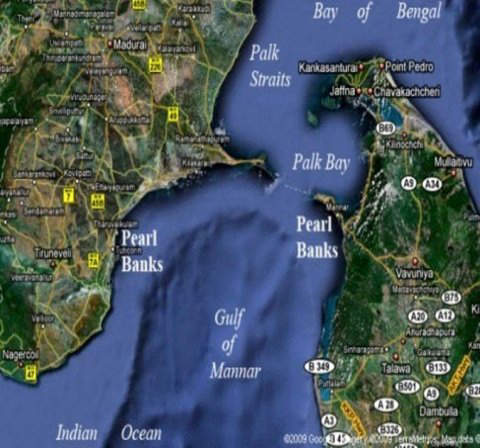
Pearl Banks of the Gulf of Mannar
During the Dutch period in the 18th century pearl fishing rights in the Gulf of Mannar on the Sri Lankan side was rented out to private entrepreneurs on an annual basis. The British colonialists who came in after the Dutch towards the end of the 18th century, initially followed the Dutch system of renting out pearl fishing rights annually, but later took a direct part in pearl fishing by employing pearl divers and boats and taking two-third of the harvest, while giving one-third to the pearl divers and the boat owners. The whole fishery was supervised by the government, which sold its share of the pearl oysters by public auction. Intensive exploitation of the pearl banks led to depletion of resources, and eventually pearling in the Gulf of Mannar was abandoned by the British at the beginning of the 20th century.
Pearls used in the Baroda Pearl Necklace and the Pearl Carpet of Baroda originated in the Persian Gulf, the Red Sea and the Gulf of Mannar
Most of the pearls harvested in the Persian Gulf, the Red Sea and the Gulf of Mannar, in the 16th to 19th centuries found their way to the lucrative pearl market in Bombay where the merchants received much higher prices for their products than the London market. During the height of the Mughal period in India from 1526 to 1707, almost all the pearls produced in this region, entered the courts of the Mughal Empire in Agra and Delhi. With the decline of the Mughal Empire after Aurangzeb in 1707, several independent kingdoms were established in different parts of India, ruled by powerful Maharajahs. The Maratha kingdom set up by Maharaj Chattrapati Shivaji and the Kingdom of Hyderabad founded by Asaf Jah, Mir Qamar-ud-Din in 1724 were two of the powerful kingdoms that were established. The Kingdom of Baroda was founded in 1732, when the Marathi General Pilaji Rao Gaekwad conquered Baroda City from the Mughal Empire. The Kingdom of Baroda and the Kingdom of Hyderabad were two of the kingdoms that aligned themselves with the British colonialists, and thus received their protection and were granted internal autonomy, in return for recognizing British suzerainty. These two kingdoms eventually turned out to be the richest kingdoms in India, and their rulers also lavished large sums of money in the purchase of high quality pearls from the Persian Gulf and the Gulf of Mannar. Khande Rao Gaekwad, the 10th Maharajah of Baroda also made lavish purchases of pearls originating from these regions, which were incorporated in the fabulous pieces of jewelry such as the Baroda Pearl Necklace, that was produced during this period. The large number of seed pearls incorporated in the Baroda Pearl Carpet, another creation of this period, also came from this region.
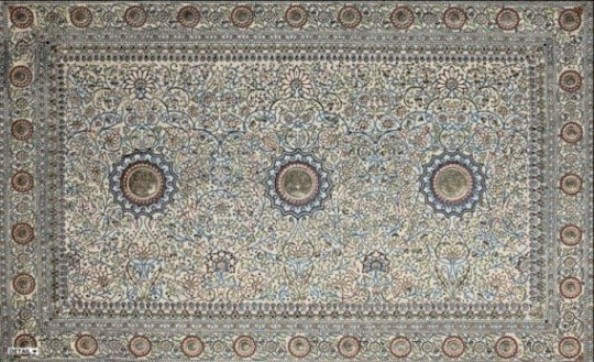
The Pearl Carpet of Baroda
© Sotheby's
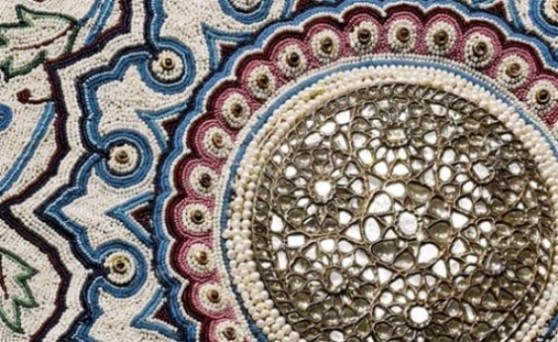
Close up of central rosette of the Pearl Carpet of Baroda
© Sotheby's
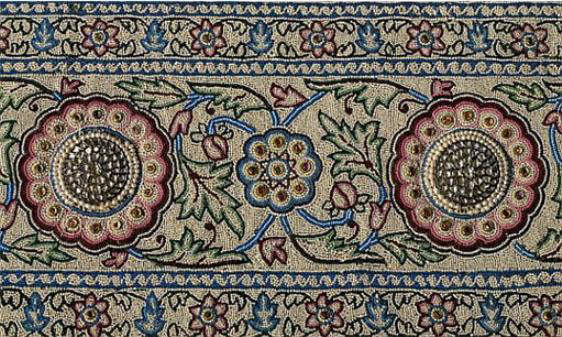
The Pearl Carpet of Baroda- peripheral rosettes.
© Sotheby's
Pinctada radiata the oyster that produced the Baroda Pearls
Pinctada radiata, part of a globally distributed species complex ?
Pinctada radiata, the Gulf Pearl Oyster was the main pearl oyster species found in the Persian Gulf, the Red Sea and the Gulf of Mannar, around which the natural pearl industry was built since ancient times. The species is also found in other geographic locations such as the Caribbean coasts of Panama, Colombia and Venezuela, Southern Atlantic coast of the United States, Northern coast of Brazil and Bermuda, where it is known as the Atlantic pearl oyster (Pinctada imbricata). Other geographic locations where the species is found is the Indo-Pacific regions of China, Japan and Korea, where it is known as Pinctada fucata and Pinctada martensii, and Australia. According to modern scientific evidence based on the study of DNA profiles, the four Pinctada species found in different geographic regions of the world, radiata, imbricata, fucata and martensii, which were originally thought to be different species, based on minor morphological and anatomical differences, are now considered to be a species complex, known as fucata/imbricata/martensii/radiata species complex. The complex represents a cosmopolitan, globally distributed species, characterized by substantial intraspecific variation over its range. Thus the Gulf pearl oyster Pinctada radiata, the Atlantic pearl oyster Pinctada imbricata and the Indo-Pacific pearl oysters Pinctada fucata and Pinctada martensii belong to the same species in spite of their widely separated habitats.
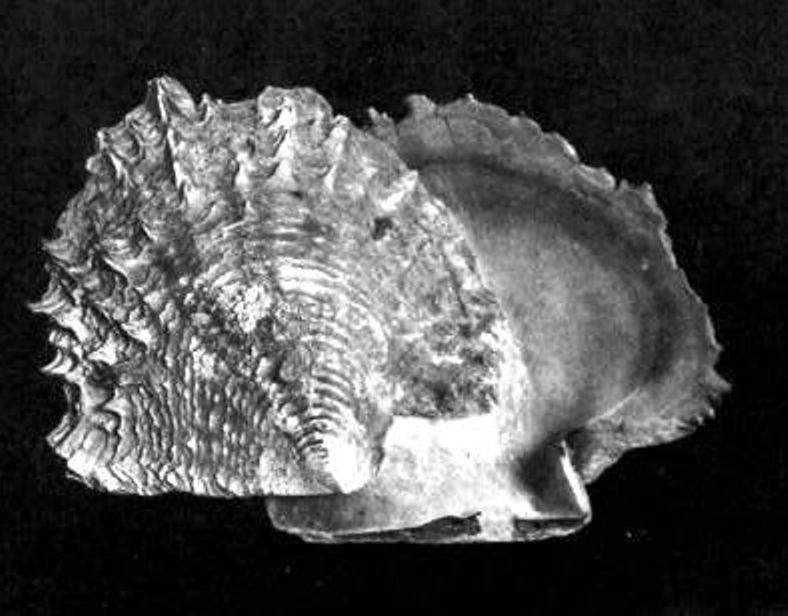
Ceylon Pearl Oyster - Pinctada radiata
Some characteristics of Pinctada radiata
Pinctada radiata in the Gulf of Mannar, has pale yellow shells, with 7 to 8 brownish radial bands, and a slightly pinkish lip. The average length of the shells is 7 to 8 cm. The Persian Gulf variety of the species, is larger, darker and has a reddish lip. The nacre color is usually white, cream or light pink. Rarely the color of the nacre can be yellow, brown or violet. The average life span of the oysters is 7 to 8 years. The species is well known for producing seed pearls (< 2mm in diameter). The approximately 1.5 million seed pearls used in the Baroda Pearl Carpet originated from Pinctada radiata species of the Persian Gulf and the Gulf of Mannar. But the species also produces pearls of medium size and larger pearls varying in size from 9 to 16 mm, as seen in the reconstituted Baroda Pearl Necklace. Pinctada radiata is found in clusters attached to rocks and other hard surfaces by byssal threads at depths of 10-20 meters.
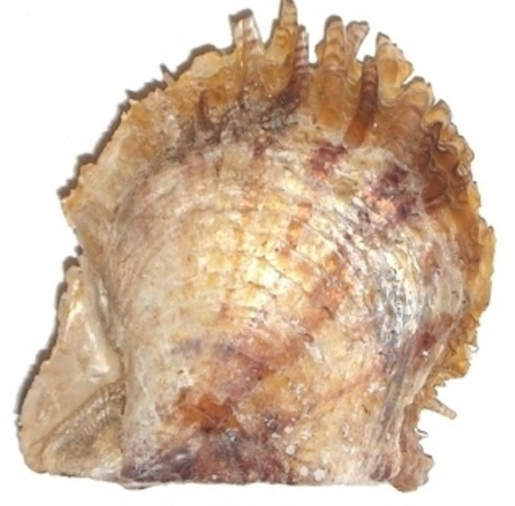
Pale-yellow shell of Pinctada radiata
The extravagance of Maharajah Khande Rao Gaekwar
Khande Rao Gaekwad, the greatest collector of jewels in the 19th century
In a discussion of the history of any famous jewelry piece that once belonged to the Baroda Crown Jewels, like the Baroda Pearl Necklace, the main character that invariably emerges is Maharajah Khande Rao Gaekwad, the 10th Gaekwar Maharajah that ruled the kingdom of Baroda from 1856 to 1870. The obvious reason for this was that most of the renowned pieces of jewelry belonging to the Baroda Crown Jewels, known today, originated during his period of rule. Khande Rao Gaekwad has gone down in the history of the Baroda Kingdom for his most lavish and extravagant spending habits, investing heavily on jewels and jewelry. He was reputed to be the greatest collector of jewels and jewelry in the 19th century. He acquired the 128.48-carat, "Star of the South" diamond, an exceptional quality Brazilian diamond for £80,000, and organized a massive celebration to welcome the diamond to Baroda soil, that included a parade of elephants dressed in their finest gilded arrays. Subsequently he purchased the 76.5-carat, drop-shaped "English Dresden" diamond reputedly for a sum of around £40,000. He then got both diamonds incorporated as the centerpiece of a three-tiered diamond necklace, that came to be known as the "Baroda Diamond Necklace." Another piece that is attributed to his period of rule, is the seven-stranded magnificent diamond and emerald ceremonial necklace, known as the "Hindu Necklace."
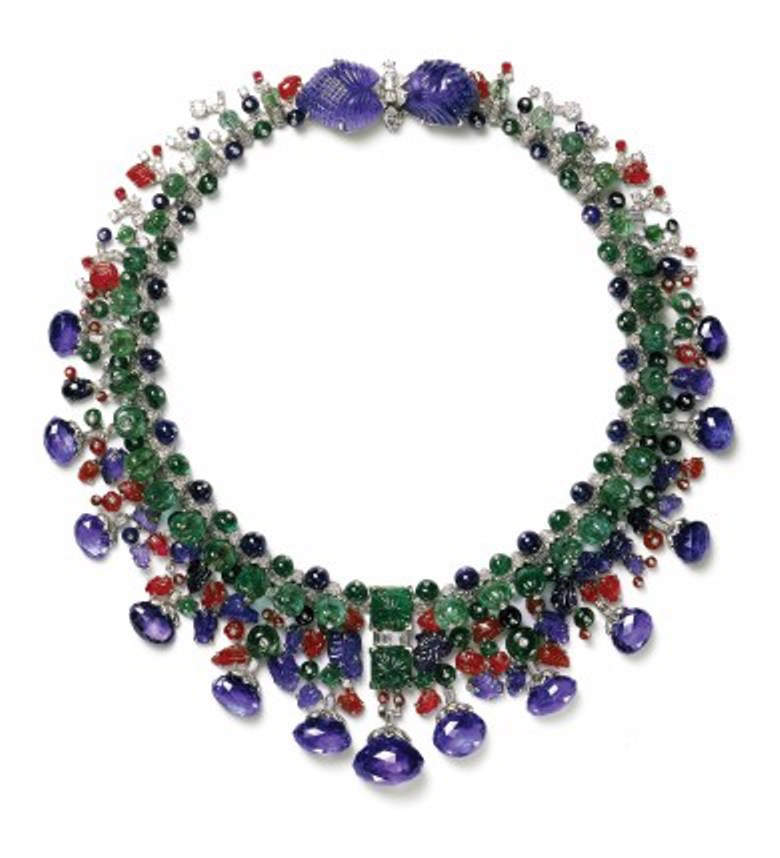
Modern Cartier Hindu Necklace made of diamonds, sapphires, emeralds and rubies, based on the original Hindu Necklace of the Maharajah of Baroda
George Frederick Kunz estimated the value of the Baroda Pearl Necklace to be around $500,000 in 1908
However, the piece that represents the peak of his extravagance was undoubtedly what is known today as the "Pearl Carpet of Baroda," which is believed to be actually one of four such carpets that was to form a canopy over the tomb of Prophet Muhammad at Medina, a pet project of the maharajah, probably in fulfillment of a vow he had undertaken for prayers answered. The four gold posts that was to serve as supports for the canopy, were in the process of being manufactured, when the Maharajah died. His successor Malhar Rao Gaekwad did not share his enthusiasm for the project and the carpets remained in Baroda. George Frederick Kunz in his book "The Book of the Pearls" published in 1908, states that the "Pearl Carpet of Baroda" is probably the most costly pearl ornament in the world, its value being estimated at several million dollars. Kunz estimates the total value of the treasures held by the Gaekwar of Baroda at $12 million in 1908, and places an estimate of half-a-million dollars on the Baroda Pearl Necklace, made up of seven rows of superb pearls.
The riches of the Baroda treasury exposed to the outside world by Sayaji Rao III
The Baroda Pearl Necklace together with the other crown jewels of Baroda, was then inherited by Malhar Rao Gaekwad (1870-75), who was forced to abdicate his throne in favor of the young Sayaji Rao III, from a different lineage of the Gaekwar family, after his purported involvement in a plot to poison the British Resident Colonel Phayre. Sayaji Rao III (1875-1939), who was educated in England and exposed to life in Europe during his extensive travels, was the most enlightened of all the Gaekwar Maharajahs, and introduced some of the advances he had observed in these countries to the development of his own domain, and Baroda became one of the most developed Princely States in India. G. F. Kunz's "The Book of the Pearls" published a photograph of Sayaji Rao III Gaekwad wearing the renowned seven-stranded Baroda Pearl Necklace. However, Sayaji Rao III rarely adorned any of the enormous collection of jewels at his disposal, and it was through him the outside world came to know about the enormous treasures held by the Baroda Crown. In 1909, Sayyaji Rao III, took his guest Reverend Weeden on a tour of the Baroda State Treasury, underneath the Nazr Bagh Palace. The Reverend was simply overwhelmed with the vast amounts of silver, gold and jewels he saw, stored in the vault, and also reported seeing bejeweled vessels and ornamentation, crammed into every nook of the guarded vault.
Most of the Baroda crown jewels including the Baroda Pearl Necklace are transferred to the Monaco residence of Pratapsingh Rao Gaekwad
The treasures including the Baroda Pearl Necklace, was then inherited by Sayaji Rao's grandson Pratapsingh Rao Gaekwad (1939-51) in 1939, who became famous for breaking with tradition and taking a second wife, Maharani Sita Devi in 1943, while his first wife was still living. After World War II in 1946, Maharani Sita Devi relocated to the independent principality of Monaco, in Europe, where the Maharajah purchased a magnificent mansion for her, and most of the crown jewels of Baroda were eventually moved to this overseas palace of the Maharajah. It was while in Monaco that Maharajah Pratapsingh Rao was photographed by Henri Cartier Bresson wearing the seven-stranded pearl necklace, during a formal occasion in the Monaco palace.
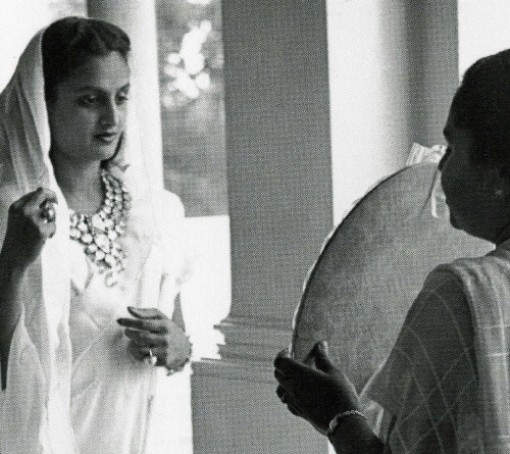
Maharani Sita Devi wearing the three-tiered diamond necklace
The Baroda Pearl Necklace is returned to the Baroda treasury together with some other valuable pieces of jewelry
In 1947, when India gained independence, the Princely State of Baroda acceded to the Indian Union, and became part of the newly created Bombay State. The Government of India took over the Baroda treasury, and was shocked to find that the treasury was virtually empty, and all the valuable treasures gone. The government issued an ultimatum to the former Maharajah Pratapsingh Rao Gaekwad, to return all the stolen treasures of Baroda, now in the custody of his second wife Maharani Sita Devi in Monaco, or choose abdication in favor of his son by his first wife and loose all princely privileges. The Maharajah then returned some of the jewels, that included the Baroda Pearl Necklace and the three-tiered diamond necklace containing the "Star of the South" diamond and the "English Dresden" diamond; two of the most expensive pieces of jewelry in the collection. The seven-stranded pearl necklace however, was now reduced to a six-stranded necklace. In spite of the return of some of the treasures in the Baroda treasury, Maharajah Pratapsingh Rao Gaekwad was asked to abdicate in favor of his son by his first wife, in 1951, mainly because of the anti-Indian stance taken by him while living abroad. The maharajah then returned to his European residence in Monaco.
The sudden appearance of the reconstituted Baroda Pearl Necklace in April 2007 at a Christie's auction in New York
The Baroda Pearl necklace that entered the treasury of the Lakshmi Villas Palace was not heard of again, until it reappeared at a Christie's "Magnificent Jewels" sale, in New York on April 25, 2007, in a reconstituted form containing only two-strands. The auction house maintained the anonymity of the owner of the necklace as well as its purchaser at the auctions, said to be an Asian private collector, who bid by telephone. The necklace fetched a record price of $7.1 million, the highest price ever paid for a natural pearl necklace at an auction, and in keeping with the pre-sale estimate of $7 million to $ 9 million. The previous record was set by another two-strand natural pearl necklace which sold for $3.1 million at a Christie's auction in Geneva, in November 2004. The Christie's "Magnificent Jewels" sale, netted a total of $39.1 million, and also included a 22.66-carat Kashmir blue sapphire, belonging to the Minnesota Historical Society, that sold for $3.1 million, the highest price ever paid for a blue sapphire at an auction. The two-strand Baroda pearl necklace was actually a part of an entire suite of pearl jewelry that also included a matching pair of natural pearl and diamond ear pendants, a brooch and a ring.
You are welcome to discuss this post/related topics with Dr Shihaan and other experts from around the world in our FORUMS (forums.internetstones.com)
Related :-
External Links :-
Baroda Pearls sell for record price - www.modernjeweler.com
References :-
1) The Book of the Pearl - G. F. Kunz, Pearls of the Gaekwar of Baroda, pp 460
2) Pinctada radiata - www.pearl-guide.com
3) Business Standard - Missing Baroda Pearls at Christie's - Kishore Singh, March 24, 2007
4) Gaekwad - From Wikipedia, the free encyclopedia
5) Christie's to offer the most important pearl necklace ever seen at auction - Christie's Press Release
6) Baroda Pearls sell for record price - www.modernjeweler.com
 Home
Security & Guarantee
How it Works
Technology Partners
Updated Tables
Famous Diamonds
More Famous Diamonds
Famous Pearls
Famous Gemstones
Contact Dr Shihaan Larif
Contact Senior Editor
Famous Jewelry
Reference Database
Forums
Learning Center
Gemstone Gallery
e-mail Notifications
Advertise
Press Release
About Us
Privacy Policy
Contact Us
FAQ'S
Site Map
Staff Mail Login
Staff Documents
Birthstones
History
Minerals
Shows
Live Metal Prices
Jewellery Gallery
News
Marketplace
Marketplace Support
Open Store
Online Auctions
Join Us & Contribute
Directory
Classifieds
List your products
Wholesale Trading
Post Buy Request
Go Green Policy
Site Updates
Upcoming-ToDo List
Latest News
Latest Articles
Latest Blog Updates
Chat Rooms
Job Board
User Gallery
Videos
New Newsletter Archive
Old Newsletter Archive
Jewelry & Mineral Blog
User Blogs & Social Network
Search
Answers (Q & A)
Valuation
Help me find a diamond/jewelry
pin.internetstones.com- Social Pinboard- Sart yours & connect with millions
Invite Friends From Yahoo, Gmail etc-One Click
Home
Security & Guarantee
How it Works
Technology Partners
Updated Tables
Famous Diamonds
More Famous Diamonds
Famous Pearls
Famous Gemstones
Contact Dr Shihaan Larif
Contact Senior Editor
Famous Jewelry
Reference Database
Forums
Learning Center
Gemstone Gallery
e-mail Notifications
Advertise
Press Release
About Us
Privacy Policy
Contact Us
FAQ'S
Site Map
Staff Mail Login
Staff Documents
Birthstones
History
Minerals
Shows
Live Metal Prices
Jewellery Gallery
News
Marketplace
Marketplace Support
Open Store
Online Auctions
Join Us & Contribute
Directory
Classifieds
List your products
Wholesale Trading
Post Buy Request
Go Green Policy
Site Updates
Upcoming-ToDo List
Latest News
Latest Articles
Latest Blog Updates
Chat Rooms
Job Board
User Gallery
Videos
New Newsletter Archive
Old Newsletter Archive
Jewelry & Mineral Blog
User Blogs & Social Network
Search
Answers (Q & A)
Valuation
Help me find a diamond/jewelry
pin.internetstones.com- Social Pinboard- Sart yours & connect with millions
Invite Friends From Yahoo, Gmail etc-One Click




Our Global Jewelry Industry Job Network


Buy & Sell in our Marketplace

Subscribe to our Newsletter

List in our Classifieds

List in our Directory

User Uploaded Gallery

Powered by Ultra Secure
Amazon (USA) Cloud Network

Founder Internet Stones.COM
Register in our Forums

| Featured In
|
|
|
|
|
|
|
|







Blog & Education Feed
Articles Feed
 |
 |
 |

Copyright © .Internet Stones.COM. All rights reserved.