Beauharnais Emerald Collection - Grand Duchess Stephanie Emerald Parure
Open FREE Unlimited Store Join Our Newsletter
Origin of name
Stephanie de Beauharnais, the Grand Duchess of Baden, was a niece to Alexandre Vicomte de Beauharnais, the first husband of Empress Josephine de Beauharnais, who was killed during the upheavals of the French revolution. On March 9, 1796, when Napoleon Bonaparte married Josephine de Beauharnais, he became the step-father to two of Josephine's children Eugene de Beauharnais and Hortense de Beauharnais, who were second cousins to Stephanie de Beauharnais. As Napoleon rose to the position of First Consul of France and later Emperor in 1804, he became the de facto patron of both the Bonaparte and the de Beauharnais families. Napoleon who was the "uncle" of Stephanie, extended his benevolence to Stephanie and adopted her as his daughter, and in keeping with her new imperial status she moved into the Tuileries Palace.

In 1806, Napoleon arranged the marriage of Stephanie de Beauharnais whom he referred to as "Princesse Francaise" (French Princess), to Karl Ludwig Friedrich, the heir to the Grand Duke of Baden, with the intention of securing an alliance between the two ruling dynasties. On this occasion Napoleon showered his adopted daughter, Stephanie de Beauharnais, with several valuable jewelry suites, costing 500,000 French francs, and a handsome dowry of 2 million French francs. Among the jewelry suites he gifted to Stephanie de Beauharnais were an emerald parure, a pearl parure and a diamond parure.
The emerald parure consisted of a tiara, necklace, a pair of earrings and a pair of bracelets, and came to be known as the Grand Duchess Stephanie Emerald Parure. However, only the emerald necklace and the pair of earrings of the original parure, known as the "Beauharnais Emerald Collection" had survived up to this day, and are preserved and displayed at the Victoria & Albert Museum in London.
Description of the Beauharnais Emerald and Diamond Necklace
The necklace that was designed and executed by Napoleon's court jewelers Nitot & Fils, exhibits neo-classical features of the Napoleonic era, such as the briolette-cut emeralds, hanging as pendants from around the necklace, a design that suited the low-neck dresses of the ladies of Napoleon's court during this period. Other creations of this period that have similar designs are the Marie-Louise emerald and diamond necklace and the Marquess of Lothian emerald and diamond necklace.
The necklace is essentially a double-stranded emerald and diamond necklace, interspersed with square, rectangular and cushion-cut emeralds placed in symmetrical positions and surrounded by small round or cushion-cut diamonds. The strands of the necklace are made up of alternating round-shaped small emeralds and diamonds.
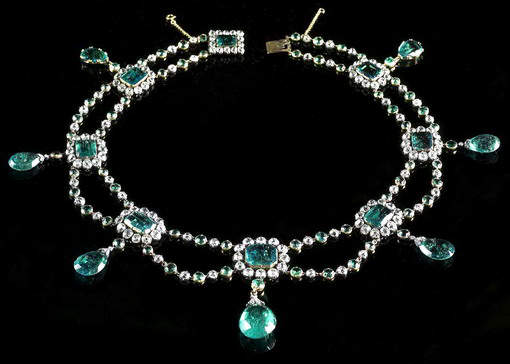
©Victoria and Albert Museum
The centerpiece of the necklace is a large cushion-cut emerald surrounded by 12 small round-shaped diamonds, from which hangs the largest briolette-cut emerald pendant in the necklace. The emerald on the rear-side of the necklace, in line with the centerpiece, is a square-shaped emerald, surrounded by 14 closely set round white diamonds. The gap between the centerpiece and the rear emerald, on either side is occupied by three identical rectangular-shaped emeralds, each surrounded by 12 small round-shaped diamonds, and placed on symmetrical positions on either side of the necklace. Briolette-cut emerald pendants are attached to all the large emeralds on the necklace, except the rear square-shaped emerald. Thus there are eight large emeralds on the double-stranded necklace, but only seven large briolette pendants. In the painting appearing above Grand Duchess Stephanie is shown wearing the emerald and diamond necklace, together with the matching pair of earrings.
The most striking features of this necklace are the color contrast between the green emeralds and the white diamonds; the large briolette-cut emerald pendants arising from the necklace; the double strand of emeralds and diamonds that link all large emeralds together; and the open-back settings of the emeralds and diamonds, which allowed more light to pass through the stones, increasing their brilliance.
Description of the Beauharnais Emerald and Diamond Earrings.
The identical pair of emerald and diamond pendant earrings complements the emerald and diamond necklace. Each earring of the matching pair consists of two sections. An upper circular or round-shaped section and a lower pear or drop-shaped section. The centerpiece of the upper round-shaped section which fits on to the ear lobe, is a round-shaped emerald surrounded by 12 small round-shaped diamonds. The centerpiece of the pear or drop-shaped section is a large free swinging briolette-cut emerald, surrounded by 18 round or cushion-shaped diamonds. Even in the earrings the emeralds and diamonds are set in open-back settings like the necklace.
History of the Beauharnais Emerald Collection
A short biography of Stephanie de Beauharnais
Stephanie de Beauharnais relationship to Eugene and Hortense de Beauharnais
Stephanie de Beauharnais who was born in Versailles on August 28, 1789, at the beginning of the French revolution was the daughter of Claude de Beauharnais (1756-1819), the 2nd Count des Roches-Baritaud and his wife Claude Francoise de Lezay (1767-1791). Claude de Beauharnais was the first cousin to Alexandre Vicomte de Beauharnais who married Josephine Tascher de la Pagerie in 1779. Alexandre and Josephine had two children, Eugene de Beauharnais and Hortense de Beauharnais. Thus Stephanie de Beauharnais was a second cousin to Eugene and Hortense. Alexandre and Josephine separated in 1785 after six years of marriage, as Alexandre was ashamed of Josephine's rural manners and lack of sophistication, which prevented her from associating with the elite ladies of the Royal court. After the divorce, Josephine refused to return to her rural village in the island of Martinique, and instead chose to remain in Paris and was determined to learn the life style of the elitist high society and the aristocrats. In 1794, at the height of the French revolution, her former husband Alexandre Vicomte de Beauharnais was guillotined to death. Josephine who was now a cultured high society lady was introduced to Napoleon Bonaparte who fell in love with her and began courting her, and on March 9, 1796 they were married. Napoleon Bonaparte was now the step-father to Eugene de Beauharnais and Hortense de Beauharnais.
Stephanie de Beauharnais becomes the adopted daughter of Napoleon Bonarparte
After Napoleon became the First Consul of France in 1799, and later the Emperor in 1804, he also became the de facto patron of both the Bonaparte and de Beauharnais families. He also decided to adopt Stephanie de Beauharnais as his daughter, and as a member of the new imperial family she moved into the Tuileries Palace.
Stephanie de Beauharnais' marriage to Karl Ludwig Friedrich the heir to the Grand Duke of Baden Karl Friedrich
In 1806, Napoleon sought to secure an alliance with the Prince Elector of Baden, through a marriage between the members of the two ruling dynasties. Accordingly he arranged the marriage of his adopted daughter Stephanie de Beauharnais to the heir to the Grand Duke of Baden Karl Friedrich, which took place in Paris on April 8, 1806. After initial difficulties in their marriage, the couple eventually reconciled and were blessed with five children. Karl Ludwig Friedrich succeeded his grandfather as the Grand Duke of Baden, on June 10, 1811.
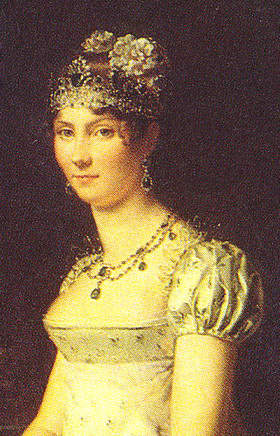
Grand Duchess Stephanie de Beauharnais wearing the emerald necklace and matching pair of emerald earrings
At the time of Stephanie de Beauharnais marriage to Karl Ludwig Friedrich, Napoleon Bonaparte gifted several jewelry suites to his adopted daughter Stephanie whose value was said to be over 500,000 French francs, besides a dowry of 2 million French francs in cash. The jewelry suites included an emerald, diamond and pearl parures.
Grand Duchess Stephanie de Beauharnais becomes a widow at 29 years and remains a widow for the rest of her long life of 71 years
Grand Duke Karl Ludwig Friedrich died on December 8, 1818 at the age of 32 years. The Grand Duchess Stephanie de Beauharnais who was only 29 years at the time of her husband's death, however remained a widow for the rest of her long life, remaining a devoted mother to her three daughters. The Grand Duchess Stephanie de Beauharnais died in Nice, in 1860 at the age of 71 years, 41 years after the death of her husband.
A short history of Baden
History of Baden from ancient times up to its re-unification in 1771
Baden was an independent state on the east bank of the Rhine river, in the southwestern corner of present Germany, which is now part of the Baden-Wurttemberg State of unified Germany. Ancient Baden was occupied by the Celts, followed by the Germanic peoples. The Romans conquered Baden in the 1st century A.D. followed by the Alemanni in the 3rd century A.D. In the 8th century the Franks conquered the area, and were also responsible for Christianizing its people. The rulers of Baden were known by the title "Margrave," and were members of the House of Zahringen. In 1535, the territory was divided into two margravates, the Baden-Baden margravate in the south and the Baden-Durlach margravate in the north. Baden suffered heavily during the "Thirty Years War" (1618-48) and also during the expansionist wars of Louis XIV of France in the late 17th century. Baden was finally re-united in 1771, by Karl Friedrich (Charles Frederick) the margrave of Baden-Durlach. Under Karl Friedrich, Baden enjoyed a long period of prosperity and happiness.
History of Baden during the Napoleonic period
During the French revolution, that was followed by the rise of Napoleon Bonaparte, Baden came under the influence of France, and became one of its satellite states. Between 1803 and 1806, Napoleon Bonaparte expanded the territory of Baden by conquest, as far as the Main River in the north and the Lake Constance to the south. The territory of the margravate increased by four to five times its original size. In 1806, Napoleon Bonaparte dissolved the margravate and converted it into a Grand Duchy, that became a member of Napoleon's Confederation of the Rhine. With the formation of the Grand Duchy in 1806, Karl Friedrich became the Grand Duke of Baden, and his grandson Karl Ludwig Friedrich became his heir. It was his heir Karl Ludwig Friedrich who married Napoleon Bonaparte's adopted daughter Stephanie de Beauharnais in 1806, and succeeded him as the Grand Duke on his death on June 10, 1811.
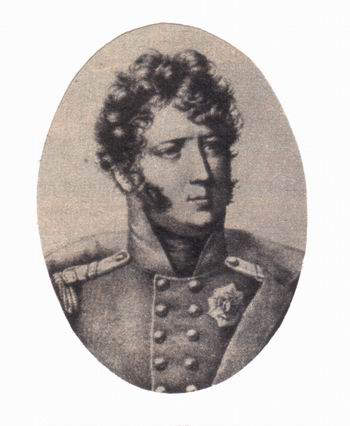
Karl Ludwig Friedrich, Grand Duke of Baden
Baden becomes an independent Grand Duchy after the fall of Napoleon Bonaparte
After Napoleon Bonaparte's downfall in 1814, the Congress of Vienna recognized Baden as a unified state, and a sovereign member of the newly formed German Confederation, and was allowed to retain the territorial gains it had achieved during the Napoleonic period. In the year 1818, just before his death Karl Ludwig Friedrich introduced a new liberal constitution, that made Baden one of the first German states to set up a representative assembly.
Grand Duke Karl Ludwig Friedrich died on December 8, 1818, and since he did not have any surviving male children, was succeeded by his uncle Ludwig I (Louis I), who ruled from 1818 to 1830. Ludwig I supported the development of the University of Freiburg, which eventually came to be known as the Albert-Ludwig University. Ludwig I also founded the Polytechnic Hochschule Karlsruhe in 1825, the oldest technical school in Germany. He was also responsible for the construction of most of the classical revival buildings in the city center.
When Ludwig I died in 1830 he was succeeded by his half brother Leopold I, who ruled from 1830 to 1852. During his rule in 1848 a revolutionary government ousted Leopold I and took control of the duchy. However in 1849, the Prussian military intervened on Leopold's behalf, ousted the revolutionary government, and restored Leopold I as the Grand Duke.
Frederick I joins Prussia in 1871 to form the German Empire
Leopold I was succeeded by his son Ludwig II, in 1852, but being mentally ill his brother Frederick I was appointed regent. Subsequently in 1856, Frederick I assumed the title of Grand Duke and continued his rule until his death in 1907. Frederick I married Princess Louise of Prussia, daughter of Emperor Wilhelm I and Empress Augusta of Prussia. He was a liberal supporter of a constitutional monarchy. During his reign he introduced the option of civil marriages in Baden, and also direct elections to the Lower House of Parliament. In 1871, Frederick I decided to join Prussia to form the German Empire - a move initiated by the Prussian Prime Minister, Otto von Bismarck - but still remaining as a Grand Duchy within the Empire.
Frederick II abdicates after World War I and Baden joins the new German Republic
Frederick I died in 1907 and was succeeded by his son Frederick II, who was the last Grand Duke of Baden. Following Germany's defeat in World War I, the country was declared a republic on November 9, 1918. Emperor Wilhelm II abdicated and fled to the Netherlands. Frederick II, the Grand Duke of Baden followed suit and abdicated on November 22, 1918, and the Grand Duchy of Baden cease to exist. Under the republican constitution of 1919, Baden ceased to be a Grand Duchy, and became a land of the German Reich. After World War II, Baden was divided into American and French zones of occupation, which eventually became the administrative district of the newly formed state of Baden-Wurttemberg.
Fate of the Emerald and Diamond Parure after the death of Stephanie de Beauharnais
Stephanie de Beauharnais died in Nice in 1860, at the age of 71 years. The fate of the necklace after her death is not exactly known. Perhaps the parure might have been disposed even before her death, or bequeathed after her death to any one of her three daughters, with whom she had been very close. Her eldest daughter was Princess Luise Amelie Stephanie of Baden, who married Gustav, the Prince of Vasa in the year 1830. Her second daughter was Princess Josephine Friederike Luise of Baden, who married Karl Anton, Furst of Hohenzollern Sigmaringen in 1834, and her third daughter was Princess Marie Amelie Elisabeth Caroline of Baden, who married William Alexander Anthony Archibald Douglas Hamilton, the 11th Duke of Hamilton in 1843. It is not known to which of her daughters she bequeathed her emerald parure.
It might also be possible that the parure remained as a royal jewel belonging to the Duchy of Baden, and passed down the successive grand dukes and duchesses of Baden, until it was inherited by the last Grand Duke of Baden, Frederick II, who abdicated on November 22, 1918, immediately after World War II. It is said that the parure was broken up after World War II, and only the necklace and the pair of earrings were acquired by Count Tagliavia. Subsequently, the widow of Count Tagliavia, Countess Margharita Tagliavia, presented the necklace and the pair of earrings, to the Victoria and Albert Museum in London, in memory of her son.
The Beauharnais Emerald Collection on display at the new William and Judith Bollinger Jewelry Gallery at the Victoria and Albert Museum
Classification of the Museum's Collections
The Victoria and Albert Museum, which was founded in 1852 as the South Kensington Museum by Prince Albert, using funds raised by holding the Great Exhibition of 1851, of which he was the chief organizer, is today the world's largest museum of decorative arts and design, with a collection of over 4.5 million objects, derived from over 5,000 years of human history, in virtually every possible medium of art, and from cultures of all the five continents of the world. The museum that now covers an area of 12.5 acres, has 145 galleries, but only a small percentage of the collection can be displayed at any given time.
The Museum is split into four collection departments :-
1) Asia 2) Furniture, Textiles, Fashion and Jewelry 3) Sculpture, Metalwork, Ceramics and Glass 3) Word and Image, which includes prints and books, paintings and drawings, and photography.
The collection departments are further sub-divided into 16 display areas, which can be listed in alphabetical order as follows :-
Architecture, Asia, British Galleries, Ceramics, Childhood, Contemporary, Fashion and Jewelry, Furniture, Glass, Metalwork, Paintings and Drawings, Periods and Styles, Photography, Prints and Books, Sculpture, Textiles.
Fashion and Jewelry
There are over 6,000 items in the jewelry collection, which includes jewelry of all periods from the ancient to the modern, such as Ancient Egypt, Ancient Greece, Ancient Rome, the Medieval Period, Elizabethan Jewels, 17th Century Jewels, 18th Century Jewels, 19th Century Jewels, and Modern Jewelry. The collection includes some of the finest pieces by Cartier, Lalique and Peter Carl Faberge. Among items of historic significance are diamond dress ornaments made for Catherine the Great, bracelet clasps that once belonged to Marie Antoinette, and the Beauharnais emerald necklace and earrings presented by Napoleon to his adopted daughter Stephanie de Beauharnais in 1806 on the occasion of her marriage to the heir of the Grand Duchy of Baden.
Among the modern jewelry are creations by designers such as Gerda Flockinger and Wendy Ramshaw. There are also items of jewelry from Asia and the African continent. The jewelry items also include collections bequeathed to the museum by several individual collectors, such as a collection of 154 gems by Reverend Chauncy Hare Townsend bequeathed in 1869, A collection of diamond jewelry from the 18th and 19th centuries bequeathed in 1951, by Lady Cory, a collection of more than 800 jewels from the middle ages to the early 19h century, that belonged to the jewelry scholar Dame Joan Evans, bequeathed in 1977.
William and Judith Bollinger Jewelry Gallery
On May 24, 2008 a new jewelry gallery donated by William and Judith Bollinger was opened at the Victoria and Albert Museum. This gallery displays 3,500 jewels from the V&A's jewelry collection dating from the 7th century to the present day. The jewels that are on display reflect the splendor of courtly life of the European monarchies in the last 800 years. The display also includes some of the finest designs created by contemporary designers, and the great jewelry houses of the 20th century.
Among the jewelry of historical significance that are displayed in the gallery are jeweled pendants given by Queen Elizabeth I to her courtiers, diamond jewelry worn by Empress Catherine the Great of Russia, the Beauharnais Emerald Collection, gifted by Napoleon to his adopted daughter Stephanie de Beauharnais, tiaras and ornaments worn by Empress Josephine, creations by Peter Carl Faberge, that include an enameled snuff box with the diamond monogram of Czar Nicholas II, several pieces of 19th century jewelry that include sprays of diamonds mounted on tremblers, and revivalist jewelry in the archaeological and renaissance styles.
Some of the new additions to the V&A's jewelry collection that have been put on display in the new gallery are, a collection of jewelry by Lalique, Lady Mountbatten's "tutti frutti" ruby, sapphire, emerald and diamond bandeau, purchased by her from Cartier in 1928, and the jewelry collection of the New York collector and dealer Patricia V. Goldstein gifted to the V&A, which includes several pieces by Tiffany and Cartier.
The four-year renovation of the jewelry gallery of the Victoria and Albert Museum was made possible by a generous donation given to the museum by William and Judith Bollinger. Architect Eva Jiricna who was in charge of the project, redesigned the exhibition space, incorporating a central glass spiral staircase rising to a new mezzanine floor.
According to Mark Jones, the Director of the V&A, "the power of jewels lies in their beauty and their ability to stir human emotions. The V&A has one of the finest collections of jewelry, and the imagination and passion of William and Judith Bollinger have allowed us to create a gallery worthy of this collection."
You are welcome to discuss this post/related topics with Dr Shihaan and other experts from around the world in our FORUMS (forums.internetstones.com)
Related :-
1) Emerald and Diamond Parure of Marie Louise Empress of France
2) Catherine the Great Emerald and Diamond Necklace
References
1.V&A's jewelry collection - website of the V&A Museum.
2.V&A's new jewelry gallery : rocks of ages -Telegraph.co.uk 11-5-2008.
3.V&A jewelry : treasures brought to sparklinglife - Telegraph,co.uk 20-5-2008
4.V&A to open William and Judith Bollinger Jewelry Gallery - artdaily.org October 2, 2008.
5.Victoria and Albert Museum -From Wikipedia, the free encyclopedia.
6.Stephanie de Beauharnais - From Wikipedia, the free encyclopedia.
7.Encyclopedia Britannica - 2006
 Home
Security & Guarantee
How it Works
Technology Partners
Updated Tables
Famous Diamonds
More Famous Diamonds
Famous Pearls
Famous Gemstones
Contact Dr Shihaan Larif
Contact Senior Editor
Famous Jewelry
Reference Database
Forums
Learning Center
Gemstone Gallery
e-mail Notifications
Advertise
Press Release
About Us
Privacy Policy
Contact Us
FAQ'S
Site Map
Staff Mail Login
Staff Documents
Birthstones
History
Minerals
Shows
Live Metal Prices
Jewellery Gallery
News
Marketplace
Marketplace Support
Open Store
Online Auctions
Join Us & Contribute
Directory
Classifieds
List your products
Wholesale Trading
Post Buy Request
Go Green Policy
Site Updates
Upcoming-ToDo List
Latest News
Latest Articles
Latest Blog Updates
Chat Rooms
Job Board
User Gallery
Videos
New Newsletter Archive
Old Newsletter Archive
Jewelry & Mineral Blog
User Blogs & Social Network
Search
Answers (Q & A)
Valuation
Help me find a diamond/jewelry
pin.internetstones.com- Social Pinboard- Sart yours & connect with millions
Invite Friends From Yahoo, Gmail etc-One Click
Home
Security & Guarantee
How it Works
Technology Partners
Updated Tables
Famous Diamonds
More Famous Diamonds
Famous Pearls
Famous Gemstones
Contact Dr Shihaan Larif
Contact Senior Editor
Famous Jewelry
Reference Database
Forums
Learning Center
Gemstone Gallery
e-mail Notifications
Advertise
Press Release
About Us
Privacy Policy
Contact Us
FAQ'S
Site Map
Staff Mail Login
Staff Documents
Birthstones
History
Minerals
Shows
Live Metal Prices
Jewellery Gallery
News
Marketplace
Marketplace Support
Open Store
Online Auctions
Join Us & Contribute
Directory
Classifieds
List your products
Wholesale Trading
Post Buy Request
Go Green Policy
Site Updates
Upcoming-ToDo List
Latest News
Latest Articles
Latest Blog Updates
Chat Rooms
Job Board
User Gallery
Videos
New Newsletter Archive
Old Newsletter Archive
Jewelry & Mineral Blog
User Blogs & Social Network
Search
Answers (Q & A)
Valuation
Help me find a diamond/jewelry
pin.internetstones.com- Social Pinboard- Sart yours & connect with millions
Invite Friends From Yahoo, Gmail etc-One Click




Our Global Jewelry Industry Job Network


Buy & Sell in our Marketplace

Subscribe to our Newsletter

List in our Classifieds

List in our Directory

User Uploaded Gallery

Powered by Ultra Secure
Amazon (USA) Cloud Network

Founder Internet Stones.COM
Register in our Forums

| Featured In
|
|
|
|
|
|
|
|







Blog & Education Feed
Articles Feed
 |
 |
 |

Copyright © .Internet Stones.COM. All rights reserved.