BELLE ÉPOQUE NATURAL GREY/BROWN PEARL PENDANT NECKLACE
Open FREE Unlimited Store Join Our Newsletter
Dr. Shihaan M. Lariff
Origin of Name
The name refers to an exceptional Belle Époque natural grey/brown pearl pendant necklace, that appeared at a Christie's Contemporary Jewelry and Watches Sale, held on April 29, 2008, at Jumeirah Emirates Towers Hotel, in Dubai, the United Arab Emirates, believed to have originated in the year 1900, during the Belle Époque period.

Characteristics of the Pearl Pendant Necklace
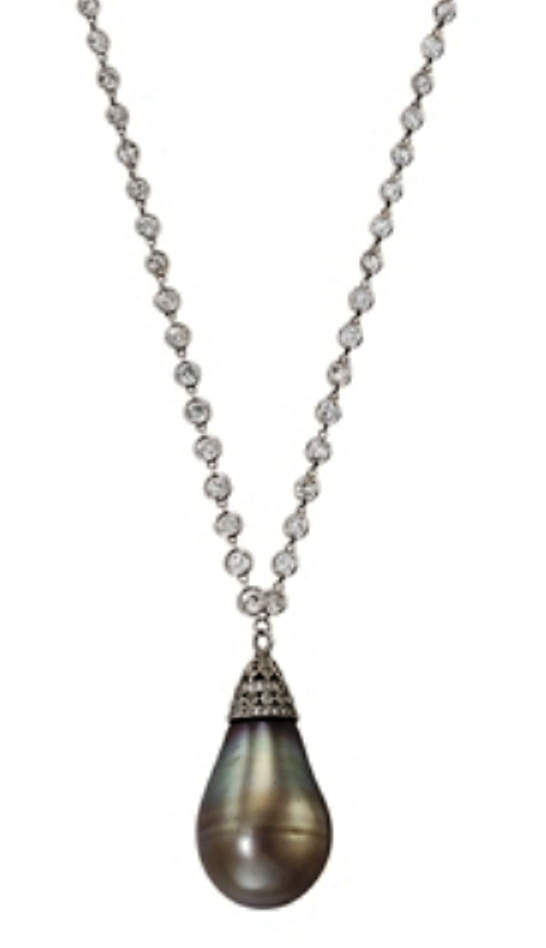
Belle Époque natural grey/brown pearl pendant necklace
© Christie's
The shape of the pearl
The pearl which forms the centerpiece of this pendant necklace is a perfectly symmetrical, natural, drop-shaped pearl. The perfect symmetry of this natural pearl is indeed very stunning, an extremely rare occurrence in nature, where the usual tendency is to form baroque pearls. GIA classifies pearls into three basic shapes - 1) Spherical 2) Symmetrical and 3) Baroque. This natural drop-shaped pearl falls under the second category. Apart from drop-shape other shapes that fall under Symmetrical pearls are pear-shape, oval-shape, button-shape. A Symmetrical pearl has only one line of symmetry through which the pearl can be divided into two equal halves.
The color of the pearl
The color of the pearl has been described in the Christie's website as grey/brown. However, according to photographs of the pearl, grey color appears to be the main body color of the pearl, and brown color appears to be an overtone color. Thus, this pearl appears to fall under the category of black and grey pearls, produced by the pearl oyster species Pinctada margaritifera. The grey color of these pearls is produced by melanin pigments, secreted by special secretory cells in the mantle. The melanin pigments combine with the protein component of nacre, conchiolin. Overtone colors, that appear to float over the surface of the pearl, are produced by the interference of light as it passes through alternating layers of aragonite and conchiolin. Overtone colors tend to modify the body color of pearls. If brown is an overtone color and grey the body color, the combination of the two colors is known as brownish-grey.
The weight of the Pearl. This pearl is the largest and most perfectly symmetrical drop-shaped pearl in the world, as well as the largest colored drop-shaped pearl in the world
The weight of the pearl is 56.81 carats, which is equivalent to 56.81 x 4 = 227.24 grains. From the table below it is seen, that based on the weight of the pearl, this drop-shaped grey/brown pearl is the 14th largest nacreous pearl recorded, the seventh largest drop-shaped pearl, and the largest colored drop-shaped pearl in the world. It is also the largest and most perfectly symmetrical drop-shaped pearl in the world, as all other six pearls above it are irregular or asymmetrical drop-shaped pearls, except perhaps the "La Regente" Pearl, which is a pear-shaped drop pearl. Likewise, out of the six larger pearls above, only the La Regente Pearl is more attractive than this pearl, whereas all others have signs of distress such as lines caused by drying or staining.
Table of famous nacreous pearls arranged in descending order of weight
| S/N | Name of Pearl | Weight in Carats and Grains | Shape of Pearl |
Type of Pearl | Color of Pearl |
| 1 | Pearl of Asia | 600 carats, 2,400 grains | Baroque, garden-egg shaped | Saltwater, nacreous pearl | White |
| 2 | Arco-Valley Pearl | 575 carats, 2300 grains | Baroque | Saltwater, nacreous pearl | White |
| 3 | Big Pink Pearl | 470 carats, 1,880 grains | Baroque | Saltwater, nacreous abalone pearl | Pink |
| 4 | Hope Pearl | 450 carats, 1,800 grains | Baroque drop-shaped | Saltwater, nacreous pearl | White |
| 5 | Christopher Walling Abalone Pearl | 187.5 carats, 750 grains | Horn shaped | Saltwater , nacreous pearl | Multi-colored |
| 6 | Imperial Hong Kong Pearl | 127.5 carats, 510 grains | Irregular drop | Saltwater, nacreous pearl | White |
| 7 | Gogibus Pearl | 126 carats, 504 grains | Pear-shaped drop | Saltwater, nacreous pearl | White |
| 8 | Shah Sofi Pearl | 125 carata. 500 graina | Pear-shaped drop | Saltwater, nacreous perl | White |
| 9 | Survival Pearl | 90.35 carats, 361.40 grains | Baroque | Freshwater, nacreous pearl | White |
| 10 | La Regente | 75.67 carats, 302.68 grains | Pear-shaped drop | Saltwater, nacreous pearl | White |
| 11 | Pearl of Kuwait | 64.35 carats, 257.40 grains | Asymmetrical drop-shape | Saltwater, nacreous pearl | White |
| 12 | Paspaley Pearl | 60.94 carats, 243.76 grains | Perfectly spherical | Saltwater, nacreous, cultured pearl | White |
| 13 | Large natural freshwater nacreous pearl, that appeared at Christie's sale 7664 at Dubai | 60.36 carats, 241.44 grains | Near-Spherical | Freshwater nacreous pearl | Yellowish- orange to pinkish-orange |
| 14 | Natural Grey/Brown Pearl | 56.81 carats, 227.24 grains | Symmetrical drop-shape | Saltwater, nacreous pearl | Grey/Brown |
| 15 | La Peregrina | 55.95 carats, 223.8 grains | Pear-shaped drop | Saltwater, nacreous pearl | White |
| 16 | Sara Pearl | 55.0 carats, 220 grains | Drop-shaped | Saltwater, nacreous pearl | Gray |
| 17 | Shaista Khan's Pearl | 55.0 carats, 220 grains | Pear-shaped drop pearl | Saltwater nacreous pearl | White |
| 18 | Peacock Throne Pearl | 50 carats, 200 grains | Pear-shaped drop | Saltwater nacreous pearl | Yellow |
| 19 | Mancini Pearls | 50 carats, 200 grains. 50 carats, 200 grains | Drop-shaped pearls | Saltwater nacreous | White |
| 20 | Moghul Pearls | 45.5 carats, 182 grains. 45.5 carats, 182 grains | Pear-shaped drop | Saltwater nacreous pearls | White |
| 21 | Drexel Pearl | 33.80 carats, 135.2 grains | Symmetrical drop-shape | Saltwater nacreous pearl | Black Tahitian |
| 22 | La Pelegrina one | 33.29 carats, 133.16 grains | Pear-shaped drop | Saltwater, nacreous pearl | White |
| 23 | Charles II Pearl | 32.5 carats, 130 grains | Pear-shaped drop | Saltwater, nacreous pearl | White |
| 24 | Tararequi Pearls | 31 carats, 124 grains | Pear-shaped drop | Saltwater, nacreous | White |
| 25 | Bapst Pearls | 113.75 grains, 113.25 grains | Perfectly spherical pearls | Saltwater nacreous pearls | White |
| 26 | La Pelegrina two | 27.88 carats, 111.5 grains | Perfectly spherical pearl | Saltwater nacreous pearl | White |
| 27 | La Reine De Pearls | 27.5 carats, 110 grains | Perfectly spherical pearl | Saltwater, nacreous pearl | White |
| 28 | Oviedo Pearl | 26 carats, 104 grains | Perfectly spherical pearl | Saltwater, nacreous | White |
| 29 | Queen/Patterson Pearl | 23.25 carats, 93 grains | Baroque | Freshwater, nacreous pearl | White |
| 30 | Paspaley Drop-shaped Pearls | 18.75 carats, 75 grains. 18.75 carats, 75 grains | Drop-shaped pearls | Saltwater, nacreous pearl | White |
| 31 | Finest black pearl in Europe in 1900 | 12.25 carats, 49 grains | Pear-shaped drop pearl | Saltwater, nacreous pearl | Black pearl with green overtone |
© internetstones.com
Please do not copy our tables without our permission. We may be compelled to inform the search engines if our content and tables are plagiarised.
The dimensions of the pearl
The pearl has a length of 26.45 mm (2.645 cm) and a diameter varying from 17.14 mm to 18.68 mm (1.714-1.868 cm). In comparison the dimensions of the drop shaped pearls above this pearl are :- Hope pearl (length 5.08 cm, width of 1.32 to 1.82 cm) , Imperial Hong Kong Pearl (length 3.9 cm, width 2.6 cm), Gogibus pearl (length 6.35 cm, width 5.08 cm) , Shah Sofi pearl (dimensions not known), La Regente pearl (dimensions not known), Pearl of Kuwait (length 4.128 cm, width 1.905 cm).
The luster and surface quality of the pearl
The luster of the pearl, a reflective property of the surface layers of the pearl is also exceptional being a saltwater nacreous pearl. Like wise the surface quality of the pearl is also exceptional appearing almost blemish-free.
Description of the necklace and pendant
The grey drop-shaped pearl with a brownish overtone is mounted with a bell cap at its narrower end, carrying a hook for attachment to a necklace. The bell cap carries a motif of circular bands, circles and leaves, which is mounted with small diamonds. The pearl-pendant so formed is attached to a spectacle-set chain, 78 cm long. The metal used for the bell cap and chain must be platinum, the common metal used for necklaces during this period. The design of the necklace and pendant is believed to belong to circa 1900 during the Belle Époque period.
History of the Belle Époque pearl pendant necklace
The Belle Époque period
"Belle Époque" in French means "beautiful time" and the term is usually applied to refer to the Edwardian Period in England, the period that immediately followed the long period of mourning of Queen Victoria, which extended from the time of death of her husband in 1861 to the time of her own death in 1901. During this period clothing and jewelry designs became more somber and austere. Full mourning colors such as black and half-mourning colors such as gray, mauve and purple, were the colors used for clothing. Jewelry colors also followed the same trend, black jewelry set with black onyx, jet and vulcanite becoming popular. Amethysts (purple) and red garnets were also used in mourning jewelry.
The death of Queen Victoria in 1901, followed by the ascension of her son Edward VII to the throne of the United Kingdom, marked the beginning of an era of elegance, fun and frivolity, that came to be known as the "Belle Époque" period, after the long period of mourning of Queen Victoria. The period coincided with the acquisition of new wealth by the upper and middle classes, and the birth of the automobile and movie industries. Edward VII's period of rule was short, lasting until his death in 1910, but the "Belle Époque" period continued until the onset of World War I. Belle Époque period coincided with the period known as Art Nouveau period in France, that started around 1890 and lasted until the beginning of World War I.
Jewelry designs of the Belle Époque period
A characteristic feature of the clothing and jewelry designs of the "Belle Epoque" period, was the use of light and delicate material, such as delicate fabric, lace and feathers in clothing and the introduction of Platinum as the main metal in jewelry manufacture, which enabled the creation of invisible, lightweight settings that made use of minimum of metal to hold gemstones. White on white color scheme for jewelry settings became very popular, that made use of white diamonds and pearls on platinum, that enhanced their radiance. Pearl chokers were introduced during this period, which were sometimes worn in combination with long strings or chains of pearls. Necklaces with negligee pendants, consisting of two pearl drops of unequal length, suspended from a centerpiece also had their origin in the "Belle Époque" period. Jewelry of the "Belle Époque" were graceful, decorated with openwork garland, lacy, filigree designs. Dog collars, sautoirs, lavalieres, and garland style festoon necklaces became popular during this period. Spectacle-set chains also originated during this period.
The possible source of the grey/black - colored pearl
The natural geographic range of the oyster species that produces black/grey pearls
The saltwater oyster species that produced the grey/black pearl with the brownish overtone, is undoubtedly Pinctada margaritifera, the black-lipped pearl oyster, which has a wide geographic distribution extending from the Persian Gulf, through the Indian Ocean and the South Sea to the Pacific Ocean, up to the Gulf of California in Mexico. In the Pacific Ocean, the black-lipped pearl oyster has a distribution from Japan in the northern Pacific to the French Polynesian Islands in the southern Pacific. The species reaches its greatest abundance in the atolls lagoons of French Polynesia whose capital is Tahiti, from which the pearls derive their internationally recognized trade name Black Tahitian pearls.
The source of natural black pearls throughout the ages
In ancient times the main source of black pearls was the Persian Gulf, where the species Pinctada margaritifera co-existed with the dominant species Pinctada radiata, the main source of white pearls. However, in the 16th and 17th centuries with the discovery of black pearls in the Gulf of California, Baja, California became the main source of black pearls, that entered the markets in Europe. In the early 19th-century after the arrival of European explorers and traders, black-lipped pearl oysters in the Polynesian Islands were exploited on a large scale for their shell, for the international shell button industry. Natural black Tahitian pearls became a by-product of this industry, and French Polynesia became the main source of natural black pearls in the world in the 19th-century. However, like the Gulf of California, pearl oyster resources in the atolls of Polynesia were also exhausted in the 1880s due to over exploitation, and harvesting was abandoned by the end of 19-th century. Japan and northern Australia became a source of natural black pearls, in the late 19th and early 20th centuries, as the sources of Black Tahitian pearls were gradually exhausted. However, with the successful culturing of Akoya pearls, by Kokichi Mikimoto, in Pinctada fucata martensi in 1916, and the opening of large numbers of Akoya pearl farms in the 1920s and 1930s, the culturing of black pearls from the black-lipped pearl oyster became a distinct possibility, and only a matter of time. In fact, Mikimoto himself continued his research work on the black-lipped pearl oyster, after opening a farm for the oyster on Ishigaki Island in Okinawa. However, it was not until 1931, that he was first able to produce successfully a black cultured pearl. Thus, black cultured pearls first came into the markets in the 1930s. The technology developed by the Japanese for black cultured pearls were adopted for the production of black cultured pearls in Australia and Tahiti in the late 20th-century, and today Australia and Tahiti produce substantial quantities of cultured black pearls, to cater to the international demand in black pearls.
Can Tahiti be the source of the grey/black colored pearl ?
In the 19th-century the main source of natural black pearls in the world was the French Polynesian Islands, and the pearls came to be known as black Tahitian pearls. The famous Drexel Pearl, another perfectly symmetrical natural drop-shaped black pearl, weighing 33.8 carats or 135.2 grains, incorporated in a "Belle Époque" circle brooch by Cartier's of New York in 1905, is believed to have originated in the French Polynesia. Thus, it is quite possible that the grey/black pearl with a brownish overtone incorporated as a pendant in this "Belle Époque" pendant necklace, designed in the year 1900, too, originated in the French Polynesia.
The sale of the Belle Époque natural grey/brown pearl pendant necklace
The necklace is put up for sale at a Christie's auction in Dubai held on April 29, 2008
The exceptional Belle Époque natural grey/brown pearl pendant necklace, was put up for sale by its anonymous owner, at a Christie's Contemporary Jewelry and Watches Sale, held on April 29, 2008, at Jumeirah Emirates Towers Hotel, in Dubai, United Arab Emirates. The necklace was Lot No. 174 under the Sale, bearing No. 7664. The pre-sale estimate of the necklace was placed between $700,000 and $1,000,000. The price realized at the auction that included the buyer's premium was $769,000. The price realized is in keeping with the recent increase in demand and strong auction market for natural pearls, a fact that is brought out clearly by the following table :-
Table of some famous natural pearls/pearl jewelry sold at public auctions conducted by international auction houses, giving the date of auction and the prices realized, during the period 1970 to 2009
| S/N | Name of pearl/pearl jewelry | Probable period of origin | weight |
date of auction | Price realized |
| 1 | La Peregrina | 1513 | 203.84 grains | 1969 | USD 37,000 |
| 2 | Mancini pearls | 1500-1600 | 400 grains | Oct.1979 | USD 253,000 |
| 3 | Mona Bismarck 2-strand pearl necklace | 1920-1930 | Double-strand of 70 pearls | May 1986 | USD 410,000 |
| 4 | Duchess of Windsor pearl necklace | 1910-1936 | Single-strand of 28 natural pearls. Total weight 1266.33 grains | April 1987
Dec 2007 |
USD 733,333
3,625,000 |
| 5 | Empress Eugenie tiara | 1853 | 212 pearls, 2,520 grains | Nov 1992 | USD 650,000 |
| 6 | Nina Dyer black pearl necklace | 1950s | 151 natural black pearls | Nov 1997 | USD 913,320 |
| 7 | Barbara Hutton pearls | 1600-1666 | 44 natural pearls, total weight of 1,816.68 grains | May 1992
Nov 1999 |
USD 580,000
USD 1,470,000 |
| 8 | Unidentified natural pearl necklace by Cartier | Historical provenance not revealed | Double-strand necklace with 88 natural pearls | Nov 2004 | USD 3,100,000 |
| 9 | La Regente | 1811 | 302.68 grains | Nov 2005 | USD 2,483,968 |
| 10 | Gulf pearl parure designed by Harry Winston | 1932-1978 | Nov 2006 | USD 4,100,000 | |
| 11 | Baroda pearl necklace | 1856-1870 | Double-strand with 68 natural pearls from the original 7-strand necklace | April 2007 | USD 7,096,000 |
| 12 | Umm Kulthum pearl necklace | 1880 | nine-stranded necklace with 1,888 pearls | April 2008 | USD 1,390,000 |
| 13 | Pearl necklace from an unidentified notable collection | Historical provenance not revealed | Single-strand necklace with 41 natural pearls | Nov 2008 | USD 1,321,110 |
| 14 | Unidentified pearl and diamond festoon necklace | Historical provenance not revealed | Nine-strand pearl and diamond festoon necklace. Length 645mm to 1060mm | Nov 2008 | USD 946,610 |
| 15 | Pearl Carpet of Baroda | 1860 | 1.5-2.0 million natural seed pearls | March 2009 | USD 5,500,000 |
© internetstones.com
Please do not copy our tables without our permission. We may be compelled to inform the search engines if our content and tables are plagiarised.
The price of USD 760,000 realized for the pearl compared with the record price realized for the La Regente pearl in November 2005
The 302.68-grain La Regente Pearl sold in November 2005, has set the record as the single natural pearl that fetched the highest price at a public auction, viz. USD 2,483,968. A significant part of the value of this pearl is no doubt attributable to the historic provenance of the pearl that dates back to 1811, the period of Emperor Napoleon Bonaparte, who is believed to have purchased the pearl and gifted it to his second wife and queen consort Marie Louise, as the centerpiece of a pearl tiara, which was the main component of a complete pearl parure. In comparison, the 227.24-grain grey/black pearl, which is the subject of this webpage, had sold for only USD 769,000. The lesser price realized for this pearl in comparison to the La Regente can be attributed, to the lower weight of the pearl, and more importantly the lack of a historic provenance to enhance its value. Nevertheless, the pearl with its combined characteristics of several desirable features in pearls, qualify to be listed under the category of famous pearls.
You are welcome to discuss this post/related topics with Dr Shihaan and other experts from around the world in our FORUMS (forums.internetstones.com)
Related :-
1) Drexel Pearl
External Links :-
References :-
1) An Exceptional Belle Epoque Natural Grey/Brown Pearl Pendant Necklace - Sale 7664. Lot No. 174. www.christie's.com
2) Anna Thomson Dodge/Catherine the Great Pearl Necklace - www.internetstones.com
3) Drexel Pearl - www.internetstones.com
4) La Regente Pearl - www.internetstones.com
5) Marilyn Monroe Pearl Necklace - www.internetstones.com
 Home
Security & Guarantee
How it Works
Technology Partners
Updated Tables
Famous Diamonds
More Famous Diamonds
Famous Pearls
Famous Gemstones
Contact Dr Shihaan Larif
Contact Senior Editor
Famous Jewelry
Reference Database
Forums
Learning Center
Gemstone Gallery
e-mail Notifications
Advertise
Press Release
About Us
Privacy Policy
Contact Us
FAQ'S
Site Map
Staff Mail Login
Staff Documents
Birthstones
History
Minerals
Shows
Live Metal Prices
Jewellery Gallery
News
Marketplace
Marketplace Support
Open Store
Online Auctions
Join Us & Contribute
Directory
Classifieds
List your products
Wholesale Trading
Post Buy Request
Go Green Policy
Site Updates
Upcoming-ToDo List
Latest News
Latest Articles
Latest Blog Updates
Chat Rooms
Job Board
User Gallery
Videos
New Newsletter Archive
Old Newsletter Archive
Jewelry & Mineral Blog
User Blogs & Social Network
Search
Answers (Q & A)
Valuation
Help me find a diamond/jewelry
pin.internetstones.com- Social Pinboard- Sart yours & connect with millions
Invite Friends From Yahoo, Gmail etc-One Click
Home
Security & Guarantee
How it Works
Technology Partners
Updated Tables
Famous Diamonds
More Famous Diamonds
Famous Pearls
Famous Gemstones
Contact Dr Shihaan Larif
Contact Senior Editor
Famous Jewelry
Reference Database
Forums
Learning Center
Gemstone Gallery
e-mail Notifications
Advertise
Press Release
About Us
Privacy Policy
Contact Us
FAQ'S
Site Map
Staff Mail Login
Staff Documents
Birthstones
History
Minerals
Shows
Live Metal Prices
Jewellery Gallery
News
Marketplace
Marketplace Support
Open Store
Online Auctions
Join Us & Contribute
Directory
Classifieds
List your products
Wholesale Trading
Post Buy Request
Go Green Policy
Site Updates
Upcoming-ToDo List
Latest News
Latest Articles
Latest Blog Updates
Chat Rooms
Job Board
User Gallery
Videos
New Newsletter Archive
Old Newsletter Archive
Jewelry & Mineral Blog
User Blogs & Social Network
Search
Answers (Q & A)
Valuation
Help me find a diamond/jewelry
pin.internetstones.com- Social Pinboard- Sart yours & connect with millions
Invite Friends From Yahoo, Gmail etc-One Click




Our Global Jewelry Industry Job Network


Buy & Sell in our Marketplace

Subscribe to our Newsletter

List in our Classifieds

List in our Directory

User Uploaded Gallery

Powered by Ultra Secure
Amazon (USA) Cloud Network

Founder Internet Stones.COM
Register in our Forums

| Featured In
|
|
|
|
|
|
|
|







Blog & Education Feed
Articles Feed
 |
 |
 |

Copyright © .Internet Stones.COM. All rights reserved.