The Black Orlov Diamond - Eye of Brahma Diamond
Open FREE Unlimited Store Join Our Newsletter
Origin of Name
The name Black Orlov for the diamond seems to have been inspired by the color of the stone, as well as the name of the onetime purported owner of the diamond, the non-existent, fictitious Princess, Nadia Vyegin Orlov of Russia. The other Orlov diamond, a historic diamond of Indian origin, with well authenticated credentials, is a 189.62-carat, colorless, Indian rose-cut diamond, presented by Count Grigory Grigoryevich Orlov to Empress Catherine the Great (1762-96), and later mounted on the royal scepter, on the orders of the great Empress, which subsequently became one of the most important components of the Romanov crown jewels, and is currently preserved among the treasures of the Kremlin Diamond Fund.
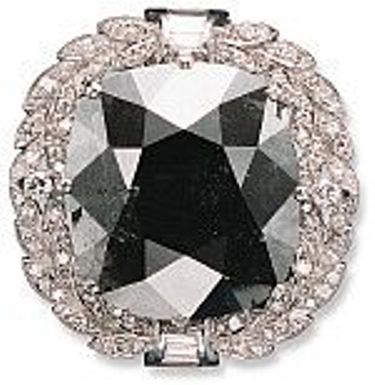
Cartier Black Orlov diamond pendant/brooch setting

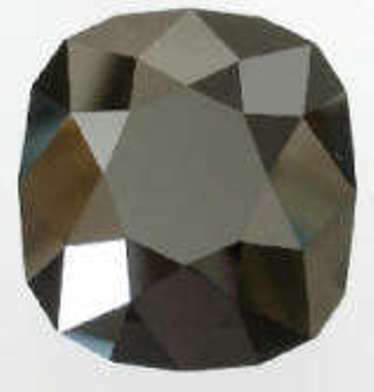
Replica of the cushion-cut Black Orlov diamod created by Scott Sucher
https://www.museumdiamonds.com/~scottsuc/index.php/Scott_Sucher.html
Characteristics of the diamond
The Black Orlov Diamond is the 7th largest black diamond and perhaps the largest cushion-cut black diamond in the world
The Black Orlov diamond is a 67.50-carat, cushion-cut, black diamond, which is the 7th largest black diamond among the known black diamonds in the world. If the 202-carat, Black Star of Africa whose whereabouts are not known, and whose cut is also unknown, is not a cushion-cut diamond, the Black Orlov qualifies as the largest cushion-cut black diamond in the world. See table below.
List of Famous Black Diamonds
S/N |
Name | Country/Period of Origin | Weight of Rough Diamond | Carat weight after cutting | Cut/Shape | Price realized at last sale or auction |
| 1 | Unnamed black diamond | 489.07 | Rectangular-cut | US$1.7 million | ||
| 2 | Spirit of de Grisogono Diamond | Central African Republic | 587.00 | 312.24 | Old Moghul-cut | Stone remains with original owner Fawaz Gruosi |
| 3 | The Black Star of Africa | Central African Republic | 202.00 | Seen for the last time in Tokyo in 1971 |
||
| 4 | The Table of Islam | Central African Republic | 160.18 | Emerald cut | ||
| 5 | Gruosi Diamond | India | 300.12 | 115.34 | Heart-shaped | Stone remains with original owner Fawaz Gruosi |
| 6 | Korloff Noir Diamond | Russia | 421.00 | 88.00 | Round brilliant-cut with standard 57 facets | Property of Korloff Jewelers France |
| 7 | Black Orlov Diamond | India or Russia | 195.00 | 67.50 | Cushion-cut | US$360,000 Christie's NY. Oct.2006 |
| 8 | Amsterdam Diamond | South Africa - 1972 | 55.85 | 33.74 | Pear-shaped | US$352,000 Christie's Geneva. Nov |
©internetstones.com
Please do not copy our tables without our permission. We may be compelled to inform the search engines if our content and tables are plagiarised.
Cartier's setting of the Black Orlov Diamond
The Black Orlov diamond was set by Cartier in a modern diamond-and-platinum necklace. The 67.5-carat, cushion-cut black diamond was incorporated as the centerpiece of a brooch/pendant surrounded by 108 smaller white diamonds. The pendant is suspended from a platinum necklace mounted with 124 small white diamonds. The color contrast between the black and white diamonds is very striking and enhances the beauty of the stone. It is the beauty of this setting that inspired the "King of Black Diamonds" Fawaz Gruosi in 1996, to experiment with black diamonds as an ornamental stone, that became an instant success, and have made black diamond jewelry, the most sought after by women around the world.
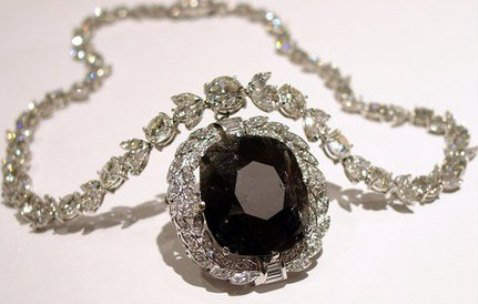
Cartier's Black Orloff Diamond Necklace
Properties of black diamonds in contrast to that of conventional diamonds
Black diamonds, being opaque are in a class by themselves and do not fit into the classification of conventional diamonds, which are divided into Type I and Type II, depending on the presence or absence of nitrogen.
The properties of black diamonds are entirely different to that of conventional diamonds.
1) Whereas conventional diamonds are produced deep inside the earth's surface, probably in it's mantle and are subsequently brought up during volcanic eruptions forming Lamproite and Kimberlite pipes, black diamonds are never found in Kimberlite pipes, and usually occur in alluvial deposits.
2) Whereas conventional diamonds build up as enormous single crystals made up of giant molecules of repeated tetrahedral units of carbon atoms, black diamonds appear to be composed of millions of minute diamond crystals stuck together, giving it a porous nature. Apart from graphite, iron compounds such as hematite and magnetite could sometimes be associated with the conglomerate crystals giving it magnetic properties.
3) Whereas conventional diamonds are free of trapped gas bubbles, as the high pressure conditions in which they were produced do not allow the existence of gases, black diamonds are full of gas bubbles trapped in the porous material, containing gases that were present when the diamonds were formed, such as hydrogen and nitrogen, which lends evidence for their stellar origins.
4) Whereas conventional diamonds are the hardest substances known on earth, black diamonds are even harder than the conventional diamonds, and are therefore extremely difficult to cut and polish. However there hardness may not not be uniformly distributed. There may be areas in the porous material that are loosely bound and are softer than other areas.
5) Whereas conventional diamonds can be cleaved along cleavage planes, in spite of their hardness, black diamonds do not have cleavage planes and their extreme hardness is attributed to this property.
6) Whereas conventional diamonds are more suitable for ornamental purposes, black diamonds are more suitable for industrial purposes; gem quality black diamonds being quite rare.
History
The uncut 195-carat Black Orlov diamond is deliberately given an infamous origin of being prised out of the eye of an idol in India, with a consequent curse allegedly being placed on it, a favorite theme that imparts notoriety to diamonds and boosts their popularity, that may eventually have a bearing on their price
The early history of the Black Orlov diamond, seems to be as dark as the diamond itself and shrouded in mystery. According to a legend, the Black Orlov diamond also known as the "Eye of Brahma" diamond was an uncut black diamond of Indian origin, weighing 195 carats, prised out of the eye of the statute of a sacred Hindu God Brahma, from a temple near Pondicherry in Southern India. This act of sacrilege infuriated the Hindu priests of the temple, who placed an alleged curse on the diamond, that condemned all future owners of the diamond to a violent death. Other famous diamonds of Indian origin that seem to have had similar infamous beginnings are the Hope diamond, the Orlov diamond and the "Idol's Eye" diamond. Out of these only the Hope Diamond is alleged to have been cursed, and is the most notorious of all cursed diamonds, bringing misfortune and sometimes death to it's owners or their close relatives. Since the stealing of diamonds from the eyes of statutes followed by curses being paced on them had become a favorite theme that imparts notoriety to diamonds, the person or persons who created the story of the alleged curse of the Black Orlov diamond, seem to have been inspired by this theme, to gain popularity for the diamond, which may eventually have a bearing on it's price.
The occurrence and distribution of black diamonds in the world raises serious doubts about the Indian origin of the diamond
Black diamonds do not seem to have originated deep inside the earth's crust like conventional diamonds and are therefore not found in Kimberlite pipes. Therefore not a single black diamond has ever been produced in the conventional Kimberlite diamond mines of South Africa, Russia, Canada, and Australia, the main sources of the approximately 600 tons of conventional diamonds produced in the last century. Today the only important source of black diamonds in the world are Brazil and the Central African Republic. Even in the long history of exploitation of diamonds from the five groups of diamond mines on the eastern Deccan Plateau of the Indian sub-continent, the discovery of any significant black diamond has never been reported. Therefore the purported origin of the Black Orlov diamond in the historical diamond mines of India, seem to be highly improbable, and the story of the origin of the diamond from the eye of the statute of Brahma, from a temple in Pondicherry, India, seems to have originated from the fertile imagination of a seasoned story teller. This story may be similar to the story of the Idol's Eye diamond originating from the eye of an idol at a temple in Benghazi, Libya, an Islamic country, where idol worship had been abolished since the 8th century A.D !!! The diamond most probably originated in the Central African Republic.
The diamond mysteriously reaches Russia, where it is acquired by a Russian princess whose existence is not documented
It is not known in which period or year the diamond was stolen from the temple. However, the stolen diamond somehow found it's way to Russia, where it is believed to have been acquired by a Princess. No details are available as to how the diamond reached Russia, and at what time it became the property of the so called Princess. The name of the Princess is said to be Nadia Vyegin Orlov, but there is no documentation of Russia having had a Princess by that name. But, it has been reported that there was a Princess by the name of Nadezhda Petrovna Orlov, who fled Russia after the Bolshevik revolution of October 1917, and took up residence in France.
The diamond reaches the United States in 1932, where it claims its first victim, J.W. Paris, but there are no records of such a person having jumped from a New York skyscraper
Eventually the diamond is said to have found it's way to the United States in 1932, acquired by a diamond dealer by the name of J. W. Paris, but the person from whom he purchased the diamond is not known. The first casualty of the curse is J. W. Paris, who is reported to have jumped to his death from a New York City skyscraper, shortly after selling the stone in 1932. It is rather strange, that the curse had waited till the diamond arrived in the United States, for it to claim it's first victim !! Possibly, the priests in India placed a "delayed action curse" that exempted the Russian owners of the diamond, in Russian soil !!! It appears that there is no record of a jeweler having jumped from a New York skyscraper in 1932.
The curse claims two other victims in 1947, both Russian princesses, one of them the fictitious princess who first purchased the stone and the second a real Russian princess who is well authenticated to have died in Switzerland much earlier in 1918, at the ripe old age of 102 years
The curse waited for another 15 years to claim it's 2nd and 3rd victims, but instead of taking revenge from the current owner of the diamond who purchased it from J. W. Paris, it seems to have affected two Russian Princesses, who are said to have separately owned the Black Orlov, at one time or another in the past, possibly when they were in Russia. The curse seem to be showing some form of retro-action, taking revenge from past owners. Princess Nadia Vyegin Orlov, the non-existent Princess according to Russian records, and Princess Leonila Galitsine Bariatinsky, committed suicide several months apart in 1947, by jumping from buildings in Rome. But there are no records to show that such suicides did take place. In fact, Princess Leonila Galistine Bariatinsky, lived up to the ripe old age of 102 years, and died long before 1947, in Switzerland, in the year 1918. How she could have been resurrected from the dead, and leapt from a building in Rome, experiencing a second death, is beyond anyone's comprehension !!! As for the other Princess who also leapt to her death, it seems in all probability that she was a fictitious character. The real princess Nadezhda Petrovna Orlov, who took up residence in France, lived up to 90 years, and died of natural causes in 1988, in France.
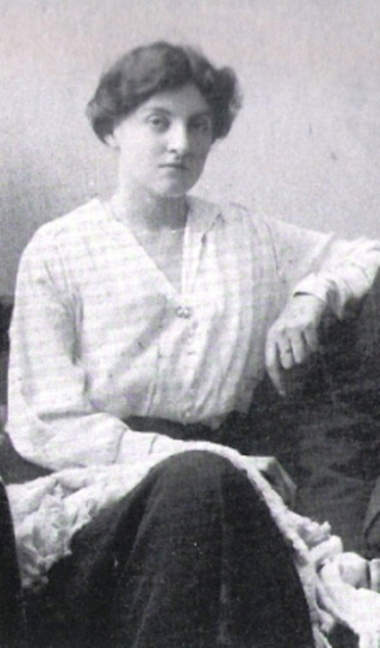
Princess Nadezhda Petrovna Orlov, who died of natural causes at the age of 90 years
A drastic loss of weight in processing the diamond, from 195 carats to 67.50 carats, which is normal for carbonados, has been deliberately misrepresented as an attempt to break the curse, by the claimed cleaving of the diamond into three pieces, the largest piece purpotedly being transformed into the 67.50-carat diamond
It is also said that in an attempt to break the curse an Austrian cutter cleaved the original stone into three pieces and the largest piece was eventually transformed into the 67.50-carat, cushion-cut, black Orlov diamond we know of today. The whole operation it is said, took more than two years. This is quite understandable given the extreme hardness of black diamonds and the lack of cleavage planes in the diamond. However the identity of the cutter and the year in which such operation was performed is not given, raising doubts as to whether such operation was actually carried out. Moreover the fate of the remaining two pieces is also not known.
The drastic loss of weight from the original 195 carats to 67.50 carats is something very common in the processing of rough black diamonds because of the porous nature of the stones and the possibility of the occurrence of loose material in the stone.
After 1947 the curse did not claim the lives of owners whose ownership is well authenticated
Strangely enough after the curse took it's two victims in 1947, it's effects seem to have mellowed down, and did not claim the lives of the subsequent owners of the stone, whose ownership is well authenticated. Such an owner was Charles F Winson, the New York City gem dealer, who valued the stone at $ 150,000. In fact Charles F. Winson appear to be the first authenticated owner of the Black Orlov, but unfortunately it is not known from whom he acquired the stone. The stone appears to have been set in the brooch surrounded by white diamonds by Cartier. While in the possession of Charles F. Winson, the stone was exhibited on two occasions in the United States, one at the American Museum of Natural History in New York in 1951, and the other at the Wonderful World of Fine Jewelry and Gifts, at the 1964 Texas State Fair, Dallas. The stone was taken to South Africa in 1967, and exhibited at the Diamond Pavilion in Johannesburg.
The sale and transfer of ownership of the diamond in 1969, 1990, 1995 and 2004, the stone coming into the possession of the Johnstown, Pennsylvania jeweler and diamond dealer Dennis Petimezas
In 1969, the stone was sold to an unknown buyer by Charles Winson for $ 300,000. The diamond came up for auction again in 1990 at Sotheby's and was sold For $ 99,000. But, the highest value for the stone was realized in 1995, when it was sold at an auction to an anonymous private collector, for $ 1.5 million. Then in the year 2004, J. Dennis Petimezas, a jeweler and diamond dealer of Johnstown, Pennsylvania, acquired the diamond from the anonymous private collector, who purchased it in 1995 for $ 1.5 million, after protracted negotiations conducted on his behalf by a gem broker of 5th Avenue New York. The purchase price of the diamond was not disclosed, but considering the time spent on negotiations, almost 6 months, it may not be less than $ 1.5 million.
Dennis Petimezas dismisses outright any ill effects of the curse and claims that the diamond had brought him nothing but good luck
Dennis Petimezas owned the diamond for almost 30 months, and dismisses the purported curse placed on the diamond. He says that the diamond had brought him nothing but good luck during his tenure of ownership. According to him, during this period he married his long time sweetheart, and moved into their own dream home, and enjoyed continued growth in the diamond business. However, it was during his period of ownership that the "infamous" Orlov Diamond received it's widest media publicity both for it's beauty as well as the alleged curse placed on it.
The media was responsibe for bloating the news of the alleged curse of the Orlov diamond, by publishing untruths and half-truths about the diamond, without veryfying the facts
The media characterized the diamond as the "most accursed of all gems" and the "evil death gem," and gave accounts of alleged suicides committed by the two Russian Princesses and the American diamond dealer J. W. Paris. The media publicity came in the wake of two highly publicized events, the display of the "accursed" Orlov diamond in U.K. for the first time, at the Natural History Museum's "Diamonds Exhibition," held between 21st September 2005 and February 2006, and the 2006 Academy Awards ceremony held in Los Angles in March 2006.
An exhibition of the Black Orlov diamond at London's Natural History Museum due to take place between September 2005 and February 2006 was closed down prematurely as police received credible reports of criminals planning to target it
At the "Diamonds Exhibition" held in the London's Natural History Museum the Black Orlov was displayed together with other world renowned diamonds like the 203.04-carat "Millennium Star," the 59.6-carat "Steinmetz Pink", and the 407.48-carat the "Incomparable" diamond. The exhibition was sponsored by the Steinmetz Group, with the Diamond Trading Company as co-sponsors. The event was characterized as a once-in-a-lifetime opportunity to see such an astonishing array of important diamonds in one exhibition. There was an enthusiastic response from the diamond-loving public to view this rare exhibition. However, on November 22nd, 2005, just two months after the 5-month long exhibition started, the Director of the Museum decided to close down the exhibition, on the advice of the London Metropolitan Police, who said that they have received credible reports, that criminals were planning to target the exhibition. The Director, Dr Michael Dixon said, the museums priority was the safety and security of the visitors and staff, and the only responsible course of action in this situation was to close the exhibition. Surprisingly, the press did not go to town with the news that the alleged curse was responsible for the sudden closure of the exhibition !!!
Black Orlov at the Oscars 2006
The Black Orlov diamond then traveled to California to make it's next star appearance at the Academy Awards held on Sunday, March 5th, 2006, and was accompanied by it's owner Dennis Petimezas. The star of the film "Transamerica," Felicity Huffman, who was nominated for the Best Actress award for her role in the film, was approached by Dennis Petimezas to persuade her to wear the $ 2 million Black Orlov necklace. It was widely expected that she would wear, the supposedly cursed diamond necklace at the glittering ceremony, to be broadcast live around the world, to debunk the curse theory associated with the diamond.
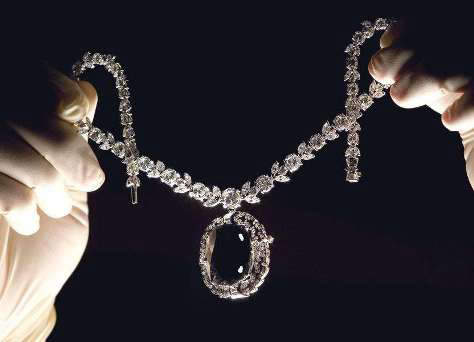
The notorious Black Orlov necklace, that was expected to be worn by Felicity Huffman at the Academy Awards 2006
The black Orlov necklace was put on display at the pre-Oscar festivities held at the Mondrain Hotel Penthouse on March 2nd 2006, where celebrities were able to view $ 12 million worth of Jewelry, exhibited by 25 jewelers. The jewelry displayed in the Platinum Guild jewelry suite was intended to give celebrities an opportunity to borrow pieces for the weekend's festivities.

Felicity Huffman star of "Transamerica" received Academy Award nomination for her portrayal of Bree Osbourne in the film
The Black Orlov necklace would have been easily spotted, when Huffman walked the red carpet with her husband, actor Wiliam H. Macy. However, when she did eventually appear on the red carpet, her neck was conspicuously bare, giving rise to speculation whether she too unconsciously succumbed to the baseless curse theory.
Last transaction and present owners of the diamond
Dennis Petimezas, who owned the Black Orlov diamond for 30 months finally decided to dispose of it, as he was planning to buy the Monroe Diamond. Christie's of New York, put up the diamond for sale on October 11th, 2006, and the diamond was eventually sold to an anonymous buyer from a different continent, for $ 360,000. It would be interesting to track down the new owner of the diamond, not because of the rarity of the stone, but its notoriety, and to keep a tab on its so-called curse in order to debunk the fictitious claims associated with a harmless diamond.
You are welcome to discuss this post/related topics with Dr Shihaan and other experts from around the world in our FORUMS (forums.internetstones.com)
Related :-
2) Spirit of de Grisogono Diamond
References :-
1) The Black Orlov - www.famousdiamonds.tripod.com
2) Famous Diamonds - Ian Balfour (1997) Page 290.
3) Black Orlov - From Wikipedia, the free encyclopedia
4) The Black Orlov joins Diamonds - Sept. 21, 2005 Natural History Museum -www.nhm.ac.uk
5) Black Orlov Diamond reportedly to be worn by nominee Huffman during Academy Awards- by Tom Lavis. www.tribune-democrat.com
6) Felicity Huffman - From Wikipedia, the free encyclopedia.
7) Black Orlov - www.museumdiamonds.com
 Home
Security & Guarantee
How it Works
Technology Partners
Updated Tables
Famous Diamonds
More Famous Diamonds
Famous Pearls
Famous Gemstones
Contact Dr Shihaan Larif
Contact Senior Editor
Famous Jewelry
Reference Database
Forums
Learning Center
Gemstone Gallery
e-mail Notifications
Advertise
Press Release
About Us
Privacy Policy
Contact Us
FAQ'S
Site Map
Staff Mail Login
Staff Documents
Birthstones
History
Minerals
Shows
Live Metal Prices
Jewellery Gallery
News
Marketplace
Marketplace Support
Open Store
Online Auctions
Join Us & Contribute
Directory
Classifieds
List your products
Wholesale Trading
Post Buy Request
Go Green Policy
Site Updates
Upcoming-ToDo List
Latest News
Latest Articles
Latest Blog Updates
Chat Rooms
Job Board
User Gallery
Videos
New Newsletter Archive
Old Newsletter Archive
Jewelry & Mineral Blog
User Blogs & Social Network
Search
Answers (Q & A)
Valuation
Help me find a diamond/jewelry
pin.internetstones.com- Social Pinboard- Sart yours & connect with millions
Invite Friends From Yahoo, Gmail etc-One Click
Home
Security & Guarantee
How it Works
Technology Partners
Updated Tables
Famous Diamonds
More Famous Diamonds
Famous Pearls
Famous Gemstones
Contact Dr Shihaan Larif
Contact Senior Editor
Famous Jewelry
Reference Database
Forums
Learning Center
Gemstone Gallery
e-mail Notifications
Advertise
Press Release
About Us
Privacy Policy
Contact Us
FAQ'S
Site Map
Staff Mail Login
Staff Documents
Birthstones
History
Minerals
Shows
Live Metal Prices
Jewellery Gallery
News
Marketplace
Marketplace Support
Open Store
Online Auctions
Join Us & Contribute
Directory
Classifieds
List your products
Wholesale Trading
Post Buy Request
Go Green Policy
Site Updates
Upcoming-ToDo List
Latest News
Latest Articles
Latest Blog Updates
Chat Rooms
Job Board
User Gallery
Videos
New Newsletter Archive
Old Newsletter Archive
Jewelry & Mineral Blog
User Blogs & Social Network
Search
Answers (Q & A)
Valuation
Help me find a diamond/jewelry
pin.internetstones.com- Social Pinboard- Sart yours & connect with millions
Invite Friends From Yahoo, Gmail etc-One Click




Our Global Jewelry Industry Job Network


Buy & Sell in our Marketplace

Subscribe to our Newsletter

List in our Classifieds

List in our Directory

User Uploaded Gallery

Powered by Ultra Secure
Amazon (USA) Cloud Network

Founder Internet Stones.COM
Register in our Forums

| Featured In
|
|
|
|
|
|
|
|







Blog & Education Feed
Articles Feed
 |
 |
 |

Copyright © .Internet Stones.COM. All rights reserved.