Black Tahitian Keshi Pearl, Aquamarine and Diamond Necklace
Open FREE Unlimited Store Join Our Newsletter
Dr. Shihaan M. Lariff
Origin of Name
The name refers to an exquisitely designed necklace whose predominant component is black Tahitian keshi pearls, followed by aquamarines and diamonds, that appeared at a Bonhams Natural History Auctions, held on December 6, 2009, at Los Angeles, California. The extraordinary beauty of this necklace is undoubtedly due its innovative design using baroque-shaped, large, black Tahitian keshi pearls. No two pearls in the necklace have identical shapes, but thanks to the ingenuity of the designer, these unique individual pieces of irregular shaped pearls has been put together, in such a way as to give a semblance of symmetry. In other words the designer in creating this unique piece of jewelry has attempted to create order from disorder, represented by highly irregular pieces of black Tahitian keshi pearls, in which no two pieces are identical. The necklace represents a synthesis of three main categories of gemstones, organic stones (pearls), colored stones (aquamarines) and diamonds, which is reflected in the name of the necklace.
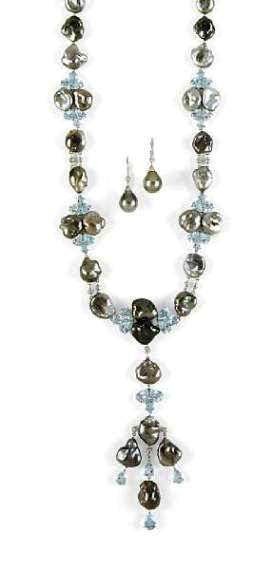
Black Tahitian Keshi Pearl, Aquamarine and Diamond Necklace

Characteristics of the Necklace
The necklace which is 16 inches (40.6 cm) long, falls within the category of a choker, whose length varies from 14-16 inches in the Mikimoto classification of necklaces. A pendant made up of the same gemstones as the necklace, hangs from the middle of the necklace, forming its centerpiece. The entire necklace is made up of 33 cultured black color Tahitian keshi pearls, varying in size between 10-15 mm. There are five black keshi pearls in the pendant, all of which are baroque in shape, and non-identical. However, three of these pearls, the upper most and two pearls on the sides, arising from the middle pearl, have a somewhat irregular drop shape. Pear-shaped aquamarines and small rose-cut diamonds are interspersed between the pearls, and mounted on white gold. There are seven aquamarines on the pendant, which is suspended from the lower end of the necklace, at which point a pair of baroque pearls are mounted.
There are five pairs of these baroque pearls on this necklace, and the designer has tried as much as possible to pair together pearls that have almost identical size, shape and color. The pairs of pearls are placed symmetrically on the necklace. Two single baroque pearls are placed in between the pairs of baroque pearls, making a total of eight single pearls. Ten single baroque pearls are placed one after another on the rear of the necklace, without any diamonds or aquamarines in between them. Thus in the necklace there are 18 single pearls and 5 pairs of pearls, making a total of 28 pearls, which together with the 5 pearls on the pendant gives a final total of 33 baroque pearls.
The pear-shaped aquamarines in the necklace are placed closer to the five pairs of baroque pearls, and on either side of the pairs. There are three pear-shaped aquamarines on either side of each pair of baroque pearls, making six aquamarines for each pair, and 30 aquamarines for the 5 pairs of baroque pearls. The 30 aquamarines on the necklace together with the 7 aquamarines on the pendant, give a total of 37 aquamarines, which has a total weight of 15.68 carats. Small rose-cut diamond accents are placed only at one point on the pendant, where it joins the necklace, and four symmetrical points on the lower part of the necklace, between the single baroque pearls. The total weight of the diamond accents is 0.62 carats.
The definition of keshi pearls by the International Jewelry Confederation (CIBJO)
Early definition included only non-nucleated pearls produced accidentally or spontaneously in Akoya pearl oysters
The International Jewelry Confederation going by the French acronym CIBJO has defined keshi pearls as non-beaded cultured pearls, formed accidentally or intentionally by human intervention in marine pearl oysters such as the Akoya oyster (Pinctada fucata), Silver/Gold lipped oyster (Pinctada maxima) and Black lipped oyster (Pinctada margaritifera), and is a by product of the culturing process. The definition reflects the genesis of keshi pearls, which first came to prominence as a by product of Akoya pearl cultivation in Japan. The pearls were found to be non-nucleated and made of nacre only and formed accidentally or spontaneously, as a result of the oyster rejecting the implanted bead nucleus, but retaining the mantle tissue implant, which formed a single pearl sac or several pearl sacs after fragmentation, leading to the formation of one or more non-nucleated nacre-only pearls inside the oyster, usually less than 2 mm in size, and hence known as keshi (seed) pearls by the Japanese. The cause of the oyster rejecting the bead nucleus is unknown. Due to the spontaneous provenance of these pearls, some gemologists believe that keshi pearls should be classified as natural pearls.
Another possible way of keshi pearls developing accidentally, was for the bead nucleus to remain intact, but tiny fragments of mantle tissue to separate and move away from the nucleus, and form several pearl sacs. Thus a bead nucleated pearl and several keshi pearls develop within the same oyster. However, the nucleated pearl will be small, as part of the nacre is used for forming keshi pearls. The two accidental methods given above can be attributed to the behavior of the oyster, and the pearls formed may be considered as natural.
However, there are also accidents caused by man, such as accidental contamination of the pearl-forming tissues of the oyster, during implantation, with fragments of mantle tissue, shell bead, parasites and even sand particles, that causes irritation and the formation of pearl sacs. Keshi pearls produced by accidental contamination cannot be considered as natural pearls.
Later definition expanded to include intentionally produced non-nucleated pearls too, not only from Akoya oysters, but also from South Sea and Black Tahitian pearl oysters.
Keshi pearls were produced intentionally by Akoya pearl farmers in Japan by implanting only mantle tissue in saltwater oysters, after there was an unexpected demand for these pearls from the Middle Eastern Arab countries, where there was a great demand for natural pearls, and the people were averse to wearing jewelry made of cultured pearls, which oysters had been forced to grow. Thus the definition of keshi pearls was expanded to include also intentionally created keshi pearls from saltwater oysters. Later with the development of the cultured pearl industry in Australia based on the Silver/Gold lipped oyster (Pinctada maxima), and the South Pacific including the Tahiti islands, based on Black lipped oyster (Pinctada margaritifera), the formation of keshi pearls were also reported from these areas, as a by product of their pearl industry. Accordingly, the definition also included keshi pearls produced by these oyster species, even though the pearls produced were much larger, reaching a size of 10-15 mm.
Two important qualifications in the CIBJO definition
Two important qualifications in the CIBJO definition of keshi pearls, are that they are "cultured" and produced by "marine oysters only." The CIBJO does not recognize keshi as natural, even though some of them are produced spontaneously like natural pearls, and are composed of nacre only, imparting a luster and orient similar to natural saltwater pearls. Perhaps, the reasons that prompted them not to classify them as natural was that the pearls were still a by-product of the culturing process and that there was no way of distinguishing a spontaneously produced keshi pearl from an intentionally produced one. The qualification "marine pearl oysters" came after representations made by the gem and jewelry trade to restrict the term "keshi" only for pearls produced by marine pearl oysters, after the Japanese introduced the lesser quality freshwater keshi pearls to the markets, following the development of the freshwater pearl culturing industry in the early 1960s.
Japanese and the Chinese extended the term keshi to include pearls produced by freshwater musssels
The Japanese used the term keshi for all freshwater pearls produced by freshwater mussels, because technically speaking these pearls are also non-nucleated and produced around mantle tissue like keshi pearls. The Chinese also use the term keshi to refer to their cultured freshwater pearls, but only for the second and third generation pearls, which are thin and flat, and produced without any implantation. The first generation pearls which are plump and full with desired shapes are not referred to as keshi, by the Chinese. However, the term "keshi" as used by the Japanese and Chinese pearl culturists, is not recognized by the CIBJO.
Properties of black Tahitian keshi pearls
Size of the black keshi pearls
The size of black Tahitian cultured pearls vary from about 8 mm to 20 mm, giving an average of 14 mm. The black Tahitian keshi pearls which are smaller than their bead nucleated counterparts have a lower range, varying from about 5 mm to 15 mm, giving an average of about 10 mm.
Shape of the black keshi pearls
Like all keshi pearls, black Tahitian keshi pearls are also mainly irregular or baroque in shape, as they have no bead to guide their growth. No two black keshi pearls can have identical sizes and shapes, as seen clearly in the accompanying photograph of black Tahitian keshi pearls. In fact the beauty and romance of these pearls lie in their odd shapes, highly valued by jewelry designers because of the immense opportunities presented for the creation of innovative designs, like the pearl necklace which is the subject of this webpage.
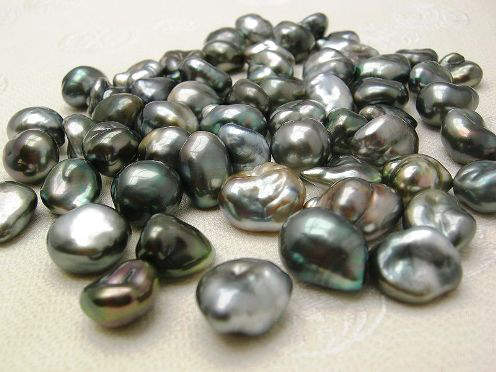
Black Tahiti Keshi Pearls
Color of the black keshi pearls
The black color of Tahitian pearls is caused by melanin pigments, secreted by special glandular cells in the mantle, at the time of nacre formation. Melanin combines with conchiolin the protein component of nacre. Aragonite, the non-protein component of nacre, composed of calcium carbonate, remains colorless and transparent, through which the black color of melanin shows through. Black and gray are the main body colors of black Tahitian pearls, as well as black Tahitian keshi pearls.
Overtones of the black keshi pearls
Apart from the black body color, black Tahitian keshi pearls also show a variety of overtone colors, which are translucent colors, appearing on top of the pearl's main body color, that tend to modify the body color and add depth and glow to a pearl. Overtone colors are not caused by pigments, but are optical effects like iridescence, caused by the interference of light as it passes through alternative layers of aragonite and conchiolin, and is dependent on the thickness of the nacre. Keshi pearls being made of nacre only, have a very high luster, orient and overtones, properties that are dependent on the thickness of nacre.
The basic body color of black keshi pearls, the possible overtone colors and the modified color of the pearls are given in the following table :-
Combination of body color and overtones in black Tahitian pearls
S/N |
Basic body color | Overtone | Combination | Special name |
| 1 | gray | yellow | yellowish-gray | Champagne |
| 2 | black | purple | purplish-black | Cherry |
| 3 | black | blue | bluish-black | Lavender |
| 4 | pale gray | - | pale gray | Moon Gray |
| 5 | black | green | greenish-black | Peacock-green or black-green |
| 6 | black | rainbow of colors | - | Peacock or Rainbow |
| 7 | black | reddish-purple | - | Aubergine or Egg plant |
| 8 | gray | purple | purple-gray | Pigeon Gray |
| 9 | gray | green | greenish-gray | Pistachio |
| 10 | gray | - | gray | Silver |
| 11 | black | gold | golden-black | Tahitian Gold |
The presence of overtones enhances the value of black Tahitian pearls and their keshis. The most sought after combination of colors in black Tahitian pearls, are Peacock, the combination of black and rainbow; Peacock-green, the combination of black and green; and pistachio, the combination of gray and green.
The source of black Tahitian pearls
The geographic range of Pinctada margaritifera the oyster species that produces black Tahitian pearls
The oyster species that produces black Tahitian pearls is Pinctada margaritifera, whose natural habitat is the Indo-Pacific waters, extending from the Persian Gulf in the Indian Ocean, through the South China Sea and the Pacific Ocean to the Gulf of California in North America. In the Pacific Ocean, the range of Pinctada margaritifera extends from Japan in the northern hemisphere to the Southern Pacific Islands of French Polynesia, reaching its greatest abundance in the atoll lagoons of Eastern Polynesia. The origin of the black Tahitian pearls in the atoll lagoons of Eastern Polynesia, is the oyster species known as Pinctada margaritifera cumingi, which has a life span of about 30 years, growing to a maximum size of about 30 cm, weighing up to 5kg. The oysters maximum pearl productive period is when it is 3-7 years old, having a diameter of 15 to 20 cm.
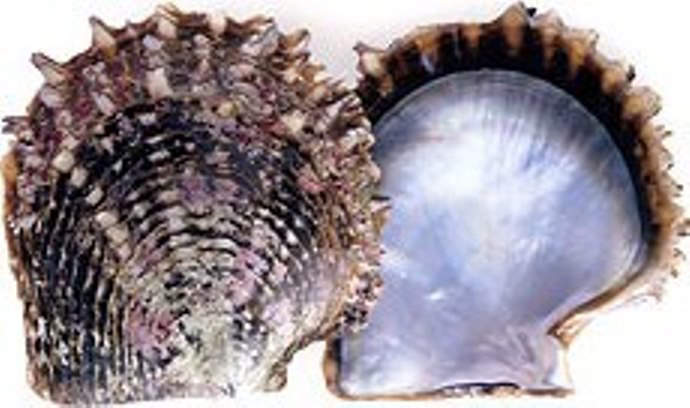
The exterior and interior of the shell valves of Black-lipped Pearl Oyster, Pinctada margaritifera
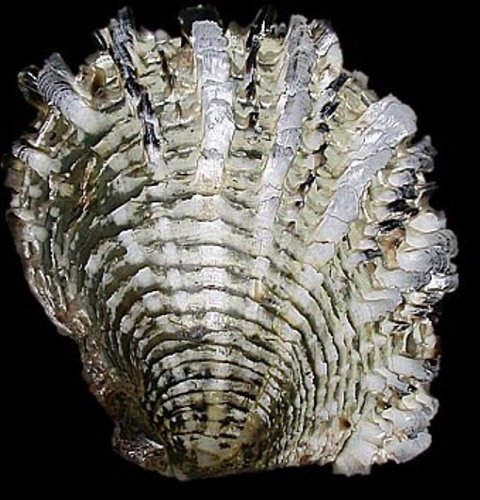
Exterior of the shell of Pinctada margaritifera - Black-lipped pearl oyster/Pacific pearl oyster
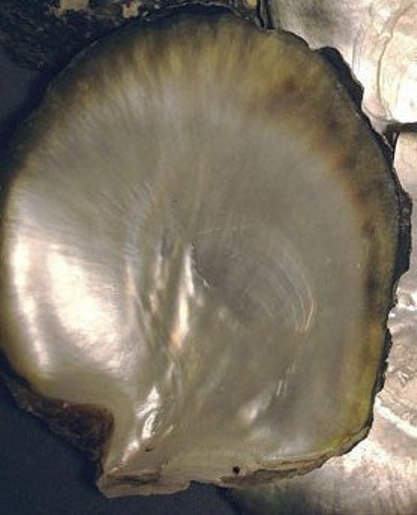
Interior of Shell of Pinctada margaritifera cumingi - Black Tahitian Pearl Oyster
Tuamotu Archipelago was the main source of natural black Tahitian pearls in ancient times
The main source of natural black Tahitian pearls since ancient times had been the Tuamotu Archipelago, situated about 300 km northeast of Tahiti. The islanders of Tuamotu, used natural black Tahitian pearls as a currency to purchase goods brought from Tahiti. The European and American explorers exploited the black-lipped pearl oyster, mainly as a source of mother-of-pearl for the shell button industry. The continuous exploitation of the oyster for over 70 years from 1802 to 1880, led to serious depletion of oyster populations, and the foreigners abandoned the atolls in 1880. Any black pearls recovered as a by product of the industry, was sold in the pearl markets of the world.
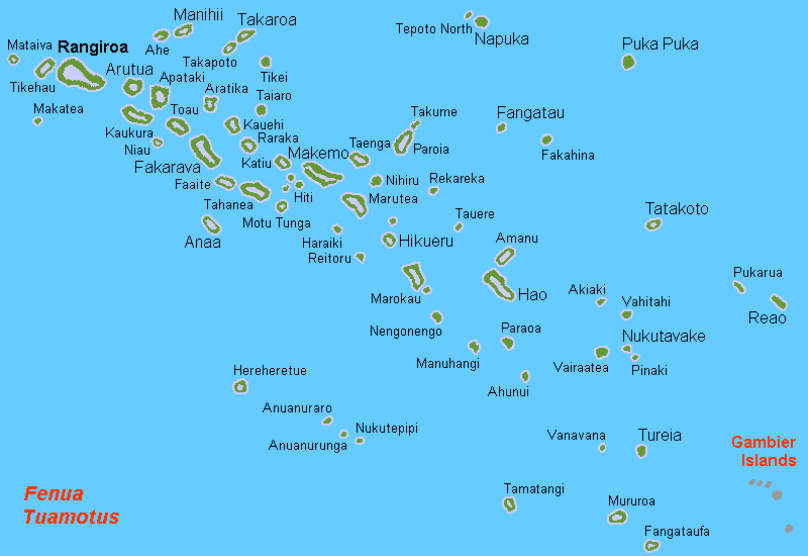
Islands of the Tuamotu Archipelago
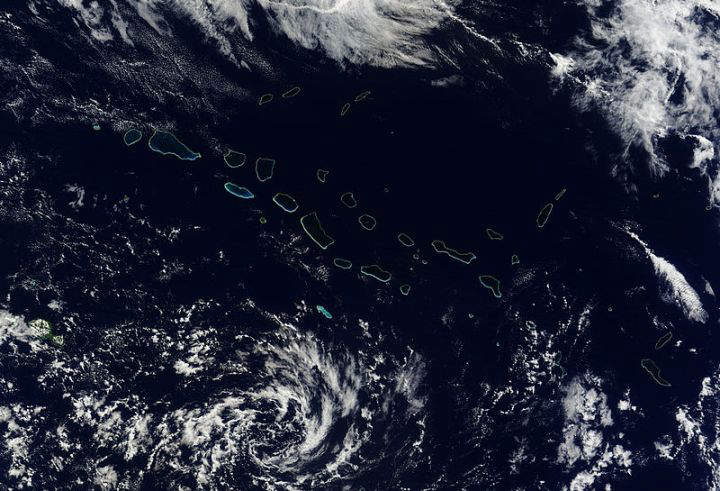
NASA's satellite image of the northwestern part of the Tuamotu Archipelago
History of the black cultured pearl industry in the French Polynesia
Kokichi Mikimoto was first person to culture black pearls using Pinctada margaritifera in 1931
After Mikimoto successfully cultured Akoya pearls in 1916, leading to the establishment of hundreds of pearl farms producing millions of cultured Akoya pearls annually, he diverted his attention towards the culturing of black pearls using the oyster species Pinctada margaritifera. At first he set up a farm on the Ishigaki Island in Okinawa to culture the black-lipped oysters, but it was not until 1931 that he was first able to culture black pearls, which eventually entered the pearl markets in the late 1930s.
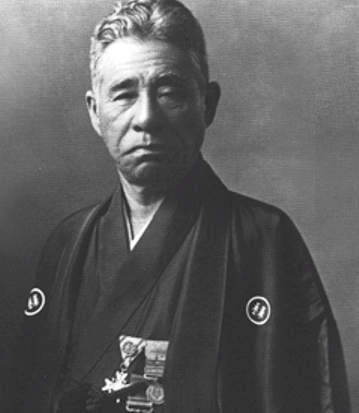
Mikimoto Kokichi, father of the modern cultured pearl industry, who was also the first to culture black pearls in 1931
The contributions of Jean-Marie Dornard, Jean-Claude Brouillet and Robert Wan in the development of the cultured pearl industry in French Polynesia
The first successful culturing of black Tahitian pearls was achieved in 1962 by the French Scientist Jean-Marie Dornard who nucleated about 5,000 oysters in two experimental farms in Hikueru in the Tuamotu Archipelago and Bora Bora in the Society Archipelago, applying Mikimoto's technique, and harvesting around 1,000 high-quality Tahitian black cultured pearls. Following this success more pearl farms were opened in both archipelagos and French Polynesia attained international recognition as a source of black Tahiti pearls.
However, the actual international popularity of black Tahitian pearls came after 1975, when production from a pearl farm owned by the French aviation pioneer of Gabon, Jean-Claude Brouillet in South Marutea that employed the services of skilled Japanese pearl culturists and technicians, hit the international pearl markets. It was Jean-Claude Brouillet together with his friend Salvator Assael, an internationally respected pearl trader, who were responsible for initially popularizing the black Tahitian pearl worldwide and making them the most sought after pearl in the world.
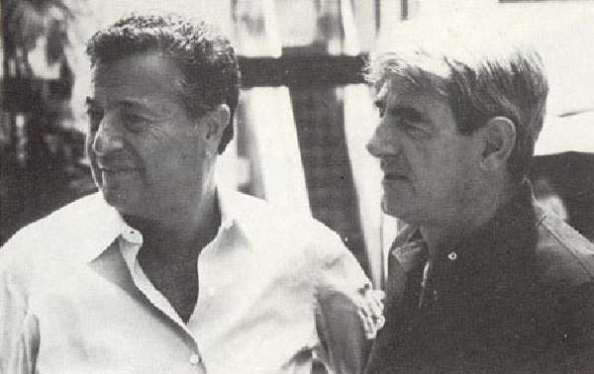
Jean-Claude Brouillet (right) and his friend Salvator Assael, who first popularized Tahitian black pearls
Photo extracted from Jean-Claude Brouillet Album Photos
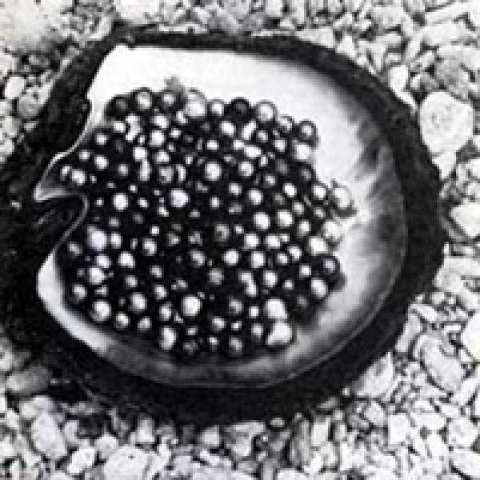
Black pearls produced in Jean-Claude Brouillet's farm in Tahiti
Photo extracted from Jean-Claude Brouillet Album Photos
In 1984, the ownership of Brouillet pearl farms were acquired by another renowned pearl culturist Robert Wan, who worked in close collaboration with the Tahitian Government, with the twin objectives of popularizing the high-quality black Tahitian cultured pearls in the international pearl markets, and making cultured pearls the country's main export commodity. Robert Wan expanded production by opening new pearl farms, and introduced quality control measures that enhanced the worldwide reputation of black Tahitian cultured pearls. In recognition of his contribution to the Tahitian pearl industry, he is popularly referred to as the "father of the black Tahitian pearl."
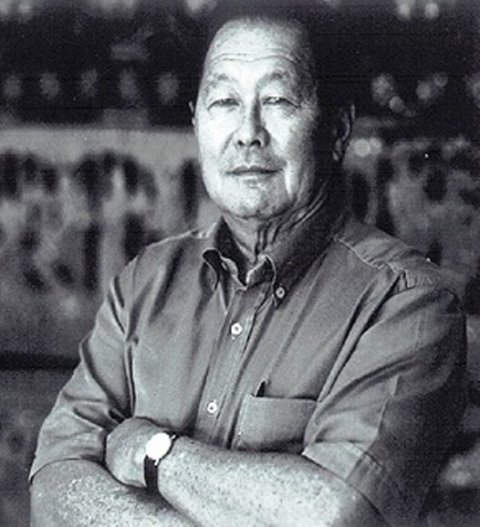
Robert Wan, father of the black Tahitian Pearl
The culturing process of black Tahitian pearls
The first step in pearl cultivation is the collection of spats (d-shaped larvae more than 24 days old) that are about to attach to a surface such as a coral reef and begin growth, by laying out spat collectors at the bottom of the lagoon, during the reproductive period, from October to February. When the spats have grown to young oysters of a certain size, they are transferred to protective baskets which are placed in deep water areas of the lagoon for 2-3 years until they become pearl productive (2.5 to 7.0 years). The protective nets are then transferred from deep waters to holding platforms near seeding laboratories, until the oysters are seeded. Seeding is done in surgically clean laboratories using sterilized equipment to reduce the chances of infection, and keshi pearl formation. Cutting instruments used are razor sharp to reduce the trauma on the oysters, and antibiotics are used to prevent infection. Oysters removed from the protective baskets are scraped and cleaned before opening. The valves of the oyster are opened carefully by the pearl technician, who then makes a small incision on the gonad with his razor sharp scalpel. A sterilized mother-of-pearl nucleus (from a Mississippi freshwater mussel) is inserted into the incision, followed by a small piece of mantle tissue from a sacrificial oyster, such that the mantle tissue lies between the bead and the gonad, with the side containing epithelial cells facing the nucleus. The valves are then closed and the grafted oysters transferred back to the protective baskets, which are then transferred back to the deep waters of the lagoon, for the husbandry or growing out period, which generally lasts for about two years. However, from time to time the baskets are hauled up and the external surfaces of the oysters cleaned to remove marine growths that can harbor parasites and diseases.
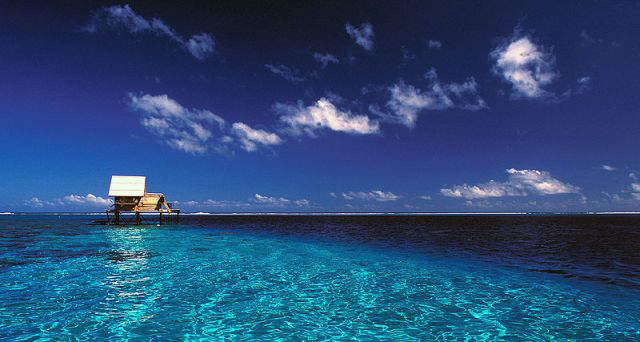
Seeding Laboratory in a pearl farm of one of the islands of Tuamotu Archipelago
Harvesting of cultured black Tahitian pearls and keshis formed in oysters that have rejected the graft
After two years the seeded oysters are brought back to the holding platform near the laboratories for harvesting. The oysters are removed from the baskets, cleaned and opened gently, and the cultured pearl extracted from the gonad. If the pearl is of good quality, the oyster is selected for a second grafting, and a second nucleus is quickly inserted followed by a small piece of mantle tissue, and the valves are closed again, and transferred to the protective baskets, for the second grow out period. During harvesting oysters are often discovered that have rejected the first graft and formed "keshis." Such oysters are not chosen for a second graft, so also are oysters that have a sickly appearance. Robust and healthy oysters are sometimes used even for a third graft, but generally the quality of the pearl decreases as the number of grafts increase, due to the increase in age of the oyster. Even though several graftings are possible in the black-lipped oyster, it is important to note that unlike freshwater mussels, these oysters can only take one graft at a time. Thus cultured black Tahitian pearls as well as cultured black Tahitian "keshis" are much scarcer than freshwater cultured pearls or their "keshis."
Tahiti pearls are not actually produced in island of Tahiti, but in other islands in the five island groups of French Polynesia
Tahiti is the largest and most densely populated island in the French Polynesia, which is part of the Society Islands group, and the capital city Papeete is also situated in this island. Even though the black cultured pearls produced in French Polynesia are known as Black Tahitian pearls, most of these pearls are not produced in Tahiti, but in various other islands, in the five island groups of the French Polynesia, chief among which are the islands of the Tuamotu archipelago such as Hikueru, Fakarava, Rangiroa, Manihi and Tikehau situated about 300 km northeast of Tahiti and the Society Islands Group, such as Bora Bora, Tahaa, Huahine, and Raiatea, situated about 200 km northwest of Tahiti.
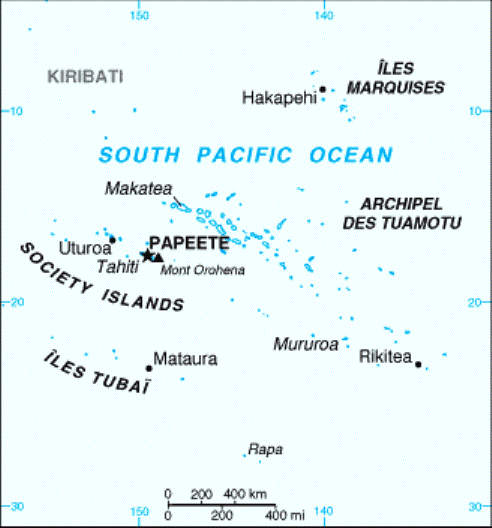
Map of the French Polynesia in the South Pacific Ocean
The Black Tahitian Keshi Pearls, Aquamarine and Diamond Necklace appears at the Bonhams Natural History Sale on Dec 6, 2009
The Black Tahitian Keshi Pearls, Aquamarine and Diamond Necklace came up for auctions at the Bonhams Natural History Sale No, 17535, held on December 6, 2009, in Los Angeles, California. The necklace was assigned Lot No. 2358 and a pre-sale estimate of USD 6,000 to 8,000 was placed on the necklace. However, the necklace remained unsold at the auction.
You are welcome to discuss this post/related topics with Dr Shihaan and other experts from around the world in our FORUMS (forums.internetstones.com)
Related :-
1) Birk's Black Tahitian Double Row Pearl Necklace
4) Keshi pearls - Non-nucleated Cultured Pearls Formed Accidentally or Intentionally in Marine Oysters.
References :-
1) Black Color Keshi Pearl, Aquamarine and Diamond Necklace - Lot No. 2358. Bonhams Natural History Sale 17535, 6 Dec 2009
2) Keshi pearls - Non-nucleated Cultured Pearls Formed Accidentally or Intentionally in Marine Oysters. www.internetstones.com
 Home
Security & Guarantee
How it Works
Technology Partners
Updated Tables
Famous Diamonds
More Famous Diamonds
Famous Pearls
Famous Gemstones
Contact Dr Shihaan Larif
Contact Senior Editor
Famous Jewelry
Reference Database
Forums
Learning Center
Gemstone Gallery
e-mail Notifications
Advertise
Press Release
About Us
Privacy Policy
Contact Us
FAQ'S
Site Map
Staff Mail Login
Staff Documents
Birthstones
History
Minerals
Shows
Live Metal Prices
Jewellery Gallery
News
Marketplace
Marketplace Support
Open Store
Online Auctions
Join Us & Contribute
Directory
Classifieds
List your products
Wholesale Trading
Post Buy Request
Go Green Policy
Site Updates
Upcoming-ToDo List
Latest News
Latest Articles
Latest Blog Updates
Chat Rooms
Job Board
User Gallery
Videos
New Newsletter Archive
Old Newsletter Archive
Jewelry & Mineral Blog
User Blogs & Social Network
Search
Answers (Q & A)
Valuation
Help me find a diamond/jewelry
pin.internetstones.com- Social Pinboard- Sart yours & connect with millions
Invite Friends From Yahoo, Gmail etc-One Click
Home
Security & Guarantee
How it Works
Technology Partners
Updated Tables
Famous Diamonds
More Famous Diamonds
Famous Pearls
Famous Gemstones
Contact Dr Shihaan Larif
Contact Senior Editor
Famous Jewelry
Reference Database
Forums
Learning Center
Gemstone Gallery
e-mail Notifications
Advertise
Press Release
About Us
Privacy Policy
Contact Us
FAQ'S
Site Map
Staff Mail Login
Staff Documents
Birthstones
History
Minerals
Shows
Live Metal Prices
Jewellery Gallery
News
Marketplace
Marketplace Support
Open Store
Online Auctions
Join Us & Contribute
Directory
Classifieds
List your products
Wholesale Trading
Post Buy Request
Go Green Policy
Site Updates
Upcoming-ToDo List
Latest News
Latest Articles
Latest Blog Updates
Chat Rooms
Job Board
User Gallery
Videos
New Newsletter Archive
Old Newsletter Archive
Jewelry & Mineral Blog
User Blogs & Social Network
Search
Answers (Q & A)
Valuation
Help me find a diamond/jewelry
pin.internetstones.com- Social Pinboard- Sart yours & connect with millions
Invite Friends From Yahoo, Gmail etc-One Click




Our Global Jewelry Industry Job Network


Buy & Sell in our Marketplace

Subscribe to our Newsletter

List in our Classifieds

List in our Directory

User Uploaded Gallery

Powered by Ultra Secure
Amazon (USA) Cloud Network

Founder Internet Stones.COM
Register in our Forums

| Featured In
|
|
|
|
|
|
|
|







Blog & Education Feed
Articles Feed
 |
 |
 |

Copyright © .Internet Stones.COM. All rights reserved.