The Blue Heart Diamond
Open FREE Unlimited Store Join Our Newsletter
Origin of Name
Lareef A. Samad B.Sc.(Hons)
The name "Blue Heart" seems to have been inspired by the rare deep blue color of the diamond and it's extraordinarily beautiful heart-shaped cut, that makes it perhaps the world's prettiest blue diamond. The "Blue Heart" diamond is sometimes known as the "Unzue" diamond, after the Argentinean woman Mrs. Unzue who owned the diamond for 43 years, having purchased it from Cartier's in 1910, two years after it's discovery. The diamond is also mistakenly referred to as the "Eugenie Blue," after Empress Eugenie of France, the empress consort of Napoleon III (1852-1870), but she could never have owned this diamond because it was discovered only in 1908.
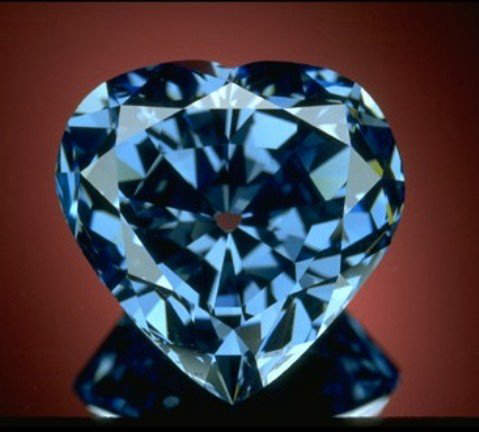
The Blue Heart Diamond
© Smithsonian institution, photo by Chip Clark

Characteristics of the Diamond
The Blue Heart diamond is a 30.62-carat, heart-shaped, brilliant-cut blue diamond. According to the Gemological Institute of America, the Blue Heart Diamond is a natural fancy deep-blue diamond, with a clarity grade of VS-2.
The "Blue Heart Diamond" enjoys the rare distinction of being the largest heart-shaped blue diamond in the world
The "Blue Heart" diamond belonging to the National Gem Collection of the Smithsonian Institution, is the 11th largest blue diamond in the world, according to our list of known famous blue diamonds in the world, arranged in descending order of carat weights. However, this blue diamond with a rare heart-shaped cut, enjoys the rare distinction of being the largest heart-shaped blue diamond in the world, a position which it had held since its cutting in Paris in 1909/1910, a position which may not change in the forseeable future, given the extreme rarity of large blue diamonds, and the rarity of the heart-shaped cut, seldom employed in blue diamonds. Apart from the 30.82-carat Blue Heart diamond, there are only three other heart-shaped blue diamonds in the table given below, an indication of the rarity of this shape. These are the 27.64-carat, "Heart of Eternity" diamond, the largest of 10 extremely rare blue diamonds exhibited at the Millennium Dome in London in the year 2,000 together with the 203.04-carat Millennium Star, the centerpiece of the exhibition; the 13.78-carat heart-shaped Begum-blue diamond; and the 5.46-carat heart-shaped Marie Antoinette blue diamond.
List of known famous blue diamonds in the world arranged in descending order of carat weights
S/N |
Name |
Price realized at Auction/Value when last sold | Country/Period of Origin | Carat weight |
Cut/Shape | Color/Clarity |
| 1 | Unnamed cushion-cut blue diamond | Cut from a 704.56-carat rough diamond Valued between $45-50 mill. | 261.00 | Cushion-cut | fancy blue | |
| 2 | Unnamed brilliant | 51.84 | Round-brilliant | fancy blue | ||
| 3 | Copenhagen Blue diamond | Named in honor of an exhibition in Copenhagen in 1960 | Jagersfontein Mine, South Africaa | 45.85 | Emerald-cut | fancy blue |
| 4 | Hope diamond | Over $300,000 in 1911. Current estimate $200-$250 mill. |
Golconda, India 1663-68 | 45.52 | Antique-cushion brilliant | fancy dark grayish- blue/VS1 |
| 5 | Tereschenko | $4.6 mill. Christie's Genv. sale Nov.1984 | Golconda, India | 42.92 | Pear-shaped | fancy blue |
| 6 | Graff Imperial Blue | Guinea | 39.81 | Pear-shaped | fancy light blue/IF | |
| 7 | Crown of Charlemagne | Last sold by Harry Winston in 1967 | 37.05 | Old-European cut | fancy light blue | |
| 8 | Wittelsbach-Graff | $24.3 mill. | Gloconda, India | 35.56 /31.06 | Cushion-shaped | fancy deep blue/IF |
| 9 | Sultan of Morocco | $250,000 in 1972, Private sale | Golconda,India | 35.27 | Cushion-cut | fancy grayish blue |
| 10 | Cornflower Blue diamond-1 | Sold by Harry Winston in 1969, later re-purchased and sold to a Middle eastern client in 1971. | Premier Mine, S.A. | 31.93 | Pear-shaped | fancy blue |
| 11 | The Blue Heart or Eugenie Blue | $300,000 in 1953. Sale by Van Cleef & Arpels after change of setting | Premier Mine, S.A. | 30.62 | Heart-shaped | fancy vivid blue |
| 12 | Blue Lili | Premier Mine, S.A. | 30.06 | Tapered cushion-cut | fancy intense blue | |
| 13 | The Heart of Eternity | Premier Mine, S.A. | 27.64 | Heart-shaped | fancy vivid blue/VS2 | |
| 14 | Transvaal Blue | Premier Mine, S.A. | 25.00 | Pear-shaped | fancy blue | |
| 15 | Sam Abram Fancy Blue diamond | $9.9 mill. Soth.NY. Oct 1994 | Premier Mine, S.A. | 20.17 | Emerald-cut | fancy vivid blue/VS2 |
| 16 | Graff Blue Ice Diamond | Premier Mine, S.A. | 20.02 | Pear-shaped | fancy deep blue | |
| 17 | The Blue Empress | Premier Mine, S.A. | 14.00 | Pear-shaped | fancy blue | |
| 18 | The Begum Blue | $7.75 mill. Christie's Geneva. November 1994 | Premier Mine, S.A. | 13.78 | Heart-shaped | fancy deep blue |
| 19 | Brunswick Blue-1 Previously believed to have been cut from the French Blue diamond |
Part of the Duke of Brunswick collection of jewels sold in 1874 | Golconda, India | 13.75 | Pear-shaped | fancy blue |
| 20 | Cut-cornered rectangular mixed-cut blue diamond | $8.87million Christie's Geneva, May 2008 |
Premier Mine, S.A. | 13.39 | Cut-cornered rectangular mixed-cut | fancy intense blue |
| 21 | Marquise-cut fancy blue diamond | $7.6 million Christie's Hong Kong, May 2011 | Premier Mine, S.A. | 13.39 | Marquise-cut | fancy blue/VVS2 |
| 22 | Cornflower Blue diamond-2 | Set in a ring and sold by Harry Winston in 1969 | Premier Mine, S.A. | 12.39 | Round brilliant | fancy blue |
| 23 | The Blue Magic | Premier Mine, S.A. | 12.02 | Modified pear-shaped | fancy vivid blue/VVS2 | |
| 24 | Bulgari Blue | $15.7 mill. Christ.NY Oct.2010 | Premier Mine, S.A. | 10.95 | Triangular-shaped | fancy vivid blue |
| 25 | Christie's N.Y. April 2007 | $2..4 million | 9.39 | Cushion-cut | fancy grayish blue | |
| 26 | Sotheby's HK. Oct. 2009 | $5.7 mill.Soth.HK. | Premier Mine, S.A. | 8.74 | Emerald-cut | fancy intense blue/VVS1 |
| 27 | Christie' Geneva, Dec.1999 | $3.2 million | Premier Mine, S.A. | 7.96 | Pear-shaped | fancy vivid blue/VS1 |
| 28 | Soth. Geneva May 2010 | $8.03 mill. | Premier Mine, S.A. | 7.64 | Cushion-cut | fancy intense blue/VVS2 |
| 29 | Christie's Hong Kong. April 2002 | $2.6 mill. | Premier Mine, S.A. | 7.15 | Pear-shaped | fancy vivid blue |
| 30 | Petra Blue/Star of Josephine | $9.5 mill. Soth. Geneva. May 2009 | Premier / Cullinan/Petra Mine.S.A. | 7.03 | Cushion-cut | fancy vivid blue/IF |
| 31 | Brunswick Blue-2 | Part of the Duke of Brunswick collection of jewels sold in 1874 | Premier Mine, S.A, | 6.50 | Pear-shaped | fancy blue |
| 32 | Christie's New York | $3.6 mill | Premier Mine, S.A. | 6.29 | Pear-shaped | fancy intense blue |
| 33 | Graff Blue diamond | Premier Mine, S.A. | 6.19 | Pear-shaped | fancy intense blue | |
| 34 | Moussaieff Jewelers unnamed blue diamond | $7.98 mill Sotheby's HK, Oct.2007 | Premier Mine, S.A. | 6.04 | Emerald-cut | fancy vivid blue |
| 35 | Sotheby's HK, Oct.2011 | $10.1 mill. Soth.HK. | Premier Mine, S.A. . | 6.01 | Cushion-cut | fancy vivid blue |
| 36 | Sotheby's Geneva, Nov.2009 | $7.5 mill | Premier Mine, S.A. . | 5.96 | Pear-shaped modified brilliant | fancy vivid blue |
| 37 | Christie's Geneva, Dec.1999 | $1.13 mill. | Premier Mine, S.A. | 5.80 | Pear-shaped | fancy intense blue/IF |
| 38 | Marie Antoinette Blue diamond | Set in a ring said to have belonged to Marie Antoinette. Last offered for sale in1983 but not sold | Golconda,India |
5.46 | Heart-shaped | fancy grayish-blue |
| 39 | De Beers Millennium Blue, Jewel II- Apr.2010 Sotheby's HK | $6.4 mill. Soth.HK. | Premier Mine, S.A. |
5.16 | Pear-shaped | fancy vivid blue/IF |
| 40 | toi et moi ring - Soth. Geneva May 2010 | $6.32 mill. | Premier Mine, S.A. | 5.02 5.42 |
Pear-shaped Pear-shaped |
fancy vivid blue D-color |
| 41 | Christie's Geneva, Dec.1999 | $1.24 mill. | Premier Mine, S.A. | 4.77 | Circular-cut | fancy deep blue/VS2 |
| 42 | Soth. Geneva. Nov,2007 | $4.7 mill | Premier Mine, S.A. | 4.16 | Pear-shaped | fancy vivid blue/ |
| 43 | Bulgari Blue | $2.97 mill. Bonhams Lond. 2011 | Premier Mine, S.A. | 3.78 | Pear-shaped | fancy vivid blue |
| 44 | Soth. Geneva May 2008 | $4.96 mill | Premier Mine, S.A. | 3.73 | Pear-shaped | fancy vivid blue |
| 45 | Aleks Paul of Essex Global Trading | $3.6 mill Christie's NY Apr. 2011 | Premier Mine, S.A. | 3.25 | Square Emerald cut | fancy vivid blue/IF |
| 46 | Christie's NY Oct.2011 | $2.7mill | Premier Mine, S.A. | 3.21 | Modified Pear-shape | fancy vivid blue |
| 47 | Sotheby's NY. Apr. 2011 | $3.27 mill. | Premier Mine, S.A. | 3.18 | Marquise-cut | fancy vivid blue /IF |
©Internet Stones.com
Please do not copy our tables without our permission. We may be compelled to inform the search engines if our content and tables are plagiarised.
The Blue Heart Diamond is a rare Type IIb diamond
The Blue heart diamond is a rare Type IIb diamond, and all naturally colored blue diamonds belong to this group. However, the occurrence of these diamonds is much less than 0.1 % of all natural diamonds. Type II diamonds are nitrogen-free or contain undetectable quantities of nitrogen.
If the diamonds are not only nitrogen-free but free of all other chemical impurities, they are known as Type IIa, which constitute about 1-2 % of all naturally occurring diamonds. However, instead of nitrogen, if they contain trace quantities of another impurity boron, the diamonds are known as Type IIb. Boron atoms incorporated in the crystal structure of the diamond, changes it's absorption spectrum imparting the blue color to the diamonds. The diamonds also become semi-conducting, unlike other diamonds which are non-conductors of electricity.
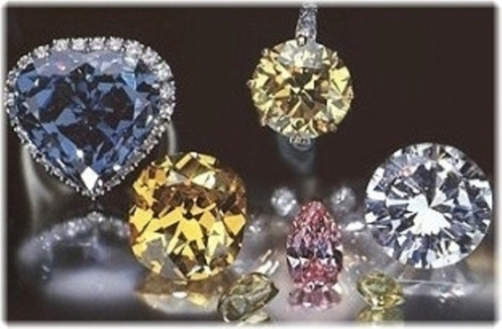
Blue Heart diamond exhibited with the Shepard diamond (yellow cushion-shaped), the Pearson diamond (white round-brilliant) and other diamonds
© Smithsonian institution, photo by Chip Clark
History
Doubts about the origin of the Blue Heart diamond cleared by researches of the National Museum of Natural History of the Smithsonian Institution
Previously the origin of the Blue Heart diamond was uncertain, and thought to be either India or South Africa, even though by the beginning of the 20th century, most of the historical diamond mines of the Eastern Deccan Plateau in India were already abandoned.
However, this mystery has been solved and more information about the diamond has been unearthed, thanks to the untiring efforts of the dedicated scientists of the Natural History Museum of the Smithsonian Institution, the present owners of the diamond. The researches went into the archives of De Beers, and unearthed evidence to show that the diamond was discovered in the Premier diamond mines of South Africa, in November, 1908, and the rough stone weighed 100.5 carats.
Mistaken reference to "Blue Heart Diamond" as "Eugenie Blue Diamond" corrected after the Smithsonian research
The "Blue Heart" diamond was earlier mistakenly referred to as the "Eugenie Blue" diamond, because of the misconceived notion, that the diamond once belonged, to Empress Eugenie of France, the Empress consort of Napoleon III (1852-1870). However,we now know for certain that Empress Eugenie, who reigned between 1852 and 1870, could never have owned this diamond, because it was discovered only in 1908.
The French Connection to the Blue Heart Diamond
The Blue Heart diamond certainly did not belong to Empress Eugenie of France, but undoubtedly there is a French connection to this diamond, as the rough diamond was cut and polished, and transformed into it's modern heart-shaped form by the renowned French diamond cutting firm, Atanik Ekyanan of Neuilly, Paris between 1909 and 1910. The cut and polished diamond was sold in 1910 to Cartier's, who set the diamond in a "Lily of the Valley" corsage and sold it to an Argentinean woman Mrs. Unzue in 1911.
The Blue Heart Diamond is sometimes referred to as the "Unzue Diamond" as the Unzue family owned the diamond, until 1953
The diamond remained in the Unzue family for 42 years and hence the diamond is sometimes referred to as the "Unzue Diamond." In 1953, it was purchased by the jewelry firm Van Cleef & Arpels, who dismantled the corsage setting, and re-set the diamond in a pendant, surrounded by 25 colorless or white diamonds. The pendant and the accompanying necklace was priced at US$ 300,000, and was sold to an unnamed European titled family.
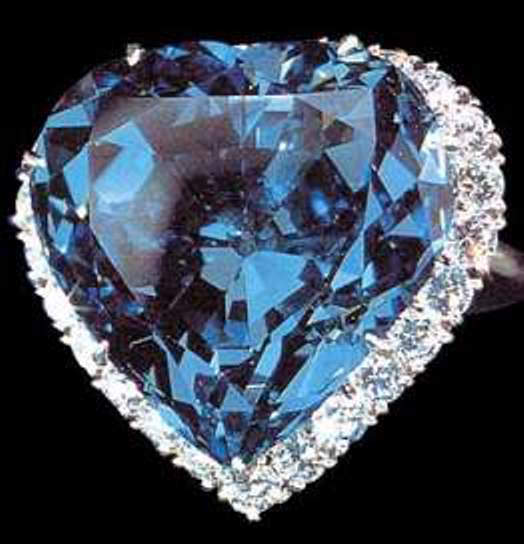
Harry Winston's setting of the Blue Heart diamond on a platinum ring, surrounded by 25 white diamonds.
Harry Winston's setting of the Blue Heart diamond on a platinum ring, surrounded by 25 white diamonds.
In 1959, Harry Winston acquired the diamond, and re-set it again in a platinum ring, surrounded by 25 colorless/white, round brilliant-cut diamonds and sold it to Marjorie Merriweather Post, the American socialite and founder of General Foods Inc., in 1960.
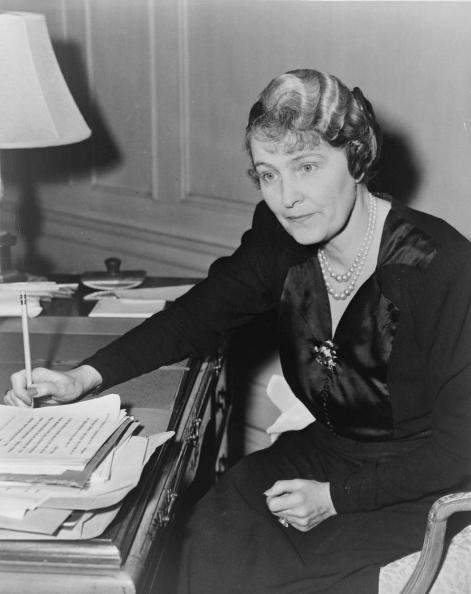
Marjorie Merriweather Post Hutton Davies - American Socialite and founder of General Foods, Inc.
Marjorie Merriweather Post generously donates the Blue Heart Diamond in 1964 to National Museum of Natural History of the Smithsonian Institution
The diamond remained with Mrs. Post until the year 1964, when she finally decided to generously donate the rare blue diamond to the National Museum of Natural History of the Smithsonian Institution, at Washington DC, where it is on display in the Janet Annenberg Hooker Hall of Geology, Gems and Minerals.
The sale of a rare fancy vivid blue diamond weighing 6.04 carats at a Sotheby's auction in Hong Kong, on October 8, 2007, for US$ 7.98 million, sets a record-breaking per-carat-price of US$ 1.32 million, breaking the 20-year-old world record previously set by the Hancock Red diamond, of US$ 926,000 per carat in 1987.
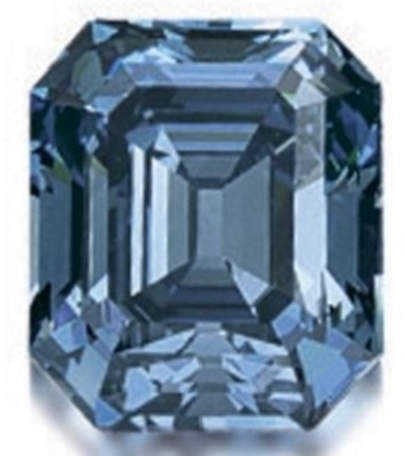
6.04-carat, fancy vivid blue diamond sold at Sotheby's Hong Kong in October 2007 for a record-breaking US$ 7.98 million
Natural blue diamonds surpass all other gemstones for their sheer beauty, and it is this uniqueness in their beauty combined with their rarity, that make them the most sought after diamonds by collectors and connoisseurs, around the world. The sale of a rare fancy vivid blue diamond weighing 6.04 carats at a Sotheby's auction in Hong Kong, on October 8, 2007, for a record-breaking price of 7.98 million, therefore comes as little surprise to those in the trade and the well informed. The $ 1.32 million per carat price of this diamond has broken the 20-year old world record, set by the Hancock Red (Halphen Red) diamond in 1987, which sold at $ 926,000 per carat. The diamond is reported to have been purchased by Moussaieff Jewelers of London, who in 2001 purchased another extremely rare 5.11-carat red diamond known as the "Red Shield," for an undisclosed amount, from the William Goldberg Corporation of New York. The Red Shield was subsequently re-named the "Moussaieff Red," which is the largest red diamond in the world.
You are welcome to discuss this post/related topics with Dr Shihaan and other experts from around the world in our FORUMS (forums.internetstones.com)
Related :-
External Links :-
Blue Heart Diamond-www.mineralsciences.si.edu/collections/gemgallery
References :-
1) Famous Diamonds -by Ian balfour
2) The National Gem Collection - by Jeffrey E. Post
3) Smithsonian's National Museum of Natural History -Division of Mineralogy - Gem Gallery - Blue Heart Diamond -www.mineralsciences.si.edu/collections/gemgallery
 Home
Security & Guarantee
How it Works
Technology Partners
Updated Tables
Famous Diamonds
More Famous Diamonds
Famous Pearls
Famous Gemstones
Contact Dr Shihaan Larif
Contact Senior Editor
Famous Jewelry
Reference Database
Forums
Learning Center
Gemstone Gallery
e-mail Notifications
Advertise
Press Release
About Us
Privacy Policy
Contact Us
FAQ'S
Site Map
Staff Mail Login
Staff Documents
Birthstones
History
Minerals
Shows
Live Metal Prices
Jewellery Gallery
News
Marketplace
Marketplace Support
Open Store
Online Auctions
Join Us & Contribute
Directory
Classifieds
List your products
Wholesale Trading
Post Buy Request
Go Green Policy
Site Updates
Upcoming-ToDo List
Latest News
Latest Articles
Latest Blog Updates
Chat Rooms
Job Board
User Gallery
Videos
New Newsletter Archive
Old Newsletter Archive
Jewelry & Mineral Blog
User Blogs & Social Network
Search
Answers (Q & A)
Valuation
Help me find a diamond/jewelry
pin.internetstones.com- Social Pinboard- Sart yours & connect with millions
Invite Friends From Yahoo, Gmail etc-One Click
Home
Security & Guarantee
How it Works
Technology Partners
Updated Tables
Famous Diamonds
More Famous Diamonds
Famous Pearls
Famous Gemstones
Contact Dr Shihaan Larif
Contact Senior Editor
Famous Jewelry
Reference Database
Forums
Learning Center
Gemstone Gallery
e-mail Notifications
Advertise
Press Release
About Us
Privacy Policy
Contact Us
FAQ'S
Site Map
Staff Mail Login
Staff Documents
Birthstones
History
Minerals
Shows
Live Metal Prices
Jewellery Gallery
News
Marketplace
Marketplace Support
Open Store
Online Auctions
Join Us & Contribute
Directory
Classifieds
List your products
Wholesale Trading
Post Buy Request
Go Green Policy
Site Updates
Upcoming-ToDo List
Latest News
Latest Articles
Latest Blog Updates
Chat Rooms
Job Board
User Gallery
Videos
New Newsletter Archive
Old Newsletter Archive
Jewelry & Mineral Blog
User Blogs & Social Network
Search
Answers (Q & A)
Valuation
Help me find a diamond/jewelry
pin.internetstones.com- Social Pinboard- Sart yours & connect with millions
Invite Friends From Yahoo, Gmail etc-One Click




Our Global Jewelry Industry Job Network


Buy & Sell in our Marketplace

Subscribe to our Newsletter

List in our Classifieds
List in our Directory

User Uploaded Gallery

Powered by Ultra Secure
Amazon (USA) Cloud Network

Founder Internet Stones.COM
Register in our Forums

| Featured In
|
|
|
|
|
|
|
|







Blog & Education Feed
Articles Feed
 |
 |
 |

Copyright © .Internet Stones.COM. All rights reserved.