Blue Magic Diamond
Open FREE Unlimited Store Join Our Newsletter
Lareef A Samad B.Sc. (Hons)
Origin of Name
The name "Blue Magic" for the diamond seems to emphasize the rare fancy vivid blue color of the diamond, the highest color grading for a blue diamond, which is an extremely rare occurrence. The phenomenon of blue diamonds is an extremely rare occurrence in nature; on top of that to have a fancy vivid blue diamond, the highest color grading for any color, becomes a "rarest of the rare" occurrences in nature. The sight of the diamond even on a photograph is breathtaking, talk less of having a first hand experience in viewing the diamond, whose beauty would be unimaginable.
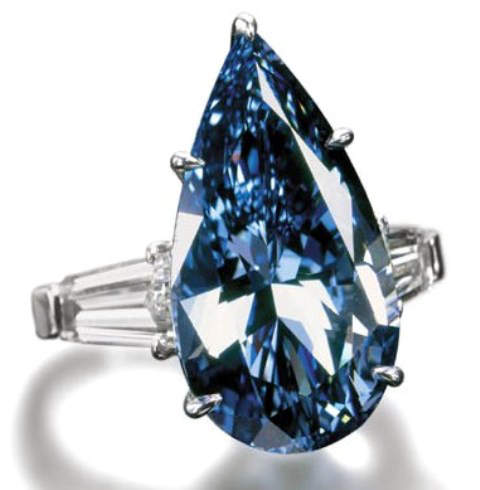
Blue Magic diamond set in an 18-carat white gold ring
© Christie's

Characteristics of the diamond
The 4Cs of the diamond
The GIA certificate issued for this diamond on June 19, 2001, states, that it has a modified pear-shaped cut, with a weight of 12.02 carats. The diamond is further stated to be a naturally colored, fancy vivid blue diamond, with a clarity of VVS-2, only slightly less than internally flawless. The dimensions of the diamond are 21.42 x 11.61 x 7.76 mm
Overall position occupied by the Blue Magic Diamond in the table of blue diamonds
The Blue Magic diamond occupies the 23rd position, in the list of known famous blue diamonds in the world, given below. It is the 8th largest pear-shaped blue diamond in the world, after the first seven pear-shaped diamonds, which are in order, the Tereschenko, Graff Imperial Blue, the 31.93-carat Cornflower Blue, Transvaal Blue, Graff Blue Ice, Blue Empress and Brunswick Blue diamonds. It may also be the 4th largest fancy vivid blue diamond in the world, after the Blue Heart, Heart of Eternity, and Sam Abram fancy vivid blue diamonds, if the color gradings of all diamonds in the table below are accurate.
List of known famous blue diamonds in the world arranged in descending order of carat weights
S/N |
Name |
Price realized at Auction/Value when last sold | Country/Period of Origin | Carat weight |
Cut/Shape | Color/ Clarity |
| 1 | Unnamed cushion-cut blue diamond | Cut from a 704.56-carat rough diamond Valued between $45-50 mill. | 261.00 | Cushion-cut | fancy blue | |
| 2 | Unnamed brilliant | 51.84 | Round-brilliant | fancy blue | ||
| 3 | Copenhagen Blue diamond | Named in honor of an exhibition in Copenhagen in 1960 | Jagersfontein Mine, South Africaa | 45.85 | Emerald-cut | fancy blue |
| 4 | Hope diamond | Over $300,000 in 1911. Current estimate $200-$250 mill. |
Golconda, India 1663-68 | 45.52 | Antique-cushion brilliant | fancy dark grayish- blue/VS1 |
| 5 | Tereschenko | $4.6 mill. Christie's Genv. sale Nov.1984 | Golconda, India | 42.92 | Pear-shaped | fancy blue |
| 6 | Graff Imperial Blue | Guinea | 39.81 | Pear-shaped | fancy light blue/IF | |
| 7 | Crown of Charlemagne | Last sold by Harry Winston in 1967 | 37.05 | Old-European cut | fancy light blue | |
| 8 | Wittelsbach-Graff | $24.3 mill. | Gloconda, India | 35.56 /31.06 | Cushion-shaped | fancy deep blue/IF |
| 9 | Sultan of Morocco | $250,000 in 1972, Private sale | Golconda,India | 35.27 | Cushion-cut | fancy grayish blue |
| 10 | Cornflower Blue diamond-1 | Sold by Harry Winston in 1969, later re-purchased and sold to a Middle eastern client in 1971. | Premier Mine, S.A. | 31.93 | Pear-shaped | fancy blue |
| 11 | The Blue Heart or Eugenie Blue | $300,000 in 1953. Sale by Van Cleef & Arpels after change of setting | Premier Mine, S.A. | 30.62 | Heart-shaped | fancy vivid blue |
| 12 | Blue Lili | Premier Mine, S.A. | 30.06 | Tapered cushion-cut | fancy intense blue | |
| 13 | The Heart of Eternity | Premier Mine, S.A. | 27.64 | Heart-shaped | fancy vivid blue/VS2 | |
| 14 | Transvaal Blue | Premier Mine, S.A. | 25.00 | Pear-shaped | fancy blue | |
| 15 | Sam Abram Fancy Blue diamond | $9.9 mill. Soth.NY. Oct 1994 | Premier Mine, S.A. | 20.17 | Emerald-cut | fancy vivid blue/VS2 |
| 16 | Graff Blue Ice Diamond | Premier Mine, S.A. | 20.02 | Pear-shaped | fancy deep blue | |
| 17 | The Blue Empress | Premier Mine, S.A. | 14.00 | Pear-shaped | fancy blue | |
| 18 | The Begum Blue | $7.75 mill. Christie's Geneva. November 1994 | Premier Mine, S.A. | 13.78 | Heart-shaped | fancy deep blue |
| 19 | Brunswick Blue-1 Previously believed to have been cut from the French Blue diamond |
Part of the Duke of Brunswick collection of jewels sold in 1874 | Golconda, India | 13.75 | Pear-shaped | fancy blue |
| 20 | Cut-cornered rectangular mixed-cut blue diamond | $8.87million Christie's Geneva, May 2008 |
Premier Mine, S.A. | 13.39 | Cut-cornered rectangular mixed-cut | fancy intense blue |
| 21 | Marquise-cut fancy blue diamond | $7.6 million Christie's Hong Kong, May 2011 | Premier Mine, S.A. | 13.39 | Marquise-cut | fancy blue/VVS2 |
| 22 | Cornflower Blue diamond-2 | Set in a ring and sold by Harry Winston in 1969 | Premier Mine, S.A. | 12.39 | Round brilliant | fancy blue |
| 23 | The Blue Magic | Premier Mine, S.A. | 12.02 | Modified pear-shaped | fancy vivid blue/VVS2 | |
| 24 | Bulgari Blue | $15.7 mill. Christ.NY Oct.2010 | Premier Mine, S.A. | 10.95 | Triangular-shaped | fancy vivid blue |
| 25 | Christie's N.Y. April 2007 | $2..4 million | 9.39 | Cushion-cut | fancy grayish blue | |
| 26 | Sotheby's HK. Oct. 2009 | $5.7 mill.Soth.HK. | Premier Mine, S.A. | 8.74 | Emerald-cut | fancy intense blue/VVS1 |
| 27 | Christie' Geneva, Dec.1999 | $3.2 million | Premier Mine, S.A. | 7.96 | Pear-shaped | fancy vivid blue/VS1 |
| 28 | Soth. Geneva May 2010 | $8.03 mill. | Premier Mine, S.A. | 7.64 | Cushion-cut | fancy intense blue/VVS2 |
| 29 | Christie's Hong Kong. April 2002 | $2.6 mill. | Premier Mine, S.A. | 7.15 | Pear-shaped | fancy vivid blue |
| 30 | Petra Blue/Star of Josephine | $9.5 mill. Soth. Geneva. May 2009 | Premier / Cullinan/Petra Mine.S.A. | 7.03 | Cushion-cut | fancy vivid blue/IF |
| 31 | Brunswick Blue-2 | Part of the Duke of Brunswick collection of jewels sold in 1874 | Premier Mine, S.A, | 6.50 | Pear-shaped | fancy blue |
| 32 | Christie's New York | $3.6 mill | Premier Mine, S.A. | 6.29 | Pear-shaped | fancy intense blue |
| 33 | Graff Blue diamond | Premier Mine, S.A. | 6.19 | Pear-shaped | fancy intense blue | |
| 34 | Moussaieff Jewelers unnamed blue diamond | $7.98 mill Sotheby's HK, Oct.2007 | Premier Mine, S.A. | 6.04 | Emerald-cut | fancy vivid blue |
| 35 | Sotheby's HK, Oct.2011 | $10.1 mill. Soth.HK. | Premier Mine, S.A. . | 6.01 | Cushion-cut | fancy vivid blue |
| 36 | Sotheby's Geneva, Nov.2009 | $7.5 mill | Premier Mine, S.A. . | 5.96 | Pear-shaped modified brilliant | fancy vivid blue |
| 37 | Christie's Geneva, Dec.1999 | $1.13 mill. | Premier Mine, S.A. | 5.80 | Pear-shaped | fancy intense blue/IF |
| 38 | Marie Antoinette Blue diamond | Set in a ring said to have belonged to Marie Antoinette. Last offered for sale in1983 but not sold | Golconda,India |
5.46 | Heart-shaped | fancy grayish-blue |
| 39 | De Beers Millennium Blue, Jewel II- Apr.2010 Sotheby's HK | $6.4 mill. Soth.HK. | Premier Mine, S.A. |
5.16 | Pear-shaped | fancy vivid blue/IF |
| 40 | toi et moi ring - Soth. Geneva May 2010 | $6.32 mill. | Premier Mine, S.A. | 5.02 5.42 |
Pear-shaped Pear-shaped |
fancy vivid blue D-color |
| 41 | Christie's Geneva, Dec.1999 | $1.24 mill. | Premier Mine, S.A. | 4.77 | Circular-cut | fancy deep blue/VS2 |
| 42 | Soth. Geneva. Nov,2007 | $4.7 mill | Premier Mine, S.A. | 4.16 | Pear-shaped | fancy vivid blue/ |
| 43 | Bulgari Blue | $2.97 mill. Bonhams Lond. 2011 | Premier Mine, S.A. | 3.78 | Pear-shaped | fancy vivid blue |
| 44 | Soth. Geneva May 2008 | $4.96 mill | Premier Mine, S.A. | 3.73 | Pear-shaped | fancy vivid blue |
| 45 | Aleks Paul of Essex Global Trading | $3.6 mill Christie's NY Apr. 2011 | Premier Mine, S.A. | 3.25 | Square Emerald cut | fancy vivid blue/IF |
| 46 | Christie's NY Oct.2011 | $2.7mill | Premier Mine, S.A. | 3.21 | Modified Pear-shape | fancy vivid blue |
| 47 | Sotheby's NY. Apr. 2011 | $3.27 mill. | Premier Mine, S.A. | 3.18 | Marquise-cut | fancy vivid blue /IF |
©Internet Stones.com
Please do not copy our tables without our permission. We may be compelled to inform the search engines if our content and tables are plagiarised.
The Blue Magic Diamond is a rare Type IIb diamond
The Blue Magic diamond is a rare Type IIb diamond, whose occurrence is less than 0.1 % of all naturally occurring diamonds. The diamond is Type II, because it is nitrogen-free or contains undetectable quantities of nitrogen. Type II diamonds diamonds are again divided into two :- Type IIa and Type IIb.
Type IIa - These diamonds are not only free of nitrogen but also free of all other chemical impurities, such as boron and hydrogen. Being free of impurities, these diamonds are absolutely colorless. The D-F grade of diamonds may belong to this group. They constitute about 1-2 % of all naturally occurring diamonds. However, a very small percentage of these diamonds, perhaps lees than 0.1 % might have undergone plastic deformation in their crystal structure or might have been exposed to natural irradiation over a long period of time. Plastically deformed crystals have rare fancy colors, such as red, purple, and pink, and also brown color. Naturally irradiated crystals, have a green color
Type IIb - These diamonds are free of nitrogen, but instead contain trace quantities of another impurity, boron, which imparts a blue color to the diamonds. All naturally colored blue diamonds fall under this group, including the Blue Magic diamond. A peculiar property of blue diamonds is, that they are semi-conductors, unlike other diamonds which are non-conductors of electricity. The occurrence of blue diamonds is less than 0.1 % of all naturally occurring diamonds.
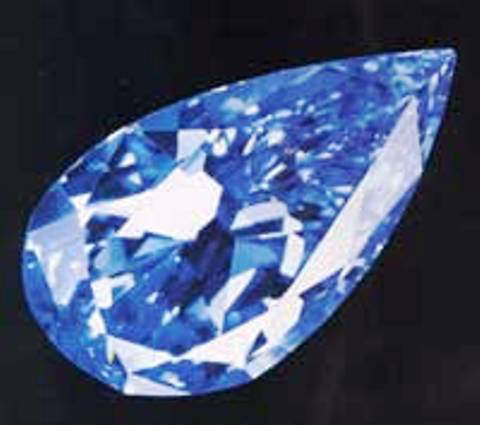
The Blue Magic Diamond removed from its ring setting
© Christie's
History
Early history of the diamond not known
The early history of the diamond, such as country and mine of origin, date of discovery, original owners of the diamond, persons involved in the cutting etc. are all unknown. However, an indication of the country and mine of origin can be obtained from the approximate period of appearance of the diamond, given the fact that sources of blue diamonds in the world are very limited.
Existence of the Blue Magic Diamond first revealed in 2001
The existence of the Blue Magic Diamond was first revealed to the outside world, when its anoymous owner entrusted Christie's to put it up for auction at its "Simply Blue" Sale 1289, held in Geneva on November 13, 2001. The 12.02-carat, modified pear-shaped, fancy vivid blue diamond, was set as the centerpiece of a white gold ring, with a tapered baguette cut diamond mounted on either side on the shoulders of the ring. A pre-sale estimate of US$ 5-6 million was placed on the ring, but was however withdrawn from the sale, as it did not realize it's reserve. Since then the diamond has not come up for auction again, and probably still remains the property of the anonymous owner who put it up for auction in 2001, unless of course the diamond was not disposed of by a privately negotiated sale. Given the fact that the diamond first made its appearance at the beginning of the 21st century, undoubtedly shows that the diamond is of 20th century origin.
The original source of blue diamonds in the world was the Kollur mines of Golconda
Historically, the original source of blue diamonds was the Kollur mines near Golconda, in the Southern Indian State of Andhra Pradesh. Golconda was a fortress city, now ruined, lying 8 Km west of Hyderabad City, in North-Central Andhra Pradesh State of Southern India. It was the Capital of the Qutub Shahi Kingdom from 1512 to 1687, one of the five Muslim Sultanates of the Deccan. This was also the period, when the Kollur mines, discovered in the early 16th century, had peak production outputs, as witnessed by Tavernier himself, when he visited Golconda in 1642. Around 20 highly productive mines, employing over 60,000 people were in active production during Tavernier's visit.
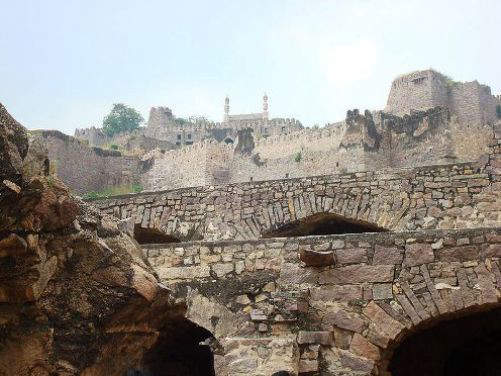
The ruined Fortress of Golconda
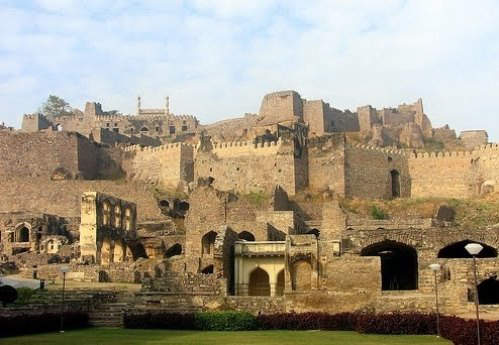
Another view of the ruined fortress of Golconda
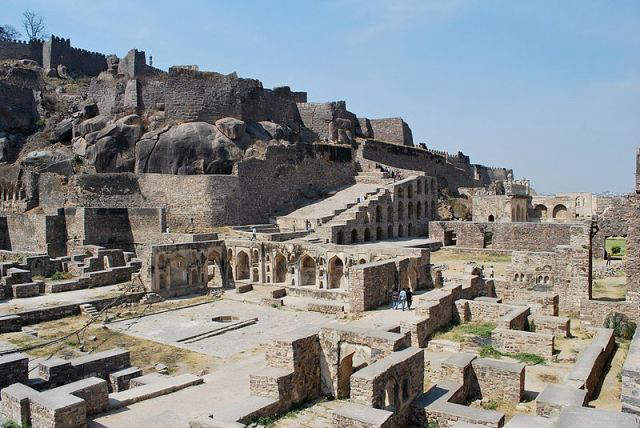
Ruined palaces of the Golconda Fortress
The territory of Golconda lies between the lower reaches of the Godavari and Krishna rivers, and extended to the Bay of Bengal coast. In 1687, the ruling dynasty of Qutub Shahis was overthrown by the Mogul Emperor Aurangzeb, and Golconda was annexed to the Mogul Empire (1526-1857). The Golconda fortress is 3 miles in circumference, with concentric masonary-block walls. Palaces, mosques, and the Qutub Shahi tombs still remain in-tact. The diamonds seem to have been derived from the conglomerate rocks of the nearby hills. The diamond mines known as the Kollur mines, were actually situated around 100 miles east of Golconda, on the right bank of the Krishna river, west of Chintapilly. All diamonds discovered in the Kollur and other mines in the area found their way to the diamond market in the city of Golconda, which was also patronized by foreign nationals such as Persians and Europeans. Several historically important diamonds such as the Hope, Darya-i-Nur, Nur-ul-Ain, Tereschenko, Dresden Green, Shah, Shah Jahaan, Idol's Eye etc. seem to have originated in these mines.
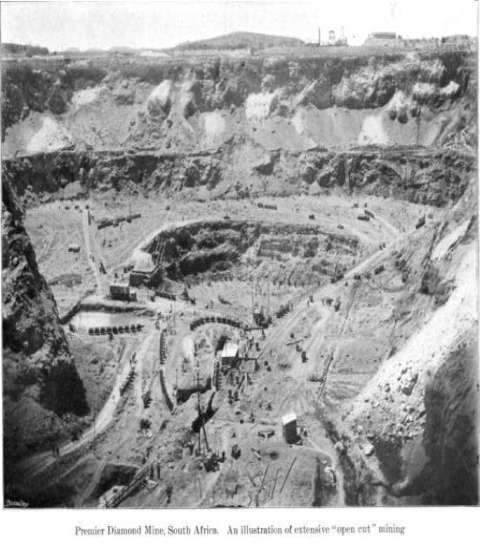
Extensive open-pit mining at the Premier Diamond Mines circa 1918
The present day source of blue diamonds are the Premier/Cullinan/Petra Diamond mines of Transvaal, South Africa
The Indian deposits of diamonds including the blue diamonds are now completely exhausted, and the present day source of blue diamonds is mainly the Premier diamond mines in Transvaal, South Africa. The Blue Magic diamond, being a 20th century diamond, also seems to have originated in these mines. The eleven extremely rare blue diamonds that formed part of the De Beers Limited Edition Millennium Diamonds Collection, exhibited at the Millennium Dome throughout the year 2000, were all sourced from the Premier diamond mines in South Africa.
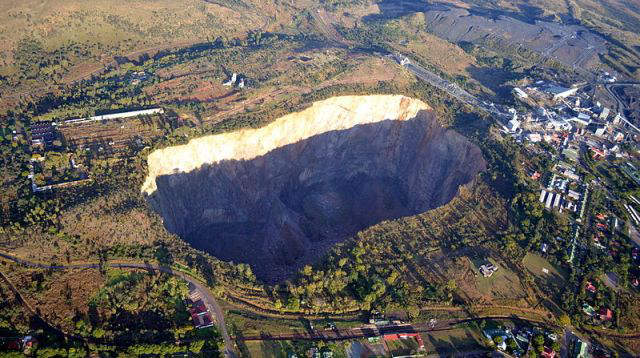
Photograph of Premier Diamond Mine taken by Paul Parsons in May 2011
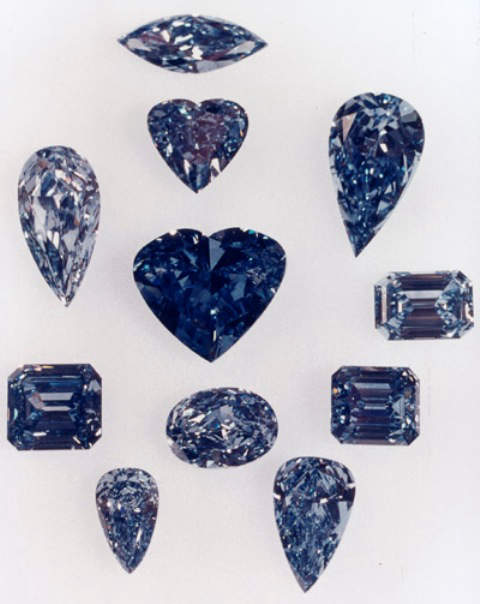
The eleven De Beers Millennium Blue Diamonds exhibited at the London's Millennium Dome
The occurrence of blue diamonds is much less than 0.1%
The occurrence of blue diamonds is said to be extremely rare, but if this statement is to be quantified a statistical analysis of the production of blue diamonds in the Premier mines becomes necessary. It is said that only one significant blue diamond is produced per year out of all the Premier diamond mines rough diamond production for an year. This will be much less than 0.1 %. If for example a 10 carat blue diamond was produced in an year when the total production was approximately one million carats, the percentage production works out to 0.001%. For pink diamonds the percentage production is even lower than that for blue diamonds. In the Argyle mines in Western Australia, only a single carat of pink diamond is produced for every one million carats of rough diamonds. This works out to an astonishingly low percentage of 0.0001 % !!!
Rare blue diamond breaks world record at Sotheby's auction in Hong Kong-October 8th 2007.
The best blue diamonds surpass all other gems for their sheer beauty. It is a combination of color, brilliance and rarity that makes blue diamonds so special. Blue diamonds are greatly admired and eagerly sought after by collectors and connoisseurs of diamonds. As such there is little wonder that a rare blue diamond weighing only 6.04 carats (Diamond No. 34 in the above table) is reported to have broken the 20-year old world record for price per carat, held by the "Hancock Red" diamond. The record-breaking sale took place at a Sotheby's auction in Hong Kong, held on Monday, October 8th, 2007. The internally flawless, fancy vivid blue diamond, belonging to a private Asian collector fetched a price of US$ 7.98 million at the auction, which works out to a record-breaking price of US$ 1.32 million per carat. The diamond was purchased by Moussaieff Jewelers of London. The previous record held by the "Hancock Red" diamond was U. S. $ 926,000 per carat, and was purchased by the agents of the Sultan of Brunei, at a Sotheby's auction held in 1987. The Hancock Red actually had a weight of only 0.95 carats, and sold for U.S. $ 880,000. This works out to a price of U.S.$ 926,000.
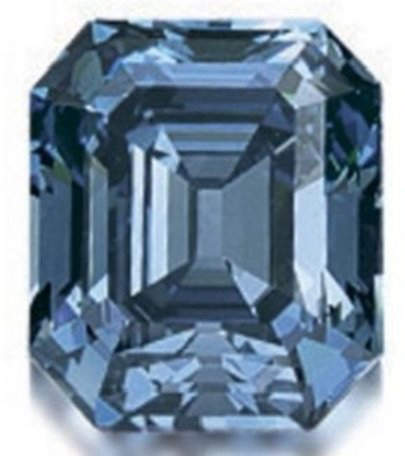
6.04-carat, fancy vivid blue diamond sold at Sotheby's Hong Kong in October 2007 for US$ 7.98 million sets a record-breaking price-per-carat of US$ 1.32 million
You are welcome to discuss this post/related topics with Dr Shihaan and other experts from around the world in our FORUMS (forums.internetstones.com)
Related :-
References :-
1) Christie's Simply Blue Sale - Sale 1289. Geneva, November 13, 2001 -www.christies.com
2) The Blue Empress Diamond - www.internetstones.com
3) Golkonda - From Wikipedia, the free encyclopedia
4) Premier Mine - From Wikipedia, the free encyclopedia
 Home
Security & Guarantee
How it Works
Technology Partners
Updated Tables
Famous Diamonds
More Famous Diamonds
Famous Pearls
Famous Gemstones
Contact Dr Shihaan Larif
Contact Senior Editor
Famous Jewelry
Reference Database
Forums
Learning Center
Gemstone Gallery
e-mail Notifications
Advertise
Press Release
About Us
Privacy Policy
Contact Us
FAQ'S
Site Map
Staff Mail Login
Staff Documents
Birthstones
History
Minerals
Shows
Live Metal Prices
Jewellery Gallery
News
Marketplace
Marketplace Support
Open Store
Online Auctions
Join Us & Contribute
Directory
Classifieds
List your products
Wholesale Trading
Post Buy Request
Go Green Policy
Site Updates
Upcoming-ToDo List
Latest News
Latest Articles
Latest Blog Updates
Chat Rooms
Job Board
User Gallery
Videos
New Newsletter Archive
Old Newsletter Archive
Jewelry & Mineral Blog
User Blogs & Social Network
Search
Answers (Q & A)
Valuation
Help me find a diamond/jewelry
pin.internetstones.com- Social Pinboard- Sart yours & connect with millions
Invite Friends From Yahoo, Gmail etc-One Click
Home
Security & Guarantee
How it Works
Technology Partners
Updated Tables
Famous Diamonds
More Famous Diamonds
Famous Pearls
Famous Gemstones
Contact Dr Shihaan Larif
Contact Senior Editor
Famous Jewelry
Reference Database
Forums
Learning Center
Gemstone Gallery
e-mail Notifications
Advertise
Press Release
About Us
Privacy Policy
Contact Us
FAQ'S
Site Map
Staff Mail Login
Staff Documents
Birthstones
History
Minerals
Shows
Live Metal Prices
Jewellery Gallery
News
Marketplace
Marketplace Support
Open Store
Online Auctions
Join Us & Contribute
Directory
Classifieds
List your products
Wholesale Trading
Post Buy Request
Go Green Policy
Site Updates
Upcoming-ToDo List
Latest News
Latest Articles
Latest Blog Updates
Chat Rooms
Job Board
User Gallery
Videos
New Newsletter Archive
Old Newsletter Archive
Jewelry & Mineral Blog
User Blogs & Social Network
Search
Answers (Q & A)
Valuation
Help me find a diamond/jewelry
pin.internetstones.com- Social Pinboard- Sart yours & connect with millions
Invite Friends From Yahoo, Gmail etc-One Click




Our Global Jewelry Industry Job Network


Buy & Sell in our Marketplace

Subscribe to our Newsletter

List in our Classifieds
List in our Directory

User Uploaded Gallery

Powered by Ultra Secure
Amazon (USA) Cloud Network

Founder Internet Stones.COM
Register in our Forums

| Featured In
|
|
|
|
|
|
|
|







Blog & Education Feed
Articles Feed
 |
 |
 |

Copyright © .Internet Stones.COM. All rights reserved.