Braganza "Diamond"
Open FREE Unlimited Store Join Our Newsletter
Origin of name
The Braganza Diamond, previously thought to be a diamond but now considered to be a giant topaz crystal was discovered in Minas Gerais in Brazil, in the late 18th century, and in accordance with the royal decree prevalent at that time, found its way to the Colonial Governor's house in Rio de Janeiro, from where it was dispatched to Lisbon, the capital city, of Portugal, the colonial power that ruled Brazil at that time. The enormous gemstone finally entered the royal palace of Queen Maria Isabella during the period of her mental derangement, after her son John VI was appointed as regent in 1797. Queen Maria and John VI belonged to the ruling dynasty of Portugal known as the House of Braganza, who ruled Portugal from 1640 to 1910. The Braganza Diamond seem to get its name from the name of the ruling dynasty of Portugal, the House of Braganza.

An alternative name for the "Braganza Diamond" is the "Prince Regent Diamond," a name that was derived from the Prince Regent John VI, during whose regency the diamond entered the court of the Queen of Portugal.
The royal family of Portugal escaped to Brazil on November 27, 1807, on a ship escorted by British naval vessels, after Napoleon I declared that the House of Braganza had ceased to reign, prior to his forces invading and annexing the kingdom. In Brazil the royal family set up court in Rio de Janeiro, where it remained for the next 14 years. After his mother's death in 1816, John VI ascended the throne of Portugal, and eventually returned to Lisbon on July 3, 1821, only as the head of a constitutional monarchy, with his powers severely curtailed.
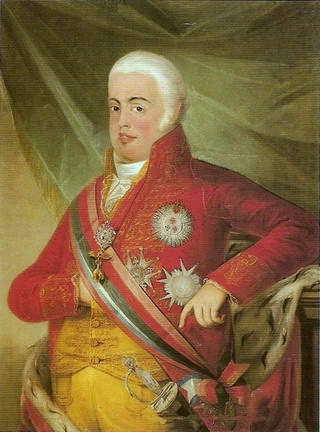
King John VI of Portugal
Characteristics of the gemstone
Carat-weight, color, shape and size of the rough crystal
The Braganza "Diamond" is an enormous uncut rough crystal weighing 1,680 carats, but its weight had been variously recorded by different authors as 1,730 carats and 1,880 carats. It is said that King John VI had a hole drilled through the rough crystal and wore it as a necklace on ceremonial occasions only.
Even the color of the stone have been reported variously by different authors. While Murray tells us that according to Mawe the stone was considered to be a "Nova Mina" or white topaz and not a diamond, implying that the stone whether a diamond or topaz was white or colorless. However the French writer Barbot, describes the stone as "d'une couleur jaune fonce" which translated into English means "a yellow color darkens." Thus according to Barbot, the color of the diamond or topaz was a dark yellow color.
Description of the shape and size of the rough crystal also differs. While according to Mawe's book, of his travels in Brazil, "A Few Leagues" the stone was said to be about the size of a goose's egg, Barbot describes the stone as having the shape of a pea, and might be about the size of a hen's egg.
The largest gem-quality rough "diamond" to be discovered in the world in 1797 ?
If the Braganza "Diamond" was in fact a genuine diamond and not a topaz as suspected, the rough diamond discovered in the year 1797, would have become the largest ever gem-quality rough diamond discovered in the world after the 787-carat "Great Mogul Diamond" discovered in 1650, and if the credentials of the "Braganza Diamond" could have been upheld up to this day, it would have become the second largest gem-quality rough diamond to have been discovered in the world after the 3,106-carat "Cullinan Diamond" discovered in 1905, in South Africa. See table below.
List of largest gem-quality rough diamonds discovered in the world
Name |
Country of discovery | Year of discovery | Carat Weight | Position |
| Cullinan | South Africa | 1905 | 3,106 | 1 |
| Excelsior | South Africa | 1893 | 995 | 2 |
| Star of Sierra Leone | Sierra Leone | 1972 | 969.80 | 3 |
| Incomparable | Zaire | 1984 | 890 | 4 |
| Great Mogul | India | 1650 | 787 | 5 |
| Millennium Star | Zaire | 1990 | 777 | 6 |
| Woyie River | Sierra Leone | 1945 | 770 | 7 |
| Golden Jubilee | South Africa | 1985 | 755 | 8 |
| President Vargas | Brazil | 1938 | 726.60 | 9 |
| Jonker | South Africa | 1934 | 726 | 10 |
| Jubilee-Reitz | South Africa | 1895 | 650.80 | 11 |
| Unnamed | South Africa | 1984 | 620.14 | 12 |
| Sefadu | Sierra Leone | 1970 | 620 | 13 |
| Kimberley Octahedral | South Africa | 616 | 14 | |
| Lesotho Promise | Lesotho | 2006 | 603 | 15 |
| Centenary | South Africa | 1986 | 599 | 16 |
| De Grisogono | Central Africa | 587 | 17 | |
| Jacob-Victoria | South Africa | 1884 | 457.50 | 18 |
| Zale light of peace | Sierra Leone | 1969 | 435 | 19 |
| De Beers | South Africa | 1888 | 428.50 | 20 |
| Niarchos | South Africa | 1954 | 426.50 | 21 |
History of the Braganza Diamond
The source of the "Braganza Diamond"
Even with respect to the origin and source of the "Braganza Diamond" various conflicting reports have been given by different authors. According to Mawe, the Braganza Diamond was discovered about 1797, from he bed of the River Abaite, which rises in the Mata da Corda mountains. and flows through the province of Minas Gerais. But, author Jones says that the diamond was extracted from the mine of Caetha Mirim in 1741. Jones goes on further to state that there were actually two diamonds, one bearing the name "Braganza" and the other "Abaite," discovered in the mine of Caetha Mirim, and the river Abaite, respectively. But, many authors seem to agree that the bed of the River Abaite is the actual source of the "Braganza Diamond."
Minas Gerais, one of the most productive gem-mining regions in the world
Minas Gerais, which in the Portuguese language means "General Mines" was the name given by the Portuguese Colonialists to the region, after the discovery of gold in 1693 and later diamonds in 1727. The mineral-rich region of Brazil, was the source of most of the gold produced in the world for about 200 years, from 1693 to the end of the 19th century, until the discovery of gold in South Africa in the latter half of the 19th century. Likewise Minas Gerais also became the main source of diamonds in the world after 1727, when the alluvial diamond deposits of Golconda and other diamond mines in the river basins of the eastern Deccan Plateau of South and Central India, was almost exhausted. The main gold producing area of Minas Gerais was the mountainous region west of Ouro Petro, the capital city of Minas Gerais, which became one of the most prosperous and populated cities in the whole of America, during this period. It is in this same region today, the so-called topaz belt of Minas Gerais is situated, the source of many enormous topaz crystals found in the Museum and other collections around the world. Please click here for the list of famous faceted topaz greater than 1,000 carats in weight. Diamonds were first discovered in Minas Gerais in 1725, by miners prospecting for gold on the banks of the river Rio Jequitinhonha, near the town of Tejuco, now known as Diamantina.
Today, after the exhaustion of gold and diamond deposits, Minas Gerais has discovered several other gem and mineral deposits besides topaz, which was one of the first gems to be discovered. Minas Gerais has vast quantities of aquamarine, chrysoberyl, emerald, kunzite, morganite, and tourmaline, making it one of the most productive gem-mining regions in the world. The total output of gems and minerals in Minas Gerais represents almost 80% of the total national output, furnishing further proof that Minas Gerais is the main gem and mineral producing state in Brazil.
The year of discovery of the "Braganza Diamond"
Like all other aspects of this enormous crystal even its year of discovery has been disputed by various authorities. According to Kluge, the "Braganza" was discovered in the year 1741, but Murray says it was discovered around the year 1764. But, most of the authors including Mawe are of the opinion that the "Braganza" was discovered around the year 1797, and this seem to correspond with the year that Prince John was declared the Prince Regent to his mentally deranged mother Queen Maria Isabella. The enormous gemstone entered his court, and came to be known as the "Prince Regent Diamond" an alternative name for the "Braganza Diamond."
Circumstances of the discovery of the "Braganza Diamond"
The "Braganza Diamond" is one of gemstones in the history of famous gemstones of the world, whose history itself seems to be shrouded in mystery, giving rise to conflicting accounts about its nature and characteristics, and circumstances of its discovery, based on speculation. There are at least two different versions about the circumstances relating to the discovery of this gemstone.
According to one of the common versions related by many gem historians, the discovery of the gemstone was the ultimate effort of three ex-convicts who had been found guilty of high crimes, and banished from civilized society into the jungles of Brazil, with strict instructions not to approach any human settlements, such as villages, towns and cities, with the threat of perpetual imprisonment if disobeyed. The three convicts decided to embark on a quest for new deposits of minerals such as gold, diamond or any other rare minerals in the hitherto unexplored jungles of Brazil, which, if fortunate would earn them a pardon from the Governor of Brazil, the representative of the King of Portugal, and help them gain their freedom and status in society. After a continuous search of more than six years in different parts of the interior of Minas Gerais, they finally decided to explore the bed of the river Abaite, that was partly exposed due to a prolonged drought in the region, and the resulting drop in the level of water in the river. Here, while they were digging the bed of the river, searching and washing for gold, they unexpectedly discovered an enormous crystal, which they suspected was a large diamond. The convicts believed that God almighty had finally answered their prayers and had given them this enormous diamond, in order to help them regain their freedom.
They lost no time in consulting a clergyman from the nearby village, who advised them to trust in the mercy of the state, and offered to accompany them to Villa Rica, in order to procure an appointment with the Governor. The convicts agreed, and accompanied the clergyman to the Governor, who was gracious enough to grant them an appointment. They surrendered the enormous gemstone to the Governor, relating to him all the circumstances connected to the discovery. While the governor seemed to be touched by the sincerity of the convicts, he was clearly astonished by the magnitude of the rough diamond, being used to seeing rough diamonds that were generally only a fraction of the enormous gemstone that he was seeing right in front of him. He commissioned his experts to study the stone and it was revealed that the stone was indeed a diamond. His immediate reaction was to thank the convicts and the clergyman, for their honesty in delivering the stone to him, and proceeded immediately to suspend the harsh sentences given to the men, as a reward for their honesty and sincerity. The gemstone was later sent to Rio de Janeiro, from where it was dispatched to Lisbon, by ship, being accompanied by the clergyman, who was to make representations to the king about the circumstances surrounding its discovery. The sovereign who happened to be the Prince Regent, John VI, who was a connoisseur and collector of diamonds and other precious stones, was pleased with the action taken by his governor, and confirmed the pardoning of the convicts, and bestowed some preferment on the holy father.
According to an alternative version of the discovery of the Braganza as related by Barbot, the diamond was discovered not by three banished criminals, as stated in the popular version of its discovery, but by a negro slave, who was granted his liberty as was the practice at that time, and was also granted "une pension viagere pour lui et la famille" which translated into English means, "a pension annuity for him and the family."
Out of the two versions given above the first version is the normally accepted version of the circumstances surrounding the discovery of the "Braganza Diamond."
The fate of the Braganza diamond
In November 1807, the royal family of Portugal was forced to withdraw to Rio de Janeiro in Brazil, following the declaration of Napoleon I, that the House of Braganza had ceased to reign, preparing the way for his forces to invade Portugal. It is believed, that the "Braganza Diamond" was among the valuable treasures carried by the royal family to Brazil, where they set up court in Rio de Janeiro for the next 14 years, up to 1821. In the meantime lot of events transpired in Portugal, including the defeat and withdrawal of Napoleon's forces, the making of peace with France in 1814, the constitutional revolution of 1820, and the formation of a Junta in Lisbon, the formation of a constituent assembly that drew up a liberal constitution. Viscount Beresford, a British officer, who was placed in command of the Portuguese army in 1809, administered Portugal up to the year 1820, on behalf of the royal family who were away in Brazil. Amidst the turmoil in the country, Beresford himself went to Brazil in March 1820, and pressed King John VI to return to Portugal, but the king was reluctant to do so because of the volatile political situation in the country. On his return to Portugal, Beresford was not allowed to land in Portugal, and all the British officers in the army were expelled by the Junta.
King John VI finally decided to return to Portugal, and after appointing his eldest son Pedro, as the Governor of Brazil, returned to Lisbon on July 3, 1821. He swore to uphold the new constitution that severely curtailed his powers as monarch. The constitutional monarchy that was set up in 1821 lasted until 1910, when Portugal finally opted to become a republic.
There is a difference of opinion as to the fate of the "Braganza diamond" after King John VI's death, who was reported to have worn it as a rough suspended gem on ceremonial occasions. The diamond apparently disappeared after John VI died in 1826.
Is the Braganza Diamond set on the Portuguese Crown ?
According to Dr. J. Kourimsky, the author of the book "The Illustrated Encyclopedia of Minerals and Rocks, the Braganza is presently set in the Portuguese Crown. Dr. Kourimsky apparently had not verified the facts before he made this statement, as the only crown and scepter used by the rulers of the House of Braganza during their accession ceremony from the time of King John VI, when they featured during his acclamation on February 6, 1818, are made of Brazilian gold and unadorned by jewels. This new set of symbolic accession regalia were designed and manufactured in Rio de Janeiro, by jewelry craftsmen commissioned by King John VI, when the Portugal Royal Family was holding court in exile in Brazil, during the tumultuous years of Napoleon's invasion of Portugal. The last formal coronation of a king of Portugal by placing a crown on the head, as it takes place in other monarchies, was held on December 15, 1640, when the Duke of Braganza, the first monarch of the House of Braganza, ascended the throne as King John IV. It is said that King John IV placed his crown on the head of a statute of Virgin Mary, as an act of devotion, and since then no subsequent monarch had the temerity to remove the crown from the statute in order to crown himself or herself. As a result every accession of a new monarch was marked by an acclamation or presentation of the new sovereign for public approval, followed by an oath-taking. This procedure was followed until the formal accession of King John VI, in 1818, when the new crown and scepter made of Brazilian gold was used for the ceremony. When John VI returned to Portugal in 1821, he carried the new coronation regalia with him, and these were used in the accession ceremonies of all his successors down to the last King Manuel II in 1908. King John IV's crown and scepter is now on display at the Palacio Nacional da Ajuda at Lisbon, the capital city of Portugal. It should be noted that this crown is unadorned with jewels and made of gold only. Thus the story of the "Braganza Diamond" being set in the Portuguese Crown is untenable.
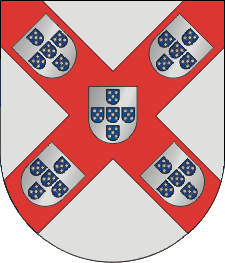
Insignia of the House of Braganza
Is the Braganza Diamond still in the Portuguese Treasury?
The most popular belief today in respect of the "Braganza Diamond" is that the renowned gemstone is still preserved safely with the Portuguese Crown Jewels either in a museum or safely locked up in the Portuguese treasury. But, it has been reported recently that officials of the Government of Portugal in a communication to the Gemological Institute of America had refuted this belief, which in effect means that they have no knowledge of a diamond by that name. This refutation also means that the so called "Braganza Diamond" about which so many famous gem historians had written voluminously in their publications in the past, including Edwin Streeter, had disappeared without any trace, after the death of King John VI in 1826.
Possible explanations for the disappearance of the "Braganza Diamond"
1) Tendency to maintain the mystery and controversy surrounding the stone
The "Braganza Diamond" was named for the Portuguese Royal House of Braganza, and since its discovery there had been a controversy over whether the stone was truly a diamond. Some researches have suggested that the Braganza was not a diamond but a white or yellow topaz, and that the royal household deliberately maintained the fiction of a diamond, because they thought it sounded better. Rather than preserving such a stone with its history of controversy, with the possibility that some day future researches would lay their hands on it and discover the real nature of the stone, it would be better to put the stone aside or destroy it, in order to maintain the mystery and controversy of the stone till eternity. This possibly explains the denial of the Portuguese officials of its existence.
2) The Braganza Diamond was possibly stolen during the invasion of Portugal by Napoleon's forces.
Another explanation would be that the Braganza was indeed a diamond and was stolen in the confusion of the early 19th century as Napoleon's armies struggled in Spain and Portugal with the Duke of Wellington, and the Portuguese court fled to Brazil. It is said that when the English army forced the French General, the duke of Abrantes, to retreat from Portugal the Frenchman sent a casket stuffed with 40,000 Portuguese gold coins to his wife in France. The suspicion arose that the French duke had got hold of the Braganza too, and dispatched it to France with the coins.
3) The Braganza diamond fell into the hands of Don Miguel who pledged or disposed of the stone
But if the Prince Regent John VI had the presence of mind to carry the enormous "Braganza Diamond" to Brazil when the Portuguese Royal Family emigrated to Brazil, as had been suggested by several gem historians, he would have probably brought it back with other crown jewels when he returned to Portugal in 1821. The question now arises whether he gave the "Braganza Diamond" to his second son Don Miguel or left it as a crown jewel, and as such devolved upon Don Pedro, the eldest son, along with the kingdom of Portugal. Don Pedro who was the Governor of Brazil, refused to toe the line of the Portuguese Constitutionalists and declared Brazil independent of Portugal on September 7, 1822, and became the first Emperor of Brazil as Pedro I. At the time of King John VI's death in 1826 Don Pedro was away in Brazil, and his daughter Maria da Gloria was appointed as regent, until Pedro was able to come to Brazil and claim his throne. In the meantime Don Miguel who had previously refused to swore allegiance to the new constitution and was banished from Portugal, manipulated his way with the help of the absolutists, and was appointed regent. In 1828, Miguel was declared the rightful king by his supporters. Miguel ruled Portugal from 1828 to 1834, and probably the "Braganza Diamond" would have fallen into his hands and later pledged or disposed of, in order to prosecute the war against his brother Don Pedro.
4) The Braganza Diamond weathered the political upheavals of the early 19th century and survived up to the declaration of the first republic
In 1831, Don Pedro having abdicated the Brazilian Throne went to Europe, and began raising funds and recruiting men for the conquest of Portugal. In February 1832, the expeditionary force landed in Island of Terceria, in the Azores, whose inhabitants had sustained the liberal cause, and set up a regency on behalf of of Maria da Gloria. Using Terceria as the springboard the liberals invaded Portugal first landing and occupying the city of Porto in July 1832, then Algarve in June 1833, Lisbon in July 1833, and finally Don Miguel capitulated at Evora Monte in May 1834. Don Miguel was exiled in June 1834, and Don Pedro died in September 1834, following which Maria da Gloria ascended the throne of Portugal as Queen Maria II at the age of 15 years. It was also quite possible that the Braganza Diamond took a back stage during these political upheavals of the early half of the 19th century, and remained safely in the treasury of the Portuguese crown, until the dawn of the first republic in 1910.
The mystery and controversy surrounding the "Braganza Diamond" still lives on
The whereabouts of the "Braganza Diamond" had been a mystery since the death of King John VI and remains a mystery up to this day. The controversy surrounding the "Braganza Diamond" as to its exact nature; whether it is a true diamond or an enormous topaz crystal is also unresolved as no expert had ever had the opportunity of examining the elusive gemstone.
You are welcome to discuss this post/related topics with Dr Shihaan and other experts from around the world in our FORUMS (forums.internetstones.com)
Related :-
American Golden Topaz
Famous Topaz Gemstones- Cut and Uncut
References
1. Braganza Diamond - Diamond Dictionary.net
2. Stories About Famous Precious Stones - Mrs. Goddard Orpen
3. Diamond: A Journey to the Heart of an Obsession - Matthew Hart
4. Large and Famous Diamonds - Rafal Swiecki (Geological Engineer) minelinks.com.
5. Royal Baubles - Fabulous Precious Stones, oldandsold .com
6. Great (Famous Diamonds) - Edwin Streeter
7. Encyclopaedia Britannica - 2006
 Home
Security & Guarantee
How it Works
Technology Partners
Updated Tables
Famous Diamonds
More Famous Diamonds
Famous Pearls
Famous Gemstones
Contact Dr Shihaan Larif
Contact Senior Editor
Famous Jewelry
Reference Database
Forums
Learning Center
Gemstone Gallery
e-mail Notifications
Advertise
Press Release
About Us
Privacy Policy
Contact Us
FAQ'S
Site Map
Staff Mail Login
Staff Documents
Birthstones
History
Minerals
Shows
Live Metal Prices
Jewellery Gallery
News
Marketplace
Marketplace Support
Open Store
Online Auctions
Join Us & Contribute
Directory
Classifieds
List your products
Wholesale Trading
Post Buy Request
Go Green Policy
Site Updates
Upcoming-ToDo List
Latest News
Latest Articles
Latest Blog Updates
Chat Rooms
Job Board
User Gallery
Videos
New Newsletter Archive
Old Newsletter Archive
Jewelry & Mineral Blog
User Blogs & Social Network
Search
Answers (Q & A)
Valuation
Help me find a diamond/jewelry
pin.internetstones.com- Social Pinboard- Sart yours & connect with millions
Invite Friends From Yahoo, Gmail etc-One Click
Home
Security & Guarantee
How it Works
Technology Partners
Updated Tables
Famous Diamonds
More Famous Diamonds
Famous Pearls
Famous Gemstones
Contact Dr Shihaan Larif
Contact Senior Editor
Famous Jewelry
Reference Database
Forums
Learning Center
Gemstone Gallery
e-mail Notifications
Advertise
Press Release
About Us
Privacy Policy
Contact Us
FAQ'S
Site Map
Staff Mail Login
Staff Documents
Birthstones
History
Minerals
Shows
Live Metal Prices
Jewellery Gallery
News
Marketplace
Marketplace Support
Open Store
Online Auctions
Join Us & Contribute
Directory
Classifieds
List your products
Wholesale Trading
Post Buy Request
Go Green Policy
Site Updates
Upcoming-ToDo List
Latest News
Latest Articles
Latest Blog Updates
Chat Rooms
Job Board
User Gallery
Videos
New Newsletter Archive
Old Newsletter Archive
Jewelry & Mineral Blog
User Blogs & Social Network
Search
Answers (Q & A)
Valuation
Help me find a diamond/jewelry
pin.internetstones.com- Social Pinboard- Sart yours & connect with millions
Invite Friends From Yahoo, Gmail etc-One Click




Our Global Jewelry Industry Job Network


Buy & Sell in our Marketplace

Subscribe to our Newsletter

List in our Classifieds

List in our Directory

User Uploaded Gallery

Powered by Ultra Secure
Amazon (USA) Cloud Network

Founder Internet Stones.COM
Register in our Forums

| Featured In
|
|
|
|
|
|
|
|







Blog & Education Feed
Articles Feed
 |
 |
 |

Copyright © .Internet Stones.COM. All rights reserved.