Ceylon/Sri Lanka Tri-Colored Pearl Necklace - Nizam of Hyderabad Pearl Necklace
Open FREE Unlimited Store Join Our Newsletter
Origin of Name:-
The necklace gets its name obviously from the source of the pearls that constitute it, viz. Ceylon (Sri Lanka), one of the most ancient sources of saltwater pearls in the world, whose rich pearl banks in the Gulf of Mannar together with the pearl banks of the Persian Gulf and the Red Sea, were the hub of the international pearl trade since time immemorial. According to the "Mahawamsa" (The Great Chronicle), that records the history of Sri Lanka from the 5th century B.C. the pearl industry was already well established in Sri Lanka, at the time of arrival of Prince Vijaya, a Kalinga (ancient Orissa) prince, who landed in Sri Lanka with his followers near the Mannar coast, in the 5th century B.C. The Sinhalese, the major ethnic group living in the island nation, trace their ancestry to the north Indian prince. The "Mahawamsa" states that at the time King Vijaya married a princess from India, he sent a gift of a shell pearl worth twice a hundred thousand pieces of money, to his father-in-law, the Pandu king of India. Another gift of valuable pearls from Sri Lanka from the King Devanampiyatissa to Emperor Ashoka Maurya of India during the period 265 B.C. to 238 B.C. that was dispatched to India through Prince Mahindra, the son of Emperor Ashoka, who visited Sri Lanka at the time, is also recorded in the Mahawamsa.
Sri Lanka was known to the ancient Greeks as "Palaesimoundu" and "Taprobane" and the island of Mannar, the center of the pearl trade was known as "Epidorus." The early Arab travelers called Sri Lanka by several names, such as "Serendib," (Island of Rubies), "Saheelan" and "Seylan." The European travelers form the 13th century onwards called the island "Zeylan" derived from the Arabic "Seylan." Eventually as the island nation was colonized by the British in the late 18th century, the country came to be known as "Ceylon."
The seven-strand pearl necklace is tri-colored, with three color zones in it, golden-yellow, yellow and white, which are common colors found in pearls produced by the pearl oyster Pinctada radiata, the species of oyster found in the Gulf of Mannar.

Characteristics of the tri-colored Ceylon Pearl Necklace
The Ceylon Pearl Necklace is a seven-strand necklace, with each strand consisting of natural Ceylon pearls perfectly matched for both size and color. The size of the pearls are not known, but the appearance of the pearls in the photograph show that they are of almost uniform size throughout the length of the strands, perhaps falling within the range of seed pearls. According to a modern definition, pearls that have a size of <2mm in diameter or < 0.25 grains in weight, are known as seed pearls. But this definition had varied from time to time. Previously pearls <5 mm in diameter were classified as seed pearls. However, given the fact that the species of pearl oyster found in the Gulf of Mannar, in Sri Lanka, is a variety of Pinctada radiata belonging to the Pinctada fucata/imbricata/martensii/radiata complex, it is highly probable that the pearls in the necklace are seed pearls, because this species is well known for producing seed pearls.
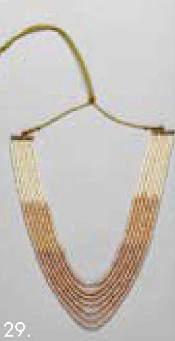
The Ceylon Pearl Necklace
©ROM
The length of the individual strands are not known, but the overall appearance of the necklace is equivalent to that of a modern festoon pearl necklace. The length of the strands are undoubtedly greater than 28 ins.(71 cm), and under the modern Mikimoto classification of pearl necklaces, all strands fall under the categories of "opera" and "rope."
The composite necklace clearly shows three different color zones, each with a different shade of color :- golden yellow, yellow and white. These are some of the common colors of pearls produced by the pearl oyster Pinctada radiata. The golden-yellow colored zone occupies the lower curvature of the festoon. The yellow colored zones are intermediate situated on either side of the necklace between the golden-yellow and white colored zones. The white colored zones are situated on either side of the necklace, at its two ends, above the yellow colored zones.
The festoon necklace has no clasp, as in modern necklaces. Instead a tough silk rope connects the two ends of the necklace occupied by a horizontal metallic bar made of silver or gold, from which the seven strands on either side arise. This arrangement has the added advantage of displaying all the pearls in the necklace, without some pearls being hidden behind the neck. The necklace is believed to have belonged to Mir Usman Ali Khan, the seventh and the last Nizam of Hyderabad, who ruled from 1911 to 1948, one of the wealthiest men in the world at that time, and also a great collector of pearls. The fact that there are several other necklaces of this design made of pearls as well as other gemstones, in the collection of jewelry that once belonged to the Nizam of Hyderabad, exhibited today at the Museum of Hyderabad, undoubtedly confirms the previous ownership of the necklace. Such necklaces with a silk rope behind instead of a clasp, was a common Indian design found among the jewelry of the Mughals, as well as other Maharajahs of India.
History of the Ceylon Pearl Necklace
The source of the pearls in the necklace
The source of the pearls in the Ceylon Pearl Necklace or the Nizam of Hyderabad Pearl necklace, is the pearl banks on the Sri Lankan side of the Gulf of Mannar, in the Kondaichchi Bay, on the northwest coast of Sri Lanka, just south of the Mannar Island. Some of the villages in the Kondaichchi Bay, from where the pearl fishing operations were carried out were Silavatturai, Arippu and Marichchukkaddi. The pearl banks on the Sri Lankan side of the Gulf of Mannar were richer than the pearl banks on the Indian side off the coast of Tinnelvelly in Tuticorin.
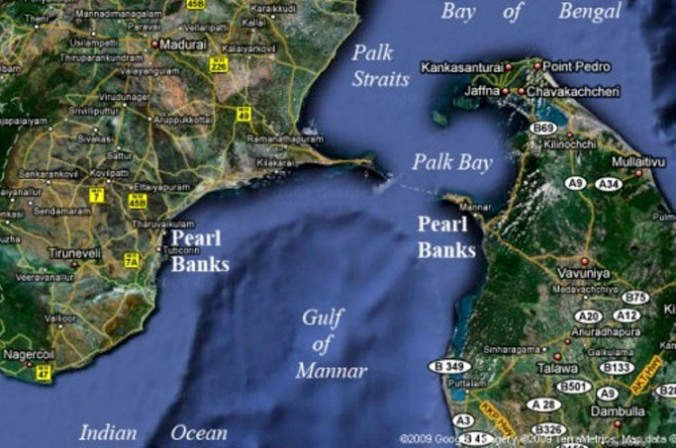
Pearl banks of the Gulf of Mannar
Pearl trade of Sri Lanka from the 10th-century B.C. to the 1st-century B.C.
The Gulf of Mannar together with the Persian Gulf and the Red Sea were reputed to be the hub of the international pearl trade since very ancient times. Pearls from the Gulf of Mannar are believed to have reached the courts of the kings and emperors of ancient empires such as the Mesopotamian, Egyptian, Greek, Phoenician, Scythian, Roman, Byzantine etc. In the 10th-century B.C. King Solomon's ships are believed to have reached the ports of Sri Lanka, from where they collected pearls, rubies, sapphires, ivory and peacocks. The Phoenician trade fleets are also believed to have reached the Gulf of Mannar to purchase pearls. As pointed out earlier, the antiquity of the pearl trade in Sri Lanka has been recorded in the historical chronicles of Sri Lanka, such as the Mahawamsa (the Great Chronicle) and the Chulawamsa (the Lesser Chronicle), pearls being sent as gifts by Kings of Sri Lanka to Indian Kings in the 5th-century and 3rd-century B.C. Megasthenes, the Greek Ambassador to the Mauryan King Chandragupta, wrote in the 3rd-century B.C. that "the Island of Taprobane was more productive of gold and large pearls than the Indias."
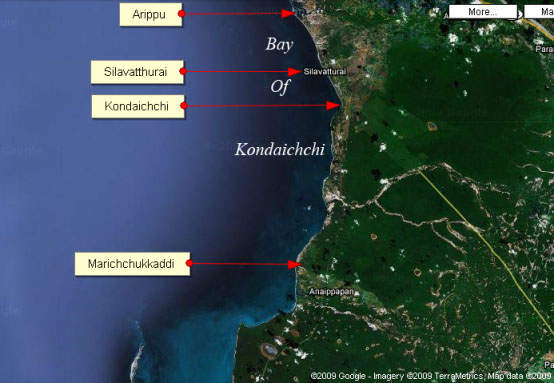
Pearling Stations in the Bay of Kondaichchi
Pearl trade of Sri Lanka from the 1st-century A.D. to the 15th-century A.D.
In the year 60 A.D. the Greek author who wrote the "Periplus of the Erythraen Sea," gives an account of the pearl fishery in the Gulf of Mannar. The Arabs who became a maritime power between the 6th to 15th centuries A.D. reached the Gulf of Mannar during this period and took an active part in the pearl fisheries held annually. The Arab pearl divers of the Persian Gulf were renowned as the best pearl divers in the world, and their participation in the pearl fishery at Mannar, helped in the introduction of new diving techniques into the region. Both the Arab jewelers and merchants, and the local Sinhalese and Tamil Kings of Sri Lanka benefited immensely by Arab participation. While the local rulers were assured of an attractive price for their pearls, the Arabs were assured of a regular supply of good quality pearls, which fetched very high prices in the Baghdad pearl market. The Arab dominance in the world trade continued until the emergence of western nations such as Spain, Portugal, Netherlands, France and Britain as maritime powers in the 15th-century A.D.
The entry of western nations into the pearl trade of the Gulf of Mannar, destabilizes the area and causes hardships for the inhabitants
The first western nation to reach the shores of Sri Lanka, were the Portuguese, who colonized the coastal areas of the southern part of the Island in 1505. However, the Portuguese were not able to take control of the pearl banks at Kondaichchi Bay in the northwest region of the Island, as the area was under the control of the Jaffna kingdom, whose rulers successfully fought the Portuguese and kept them at bay for 114 years, until the year 1619, when they finally captured Jaffna. The atrocities committed by the Portuguese in Jaffna in 1619, killing thousands of innocent civilians and razing to the ground all ancient Hindu temples, was almost equivalent to the atrocities committed by the Spanish Conquistadors led by Hernan Cortez, 100 years earlier in October 1519 at Cholula, in central Mexico, when Cortez's forces were marching towards Tenochtitlan, the prosperous capital of the Aztec empire, led by Montezuma II. The Portuguese were able to exploit the pearl banks of the Kondaichchi Bay only for a short period until 1658, when the area including Jaffna came under the control of the Dutch. On the Indian side of the Gulf of Mannar, the Portuguese were more successful taking control of the pearl banks off the coast of Tinnelvelly in Tuticorin, in the mid-16th century, after the mass scale proseletization of the Parawa community by St. Francis Xavier in 1544. However, in retrospect one can see that the entry of the western nations into the pearl trade in the Gulf of Mannar was a disaster for the people of the area and their livelihood, as these nations used their fire power to terrorize the people, that caused a lot of tension and insecurity in the area, where hitherto pearling activities had taken place in a peaceful atmosphere for thousands of years.
Exploitation of the pearl resources by the Dutch and the British
The Dutch who took control of the Mannar pearl banks in 1658, continued their exploitation until the year 1796, when the British ousted the Dutch from the Island. Pearl fishing during the Dutch period were conducted every 3 years. The interval of 3 years gave sufficient time for the regeneration of oyster populations, and for pearls if any inside the oysters, to grow to an optimum size. The Dutch did not play a direct part in the exploitation, but sold the fishing rights to private entrepreneurs. The British who took control of the pearl banks in 1796, initially followed the Dutch method of selling the fishing rights to private entrepreneurs, but government officials determined which areas were to be fished, the number of boats that could be used and how long the fishing would last. However, after 1833, the British played a more direct role in the fishing activities, hiring boats and divers to work for them under official supervision. The government took two-thirds of the share of every catch, leaving one-third to the divers and boat owners. The government share was subsequently sold by auction to pearl traders and merchants, who processed the oysters for pearls by putrefaction in pits and subsequent washing with large quantities of water, all carried out by the sea shore. Seed pearls usually occur as multiple pearls in a single oyster, but the putrefaction usually scatters the pearls. Instances of up to 150 seed pearls in a single oyster have been reported.
The last pearl fishery conducted by the British in 1906
Pearling activities had been regularly conducted by the British, but their had been disruptions on at least five occasions during the period they exploited the banks from 1797 to 1906, due to serious depletion of oyster resources in the pearl banks, partly due to over exploitation, and partly due to other natural causes such as predation by skate and other voracious fish, burial of young oysters under shifting sands, washing away of young oysters by strong underwater currents etc. The last pearl fishery was held by the British in 1906 at Marichchukkaddi, presided over by Leonard Woolf, Government Agent at Jaffna Kachcheri (secretariat), and was a failure lasting only 11 days from February 20 to April 3, even though over 25,000 people, that included pearl divers, boat owners, merchants, dealers, financiers, shop-keepers, shark charmers, criminals, police and government officials attended.
Attempts to culture pearls in Sri Lanka after 1906 by a British company ends in failure
The British then decided to sell its monopoly in pearling to a private company which attempted to culture pearl oysters in farms, and artificially induce them to produce pearls. This was the time, when in Japan, Kokichi Mikimoto, had already successfully cultured "mabe" pearls, and was trying to perfect a commercially viable technique to culture spherical pearls, which he eventually achieved only in 1916, after adopting the Mise-Nishikawa technique. The Sri Lankan experiment to culture pearls by artificial seeding was a disaster, and the company closed down after incurring enormous losses. So ends the story of pearling in the Gulf of Mannar, in Sri Lanka, one of the most ancient sources of natural pearls in the world, which had adorned the courts of kings and emperors throughout the history of mankind.
No organized pearling activities in Sri Lanka after 1906. Prospects for the future after restoration of peace in Sri Lanka.
There had been no organized pearling activities in the region since 1906, and the status quo continues to this day. On the Indian side of the Gulf, considerable success has been achieved in the culturing of pearls, with Japanese technical assistance. But unfortunately in Sri Lanka no headway could be made in introducing Japanese technology to the region, as it was under the control of the Tamil Tiger rebels. Now, with the elimination of the Tamil Tiger rebel movement and restoration of peace to the Island nation, it is hoped that the Government of Sri Lanka, would provide the necessary incentives and encouragement, for private companies to invest in the lucrative pearl culturing industry, in collaboration with the Chinese or the Japanese, who have made considerable headway in the industry, and thus restore Sri Lanka's fame as a pearl producing center for the entire world.
Marketing of Sri Lankan pearls in ancient times
During the period when Arabs were heavily involved in the pearl trade from the 7th to 13th centuries A.D., the pearls acquired by the Arab traders were eventually sold in the pearl markets of capital cities such as Baghdad, Damascus and Cairo. After the western nations entered the pearl trade, Sri Lankan pearls appeared in the pearl markets of London, Paris, Amsterdam and other capital cities. However, during the British period the bulk of the pearls were purchased by Indian chetties who carried the pearls to Bombay, the regional center of the pearl trade, which also attracted the bulk of the pearl production from the Persian Gulf. At Bombay the pearls were sorted according to quality, perforated and strung into necklaces, and sold to the wealthy Maharajah's of India, who paid much higher prices for pearls, than what could be obtained from the pearl dealers in London. A substantial quantity of the pearls also reached the London pearl markets, but it was nearly impossible to buy any really fine pearls in Colombo, the capital of Sri Lanka.
Was the tri-colored Ceylon Pearl necklace strung together in Bombay or Hyderabad ?
Thus, it appears that the Ceylon Pearl Necklace which is the subject of this webpage was also strung into a seven-stranded pearl necklace at Bombay, and subsequently sold to an agent of the Nizam of Hyderabad. Alternatively it was also possible, that the loose pearls were purchased by the agents of the Nizam, and then after matching for color, size and other qualities, were subsequently strung into the unique tri-colored seven-stranded necklace by the jewelers of the Nizam's court at Hyderabad.
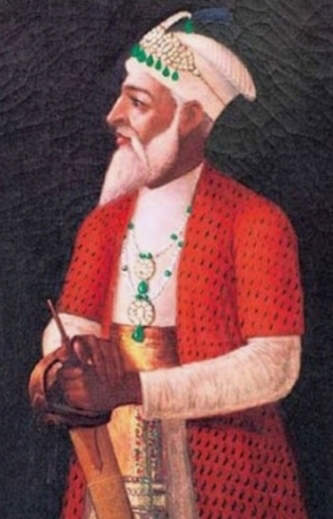
Mir Qamar-ud-Din Khan Siddiqui - Nizam-ul-Mulk, founder of the Asaf Jah dynasty and the kingdom of Hyderabad
Who was the Nizam-ul-Mulk at the time the Ceylon Pearl Necklace entered the court at Hyderabad ?
Founding of the kingdom of Hyderabad
The State of Hyderabad that was situated in the south central region of the Indian sub-continent, with an extent of 82,000 square miles (212,000 km²), consisted of areas that are today parts of Andhra Pradesh, Madya Pradesh, Maharashtra and Karnataka. The capital city was situated at Hyderabad, which is today the capital of Andhra Pradesh. The state was ruled by the "Nizams" a shortened version of Nizam-ul-Mulk (Administrator of the Realm), the title of the rulers of the state, belonging to the Asaf Jah dynasty, founded by Mir Qamar-ud-din Khan Siddiqui, a viceroy of the Deccan under the Mughal emperors from 1713 to 1721, who declared his region independent of the Mughal empire in 1724, after southern regions of the empire began to crumble following the death of Aurangzeb in 1707. Seven Nizams ruled Hyderabad for over two centuries (224 years), until the country was forcefully integrated into the Indian Union in 1948, after independence from the British. They were the strongest allies of the British colonialists in India, and became the wealthiest monarchy in the world. The Nizams of Hyderabad were great patrons of art, literature, architecture, culture, jewelry collection and rich food. The renowned "Briyani" a delicious rice dish mixed with mutton or beef and other spicy ingredients, that has tickled the palettes of people around the world for centuries, and still continue to do so, is believed to have originated in the court kitchens of the Nizams of Hyderabad.
The names, titles and periods of rule of the seven Nizams of Hyderabad
S/N |
Name |
Title |
Period of rule |
1 |
Mir Qamar-ud-Din Khan Siddiqui
|
Asaf Jah I |
1720-1748 |
2 |
Mir Nizam Ali Khan Siddiqui Bahadur
|
Asaf Jah II |
1762-1803 |
3 |
Mir Akbar Ali Khan Sikandar Jah Siddiqui
|
Asaf Jah III |
1803-1829 |
4 |
Mir Farkhonda Ali Khan Siddiqui Nasir-ud-Daulah
|
Asaf Jah IV |
1829-1857 |
5 |
Mir Tahniat Ali Khan Siddiqui Afzal-ud-Daulah
|
Asaf Jah V |
1857-1869 |
6 |
Mir Mahboob Ali Khan Siddiqui
|
Asaf Jah VI |
1869-1911 |
7 |
Mir Osman Ali Khan Siddiqui
|
Asaf Jah VII |
1911-1948 |
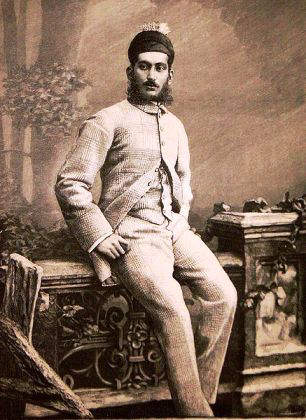
Mahbub Ali Khan, Asaf Jah VI, the VIth Nizam of Hyderabad
Did the Ceylon Pearl Necklace enter the treasury of the kingdom of Hyderabad during the reign of Mir Mahboob Ali Khan ?
The seven-stranded Ceylon pearl necklace could not have entered the treasury of the Nizams of Hyderabad during the reign of Mir Osman Ali Khan Siddiqui, the last Nizam of Hyderabad, because he ascended the throne in 1911, by which time the Sri Lankan pearl banks were already abandoned by the British, and there were hardly any Sri Lankan pearls coming to the Bombay pearl markets. Thus the pearl necklace undoubtedly became part of the fabulous collection of jewelry of the Nizams of Hyderabad during the reign of one of the six predecessors of the last Nizam of Hyderabad, Mir Usman Ali Khan Siddiqui. It is not known exactly during whose rule the pearl necklace was purchased, but it could be any one of the Nizams from Asaf Jah II to Asaf Jah VI, who ruled between 1762 and 1911. Pearls from Sri Lanka reached the Bombay pearl markets in large quantities only during the period when the pearl banks of Srl Lanka were managed by the British, that extended from 1796 to 1906. This corresponds to the period of rule from the 2nd to the 6th Nizams of Hyderabad. However, out of the five Nizams of Hyderabad from the 2nd to the 6th, one of the most notorious collectors was Mir Mahboob Ali Khan Siddiqui (1869-1911), who was reputed to have purchased the famous Victoria-Jacob diamond diamond for £150,000 in spite of objections by the British Resident of Hyderabad. Thus it was quite possible that the seven-stranded Ceylon Pearl Necklace entered the jewelry collection of the Nizams, during the period of Mir Mahboob Ali Khan, the sixth Nizam of Hyderabad.
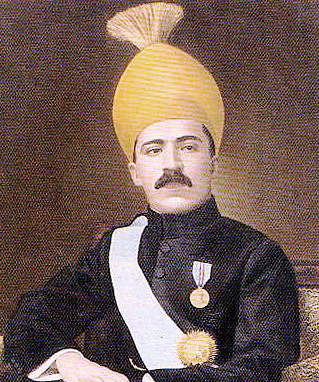
Mir Osman Ali Khan Siddiqui, Asaf Jah VII
Did the Ceylon Pearl Necklace enter the treasury of the Nizams of Hyderabad during the reign of Mir Ali Khan Siddiqui Nasir-ud-Daulah?
The 4th Nizam of Hyderabad, Asaf Jah IV, Mir Ali Khan Siddiqui Nasir-ud-Daulah, reigned between 1829 to 1857. Seed pearl jewelry first became popular during the second quarter of the 19th century, from 1825 to 1850. This was the early Victorian period, also known as the Romantic period, that extended from the year Queen Victoria ascended the throne in 1837, until the death of her beloved husband Prince Albert in 1861. Seed pearl jewelry was the epitome of this romantic sentiment, and reached the height of its popularity between 1840 and 1850 in England and the United States. The Ceylon Pearl Necklace that appears to be made mainly of seed pearls was also perhaps designed and produced during this period, in keeping with the popularity of these pearls during the period. If it was so then the Ceylon Pearl Necklace would most probably have entered the treasury of the Nizams during the rule of Asaf Jah IV, Mir Ali Khan Siddiqui Nasir-ud-Daulah, who ruled between 1829 and 1857.
When was the Ceylon Pearl Necklace sold ?
The Ceylon Pearl Necklace is now part of the private collection of Mrs. Meera Gandhi
The Ceylon Pearl Necklace now belongs to the private collection of Mrs. Meera Gandhi, an Indian American, a socialite, philanthropist, dedicated humanitarian worker and community leader, based in New York, and the wife of investment banker Vikram Gandhi. It is not known how Mrs. Gandhi came to acquire the necklace, but in all probability it must have been purchased at an auction conducted by one of the auction houses like Sotheby's or Christie's. This necessarily means that the necklace had left the Nizam of Hyderabad's collection, either before or at the time of abdication of the last Nizam of Hyderabad, Mir Usman Ali Khan Siddiqui, in 1948. Soon after his forceful abdication, Mir Usman Ali Khan, got his entire collection of jewelry inventoried. He then divided the jewelry into two lots, and created two separate trusts. The jewelry were then kept in the vaults of the Flora Fountain Branch of the Hong Kong and Shanghai Banking Corporation in Mumbai. One of the conditions he laid down was that the jewelry should not be sold during the lifetime of his eldest son Azam Jah.
The Government of India obtains a stay order from the Supreme Court to stop the auction of the Nizam's jewels
Subsequently, after the death of Azam Jah in 1970, the trustees decided to sell part of the jewels by public auction, advertised internationally, in order to meet the family's staggering tax liabilities. But, the Government of India intervened and obtained a stay order from the Supreme Court to suspend the auction, saying that the jewelry collection was part of the National Heritage of India, and needs to be preserved in India. The Government of India's intervention could not be justified as it had allowed all other Maharajah's whose domains were absorbed into the Indian Union after independence, to dispose of their jewelry collections as and when they deemed it fit, without any interference. The Maharajah's of Baroda, Patiala etc. disposed of their valuable jewels at international jewelry auctions without any government intervention.
After long drawn out litigation the Government of India agrees to purchase the collection for $71 million
Subsequently, in 1979, on the initiative of the Late Nizam's relatives, the trustees of the jewelry filed action in the Supreme Court, seeking court permission to dispose of the jewels. This led to a long drawn out litigation that lasted 16 years, and finally the Government of India deccided to purchase the collection, from the family of the Late Nizam for a sum of $71 million. However, the matter went up to the Supreme Court again when the trustees demanded full payment at once instead of six installments proposed by the Government. The Supreme Court decided in favor of the trustees and directed that the Government pay up in full. The Government was still dragging its feet on the Supreme Court order, when the trustees requested permission from court to invite foreign buyers to sell the collection, which was granted. The Government requested more time to conclude the deal, and time was granted up to January 16, 1995, after which the trustees were free to dispose of the jewelry as they pleased. Subsequently, the government sought the approval and the necessary funds for the conclusion of the deal, from the Lower House (Lok Sabha) and Upper House (Rajya Sabha) of Parliaments which was granted, and the deal was finally concluded on January 12, 1995.
The Nizam of Hyderabad's collection was put out on display at the National Museum in New Delhi and Salar Jung Museum in Hyderabad on at least two occasions
The collection that consists of 173 pieces, including turban ornaments (sarpechs), necklaces, armbands, earrings, bracelets, buttons, belts, cuff links, watch chains, anklets, rings etc. studded with diamonds, rubies, emeralds, sapphires, spinels, pearls and other gemstones, and also the famous 184.75-carat Victoria-Jacob diamond, is today estimated to be worth around $6 billion, and was put on display on two occasions at the National Museum in New Delhi, and at the Salar Jung Museum in Hyderabad, Andhra Pradesh, the state of origin of the renowned collection. The priceless collection is now preserved in the vaults of the Reserve Bank of India, in Mumbai, until the Government of India decides on a secure venue to put them on permanent display.
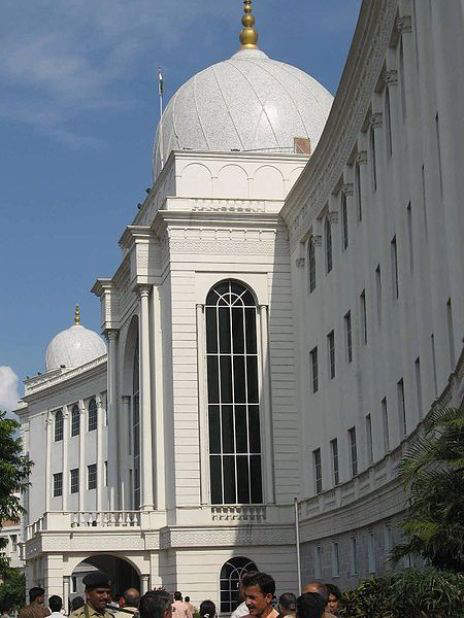
Salar Jung Museum, Nayapul, Hyderabad, Andhra Pradesh
The possible ways in which the Ceylon Pearl Necklace would have left the collection
The tri-colored Ceylon Pearl Necklace, which is not part of this collection, was obviously removed from the collection, either before or at the time of the abdication of Mir Usman Ali Khan, the last Nizam of Hyderabad. It was possible that the Nizam himself had given the necklace as a gift to someone close to him, in his family, to mark or celebrate an occasion. It was also quite possible that the Nizam had kept some of the jewels with him, without including them in the two lots he created that was subsequently placed in the HSBC bank vault at Bombay, so that he could sell them when faced with any financial constraints in the future. The tri-colored Ceylon Pearl Necklace, was perhaps one such piece, that was sold by the Nizam himself or his agents, either in Bombay or one of the capitals of the west, after his abdication to tide over a difficult period. This was perfectly in order as the jewels had belonged to his ancestors, and he was free to dispose of them as he pleased.
Meera Gandhi - A short biography
Her early life, education, marriage and migration to the United States
Meera Gandhi who was born in Mumbai, India, was the daughter of an Indian father, Mr. Agarwal and Irish mother Ellen Agarwal. She had a early education at the Cathedral and John Connon School in Mumbai, and later at Lester B. Pearson United World College at Canada, where she studied for two years. She graduated from the Jesus and Mary College, University of Delhi, in 1985. In 1986, she married her childhood sweetheart Vikram Gandhi, and in the same year the couple emigrated to Boston, Chicago, in the United States. At Boston the couple registered for an MBA program at Boston University, and obtained their MBA degree in 1989. They both joined the banking sector after their graduation from Boston. Eventually Meera moved from banking to fashion, and worked as a buyer for Macy's Chain of Department Stores, Lord and Taylor, Calvin Klein, Armani and Oscar de la Renta. In 1993, she started her own fashion business, Meera Collections Inc. Vikram Gandhi continued his banking career, and became a successful investment banker, and today he is the Global Head of Financial Institutions at Credit Suisse.
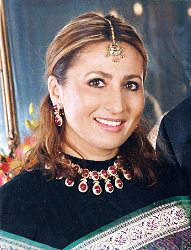
Mrs Meera Gandhi
© www. meersgandhi.com
Meera Gandhi's promotion of humanitarian causes to reduce suffering and deprivation around the globe
In 1997, Meera Gandhi and her husband moved to India for three years, where Vikram continued his work with the Credit Suisse in India. After returning to New York in the year 2000, they purchased their celebrated town house on Park Avenue, New York, that was once the residence of First Lady Eleanor Roosevelt. Encouraged by her husband Vikram, she then committed herself to actively promoting humanitarian causes to reduce suffering and deprivation around the globe. Some of the humanitarian causes she promoted included the successful raising of funds for a number of notable charities in the United States and India, She had played an active role in organizations such as "Safety Net," that caters for battered women; "Pratham," that works for the education of street children in India; "Children's Hope," working for the underprivileged children of New York. She was also a member of the boards of the Franklin and Eleanor Roosevelt Institute (FERI), and the Eleanor Roosevelt Center at Val-Kill (ERVK), and a Co-Chairman of the US Committee for United World College (UWC) with HRH Pavlos, whose patron is HRH Queen Noor of Jordan.
Her Park Avenue residence at New York, becomes a center for hosting charitable events, and is visited by world leaders and celebrities
Her residence at New York, became the center for hosting many charitable events, and during her active pursuit of humanitarian causes, her residence was visited by several world leaders such as Hilary Clinton, Cherie Blair, Rahul Gandhi, Robert Kennedy Jr., etc. and famous literary, academic and entertainment personalities such as, Arthur Schlesinger, Gabriel Byrne, Phylicia Rashad, Glen Close, Mira Nair, the late Ismail Merchant etc.
Meera's motto, "We are to the universe only as much as we can give back to it" motivates her in pursuing humanitarian causes and social service
Presently, Meera Gandhi is the CEO of MTG Productions, her own Television and Internet production company, which she launched in 2008. Her productions also try to drive home the message of serving the cause of humanity and reducing human suffering. This was in keeping with her Motto, "We are to the universe only as much as we can give back to it." A truly philosophical message, that had provided the motivation for her humanitarian causes, to relieve suffering and deprivation around the globe.
Meera and Vikram have been happily married for the last 23 years, and have three children, Kiran, Kanika and Kabir aged 20. 16 and 12 years respectively.
The Ceylon Pearl Necklace was exhibited around the world as part of the traveling exhibition "Pearls : A Natural History"
According to the American Museum of Natural History, New York City, the tri-colored Ceylon Pearl Necklace, belongs to the private collection of Meera Gandhi, and was given on loan to the Museum, to be included as an exhibit in the traveling exhibition "Pearls : A Natural History" organized by the AMNH in collaboration with the Chicago Field Museum, that was held for the first time at AMNH in October 2001, and subsequently moved around museums in the United States, Canada, Japan, Australia, the United Arab Emirates and France, until March 10, 2008. The Ceylon Pearl Necklace was exhibited at all venues where the exhibition was hosted, and became famous for its historical value as well as its unique tri-color design.
You are welcome to discuss this post/related topics with Dr Shihaan and other experts from around the world in our FORUMS (forums.internetstones.com)
Related :-
External Links :-
References :-
1) Pearls, Opulence and Obsession - Australian Museum
2) Early Victorian Seed Pearl Jewelry - www.marigoldlane.com
3) Species with Hinged Teeth, Pinctada Radiata - www.pearl-guide.com
4) The Strong Auction Market for Natural Pearls - By David Bennett, World Pearl Forum, Dubai 2009
5) About Meera Gandhi - www.meeragandhi.com
6) An Oral History of Meera Gandhi and Kiran Gandhi - Anna Thomas, Women and Migration, 14, December 2007.
7) The High Life - By Lavina Melwani. www.littleindia.com
 Home
Security & Guarantee
How it Works
Technology Partners
Updated Tables
Famous Diamonds
More Famous Diamonds
Famous Pearls
Famous Gemstones
Contact Dr Shihaan Larif
Contact Senior Editor
Famous Jewelry
Reference Database
Forums
Learning Center
Gemstone Gallery
e-mail Notifications
Advertise
Press Release
About Us
Privacy Policy
Contact Us
FAQ'S
Site Map
Staff Mail Login
Staff Documents
Birthstones
History
Minerals
Shows
Live Metal Prices
Jewellery Gallery
News
Marketplace
Marketplace Support
Open Store
Online Auctions
Join Us & Contribute
Directory
Classifieds
List your products
Wholesale Trading
Post Buy Request
Go Green Policy
Site Updates
Upcoming-ToDo List
Latest News
Latest Articles
Latest Blog Updates
Chat Rooms
Job Board
User Gallery
Videos
New Newsletter Archive
Old Newsletter Archive
Jewelry & Mineral Blog
User Blogs & Social Network
Search
Answers (Q & A)
Valuation
Help me find a diamond/jewelry
pin.internetstones.com- Social Pinboard- Sart yours & connect with millions
Invite Friends From Yahoo, Gmail etc-One Click
Home
Security & Guarantee
How it Works
Technology Partners
Updated Tables
Famous Diamonds
More Famous Diamonds
Famous Pearls
Famous Gemstones
Contact Dr Shihaan Larif
Contact Senior Editor
Famous Jewelry
Reference Database
Forums
Learning Center
Gemstone Gallery
e-mail Notifications
Advertise
Press Release
About Us
Privacy Policy
Contact Us
FAQ'S
Site Map
Staff Mail Login
Staff Documents
Birthstones
History
Minerals
Shows
Live Metal Prices
Jewellery Gallery
News
Marketplace
Marketplace Support
Open Store
Online Auctions
Join Us & Contribute
Directory
Classifieds
List your products
Wholesale Trading
Post Buy Request
Go Green Policy
Site Updates
Upcoming-ToDo List
Latest News
Latest Articles
Latest Blog Updates
Chat Rooms
Job Board
User Gallery
Videos
New Newsletter Archive
Old Newsletter Archive
Jewelry & Mineral Blog
User Blogs & Social Network
Search
Answers (Q & A)
Valuation
Help me find a diamond/jewelry
pin.internetstones.com- Social Pinboard- Sart yours & connect with millions
Invite Friends From Yahoo, Gmail etc-One Click




Our Global Jewelry Industry Job Network


Buy & Sell in our Marketplace

Subscribe to our Newsletter

List in our Classifieds

List in our Directory

User Uploaded Gallery

Powered by Ultra Secure
Amazon (USA) Cloud Network
Founder Internet Stones.COM
Register in our Forums

| Featured In
|
|
|
|
|
|
|
|







Blog & Education Feed
Articles Feed
 |
 |
 |

Copyright © .Internet Stones.COM. All rights reserved.