Chrysanthemum Pearl Brooch
Open FREE Unlimited Store Join Our Newsletter
Dr. Shihaan M. Lariff
Origin of Name
The origin of the name Chrysanthemum Brooch is self explanatory, as it is based on a naturalistic theme, represented by the Chrysanthemum flower. This unique fresh water pearl brooch with a creative design in the form of a Chrysanthemum flower, was designed and executed by the chief jewelry designer of Tiffany's, New York, in 1904, G. Paulding Farnham, incorporating natural freshwater pearls from the tributaries of the Mississippi River.

Characteristics of the Chrysanthemum Brooch
The brooch is composed of freshwater "dogtooth" pearls
The Chrysanthemum brooch which is a reflection of the consummate skill of the master designer of Tiffany's at the turn of the 20th century, Paulding Farnham, demonstrates the creative use of freshwater Mississippi pearls, in combination with diamonds, gold and platinum. In the early 1900s George Frederick Kunz, Tiffany & Company's world renowned geologist and gemologist, discovered an abundance of freshwater pearls in the Mississippi River valley. Most of these pearls were elongated in shape and were known as "dogtooth" pearls. The predominant color of these pearls was pink.
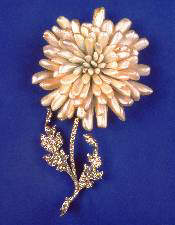
Chrysanthemum Brooch
© AMNH
Description of the brooch
The designing of the Chrysanthemum brooch was an ingenious attempt by Paulding Farnham to put the abundant supplies of "dogtooth" pearls into some form of creative use. The "dogtooth" pearls were drilled and mounted on gold spikes radiating from the center, in almost concentric whorls, the innermost whorl containing the shortest pearls, and the length of the pearls increasing gradually towards the outermost whorl. The shape of the pearls almost resembles the shape of the "ray florets" of the Chrysanthemum "flower." It is important to remember that contrary to popular belief the Chrysanthemum "flower" is not actually a flower but an inflorescence known as the head or capitulum, made up of an aggregate of florets known as "ray florets" and "disc florets." The particular variety of Chrysanthemum used by Paulding Farnham as his model in designing this brooch, consisted of a predominance of ray florets, with the disc florets almost hidden in the center. The stem and two serrated leaves of the Chrysanthemum bloom, is made of gold and platinum and studded with sparkling diamonds.

Chrysanthemum inflorescence
History of the Chrysanthemum brooch
The Chrysanthemum brooch was given as a gift to comic opera star Lillian Russell ?
An inscription on the brooch "L.R. Dec 04" reveals that the brooch belonged to the internationally renowned singer and comic opera star, Lillian Russell (1861-1922), who was reported to have had a close romantic relationship with the bachelor millionaire Diamond Jim Brady, well known for his penchant in collecting jewels, especially diamonds. Diamond Jim Brady was known to have showered Lillian Russell with extravagant gifts of diamonds and gemstones, and perhaps the Chrysanthemum brooch might have been one such gift, symbolizing happiness and amiability. However, Tiffany's website reveals that the brooch was presented to the comic opera star Lillian Russell in 1904, but does not specify the donor. The text of this web article may also imply that the brooch was a gift by the company Tiffany & Co. to the renowned singer and star. The month December 04, undoubtedly refers to the month and year the brooch was designed and presented to the famed star.
The World's largest ecosystem that supports the largest number of species of freshwater mussels
Freshwater pearls are produced by freshwater mussels belonging to the family Unionidae of bivalve mollusks, found in unpolluted, standing or flowing waters rich in oxygen, calcium and suspended food particles, such as algae and other organic matter. North America is the home of the world's richest and most diverse assemblage of freshwater pearl mussels, consisting of around 300 species out of around 1,000 species found worldwide. Out of this a greater concentration of species (127 species) are found in a single large ecosystem in the United States, the rivers and streams of the Ohio river basin, which includes rivers and streams in 13 states :- Ohio, Mississippi, Alabama, Kentucky, Georgia, North Carolina, New York, Illinois, Indiana, Pennsylvania, West Virginia, Tennessee and Virginia. Some of the large river systems where freshwater mussels occur in abundance are the Mississippi, Ohio and Tennessee. Out of the 127 different species of freshwater mussels found in the Ohio River basin, only about 20 species are commercially harvested.
The discovery of the first freshwater pearls in America since the time of the ancient Indians
Archaeological evidence suggests the exploitation of freshwater mussels by native Indians in America, that extends back to several millennia. Besides using the mussels as a source of food, the discarded shells had other multiple uses such as, production of tools and utensils, like hoes, spoons and scrapers, production of ornamental jewelry, used as tempering in pottery manufacture, and used as currency. The occasional pearls that were discovered in the mussels were mainly used for ornamental purposes. The first freshwater pearl discovered in North America since the time of the ancient Indians was in 1857, when a 93-grain pink pearl was discovered by a carpenter named Jacob Quackenbush, in the streams of Notch brook, near Paterson City, New Jersey. The pearl was purchased by Charles L. Tiffany, the founder of Tiffany & Co. for $1,500, and later sold in Paris to a French gem dealer for $2,500, who in turn sold it to Empress Eugenie, the Empress Consort of Napoleon III, and came to be known as the "Queen Pearl." This discovery set off a "pearl mania" in New Jersey, in which hundreds of thousands joined in the search for freshwater mussels in the streams and rivers of the State, that led to the discovery of substantial quantities of pearls, but led to the decimation of the pearl populations due to overexploitation. The fever spread to other neighboring states such as New York, Ohio, Texas, Arkansas, Wisconsin, Mississippi, Kentucky, Illinois, Tennessee etc. where too substantial quantities of freshwater pearls were discovered.
Abundant supplies of freshwater mussel shells led to the setting up of the largest mother-of-pearl button manufacturing industry in the world
The abundant supplies of freshwater mussel shells from the rivers and lakes of southern, eastern and central United States, led to the setting up of the largest mother-of-pearl button manufacturing industry in the world, in the United States, which by the year 1912, had over 200 button manufacturing plants. The multi-million dollar industry begin to decline rapidly after 1930, due to over exploitation, and the dwindling supply of shells. However, in spite of the decrease in production, the industry survived until World War II. After World War II, plastic buttons were produced, that displaced the shell buttons, and this resulted in the demise of the mother-of-pearl button manufacturing industry in the United States. The death of the mother-of-pearl industry was bad news to the economy of the United States, but good news to the freshwater mussels, which after decades of overexploitation were given the chance to recover.
The revival of the freshwater mussel fishery in the 1950s after the discovery that American freshwater mussel shells provided the best bead nuclei for Japanese cultured pearls
However the mussels did not enjoy the respite for long, for in the early 1950s Japanese scientists came up with an alternative use for the American freshwater mussel shells. Scientists discovered that the American freshwater mussel shells provided the best material to serve as the bead nuclei for the Japanese cultured pearls. The finding resulted in the large scale importation of freshwater mussel shells from the United States to Japan, and to the revival of the dormant freshwater mussel fishery. It was during this time in 1954, that John Latendresse founded the Tennessee Shell Company, that eventually became the main supplier of mussel shells for the cultured pearl industry. The mussel shell exports to Japan was worth around $50 million in the 1990s, and a by product of this industry was the occasional natural freshwater pearls discovered in the mussels. Thus John Latendresse was able to build up the largest collection of natural freshwater pearls ever put together by an individual collector.
Shapes of natural freshwater pearls
The most common shape of natural freshwater pearls is baroque or irregular. However, freshwater pearls can also exist in a variety of different shapes such as wings, slugs, rosebud, turtleback, feather, button, drop, snail, angel. round, semi-round, near-round, off-round, teardrop and dogtooth. Some of the pearls like dogtooth pearls can be found as clusters inside the mussel.
Colors of natural freshwater pearls
The color of the pearl is determined by the color of the pearly nacre on the inner surface of the shell, which can vary from pure white to shades of pink, salmon, gray and purple. Thus the pearl that develops inside the mussels can assume any on e of these colors. However, the most common color found in freshwater pearls is white, followed by pink, rose, lavender and purple. Other rare colors in which they occur, include cream, yellow, green, blue, brown and red.
Chrysanthemum pearl brooch exhibited in the traveling exhibition "Pearls : A Natural History"
The Chrysanthemum pearl brooch which is now part of the collection of Mr. and Mrs. R. Weatherly was given out on loan to the American Museum of Natural History, New York, to be exhibited at the traveling exhibition organized by them in collaboration with the Field Museum of Chicago, known as "Pearls - A Natural History." The exhibition which was first held in October 2001, at the AMNH, New York City, has since been hosted in several museums around the United States, and also in countries like Canada, France, Australia, Japan and Abu Dhabi in the United Arab Emirates. The exhibition features more than 600 pearl exhibits, ranging from a replica of the largest pearl ever discovered, the 14.5 pounds "Pearl of Islam" to pearl jewelry and fashions, that had once been used by renowned personalities and celebrities like Queen Victoria, Marie Antoinette, Audrey Hepburn, Marilyn Monroe and Elizabeth Taylor.
History of pearl jewelry designing by Tiffany & Co. the makers of the Chrysanthemum Pearl Brooch
Dr. George Frederick Kunz is appointed as geologist/gemologist for Tiffany & Co
Tiffany & Co., a household name in the international jewelry trade, which was founded in the year 1837, has been internationally renowned since its inception as a supplier and dealer of the finest pearls in the world, set in exquisitely designed jewelry. The founder of the company Charles Lewis Tiffany (1812-1902), engaged the services of one of the World's most eminent geologists/gemologists, Dr. George Frederick Kunz (1856-1932), to source for the highest quality pearls, gemstones and diamonds, to be used in the creation of the wide range of jewelry for which the company became famous for. While still in the services of the company, Dr. G. F. Kunz wrote his famous work on all aspects of pearls and pearl industry in the world, titled "The Book of the Pearl," which is still regarded by many as a standard source of reference on the subject.
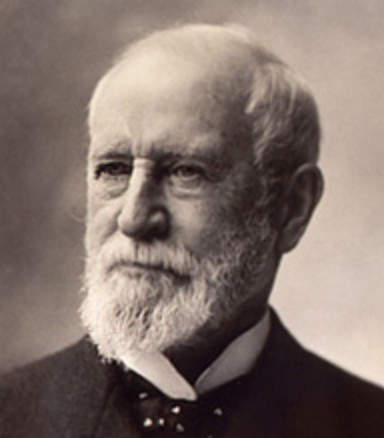
Charles Lewis Tiffany- Founder of Tiffany and Co.
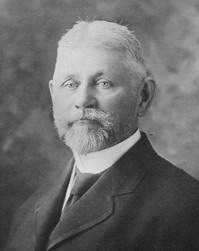
George Frederick Kunz
Tiffany & Co. was a prime player in the development of the natural freshwater pearl industry in the United States
Tiffany & Co. was undoubtedly a prime player in the development of the American natural freshwater pearl industry, since the discovery of the first freshwater pearl in North America, the Paterson/Queen pearl, in 1857, by paying attractive prices for the pearls discovered by prospectors. It was the lure of the lucrative prices paid for pearls by companies like Tiffany & Co. that prodded on the prospectors to scout for more freshwater pearls. The first pearl discovered in America was purchased by Charles Lewis Tiffany, the founder, who paid $1,500 for the 93-grain pink pearl, and later sold it to an agent of Napoleon III for $2,500.
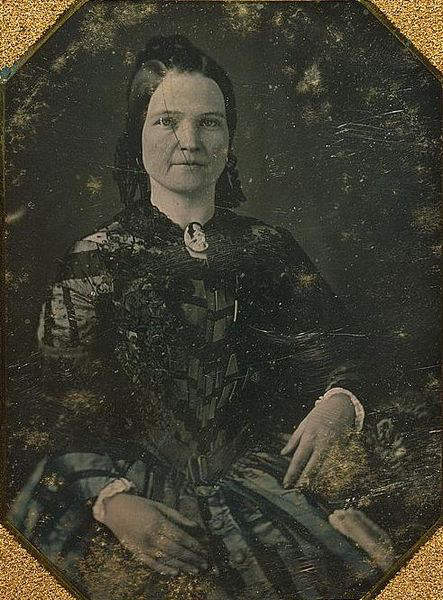
Mary Todd Lincon
Tiffany & Co. designs a pearl jewelry set for Mary Todd Lincoln, wife of President Abraham Lincoln
Tiffany & Co. gained international recognition for some of its pearl jewelry creations. Among the first such creation that gained international prominence was the exquisitely crafted pearl jewelry set created for President Abraham Lincoln, who gifted it to his wife, Mary Todd Lincoln, on the occasion of his first inauguration. The pearl parure consisted of a necklace, a pair of earrings, a bracelet and a brooch, all set with seed pearls, probably of Persian Gulf origin. The pearl set is currently preserved in The Library of Congress, in Washington D.C.
Tiffany & Co. are awarded the gold medal for their display at the 1889 International Paris Exposition
In the late-19th century, Tiffany & Co. gained unprecedented international recognition at some of the World's great industrial and trade exhibitions, and pearl jewelry created by the company played no small part in attaining such recognition. The company's lavish displays of jewelry creations, showcased the innovative designs of Paulding Farnham, the chief jewelry designer of Tiffany's, whose extraordinary creations won more honors than that of any other jewelry designer of his time. Farnham exhibited extraordinary skill in combining colored gemstones and pearls in his jewelry creations, that was inspired by a wide range of influences from botanical and native American motifs to Orientalism. At the 1889 International Paris Exposition, Tiffany's were awarded the gold medal for their display that included three of Farnham's exquisite creations, the Hupa Brooch whose motif was based on the basketwork of Alaskan Indians, and incorporated with pearls from Ohio's Miami River, the Florida Palm Brooch, set with a Montana sapphire, pink pearls and diamonds and pearl and diamond spider brooches, perfectly naturalistic and accurate to the finest details.
Tiffany & Co. was the main producer of high-end pearl necklaces by the end of the 19th century
In Tiffany's history, pearl necklaces occupied pride of place and were among the most expensive jewels designed by the company. At the World's Columbian Exhibition held in Chicago in 1893, the company displayed a magnificent single-stranded pearl necklace consisting of 38 natural pearls and price marked at $200,000. By the end of the 19th century, Tiffany's was the main producer of high end pearl necklaces of waist length, catering to the elite of American society, and one of the pearl necklaces put together for Mrs. George Gould, the New York socialite was priced at well over a million dollars.
Tiffany & Co. repeats its gold medal feat at the World's Fair in Buffalo
Again in 1901, at the World's Fair in Buffalo Tiffany's repeated its gold medal winning feat, acquired by two other creations of Paulding Farnham, an Italian Renaissance style gold pendant, incorporating diamonds, rubies, emeralds and American freshwater pearls, and an East Indian style brooch incorporating a 101-grain pale-purple pearl, a 64.5-carat cat's-eye and a 28-carat ruby. Another renowned piece created by Tiffany's in 1904, was the Chrysanthemum Pearl Brooch, the subject of this webpage, incorporating American freshwater dogtooth pearls and diamonds, that was presented to the famous comic opera star Lillian Russell.
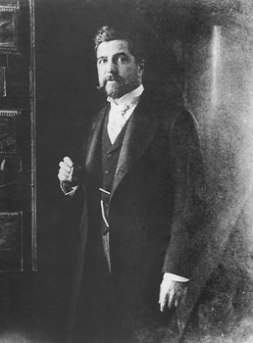
Louis Comfort Tiffany
Joint effort by Louis Comfort Tiffany and George Frederick Kunz in popularizing American gemstones
Louis Comfort Tiffany, the son of the founder Charles Lewis Tiffany, the leading Art Nouveau style designer in America, worked together with the company's geologist/gemologist George Frederick Kunz, in popularizing American gemstones and pearls, by creating innovative designs. One such effort was the incorporation of baroque pearls in jewelry designs created by Tiffany's from the year 1907, introducing the beauty of the baroque pearls to American jewelry lovers.
Tiffany & Co. continues to maintain its high quality standards in designing all types of jewelry
Today Tiffany & Co. continues with its age-old tradition of incorporating pearls of different kinds and the highest quality, sourced from different parts of the world, in its jewelry designs, such as Akoya pearls from Japan, irregular-shaped keshi pearls, freshwater pearls, mabe pearls, South Sea pearls from Australia and Philippines and black Tahitian pearls. The ultimate perfection in Tiffany's designs is the signature pearl strand composed of luminous South Sea pearls, uniformly matched for size, shape, color, luster and other important characteristics.
A short biography of Lilian Russel
Her early life and events that led her to choosing an operatic career
Lillian Russell was a great comic opera star and singer of the late 19th and early 20th centuries, acclaimed both in America and Europe. Russell who was born in 1861 in Clinton, Iowa, was the daughter of Charles E. Leonard, a newspaper publisher and Cynthia Rowland Leonard, a feminist and author. In 1865, the family moved to Chicago where Lillian received her education in the Convent of the Sacred Heart, and the Park Institute. Her parents separated in 1878, when she was 17, and she moved to New York with her mother, where she studied singing under Leopold Damrosch, in anticipation of pursuing an operatic career. Her extraordinary physical beauty, and sweet voice were great assets that assisted her in embarking on the career of her choice. She had her first break in her career, when she joined the chorus of Brooklyn Park Theatre. In November 1879 she had the fortune of making her first appearance in Broadway, billed as an "English Ballard Singer" at Tony Pastor's Casino Theatre.
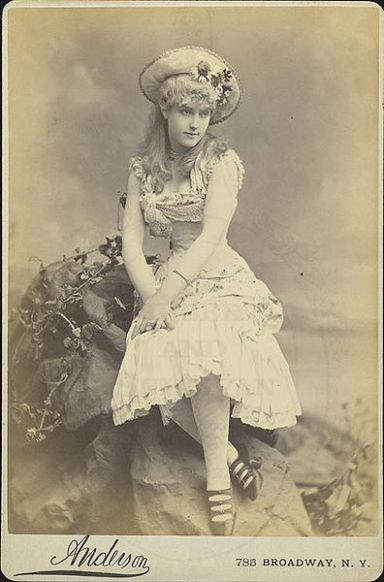
Lillian Russell in the comic opera - Patience
Her carrier from 1879 to 1882
Later in 1879 she joined the chorus of a touring production of Gilbert and Sullivan's comic opera, H.M.S. Pinafore. This assignment was significant in her life, for just two weeks after joining the company, she married the orchestra leader Harry Graham, her first husband. In the following year after the death of their infant child, the couple were divorced. Then followed a series of acting roles starting from 1881, as Mabel in "Pirates of Penzance," in Tony Pastor's theatre, as Djenna in "The Great Mogul" at the Bijou Theatre, as Bathilda in "Olivett," with McCaull Opera Company, as Aline in Gilbert and Sullivan's "Sorcerer" and the title role also in Gilbert and Sullivan's "Patience."
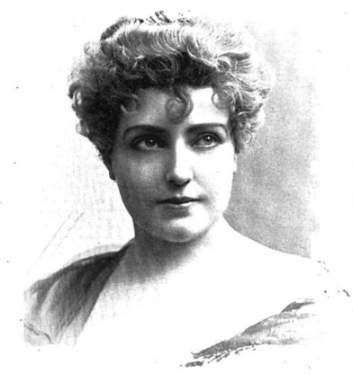
1897 photograph of Lilian Russel
Her carrier from 1883 to 1893
In 1883 she returned to Pastor's Casino Theatre, and played the role of Phoebe in "Billy Taylor" for which music was composed by Edward Solomon. Russell married her second husband Edward Solomon in 1884 and sailed with him to England, where she played roles in several of Solomon's productions such as Virginia in "Paul and Virginia," and title characters in Polly and Grundy and Pocahontas. They returned to New York in the winter in the winter of 1885, and toured the following season for Tony Pastor in Solomon's comic operas. However, in 1886 Solomon was arrested on charges of bigamy.
Russel continued her acting career, starring in comic operas and other musical theatre in Broadway Theatres, in a variety of roles in different productions. For several years Russell reigned as the undisputed queen of opera singers in America, her voice, beauty and stage presence taking the audience by storm. Russell's singing voice was used to inaugurate the first long distance telephone service introduced by Alexander Graham Bell, from New York City to Boston and Washington D.C. on May 8, 1890.
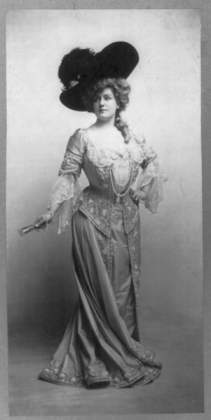
Lilian Russel as Lady Teazle in the 1904 opera by the same name
Her career from 1893 to 1919
In 1893, she filed for divorce from Solomon. She then joined the J.C. Duff Opera Company, with whom she toured for some time. In 1894, she married her third husband John Haley Augustin Chatterton, who used the stage name Giovanni Perugini, but they separated after only six months. Between 1895 and 1899, she continued to play lead roles in various productions in different Broadway Theatres, but had a declining audience. Thus in 1899 she joined the Weber and Fields Music Hall, starring in their comic operas and other entertainments until 1904. She then had vocal difficulties, with deterioration of her voice. However, she did not retire from the stage, but instead switched to non-musical comedies, touring with James Brookes. In 1911 she again returned to singing. In 1912, she married her fourth husband, Alexander Pollock Moore, owner of the "Pittsburg Leader," and made her last appearance on Broadway the same year, in Weber and Fields "Hokey Pokey." In 1915, Russel appeared with Lionel Barrymore, in one of her few motion picture appearances "Wildfire" based on the 1908 play of the same name in which she appeared. She continued singing in Vaudeville until 1919, when she finally retired from the stage due to ill health.
Her life after retirement until her death in 1922
During the years of her retirement she wrote a newspaper column, became a strong advocate of woman suffrage, and lectured on health, beauty and love. During World War I, she recruited for the Marine Corps, and helped raise money for the war effort. In 1922, Russell toured Europe, on assignment for President Harding, as special investigator on immigration; a fact-finding mission to investigate the increase in immigration. Her recommendations included a five-year moratorium on immigration, and led to the immigration reform law of 1924. She died at her home in Pittsburg, Pennsylvania on June 6, 1922, aged 61, shortly after her arrival from the fact-finding mission to Europe.
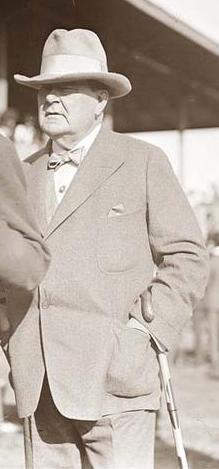
Diamond Jim Brady
Lilian Russel's romantic association with Diamond Jim Brady
During her lifetime Lillian Russsel was also known to have had a close romantic association with businessman James Buchannan Brady, also known as Diamond Jim Brady, an American businessman, financier and philanthropist. Brady was well known for his penchant in collecting jewels, especially diamonds. His collection of jewels and jewelry was estimated to be worth in excess of $2 million in the early 20th century, which adjusted to present day values is about $50 million. Brady is said to have showered Lilian Russel with extravagant gifts of diamonds and gemstones, and supported her extravagant life style.
A short biography of George Paulding Farnham
G. Paulding Farnham's talents recognized by Charles Lewis Tiffany, the founder of Tiffany's
George Paulding Farnham, the renowned jewelry designer, artist and sculptor, was born in 1859 in New York. In the year 1885, at the age of 26 years he joined the Tiffany's design department, probably under the aegis of his uncle, Charles T. Cook, the vice-president of the company. He started a period of apprenticeship under Edward C. Moore, the director of the silverware division. His training in the Tiffany's design studio involved drawing directly from specimens brought into the studio. His interest in three-dimensional representation led him to modeling and sculpture. His grasp and understanding of proportion and balance in sculpture, undoubtedly had a profound influence in his ability to excel in the creation of unique jewelry designs that eventually received international acclaim. Farnham quickly distinguished himself as a skilful and innovative artist. His talents were recognized by the founder Charles Lewis Tiffany (1812-1902), who appointed him as director of the jewelry department in the 1890s, and towards the end of the century as overall art director.
Paulding Farnham attains international recognition at the 1889 Paris International Exhibition
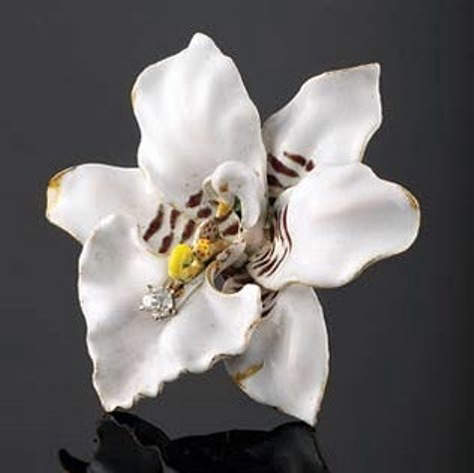
Orchid Brooch designed by Paulding Farnham for Tiffany in 1889
Prior to the Paris International Exhibition held in 1889, Farnham and Moore were jointly assigned the task of designing the pieces of jewelry that were to be exhibited at the Tiffany's stall at the exhibition. Tiffany's jewelry exhibits at this exposition, received international acclaim and won an unprecedented six gold medals, and Farnham was universally recognized as the genius behind this achievement. Farnham's Art Nouveau jewelry designs in the form of enameled and bejeweled orchids, exactly similar to the natural specimens to the minutest detail, in structure as well as color, were hailed by jewelry experts as exceptional and difficult to be imitated. "The copying of flowers in jewelry, is of course no new thing, but the orchids of Messrs Tiffany are the first that we have seen, and it would be impossible to surpass them, whether for cleverness of imitation or for perfection of workmanship." said Gustave Stickley, leader of the Arts and Crafts movement, a view also shared by the French art critics. Apart from this naturalistic theme, they were also impressed by Farnham's array of colorful designs inspired by a variety of sources, such as native American pottery, historical designs from France belonging to the periods of Louis XIV, XV and XVI, Eastern European designs, and jewelry from India and Japan.
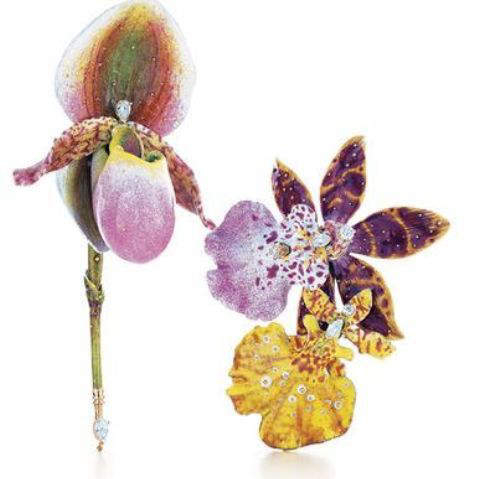
Some of the naturalistic orchid brooches designed by George Paulding Farnham
Paulding Farnham repeats his feat in the exhibition of 1890
In the following year, Farnham again helped Tiffany's to repeat its previous year's triumph, as jewelry designed and exquisitely crafted by him, won the grand prize for jewelry at the exhibition. However the success achieved by designer Farnham was actually a joint effort by him and Tiffany's geologist and gemologist George Frederick Kunz, who is said to have provided him the raw materials in the form of an array of colored stones such as Montana blue sapphires, Arizona turquoise, Mexican fire opals, demantoid garnets, pink topaz and pink conch pearls
Paulding Farnham resigns from Tiffany's in 1908, and becomes a full-fledged artist
In 1902, After the death of Charles Lewis Tiffany, the founder of the company, he was succeeded by his son Louis Comfort Tiffany (1848-1933), who became the second vice-president. He also took over part of the duties of Farnham as art director, and in 1907 replaced Farnham as the overall art director of the company. Farnham who was unhappy with the developments in the company, began selling his shares in the company, and on June 2, 1908, tendered his resignation. That ended the career of a creative jewelry designer who attained international fame within a short period of his career. However the loss for the world of decorative arts was a gain for the world of creative arts, such as painting and sculpturing. Farnham migrated to the west coast of America, where he settled down in Mill Valley, California, and became a full-fledged painter, turning out some extraordinary works of art, in keeping with his genius.
You are welcome to discuss this post/related topics with Dr Shihaan and other experts from around the world in our FORUMS (forums.internetstones.com)
Related :-
External Links :-
1) Tiffany & Co. For The Press / About Tiffany & Co. / Tiffany Pearls
References :-
1) Chrysanthemum Brooch, Pearls : A Natural History - website of the American Museum of Natural History
2) Pearls : A Natural History, International Art Treasures Web Magazine
3) Tiffany & Co. For The Press / About Tiffany & Co. / Tiffany Pearls
4) Paulding Farnham - Antique Jewelry University, www.langantiques.com
5) More about Paulding Farnham, Tiffany's designer extraordinaire - Janet Zapata, Magazine Antiques, March, 1999.
6) Lilian Russel - From Wikipedia, the free encyclopedia
7) Russel Lilian - River Campus Libraries, University of Rochester, www.library.rochester.edu
8) Chrysanthemum - From Wikipedia, the free encyclopedia
 Home
Security & Guarantee
How it Works
Technology Partners
Updated Tables
Famous Diamonds
More Famous Diamonds
Famous Pearls
Famous Gemstones
Contact Dr Shihaan Larif
Contact Senior Editor
Famous Jewelry
Reference Database
Forums
Learning Center
Gemstone Gallery
e-mail Notifications
Advertise
Press Release
About Us
Privacy Policy
Contact Us
FAQ'S
Site Map
Staff Mail Login
Staff Documents
Birthstones
History
Minerals
Shows
Live Metal Prices
Jewellery Gallery
News
Marketplace
Marketplace Support
Open Store
Online Auctions
Join Us & Contribute
Directory
Classifieds
List your products
Wholesale Trading
Post Buy Request
Go Green Policy
Site Updates
Upcoming-ToDo List
Latest News
Latest Articles
Latest Blog Updates
Chat Rooms
Job Board
User Gallery
Videos
New Newsletter Archive
Old Newsletter Archive
Jewelry & Mineral Blog
User Blogs & Social Network
Search
Answers (Q & A)
Valuation
Help me find a diamond/jewelry
pin.internetstones.com- Social Pinboard- Sart yours & connect with millions
Invite Friends From Yahoo, Gmail etc-One Click
Home
Security & Guarantee
How it Works
Technology Partners
Updated Tables
Famous Diamonds
More Famous Diamonds
Famous Pearls
Famous Gemstones
Contact Dr Shihaan Larif
Contact Senior Editor
Famous Jewelry
Reference Database
Forums
Learning Center
Gemstone Gallery
e-mail Notifications
Advertise
Press Release
About Us
Privacy Policy
Contact Us
FAQ'S
Site Map
Staff Mail Login
Staff Documents
Birthstones
History
Minerals
Shows
Live Metal Prices
Jewellery Gallery
News
Marketplace
Marketplace Support
Open Store
Online Auctions
Join Us & Contribute
Directory
Classifieds
List your products
Wholesale Trading
Post Buy Request
Go Green Policy
Site Updates
Upcoming-ToDo List
Latest News
Latest Articles
Latest Blog Updates
Chat Rooms
Job Board
User Gallery
Videos
New Newsletter Archive
Old Newsletter Archive
Jewelry & Mineral Blog
User Blogs & Social Network
Search
Answers (Q & A)
Valuation
Help me find a diamond/jewelry
pin.internetstones.com- Social Pinboard- Sart yours & connect with millions
Invite Friends From Yahoo, Gmail etc-One Click




Our Global Jewelry Industry Job Network


Buy & Sell in our Marketplace

Subscribe to our Newsletter

List in our Classifieds

List in our Directory

User Uploaded Gallery

Powered by Ultra Secure
Amazon (USA) Cloud Network

Founder Internet Stones.COM
Register in our Forums

| Featured In
|
|
|
|
|
|
|
|







Blog & Education Feed
Articles Feed
 |
 |
 |

Copyright © .Internet Stones.COM. All rights reserved.