Chalk Emerald Ring
Open FREE Unlimited Store Join Our Newsletter
Origin of name
The Chalk Emerald Ring which is an important and famous exhibit in the National Gem Collection of the National Museum of Natural History of the Smithsonian Institution, gets its name from the one time owner of the emerald Mrs. Claire Chalk, wife of Oscar Roy Chalk, the renowned New York entrepreneur who was the owner of real estate, airlines, bus companies, newspapers and a rail line that transported bananas in Central America, and even a Central American banana plantation for a short period. Mr. O. Roy Chalk purchased the emerald ring from Harry Winston and gifted it to his wife, who wore the stunning emerald ring for a state dinner at the White House, in honor of Queen Elizabeth II. However, during the party Mrs. Claire Chalk observed that Her Excellency the Queen, was wearing a less attractive emerald ring, and decided to turn her ring around on her finger, so as not to upstage the queen. In the year 1972, Mrs. Claire Chalk in consultation with her husband, donated the fabulous emerald ring to the National Museum of Natural History, of the Smithsonian Institution.
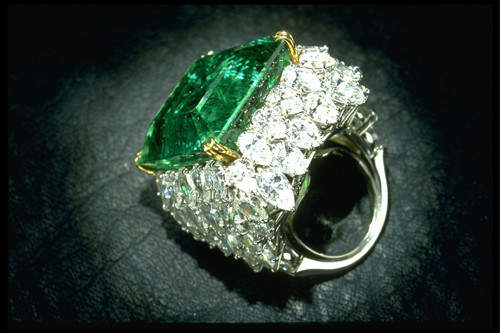
© Smithsonian Institution, photo by Chip Clark
Characteristics of the gemstone
The Chalk Emerald is a 37.82-carat, square emerald-cut, deep bluish-green emerald of Colombian origin, with a good transparency. Like all natural emeralds the Chalk Emerald also contain some Jardin or inclusions, but in spite of it ranks among the very finest of Colombian emeralds.
The top quality emerald was previously the centerpiece of an emerald and diamond necklace, that belonged to the most flamboyant Maharani of Baroda, Maharani Sita Devi, the "Wallis Simpson of India" who was compelled to sell part of her enormous collection of jewelry due to financial difficulties, while living in Monaco. Harry Winston purchased the necklace, and after re-cutting the emerald from its original 38.40 carats to 37.82 carats, set it in a platinum ring, surrounded by 60 pear-shaped colorless diamonds, with a total weight of 15 carats. The surrounding colorless diamonds further enhanced the beauty of the emerald, and made it a masterpiece in jewelry setting, that would forever remain a living monument to the designing skills of the the "King of Diamonds" Harry Winston.
History of the gemstone
The source of the Chalk Emerald
The Chalk Emerald is undoubtedly of Colombian origin, as all other emeralds that reached India during and after the Moghul period that lasted from the early-16th century to the mid-19th century. The Spanish discovery of emeralds in Colombia also took place around the mid-16th century, and most of the emeralds mined from the historic emerald mines of Colombia, Muzo, Chivor and Coscuez, eventually found their way to the Islamic Empires of Turkey, Persia (Iran) and India (Moghul Empire). The Chalk Emerald would have entered the treasury of Baroda either during the Mughal period of its history that lasted from 1573 to 1734 or during the Maratha period (1734-1947) when Baroda became the capital of the powerful Gaekwar family.
Is Chivor the possible mine of origin of the Chalk Emerald?
Even though it is known for certain that the Chalk Emerald originated in Colombia, the actual mine from which the emerald was discovered is not known. But, the deep bluish-green color of the emerald might provide some clue as to the mine of origin, as the emeralds produced in the three mines have their own characteristic colors and other physical and optical properties such as specific gravity and refractive index. Emeralds produced in the Muzo mines have a deep herbal-green color, those produced in Coscuez have a typical yellowish-green color, while those produced in the Chivor mines are deep bluish-green in color. Thus the Chalk Emerald based on its color alone appears to have originated in the Chivor mines of Colombia. This could have been confirmed if the specific gravity and the refractive index of the emerald was known, as emeralds originating in Chivor have a slightly lower specific gravity (2.69) and refractive index (1.571), than those of the Muzo emeralds (2.71 and 1.578).
When was the Chalk Emerald discovered ?
If the origin of the Chalk Emerald is the Chivor mines, situated at the southeastern end of the NW-SE emerald belt of the Andes Mountains, the emerald would have been discovered in Chivor most probably in the period between the 1540s and 1675, before the Chivor mines were closed down indefinitely by royal decree issued by King Charles II of Spain, due to the brutal and unbearable cruelty shown towards the Indian workers. After the closure of the Chivor mines, the surrounding jungles reclaimed the mines, and the whereabouts of the mine was unknown, until rediscovered in 1896 by the mining engineer Don Francisco Restrepo. However, production in the Chivor mines resumed only in the year 1911. It is also quite possible that the Chalk Emerald was discovered after 1911 and entered the Baroda treasury between the years 1911 and 1947, the year the Princely States were abolished. But, the period 1540 to 1675 is more favorable as emeralds in large quantities entered the Mughal treasury during this period, the height of Mughal power in India. Large quantities of the bright green stones filled several chests in the Mughal treasury, and several of them were mounted on the splendorous "Peacock Throne" of Emperor Shah Jahaan (1628-58). It is also well known that Nadir Shah the mighty conqueror from Iran, carried away several chests full of emeralds, rubies, sapphires, diamonds and pearls, when he invaded Delhi and Agra in 1739, and plundered the wealth of the two cities. According to historical evidence, India, under the mighty Moghul Emperors Babur (1526-30), Humayun (1530-56), Akbar the Great (1556-1605), Jahangir (1605-27), Shah Jahaan (1628-58) and Aurangzeb (1658-1707), was one of the richest nations on earth, whose subjugation and eventual colonization was the primary aim of the western colonial powers.
The Chalk Emerald enters the Baroda treasury
Khande Rao Gaekwar
The Maharajah's of Baroda were well known for their lavish and extravagant tastes, which almost reached mythical proportions during the reign of Khande Rao Gaekwar (1856-70), who was one of the most notable jewelry collectors of the 19th century, and possessed an impressive and unparalleled collection of jewels and jewelry. Khande Rao Gaekwar did not mind the expenditure, when it came to the acquisition of remarkable pieces of jewels and jewelry. In fact one of his most remarkable acquisitions was the 128.48-carat "Star of the South" diamond, which has gone down in history as the first Brazilian diamond to receive international acclaim, and was purchased by the Maharajah for £80,000. The Maharajah also purchased the 76.5-carat drop-shaped "English Dresden Diamond" and got both stones set as the centerpiece of a triple-tiered diamond necklace, which came to be known as the "Baroda Diamond Necklace."
Some of the other extravagant pieces of jewelry attributed to Khande Rao Gaekwar are , the magnificent ceremonial necklace, the seven-stranded diamond and emerald necklace known as the "Hindu Necklace," and the magnificent and legendary seven-stranded natural pearl necklace, which came to be known as the "Baroda Pearl Necklace." These two pieces were the most expensive pieces of jewelry owned by the Gaekwar of Baroda.
If the Chalk Emerald originated in the Chivor mines, it might not have entered the Baroda treasury during the reign of Khande Rao Gaekwar (1856-70), as during this period the mines were not yet rediscovered. But, it is possible that Khande Rao Gaekwar might have inherited the Chalk Emerald from his predecessors, who acquired or received the gemstone as a gift from the Moghul Emperors.
Sayagi Rao Gaekwar III
Khande Rao Gaekwar was succeeded by his estranged brother Mulhar Rao who only reigned for a very short period from 1870 to 1875, and was forced to abdicate in 1875 by the British, after being found guilty of attempting to poison the British Resident Officer of Baroda Colonel Phayre with diamond dust. As their were no heirs to the throne of Baroda, the British adopted a twelve year old boy from another branch of the Gaekwar lineage, as successor, who ascended the throne as Sayagi Rao Gaekwar III, who ruled from 1875 to 1939. Sayagi Rao who was educated in England by the British, traveled extensively in Europe, and was exposed to the cultures of different nations, and after returning to Baroda adopted some measures which he experienced personally in these countries that would uplift the living standards of his people. In the field of education he established compulsory primary education, a library system and the Maharajah Sayajirao University of Baroda. He promoted the health care of his people, addressed social injustice, developed communication networks, and also established a museum in Baroda. He also set up textile factories that helped create the Baroda textile industry. He was one of the first Indian Princes who staunchly supported Indian nationalism and the idea of a free India. Thus, without any doubt, Sayagi Rao Gaekwar III became one of the most enlightened and greatest modern leaders of India. Sayagi Rao Gaekwar III was greatly assisted by his wife Chimnabai in the implementation of the progressive measures adopted by her husband.
Chimnabai had a great passion for gemstones, pearls and diamonds, and was a connoisseur and collector of these items. She had profound knowledge of jewels and traveled extensively in Europe, making purchases of jewels for her collection. She made all the purchasing decisions and used her knowledge to outwit the European jewelers when making purchases of diamonds and other gemstones such as emeralds, rubies etc. She built up a working relationship with the House of Cartier, and invited Jacques Cartier to India in 1911. Thus, it is quite possible that the extraordinary emerald that came to be known as the "Chalk Emerald" would have been purchased by Chimnabai during one of her trips to Europe after 1911, when the Chivor mine came into full production once again. The cut and polished emerald was incorporated into an emerald and diamond necklace in which it became the centerpiece.
Pratapsingh Rao
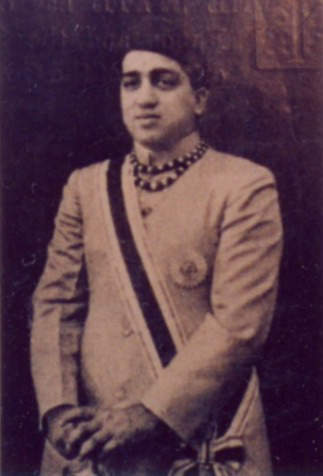
Pratapsingh Rao
Sayagi Rao Gaekwar III was succeeded by his grandson Pratapsingh Rao (1939-47), who was the last Gaekwar of Baroda, before the Princely State was absorbed into the new Indian Republic created in 1947. Pratapsingh Rao Gaekwad became very famous because he contracted a second marriage in 1943 to Sita Devi, wife of the Zamindar of Vayyur, while his first wife, the Maharani, who bore him four children was still living. It all happened when Pratapsingh Rao Gaekwad attended the Madras races in 1943. He met and fell in love with a beautiful lady, the wife of the Zamindar of Vayyur, who reciprocated his advances. However, since both of them were already married there were many legal obstacles that had to be overcome before they could unite as man and wife. The first hurdle was for Sita Devi to obtain a divorce from her husband. But, to obtain a divorce from her husband without any valid reason was a difficult task. Legal advisers to Sita Devi and the Maharaja put forward an ingenuous plan, that required Sita Devi to convert to the religion of Islam. After her conversion she invited her Zamindar husband to follow suit to reap the benefits of her new religion. The Hindu Zamindar husband was well aware of Sita Devi's intentions and did not even bother to react to this drama. A week later she filed for divorce from her Hindu husband under Islamic law that does not permit a Muslim woman to take a non-Muslim husband. The divorce was granted and she was free. Immediately after the divorce she converted herself back to Hinduism by Arya Samaj rights, and married her lover, Maharaj Pratapsingh Rao, in spite of the fact that he was already married with four children.
According to the law of Baroda State decreed by Sayagi Rao Gaekwar, the grandfather of Pratapsingh Rao, nobody in Baroda could take a second spouse if the earlier one was still alive and not divorced. The British Viceroy who was not happy about the farce that was enacted by the Maharaja, summoned him and informed him that he had violated the law of the State, to which the Maharaja replied that the laws forbidding bigamy were applicable only to his subjects, and he as the ruler was exempted from this ban. Legal opinion sought by the British favored the Maharaja, and thus his second marriage to Sita Devi was accepted as legal.
Maharani Sita Devi
Soon after the end of World War II, in 1946, Pratapsingh Rao took his second wife Sita Devi for a tour of Europe. The main purpose of their visit was to find a suitable country where they could set up a second home, and perhaps Maharani Sita Devi could take up permanent residence. After visiting many countries and seeing the ravages caused by the war, they found that the independent principality of Monaco which was untouched by the war was a suitable place to set up their second home. They bought a magnificent mansion in Monaco and Maharani Sita Devi took up permanent residence in this mansion. The Maharaja then moved cabin loads of the great treasures of Baroda State to his new home in Monaco and the Maharani became the custodian of these treasures. Prince Rainier of Monaco welcomed the Maharaja and Maharani, and helped them to set up home in his domain. The Maharaja was considered to be the 8th richest man in the world, and his presence in Monaco was a big boost to his country's image.
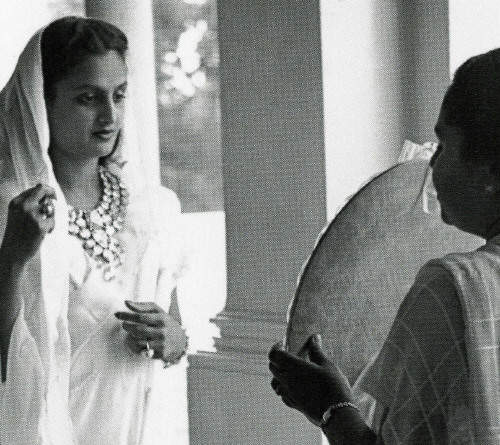
Maharani Sita Devi
Just one year after in 1947, India became an independent republic, and the Princely State of Baroda joined the Indian Union. The Government of India took over the Baroda treasury and was shocked to find that all the valuable treasures were gone, and the treasury was virtually empty. The government attempted to force the Maharaja to bring back the stolen treasures, but the Maharaja only returned the famous 7-stranded necklace now reduced to six strands. Shortly afterwards the Maharaja was forced to abdicate in favor of his son, by his first wife. In Monaco, Maharani Sita Devi had taken full control of all the jewels and long before independence had got her husband to transfer the ownership of the jewels to her name. She also got the jewelry firm Van Cleef & Arpels based in Paris and New York, to remove the jewels from the old settings and remount them in new settings. Thousands of old gemstones were remounted in this way. It is not known whether the Chalk Emerald was also one of the gemstones that was remounted in a new setting.
Maharani Sita Devi now became a celebrated figure in the west and was invited for many high society functions and gatherings. The western media now began to refer to her as India's Wallis Simpson. The original Wallis Simpson, the Duchess of Windsor, had also swapped husbands like Maharani Sita Devi.
Meeting of the two Wallis Simpsons
Sita Devi who inherited a fortune of over $300 million settled down in comfort with her only son Princie, in her luxurious mansion in Monaco. Her Husband Pratapsingh Rao Gaekwad visited them from India, several times in a year. Many stories are told about her high flying life style in Monaco, mingling with the rich and the powerful of the world. One such story refers to her attempts to make a call to her husband in India, when she was on a trip to the United States. She encountered difficulties in making the call from the U.S. and decided to fly across the Atlantic to London, to make her call to India, which she did, and then returned to the U.S. to continue her holiday.
Another interesting story concerns the meeting of the two Wallis Simpsons of the east and the west at a New York ball held in 1957. Harry Winston the "King of Jewelers" and "Jeweler to the Kings" based in New York, purchased a pair of anklets mounted with cabochon-cut emeralds and rose-cut diamonds, belonging to Maharani Sita Devi, in 1953. The expert jewelry designer that he was, Winston decided to remount the jewels of the anklet on a newly designed diamond choker, and sold the exquisitely crafted item to the Duchess of Windsor (former Wallis Simpson), who wore the choker to a New York ball held in 1957, which coincidentally was also attended by Maharani Sita Devi, the India's Wallis Simpson. Sita Devi was sharp enough to recognize the diamonds on the Duchess of Windsor's choker as the one's that once adorned her feet, mounted on the anklets, but she pretended not to know anything about it. At one point during the party, when the guests mesmerized by the beauty and size of the diamond choker were congratulating the Duchess on her recent acquisition, Sita Devi unable to bear it anymore commented loudly, that they had also looked very nice on her feet. The Duchess of Windsor seemed to be humiliated by this incident, and the very next day returned the diamond choker to Harry Winston.
The declining years of the Maharani
As time passed Sita Devi's glamour as well as her riches faded. Since the time she settled in Monaco, the Maharani had gone on an unprecedented spending spree, and her fortunes began declining as she continued to spend without an income to replenish her savings. Moreover, after her husband's kingdom acceded to join the Indian Union and the forceful abdication of her husband in favor of his son, all her sources of income dried up. Sita Devi then resorted to selling her expensive jewelry items secretly whenever she needed money. The selling of the diamond and emerald anklets to Harry Winston in 1953 was one such instance of a private sale. Perhaps, the necklace containing the Chalk Emerald as the centerpiece might also have been sold to Harry Winston during this period under similar circumstances.
Adding to the Maharani's woes was the estrangement between her and her husband Pratapsingh Rao which eventually led to separation and divorce in 1956. Pratapsingh Rao moved to London, where he took up residence and eventually died in exile in 1968. Sita Devi's financial situation worsened, and she was forced to pawn her more expensive jewels, which included the Hindu Necklace. But, this compounded her problems, as she was forced to pay an annual interest of $200,000. Finally the Maharani was forced to sell her jewels at a secret auction held in Monte Carlo in 1974, organized by Credit Mobilier of Monaco, and the sale netted her $4 million.
More misfortunes came her way, and in the year 1985 she lost her only son Princie after his 40th birthday, apparently by suicide, precipitated by alcoholism and drug addiction. The loss of her only son was too much for the aging Maharani to bear, and she too died the following year in 1986, in Neuilly-sur-Seine, France, at the age of 69 years.
Harry Winston resets the Chalk Emerald on a ring and sells it to Oscar Roy Chalk
Harry Winston who purchased the necklace in which the Chalk Emerald was the centerpiece, got the emerald slightly re-cut from its original weight of 38.40 carats to 37.82 carats, and set it as the centerpiece of an exquisitely crafted ring, surrounded by 60 pear-shaped diamonds, with a total weight of 15 carats. Mr. O. Roy Chalk then purchased the fabulous ring from Harry Winston and gifted it to his wife, Mrs. Claire Chalk, who wore the ring for a State Dinner at the White House, in honor of Queen Elizabeth II. Later in the year 1972, Mr. and Mrs. O. Roy Chalk, donated the extraordinary emerald ring to the National Museum of Natural History of the Smithsonian Institution, and the ring came to be known as the "Chalk Emerald Ring." Today the "Chalk Emerald Ring" is exhibited in the Janet Annenberg Hooker Hall of Geology, Gems and Minerals of the Smithsonian Institution.
A short biography of O. Roy Chalk
Oscar Roy Chalk was born in Britain on June 7, 1907, to a Russian-born father and Polish-born mother, who brought him to New York, America, when he was 3 years old. He grew up in the Bronx, and among his neighbors were George and Ira Gershwin. Chalk graduated from New York University and its Law School. He married Claire, the daughter of Nina and Jacob Cole. It was under Jacob Cole that Chalk received his first lessons about the real estate business. His business boomed and eventually he became the owner of several New York City apartment buildings.
From the real estate business he branched into the metropolitan transit business, acquiring the Washington D.C. transit system in 1955, and unsuccessfully attempting to purchase the New York transit system in 1959. He further expanded his business activities by entering the airline business, starting Trans Caribbean Airlines with two DC-3 aircraft. In the mid-1960's, the Trans Caribbean Airlines acquired the 800-mile rail line that transported bananas in Central America, known as the International Railways of Central America, and Mr. Chalk became its chairman. This railway company had been in the business of hauling bananas for the United Fruit Company for several decades. Later it is said that Mr. Chalk himself invested in the banana growing industry and owned a banana plantation for sometime. The Trans Caribbean Airlines was later sold to the American Airlines.
In the early 1960s he ventured into the publishing business, and started the tabloid newspaper "The Washington Examiner" which he promoted aggressively. The maiden issue of the newspaper was given free to the public, and he also ordered that free copies of the first issue be placed on all buses belonging to his transit system. This is a strategy that is still being adopted by most newspaper companies when they put out their maiden issue. Later Mr. Roy Chalk acquired two Spanish Language newspapers published in New York, El Diaro de Nueva York and La Prensa, and merged them into a single newspaper El Diaro La Prensa. The Newspaper was subsequently sold to the Gannett Company in 1981.
Mr. Chalk had residences in Manhattan, Washington and Palm Beach. He was a connoisseur and collector of artworks, and owned a collection of works by Renoir. In October 1954, Mr. Roy O. Chalk acquired the renowned painting by Nicholas Benjamin De La Pierre, "Portrait of a Seated Gentleman" executed in canvas in 1785, from Parke-Bennett Galleries in New York. His other interests included traveling, owning fancy cars, yachts, and plenty of clothes. He was fashion conscious, and dressed well to suit the occasion. He owned dozens of suits, with shirts, ties and shoes to match. His interests also included the promotion of cultural and charitable endeavors. He once sponsored a lavish ball at the Plaza Hotel in aid of the National Society for Crippled Children and Adults.
His interests also reached an international dimension when he founded the American-Korean Foundation to foster closer ties between the people of the United States and South Korea. In recognition of his services to this foundation, the Government of South Korea not only gave him the National Medal of Honor, but also awarded him with an honorary citizenship, something Mr. Chalk cherished until his death. His other international commitment included the Chairmanship of the United Nations Finance Committee for several years, a vital body that generates and administers the funds of the World Organization.
His national responsibilities included, fund raiser for the Democratic Party in the 1960's, fund raiser for the United Negro College Fund, and serving as member of the Georgetown University Board of Regents.
Thus Mr. Oscar Roy Chalk, the son of immigrant parents to the United States, eventually turned out to be a great American citizen, who excelled in whatever field he chose to apply himself, be it in business enterprises, social services, or other national and international assignments.
Mr. Oscar Roy Chalk died from cancer in a New York hospital, on December 1, 1995, at the age of 88 years.
Mrs. Claire Chalk
Mrs. Claire Chalk was born on January 22, 1911, in New York, and was the daughter of Jacob and Nina Cole. She married Oscar Roy Chalk the young New York University Law Graduate, who was four years her senior. Her husband O. Roy Chalk was introduced to the real estate business, by her father, and he became so successful in his business, that within a short period he was the proud owner of several New York City apartment buildings.
Claire Chalk was Roy Chalk's constant companion and adviser and their joint effort helped them to diversify into multifarious business activities, such as mass transit bus companies, airlines, railways, and newspaper publishing, building up a successful business empire.
Besides assisting her husband in his business activities, Mrs. Claire Chalk took an active part in the work of several voluntary and humanitarian organizations, such as the American Red Cross, the American Heart Association, the American Cancer Society, the Retina Foundation, the Salvation Army, Good Samaritan and St. Mary's Medical Center, and the Animal Rescue League. Towards the latter part of her life, she lived mainly in her Palm Beach House, and was active in Palm Beach charity and society.
Mrs. Claire Chalk is well known in the United States, as the owner of the renowned 37.82-carat Chalk Emerald Ring, exhibited in the Janet Annenberg Hooker Hall of Geology, Gems and Minerals, of the National Museum of Natural History, of the Smithsonian Institution. This webpage is entirely dedicated to this extraordinary ring. Mr. & Mrs. Chalk donated the Chalk Emerald Ring to the Smithsonian Institution in the year 1972. Mrs. Claire Chalk died on Monday, May 1, 2006, at the ripe old age of 95 years.
You are welcome to discuss this post/related topics with Dr Shihaan and other experts from around the world in our FORUMS (forums.internetstones.com)
Related :-
4) The Duke of Devonshire Emerald
References
1.The National Gem Collection - Jeffrey Post
2.The Maharaja's Jewels - John Adamson and Katherine Prior
3.The most flamboyant Maharani - K. R. N. Swamy. The Tribune, on line edition. Sunday, August 13, 2006.
4.Royal-Magazine.de - The Hindu Necklace, Three-tiered Baroda Diamond Necklace, The famous Baroda Pearl Necklace.
5.The New York Times - December 2, 1995.- O. Roy Chalk, 88, Entrepreneur With Diverse Holdings is Dead.
6.The Palm Beach Daily News - Sunday, May 14, 2006 - Chalk Emerald owner dies at 95.

 Home
Security & Guarantee
How it Works
Technology Partners
Updated Tables
Famous Diamonds
More Famous Diamonds
Famous Pearls
Famous Gemstones
Contact Dr Shihaan Larif
Contact Senior Editor
Famous Jewelry
Reference Database
Forums
Learning Center
Gemstone Gallery
e-mail Notifications
Advertise
Press Release
About Us
Privacy Policy
Contact Us
FAQ'S
Site Map
Staff Mail Login
Staff Documents
Birthstones
History
Minerals
Shows
Live Metal Prices
Jewellery Gallery
News
Marketplace
Marketplace Support
Open Store
Online Auctions
Join Us & Contribute
Directory
Classifieds
List your products
Wholesale Trading
Post Buy Request
Go Green Policy
Site Updates
Upcoming-ToDo List
Latest News
Latest Articles
Latest Blog Updates
Chat Rooms
Job Board
User Gallery
Videos
New Newsletter Archive
Old Newsletter Archive
Jewelry & Mineral Blog
User Blogs & Social Network
Search
Answers (Q & A)
Valuation
Help me find a diamond/jewelry
pin.internetstones.com- Social Pinboard- Sart yours & connect with millions
Invite Friends From Yahoo, Gmail etc-One Click
Home
Security & Guarantee
How it Works
Technology Partners
Updated Tables
Famous Diamonds
More Famous Diamonds
Famous Pearls
Famous Gemstones
Contact Dr Shihaan Larif
Contact Senior Editor
Famous Jewelry
Reference Database
Forums
Learning Center
Gemstone Gallery
e-mail Notifications
Advertise
Press Release
About Us
Privacy Policy
Contact Us
FAQ'S
Site Map
Staff Mail Login
Staff Documents
Birthstones
History
Minerals
Shows
Live Metal Prices
Jewellery Gallery
News
Marketplace
Marketplace Support
Open Store
Online Auctions
Join Us & Contribute
Directory
Classifieds
List your products
Wholesale Trading
Post Buy Request
Go Green Policy
Site Updates
Upcoming-ToDo List
Latest News
Latest Articles
Latest Blog Updates
Chat Rooms
Job Board
User Gallery
Videos
New Newsletter Archive
Old Newsletter Archive
Jewelry & Mineral Blog
User Blogs & Social Network
Search
Answers (Q & A)
Valuation
Help me find a diamond/jewelry
pin.internetstones.com- Social Pinboard- Sart yours & connect with millions
Invite Friends From Yahoo, Gmail etc-One Click




Our Global Jewelry Industry Job Network


Buy & Sell in our Marketplace

Subscribe to our Newsletter

List in our Classifieds

List in our Directory

User Uploaded Gallery

Powered by Ultra Secure
Amazon (USA) Cloud Network

Founder Internet Stones.COM
Register in our Forums

| Featured In
|
|
|
|
|
|
|
|







Blog & Education Feed
Articles Feed
 |
 |
 |

Copyright © .Internet Stones.COM. All rights reserved.