Crown of the Andes - Emerald-studded Crown
Open FREE Unlimited Store Join Our Newsletter
Origin of name
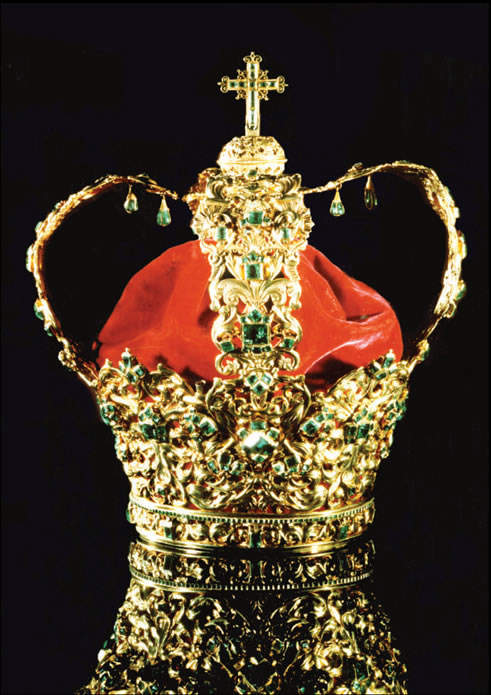
The "Crown of the Andes," one of the most renowned pieces of Jewelry of 16th-century origin, is perhaps one of the first pieces of jewelry to be adorned with emeralds of Colombian origin, after the discovery of emeralds in Colombia in the mid-16th century. The renowned piece represents one of the finest surviving examples of the craftsmanship of 16th century Spanish goldsmiths.

The name "Crown of the Andes" reflects the place of origin of the emerald-studded gold crown, which is the city of Popayan, high up in the Andes, founded by the Spanish in 1537. The crown was offered as a gesture of gratitude to the Virgin Mary, by the residents of Popayan, for miraculously saving the city from the scourge of a devastating epidemic of smallpox in the region, that originated in Ecuador and eventually spread to Colombia, wiping out many human settlements, including neighboring villages in the year 1590. The crown was designed and executed by Spanish goldsmiths, using gold and emeralds donated by the indigenous Inca population, on a suggestion made by the Catholic Bishop of Popayan that the people do something to thank the Virgin Mary for her timely intervention.
Characteristics of the Crown
The design and construction of the Crown began in 1593, and almost 24 goldsmiths were involved in the project. The intention of the initiators of this laudable project, was to turnout a crown that exceeded in beauty, grandeur and value the crown of any reigning monarch on this mundane earth, in order to become a befitting gift to the heavenly Virgin. The villagers donated large quantities of gold which were melted down to form a solid block of gold, from which the frame of the crown was designed. The villagers also donated a large number of rough emeralds, which were cut and finished as table-cut gemstones, the simple cutting style in vogue at that time. Emeralds taken by the Spanish conquistadors from the last king of the Incas, Atahualpa, in 1532, who was captured and executed by the Spanish, was also incorporated in the Crown. The Inca ruler was said to have been riding in a litter or palanquin, paved with 190 pounds of gold and studded with clusters of emeralds, at the time of his capture. The largest emerald incorporated in the crown, the 45-carat Atahualpa emerald is reputed to be one of the emeralds seized from the king at the time of his capture. The crown was set with 453 emeralds having a total weight of 1,500 carats, out of which 17 were pear-shaped emeralds hanging from the crown.
The bottom-half of the crown was a circlet rising to eight points. that was pierced and embossed with elaborately entwined acanthus scrolls, and mounted with clusters of table-cut emeralds. The two intersecting arches were also pierced and mounted with emeralds, and was surmounted by the orb carrying a small cross on top of it. The entire framework of the crown was made up of sovereign gold. Work on the crown was completed after six years in 1599, and the finished crown had a weight of 4.8 pounds, standing at a height of 13 inches. An elaborate thanksgiving ceremony was then organized in the cathedral by the Bishop of Popayan, in 1599, which was attended by the entire populace of the hilltop city in the Andes mountain range. The ceremony culminated in the coronation of the more than life-size statute of the Virgin Mary in the cathedral, with the "Crown of Andes" placed on its head, by the Catholic Bishop of Popayan.
History of the Crown of Andes
The founding of the City of Popayan by Sebastian de Belalcazar in 1537
Sebastian de Belalcazar was born in 1495 in Benalcazar, Spain. In 1519 at the age of 24 he joined the Spanish Conquistadors who sailed to the New World, to conquer and colonize new lands on behalf of the Spanish Crown. At first Sebastian joined the forces of Pedro Arias Davila as an officer, and in 1524 was sent as the head of an expedition that attacked and successfully conquered Nicaragua. In 1531, he joined Francisco Pizarro's expedition to Peru, and was given command of the supporting base at Piura. In 1533, under orders from Francisco Pizarro he led an attack and conquered the region what is now known as Ecuador. He defeated the forces of Inca Chief Ruminahui and on December 6, 1534, occupied the ancient Indian city of Quito, which is now the capital city of Ecuador. In 1535, he founded a new settlement which subsequently was moved to more healthy surroundings and became the modern city of Guayaquil. In 1537, Sebastian de Belalcazar led an expedition towards the southwest of Colombia, in search of the legendary city of Eldorado. He conquered the region and founded the city of Popayan, in 1537, high up in the Andes mountain range, 5,700 feet (2,241m) above sea level, and became the Governor of the region. Today, Popayan is the capital of the Cauca departamento, of Southwestern Colombia, situated at the base of the 15,603 feet (4,756m) Purace Volcano.
Popayan became a frontier town during the Spanish gold rush. In 1547 the city became a bishopric. The Jesuits founded a University and also built a cathedral in the prosperous years that followed. Landowners and mining entrepreneurs settled in Popayan during the colonial period. The city also attained major cultural and religious importance. The architecture of the buildings that were constructed in Popayan, had a distinctive Spanish style. Today, Popayan with its many beautiful old buildings is often referred to as the "Florence" of South America.
A devastating plague hits the region in 1590
The colonization of the New World by Europeans not only destroyed established ancient civilizations in the region but also introduced new microbes into the region that devastated vast populations who were hitherto not exposed to these disease causing agents. Smallpox and bubonic plague were the more virulent type of infections that decimated large populations.
One such devastating epidemic of smallpox was reported from Ecuador in 1590, which soon spread across the region into neighboring Peru, Colombia and Brazil. The disease entered southwestern Colombia, and swept across many coastal villages. The news of the epidemic reached the isolated hilly outpost of Popayan, and the population of the town became panicky and were preparing to flee the town. The priests of the Roman Catholic church intervened and pleaded with the population to stay put, and seek the divine intervention of the Blessed Virgin. The terror-stricken population agreed and prayed to the Blessed Mother for her help. Their prayer was answered and the Virgin Mary delivered the town from the plague. The faithful believed that the Holy Virgin curtailed the spread of the vermin, preventing it from entering the city. But, a more rational explanation attributed the city's escape from the plague to its isolation at the top of the mountains, 5,700 feet above sea level.
Popayan's gesture of gratitude to the Virgin Mary
The Catholic Bishop of Popayan proposed that the population of the town do something to thank the Virgin Mary for her intervention. In response to this suggestion leading citizens of the town decided to commission a crown befitting the divinely status of the Virgin, and invite the reverend Bishop to perform the coronation of the statute of the Virgin Mary, in the cathedral of Popayan. It was also stipulated that the completed crown should surpass all other crowns in the world, both of reigning monarchs as well as ex-monarchs who had been relegated to history, in beauty, grandeur and value, to show the clear distinction between the mundane and the spiritual. The people of Popayan were asked to donate in cash and kind for the success of this laudable project. The response of the people was spontaneous, and large amounts of gold and emeralds, two valuable resources that were found abundantly in the land of the Incas, were donated for the success of the project. Work on the crown began in 1593, and 24 skilled craftsmen were deployed on the project, which was finally completed after six years in 1599. The completed crown was undoubtedly one of the most splendorous crowns ever made in the history of mankind. After the crown was completed the Bishop of Popayan performed the coronation of the statute of Virgin Mary, in the cathedral of Popayan, at an elaborate thanksgiving ceremony organized for the purpose.
The Confraternity of the Immaculate Conception
The "Crown of Andes" became the most valuable of the ecclesiastical treasures of Popayan, and was seen by the faithful only once a year during a spectacular procession organized to celebrate the Holy Week. The fame of the crown spread far and wide, and was coveted by thieves, treasure hunters, pirates and mercenaries. In order to protect the valuable treasures the leaders of the church congregation formed an organization known as the "Confraternity of the Immaculate Conception." Members of the Confraternity whisked the crown and other relics to the jungles, whenever the town was invaded. However, in spite of these precautions there were occasions when the crown was seized by different groups. In the year 1650, the "Crown of Andes" was captured by the English privateers, from whom the Spanish re-captured the crown, after almost three days of bitter street fighting. Again, in 1812, Simon Bolivar, the revolutionary, who fought against Spanish imperialism, and was responsible for the liberation of the Spanish colonies of Colombia, Peru, Ecuador and Bolivia, captured the "Crown of Andes," but later returned it to Popayan. After this the crown was dismantled and divided between several guardians, who hid the components in different places, and was only brought together for the annual celebrations. As a result of these stringent precautionary measures, the "Crown of Andes" survived until the 20th century, whereas most other jewelry of this period had their gemstones removed from their settings, and then melted down and remounted in contemporary designs. Thus the "Crown of Andes" became one of the finest surviving examples of 16th-century Spanish craftsmanship.
Pope Pius X grants permission in 1914 for the sale of the Crown of Andes
At the beginning of the 20th century the Popayan church needed funds for the construction of a hospital, a home for the aged and an orphanage, and therefore decided to sell their most valuable ecclesiastical possession, the "Crown of the Andes" in order to raise the required funds. They sought the permission of Pope Pius X for the sale which was duly granted in 1914. The "Confraternity of the Immaculate Conception" made an all out effort to find an international buyer for the crown. Czar Nicholas II of Russia learnt about the proposed sale, and expressed a lot of interest in the crown, but unfortunately the Russian Bolshevik Revolution of 1917 got in the way of its successful sale. Plans for the sale of the crown during the next two decades also stalled due to various reasons, until in the year 1936, a syndicate of American gem dealers put together by Wheaton's Warren J. Piper, a wholesale jeweler and diamond exporter, agreed to purchase it. The sale that was concluded in June 1936, realized a sum of $ 125,000. In fact Warren J. Piper had heard about the sale of the crown in 1915, and since then had been painstakingly at work, putting together the partners of the syndicate and eventually negotiating the purchase price.
The Crown of Andes is displayed at industrial shows and museums
In June 1936, the syndicate put the crown on show at the Waldorf-Astoria in New York. The New York Times reported about the acquisition of the "Crown of Andes" by the syndicate. In an interview given to the press by Mr. Piper, he said the intention of the syndicate was to dismantle the crown and sell the emeralds piecemeal. When asked about the purchase price of the crown he declined to reveal the price. However, when journalists asked him about the present estimated value of the crown, he said that emeralds sold at $3,000 a carat and there were 1,500 carats of emeralds in the crown. When a journalist said that this would mean that the estimated value of the crown is $ 4.5 million he answered in the affirmative. In fact it is doubtful whether the actual value of the crown would have reached a million dollars in the 1930s.
The renowned crown was then exhibited all over North America, including twice in Chicago in 1937 and 1940. The syndicate realized that exhibiting the crown at industrial shows was a very lucrative business, and accordingly the syndicate agreed to borrow out the crown for all such shows. The General Motors borrowed the crown in November 1937, for a show organized by the company to inaugurate its new Chevrolets in Detroit. During the course of the week the crown was exhibited it is said that it attracted around 225,000 visitors. The crown was also exhibited at the New York World Fair in 1939 and also at the Royal Ontario Museum in 1959. Thus the original intention of the syndicate to dismantle the crown and sell the emeralds piecemeal never materialized.
The syndicate decides to sell the Crown of Andes
However in 1963, the syndicate finally decided to dispose of the crown and consigned the crown to Sotheby's of London for sale. The bidding at the auction reached a meager $154,000 and was purchased by the Asscher Diamond Company of Amsterdam for an unnamed third party.
Proposed sale of Crown of Andes by Christie's triggers a court case
In 1995, the new owner of the Crown, a descendant of an original syndicate member, then assigned Christie's to sell the crown, placing a reserve value of $3 million on it. The proposed sale of the crown by Christie's brought out from the blues, a new claimant to the crown, which triggered off a court case that delayed the sale for sometime, until it was settled. The new claimant to the crown was none other than Richard Piper, the 60-year old son of Warren J. Piper, one of the original syndicate members, who negotiated the purchase of the crown from the members of the Confraternity of the Immaculate Conception.
Piper who was a retired business journalist contacted Christie's challenging the ownership of the crown, and in support of his claim submitted two letters to Christie's, allegedly written by his father in 1948. The content of one of the letters addressed "To my dear little Dickie Piper," ran as follows :- "If something should happen to me, I want you to know that the Crown of the Andes will belong to you........ . Please do everything possible to protect it and please keep it in the family." Richard Piper demanded $100,000 from the present owner of the crown, in order to preclude any legal action in support of his claim. The owner however refused to oblige, and Piper increased his demands, claiming a 50% stake in its ownership, and threatened to take legal action to pursue his claims. The auction house Christie's became suspicious, and called the police.
The police who investigated the case found that the two letters and another document, purported to have been written by his father in 1948, were actually forgeries, typed on a typewriting machine that was not manufactured until the early 1960s. Handwriting experts testified at the trial that followed, that Warren Piper's signature had been forged by Richard Piper. U. S. district judge Harry Leinenweber before whom the trial was taken up found Richard Piper guilty of the charges of forgery and attempting to defraud by forgery and other means.
Interest shown by the Colombian government in restoring the crown to the cathedral of Popayin
After the trial the Crown of the Andes came up for auction at Christie's still in the year 1995, but failed to reach anywhere near the reserved price of $3 million, and was withdrawn from the sale. The crown still remains the property of a descendant of one of the original syndicate members. However, it has been reported that the Colombian government had shown some interest in re-purchasing the 400-year old crown, and restoring it to its one time owners the cathedral of Popayin, in southwestern Colombia. It is hoped that the Crown of the Andes would once again join the other related relics, the pair of emerald earrings and the emerald necklace, and the three pieces together would once again adorn the statute of the Virgin Mary, which miraculously escaped destruction in the earthquake that hit Popayin in 1983, and thus restore the statute to its former glory.
You are welcome to discuss this post/related topics with Dr Shihaan and other experts from around the world in our FORUMS (forums.internetstones.com)
Related :-
3) The Duke of Devonshire Emerald
References
1. The Gemstone Forecaster - Vol. 14, No. 1 - Part One.
2. Crowning Glory of the Andes - Geraldine Norman, Independent, The (London), Jun 18, 1995.
3.Thorny Crown - by Richard Battin, Chicago Magazine, July 1998.
4.The Encyclopaedia Britannica - 2006, Ultimate reference suite.
 Home
Security & Guarantee
How it Works
Technology Partners
Updated Tables
Famous Diamonds
More Famous Diamonds
Famous Pearls
Famous Gemstones
Contact Dr Shihaan Larif
Contact Senior Editor
Famous Jewelry
Reference Database
Forums
Learning Center
Gemstone Gallery
e-mail Notifications
Advertise
Press Release
About Us
Privacy Policy
Contact Us
FAQ'S
Site Map
Staff Mail Login
Staff Documents
Birthstones
History
Minerals
Shows
Live Metal Prices
Jewellery Gallery
News
Marketplace
Marketplace Support
Open Store
Online Auctions
Join Us & Contribute
Directory
Classifieds
List your products
Wholesale Trading
Post Buy Request
Go Green Policy
Site Updates
Upcoming-ToDo List
Latest News
Latest Articles
Latest Blog Updates
Chat Rooms
Job Board
User Gallery
Videos
New Newsletter Archive
Old Newsletter Archive
Jewelry & Mineral Blog
User Blogs & Social Network
Search
Answers (Q & A)
Valuation
Help me find a diamond/jewelry
pin.internetstones.com- Social Pinboard- Sart yours & connect with millions
Invite Friends From Yahoo, Gmail etc-One Click
Home
Security & Guarantee
How it Works
Technology Partners
Updated Tables
Famous Diamonds
More Famous Diamonds
Famous Pearls
Famous Gemstones
Contact Dr Shihaan Larif
Contact Senior Editor
Famous Jewelry
Reference Database
Forums
Learning Center
Gemstone Gallery
e-mail Notifications
Advertise
Press Release
About Us
Privacy Policy
Contact Us
FAQ'S
Site Map
Staff Mail Login
Staff Documents
Birthstones
History
Minerals
Shows
Live Metal Prices
Jewellery Gallery
News
Marketplace
Marketplace Support
Open Store
Online Auctions
Join Us & Contribute
Directory
Classifieds
List your products
Wholesale Trading
Post Buy Request
Go Green Policy
Site Updates
Upcoming-ToDo List
Latest News
Latest Articles
Latest Blog Updates
Chat Rooms
Job Board
User Gallery
Videos
New Newsletter Archive
Old Newsletter Archive
Jewelry & Mineral Blog
User Blogs & Social Network
Search
Answers (Q & A)
Valuation
Help me find a diamond/jewelry
pin.internetstones.com- Social Pinboard- Sart yours & connect with millions
Invite Friends From Yahoo, Gmail etc-One Click




Our Global Jewelry Industry Job Network


Buy & Sell in our Marketplace

Subscribe to our Newsletter

List in our Classifieds

List in our Directory

User Uploaded Gallery

Powered by Ultra Secure
Amazon (USA) Cloud Network

Founder Internet Stones.COM
Register in our Forums

| Featured In
|
|
|
|
|
|
|
|







Blog & Education Feed
Articles Feed
 |
 |
 |

Copyright © .Internet Stones.COM. All rights reserved.