Cullinan Diamond
Open FREE Unlimited Store Join Our Newsletter
Origin of name
The Cullinan diamond discovered accidentally in the Premier diamond mines of Transvaal, South Africa, on January 26th, 1905, had an enormous weight of 3,106 carats, making it the largest ever gem-quality rough diamond to be discovered in the world. The diamond was named after Sir Thomas Cullinan, the discoverer and owner of the Premier diamond mines, where mining activity began just three years before the record-breaking discovery.
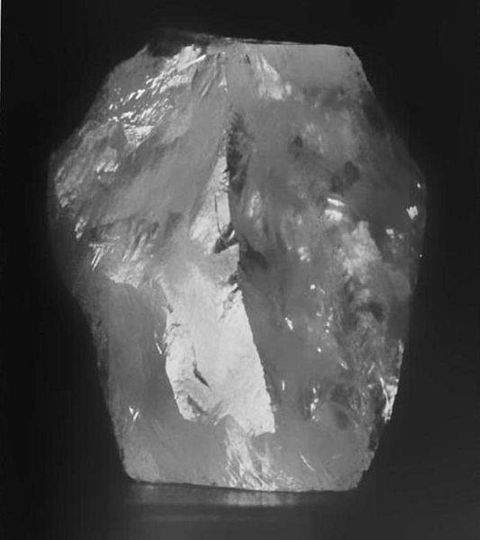
3,106-carat Cullinan Rough Diamond

Characteristics of the diamond
The cutters of the Cullinan diamond, I. J. Asscher & Co. of Amsterdam, cleaved the enormous rough diamond into 9 large pieces and around 100 other smaller pieces, all of which were eventually cut and polished into different shapes and sizes of diamonds. The Characteristics of the 9 large diamonds are summarized in the table below.
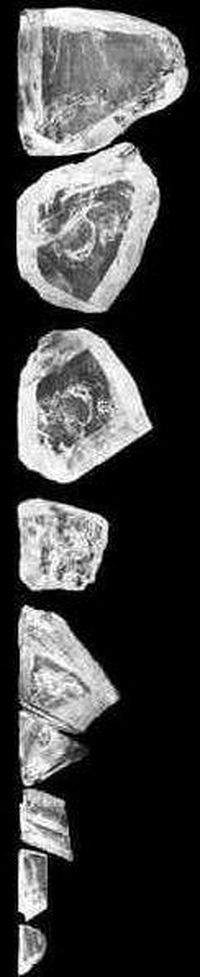
Summary of characteristics of the nine largest Cullinan diamonds
|
S/N |
Name |
Carat Weight | Shape/Cut | Present mountings of the diamond |
| 1 | Cullinan I | 530.20 | pear | Mounted on the head of the Royal Scepter. |
| 2 | Cullinan II | 317.40 | cushion | Mounted on the brow or band of the Imperial State Crown. |
| 3 | Cullinan III | 94.40 | pear | Mounted on the finial of Queen Mary's Coronation Crown. Later combined with IV as a pendant brooch |
| 4 | Cullinan IV | 63.60 | cushion | Originally set in the band of Queen Mary's Coronation Crown. Later combined with III as a pendant brooch |
| 5 | Cullinan V | 18.80 | pear | Originally mounted in a brooch for Queen Mary, used singly or mounted as the centerpiece of the Delhi Durbar Stomacher. Later mounted on the circlet of her crown as replacement for the Koh-i-Noor. |
| 6 | Cullinan VI | 11.50 | marquise | Originally mounted in the front cross-patee of Queen Alexandra's regal circlet. Later combined with the Cullinan VIII brooch by Queen Mary to form the Cullinan VI & VIII brooch. Sometimes the Cullinan VI & VIII brooch was linked to the Cullinan V brooch. |
| 7 | Cullinan VII | 8.80 | marquise | Set as a negligee pendant to the Delhi Durbar emerald and diamond necklace. The shorter pendant incorporated Cullinan VII and the longer pendant a large pear-shaped emerald. Occasionally used as a pendant to the Cullinan VIII brooch, as an alternative to Cullinan VI |
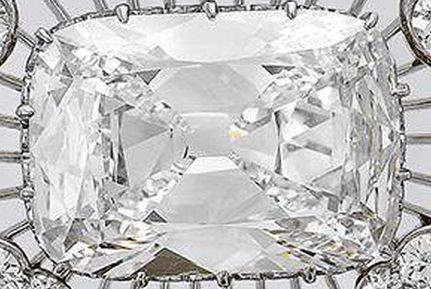
| 8 | Cullinan VIII | 6.80 | cushion | Mounted as the centerpiece of a radiating platinum mount, with smaller diamonds to form the Cullinan VIII brooch. Later combined with Cullinan VI to form the Cullinan VI & VIII brooch.Sometimes dismantled from the brooch and mounted as part of the Delhi Durbar Stomacher |
| 9 | Cullinan IX | 4.39 | pear | Mounted in a platinum ring for Queen Mary and later inherited by Queen Elizabeth II. Worn only on a few occasions by both queens. |
© internetstones.com
When the cutting of the Cullinan diamond was completed in 1908, the Cullinan I, also known as the Greater Star of Africa, with a weight of 530.20 carats, became the largest faceted diamond in the world. The Cullinan I held this rare distinction for a period of about 80 years, until the discovery of the 755-carat Golden Jubilee rough diamond in 1985, which was subsequently transformed into the 545.67-carat, cushion-shaped, fancy yellow brown diamond, the largest faceted diamond in the world.
Other notable distinctions held by the Cullinan I diamond are the largest pear-shape faceted diamond in the world; the largest D-color faceted diamond in the world; and the largest D-color, pear-shaped, faceted diamond in the world. See table below, and rank order of famous diamonds greater than 100 carats in weight, under the sub-title Cullinan I towards the end of this web page.
List of famous colorless (white) diamonds greater than 100 carats in weight
|
S/N |
Name | Carat Weight |
Shape/Cut |
|
| 1 | Cullinan I | 530.20 | pear | |
| 2 | CullinanII | 317.40 | cushion | |
| 3 | Centenary | 273.85 | modified heart | |
| 4 | Jubilee | 245.35 | cushion | |
| 5 | Millennium Star | 203.04 | pear | |
| 6 | La Luna | 200.07 | heart | |
| 7 | Orlov | 189.62 | rose | |
| 8 | Jacob-Victoria | 184.50 | oval | |
| 9 | Regent | 140.64 | cushion | |
| 10 | Paragon | 137.82 | 7-sided | |
| 11 | Premier Rose | 137.02 | pear | |
| 12 | Queen of Holland | 135.92 | cushion | |
| 13 | Zale Light of Peace | 130.27 | Pear | |
| 14 | Niarchos | 128.25 | Pear | |
| 15 | Portuguese | 127.02 | asscher | |
| 16 | Jonker | 125.35 | emerald | |
| 17 | Al-Nader | 115.83 | pear | |
| 18 | Taj-i-Mah | 115.06 | moghul | |
| 19 | Edna Star | 115.00 | emerald | |
| 20 | Koh-i-Nur | 108.93 | oval | |
| 21 | Mouawad Magic | 108.81 | emerald | |
| 22 | Cartier | 107.07 | pear | |
| 23 | Star of Egypt | 105.51 | emerald | |
| 24 | Mouawad Splendor | 101.84 | pear | |
| 25 | Star of America | 100.57 | asscher | |
| 26 | Star of Happiness | 100.36 | radiant | |
| 27 | Star of the Season | 100.10 | pear |
© internetstones.com
Please do not copy our tables without our permission. We may be compelled to inform the search engines if our content and tables are plagiarised.
History
Accidental discovery of the Cullinan rough diamond by Frederick Wells in 1905
The Cullinan diamond was discovered accidentally on January 26th, 1905, by the surface manager of the Premier diamond mines in Transvaal, South Africa, Mr. Frederick Wells, when he was on a routine inspection of the mine, late afternoon, on that particular day. Mr. Wells was about 18ft below the surface of the earth, when his attention was drawn by a shining object reflecting the last inclined rays of the setting sun, on the steep wall of the mine, a few feet above his head. Mr. Wells lost no time in scaling the wall and retrieving the shining object, which at first glance appeared to be a large diamond crystal.
The 3,106-carat Cullinan rough diamond turns out to be undisputed king of all rough diamonds in the history of mankind
The object was immediately taken for testing, and eventually turned out to be the largest gem-quality rough diamond ever discovered, weighing 3,106 carats. This unique distinction was previously held by the 995-carat Excelsior diamond for a period of 12 years, from 1893 to 1905. The rough diamond was named the "Cullinan diamond" in honor of the chairman of the company, Sir Thomas Major Cullinan.The 3,106-carat Cullinan rough diamond turned out to be the undisputed king of all rough diamonds in the history of mankind, and had been holding this position for the last 102 years. It is highly unlikely that any rival could appear, that could challenge the exalted position held by the Cullinan, in the future, unless new deposits of diamond are discovered in the world. See table below.
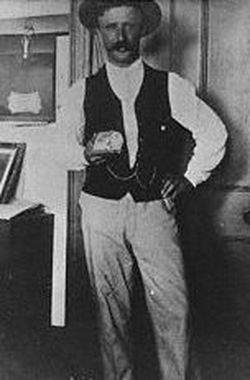
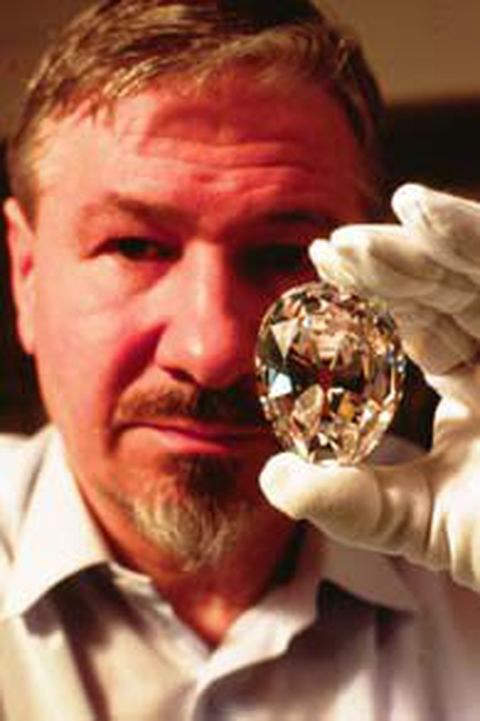
The rough Cullinan Diamond held by the mine superintendent, Frederick Wells.
List of largest gem-quality rough diamonds discovered in the world as at year 2011
|
Name |
Country of discovery | Year of discovery | Carat Weight | Color |
Position |
| Cullinan | South Africa | 1905 | 3,106 | Colorless/White | 1 |
| Excelsior | South Africa | 1893 | 995 | Colorless /White | 2 |
| Star of Sierra Leone | Sierra Leone | 1972 | 969.80 | Colorless/White | 3 |
| Incomparable | Zaire | 1984 | 890 | Brownish-yellow | 4 |
| Great Mogul | India | 1650 | 787 | Colorless/White | 5 |
| Millennium Star | Zaire | 1990 | 777 | Colorless/White | 6 |
| Woyie River | Sierra Leone | 1945 | 770 | Colorless/White | 7 |
| Golden Jubilee | South Africa | 1985 | 755 | Yellowish-brown | 8 |
| President Vargas | Brazil | 1938 | 726.60 | Colorless/White | 9 |
| Jonker | South Africa | 1934 | 726 | Colorless/White | 10 |
| Jubilee-Reitz | South Africa | 1895 | 650.80 | Colorless/White | 11 |
| Unnamed | South Africa | 1984 | 620.14 | 12 | |
| Sefadu | Sierra Leone | 1970 | 620 | Colorless/White | 13 |
| Kimberley Octahedral | South Africa | 1964 | 616 | Yellow | 14 |
| Lesotho Promise | Lesotho | 2006 | 603 | Colorless/White | 15 |
| Lesotho Brown | Lesotho | 1967 | 601 | Brown | 16 |
| Centenary | South Africa | 1986 | 599 | Colorless/White | 17 |
| De Grisogono | Central Africa | Probably in the 1950s | 587 | Black | 18 |
| Letseng Star | Lesotho | 2011 | 553 | Colorless/White | 19 |
| Unnamed Petra Diamond | South Africa | 2009 | 507 | Colorless/White | 20 |
| Letseng Legacy | Lesotho | 2007 | 493 | Colorless/White | 21 |
| Light of Letseng | Lesotho | 2008 | 478 | Colorless/White | 22 |
| Jacob-Victoria | South Africa | 1884 | 457.50 | Colorless/White | 23 |
| Zale light of peace | Sierra Leone | 1969 | 435 | Colorless/white | 24 |
| De Beers | South Africa | 1888 | 428.50 | Yellow | 25 |
| Niarchos | South Africa | 1954 | 426.50 | Colorless/White | 26 |
©internetstones.com
The discovery of the massive Cullinan diamond in 1905 provided a much-needed boost for further mining activities
The Premier diamond mine was discovered in the year 1898, by Sir Thomas Major Cullinan. After acquiring the Prinsloo family farm in which the kimberlite pipe was situated, in 1902, Sir Thomas Cullinan founded the Premier Diamond Mining Company Ltd. on December 1, 1902, and soon afterwards began exploratory mining activities, that revealed the existence of a huge funnel-shaped volcanic chimney, which outcropped on the surface, over a roughly pear-shaped area, about 80 acres in extent. Actual production at the Premier mine, by open-pit mining, began on April 24, 1903, and during the first two years of its operation, four large rough diamonds over 300 carats each, two rough diamonds between 200-300 carats each and sixteen rough diamonds between 100-200 carats each, were discovered. The massive Cullinan diamond was discovered two years after the mine began operations.This accidental and record-breaking discovery attracted international attention to the mines, providing a much-needed boost for further mining activity. In fact many diamond experts believed that the Cullinan was only a fragment of perhaps a larger diamond, and the remaining larger piece still awaited discovery. The prospect of finding the larger portion of the Cullinan stimulated the activities of miners and prospectors.
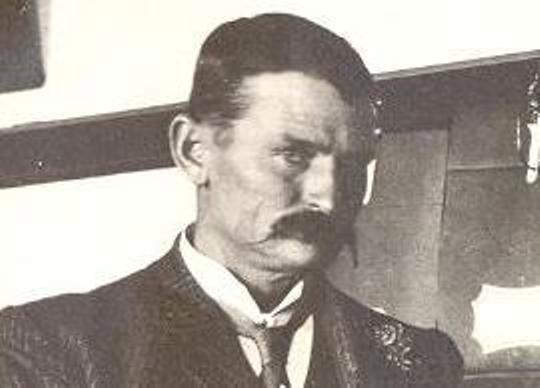
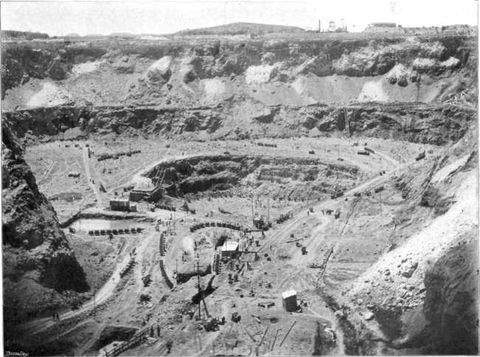
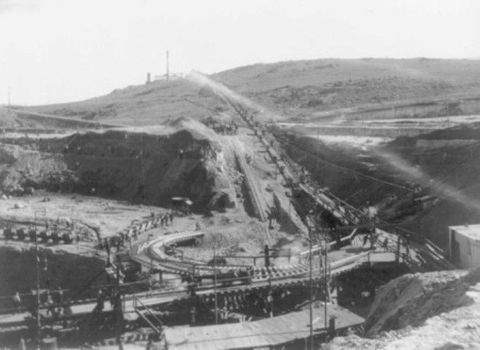
Another photograph of the Premier Diamond Mine taken before 1923
The Cullinan rough diamond is purchased by the Transvaal Government and presented as a gift to King Edward VII as a token of gratitude for granting Transvaal its own constitution and to mark his 66th birthday
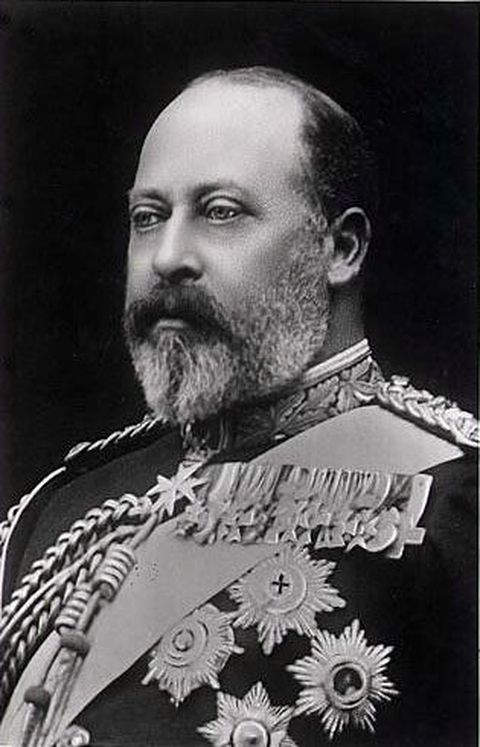
King Edward VII - King of the United Kingdom and the Emperor of India from 1901 to 1910
King Edward VII commissions I.J. Asscher & Co. of Amsterdam to undertake the cutting of the Cullinan rough diamond
King Edward commissioned the renowned diamond cutters of Amsterdam I. J. Asscher & Co. - who introduced a new diamond cut in 1902 called the Asscher-cut, also known as the square emerald-cut - to undertake the difficult task of cutting the Cullinan. The company had achieved credibility by cutting the Excelsior diamond in 1904, the world's largest rough diamond, before the discovery of the Cullinan diamond in 1905.
The stone was subjected to careful examination before the actual cutting. One of those who examined the Cullinan was Sir. William Crookes, who was astounded by it's remarkable clarity, but at the same time reported of a black spot in the midddle, around which the colors were very vivid, and changed as the analyzer was turned. This phenomenon according to Sir Williams was caused by severe internal strain, which is not uncommon for diamonds. Instances have been reported when diamonds have exploded when reaching the surface or sometimes in the pockets of miners due to body warmth, all attributed to internal strain.
The Cullinan rough diamond was cleaved into nine larger pieces and around 100 smaller pieces, all of which were cut and polished into finished diamonds of different shapes and sizes
The cutting of the Cullinan began on February 10th, 1908. The diamond was first cleaved along a pre-planned axis, by Mr. Asscher himself, who initially made an incision about half an inch deep. to accommodate the blade of a specially designed knife, which was followed by a heavy blow on the knife. The diamond split into two sections as expected. this was followed by a second cleavage in the same direction, producing three principal sections. Each of the sections were subjected to further cleavage, producing altogether nine large pieces. Around a 100 other smaller pieces were also produced. Faceting and polishing of the pieces then began, the shape of the cut being decided according to the dimensions of each piece. When the whole process was finally completed, there were nine major gems, and 96 smaller brilliants.
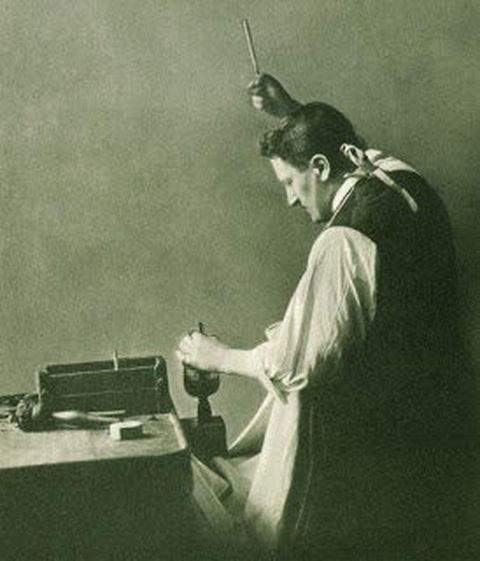
Joseph Asscher dealing the first blow that split the Cullinan rough diamond into two
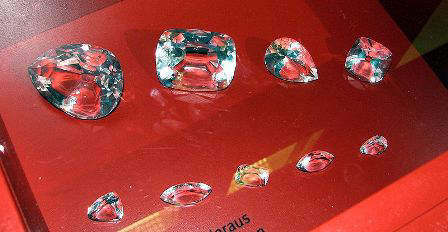
Cullinan I -
The Greater Star of Africa
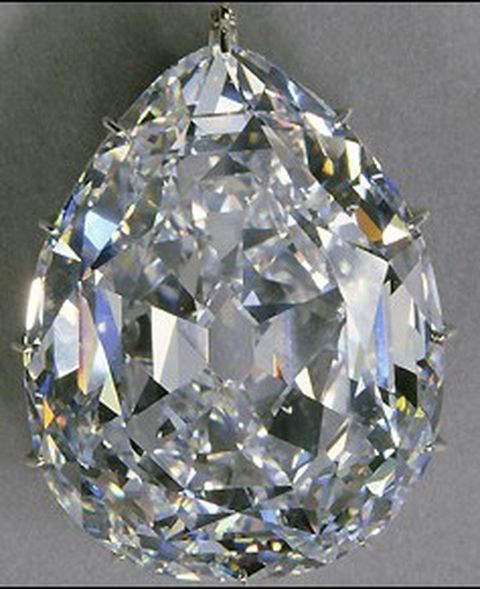
Cullinan I - The Star of Africa
The Cullinan I, aka the Greater Star of Africa , is the largest of the Cullinan diamonds, with a pear-shaped cut and weighing 530.20 carats. This was the largest faceted diamond in the world, until the discovery of the Golden Jubilee diamond, also from the premier mine in 1985. However, it still remains the largest, D-color, faceted diamond in the world. The dimensions of the diamond are 58.9 x 45.4 x 27.7 mm. The stone has a total of 76 facets.
Presently, the Cullinan I diamond is the second largest faceted diamond in the world; The largest faceted, D-color diamond in the world; The largest pear-cut/pear-shaped diamond in the world; and the largest D-color, pear-shaped diamond in the world. See table below :-
List of Famous Diamonds Greater than 100 carats in weight arranged in descending order of weights
|
S/N |
Name | carat weight | shape/cut |
color |
| 1 | Golden Jubilee | 545.67 | cushion | fancy yellow-brown |
| 2 | Cullinan I | 530.20 | pear | colorless/white |
| 3 | Unnamed Black Diamond | 489.07 | rectangular-cut | black |
| 4 | Incomparable | 407.48 | shield shaped | fancy brownish yellow |
| 5 | Cullinan II | 317.40 | cushion | colorless/white |
| 6 | Spirit of de Grisogono | 312.24 | old moghul-cut | black |
| 7 | Centenary | 273.85 | modified-heart | colorless/white |
| 8 | Oppenheimer | 253.70 | natural octahedral | yellow |
| 9 | Jubilee | 245.35 | cushion | colorless/white |
| 10 | De Beers | 234.65 | cushion | light yellow |
| 11 | Red Cross | 205.07 | cushion | canary yellow |
| 12 | Millennium Star | 203.04 | pear | colorless/white |
| 13 | Unnamed | 200.87 | pear | yellow |
| 14 | La Luna | 200.07 | heart-shaped | colorless/white |
| 15 | Orlov | 189.62 | rose-cut | colorless/white |
| 16 | Darya-i-Nur | 186 | table-cut | light pink |
| 17 | Jacob-Victoria | 184.50 | oval | colorless/white |
| 18 | Moon | 183 | round | pale yellow |
| 19 | Unnamed | 180.85 | briolette | yellow |
| 20 | Star of Peace | 170.49 | pear | brownish-yellow |
| 21 | Table of Islam | 160.18 | emerald-cut | black |
| 22 | Unnamed | 150.00 | emerald | yellow |
| 23 | Regent | 140.64 | cushion | colorless/white |
| 24 | Paragon | 137.82 | 7-sided | colorless/white |
| 25 | Florentine | 137.27 | double rose-cut | light yellow |
| 26 | Premier Rose | 137.02 | pear | colorless/white |
| 27 | Algeiba Star | 135.03 | square-brilliant | yellow |
| 28 | Sarah | 132.43 | cushion | fancy vivid yellow |
| 29 | Golden Hue | 132.42 | cushion | yellow |
| 30 | Tiffany Yellow | 128.54 |
cushion |
canary yellow |
| 31 | Star of the South | 128.48 | cushion | fancy light pinkish-brown |
| 32 | Niarchos | 128.25 | pear | colorless/white |
| 33 | Portuguese | 127.02 | asscher | colorless/white |
| 34 | Jonker | 125.35 | emerald | colorless/white |
| 35 | Stewart | 123.00 | round-brilliant | yellow |
| 36 | Delaire Sunrise | 118.08 | square emerald-cut | fancy vivid yellow |
| 37 | Meister | 118.00 | cushion | yellow |
| 38 | Vainer Briolette | 116.60 | briolette | fancy light yellow |
| 39 | Hope of Africa | 115.91 | cushion | fancy vivid yellow |
| 40 | Al-Nader | 115.83 | pear | colorless/white |
| 41 | Gruosi Diamond | 115.34 | heart-shaped | black |
| 42 | Taj-i-Mah | 115.06 | moghul-cut | colorless/white |
| 43 | Edna Star | 115.0 | emerald | colorless/white |
| 44 | Unnamed | 114.64 | briolette | yellow |
| 45 | Unnamed | 114.03 | cushion | yellow |
| 46 | Mouna | 112.50 | cushion | fancy intense yellow |
| 47 | African Yellow | 112.00 | yellow | |
| 48 | Earth Star | 111.59 | pear | brown |
| 49 | Cross of Asia | 109.26 | radiant | light brown |
| 50 | Koh-i-Noor | 108.93 | oval | colorless/white |
| 51 | Mouawad Magic | 108.81 | emerald | colorless/white |
| 52 | Anon | 108.04 | emerald | yellow |
| 53 | Rojtman | 107.46 | cushion | yellow |
| 54 | Cartier | 107.07 | pear | colorless/white |
| 55 | Golden Sun | 105.54 | emerald | yellow |
| 56 | Star of Egypt | 105.51 | emerald | colorless/white |
| 57 | Golden Door | 104.95 | pear | yellow |
| 58 | Geat Chrysanthemum | 104.61 | pear | fancy brown |
| 59 | Graff Constellation | 102.79 | round brilliant | colorless/white |
| 60 | Ashberg | 102.48 | cushion | dark orange yellow/amber |
| 61 | Mouawad Splendour | 101.84 | pear | colorless/white |
| 62 | The Alnatt | 101.29 | cushion | fancy vivid yellow |
| 63 | The Golden Star | 101.28 | cushion | fancy vivid yellow |
| 64 | Star of America | 100.57 | asscher | colorless/white |
| 65 | Sunrise | 100.52 | emerald | yellow |
| 66 | Star of Happiness | 100.36 | radiant | colorless/white |
| 67 | Star of the Season | 100.10 | pear | colorless/white |
| 68 | Graff Vivid Yellow | 100.09 | cushion | fancy vivid yellow |
©internetstones.com
On the orders of King Edward VII, the Cullinan I was mounted on the head of the Royal Scepter, and it is now on display in the Tower of London.
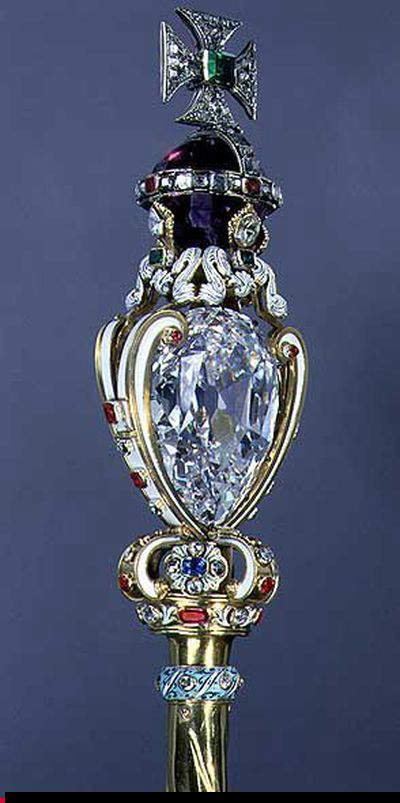
© Her Majesty the Queen of England.
Cullinan II - The
Lesser Star of Africa
The Cullinan II, aka the lesser Star of Africa is the second largest Cullinan diamond, with a cushion shape, weighing 317.4 carats. It is the fifth largest faceted diamond in the world; the second largest, D-color, faceted diamond in the world; the second largest cushion-cut diamond in the world; and the largest cushion-cut, D-color diamond in the world.
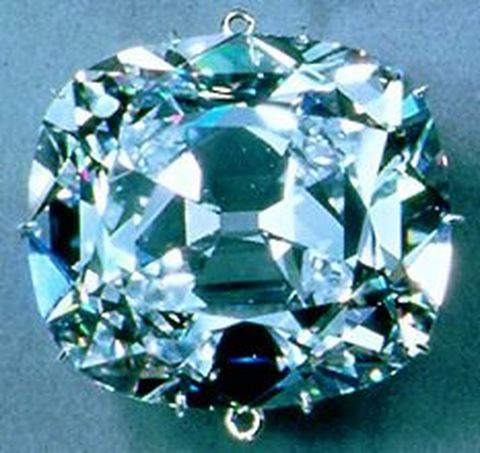
The Cullinan II has been mounted on the brow or band of the Imperial State Crown of Great Britain, which also features other notable precious stones such as St. Edwards Sapphire, the Stuart Sapphire and the Black Princess Ruby. It is also on display in the Tower of London, with the other Crown Jewels.
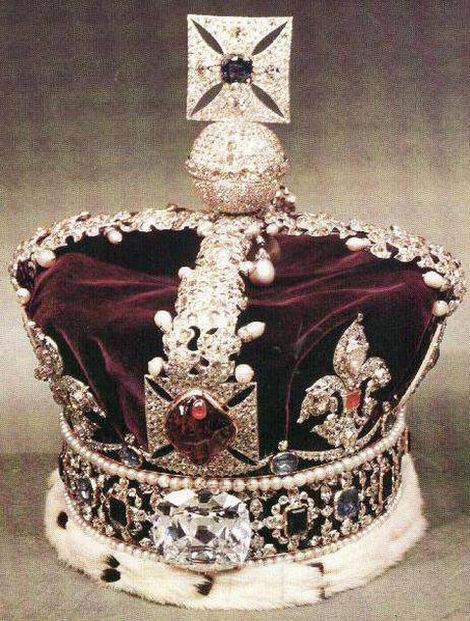
The Cushion-cut Cullinan II
mounted on the band of the Imperial State Crown of Great
Britain
Cullinan III
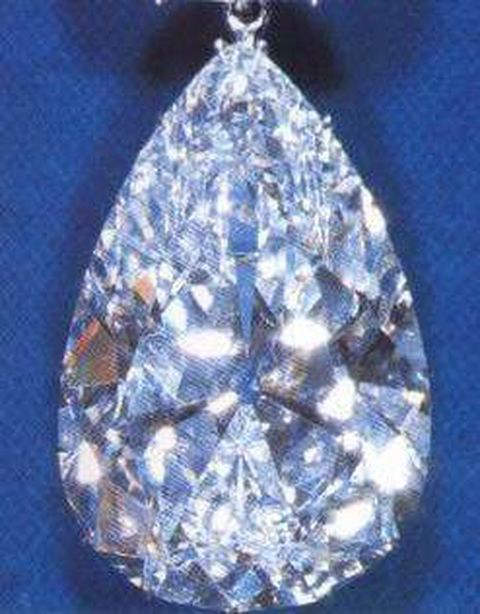
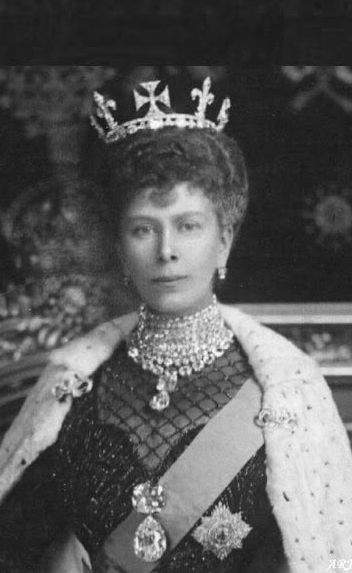
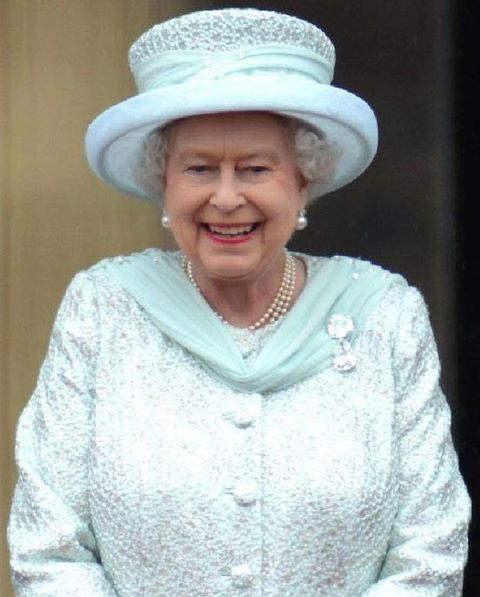
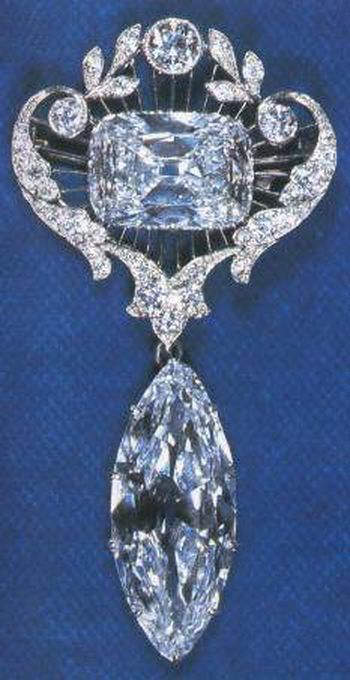
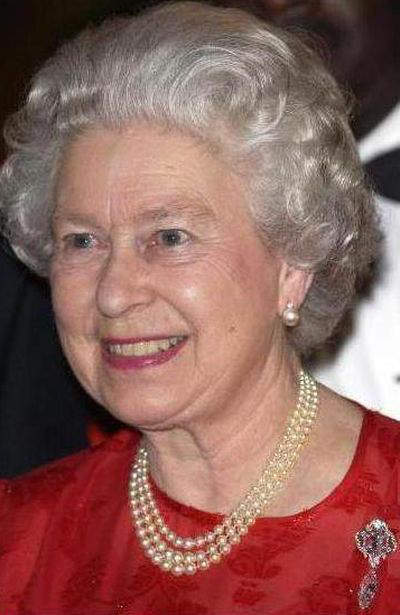
The Cullinan III weighing 94.40 carats has a pear-shaped cut and is mounted in the finial of Queen Mary's (Queen consort of King George V) Crown, but when required Cullinan III could be combined with Cullinan IV to form a pendant-brooch, and most of Queen Mary's portraits show her wearing this combination. Queen Elizabeth II, the present British Monarch, also uses the two diamonds in the same way.
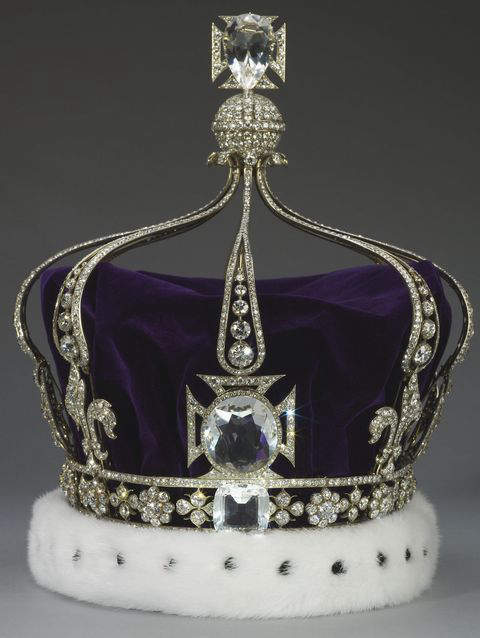
Queen Mary's 1911 Coronation Crown with its finial mounted with a replica of the pear-shaped Cullinan III and the band mounted in front with a replica of the cushion-shaped Cullinan IV diamonds
Queen Mary's Crown was commissioned by Queen Mary, consort of King George V, from the Crown Jewellers, Garrard & Co, for her coronation that was held on June 22, 1911. Apart from the Cullinan III and IV that was mounted on the finial and band of the crown respectively, another famous diamond the Koh-i-Noor was also incorporated in the crown as the centerpiece of the front cross-patee. After the coronation, the three large diamonds, the Koh-i-Noor, the Cullinan III and Cullinan IV were replaced with quartz crystal replicas, and the jewels used in alternative settings. Cullinan III & IV were combined together to form a pendan- brooch, that became a favorable piece of jewelry of the of Queen Mary, who became famous for superbly bejeweling herself for formal events.
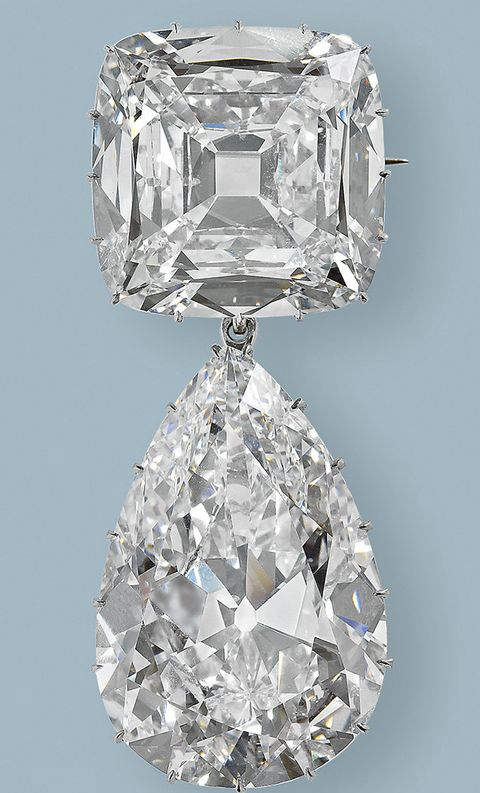
Cullinan III & IV combined together as a pendant-brooch
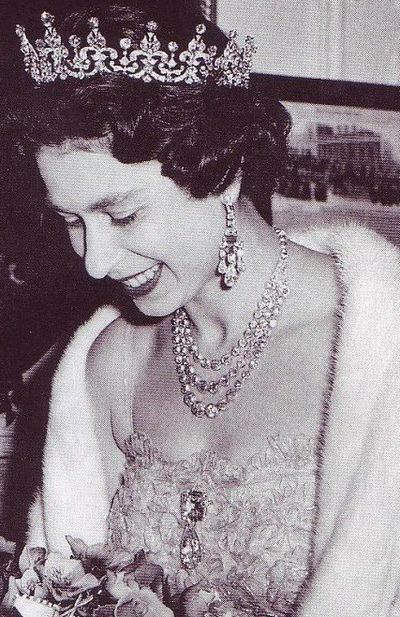
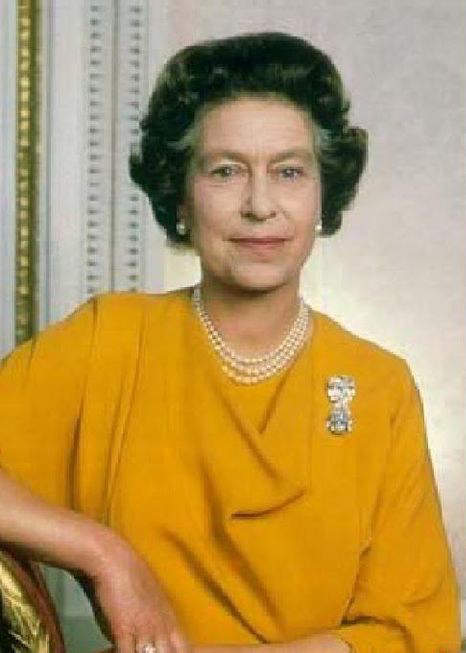
Another occasion Her Majesty the Queen was seen wearing "Granny's Chips"
Cullinan IV
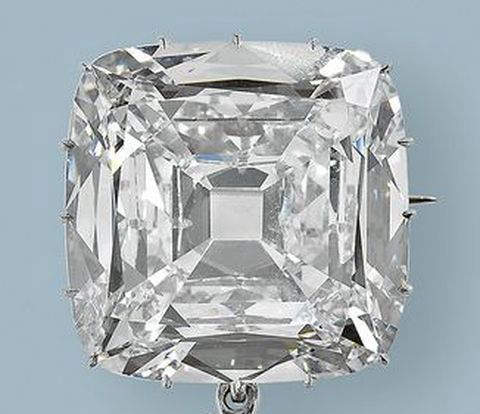
The Cullinan IV, with a cushion-cut weighs 63.60 carats, and like the Cullinan III was originally mounted on Queen Mary's Crown, but as stated above, subsequently dismantled and combined with Cullinan III to form a pendant brooch.
Cullinan V
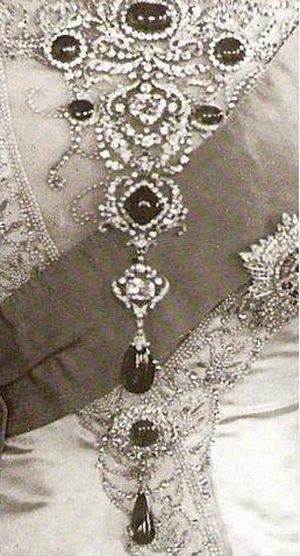
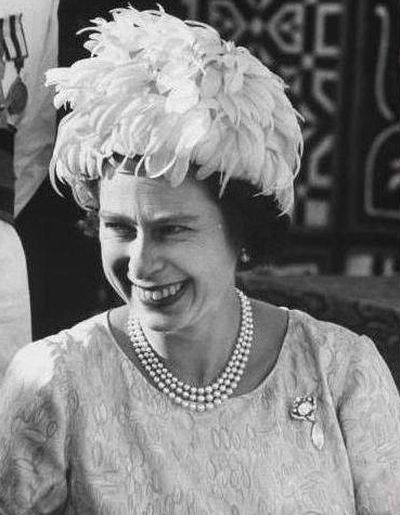
The Cullinan V, with a triangular pear-cut or heart-shaped cut, weighs 18.80 carats, and also had a dual use, one as a piece of jewelry, mounted in a brooch or as the detachable center of the emerald and diamond stomacher of the Delhi Durbar Parure designed in 1911 for Queen Mary and the other to be worn in the circlet of her crown, as a replacement for the Koh-i-Noor.
This was after the Koh-i-Noor was removed to be mounted on a new crown for Elizabeth (Queen Mother), the Duchess of York after her husband George VI's accession to the throne, upon the abdication of Edward VIII, on December 11, 1936.
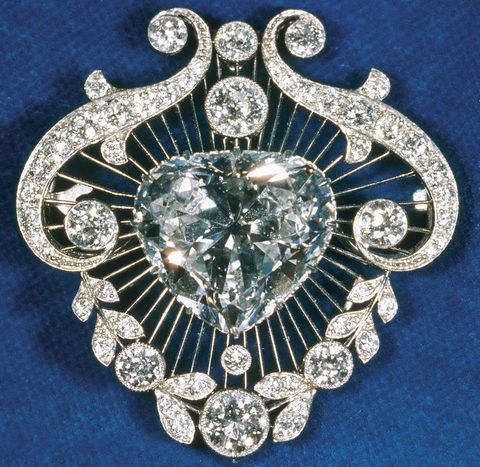
Cullinan V brooch
In the Cullinan V brooch, the heart-shaped, 18.80-carat Cullinan V diamond is mounted on a fine radiating platinum web, with a scrolling millegrain and pave-set border of brilliant diamonds.
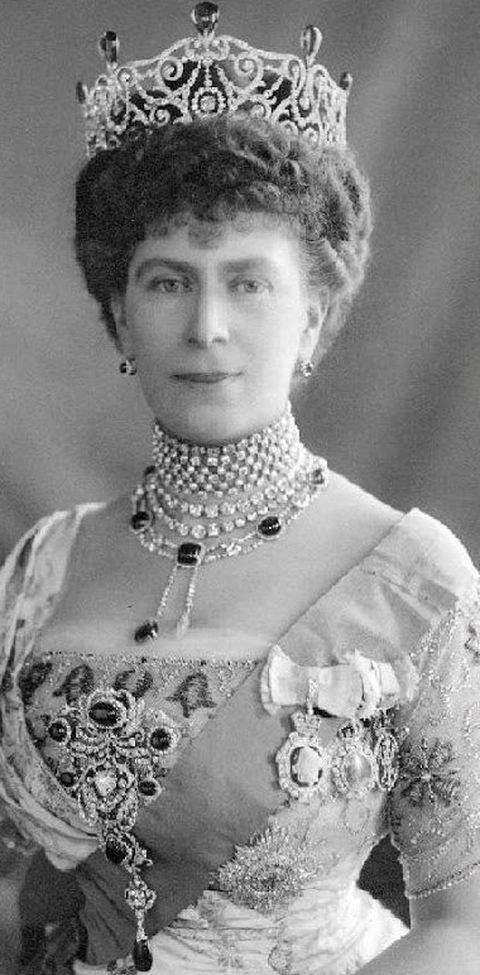
Queen Mary wearing the Delhi Durbar Parure stomacher incorporating Cullinan V as the centerpiece
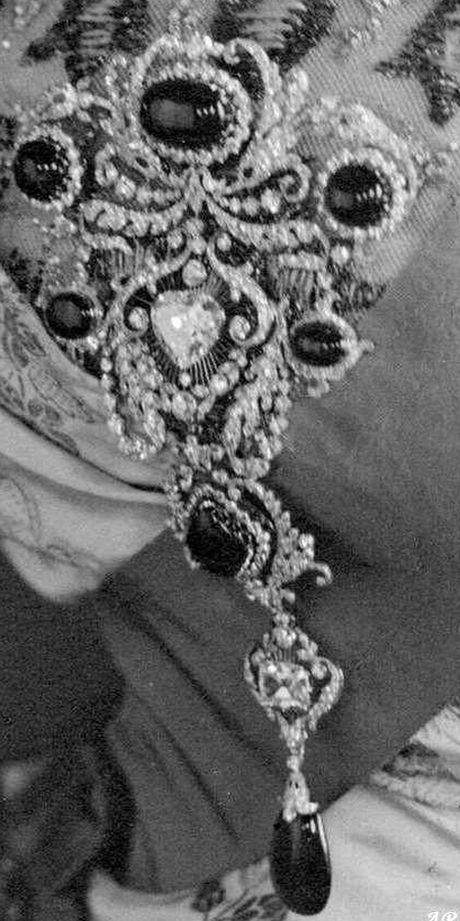
Delhi Durbar Parure Stomacher incorporating Cullinan V brooch as centerpiece
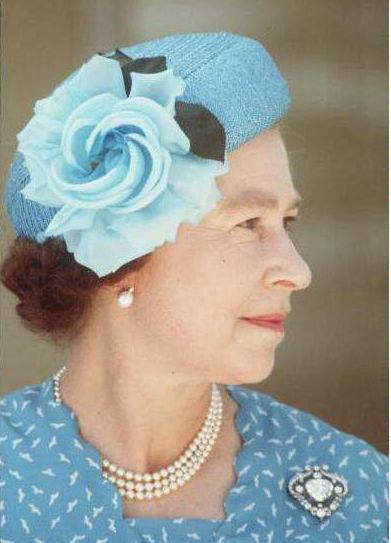
Queen Elizabeth wearing the Cullinan V brooch during a visit to Tuvalu (Ellice Islands) in Polynesia
Cullinan VI
The Cullinan VI is a marquise-cut stone, with a weight of 11.50 carats. King Edward VII purchased the diamond from Asschers and presented it to his Queen consort, Queen Alexandra, as a personal gift. Queen Alexandra got the Cullinan VI mounted in the front cross patee of her regal circlet.
Cullinan VI was inherited by Queen Mary after Queen Alexandra's death in 1925.The fashion-conscious Queen Mary decided that the ideal setting for the marquise-cut Cullinan VI diamond was as a pendant to the radiating platinum mount incorporating the 6.8-carat, emerald-cut Cullinan VIII diamond as its centerpiece, designed by the Crown Jewelers Garrards in 1911. The combination came to be christened as the Cullinan VI & VIII Brooch.
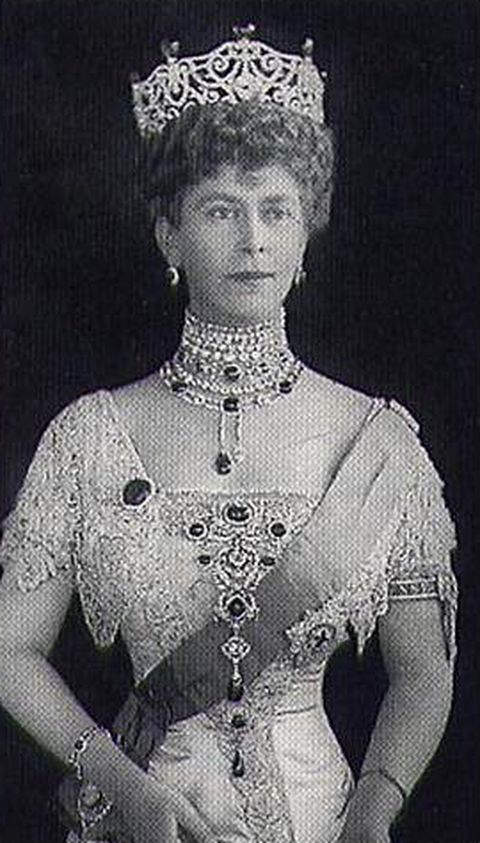
Queen Mary wearing the Delhi Durbar stomacher incorporating the Cullinan V & VIII
Cullinan VII
The
Cullinan VII is also a marquise-cut stone, weighing 8.80 carats. The permanent setting of the
Cullinan VII is as an asymmetrical pendant to the Delhi Durbar
Necklace, a negligee pendant necklace, in which the longer
pendant terminates in a pear-shaped emerald, larger in size
than the marquise-cut Cullinan VII. The Delhi Durbar Necklace
is one of the six components of the Cambridge and Delhi Durbar
Parure, designed and crafted by the crown jewelers Garrard's
in anticipation of the coronation of King George V and Queen
Mary on June 22, 1911, and their subsequent proclamation as
the Emperor and Empress of India, at a special Durbar
organized for this purpose in Delhi, on December 12, 1911.
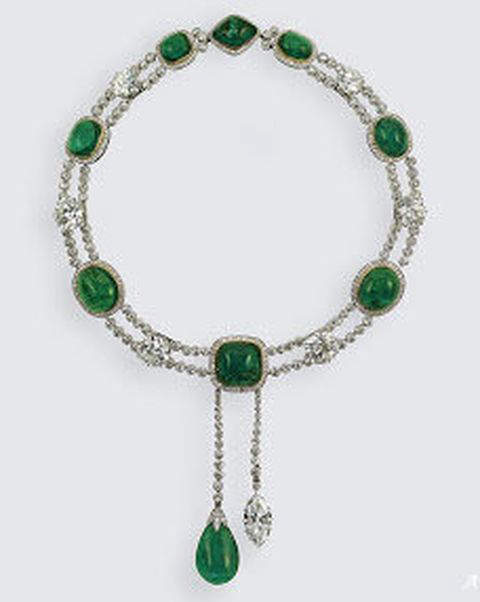
Delhi Durbar Necklace
incorporating Cullinan VII and a pear-shaped emerald as
negligee pendants
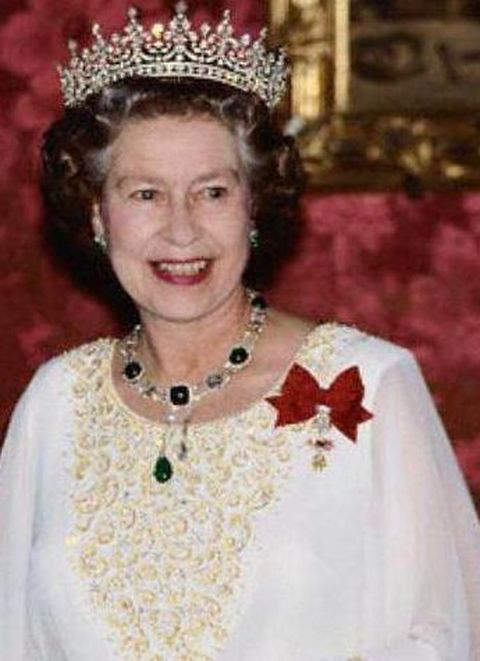
In the negligee pendant the marquise-cut Cullinan VII is suspended by a shorter detachable chain pave-set with ten graduated brilliant diamonds. The longer chain suspending the pear-shaped emerald is pave-set with 12 graduated brilliant diamonds. Apart from the large pear-shaped emerald in the longer pendant, the necklace also incorporates 8 other Cambridge emeralds, originally owned by Queen Mary's grandmother, the Duchess of Cambridge. The necklace consists of a double platinum chain pave-set with 94 smaller brilliant-cut diamonds. The eight cabochon-cut emeralds are set alternating with six large brilliant-cut diamonds.on the double platinum chain. The two emeralds on the median line of the chain, the centerpiece of the necklace and the clasp behind, are cushion-shaped, cabochon-cut emeralds. Emeralds of similar size and shape are placed on symmetrical positions on either side of the median line of the necklace. These emeralds are oval-shaped, cabochon-cut stones. Each of the emeralds on the necklace is surrounded by a single layer of small brilliant-cut diamonds.
The Delhi Durbar Necklace was a favorite piece of Queen Mary and she wore it usually with other components of the Delhi Durbar Parure.
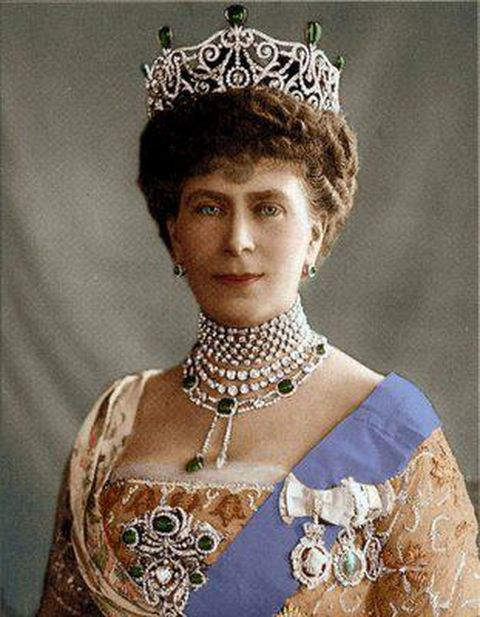
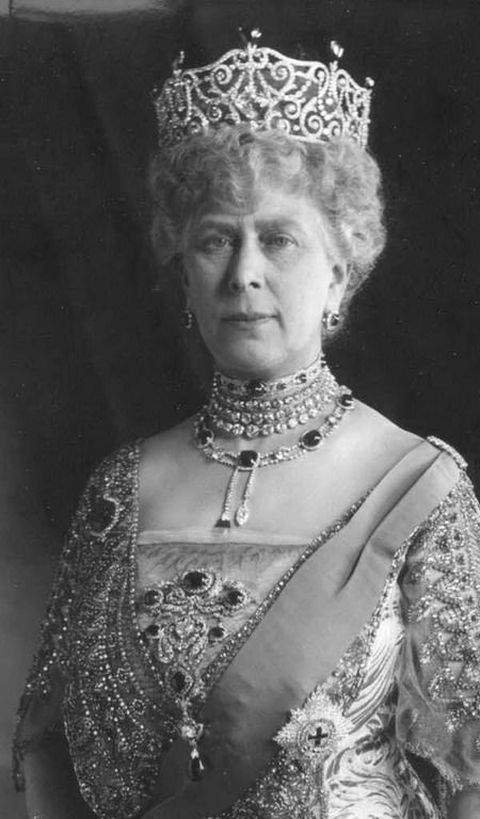
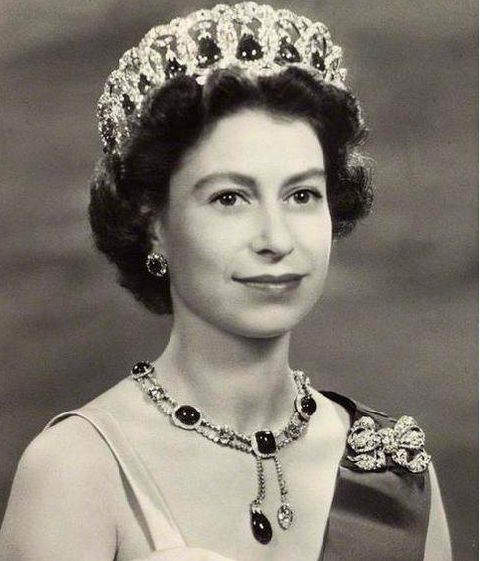
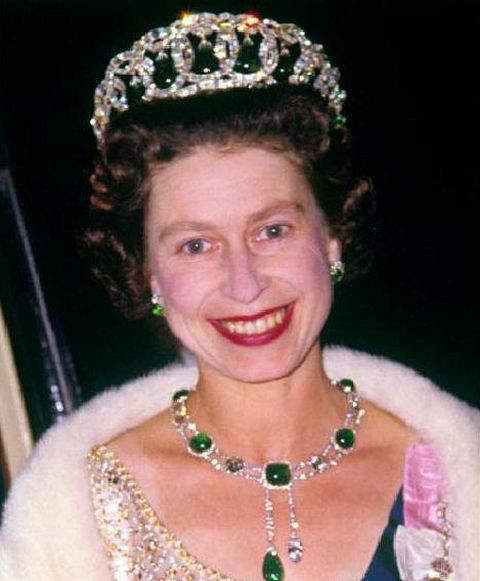
Another occasion Queen Elizabeth II was seen wearing the Grand Duchess Vladimir Tiara and the Delhi Durbar Necklace
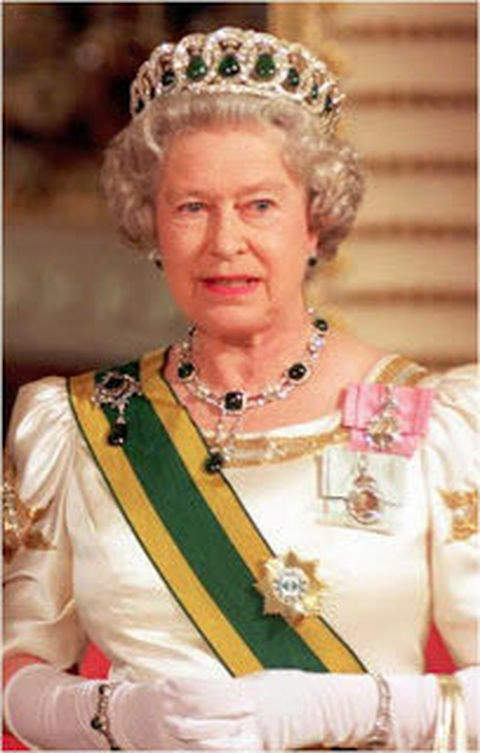
More recent occasion when Queen Elizabeth was seen wearing the Vladimir Tiara and Delhi Durbar Necklace combination
Cullinan VIII
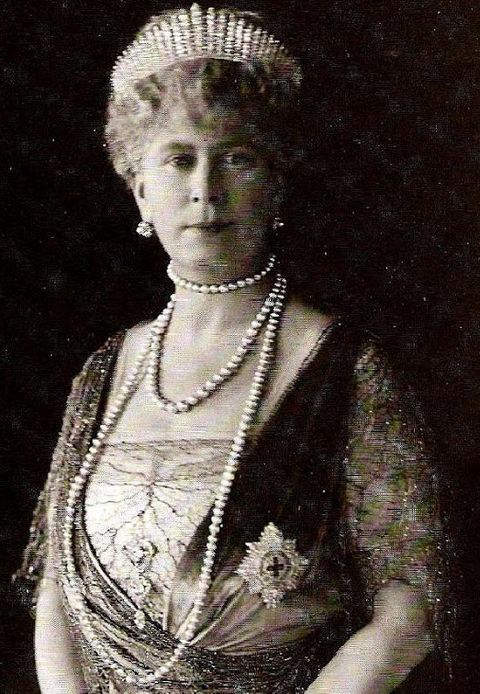
Queen Mary wearing Cullinan VI and VIII brooch linked to Cullinan V brooch
Cullinan VI and VIII brooch linked to Cullinan V brooch
Cullinan IX
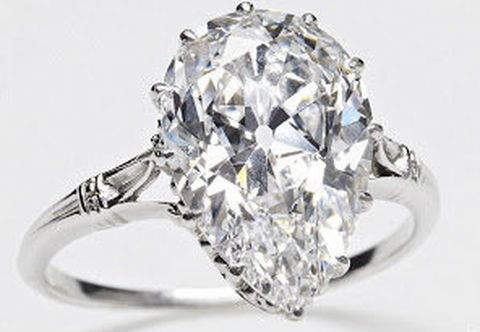
Cullinan IX diamond set in a diamond ring
Related :-
3) Cambridge and Delhi Dunbar Parure
External Links :-
https://artemisiasroyaljewels.blogspot.com/p/british-jewels.html
References :-
1) The Queen's Diamonds - by Hugh Roberts
2) The Queen's Jewels. The Personal Collection of Elizabeth II - by Leslie Field
3) The Blue Empress Diamond - www.internetstones.com
 Home
Security & Guarantee
How it Works
Technology Partners
Updated Tables
Famous Diamonds
More Famous Diamonds
Famous Pearls
Famous Gemstones
Contact Dr Shihaan Larif
Contact Senior Editor
Famous Jewelry
Reference Database
Forums
Learning Center
Gemstone Gallery
e-mail Notifications
Advertise
Press Release
About Us
Privacy Policy
Contact Us
FAQ'S
Site Map
Staff Mail Login
Staff Documents
Birthstones
History
Minerals
Shows
Live Metal Prices
Jewellery Gallery
News
Marketplace
Marketplace Support
Open Store
Online Auctions
Join Us & Contribute
Directory
Classifieds
List your products
Wholesale Trading
Post Buy Request
Go Green Policy
Site Updates
Upcoming-ToDo List
Latest News
Latest Articles
Latest Blog Updates
Chat Rooms
Job Board
User Gallery
Videos
New Newsletter Archive
Old Newsletter Archive
Jewelry & Mineral Blog
User Blogs & Social Network
Search
Answers (Q & A)
Valuation
Help me find a diamond/jewelry
pin.internetstones.com- Social Pinboard- Sart yours & connect with millions
Invite Friends From Yahoo, Gmail etc-One Click
Home
Security & Guarantee
How it Works
Technology Partners
Updated Tables
Famous Diamonds
More Famous Diamonds
Famous Pearls
Famous Gemstones
Contact Dr Shihaan Larif
Contact Senior Editor
Famous Jewelry
Reference Database
Forums
Learning Center
Gemstone Gallery
e-mail Notifications
Advertise
Press Release
About Us
Privacy Policy
Contact Us
FAQ'S
Site Map
Staff Mail Login
Staff Documents
Birthstones
History
Minerals
Shows
Live Metal Prices
Jewellery Gallery
News
Marketplace
Marketplace Support
Open Store
Online Auctions
Join Us & Contribute
Directory
Classifieds
List your products
Wholesale Trading
Post Buy Request
Go Green Policy
Site Updates
Upcoming-ToDo List
Latest News
Latest Articles
Latest Blog Updates
Chat Rooms
Job Board
User Gallery
Videos
New Newsletter Archive
Old Newsletter Archive
Jewelry & Mineral Blog
User Blogs & Social Network
Search
Answers (Q & A)
Valuation
Help me find a diamond/jewelry
pin.internetstones.com- Social Pinboard- Sart yours & connect with millions
Invite Friends From Yahoo, Gmail etc-One Click




Our Global Jewelry Industry Job Network


Buy & Sell in our Marketplace

Subscribe to our Newsletter

List in our Classifieds

List in our Directory

User Uploaded Gallery

Powered by Ultra Secure
Amazon (USA) Cloud Network

Founder Internet Stones.COM
Register in our Forums

| Featured In
|
|
|
|
|
|
|
|







Blog & Education Feed
Articles Feed
 |
 |
 |

Copyright © .Internet Stones.COM. All rights reserved.