Grey Cultured Pearl Bermuda Cedar Brooch, Two Cultured Pearl Fern Brooches, and Cultured Pearl Pin Brooch - Princess Margaret's Jewelry Collection
Open FREE Unlimited Store Join Our Newsletter
Cultured pearl jewelry in Princess Margaret's collection
There were at least 25 pieces of pearl jewelry in H.R.H. Princess Margaret's collection, out of which around 15 pieces were incorporated with cultured pearls. This webpage is dedicated to four such pieces, whose actual value were estimated to be not more than a few hundred pounds, but sold at the auctions for several thousand pounds each, a clear manifestation of the popularity of the Princess, and an irresistible urge by the people to own something that was closely associated with her life. The pieces included on this webpage are :-

1) A Grey Cultured Pearl Bermuda Cedar Brooch - Lot 60
2) A Cultured Pearl Fern Brooch - Lot 61
3) A Cultured Pearl Fern Brooch - Lot 62
4) A Cultured Pearl Pin Brooch - Lot 65
1) A Grey Cultured Pearl Bermuda Cedar Brooch - Lot 60
Features of the Bermuda Cedar tree, a Conifer belonging to the family Cupressaceae endemic to Bermuda
Bermuda cedar, Juniperus bermudiana is a coniferous tree endemic to Bermuda, evergreen and growing to a height of about 15 meters, and the branched trunk reaching a diameter of about 60 cm. The foliage is produced in blue-green sprays. Individual shoots are four-sided, and the scale-like leaves are arranged in opposite decussate pairs. The scale-like leaves are 1.5-2.5 mm long and 1.0-1.5 mm broad. Juvenile plants have needle-like leaves 4-8 mm long. Conifer seeds develop inside protective cone called a strobilus. Female seed-cones, have fleshy fruit-like coalescing scales which fuse together to form a soft berry-like structure, globose (spherical or globular) or pyriform (pear-shaped) in shape, 4-6 mm long and 5-8 mm broad which is green at first and maturing into bluish purple about 8 months after pollination, and containing 1-3 seeds. Male cones in which the scales are less compact are 4-6 mm long and yellow in color, and after releasing pollen grains turn brown in color.
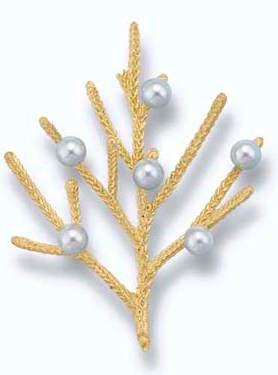
A Grey Cultured Pearl Bermuda Cedar Brooch
© Christie's
Features of the Grey Cultured Pearl Bermuda Cedar Brooch
The Brooch is designed as a sprig of Bermuda Cedar. The branched four-sided shoot with scale-like leaves arranged in opposite decussate pairs, has been designed in 18-carat yellow gold. The cedar berries, which are female seed cones, are represented by spherical grey cultured pearls. The brooch, which is 4.5 cm long, is accompanied by an original blue Astwood Dickinson, Bermuda, case.
History of the culturing of black and grey pearls
Black and grey pearls are usually cultured in the black-lipped pearl oyster Pinctada margaritifera except for the recently cultured Cortez pearls from the Rainbow-lipped pearl oyster, Pteria sterna. After the successful culturing of Akoya pearls in 1916, by Kokichi Mikimoto, it took him another 15 years to successfully culture a black pearl. Mikimoto first set up a farm on the Ishigaki Island in Okinawa, to breed the black-lipped pearl oyster, Pinctada margaritifera. It was only in 1931, that Mikimoto successfully cultured black pearls for the first time on this farm. Black cultured pearls produced in Japan first entered the international pearl markets only in the late 1930s. The first successful culturing of black Tahitian pearls was achieved in 1962, by the French Scientist Jean-Marie Dornard, who applied Mikimoto's technique, and nucleating around 5,000 black-lipped pearl oysters in two experimental farms at Hikueru in the Tuamotu archipelago and Bora Bora in Society archipelago, harvested around 1,000 high-quality Tahitian black cultured pearls. Following this more pearl farms were opened in both archipelagos, and black cultured pearls produced in Tahiti, began entering the international pearl markets. However, the actual international popularity of Black Tahitian pearls came only after 1975, when pearls produced in the South Marutea farms, owned by the French businessman Jean-Claude Brouillet, hit the international pearl markets. In 1984, the ownership of the Brouillet pearl farms, were acquired by Robert Wan, another renowned pearl culturist, who further expanded the pearl culturing industry in Tahiti and introduced quality control measures, to enhance the worldwide reputation of black Tahitian cultured pearls.
The source of the grey cultured pearls on the brooch
H.R.H. Princess Margaret is reported to have visited Bermuda on seven occasions. Twice during 1975, and again twice in 1984 and 1990. During her final visit to the island, she opened the new Cruise Ship Terminal on the North Arm of the Dockyard of Ireland Island, known as the "Jungle Island of Cedar." The Grey Cultured Pearl Bermuda Cedar Brooch was either purchased by the Princess or given as a gift to her during one of these visits. Thus, in all probability the cultured pearl brooch was designed in the year 1975 or afterwards. Hence the grey cultured pearls on the brooch, might have originated either from Japan or Tahiti, the two main black cultured pearl producing countries during this period.
The sale of the Grey Cultured Pearl Bermuda Cedar Brooch
The Grey Cultured Pearl Bermuda Cedar Brooch was Lot No.60 at the London Christie's sale of Princess Margaret's jewelry and Faberge collection held on June 13, 2006. A pre-sale estimate of only £50 to £100 was placed on the brooch, a modest estimate that reflected the true value of the brooch. However, royal provenance and the so-called "princess' premium" enhanced the value of the brooch 48 times the upper estimate, and sold for £4,800. This was in keeping with the enhanced trend recorded for the lots, right from the beginning of the sale.
2) A Cultured Pearl Fern Brooch - Lot 61
Features of the Brooch
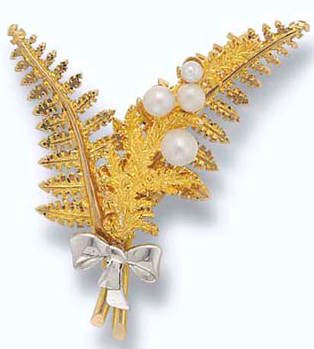
The design represents three fern fronds of different sizes, shapes and ages, tied at the bottom with a ribbon and set with four cultured pearls of different sizes. The material used in designing the fern fronds, that appear stunningly natural except for their color, is probably 9-carat yellow gold. On the smaller left frond even the brown 'sori" associated with the asexual reproduction of spores, are represented. The four spherical white cultured pearls, set on the larger frond, has only an ornamental value, and does not represent any vegetative or reproductive structure associated with Ferns. The length or height of the brooch is approximately 4.1 cm. The frond in this case is divided once into pinnae, known as once pinnate or unipinnate. The pinnae are arranged along the rachis (main axis of the frond), directly opposite to one another.
A Cultured Pearl Fern Brooch
© Christie's
The features of the cultured pearls and their probable source
The four pearls appear to be perfectly spherical in shape, but are of different sizes, positioned somewhere on the middle of the larger right frond. The largest pearl is at the bottom of this arrangement and the smallest pearl at the top. The pearls are all silvery-white in color, where white is the body color and silver the overtone color. The luster and orient of the pearls are in keeping with saltwater cultured pearls, produced by the Akoya pearl oyster. The color, overtone, and size of the pearls also seem to conform to those of Akoya pearls.
Sale of the Cultured Pearl Fern Brooch
The Cultured Pearl Fern Brooch was Lot No.61 at the Christie's London auction of Princess Margaret's collection of jewelry and Faberge, held on June 13, 2006. A pre-sale estimate of £300 to £400 was placed on the brooch, but it sold for the enhanced price of £4,800, 12 times higher than the upper pre-sale estimate, in keeping with the trend shown throughout the auction.
3) A Cultured Pearl Fern Brooch - Lot 62
Features of the Brooch
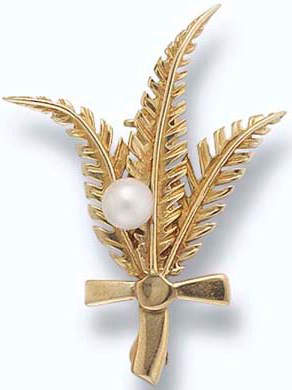
The design of this brooch similar to the previous Cultured Pearl Fern Brooch, represents a spray of three fern fronds of different sizes, tied with a ribbon at the bottom, and set with a single, large, white, spherical, cultured pearl. The brooch which is 3.5 cm long, carries Edinburgh hallmarks for 9-carat gold and the year of hallmarking 1987, which is probably the year of designing too. The difference between the fern fronds of this brooch and the brooch in Lot No.61, is that the frond in this brooch is pinnatifid, whereas in the other brooch it is pinnate. A pinnatifid fern frond is deeply incised but not to the extent of forming separate pinnae. In a pinnate fern frond the incisions are deep enough to from separate pinnae.
A Cultured Pearl Fern Brooch- Lot 62
© Christie's
The probable source of the pearl
The pearl is perfectly spherical in shape. the color of the pearl is silvery-white, in which white is the body color, and silver the overtone color. The luster and orient of the pearl is consistent with cultured saltwater pearls. The size of the pearl is not given, but appear to be around 8-10 mm in the photographs. The year of designing of the brooch is 1987. The main sources of white cultured pearls around this time was Japan and Australia. The Japanese cultured pearls are known as Akoya pearls, and the Australian cultured pearls, South Sea pearls. Given the characteristics of the pearl, such as its size, color, overtone, luster and orient, the pearl could be either an Akoya pearl or South Sea pearl, and accordingly the source of the pearl could be either Japan or Australia.
Sale of the Cultured Pearl Fern Brooch
The Cultured Pearl Fern Brooch was Lot No. 62, at the Christie's London sale of H.R.H. Princess Margaret's jewelry and Faberge collection held on June 13, 2006. A pre-sale estimate of £200 to £300 was placed on the brooch, but the brooch realized a much enhanced price of £8,160 ($15,014) which was 27 times higher than the upper pre-sale estimate. The price realized for this brooch was almost double the price realized for the previous fern brooch, which was Lot No.61. The pre-sale estimate for both fern brooches were almost the same. The enhanced price realized for the second fern brooch in comparison to the first, despite the fact that both brooches had roughly the same pre-sale estimate, can be explained only in terms of the auction mood that prevailed at that time, when bidders were desperately outbidding each other, to lay claim to any item that was used by the Princess, whom they loved and respected, or as one journalist put it was trying to secure a slice of Princess Margaret's life.
4) A Cultured Pearl Pin Brooch - Lot 65
Features of the Brooch
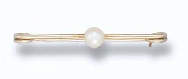
One of the simplest and most modest jewelry items in the collection, the cultured pearl pin brooch, is designed as a stock pin, with a small, white, spherical, cultured pearl set in the center of the pin. The design of the brooch is plain and simple. The pin is 3.5 cm long, and probably made of low carat yellow gold, probably 9-carat or 12-carat gold.
A Cultured Pearl Pin Brooch
© Christie's
Sale of the Cultured Pearl Pin Brooch
A modest pre-sale estimate of £50 to £100 was placed on this simple and plain piece of jewelry. Perhaps the actual value of this piece was even less than the estimated value. However, the unprecedented demand at the auction for anything associated with the Princess, did not exclude even this simple and humble piece of jewelry. A record price of £4,800 was registered for this simple piece of jewelry, which was 48 times higher than upper pre-sale estimate. This was a clear indication of how much the public cherished Princess Margaret's memory, and the deep love and respect they had for her.
You are welcome to discuss this post/related topics with Dr Shihaan and other experts from around the world in our FORUMS (forums.internetstones.com)
Related :-
1) Cultured Pearl Necklace and Earclips from Princess Margaret's collection
2) Princess Margaret's Five Row Art Deco Pearl And Diamond Necklace
3) Cultured Pearl Jabot-Pin & Coral and Cultured Pearl Bracelet, Princess Margaret's Jewelry Collection
4) Cultured Pearl Necklace and Ear clips from Princess Margaret's Collection
External Links :-
1) Christie's Sale 7335 - Sale Catalogue, Lot No.60 - A Grey Cultured Pearl Bermuda Cedar Brooch. https://www.christies.com/Lotfinder/lot_details.aspx?intObjectID=4718048
2) Christie's Sale 7335 - Sale Catalogue, Lot No.61 - A Cultured Pearl Fern Brooch. www.christies.com/lotfinder
3) Christie's Sale 7335 - Sale Catalogue, Lot No.62 - A Cultured Pearl Fern Brooch. www.christies.com/lotfinder
4) Christie's Sale 7335 - Sale Catalogue, Lot No. 65 - A Cultured Pearl Pin Brooch
References :-
1) Christie's Sale 7335 - Sale Catalogue, Lot No.60 - A Grey Cultured Pearl Bermuda Cedar Brooch. www.christies.com/lotfinder
2) Christie's Sale 7335 - Sale Catalogue, Lot No.61 - A Cultured Pearl Fern Brooch. www.christies.com/lotfinder
3) Christie's Sale 7335 - Sale Catalogue, Lot No.62 - A Cultured Pearl Fern Brooch. www.christies.com/lotfinder
4) Christie's Sale 7335 - Sale Catalogue, Lot No. 65 - A Cultured Pearl Pin Brooch
5) Juniperus Bermudiana - From Wikipedia, the free encyclopedia
6) Pinophyta - From Wikipedia, the free encyclopedia
7) Fronds - From Wikipedia, the free encyclopedia
 Home
Security & Guarantee
How it Works
Technology Partners
Updated Tables
Famous Diamonds
More Famous Diamonds
Famous Pearls
Famous Gemstones
Contact Dr Shihaan Larif
Contact Senior Editor
Famous Jewelry
Reference Database
Forums
Learning Center
Gemstone Gallery
e-mail Notifications
Advertise
Press Release
About Us
Privacy Policy
Contact Us
FAQ'S
Site Map
Staff Mail Login
Staff Documents
Birthstones
History
Minerals
Shows
Live Metal Prices
Jewellery Gallery
News
Marketplace
Marketplace Support
Open Store
Online Auctions
Join Us & Contribute
Directory
Classifieds
List your products
Wholesale Trading
Post Buy Request
Go Green Policy
Site Updates
Upcoming-ToDo List
Latest News
Latest Articles
Latest Blog Updates
Chat Rooms
Job Board
User Gallery
Videos
New Newsletter Archive
Old Newsletter Archive
Jewelry & Mineral Blog
User Blogs & Social Network
Search
Answers (Q & A)
Valuation
Help me find a diamond/jewelry
pin.internetstones.com- Social Pinboard- Sart yours & connect with millions
Invite Friends From Yahoo, Gmail etc-One Click
Home
Security & Guarantee
How it Works
Technology Partners
Updated Tables
Famous Diamonds
More Famous Diamonds
Famous Pearls
Famous Gemstones
Contact Dr Shihaan Larif
Contact Senior Editor
Famous Jewelry
Reference Database
Forums
Learning Center
Gemstone Gallery
e-mail Notifications
Advertise
Press Release
About Us
Privacy Policy
Contact Us
FAQ'S
Site Map
Staff Mail Login
Staff Documents
Birthstones
History
Minerals
Shows
Live Metal Prices
Jewellery Gallery
News
Marketplace
Marketplace Support
Open Store
Online Auctions
Join Us & Contribute
Directory
Classifieds
List your products
Wholesale Trading
Post Buy Request
Go Green Policy
Site Updates
Upcoming-ToDo List
Latest News
Latest Articles
Latest Blog Updates
Chat Rooms
Job Board
User Gallery
Videos
New Newsletter Archive
Old Newsletter Archive
Jewelry & Mineral Blog
User Blogs & Social Network
Search
Answers (Q & A)
Valuation
Help me find a diamond/jewelry
pin.internetstones.com- Social Pinboard- Sart yours & connect with millions
Invite Friends From Yahoo, Gmail etc-One Click




Our Global Jewelry Industry Job Network


Buy & Sell in our Marketplace

Subscribe to our Newsletter

List in our Classifieds

List in our Directory

User Uploaded Gallery

Powered by Ultra Secure
Amazon (USA) Cloud Network

Founder Internet Stones.COM
Register in our Forums

| Featured In
|
|
|
|
|
|
|
|







Blog & Education Feed
Articles Feed
 |
 |
 |

Copyright © .Internet Stones.COM. All rights reserved.