De Beers Diamond
Open FREE Unlimited Store Join Our Newsletter
Lareef A. Samad B.Sc (Hons)
Origin of name
The De Beers diamond gets its name from the mine where the diamond was discovered in 1888, the De Beers mine, one of the two mines that were dug initially on the farm belonging to Nicolas and Diederick de Beer, near Kimberley, after diamonds were discovered in this farm in the mid-1860s.

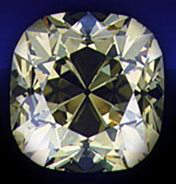
The De Beers Diamond as seen from above
Characteristics of the diamond
Four Cs of the diamond
The De Beers diamond is a 234.65-carat, pale yellow, cushion cut diamond of unknown clarity grade. However, the octahedral features of the rough diamond was at least preserved in the culet of the diamond, which appears to have four octahedral natural facets. See the side view of the De Beers diamond below.
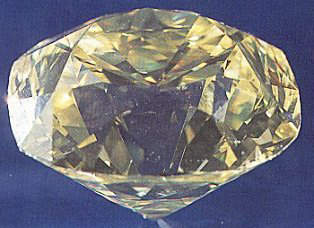
Side view of the cushion-cut De Beers Diamond
In the List of Famous Diamonds Greater than 100 Carats in Weight arranged in descending order of weights, the De Beers Diamond occupies the 10th-position
In the List of Famous Diamonds Greater than 100 Carats in Weight Arranged in Descending Order of Weights, the De Beers diamond occupies the 10th-position. In other words the De Beers diamond is the 9th-largest faceted diamond in the world, excluding the 253.70-carat, natural octahedral diamond crystal, the yellow-colored Oppenheimer diamond.
However, according to the List of famous yellow diamonds greater than 100 carats in weight, the De Beers Diamond is the 2nd largest faceted yellow diamond (disregarding the un-cut Oppenheimer) and the largest cushion-cut yellow diamond in the world. See table below.
List of famous yellow diamonds greater than 100 carats in weight
S/N |
Name | Carat Weight | Shape/Cut | Color |
| 1 | Incomparable | 407.48 | shield shaped | fancy brownish yellow |
| 2 | Oppenheimer-uncut | 253.70 | natural octahedral | yellow |
| 3 | De Beers | 234.65 | cushion | light yellow |
| 4 | Red Cross | 205.07 | cushion | canary yellow |
| 5 | unnamed | 200.87 | pear | yellow |
| 6 | Moon | 183.00 | round | pale yellow |
| 7 | unnamed | 180.85 | briolette | yellow |
| 8 | Star of Peace | 170.49 | pear | brownish yellow |
| 9 | Hope of Africa | 151.91 | cushion | fancy yellow |
| 10 | Unnamed | 150.00 | emerald | yellow |
| 11 | Florentine | 137.27 | double rose cut | light yellow |
| 12 | Algeiba Star | 135.03 | square brilliant | yellow |
| 13 | Sarah | 132.43 | cushion | fancy vivid yellow |
| 14 | Golden Hue | 132.42 | cushion | yellow |
| 15 | Tiffany Yellow | 128.54 | cushion | canary yellow |
| 16 | Stewart | 123.00 | brilliant | yellow |
| 17 | Meister | 118.00 | cushion | yellow |
| 18 | Vainer Briolette | 116.60 | briolette | fancy light yellow |
| 19 | Unnamed | 114.64 | briolette | yellow |
| 20 | Unnamed | 114.03 | cushion | yellow |
| 21 | Mouna | 112.50 | cushion | fancy intense yellow |
| 22 | African Yellow | 112.00 | - | yellow |
| 23 | Anon | 108.04 | emerald | yellow |
| 24 | Rojtman | 107.46 | cushion | yellow |
| 25 | Golden Sun | 105.54 | emerald | yellow |
| 26 | Golden Door | 104.95 | pear | yellow |
| 27 | Ashberg | 102.48 | cushion | fancy brownish yellow |
| 28 | Allnatt | 101.29 | cushion | fancy vivid yellow |
| 29 | Sunrise | 100.52 | emerald | yellow |
© internetstones.com
Please do not copy our tables without our permission. We may be compelled to inform the search engines if our content and tables are plagiarised.
The De Beers Diamond is a Type IaAB diamond
The diamond is most probably a Type IaAB diamond, being a pale yellow diamond, in which the yellow color is caused by groups of 3-atoms of nitrogen, known as N3 centers, which absorb visible light in the blue region of the spectrum, causing it's complementary color yellow color to manifest. The diamond also has A-aggregates (Groups of 2-atoms), and B-aggregates (groups of 4-atoms), but these do not affect the color of the diamond. Almost 98% of all natural diamonds belong to this group.
History
Early History of the Diamond
The founding of the De Beers Consolidated Mines Ltd in the year 1888
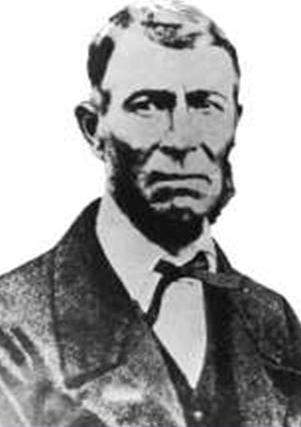
Johannes Nicholas de Beer
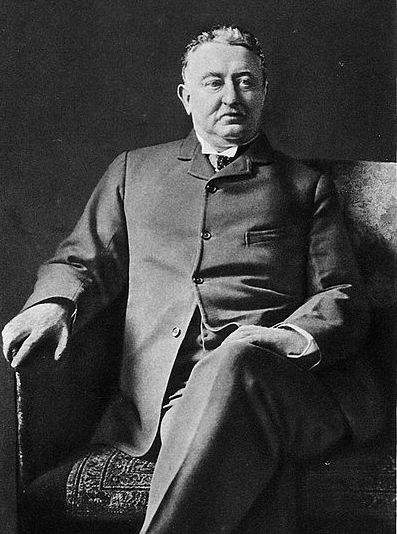
Cecil Rhodes founder-chairman of De Beers Consolidated Mines Ltd.
The De Beers rough diamond discovered in 1888 was the third largest gem-quality rough diamond in the world to be discovered at that time. Today, the De Beers rough diamond is the 26th-largest rough diamond ever to be discovered
Not long after the formation of this new company in March 1888, a very large, naturally formed, octahedral, light yellow diamond crystal was discovered in the De Beers mine, weighing 428.50 carats. The octahedral crystal had dimensions of 38 mm square at the center and 47.6 mm along it's long axis. It was the third largest gem-quality rough diamond to be discovered at that time, after the 787 carat Great Mogul diamond and the 490-carat Kimberley diamond. However after the discovery of the 995-carat Excelsior in 1893 and the 650.80-carat Jubilee in 1895, the De Beers diamond was pushed to the 5th-place by the end of the 19th century. Today, the De Beers rough diamond occupies the 26th-place in this list of largest gem-quality rough diamonds ever discovered as at year 2011. See table below.
List of largest gem-quality rough diamonds ever discovered in the world as at year 2011
Name |
Country of discovery | Year of discovery | Carat Weight | Color | Position |
| Cullinan | South Africa | 1905 | 3,106 | Colorless/White | 1 |
| Excelsior | South Africa | 1893 | 995 | Colorless /White | 2 |
| Star of Sierra Leone | Sierra Leone | 1972 | 969.80 | Colorless/White | 3 |
| Incomparable | Zaire | 1984 | 890 | Brownish-yellow | 4 |
| Great Mogul | India | 1650 | 787 | Colorless/White | 5 |
| Millennium Star | Zaire | 1990 | 777 | Colorless/White | 6 |
| Woyie River | Sierra Leone | 1945 | 770 | Colorless/White | 7 |
| Golden Jubilee | South Africa | 1985 | 755 | Yellowish-brown | 8 |
| President Vargas | Brazil | 1938 | 726.60 | Colorless/White | 9 |
| Jonker | South Africa | 1934 | 726 | Colorless/White | 10 |
| Jubilee-Reitz | South Africa | 1895 | 650.80 | Colorless/White | 11 |
| Unnamed | South Africa | 1984 | 620.14 | 12 | |
| Sefadu | Sierra Leone | 1970 | 620 | Colorless/White | 13 |
| Kimberley Octahedral | South Africa | 1964 | 616 | Yellow | 14 |
| Lesotho Promise | Lesotho | 2006 | 603 | Colorless/White | 15 |
| Lesotho Brown | Lesotho | 1967 | 601 | Brown | 16 |
| Centenary | South Africa | 1986 | 599 | Colorless/White | 17 |
| De Grisogono | Central Africa | Probably in the 1950s | 587 | Black | 18 |
| Letseng Star | Lesotho | 2011 | 553 | Colorless/White | 19 |
| Unnamed Petra Diamond | South Africa | 2009 | 507 | Colorless/White | 20 |
| Letseng Legacy | Lesotho | 2007 | 493 | Colorless/White | 21 |
| Kimberley | South Africa | 1869-1871 | 490 | Champagne | 22 |
| Light of Letseng | Lesotho | 2008 | 478 | Colorless/White | 23 |
| Jacob-Victoria | South Africa | 1884 | 457.50 | Colorless/White | 24 |
| Zale light of peace | Sierra Leone | 1969 | 435 | Colorless/white | 25 |
| De Beers | South Africa | 1888 | 428.50 | Yellow | 26 |
| Niarchos | South Africa | 1954 | 426.50 | Colorless/White | 27 |
©internetstones.com
Discovery of the De Beers rough diamond, the second largest rough diamond crystal to be discovered in South Africa at that time gave a boost to mining activities during this period
The discovery of the De Beers rough diamond in 1888 - the 2nd-largest, gem-quality, rough diamond to be discovered, since mining activities began in South Africa in 1869 - from one of the six diamond mines worked in the Kimberley region, around this period, provided an added incentive for further mining activity, that was pursued aggressively during this period. The largest gem-quality rough diamond to be discovered from the Kimberley diamond mine in South Africa during the period 1869-1871, is the 490-carat Kimberley rough diamond.
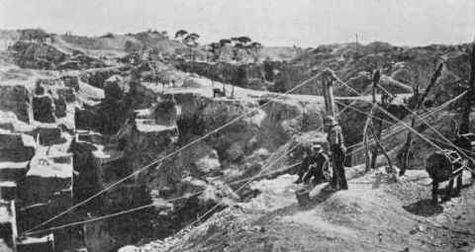
Old De Beers Mine - 1873, the mine where the De Beers Diamond was discovered
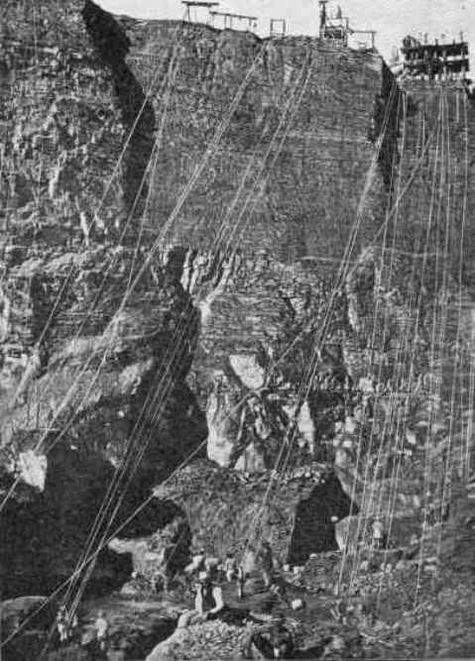
Interior of De Beers Mine in 1874
The possible country where the De Beers diamond was cut and processed ?
Even though the country where the De Beers diamond was cut is not known precisely, it must have been at Amsterdam in the Netherlands, because around this time Amsterdam was the leading diamond cutting center in the world, and most of the diamonds mined in South Africa were eventually reaching there. The rough diamond was transformed by the cutters, into a 234.65-carat, cushion-cut, pale yellow stone. However, the octahedral features of the rough diamond was at least preserved in the culet of the diamond.
Modern History of the Diamond
The De Beers diamond is purchased by the Maharajah of Patiala in 1928 after it was exhibited in Paris
The De Beers diamond was purchased by the Maharajah of Patiala, Bhupendra Singh, after it was displayed at an exhibition held in Paris in 1928. Patiala was a princely state in Punjab, in Northwestern India, which at the time of independence, merged with India in 1947. Bhupendra Singh's rule over Patiala extended from 1900 to 1938. The Princes and Princesses of the former princely states of India, were granted special privileges even after independent India came into existence in 1947. These privileges were subsequently withdrawn during the period of Mrs. Indira Gandhi, as Prime Minister, by a constitutional amendment passed in 1970.
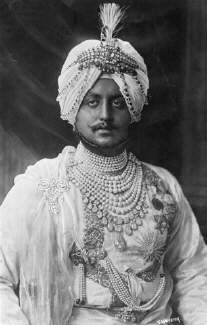
Bhupendra Singh, Maharajah of Patiala
Cartier's of Paris incorporate the De Beers diamond as the centerpiece of a ceremonial necklace, the "Patiala Necklace," one of the most spectacular pieces of jewelry ever created
In 1928 at the request of the Maharajah of Patiala, Bhupendra Singh, the jewelry firm Cartier's of Paris set the De Beers diamond, as the centerpiece of a ceremonial necklace that came to be known as "Patiala Necklace," which without any doubt was one of the most spectacular pieces of jewelry ever created. In addition to the De Beers diamond weighing 234.69 carats, there were seven other big diamonds ranging from 18 to 73 carats, incorporated into the necklace. Several expensive Burmese Rubies were also placed in the necklace. In all, the necklace also contained 2,930, smaller diamonds, weighing about 962.25 carats. Had this unique jewelry masterpiece existed today, by current market values, in addition to it's great historic significance which also adds to it's value, the price of this spectacular necklace, would have been beyond estimation.
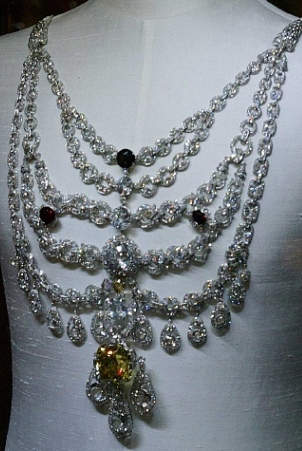
Patiala Necklace by Cartier
The "Patiala Necklace" disappears after the abolition of the Princely State of Patiala in 1947, but the remnants of the necklace are re-discovered in 1998 in a second hand jewelry shop in London
But unfortunately after the abolition of the Patiala Raj with India's independence in 1947, the Patiala necklace too disappeared. Perhaps, it was disposed of by the royal family fearing it's confiscation by the new Indian Government. Then in 1998, the remnants of the Patiala necklace were accidentally discovered in a second hand jewelry shop in London, by a curious customer. All the big stones in the necklace, which included the De Beers diamond and the seven other big diamonds ranging from 18 to 73 carats, and the rubies had all been disposed of.
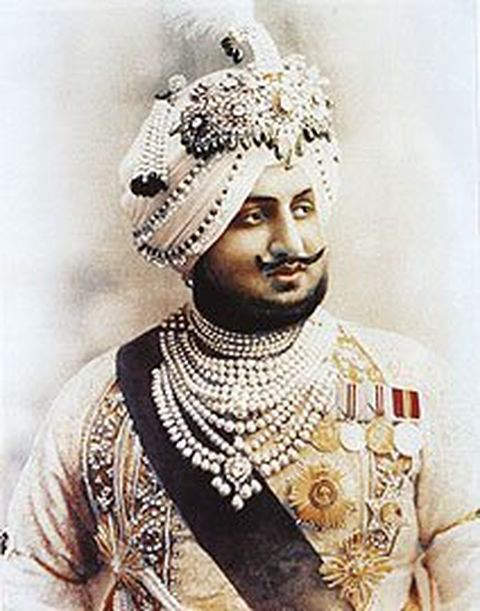
Another Portrait of Maharajah Bhupinder Singh of Patiala
Cartier's attempt to restore the "Patiala Necklace" using cubic zirconium to replace the diamonds and synthetic rubies to replace the Mogok rubies
Cartier's acquired the remains of the necklace from the London jewelry store, and embarked upon the most difficult task of trying to restore the necklace to it's former pristine glory. It took them four long years to complete the job. At first they tried to replace the missing diamonds with natural white sapphire or white topaz, but the results were very disappointing. Subsequently, they decided to use cubic zirconium to replace the seven large diamonds. The resulting effect was encouraging, though not as good as the original diamonds. Colorless zirconium resemble diamond in it's luster and brilliance. The missing De beers diamond was replaced with an exact replica made either of yellow cubic zirconium or synthetic yellow sapphire. The original Burma rubies were substituted with synthetic rubies.
The De Beers diamond re-surfaces again in 1982 at a Sotheby's auction in Geneva and was purchased by an anonymous buyer for US$ 3.16 million
The De Beers diamond suddenly surfaced again on May 6th, 1982, when it's anonymous owner put it up for auction at Sotheby's in Geneva. The speculation in the diamond trade was that the bidding for the stone could reach as much as US$ 4.5 million, but eventually the stone was purchased at the top bid of US$ 3.16 million, by an anonymous buyer, still much below it's undisclosed reserve.
You are welcome to discuss this post/related topics with Dr Shihaan and other experts from around the world in our FORUMS (forums.internetstones.com)
Related :-
External Links :-
References :-
1) Diamonds - Famous, Notable and Unique - by GIA
2) Famous Diamonds - by Ian Balfour
3) Cecil Rhodes - From Wikipedia, the free encyclopedia
4) Bhupinder Singh of Patiala - From Wikipedia, the free encyclopedia
5) The Diamond Mines of South Africa - by Gardner F. Williams M.A. published in 1905, by B.F. Buck & Company, New York.
 Home
Security & Guarantee
How it Works
Technology Partners
Updated Tables
Famous Diamonds
More Famous Diamonds
Famous Pearls
Famous Gemstones
Contact Dr Shihaan Larif
Contact Senior Editor
Famous Jewelry
Reference Database
Forums
Learning Center
Gemstone Gallery
e-mail Notifications
Advertise
Press Release
About Us
Privacy Policy
Contact Us
FAQ'S
Site Map
Staff Mail Login
Staff Documents
Birthstones
History
Minerals
Shows
Live Metal Prices
Jewellery Gallery
News
Marketplace
Marketplace Support
Open Store
Online Auctions
Join Us & Contribute
Directory
Classifieds
List your products
Wholesale Trading
Post Buy Request
Go Green Policy
Site Updates
Upcoming-ToDo List
Latest News
Latest Articles
Latest Blog Updates
Chat Rooms
Job Board
User Gallery
Videos
New Newsletter Archive
Old Newsletter Archive
Jewelry & Mineral Blog
User Blogs & Social Network
Search
Answers (Q & A)
Valuation
Help me find a diamond/jewelry
pin.internetstones.com- Social Pinboard- Sart yours & connect with millions
Invite Friends From Yahoo, Gmail etc-One Click
Home
Security & Guarantee
How it Works
Technology Partners
Updated Tables
Famous Diamonds
More Famous Diamonds
Famous Pearls
Famous Gemstones
Contact Dr Shihaan Larif
Contact Senior Editor
Famous Jewelry
Reference Database
Forums
Learning Center
Gemstone Gallery
e-mail Notifications
Advertise
Press Release
About Us
Privacy Policy
Contact Us
FAQ'S
Site Map
Staff Mail Login
Staff Documents
Birthstones
History
Minerals
Shows
Live Metal Prices
Jewellery Gallery
News
Marketplace
Marketplace Support
Open Store
Online Auctions
Join Us & Contribute
Directory
Classifieds
List your products
Wholesale Trading
Post Buy Request
Go Green Policy
Site Updates
Upcoming-ToDo List
Latest News
Latest Articles
Latest Blog Updates
Chat Rooms
Job Board
User Gallery
Videos
New Newsletter Archive
Old Newsletter Archive
Jewelry & Mineral Blog
User Blogs & Social Network
Search
Answers (Q & A)
Valuation
Help me find a diamond/jewelry
pin.internetstones.com- Social Pinboard- Sart yours & connect with millions
Invite Friends From Yahoo, Gmail etc-One Click




Our Global Jewelry Industry Job Network


Buy & Sell in our Marketplace

Subscribe to our Newsletter

List in our Classifieds

List in our Directory

User Uploaded Gallery

Powered by Ultra Secure
Amazon (USA) Cloud Network

Founder Internet Stones.COM
Register in our Forums

| Featured In
|
|
|
|
|
|
|
|







Blog & Education Feed
Articles Feed
 |
 |
 |

Copyright © .Internet Stones.COM. All rights reserved.