DeYoung Red Diamond
Open FREE Unlimited Store Join Our Newsletter
Lareef A. Samad B.Sc (Hons)
Origin of name
The "DeYoung Red" diamond gets its name from the onetime owner of the diamond Sidney DeYoung, a jeweler from Boston, who later donated the diamond to the National Museum of Natural History of the Smithsonian Institution, at Washington DC.

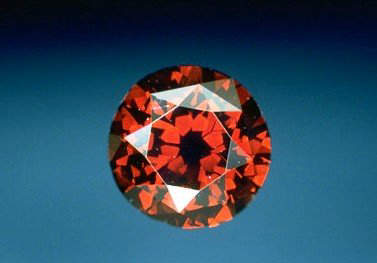
Photo by Chip Clark
©Smithsonian Institution
Characteristics of the diamond
4Cs of the diamond
The DeYoung Red diamond, is a 5.03-carat, modified round brilliant-cut, fancy dark red diamond with a slightly brownish hue, giving it the appearance of a rhodolite garnet. In fact the stone was mistakenly sold as a red garnet at the beginning. The clarity grade of the diamond is VS2 - very slightly incuded, but inclusions still invisible without magnification.
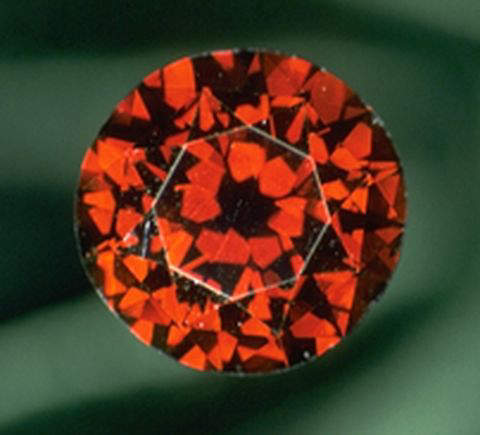
Another image of the DeYoung Red by Chip Clark
©Smithsonian Institution
The DeYoung Red is a plastically deformed Type IIa diamond, whose occurrence is much less than 0.1% of all naturally occurring diamonds
Being a red diamond, the DeYoung Red is a rare Type IIa diamond. Type II diamonds are nitrogen-free or contain undetectable quantities of nitrogen. Type II diamonds are sub-divided into two :- Type IIa and Type IIb
Type IIa - Free of all impurities. In other words they are chemically pure diamonds. 1-2 % of natural diamonds belong to this group.
Type IIb - Contain trace amounts of another impurity, boron, which imparts a blue color to the diamonds. However only 0.1 % of natural diamonds belong to this group.
Type IIa diamonds can fall into three categories :-
1) Structurally perfect 2) Structurally imperfect 3) Naturally irradiated
1) Structurally perfect :- Type IIa diamonds that are chemically pure and structurally perfect are absolutely colorless, and constitute about 1-2 % of all naturally occurring diamonds. D, E, and F color grades of diamonds, which are colorless, may fall within this category.
2) Structurally imperfect :- These are Type II diamonds, that are chemically pure, but have plastically deformed crystals. The crystals were plastically deformed following their formation in the earth's mantle, or during their ascent to the surface. The deformed areas in the crystal, change it's absorption spectrum causing the rare fancy colors such as red, pink, purple, orange and also brown colors. The occurrence of red, pink, and purple colors is much less than 0.1 % of all natural diamonds.
3) Naturally irradiated :- These are Type II diamonds, that have been exposed to natural radiation such as alpha, beta and gamma rays, over a long period of time, causing distortion in the crystal lattice that produces a green color. The occurrence of these diamonds are also very scarce and much less than 0.1 % of all natural diamonds.
Thus, the DeYoung Red diamond, is a plastically deformed Type IIa diamond. The 5.03-carat DeYoung Red diamond is the third largest red diamond in the world.
History
How the DeYoung Red was acquired as part of an estate jewelry collection in which it was wrongly identified as a garnet, but subsequently identified to be a rare red diamond ?
The DeYoung Red diamond was in the possession of Sidney DeYoung, a jeweler from Boston for quite a long time. The stone had been acquired by his establishment as part of a collection of estate jewelry in which it was wrongly identified as a garnet. The item that included the stone had been labeled as a garnet hat pin. But one day, Sidney DeYoung happened to examine the garnet hat pin a little more closely. He noticed the so-called garnet just didn't look quite like a garnet. Moreover, he observed that for an old stone, it was remarkably clean and wasn't scratched up. This observation aroused his suspicions, and he took the stone for testing by a gem-testing laboratory. His suspicions were confirmed, and it turned out that the so called garnet was in fact not a garnet, but a red diamond, the 3rd largest in the world.
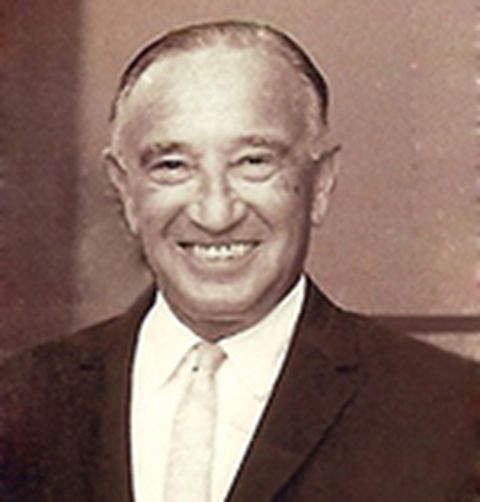
Sydney DeYoung, the third head of the J & SS DeYoung Inc. founded in 1835, diamond cutters and dealers in diamonds, natural pearls, colored gemstones and antique jewels, based in Boston, Massachusetts.
Sidney DeYoung donates the DeYoung Red diamond to the Smithsonian's National Museum of Natural History in 1987, to enrich the National Gem and Mineral Collection
Sidney DeYoung donated the rare 5.03-carat red diamond to the National Museum of Natural History of the Smithsonian Institution in 1987, to be added to the National Gem and Mineral Collection. He also donated a 2.86-carat fancy intense pink diamond that came from the Williamson mine in Tanzania, to the Institution. The two diamonds are exhibited side by side at the Natural History Museum.
The world's largest red diamond is 5.11-carat, trilliant-cut, Moussaieff Red diamond
The world's first largest red diamond is the Moussaieff Red, a 5.11-carat, trilliant-cut, fancy red, internally flawless diamond. In the rough state, this diamond weighed 13.90 carats, and was discovered by a farmer in Brazil in the mid-1990s. The rough diamond was acquired by the William Goldberg Diamond Corporation of New York, who transformed it into a spectacular triangular brilliant. The color of the diamond is a fine ruby-red, and was initially given the name "Red Shield", by the Goldberg Corporation. The diamond was later acquired by the Moussaieff jewelry firm, around the year 2001, for a rumored $ 8,000,000, and after this transaction the diamond acquired the name Moussaieff Red.
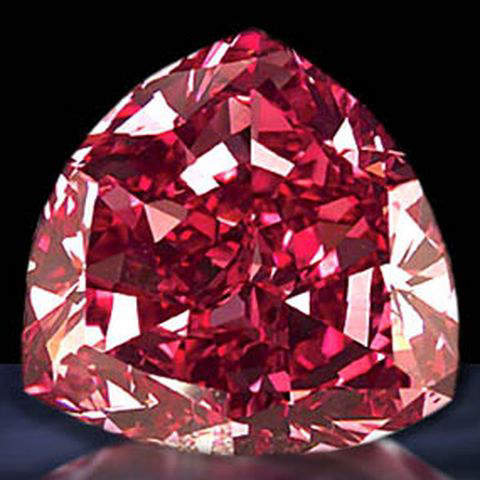
5.11-carat, trilliant-cut, fancy red Moussaieff Red diamond
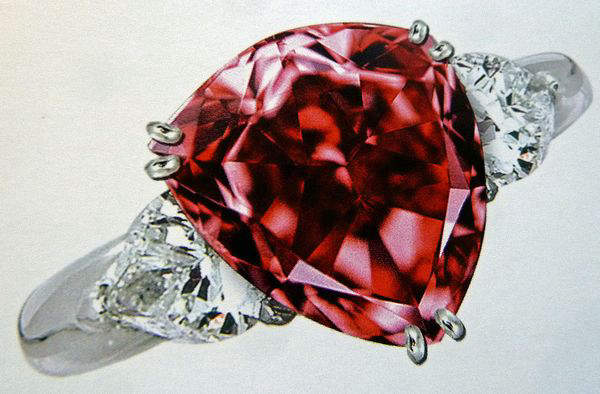
Moussaieff Red diamond set as the centerpiece of a platinum ring
The second largest red diamond in the world is the 5.05-carat, emerald-cut Kazanjian Red diamond
The second largest red diamond in the world was discovered as a 35-carat rough in Lichtenberg, South Africa, in 1927, during the "diamond rush" of the mid-1920s. The rough diamond was cut in Amsterdam, and after cutting and polishing, weighed 5.05 carats. The cut employed was an emerald-cut, believed to be the best cut that suited the rough stone. At the onset of World War II, the diamond's owners placed it in a safe in Arnhem, the Netherlands, but was eventually seized by the Nazis, who dispatched the stone to Germany. The red diamond was later discovered by U.S. General Joseph McNarney in a salt mine, but the General believed the stone to be a ruby. The stone eventually entered the private collection of an anonymous diamond connoisseur, in which it remained for 30 years, before Kazanjian Bros. Inc. purchased it in February 2007. The previously unnamed 5.05-carat Red Diamond thus acquired the name "Kazanjian Red" diamond. The "Kazanjian Red" was put on display at the Morgan Memorial Hall of Gems of American Museum of Natural History, New York, from October 1, 2010 to March 13, 2011., together with the 31.06-carat Wittelsbach-Graff blue diamond.
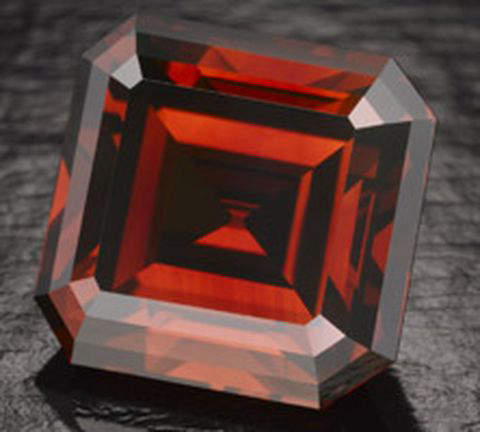
5.05-carat, emerald-cut "Kazanjian Red" diamond
Graff Purplish-Red diamond - The fifth largest red diamond in the world.
The Graff Purplish-red diamond, is a 2.26-carat, modified octagonal-cut, fancy purplish-red, SI2 clarity diamond set as the centerpiece of a 18k pink gold ring, surrounded by four heart-shaped petals, each set with a large heart-shaped colorless diamond in the center, and lined by a single layer of small, pave-set, brilliant-cut pink diamonds, The shoulders of the ring are bifurcated and set with small, brilliant-cut, pink diamonds.
The red diamond ring was Lot No. 356 at Christie's Geneva Magnificent Jewels Sale 1350, held on November 15, 2007. A pre-sale estimate of US$ 1,340,426 to US$ 1,675,532 was placed on the ring. However, the diamond ring sold at a much enhanced price of US$ 2,646,000, which was 1.5 times the upper pre-sale estimate and 1.9 times the lower pre-sale estimate.This works out to a price-per-carat of US$ 1, 170,796 a world record for a red diamond previously held by the Hancock red diamond for 20 years, that registered a price-per-carat of US$ 926,315 at a Christie's auction in New York in 1987.
The purplish-red diamond that was previously unnamed, became the Graff Purplish-red diamond after it was purchased by Laurence Graff at the auction.
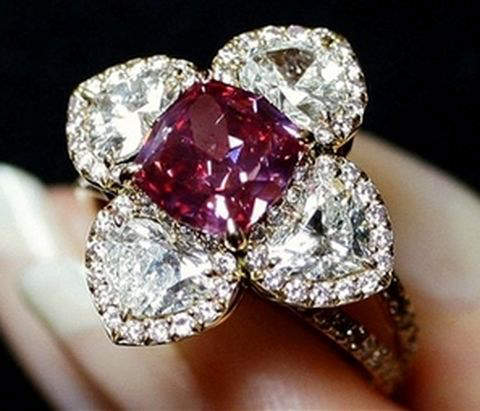
2.26-carat, fancy purplish-red, modified octagonal-cut diamond
1.92-carat, rectangular-cut, fancy red, unnamed red diamond, that set a new price-per-carat auction record for a red diamond of US$ 1,694,101 at Christie's Magnificent Jewels Geneva Sale on May 15, 2013
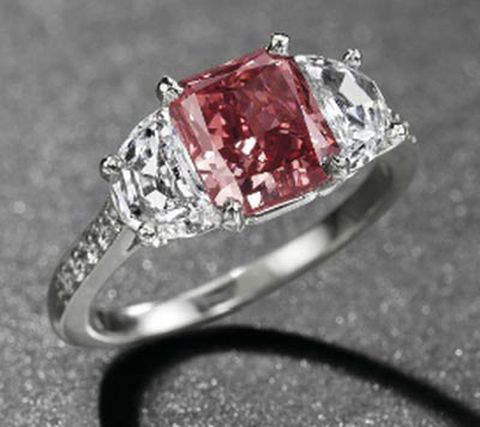
1.92-carat, rectangular-cut, fancy red diamond ring
Christie's Magnificent Jewels Geneva Sale 1397, held on May 15, 2013 featured a rare red colored diamond ring assigned Lot 301, said to be the Property of a Lady of Title. The 1.92-carat, rectangular-cut, fancy red diamond with a clarity grade of VS2, is set as the centerpiece of a platinum ring, flanked on either side with half-moon diamonds and the shoulders pave-set with round brilliant-cut diamonds. The Lot was accompanied by a report no. 11360842 dated March 20, 2001 issued by the GIA, stating that the diamond is a fancy red color, VS2 clarity diamond.
A pre-sale estimate of US$ 1,999,244 to US$ 3,051,478 was placed on the diamond ring. However, the lot was eventually sold for US$ 3,252,675, which was more than US$ 200,000 above the upper pre-sale estimate. The price of US$ 3,252,675 was a record for a red diamond, and set a new price-per-carat auction record of US$ 1,694, 101 for a red diamond, previously held by the Hancock Red diamond for 20 years and then the 2.26-carat, modified octagonal-cut, Graff Purplish-red diamond for 6 years from 2007 to 2013.
Rarity of red diamonds in nature is combined with their restricted sizes
The world's 1st, 2nd and 3rd largest red diamonds, the Moussaieff Red, the "Kazanjian Red" and the "DeYoung Red," have weights of 5.11 carats, 5.05 carats, and 5.03 carats respectively. In comparison, the world's largest colorless (D-color)diamonds of the same rank, Cullinan I, Cullinan II, and the Centenary diamonds have weights of 530.20 carats, 317.40 carats, and 273.85 carats respectively. These statistics clearly show that the rarity of the red color is combined with the restricted size of the diamonds. In terms of size, the above red diamonds would not get anywhere near the world's famous large diamonds, yet they are famous for the fact that they are red, one of the rarest colors in natural diamonds.
A table of known famous red diamonds
The following is a table of famous red diamonds. Apart from the known famous red diamonds, the table also includes other red diamonds that appeared at the sale of famous auction houses and performed impressively creating auction records.
List of Known Famous Red Diamonds Arranged in Descending Order of Carat Weights
| S/N | Name of Diamond | Carat Weight | Cut/Shape | Color | Highest price achieved at sale/auction | Price per carat |
| 1 | Moussaieff Red | 5.11 | trilliant-cut | fancy red | USD 8 million | USD 1,565,557 |
| 2 | Kazanjain Red | 5.05 | emerald-cut | |||
| 3 | DeYoung Red | 5.03 | modified round brilliant-cut | fancy dark red | ||
| 4 | Fancoldi Red Diamond | 3.16 | round brilliant-cut | fancy intense purplish-red | ||
| 5 | Graff Purplish-Red | 2.26 | modified octagonal-cut | fancy purplish-red | Christie's Geneva auction, Nov. 2007. USD 2,646,000 | USD 1,170,796 |
| 6 | Raj Red Diamond 1988 | 2.23 | ||||
| 7 | Unnamed Red Diamond | 1.92 | radiant-cut | fancy red | Phillips de Pury, New York Auction, Oct.2001, USD 1,652,500 | USD 860,677 |
| 8 | Unnamed Red Diamond | 1.92 | rectangular-cut | fancy red | Christie's Geneva, May 2013. USD 3,252,675 | USD 1,694,101 |
| 9 | Unnamed Red Diamond | 1.70 | octagonal-cut | fancy purplish-red | Christie's Hong Kong, Dec.2008 | |
| 10 | Unnamed Red Diamond | 1.59 | modified rectangular-cut | fancy purplish-red | Christie's New York April 2007, USD 958,400 | USD 602,767 |
| 11 | Unnamed Red Diamond | 1.05 | oval-cut | fancy red | Christie's April 2002, USD 442,500 | USD 421,428 |
| 12 | Unnamed Red Diamond | 1.00 | pear-shaped | fancy purplish-red | Christie's Oct 1997 Sale, USD 215,500 | USD 215,500 |
| 13 | Hancock Red | 0.95 | circular-cut | fancy purplish-red | Christie's New York auction 1987. USD 880,000 | USD 926,315 |
| 14 | Unnamed Red Diamond | 0.91 | modified square-cut | fancy purplish-red | Sotheby's Hong Kong, Nov. 2004. USD 561,392 | USD 616,914 |
| 15 | Unnamed Red Diamond, Christie's Hong Kong, May 2001 | 0.73 | rectangular-cut | fancy red | USD 391,280 | USD 536,000 |
| 16 | Rob Red | 0.59 | pear-shaped | fancy intense red | ||
| 17 | Unnamed Red Diamond, Christie's Hong Kong, May 2000 | 0.59 | oval-cut | fancy purplish-red | USD 262,550 | USD 445,000 |
| 18 | Lady in Red | 0.54 | round-brilliant | fancy intense purplish-red |
© internetstones.com
Please do not copy our tables. We may be compelled to inform the search engines or file a DMCA request if our content and tables are plagiarised.
20-year old world record for price per carat broken- October 8,2007
The combined characteristics of rarity and beauty, make red diamonds the most expensive of all diamonds in the world. The Hancock Red diamond, which has an extraordinary deep ruby-red color, and having a weight of only 0.95 carats sold for $ 880,000 at a Sotheby's auction in 1987. This works out to a record price of $ 926,000 per carat. This record had been sustained for the last 20 years, and appears to have been broken only in October 8, 2007, when a 6.04-carat, internally flawless, fancy vivid blue diamond fetched a price of $ 7.98 million-which works out to a new world record of $ 1.32 million per carat -at a Sotheby's auction held in Hong Kong. Sotheby's said that the buyer was Moussaieff Jewelers from London, which has a reputation for acquiring extremely rare and costly gemstones, like the Moussaieff Red diamond. The seller of this diamond is said to be a private Asian collector.
You are welcome to discuss this post/related topics with Dr Shihaan and other experts from around the world in our FORUMS (forums.internetstones.com)
Related :-
External Links :-
https://geogallery.si.edu/index.php/en/1007278/deyoung-red-diamond
https://thedeyoungcollection.com/history.html
References :-
1) Geneva Magnificent Jewels Sale - Christie's Press Release, April 22, 2013.
2) De Young Red Diamond (G9871) - Gem Gallery - Smithsonian, National Museum of Natural History - geogallery.si.edu/index.php/en/gems
3) The De Young Red - LEIBISH - www.fancydiamonds.net
4) The DeYoung Collection - www.thedeyoungcollection.com
 Home
Security & Guarantee
How it Works
Technology Partners
Updated Tables
Famous Diamonds
More Famous Diamonds
Famous Pearls
Famous Gemstones
Contact Dr Shihaan Larif
Contact Senior Editor
Famous Jewelry
Reference Database
Forums
Learning Center
Gemstone Gallery
e-mail Notifications
Advertise
Press Release
About Us
Privacy Policy
Contact Us
FAQ'S
Site Map
Staff Mail Login
Staff Documents
Birthstones
History
Minerals
Shows
Live Metal Prices
Jewellery Gallery
News
Marketplace
Marketplace Support
Open Store
Online Auctions
Join Us & Contribute
Directory
Classifieds
List your products
Wholesale Trading
Post Buy Request
Go Green Policy
Site Updates
Upcoming-ToDo List
Latest News
Latest Articles
Latest Blog Updates
Chat Rooms
Job Board
User Gallery
Videos
New Newsletter Archive
Old Newsletter Archive
Jewelry & Mineral Blog
User Blogs & Social Network
Search
Answers (Q & A)
Valuation
Help me find a diamond/jewelry
pin.internetstones.com- Social Pinboard- Sart yours & connect with millions
Invite Friends From Yahoo, Gmail etc-One Click
Home
Security & Guarantee
How it Works
Technology Partners
Updated Tables
Famous Diamonds
More Famous Diamonds
Famous Pearls
Famous Gemstones
Contact Dr Shihaan Larif
Contact Senior Editor
Famous Jewelry
Reference Database
Forums
Learning Center
Gemstone Gallery
e-mail Notifications
Advertise
Press Release
About Us
Privacy Policy
Contact Us
FAQ'S
Site Map
Staff Mail Login
Staff Documents
Birthstones
History
Minerals
Shows
Live Metal Prices
Jewellery Gallery
News
Marketplace
Marketplace Support
Open Store
Online Auctions
Join Us & Contribute
Directory
Classifieds
List your products
Wholesale Trading
Post Buy Request
Go Green Policy
Site Updates
Upcoming-ToDo List
Latest News
Latest Articles
Latest Blog Updates
Chat Rooms
Job Board
User Gallery
Videos
New Newsletter Archive
Old Newsletter Archive
Jewelry & Mineral Blog
User Blogs & Social Network
Search
Answers (Q & A)
Valuation
Help me find a diamond/jewelry
pin.internetstones.com- Social Pinboard- Sart yours & connect with millions
Invite Friends From Yahoo, Gmail etc-One Click




Our Global Jewelry Industry Job Network


Buy & Sell in our Marketplace

Subscribe to our Newsletter

List in our Classifieds
List in our Directory

User Uploaded Gallery

Powered by Ultra Secure
Amazon (USA) Cloud Network

Founder Internet Stones.COM
Register in our Forums

| Featured In
|
|
|
|
|
|
|
|







Blog & Education Feed
Articles Feed
 |
 |
 |

Copyright © .Internet Stones.COM. All rights reserved.