Doris Duke's Pearl Bracelets
Open FREE Unlimited Store Join Our Newsletter
Origin of Name :-
Doris Duke's Pearl Bracelets refer to a collection of six bracelets in which pearls were used as the main component, among the 399-piece jewelry collection of the renowned tobacco heiress, her personal jewelry, some of which were family heirlooms inherited from her grandmother and mother and others which she purchased herself from well known jewelers in New York and Paris, or during her trips around the world, beginning with the honeymoon tour around the world in 1935, after she married James Cromwell. Even though Doris Duke was renowned as an art collector putting together her well known Asian and Islamic art collections, that was the result of a passion for collecting such works, induced during her honeymoon tour to Asia and the Fareast, her jewelry collection was not a result of a deliberate attempt to assemble a collection of artistic and historic value, but rather an "unintentional collection," partly inherited and partly acquired by her to suit her own personal tastes, as well as in keeping with the fashion trends of the time. In fact Doris Duke herself did not consider her jewelry as a "collection" at all, but something without scholarly, artistic or historical interest, containing pieces that she liked and wore quite often or had intimate personal meaning from important moments in her life. However there is no denying of the fact that her jewelry collection is a reflection of her. own changing taste during her life time as well as changing taste in jewelry fashions from the 1850s to the end of the 20th century.

List of names by which the pearl bracelets are identified
The list of names by which the pearl bracelets in the Doris Duke's collection are identified are as follows :-
1) A pair of pearl and diamond bracelets worn together on one wrist.
2) A pearl bracelet with a central octagonal-shaped diamond.
3) Ceylon sapphire, pearl and diamond bracelet.
4) Pearl bracelet with a rectangular centerpiece studded with diamonds.
5) Cabochon emerald, pearl and diamond bracelet.
1) A pair of pearl and diamond bracelets worn together on one wrist
A pair of pearl and diamond bracelets that was purchased by Nanaline Duke, the mother of Doris Duke in 1930, but later inherited by Doris and also worn by her shows a combination of two stylistic generations. The soft graduated strands of fine pearls is a reflection of the early-twentieth century fashion trends for multi-strand pearl dog collars and bracelets. This period is also known as the Art Nouveau period (1890-1915) or the Belle Epoque period (1901-1915). The drum-shaped clasps of the bracelets with baguette cut diamonds, belong to a subsequent period known as the Art Deco period. In the 1930s Nanaline Duke wore both bracelets together on one wrist as was the fashion during that period. Even Doris Duke wore them together in a similar manner, when she was photographed by Cecil Beaton.
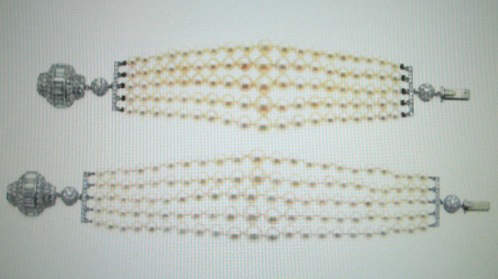
Pair of pearl and diamond bracelets worn together on one wrist.
© Doris Duke Charitable Foundation
The pair of bracelets are exactly similar in design, even though one is slightly smaller than the other in length. The longer bracelet has a length of 6.5 ins (16.5 cm). Each of the bracelets are made up of five graduated pearl strands, with the pearls arranged symmetrically, larger pearls being placed at the center of the bracelet, gradually decreasing in size towards both ends of the bracelet. The clasps and the end pieces of the bracelets are made up of platinum. The perfect spherical shapes of the pearls and the uniformity in sizes seem to suggest that the pearls may be cultured Mikimoto pearls. It was in the 1930s that cultured Mikimoto pearls from Japan first appeared in large quantities in the international pearl markets.
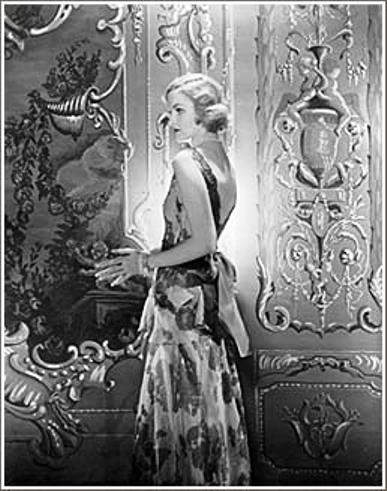
Cecil Beaton's photograph of Doris Duke
2) A pearl bracelet with a central octagonal-shaped diamond
This piece made up of pearls, diamonds and platinum was purchased by Nanaline Duke in the 1920s from Cartier's of New York. The bracelet has a central diamond plaque set with an octagonal-shaped large diamond. Six strands of pearls arise on either side of the central diamond plaque and extend towards the ends of the bracelet. All metallic components in the bracelet are made up of platinum. The rectangular-shaped metallic components on either side of the central diamond plaque, and the rectangular-shaped clasp, are studded with small diamonds. The design is a modification of the multistrand pearl choker necklace from the turn of the century during the Belle Epoque period. The length of the bracelet is 6.5 ins (16.5 cm).
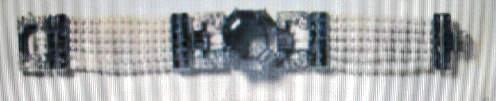
Pearl bracelet with central octagonal shaped diamond
© Doris Duke Charitable Foundation
3) Ceylon sapphire, pearl and diamond bracelet
The bracelet, also a modification of the multistrand pearl choker necklace of the Belle Epoque period as the previous two bracelets, was designed by Cartier, New York, and purchased by James B. Duke in 1925, the year of his death. James B. Duke is said to have lavished gifts of jewelry on his wife Nanaline Duke, throughout their married life, and right up to his death in 1925. The stones required for the bracelet, blue sapphires, diamonds, and pearls, including the large 35.54-carat, octagonal-shaped Ceylon blue sapphire, was provided by James B. Duke to the jewelry firm Cartier, and the job was completed by the firm and delivered before his death in 1925. However, the firm was paid the sum of $5,630, being the cost of workmanship and platinum only on November 8, 1925, after the death of James B. Duke.
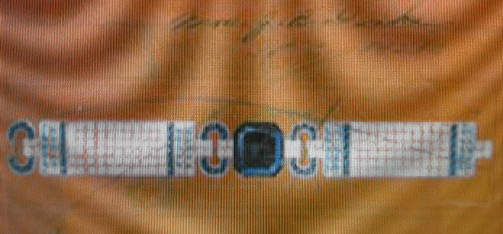
Sketch by Cartier of the design for the proposed bracelet incorporating the Ceylon blue sapphire
© Doris Duke Charitable Foundation
According to a sketch of the design of the bracelet made by Cartier, the centerpiece of the bracelet, is occupied by the large, octagonal-shaped, Ceylon blue sapphire. The two rectangular platinum rings on either side of the central blue sapphire, are also studded with smaller blue sapphires, and so also is the rectangular ring-shaped clasp. Other rectangular platinum components, that serve as end pieces between which the six strands of pearls are situated, on either side of the central blue sapphire, seem to be studded with diamonds.

The 35.54 carat Ceylon sapphire, pearl and diamond bracelet
© Doris Duke Charitable Foundation
However, the actual bracelet turned out by Cartier using this design, show the centerpiece occupied by the 35.54-carat, octagonal-shaped, Ceylon blue sapphire, with two rectangular-shaped platinum rings on either side studded with diamonds. The rectangular-shaped clasp is also studded with diamonds. The end pieces to which the six strands of Persian Gulf pearls are attached appear to be enameled platinum. The pearls are spherical, white and lustrous, and appear to be of uniform size. The 35.54-carat Ceylon sapphire is the only large colored stone in Nanaline's collection of jewels. Cartier was famous for jewelry set with colored stones in the 1920s, and this fame is evident only from this single blue sapphire bracelet in Nanaline's collection.
4) Pearl bracelet with a rectangular centerpiece studded with diamonds
The exquisitely crafted pearl and diamond bracelet in the photograph below, is also one of the pieces from the Doris Dukes jewelry collection, but it is not known when and by whom it was purchased. But given the fact that the design of the bracelet is essentially similar to the designs of the bracelets already considered, it appears to be a piece from the 1920s or 1930s. The piece like the other bracelets was perhaps purchased by Nanaline Duke and later inherited by Doris Duke.
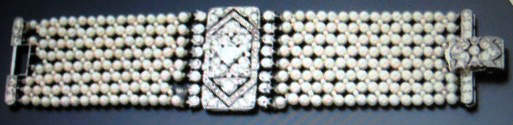
Pearl bracelet with rectangular centerpiece studded with diamonds
© Doris Duke Charitable Foundation
The bracelet has a rectangular centerpiece studded with diamonds, following a geometrical pattern, with a central square and two triangles on either side. The end pieces and the clasp are also studded with diamonds. The eight rows of large spherical pearls between the centerpiece and the end pieces on either side, contain 16 pearls in each row. Between two rows of large spherical pearls 7 or 8 small spherical pearls are placed alternately with a gap, to produce a lattice work of large and small pearls, with 11 diagonal rows in both directions, of large and small pearls alternating one another.
5) Cabochon emerald, pearl and diamond bracelet
This bracelet was designed by Cartier, New York, and purchased by Doris Duke on December 31, 1934. The bracelet which is 6.5 ins (16.5 cm) long, has a central almost circular plaque as its centerpiece, inside which cabochon emeralds are arranged according to a pattern. At the exact center of the plaque is a circular cabochon emerald, surrounded by eight oval-shaped cabochon emeralds placed along the eight cardinal points. Twenty cabochon emeralds are placed in a circle along the periphery of the plaque. These emeralds are rectangular or barrel-shaped, and are arranged alternately, with the long axis of the barrel parallel to or perpendicular to the periphery. Another eight barrel-shaped but smaller emeralds are arranged with their long axis parallel to the periphery, and placed between the outer and inner circle of emeralds, at positions between the oval-shaped emeralds that were placed along the cardinal points. A single extra emerald is placed at the two elevated points where the two semi-circles of the plaque meet, and from which two lotus flower designs arise on either side of the plaque, from which the two arms of the bracelet originate. Thus there are altogether 39 cabochon emeralds inside the central plaque of the bracelet.
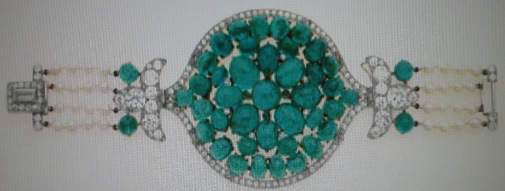
Cabochon emerald, pearl and diamond bracelet.
© Doris Duke Charitable Foundation
The periphery of the plaque is lined by a single layer of small diamonds. The lotus flowers on either side are also studded with diamonds. Four short strands of pearls, each containing four white spherical pearls, arise from each of the lotus flowers on either side and are joined to the end pieces of the bracelet. The outermost strands of pearls on either side arise from a perfectly spherical cabochon emerald placed above the lotus flower petals. The end pieces and the rectangular clasp are also studded with diamonds.
In designing the cabochon emerald, pearl and diamond brooch in 1934, Cartier was undoubtedly inspired by Indian themes as evident from the lotus flower designs he incorporated into the brooch. Emeralds were a popular gemstone in India since the time of the Mughals in the 16th century, when large quantities of emeralds from Colombia reached the Indian shores via Madrid, in Spain. Doris Duke developed a liking towards these brilliant green stones and she purchased two emerald bead necklaces incorporating emeralds of the highest quality during her trip to India in 1935. One necklace was a single strand bead necklace incorporating emeralds with a total weight of approximately 120 carats. The other necklace was a double strand bead necklace whose emeralds weighed approximately 280 carats.
Jewelry styles of the Belle Epoque period - The multi-strand bracelets are actually a modification of the multi-strand pearl choker of the Belle Epoque period.
"Bello Epoque" meaning "beautiful time" in French refers to the Edwardian period, the reign of Edward VII of England (1901-1910), that followed immediately after the long mourning period of Queen Victoria, that started with the death of her husband Prince Albert in 1861 and ended with her death in 1901. The succession of Edward VII to the throne in 1901, was the beginning of an era of elegance, frivolity and fun, a period that led to the upper and middle classes acquiring new wealth, and jewelry of new styles and designs becoming very popular. The period was also an eventful period, coinciding with the period the automobile, the airplane and the movie industries were born. The "Belle Epoque" period continued after the death of King Edward VII in 1910, until the onset of World War I.
Jewelry styles of the "Belle Epoque" period were light and delicate. Platinum was introduced as the principal metal in jewelry manufacture, which enabled the production of lightweight designs. Invisible settings that made use of minimum of metal to hold gemstones were created. Diamonds and pearls set in platinum were favored, because of the white on white color scheme. The platinum enhanced the radiance of diamonds and pearls. The cuts employed for diamonds were the rose-cut and old mine-cut or European-cut. Multistrand pearl chokers were popular and worn in combination with long strands of pearls. Most of the pearl bracelets in Doris Duke's collection are a modification of the multistrand pearl choker necklace of this period.
The most popular colored stones of the period are sapphire, peridot, chrysoberyl and amethyst. Edward VII's good luck stone was the peridot, and thus jewelry set with peridot became popular during this period. Queen Alexandra's favorite stone was the Amethyst, which was often included in the jewelry of this period. Jewelry of the period were decorated with openwork garland, lace tassel and bow motifs. Necklaces with lavaliere and negligee pendants were widely used. The negligee pendant, consisted of two drops of unequal length suspended from a centerpiece. Circle, star and crescent brooches, and bar pins with lacy filigree designs were very fashionable.
Doris Duke - A short biography
Doris Duke christened by newspapers as "the richest little girl in the world" at the time of her birth in 1912
Born on November 22, 1912, in New York City, Doris Duke was the only child of tobacco and energy tycoon James Buchanan Duke and his second wife Nanaline Holt Inman, the widow of Dr. William Patterson Inman. At the time of her birth, the newspapers christened her "the richest little girl in the world," born into one of the wealthiest families in America.
The history of the Duke's family fortune
The Duke's family fortune was built on a successful business, based on tobacco farming and processing in North Carolina, started by Washington Duke, Doris Duke's grandfather, soon after the civil war ended. The thriving business was inherited after Washington's death by his two sons, Benjamin and James Buchanan Duke, who through their business acumen developed it into a powerful monopoly known as the American Tobacco Company in 1890. Based on the success of this venture, James B. Duke set up another successful venture, dealing in the generation and supply of electricity, known as Duke Power. Both businesses were based in North Carolina, but the headquarters of the company was based in New York, from where James Duke transacted most of his business.
"Duke Farms" where Doris spent her early childhood
Doris became the darling of her father, who offered her the best that he could provide. She was educated by private tutors at home. Duke spent her early childhood at Duke Farms, the 2,700 acre estate at Hillsborough Township, New Jersey, that belonged to her father, consisting of forests, fields and ponds, most of which were created according to James' own plans. Doris adored Duke Farms throughout her life, which she identified as her home and principal residence, and where she had her offices that managed her business affairs and personal finances.
The acquisition of the Rough Point summer residence at Newport, Rhode Island in 1921
On the contrary, her mother Nanaline Duke, hated the New Jersey estate, and persuaded her husband to invest on a new property at Newport, Rhode Island, which he eventually did in 1921, when he purchased the 115-room English manor-style mansion, the former home of Frederick Vanderbilt at Rough Point, set on nine acres of beautiful waterfront property. After alterations and renovations which were completed in 1924, the mansion became the summer home of the Duke family. James B. Duke spent only two summers in his new residence after its completion.
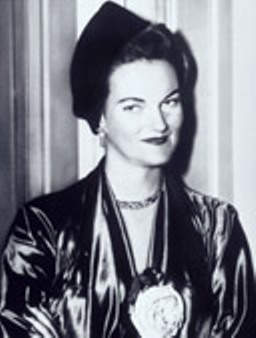
Doris Duke
James B. Duke's death in October 1925 devastates the young child
He fell ill with pneumonia during the winter of 1925, and died on October 10th of the same year. Doris, who was just 12 years old at that time, and very close to her father, was devastated by his sudden death. It is said that on his death bed James cautioned her to "trust no one," a piece of fatherly advice that kept resonating in her mind, and which she seems to have followed throughout her life. Perhaps, it was this advice that made Doris who was just 14 years old, to sue her mother, to successfully prevent her from selling "Duke Farms" her father's estate in New Jersey.
The bulk of the Duke fortune is inherited by Doris Duke, making her one of the richest women in the world.
At the time of his death, James B. Duke left the bulk of his fortune to his 12-year old daughter, Doris Duke. He left only a modest trust fund to his wife Nanaline Duke, which subsequently caused strains in their relationship. A substantial part of the fortune was also left for the "Duke Endowment." In 1993 at the time of her death, 68 years after she first inherited her fortune, her legacy had grown to over a billion dollars.
Doris Duke was brought up at the town house in New York City, and spent her summer holidays at Rough Point
After the death of her father, Doris Duke was brought up in her father's New York City residence, at the corner of Fifth Avenue and 78th Street, which subsequently became the home of the New York University's Institute of Fine Arts. At New York she continued to receive private tutoring. Later Doris wanted to attend college to further her education, but her plans were vetoed by her mother, who instead opted to take her daughter on a tour of Europe, where Doris was presented as a debutante in London. Doris spent her summers at "Rough Point" and during this period struck up a close friendship with Aletta Morris, with whom she took part in many activities such as playing tennis and other games, going for outings, including lengthy visits to the private beach known as Bailey's Beach.
Doris Duke's marriage and around-the-world honeymoon tour that radically changed her perception of the world and induced a passion for collecting artworks from eastern cultures
In the year 1935, at the age of 22 years, Doris Duke stunned the entire world, when she married an aspiring politician, James Cromwell, who was 16 years her senior. Soon after the marriage the couple embarked on a round-the-world honeymoon tour that lasted more than two years. During this tour she visited countries in North Africa and Asia, such as Egypt, the Middle eastern countries, India, Singapore, Thailand, Indonesia, the Philippines, Hong Kong, China and Japan, for the first time. These travels afforded her the opportunity to explore cultures and lifestyles entirely different to those in which she had grown up. What she saw in these countries had a profound impact on her for the rest of her life, and induced in her an admiration for the cultures of Asia and the Islamic World, that led to a passion for collecting works of art from Southeast Asia and the Islamic World, which required perpetual traveling to these lands. During her honeymoon trip she initiated both her collections of art from Southeast Asia and the Islamic World, by making significant purchases. During this trip she also began collecting jewelry from these cultures, particularly from India, whose designs in jewelry crafting had heavily influenced western jewelry designs since ancient times.,
Doris Duke's Southeast Asian art collection
Even though Doris Duke might have made some purchases of Southeast Asian art objects during her 1935 honeymoon trip, such artworks became the major focus of her collection effort only after she visited Thailand in 1957, for the first time since her honeymoon trip in 1935. Over the next few years she initiated an ambitious project known as the "Thai Village Project" with a view of educating the American public about the immensely rich Southeast Asian art and culture. The project envisaged the re-creation and furnishing of a Thai village, complete with a replica of a pavilion from the temple compound of the Royal Palace in Bangkok, and was intended to be a gift to the people of Hawaii, complementing the already established home for her vast collection of Islamic Art at "Shangri La" also in Hawaii. In order to actualize her dream concept, Doris Duke, in her characteristic passionate way began assembling works of art from Thailand, Burma, Cambodia and China. She succeeded in putting together a collection of over 2,000 works of art from Southeast Asia, that included sculptures, paintings, decorative arts etc. Some of the art objects in the collection, include tall elaborately carved pulpits from which Buddhist priests preach "bana" on the life of the Buddha and virtues of Buddhism; folded Buddhist manuscripts and their decorated storage boxes; tall cabinets used for manuscript storage; offering vessels inlaid with mother-of-pearl, "bencharong ceramics" made in China; carved ivory objects; and weapons. Unfortunately, her dream concept of the "Thai Village" never took off the ground, due to obstacles faced in securing an appropriate site for the project in Hawaii. Thus the entire collection of Southeast Asian artworks was kept in storage at her New Jersey estate, and remained so until her death in 1993. The Doris Duke Charitable Foundation which took over the management and control of all her assets after her death, decided to donate most of the Southeast Asian art objects to the Asian Art Museum of San Francisco and the Walters Art Museum of Baltimore, in order to honor Doris Duke's intention of educating the American public about Southeast Asian art and culture.
Doris Duke's Islamic Art Collection
Doris Duke was an avid collector who amassed an extraordinary collection of art objects from the Islamic world and Southeast Asia, and also an array of magnificent jewelry, fine and rare wines and French and English furniture. But her primary interest appears to have been the collection of Islamic art, for which she developed a special fascination, beginning from her honeymoon trip in 1935, and devoting a lifetime of around 60 years, putting together one of the most comprehensive collections of Islamic art in America, and perhaps the entire world. Her deep fascination for Islamic art was clearly demonstrated, when she began the construction of "Shangri La" her lavish new home, in Honululu, Hawaii, in 1937, whose construction was personally supervised by her, and into which she incorporated features of Islamic architecture, eventually converting it into a home not only for herself, but her enormous and cherished collection of 3,500 objects of Islamic art, as well as pre-Islamic art from Islamic countries, dating from 1,500 BC to the 20th century AD.
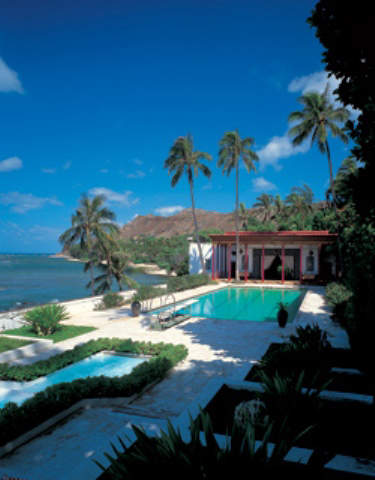
Playhouse at Shangri-La, holding works of art from Qajar dynasty Iran
© Doris Duke Foundation of Islamic Art.
Her lifetime interest in Islamic Art, took her to many Islamic countries in the Middle East and Asia, such as Morocco, Egypt, Lebanon, Syria, Iraq, Iran, Turkey, Uzbekistan, Pakistan and India. During these travels while purchasing Islamic artifacts, she also commissioned art from contemporary Muslim artists. She developed a special interest for the decorative arts of the 17th to 19th centuries, especially from the Ottoman and Mughal empires and Safavid and Qajar dynasties of the Persian empire. She personally participated in the design and installation of the art objects. Many objects were integrated into the structure of the house itself, such as ceilings, doorways, decorative elements such as ceramic tiles, lighting and furniture. The collections include both religious works of art, as well as ones made for everyday life, originating from different lifestyles, such as the royal court, city, village and nomadic life. The artworks executed in a great variety of media, such as wood, paper, enamel, glass, stone, ceramic, metal and fiber, is juxtaposed in nearly every room. Out of this, ceramic works of art constitute about one-fifth of the collection. Her intention to make her collection as comprehensive as possible, led to the acquisition of lesser known arts too, such as furniture, doors and hybrid works of art that blend Islamic and other artistic traditions.
Shangri La, the Honolulu home of Doris Duke, that houses her extensive collection of Islamic art, is presently owned and supported by the Doris Duke Foundation for Islamic Art (DDFIA), one of the three operating foundations supported by the Doris Duke Charitable Foundation (DDCF), and was created by her to promote the study and understanding of Islamic art and culture. Shangri La has been open to the public since 2002.
Doris Duke built bridges with a great civilization, and as a result she is considered to be ahead of her times
Doris Dukes collection was motivated by the fascination for the culture and life of peoples in the Islamic world, and in this respect she is considered to be ahead of her times, for she had been building bridges with a great civilization, knowingly or unknowingly, which was largely alien for a majority in the western world. Her untiring efforts during her life time to consolidate these bridges through the medium of art, has a new found relevancy in modern times, especially after the conflict of the two civilizations, and an urgency felt by many people in the western world to understand Islam, and the deep-rooted culture and way of life of its adherents.
Duke divorces James Cromwell after 8 years of marriage
After marrying James Cromwell, Duke supported his political ambitions, and also campaigned for him, but their marriage soon began to unravel. Eventually when Cromwell was appointed as Ambassador to Canada in 1940, Duke withdrew to Hawaii, where she could spend a free and anonymous life. The couple eventually divorced in 1943, after 8 years of marriage. The marriage produced a daughter, Arden, who was born prematurely and lived only for one day. Duke was devastated when doctors informed her that she will not be able to conceive again.
Her short career in journalism, and marriage to the Dominican playboy Porfirio Rubirosa
In 1945, Duke began a career in journalism, serving as a foreign correspondent for the International News Service, and reporting from various cities in war-torn Europe. After the end of World War II, she based herself in Paris, where she continued her career in journalism, working for the newspaper "Harpers Bazaar." It was while living in Paris she contracted her second marriage, after meeting and falling in love with the Dominican playboy, Porfirio Rubirosa. However, the United States Government taking into consideration her enormous wealth, warned Doris Duke, and drew up the pre-nuptial agreement. The union however, lasted only one year, after which Doris Duke did not get married again.
Doris Dukes other interests in life apart from world travel and collection of artworks and other items
Apart from extensive world travel and the collection of artworks, jewelry, furniture and wines, Doris Duke pursued a variety of other interests in life. such as historic preservation, environmental conservation, wildlife and horticulture. In 1968, she created the Newport Restoration Foundation, whose main objective was the restoration and preservation of more than 80 colonial buildings in the town, which also included her own summer house at Rough Point. Other historic properties that were included in the program were, Samuel Whitehorne House, Prescott Farm, the Buloid Perry House, the King's Arms Tavern, the Baptist Meetinghouse, and the Cotton House. After restoration most of the buildings were rented out to tenants, and five were converted to Museums.
Her interest in horticulture led to a friendship with Louis Bromfield, the Pulitzer Prize winning author and renowned scientific farmer, who owned Malabar Farm, his country home in Lucas, Ohio. After Bromfield's death she donated funds that enabled the State Government purchase Malabar Farm, and incorporate it into the Malabar Farm State Park. In 1958, she created the Duke Gardens Foundation, in order to endow the 60,000 square-foot (5,600 m²) public-display gardens she began to create at Duke Farms in New Jersey. The public-display gardens, inspired by DuPont's Longwood Gardens, consisted of eleven interconnected gardens. Doris Duke herself designed the architectural, artistic and botanical elements of the displays, based on observations and first hand experience, derived from her extensive worldwide travels. She also worked on the installation of the displays, supervising and giving instructions to the gardeners, sometimes working almost 16 hours a day.
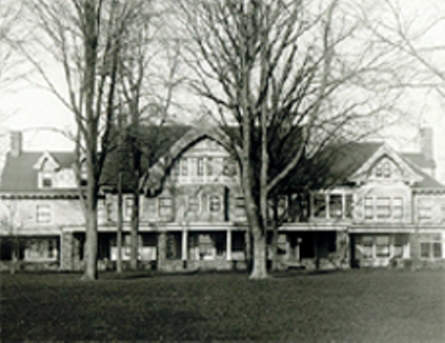
Country Manor, Duke Farms, 1910.
Doris Duke purchases a Boeing-737 jet to shuttle between her residences
Doris Duke had a permanent staff of over 200 workers, who managed her finances, looked after her and her five residences. Her principal residence was at Duke Farms, the 2,700 acre estate at Hillsborough, New Jersey. Her other residences included, a house at 78th Street New York, which in 1958 was donated to the Institute of Fine Arts of the New York University, a penthouse at Park Avenue, New York, a hillside mansion known as "Falcon's Lair" at Beverley Hills, California, once the home of Rudolph Valentino, her summer residence at Rough Point, Newport, Rhode Island, and her winter residence "Shangri La" at Honolulu, Hawaii. She purchased a Boeing-737 jet, and re-decorated its interior, and used it for her travels between her far flung homes, and also on her frequent international trips to collect artworks, and plants for her gardens.
Doris Duke's Summer Residence at Rough Point, Newport, Rhode Island.
Doris Duke's final years and her death at Beverley Hills, California, on October 28, 1993
Doris Duke first became ill in the winter of 1990, while at Shangri La, her winter home, at Honolulu, Hawaii. She then had a fall that broke her hip, and made her unconscious. After recovering from this accident, she left for Beverley Hills, with her butler Lafferty, where she sank into deep depression. In 1992, at the age of 79, she was encouraged by Lafferty, to have a series of operations, that included a face lift and knee-replacement surgery. The facelift operation was successful. but the first knee-replacement surgery was unsuccessful, leaving duke confined to a wheel chair. She was hospitalized from February 2 to April 15, 1993 for her first surgery. In July of the same year she underwent a second knee surgery and was hospitalized till October 27, 1993. Finally, just a day after she returned home from her second surgery, she suffered a stroke and died at home in Beverley Hills, on October 28, 1993, at the age of 80 years. According to her last will, her body was cremated 24 hours after her death, and her ashes scattered over the Pacific Ocean. A small container of her ashes was sent to Marshfield, Missouri, a town she came to admire during her lifetime. Her ashes were buried in a local cemetery, and a stone slab placed to honor her memory.
Doris Duke leaves virtually all her estate worth $1.3 billion to the Doris Duke Charitable Foundation, that supports medical research, environmental conservation, performing arts and prevention of cruelty to children and animals.
At the time of her death, Doris Duke's estate was estimated to be worth around $1.3 billion. In her final will she left almost all of her fortune to several existing and new charitable foundations, and appointed her Irish-born butler Bernard Lafferty as executor. Then followed a series of law suits that lasted three years, by Doris Duke's lawyers, and other interested parties, accusing Lafferty of misusing the estate funds to support his own life style, and challenging his suitability to administer such an important charity. Finally, Lafferty was removed as executor of the estate by a New York court, which appointed new competent trustees, who control all assets of the Doris Duke Charitable Foundation. In accordance with her will the DDCF supports medical research, anti-vivisectionism, prevention of cruelty to children and animals, performance arts, wildlife and ecology. The DDCF also controls funding for three foundations created by Doris Duke to administer her three former homes :- 1) The Doris Duke Foundation for Islamic Art, that administers her Shangri La home in Honolulu, housing her valuable Islamic art collection. 2) The Newport Restoration Foundation, that administers her former summer residence at Rough Point, Newport, and also other colonial buildings in Newport. 3) The Duke Farms Foundation, which administers the 2,700 acre Duke Farms estate in Hillsborough, New Jersey.
You are welcome to discuss this post/related topics with Dr Shihaan and other experts from around the world in our FORUMS (forums.internetstones.com)
External Links :-
1) Doris Duke Charitable Foundation - www.ddcf.org
References :-
1) Doris Duke - From Wikipedia, the free encyclopedia
2) Doris Duke Biography - www.biography.com
3) Doris Duke Charitable Foundation - www.ddcf.org
4) Shangri La - Doris Duke Foundation for Islamic Art - www.artstor.org
5) About the Shangri La collection - www.shangrilahawaii.org
6) The Doris Duke Collection - www.christies.com
7) Gems From The East And West - The Doris Duke Jewelry Collection, Janet Zapata, Ulysses Dietz, Zette Emmons. Published by Doris Duke Charitable Foundation. 650, Fifth Avenue, 19th floor, New York.
 Home
Security & Guarantee
How it Works
Technology Partners
Updated Tables
Famous Diamonds
More Famous Diamonds
Famous Pearls
Famous Gemstones
Contact Dr Shihaan Larif
Contact Senior Editor
Famous Jewelry
Reference Database
Forums
Learning Center
Gemstone Gallery
e-mail Notifications
Advertise
Press Release
About Us
Privacy Policy
Contact Us
FAQ'S
Site Map
Staff Mail Login
Staff Documents
Birthstones
History
Minerals
Shows
Live Metal Prices
Jewellery Gallery
News
Marketplace
Marketplace Support
Open Store
Online Auctions
Join Us & Contribute
Directory
Classifieds
List your products
Wholesale Trading
Post Buy Request
Go Green Policy
Site Updates
Upcoming-ToDo List
Latest News
Latest Articles
Latest Blog Updates
Chat Rooms
Job Board
User Gallery
Videos
New Newsletter Archive
Old Newsletter Archive
Jewelry & Mineral Blog
User Blogs & Social Network
Search
Answers (Q & A)
Valuation
Help me find a diamond/jewelry
pin.internetstones.com- Social Pinboard- Sart yours & connect with millions
Invite Friends From Yahoo, Gmail etc-One Click
Home
Security & Guarantee
How it Works
Technology Partners
Updated Tables
Famous Diamonds
More Famous Diamonds
Famous Pearls
Famous Gemstones
Contact Dr Shihaan Larif
Contact Senior Editor
Famous Jewelry
Reference Database
Forums
Learning Center
Gemstone Gallery
e-mail Notifications
Advertise
Press Release
About Us
Privacy Policy
Contact Us
FAQ'S
Site Map
Staff Mail Login
Staff Documents
Birthstones
History
Minerals
Shows
Live Metal Prices
Jewellery Gallery
News
Marketplace
Marketplace Support
Open Store
Online Auctions
Join Us & Contribute
Directory
Classifieds
List your products
Wholesale Trading
Post Buy Request
Go Green Policy
Site Updates
Upcoming-ToDo List
Latest News
Latest Articles
Latest Blog Updates
Chat Rooms
Job Board
User Gallery
Videos
New Newsletter Archive
Old Newsletter Archive
Jewelry & Mineral Blog
User Blogs & Social Network
Search
Answers (Q & A)
Valuation
Help me find a diamond/jewelry
pin.internetstones.com- Social Pinboard- Sart yours & connect with millions
Invite Friends From Yahoo, Gmail etc-One Click




Our Global Jewelry Industry Job Network


Buy & Sell in our Marketplace

Subscribe to our Newsletter

List in our Classifieds

List in our Directory

User Uploaded Gallery

Powered by Ultra Secure
Amazon (USA) Cloud Network

Founder Internet Stones.COM
Register in our Forums

| Featured In
|
|
|
|
|
|
|
|







Blog & Education Feed
Articles Feed
 |
 |
 |

Copyright © .Internet Stones.COM. All rights reserved.