Earth Star Diamond
Open FREE Unlimited Store Join Our Newsletter
Origin of name
The name of the diamond seems to have been inspired by two of the unique characters of the stone, viz. the strong brown color, and its extraordinary brilliance, which led the owner of the diamond, Mr. Joseph Baumgold, of New York, to name it the "Earth Star".

Characteristics of the diamond
The "Earth Star" is a 111.59-carat, pear-shaped diamond with a strong brown color and extraordinary brilliance, The exact color grade of the diamond is not known, but under the Argyle color grading scale for brown diamonds, going by the description of the diamond, it may fall under dark brown, which is equivalent to fancy cognac and C7 color grade.
Argyle color grading for brown diamonds
Color |
Argyle Term | Argyle Color Grade |
| Very light brown | light champagne | C1 - C2 |
| Medium brown | medium champagne | C3- C4 |
| Brown | dark champagne | C5-C6 |
| Dark brown | fancy cognac | C7 |
According to the list of known famous brown diamonds in the world, given below, the "Earth Star" diamond is perhaps the 3rd largest brown diamond in the world today.
List of famous brown diamonds
S/N |
Name | Carat Weight | Shape/Cut | color |
| 1 | Golden Jubilee | 545.67 | cushion | fancy yellow brown |
| 2 | Star of the South | 128.48 | cushion | fancy light pinkish brown |
| 3 | Earth Star | 111.59 | pear | brown |
| 4 | Cross of Asia | 109.26 | radiant | light brown |
| 5 | Great Chrysanthemum | 104.16 | pear | fancy brown |
| 6 | Ashberg diamond | 102.48 | cushion | amber |
| 7 | Golden Maharajah | 65.57 | pear | fancy dark orange brown |
| 8 | Kimberley | 55.09 | emerald | light brown |
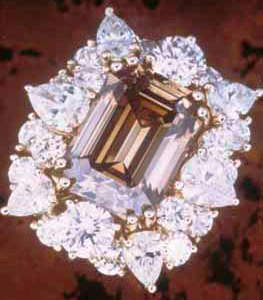
A dark coloured champagne emerald cut jewel contrasted with white diamonds.
©Argyle Diamonds
The "Earth Star" diamond being a brown diamond, is most probably a Type IIa diamond, which is nitrogen-free and in which the brown color is caused by plastic deformation of the crystal structure, which alters the absorption spectrum of the stone. Such diamonds have a highly strained character, as observed under crossed polarizing filters. Most of the Argyle brown diamonds are Type Ia diamonds, because apart from the plastic deformation, these diamonds also contain detectable quantities of Nitrogen, which vary from 100 to 500 ppm.
Type I diamonds contain detectable quantities of nitrogen and Type II diamonds are nitrogen free or contain undetectable quantities of nitrogen.
History
The diamond was discovered on May 16, 1967, at the Jagersfontein mine in Orange Free State, South Africa. The Jagersfontein mine was a diamond pipe mine opened in 1888, after the accidental discovery of a 50-carat diamond on a farm in the area in 1870. The mine was owned and operated by the New Jagersfontein Mining and Exploration Company Limited, formed in 1887,
but subsequently came under the ownership of De Beers Consolidated Mines Ltd. The Jagersfontein mine was the source of the world's second and ninth largest gem-quality rough diamonds, the Excelsior of 995 carats discovered in 1893, and the Reitz of 650 carats discovered in 1895. The Reitz was subsequently cut into a cushion-cut brilliant of 245 carats in 1887, the year of Queen Victoria's Diamond Jubilee, and was named the "Jubilee Diamond", to commemorate this occasion. The Jagersfontein mine was in operation from 1888 to 1970, except during the period of the "Great Depression" and world war II, when it was temporarily closed.
In the rough state the "Earth Star" weighed 248.9 carats. The diamond had gone through the entire recovery process until it appeared on the grease tables of the recovery plant. The discovery of this unique stone, was quite a surprise for the miners, as well as the people in the diamond industry, because Jagersfontein had been a source of numerous fine diamonds, and only a few of them had been brown. In almost 80 years of it's existence, this was the first time, that a large stone of this color was produced. Besides, this specimen came from 2,500 feet below the surface, which was exceptionally deep, for a gem of this size to be found. The diamond was purchased by Mr. Joseph Baumgold of Baumgold Brothers of New York, who named the diamond the "Earth Star."
The "Earth Star" diamond was taken to South Africa in 1971, to be displayed at an exhibition, held to mark the centenary of the discovery of the Kimberley mine.
Today the main source of brown diamonds in the world are the Argyle diamond mines of Western Australia. In fact out of all the gem-quality rough diamonds produced in the Argyle mines, almost 80 % are brown diamonds. These diamonds are processed in the diamond cutting centers of India, and marketed as champagne and cognac diamonds. Jewelry set with these brown diamonds are becoming very popular, and has ensured the economic viability of the Argyle mines.
Last transaction and present owners of the diamond
In the year 1983, the Earth Star was purchased by Mr. Stephen Zbova of Naples, Florida, for a sum of $ 900,000.
We do not have a photograph of the earth star diamond.Please let us know if you have one. Alternatively you may upload it to our forums.
You are welcome to discuss this post/related topics with Dr Shihaan and other experts from around the world in our FORUMS (forums.internetstones.com)
 Home
Security & Guarantee
How it Works
Technology Partners
Updated Tables
Famous Diamonds
More Famous Diamonds
Famous Pearls
Famous Gemstones
Contact Dr Shihaan Larif
Contact Senior Editor
Famous Jewelry
Reference Database
Forums
Learning Center
Gemstone Gallery
e-mail Notifications
Advertise
Press Release
About Us
Privacy Policy
Contact Us
FAQ'S
Site Map
Staff Mail Login
Staff Documents
Birthstones
History
Minerals
Shows
Live Metal Prices
Jewellery Gallery
News
Marketplace
Marketplace Support
Open Store
Online Auctions
Join Us & Contribute
Directory
Classifieds
List your products
Wholesale Trading
Post Buy Request
Go Green Policy
Site Updates
Upcoming-ToDo List
Latest News
Latest Articles
Latest Blog Updates
Chat Rooms
Job Board
User Gallery
Videos
New Newsletter Archive
Old Newsletter Archive
Jewelry & Mineral Blog
User Blogs & Social Network
Search
Answers (Q & A)
Valuation
Help me find a diamond/jewelry
pin.internetstones.com- Social Pinboard- Sart yours & connect with millions
Invite Friends From Yahoo, Gmail etc-One Click
Home
Security & Guarantee
How it Works
Technology Partners
Updated Tables
Famous Diamonds
More Famous Diamonds
Famous Pearls
Famous Gemstones
Contact Dr Shihaan Larif
Contact Senior Editor
Famous Jewelry
Reference Database
Forums
Learning Center
Gemstone Gallery
e-mail Notifications
Advertise
Press Release
About Us
Privacy Policy
Contact Us
FAQ'S
Site Map
Staff Mail Login
Staff Documents
Birthstones
History
Minerals
Shows
Live Metal Prices
Jewellery Gallery
News
Marketplace
Marketplace Support
Open Store
Online Auctions
Join Us & Contribute
Directory
Classifieds
List your products
Wholesale Trading
Post Buy Request
Go Green Policy
Site Updates
Upcoming-ToDo List
Latest News
Latest Articles
Latest Blog Updates
Chat Rooms
Job Board
User Gallery
Videos
New Newsletter Archive
Old Newsletter Archive
Jewelry & Mineral Blog
User Blogs & Social Network
Search
Answers (Q & A)
Valuation
Help me find a diamond/jewelry
pin.internetstones.com- Social Pinboard- Sart yours & connect with millions
Invite Friends From Yahoo, Gmail etc-One Click




Our Global Jewelry Industry Job Network


Buy & Sell in our Marketplace

Subscribe to our Newsletter

List in our Classifieds

List in our Directory

User Uploaded Gallery

Powered by Ultra Secure
Amazon (USA) Cloud Network

Founder Internet Stones.COM
Register in our Forums

| Featured In
|
|
|
|
|
|
|
|







Blog & Education Feed
Articles Feed
 |
 |
 |

Copyright © .Internet Stones.COM. All rights reserved.