Ella Gafter's Butterfly Corsage Pin
Open FREE Unlimited Store Join Our Newsletter
Origin of Name :-
A corsage pin is a piece of jewelry designed in the form of a spray of flowers, that is normally worn pinned to a woman's clothes. Apart from flowers the corsage pin in this case also contains a butterfly incorporated into the design and hence the name "butterfly corsage pin." The corsage pin made of platinum and white gold, and studded with cultured South Sea pearls, yellow sapphires, frosted crystals and diamonds was designed by none other than the famous American jewelry designer of Polish origin, Ella Gafter, of Ellagems, New York, who is also popularly referred to as "The Pearl Queen." Thus the name of the piece of jewelry reflects both the type of jewelry as well as the name of its designer. In the designing of this floral and foliage brooch, Ella Gafter has drawn inspiration from a recurrent historic theme of using plant and animal motifs in jewelry designs, starting with the ancient Egyptians and Greeks, and reaching a climax during the Art Nouveau period at the end of the 19th century and continuing well into the 20th century.

Characteristics of the corsage pin
The framework of the corsage pin is made up of platinum and white gold. The floral and foliage motif on the corsage, consists of five open flowers placed alternatively on the axis. Apart from the open flowers there are also leaves, flower buds and fruits associated with it. The leaves are made up of frosted glass. On the top left of this flower and leaf motif is a single butterfly perched on a leaf on the left side of the axis, from which the corsage gets its name. The head and pair of rear wings of the butterfly are studded with diamonds. The thorax of the butterfly is set with a yellow sapphire, and the abdomen is represented by a single large, spherical, cultured, South Sea pearl, with a diameter of 15.5 mm. The front pair of wings of the butterfly is made up of frosted glass. The butterfly is set on watch springs, causing it to quiver slightly, a technique known as en-tremblant, which Gafter uses in many of her more whimsical pieces. The center of each of the open flowers is also occupied by a single large, spherical, cultured, South Sea pearl. The petals of the open flowers are encrusted with diamonds. Likewise some of the leaves and buds are also encrusted with diamonds. Four large spherical cultured pearls attached separately to the corsage toward the lower end appear to represent fruits. Altogether there are 10 lustrous South Sea pearls on the corsage, and 8.38 carats of diamonds.
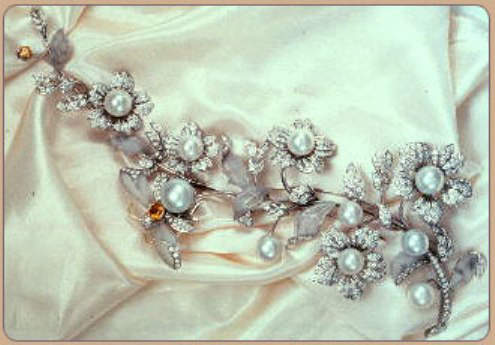
Ella Gafter's Butterfly Corsage Pin
© Ellagem
History of the corsage pin
The source of the pearls
The source of the cultured South Sea pearls in the corsage pin is none other than the pearl farms along the coastline of northern and western Australia, belonging to Paspaley Pearls Pty. Ltd. the world's largest producer of high quality South Sea Pearls. Australia is the world's largest producer of South Sea pearls whose annual turn out is valued at over US$ 200 million, of which the production of Paspaley Pearls Pty. Ltd. account for over 50%. Ella Gafter has established a close working relationship with Nick Paspaley, the chairman of the company, and most of her pearl jewelry incorporates South Sea pearls originating from this company. Paspaley Pearls Pty. Ltd. are the pioneers of cultured South Sea pearls in Australia, and are based in Darwin, Northern Australia. The company manages 20 pearl farms situated along a 2,500 km stretch of coastline in northern and western Australia, in the pollutant-free waters of isolated bays.
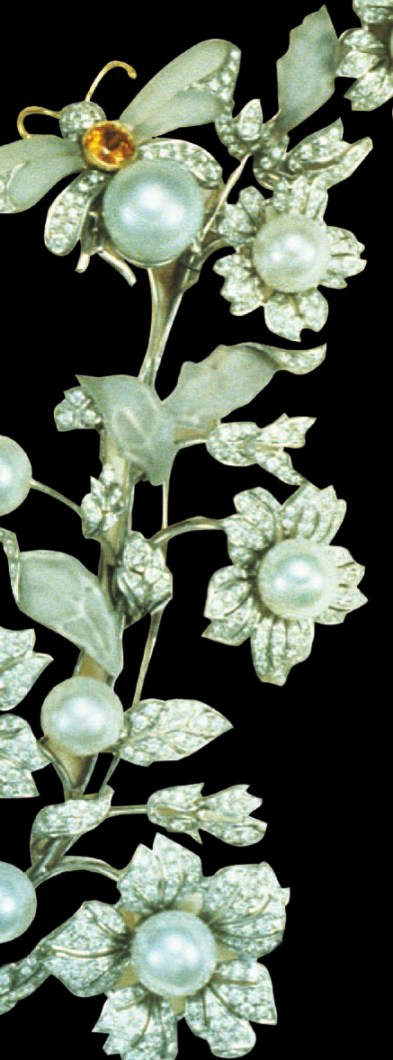
Close up view of the Ella Gafter's Butterfly Corsage Pin
© AMNH
The species of oyster that produces South Sea pearls
The species of oyster that produces South Sea pearls is Pinctada maxima, a bivalve mollusk that belongs to the family Pteriidae. Pinctada maxima is the largest naturally occurring pearl oyster in the world, growing to a maximum size of 30 cm in diameter. Pinctada maxima is also the largest commercially harvested cultured pearl oyster in the world, producing the largest cultured pearls in the world, ranging in size from 9 to 20 mm, with an average size of around 13 mm. Some of the factors that have been associated with the growth of such large pearls are the large size of the oyster with a correspondingly larger gonad, where the bead is usually implanted; the large size of the implanted bead; the conducive environment in which the oyster grows and the long growth period of the oyster. The oyster's large size enables the acceptance of a larger bead, leading to the growth of a larger pearl. The presence of the larger gonad, where the bead is usually implanted, enables faster deposition of nacre around the nucleus, in the warm conditions of the South Sea, that increases the metabolism of the oyster. Besides this a minimum of two years is given for the growth of the cultured pearl, before it is harvested, which allows the pearls to grow to a much larger size with a thick nacre.
There are two varieties of Pinctada maxima that produce pearls. These are 1) The silver-lipped pearl oyster and 2) The gold-lipped pearl oyster. The two varieties are distinguished by the distinct coloration of the outer edge of the mantle. While the silver-lipped pearl oyster generally produces silver colored pearls, the gold-lipped pearl oyster produces golden colored pearls.
The natural habitat of the South Sea pearl oyster, Pinctada maxima
The South Sea connects the Indian Ocean to the Pacific Ocean, and lies between the southern coast of China, and the northern coast of Australia. Malaysia, the Indonesian archipelago, Philippines and Papua New Guinea lie within this sea. The South Sea is the natural home of the pearl oyster species Pinctada maxima, around which a major cultured pearl industry has developed in many countries with a coastline on the South Sea, based on the successful cultured pearl industry developed in Australia centered around this species. Some of the other countries that have successfully developed a cultured pearl industry based on Pinctada maxima, apart from Australia, are Myanmar, Philippines, Indonesia, Malaysia, Thailand, Fiji and Tahiti.
The environmental conditions of the South Sea are very conducive to the successful growth and multiplication of the Pinctada maxima pearl oyster, as well as the rapid deposition of nacre during the growth of the pearl. Some of these conditions are :- 1) the clean unpolluted waters of the sea 2) the abundant availability of plankton, the favorite food source of Pinctada maxima 3) the warm waters of the sea which enhances metabolism and the speed of nacre formation. Some of the characteristics of pearls produced by Pinctada maxima are :- 1) large size ranging from 9 to 20 mm 2) thick nacre varying from 2 to 6 mm 3) unique satin-like luster 4) subtle array of colors such as white, cream, pink, silver and gold.
The location of the natural habitats of South Sea pearl oysters in Australia
In Australia the natural habitat of South Sea pearl oysters are the oyster beds located off the coast of Western Australia, the Northern Territory and Queensland. In Western Australia these oyster beds are found from Exmouth Gulf in the south to the Lacepede Islands in the north, including the renowned oyster beds off the "Eighty Mile Beach," situated almost halfway between the towns of Broome and Port Hedland. In the Northern Territory of Australia the oyster beds are situated along the Arnhem land coast in the northeast of the territory, between Golburn and Crocodile Islands. In Queensland the oyster beds are situated west of Badu Island, in the Torres Strait.
The success story of Paspaley Pearls Pty. Ltd.
Nicholas Paspaley Senior pioneers the production of cultured South Sea pearls in Australia with Japanese collaboration, but the results are not encouraging
After the final collapse of the mother-of-pearl industry in Australia in the mid-1950s following the worldwide popularization of plastic buttons, Nicholas Paspaley Senior had nurtured a dream of restoring the pearl industry in Australia to its former glory, not based on mother-of-pearls, but on cultured pearls, based on the success achieved by the Japanese with Akoya pearls which had gained worldwide popularity. To realize his dream he first went into partnership with a Japanese entrepreneur Mr. Kuribavashi in 1956, and set up the first cultured pearl farm in Australia in Kuri Bay, 420 km north of Broome. A team of Japanese pearl culturists who were employed in the project applied culturing techniques perfected by Mikimoto for Akoya pearls in Japan, for the culturing of South Sea pearls using the pearl oyster Pinctada maxima. However, the results were disappointing due to the high mortality of the seeded oysters. Another pearl farm started in 1963 in collaboration with another Japanese company, at Port Essington, East of Darwin, also suffered the same fate.
Nicholas Paspaley and his team of scientists discover the causes of the high mortality of seeded oysters
Undeterred by the disappointing results, Nicholas Paspaley Senior, together with his son Nicholas Paspaley Junior and their team of technicians and scientists, embarked on a extensive research program, to identify the causes that led to the high mortality, and to find out ways and means of reducing such mortality. The team of scientists discovered that techniques borrowed from Japan, did not suit the conditions in Australia, and had an adverse effect on the sensitive natural-bred Pinctada maxima pearl oysters. Pinctada maxima was found to be very sensitive to stressful conditions, such as pollutants, environmental changes, transfer from natural to farm environment, being out of water for long periods of time etc.
Steps taken by the Paspaley team to minimize the effect of stressful conditions on the pearl oysters
To minimize the effect of of such stresses the Paspaley team adopted the following measures :- 1) Creation of "nurseries" or "dump sites" closer to the natural oyster beds after the wild oysters were harvested, cleaned and placed in net panels of 6 or 8 shells in each. 2) Carrying out seeding operations right at the nurseries, on floating laboratories under sterile conditions, in pearling ships and transferring the seeded oysters in net panels back to the nurseries or dump site where they are left for three months before transferring to pearls farms closer to the shoreline. 3) Oysters taken aboard the ship from nurseries are kept alive by constantly circulating sea water until the seeding operation is carried out. 4) The environmental conditions of pearl farm growout sites where husbandry process takes place are maintained as far as possible closer to the conditions obtaining in the natural environment of the oyster beds. 5) Maintaining the health conditions of the seeded oysters at optimum level, by regular cleaning of implanted shells, every 2-4 weeks, manually or mechanically using high pressure cleaning machines, throughout the two year culture period, to remove marine growth on the shells that can harbor parasites and diseases.
Nicholas Paspaley Senior realizes his vision for his company and his adopted country Australia
After the adoption of the above measures the results achieved by the Paspaley team was dramatic, with a high survival rate, producing bigger and more luxurious pearls. Today Paspaley Pearls Pty. Ltd. has become the undisputed leader in the production of cultured South Sea pearls, and have set the standards for the culturing of these pearls, followed by other countries in the region with a coastline in the South Sea, such as Indonesia, Malaysia, Philippines, Thailand, Myanmar etc. The company's 20 pearl farms are situated along a wide expanse of coastline 2,500 km long in northern and western Australia, some of which are accessed by light aircraft maintained by the company, that are used for movement of personnel and supplies on a daily basis. The company also maintains more than a dozen ships and smaller working craft, that are used at all stages of the pearl production cycle, such as fishing, seeding, transport, husbandry and harvesting, besides delivering supplies and engaged in maintenance. Before Nicholas Paspaley Senior died in 1984 at the age of 71, his vision for his company as well his adopted country Australia became a reality, when the pearl industry in Australia was restored to its former glory and the country as well as the company became the world's leading producers of cultured South Sea pearls.
Jewelry designs adopted by Ella Gafter for most of her designs
Her jewelry designs are based on naturalistic themes reminiscent of the Renaissance and Art Nouveau periods
The jewelry design adopted by Ella Gafter for the corsage pin is a naturalistic theme consisting of flowers and foliage, which was in keeping with the naturalistic theme she has adopted for most of her jewelry, since she started designing jewelry in Rome, after she learnt the art of jewelry designing, having migrated from Poland after World War II. Some of the naturalistic themes used in her jewelry designs include, flower and foliage motifs, flowers only motif, bouquet of flowers, basket of flowers, animal motifs such as parrots and other birds, turtles, octopus, insects such as butterflies etc. These motifs are reminiscent of the popular jewelry designs of the Renaissance and Art Nouveau periods. Hence the descriptive terms used for her jewelry, such as "formal, yet decadent," "whimsical jewelry," "outrageously decadent jewels" etc. all in reference to the ancient naturalistic themes in her jewelry, to which she has given a new life and meaning, using magnificent pearls, corals, diamonds, sapphires, rubies and emeralds.
Naturalistic themes are a recurrent theme in the history of jewelry designing from the time of the ancient Egyptians and Mesopotamians to the modern period
The use of naturalistic themes in jewelry designing seem to be as old as the first creation of jewelry by man. Some of the earliest naturalistic themes dating back from 3000 BC to 1000 BC, are seen in ancient Egyptian jewelry such as the scarab (beetle), falcon, serpent, the eye, lotus flower etc. Among jewelry from Mesopotamia dating back 3000 BC to 2000 BC, some of the themes include plant motifs such as leaves, spirals, bunches of grapes, and animal figures. Jewelry from the Minoan and Mycenaean civilizations dating back from 2700 BC to 1100 BC show animal motifs such as starfish and cuttlefish and insects such as butterflies and bees. Jewelry from classical Greece dating from 323 BC to 31 BC had motifs like flowers, rosettes, flower vases, cupids and doves. Stylized animal motifs were used during the Medieval period (10th-13th centuries), but the common themes of this period were crucifixes and other religious emblems.
Naturalistic themes reach a climax during the Renaissance period and the Art Nouveau period
During the Renaissance period (14th-17th centuries) religious symbols used in jewelry designing were replaced by classical and naturalistic themes. The use of plant and animal motifs in jewelry designing reached a climax during this period. During the Baroque period from the 1630s to 1680s, naturalistic floral styles predominated as a result of the Botanical mania in Europe, that led to the awareness and appreciation of natural flora. During the Georgian period from 1714 to 1830 common naturalistic themes included mosaics, wheat and plumage, floral designs with a single stem or bouquet of flowers, doves and the phoenix. The early Victorian period known as the Romantic period from 1837 to 1860 saw the revival of the naturalistic themes of the Renaissance period that included plant motifs such as flowers, bouquets of flowers, branches, leaves, grapes, and berries, and animal motifs such as snakes and serpents, love and song birds and insects. Some of the naturalistic themes used in the mid-Victorian period from 1860 to 1890, included birds, swans, bees and daisies, though the period was dominated by mourning jewelry with somber and austere motifs. During the late Victorian from 1890 to 1901, the Darwinian controversy and the new botanical discoveries once again popularized natural themes such as plant and animal motifs, and insect motifs such as butterflies, beetles and houseflies. This period corresponds with the Art Nouveau period that originated in France in 1890 and lasted until around 1915. The use of naturalistic themes reached a peak during this period and included insect motifs such as butterflies, bees and dragon flies, bird motifs such as peacocks and swans, and reptile motifs such as snakes and serpents. The plant motifs included undulating vines, leaves, ferns, and a variety of flowers such as orchids, irises, water lilies, poppies, ivy etc.
Ella Gafter's career as a jewelry designer
Her early childhood and circumstances that led to her migration to Rome where she was introduced to a career in jewelry designing
Ella Gafter who was born in Poland and spent her childhood in that country, still remembers vividly the dark period of Nazi occupation of Poland during World War II and the atrocities committed on the Jewish population. This frightening experience in her childhood had a deep psychological impact and created within her a yearning for, freedom from fear, peace and security, and expression of the good qualities of human nature such as artistic, literary and other forms of peaceful human endeavors. The quest for her yearnings brought her to the city of Rome, a historical city with deep-rooted artistic traditions, and the home to artists and craftsmen of different form of artistic expressions such as painting, sculpturing, jewelry designing etc. Ella Grafter had a natural inclination towards learning the crafts of jewelry designing and goldsmithing, and accordingly underwent training in these two fields. She was intelligent and hardworking and quickly learnt the intricacies of the craft, and soon began designing and creating her own jewelry.
The jewelry she created captures the attention of the Italian nobility
The extraordinary quality of the pieces she created captured everybody's attention, and particularly that of the Italian nobility, who collected her pieces, and made her a part of their exclusive aristocratic class. This was a major breakthrough for Ella Gafter that helped her in exposing her creations to an international clientele. Ella Gafter married a third-generation Italian jeweler who specialized in diamonds and with whom she shared a common passion for beautiful things in life and the creation of exquisite pieces of jewelry. The rare combination of her talent and her friendly disposition, endeared her to her customers, including Europe's most notable families, and helped her to develop important friendships with suppliers, such as the Paspaley pearling family in Australia.
Ella Gafter shifts the base of her operations to New York, and establishes Ellagem Inc.
From Rome she shifted the base of her operations to New York's Manhattan, still maintaining her workshops in Naples, Italy. In New York she founded Ellagem Inc. with its offices on the 31st floor of a building on the fifth avenue. She converted her office into an art deco and antique private viewing showroom, which resembled an art studio in Florence or Paris, and attracted many eminent clients who came to view her exquisite collection and make purchases. The walls of her office were adorned with enlarged pictures of her most exquisite creations, and the furniture included gilded Louis XIV chairs and an Italian marble table inlaid with colored flowers, silverware and crystal, for serving freshwater and champagne to all visiting clients. Among her eminent clientele were the European aristocracy, Hollywood superstars, top pop singers such as Michael Jackson, sports stars and other celebrities and members of the American high society.
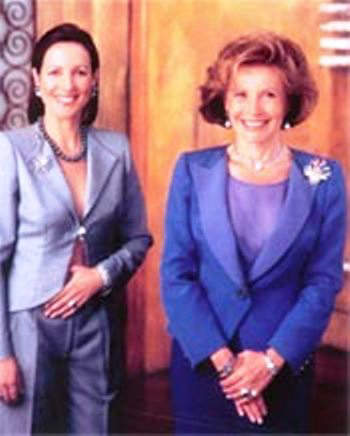
Talila (Left) and Ella Gafter of Ellagem Inc. NY
© Ellagem
Gemstones needed for her creations are chosen by herself during her trips around the world to the source of the gemstones
Ella Gafter has become one of the world's most acclaimed jewelry designers, who uses South Sea pearls as one of the principal components in her exquisitely designed pieces, combined with other gemstones such as brilliant-cut diamonds, emeralds, rubies and blue sapphires, set in gold and platinum. All her jewelry are masterpieces of exquisite handmade craftsmanship, turned out in her workshops in Naples, Italy, by a team of dedicated craftsmen, trained in jewelry crafting from childhood, and who had been serving her faithfully for more than 20 years. The gemstones used in her jewelry are of the highest quality which she herself chooses during her trips around the world to the source of the different gemstones needed for her creations. Thus, she goes to Australia where she picks the best South Sea pearls from the Paspaley's annual harvests, to Sri Lanka to select the best of the sparkling range of blue sapphires available, to Thailand, Vietnam and Myanmar looking for the flaming red rubies, to Japan for luminous Akoya pearls, and to South America and Africa for brilliant emeralds.
Ella Gafter's first trip to Australia where she meets Paspaley accidentally that leads to a long term working relationship
Most of the pearls used in Ella Gafter's creations are from Nick Paspaley's pearl farms scattered across the coastline of western and northern Australia. Ella Gafter has established a close friendship and working relationship with the Paspaley pearling family of Australia, the pioneers of the cultured South Sea pearl industry in that country. Normally anyone would assume that the friendship she had cultivated with the pearling family was as a result of routine business contacts between an internationally renowned supplier and an equally renowned consumer of pearls. However, the fact is far from this assumption. Ella Gafter first met Paspaley not in the course of a routine business transaction but accidentally while she was making a trip of a lifetime to Australia, when she arrived in the outskirts of Broome, where her car became stuck in the mud. Subsequently, she discovered that the area where her vehicle got stalled was actually a mud-soaked pearl farm belonging to Nick Paspaley. Being in the pearl business herself, and with an insatiable passion for these creations of nature Ella Gafter was fascinated with what she saw at the farm, an eventually purchased the entire crop of pearls from that farm. Since then she had been visiting Australia regularly every year after each harvest of pearls, to pick out the best pearls that would suit her creations. She would examine hundreds of pearls during these trips, but would only select a precious few that were worthy enough for her unique creations. In the year 2001, Ella Gafter and her daughter Talila, who is her business partner, visited Port Bremer, one of the remotest of Paspaley's twenty pearl farms on the Coburg Peninsula. With her usual friendly disposition Ella Gafter and her daughter were quick to make friends with the pearl farmers based in this remote area, and entertained them with her cooking skills, by preparing delicious pearl meat pasta and champagne-filled fruit salad.
Ella Gafter wins the Tahitian pearl trophy in 2002
Ella Gafter also used Tahitian black pearls in her creations. A series of her creations in 2002 consisted whimsical animal, bird and fish pins, in which the body was the pearl and the feathers, wings or fins were made of rock crystal, mother-of-pearl, rubies or black onyx. A necklace and earring ensemble which she created in 2002, consisted of entwined leaves of channel-set rubies and pave diamonds and drops of perfectly matched black Tahitian pearls. Her extraordinary skills in designing unique pieces of pearl jewelry received recognition in 2002, when she was awarded the special Arte Y Joya prize, at the first edition of the Tahitian Pearl Trophy.
Ella Gafter's extraordinary creative skills receive recognition by the American Museum of Natural History. The Butterfly Corsage Pin is selected as an exhibit for the traveling exhibition Pearls : A Natural History
In June 2001, Ella Gafter received her greatest recognition of her skills yet, when one of her contemporary pieces of pearl jewelry, the "Butterfly Corsage Pin" the subject of this webpage, was selected by the American Museum of Natural History, New York, to be displayed at its "Pearls : A Natural History" traveling exhibition organized in collaboration with the Field Museum of Chicago, which was first held in New York in October 2001 and later at the Chicago Field Museum in June 2002. Since then the exhibition had been hosted in several museums around the United States, and also in countries like Canada, France, Australia, Japan, and the United Arab Emirates. The exhibition featured more than 600 pearl exhibits that included a replica of the largest pearl ever discovered, the 14.5 pounds "Pearl of Islam", contemporary pearl jewelry, and historic pieces that had once been owned by renowned personalities and celebrities like Queen Victoria, Marie Antoinette, Audrey Hepburn, Marilyn Monroe and Elizabeth Taylor.
Ella Gafter created the "Butterfly Corsage Pin" in 1999, and since then kept it in her plush salon in New York's fifth avenue. She only brought out the pin occasionally, to impress and astound the private clients who make the pilgrimage to her salon, according to her daughter, Talila Gafter, who is a business partner in the Ellagem enterprise.
Ella Gafter goes into partnership with her daughter Talila Gafter
Ella Gafter has gone into partnership with her daughter Talila Gafter, who was born in Italy and educated in Switzerland, Rome and the United States. She has degrees in Law and Philosophy, and subsequently obtained a Ph.D. She speaks six different languages. She also obtained a business management qualification from Harvard, and contributes modern-day management skills to the company's flourishing business, and has achieved a major expansion of the brand's international presence. Together Ella Grafter and her daughter Talila Grafter have created a thriving business enterprise which has received international acclaim for its unique and magnificent jewelry creations. Talila lives in New York with her husband and three children.
You are welcome to discuss this post/related topics with Dr Shihaan and other experts from around the world in our FORUMS (forums.internetstones.com)
Related :-
2) Paspaley Drop-shaped Pearls
External Links :-
References :-
1) Ella Gafter : The Elegant Queen of Pearls. www.ellagafter.com
2) Ella Gafter, Pearl Queen - National Jeweler, Saturday, June 16, 2001.
3) Corsage pin with butterfly - Website of the American Museum of Natural History
 Home
Security & Guarantee
How it Works
Technology Partners
Updated Tables
Famous Diamonds
More Famous Diamonds
Famous Pearls
Famous Gemstones
Contact Dr Shihaan Larif
Contact Senior Editor
Famous Jewelry
Reference Database
Forums
Learning Center
Gemstone Gallery
e-mail Notifications
Advertise
Press Release
About Us
Privacy Policy
Contact Us
FAQ'S
Site Map
Staff Mail Login
Staff Documents
Birthstones
History
Minerals
Shows
Live Metal Prices
Jewellery Gallery
News
Marketplace
Marketplace Support
Open Store
Online Auctions
Join Us & Contribute
Directory
Classifieds
List your products
Wholesale Trading
Post Buy Request
Go Green Policy
Site Updates
Upcoming-ToDo List
Latest News
Latest Articles
Latest Blog Updates
Chat Rooms
Job Board
User Gallery
Videos
New Newsletter Archive
Old Newsletter Archive
Jewelry & Mineral Blog
User Blogs & Social Network
Search
Answers (Q & A)
Valuation
Help me find a diamond/jewelry
pin.internetstones.com- Social Pinboard- Sart yours & connect with millions
Invite Friends From Yahoo, Gmail etc-One Click
Home
Security & Guarantee
How it Works
Technology Partners
Updated Tables
Famous Diamonds
More Famous Diamonds
Famous Pearls
Famous Gemstones
Contact Dr Shihaan Larif
Contact Senior Editor
Famous Jewelry
Reference Database
Forums
Learning Center
Gemstone Gallery
e-mail Notifications
Advertise
Press Release
About Us
Privacy Policy
Contact Us
FAQ'S
Site Map
Staff Mail Login
Staff Documents
Birthstones
History
Minerals
Shows
Live Metal Prices
Jewellery Gallery
News
Marketplace
Marketplace Support
Open Store
Online Auctions
Join Us & Contribute
Directory
Classifieds
List your products
Wholesale Trading
Post Buy Request
Go Green Policy
Site Updates
Upcoming-ToDo List
Latest News
Latest Articles
Latest Blog Updates
Chat Rooms
Job Board
User Gallery
Videos
New Newsletter Archive
Old Newsletter Archive
Jewelry & Mineral Blog
User Blogs & Social Network
Search
Answers (Q & A)
Valuation
Help me find a diamond/jewelry
pin.internetstones.com- Social Pinboard- Sart yours & connect with millions
Invite Friends From Yahoo, Gmail etc-One Click




Our Global Jewelry Industry Job Network


Buy & Sell in our Marketplace

Subscribe to our Newsletter

List in our Classifieds

List in our Directory

User Uploaded Gallery

Powered by Ultra Secure
Amazon (USA) Cloud Network

Founder Internet Stones.COM
Register in our Forums

| Featured In
|
|
|
|
|
|
|
|







Blog & Education Feed
Articles Feed
 |
 |
 |

Copyright © .Internet Stones.COM. All rights reserved.