Emerald Man
Open FREE Unlimited Store Join Our Newsletter
Emerald Carving an Ancient Art of the Indians of Central and South America (Mesoamerica)
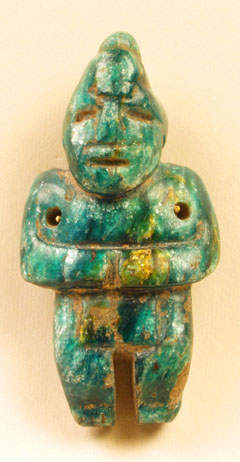
The "Emerald Man" is an artifact in the form of a small stone figurine, representing a male human figure, carved out of a single green emerald crystal, believed to be the oldest known Mesoamerican (middle American) emerald and the only known pre-Columbian carved emerald. The artifact is believed to date back from about 500 B.C. to 250 A. D. When the Spanish Conquistadors landed in Mexico and Peru, in the 16th century, they found the natives of these lands in possession of large and beautiful emeralds, some of which were cut with great skill into peculiar and characteristic forms. Five stones brought by Cortez to Europe were cut into the shapes of fantastic flowers, fishes and other natural objects. Thus, emerald carving seems to have been an ancient art prevalent in central and southern America since ancient times.

Besides being used as an ornamental stone, the emerald was also considered as a sacred stone by the ancient Indian tribes such as the Olmec, Inca, Aztec, Toltec, Maya, Chibcha, Muisca, etc. Emeralds were offered to their Gods and also buried with their dead. When the Conquistadors tried their best to locate the source of the emeralds in Peru and Mexico and failed, they desecrated the temples and grave yards of the Indian tribes and collected the emerald treasures, which they dispatched to Spain. Jose d'Costa reported that the ship by which he voyaged from Peru to Spain in 1587, carried two cases, each of which contained no less than a hundredweight of emeralds.
Today we know that the failure of the Spanish Conquistadors to discover the source of the emeralds in Peru and Mexico, was simply because there were no emerald mines in Peru and Mexico, and the emeralds used by the natives of these areas were actually brought in from elsewhere. This ancient source of emeralds were situated in the heartland of the Chibcha Indians at Somondoco (Chivor) and the Muzo Indians at Muzo. The emeralds that originated from these mines reached as far south as Bolivia, and as far north as Mexico by trade. The source of the ancient artifacts such as the emerald man which dates back to 500 BC to 250 AD, could also be one of the ancient mines in Colombia, such as the Chivor or Muzo mines.
©Hudson Museum, University of Maine
The Emerald Man
A description of the Emerald Man
The emerald figurine of the man seems to have been carved on a single elongated natural emerald crystal, with the characteristic emerald-green color but with many small areas of blackish-green and yellow mottling. The ancient lapidarists who created the masterpiece had used straight-cuts to fashion the figurine into the shape of a standing man. The man's hands are folded over his mid-section, somewhat similar to the standing posture of a modern-day Muslim devotee in prayer. The man seems to be wearing a short apron and also headgear. Two conical drill holes with a larger diameter in the front than on the reverse side, pass through the figurine under the armpits, and another drill hole passes from side to side through the head. This is obviously to enable the figurine to be suspended on a cord, perhaps to be worn or hung somewhere as an ornament. The dimensions of the figurine are height :- 5.63 cm, width :- 2.85 cm and thickness :- 1.37 cm. The weight of the figurine is 23.7g equivalent to 23.7 x 5 = 118.5 carats.
Characteristics of Natural Emeralds
Chemical Characteristics
1) Emeralds are beryls belonging to a subclass of minerals called cyclosilicates under a larger class of minerals called silicates, the most abundant class of minerals on the surface of the earth.
2) In cyclosilicates six tetrahedral silicate ions (SiO4)‾ are linked together forming a hexagonal ring, whose symmetry is reflected in the final crystal form, which is a hexagonal or bi-hexagonal crystal.
3) As six (SiO4)‾ ions link together one oxide ion is eliminated resulting in the structure [(SiO3)6]‾ . The 12 negative charges on the ring structure is balanced by 6 positive charges on 3 metal ions of Beryllium (Be2+) and 6 positive charges on 2 metal ions of Aluminum (Al3+), giving the formula Be3 Al2(SiO3)6 which is known as Beryllium Aluminum Silicate.
4) The deep-green color of the beryl emerald is caused by the displacement of some Al atoms in the crystal structure by chromium and/or vanadium atoms. When chromium predominates in the crystal, the color is deep herbal-green color, but if Vanadium predominates over chromium the color is bluish-green like the Brazilian and Zambian emeralds.
5) The presence of inclusions is a characteristic feature of most emeralds, and these inclusions referred to as "Jardin" may include cracks and fissures, besides actual foreign substances being incorporated in the crystal. The cracks and fissures were created during the turbulent genesis of the crystal, in hydrothermal veins, pegmatites, and at the contact zone of large igneous intrusions that invade aluminous schist, shale or impure limestone. The Colombian emeralds originating from the Muzo and Chivor mines have three-phase inclusions containing gas, fluids and crystals of halite. Other solid inclusions found are calcite, parisite, pyrite, and albite. Zimbabwean emeralds contain acicular tremolite as inclusions, and Zambian emeralds may contain tourmaline and biotite as inclusions.
6) The presence of flaws and inclusions was considered a hallmark of all natural emeralds, which were held in high esteem and value in spite of their inclusions. In fact the best emeralds were sometimes the most included. Even forms of treatment such as oil treatment with Canada balsam, and cedar wood oil or epoxy treatment, to cover cracks and fissures had been accepted by the trade, and special precautions had to be taken to clean jewelry set with emeralds.
7) The discovery of Zambian emeralds has re-defined the notion that the best emeralds are invariably included. Zambian emeralds have excellent color, clarity and transparency and are found in significant sizes. The clarity and transparency are directly related to the purity of the crystals. Flaws and inclusions generally found in emeralds from other sources are conspicuously absent or less in Zambian emeralds. Thus Zambian emeralds are harder and more workable than other emeralds and do not require any form of treatment.
8) The bluish-green color of Zambian emeralds is due to the predominance of vanadium over chromium as the color-causing agent (chromophore) in the crystal.
Physical and optical characteristics of emeralds
1) Emeralds crystallize in the hexagonal crystal system, forming well formed hexagonal or bi-hexagonal prisms, either short or elongated, with pinacoidal terminations.
2) The emeralds have a hardness of 7.5 to 8.0 in the mohs scale, but in spite of a significantly high hardness, the toughness of emerald is low, caused by the presence of flaws and inclusions. Thus emeralds are difficult to work with even for the most experienced cutter. The special cut known as the emerald-cut was developed as it reduces the mechanical strain placed on the crystal during the cutting and polishing process. Zambian emeralds with less or no inclusions are much tougher and easy to work with and are cut in a variety of different shapes, offering a wide range of choices to the consumers.
3) The specific gravity of emeralds is quite low varying between 2.67 and 2.78. and slightly differs from one source to another eg:- Muzo emeralds have a specific gravity of 2.71, Chivor emeralds 2.69, Zambian emeralds 2.75, Zimbabwe emeralds 2.75.
4) The refractive index of emeralds is also low varying between 1.565 and 1.599. The refractive index like the specific gravity also varies with the source. For Muzo emeralds R. I.e = 1.578 and R. I.o = 1.584, for Chivor emeralds R. I.e = 1.571 and R. I.o = 1.577, for Zambian emeralds R. I.e = 1.583 and R. I.o = 1.590, for Zimbabwe emeralds R. I.e = 1.586 and R. I.o = 1.593. (e = extraordinary ray, o = ordinary ray).
5) Birefringence of emeralds is low varying between 0.005 and 0.009. The dispersion is also low equal to 0.014. The low refractive index and dispersion of emeralds decrease the fire and brilliance of the stones, but to some extent this is compensated by the deep green color, the vitreous luster, the transparency and the special emerald-cut of the stone.
6) Dichroism in emeralds is quite distinct changing from blue-green to yellow-green
7) Natural emeralds do not fluoresce under long-wave ultraviolet light, or may show a very weak fluorescence, but some emeralds show a strong orange-red to purplish-red fluorescence. Emeralds from Chivor in Colombia are noted for their red fluorescence under long-wave length u-v light. But synthetic emeralds show a dull-red to bright-red fluorescence, and appear opaque under long u-v light. Under short-wave ultraviolet light natural emeralds give off a purplish-red glow.
8) The Chelsea color filter transmits deep-red and yellow-green light. When green emerald is observed under the Chelsea filter, yellow-green light is absorbed by the emerald but not the deep-red. Thus, the green emerald appears red under the Chelsea filter. Imitations of genuine emeralds such as pastes, doublets, and soude emeralds retain a green appearance. Also green synthetic spinels, appear green under the filter. But, the Chelsea filter cannot distinguish between the genuine and synthetic emeralds, but the red color in synthetic emeralds appear more brilliant.
Scientific studies done on the emerald man to verify its authenticity
The emerald man was bequeathed to the Hudson Museum, at the University of Maine by alumnus William P. Palmer III in 1982, and became one of the most significant exhibits in the museum, given the antiquity of the specimen, believed to be the only known Pre-Columbian carved emerald in existence, and of Mesoamerican origin. Though the color of the emerald was consistent with the color of natural emeralds, no tests had ever been carried out to verify that the specimen was indeed a natural emerald. A team of scientists of the University of Maine consisting of Stephen Wittington, James Vose and Charles Hess undertook a study in 1998, to determine whether or not the stone was an emerald and if so whether it was a natural or synthetic one. The team was headed by professor Charles T. Hess, Professor of Physics of the University of Maine. They performed a series of non-destructive tests such as visual and microscopic examination, spectral and trace-element analysis and other routine gemological tests to help them in their determination.
The results of the tests carried out are as follows :-
1) Visual and microscopic examination :-
Visual and microscopic examination of the figurine under the low power (x50) of the microscope, revealed characteristics consistent with natural emeralds, such as the emerald-green color with an irregular distribution and the presence of many inclusions, commonly found in natural emeralds.
2) Refractive index of the material :-
The refractive index of a material is the ratio of the velocity of light in air to its velocity in the given substance or material, and is characteristic of the substance, and can be used for its identification. The refractive index is determined using a refractometer and can be used only for cut and polished gemstones, that enables the entry of light into the substance. The emerald man had been carved and polished, and there are areas on the surface of the figurine that are sufficiently translucent to allow the entry of light. A method known as the spot method was used to determine the approximate refractive index, and optical contact between the figurine and the glass hemisphere of the refractometer instrument was made by using a drop of methylene iodide mixed with tetraiodoethyl. The refractive index of the substance constituting the figurine fell within the range of 1.565 and 1.599 of natural emeralds. Synthetic emeralds have a lower R. I. of between 1.561 and 1.564, for emeralds produced by the Chatham and Gilson method.
3) Specific gravity of the material :-
Specific gravity which is the weight of a substance in air compared with the weight of an equal volume of water, is also characteristic of the substance and can be used for its identification. The specific gravity of the figurine was determined by the weighing method using a diamond balance, and worked to be 2.887. The normal range of specific gravity for emeralds falls between 2.670 and 2.780. Thus the specific gravity of the emerald figurine is slightly higher than the highest range recorded for normal emeralds. It falls within the range of alkali beryls, varying from 2.800 and 2.910, but alkali beryls do not have the green color of emeralds. An alkali beryl having this range of specific gravity is the rose-red, purplish-red or pinkish caesium-containing beryl known as morganite (vorobyevite). Thus the determination of specific gravity seem to be inconclusive, but the high value of 2.887 definitely shows that the substance constituting the figurine is undoubtedly a beryl, but excludes synthetic emerald produced by the Chatham and Gilson methods whose specific gravity is 2.650, lower than natural emeralds.
4) Chelsea filter test
The Chelsea filter test may be helpful in distinguishing emeralds (natural or synthetic) from cheap imitations such as pastes, doublets, and soude emeralds and some green stones such as green glass, green synthetic spinels, green tourmaline, peridot, enstatite and green sapphire. The Chelsea filter filters out all wavelengths of light except yellow-green and deep-red wavelengths. Emerald absorbs yellow-green light but transmits red light. Thus green emerald appears red when exposed to bright incandescent light and observed through the Chelsea filter. Cheap emerald imitations and green stones listed above will appear green through the filter. However, synthetic emeralds and some natural green stones such as demantoid garnet, grossular garnet colored by chromium, green zircon, tourmaline colored by chromium and green fluorspar can also show a pink-red color under the filter. On the other hand some genuine natural emeralds from some sources like South Africa, may appear green under the filter, and stand the risk of being rejected as a natural emerald.
The Chelsea filter may not be helpful in distinguishing natural emeralds from synthetic emeralds, but the intensity of the red color observed may give an indication. The brightness of the red color seen through the filter depends on the amount of chromium in the stone. In natural emeralds chromium is present in small quantities, and they appear dull-red to bright-red under the Chelsea filter. However, in synthetic emeralds chromium is present in large quantities and appears a brilliant glowing traffic light red under the Chelsea filter. Thus the dull-red and brilliant-red appearance through the Chelsea filter may help to distinguish between natural and synthetic emeralds. Caution should be exercised in this regard as some modern synthetic emeralds appear dull-red under the filter like natural emeralds.
Therefore, the Chelsea filter test may only provide an indication as to whether a given green stone is an emerald or not, or whether it is an artificial or natural emerald. Further tests will be required for a positive identification.
The emerald man was observed under the Chelsea filter while exposing different areas of the figurine to a high-intensity fiber optic cold light source. At least one area at the edge of the right shoulder appeared reddish under the filter, consistent with natural emeralds from Colombia and Russia.
5) Spectral and trace element analysis
The stones spectrum was determined using energy-dispersive X-rays in a scanning electron microscope, and was found to be consistent with emeralds. Trace element analysis using X-ray fluorescence showed the presence of trace elements copper, barium, zinc, rubidium and titanium in the figurine, which is also found in emeralds originating from the Muzo mines of Colombia. X-ray fluorescence also indicated the presence of significant amounts of strontium in the crystal.
6) Fluorescence under ultra-violet light
When the figurine was exposed to long-wave length ultraviolet light a red glow was given off from certain areas. These areas were around the waist and below on the front, and from the shoulders to the legs on the back. The red glow may indicate that the emerald is synthetic, but it is not conclusive as natural emeralds from Chivor, Colombia, also show the same red glow.
On the other hand, when the figurine was exposed to short-wave length ultraviolet light almost the entire surface (98%) gave off a purplish-red glow, which is characteristic of true emeralds.
Conclusions of the team of Scientists of the University of Maine
Visual and microscopic examination, and the refractive index of the material are consistent with natural emeralds. The Chelsea filter revealed at least one area that was reddish under the filter, consistent with natural emeralds from Colombia and Russia. Even though the Chelsea filter test has its drawbacks and may be inconclusive, what is significant is that none of the areas on the figurine showed a brilliant red glow through the filter, that is normally consistent with synthetic emeralds. Other tests that support the finding that the emerald is natural are the spectral analysis using energy-dispersive X-rays giving a spectrum consistent with natural emeralds, and the purplish-red fluorescence produced by short-wave length ultraviolet light, which is also characteristic of natural emeralds. Trace element analysis using X-ray fluorescence showed that the trace elements in the figurine are more compatible with the Muzo emeralds of Colombia. The large number of trace elements present in the figurine also confirms that the emerald is natural, as synthetic emeralds can have only a few trace elements if any, as the starting materials of synthetic emeralds are highly purified compounds.
The only evidence that seem to go against the finding that the figurine is a natural emerald, is the reddish glow produced from the front and back of the figurine, when exposed to long-wave length ultraviolet light, which is consistent with synthetic emeralds. However, this may not be conclusive, as some natural emeralds eg. emeralds from Chivor, may also show a reddish glow. The fluorescence produced by short-wave length ultraviolet light, however is consistent with natural emeralds.
The high specific gravity of the figurine (2.887) higher than the normal range of specific gravity of emeralds (2.670-2.780), falling within the alkali emerald range (2.800-2.910), and yet remaining green like normal emeralds, calls for an explanation. X-ray fluorescence analysis showed the presence of a significant quantity of strontium, and trace amounts of rubidium and barium besides several other elements in trace quantities. The three elements strontium, barium and rubidium can form oxides with much higher molar masses than beryllium oxide, some of which are replaced in the emerald structure by these oxides. This accounts for the higher value of the specific gravity, although essentially the substance it still emerald.
The high value of the specific gravity (2.887) is a strong indirect evidence (negative evidence) to show that the substance constituting the figurine is most certainly not a synthetic emerald, as synthetic emeralds produced by the Chatham and Gilson methods have a specific gravity below the normal range (2.670-2.780) equal to 2.650. Thus the results of most of the tests carried out by the team of scientists of the University of Maine seem to suggest that the emerald man has indeed been fashioned out of a natural emerald crystal.
History of the "Emerald Man"
How the "Emerald Man" became the property of the Hudson Museum ?
The "Emerald Man" was bequeathed to the University of Maine in 1982, by alumnus William P. Palmer III, along with more than 2,000 other objects from his personal collection, the majority of which were of Mesoamerican origin. An index card that accompanied the ancient artifact and preserved in the museum states as follows :-
"Emerald figure of a man. To the best of my knowledge the only emerald carved in the round piece in existence [sic] of Pre-Colombian origin. Area unknown. 500 B.C. to 250 A.D."
Other vital information contained in the card are pertaining to its origin, claiming that the piece is Olmec; the date of purchase or delivery, given as March 30, 1968; and the original catalogue number of the piece, given as 284M. Besides, the "Emerald Man" Palmer also purchased several other objects from this New York City, art dealer, and they too bore similar catalogue numbers.
The object file pertaining to the artifact, maintained by the museum, contains the original index card and other documents relating to the object. The most interesting document in the file is the copy of a flyer (handbill) that indicates the "Emerald Man" and seven other objects were stolen from Palmer, between October 16 and 18 in 1968. However details of the robbery, and how and when the stolen goods were recovered and restored to Mr. Palmer are not given. Presently, the Hudson Museum has given the "Emerald Man" the catalogue number HM601.
The source of the emerald carving - Is it Olmec or other contemporaneous Mesoamerican artistic tradition ?
The source of the information on Palmer's index card not known
The source of the vital information on Palmer's index card that the emerald is of Pre-Colombian origin, and dated back to 500 B.C. to 250 A.D., and ascribing it to the Olmec of the Gulf Coast of Mexico is not known. The authorities of Hudson Museum contacted the art dealer from New York City, who sold the artifact to Palmer, in order to get more information on the history of the figurine, particularly about the site where the object was discovered but the dealer apparently had no information to provide.
The artifact was Pre-Colombian in origin
However certain characteristics of the figurine that were revealed during its scientific study by a team of scientists of the University of Maine, provides a clue as to its possible period of origin. The examination of the figurine under the microscope, revealed drill holes that were wider near the surface than the interior. Marks above the left hand and on the left thigh, caused by the slipping of the cutting tool, were left uncorrected. These two features suggest that the stone carver was using hand tools without the aid of magnification, which points to the fact that the artifact was undoubtedly of Pre-Colombian origin.
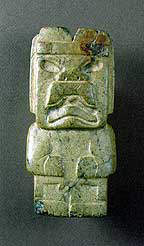
Defining characteristics of "Were Jaguar" of the Olmec
The figurine was ascribed to the Olmec of the Gulf Coast of Mexico, because of its general appearance to similar small stone figures made by the Olmec during the period from 900 B.C. to 600 B.C. This explains the information provided on the index card claiming the piece to be Olmec.
But a very close study of the figurines carved by the Olmec, show the presence of some defining characteristics, such as the cleft forehead (a V-shaped indentation); a baby face with a mouth in which the corners are turned downwards in a cry or snarl; a prominent upper lip and toothless gums, and a flat nose. Such figurines known as Were-Jaguar combined both feline (cat family to which jaguar belongs) and human traits. In the absence of such defining characteristics in the "Emerald Man" which would positively identify it as a Were-Jaguar of the Olmec, we may have to look for other figurines produced in the Mesoamerican region for identification.
©Hudson Museum, University of Maine
Were Jaguar
Features of the "Emerald Man" similar to stone figurines of other contemporaneous artistic traditions
It has been shown by archaeologists that the features of the emerald man has strong similarities to stone figures carved in ancient Guerrero, Mexico, that were contemporaneous to the Olmec figurines of the 9th to 6th century B.C. Two features in the "Emerald Man," arms folded over the belly, and the nose and mouth formed by horizontal divisions within a trapezoid, are common with the stone figurines of ancient Guerrero, from ancient traditions such as the Chontal, Mezcala or Xochipala.
The source of the emerald
The age of the "Emerald Man" ranges between 1,100 to 900 B.C.
If we accept the carving tradition adopted in sculpturing the "Emerald Man" as either Olmec or some other contemporaneous Mesoamerican tradition, the age of the "Emerald Man" ranges between 1,100 B.C. to about 900 B.C., the period during which the Olmec civilization reached its zenith, even though evidence shows the Olmec civilization is much older dating back to about 1,500 B.C. The emerald was considered a sacred stone in the ancient civilizations of the Olmec, Aztec and Maya, but emerald mines were not found in the region where these civilizations originated, in Central America. It appears that emeralds used by the people of the Olmec heartland along the gulf coast of Mexico, and the ancient Indain tribes of the Guerrero region on the Pacific coast of Mexico, actually originated in the Colombian region situated in the northwest of South America. The mines that were worked in the Colombian region since ancient times were the Muzo emerald mines of the Muzo Indians and the Somondoco (Chivor) emerald mines of the Chibcha Indians. These mines became famous for their prolific output, and the emeralds produced here reached as far south as Bolivia and as far north as Mexico. Thus, the emerald used in the carving of the "Emerald Man" possibly originated in either the Muzo or Chivor mines of Colombia.
The origin of the "Emerald Man" from the ancient emerald mines of Colombia is doubtful.
Scientific tests carried out by the team of scientists of the University of Maine indicated that the possible source of the emerald man was the Muzo mines of Colombia. By using X-ray fluorescence they were able to show that the figurine shares more trace elements, including copper, barium, zinc, rubidium and titanium, with the Muzo Colombian source, than with any other source in Colombia. But, unfortunately X-ray fluorescence also uncovered significant quantities of strontium and bromine in the emerald, which do not match any published source. Thus, based on the scientific evidence it is doubtful whether the "Emerald Man" actually originated in any of the ancient emerald mines of Colombia.
The ancient source of the "Emerald Man" still remains undiscovered
Opinions have been expressed that the ancient source of the "Emerald Man" still remains undiscovered, and besides the ancient emerald mines of Colombia, there possibly would have been other ancient sources elsewhere in the Mesoamerican region, which were abandoned and subsequently overgrown with jungle, and yet remains to be re-discovered. One such ancient site is said to exist in the jungles of eastern Ecuador, still remaining to be explored.
The Olmec Civilization
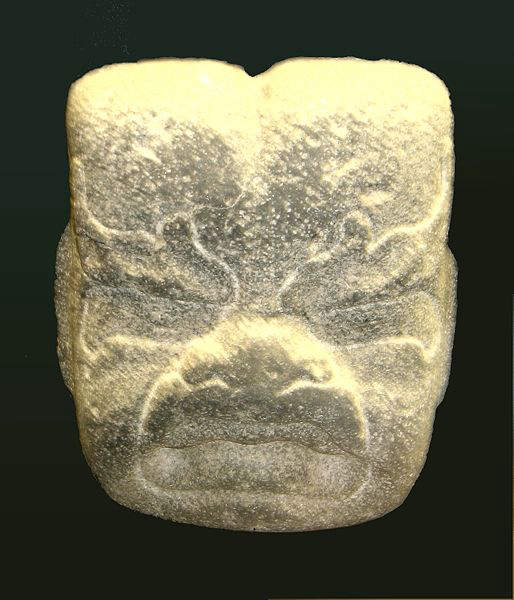
Photo Above (Creative Commons)
Were Jaguar Olmec Head Carving
The Olmec civilization that dates back to 1,200 - 400 B.C. originated in the southeastern gulf coast of Mexico, a low-lying coastal area with a hot and humid tropical climate, covered with tropical vegetation and drained by several streams. However, the exact identity and origins of this early people are unknown. The term "Olmec" was coined by modern-day archaeologists to refer to this ancient civilization, and was derived from the Nahuatl language spoken by the Aztecs and other later Indian tribes, which roughly translates to mean "Rubber People" signifying a product naturally found in this region, and extracted for the first time by these ancient people.
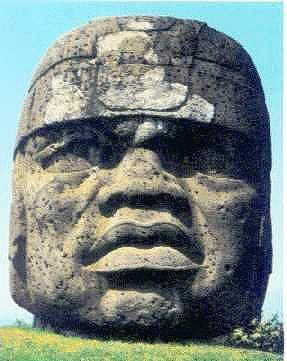
Olmec Colossal Head Carving
Modern-day archaeologists consider Olmec culture, as the "mother culture" of Mesoamerica from which subsequent cultures were derived. The fertile lowlands of southern Veracruz and Tabasco where the Olmec civilization initially originated, was very rich and increased agricultural productivity, allowing specialization in non-farming activities such as arts, architecture, construction engineering and commerce. Some of the centers where the civilization flourished include San Lorenzo Tenochtitlan in southern Veracruz province between 1,200 to 900 B.C. and La Venta in Tabasco province between 800 to 400 B.C. Some of the architectural marvels of this period include high-rising platforms with dimensions of 914 X 305 X 46 meters (3,000 X 1,000 X 150 feet), pyramids, altars and tombs, which represent a burial complex for the ruling class. Other architectural marvels include sophisticated hydraulic works and drainage systems that channeled water into palace complexes for drinking and bathing, filling decorative and sacred pools, and for waste runoff. The existence of such great architectural marvels of this period, meant massive labor intensive projects that suggests the existence Mesoamerica's first political state. Olmec civilization was on the decline after 800 B.C. and ceased to exist between 400 -300 B.C. and was replaced by other civilizations such as the Maya, Totonac and Zapotec.
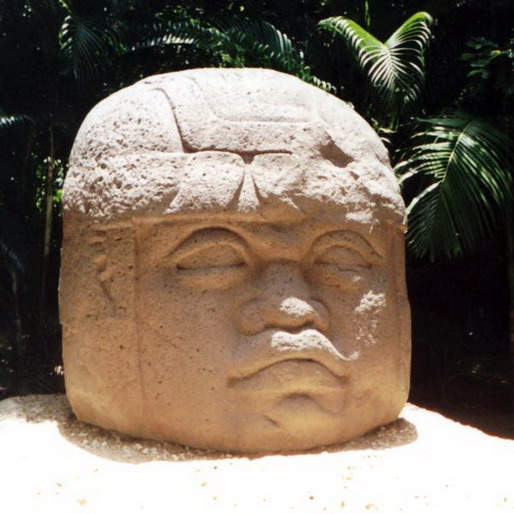
Photo Above (Creative Commons)
Olmec Colossal Head Carving
Some of the cultural achievements of the ancient Olmec civilization are as follows :-
1) The Olmec were among the first to use stone in architecture and sculpture producing impressive work from volcanic basalt, stone and jade. The most striking sculptures of the period included the carved colossal heads some of which weigh up to around 20 metric tons. These heads had flat faces, broad and flat noses, and full lips, and seemed to be wearing a headgear resembling a football helmet, which in fact many archaeologists believe to be a protective gear worn by rubber ball-players, after the discovery of ruins of a ball-court and actual discovery of several rubber-balls at an Olmec site. Besides the colossal heads, the Olmec artisans also produced smaller art objects and figurines which used human and animal subjects as well as mixed characteristics of human and animals as in the case of the "Were Jaguar."
2) The mathematicians and astronomers among the Olmecs, developed a vigesimal (base 20) numeral system based on a bar-and-dot system, and were the first in the world to recognize the importance of zero in a numeral system, and used a symbol (shell glyph) to represent zero, several centuries before Ptolemy recognized its importance. They also developed the system of counting time from a specific starting date, similar to the modern Gregorian and other calendars.
3) The Olmecs like the ancient Egyptians developed an early form of hieroglyphic writing from which experts have identified 182 symbols with specific meanings. However, the script is as yet undeciphered. After the decline of the Olmec civilization, their ancient writing was adopted by the Maya, who developed it into a more complex and elaborate system.
4) The Olmecs developed an extensive trading network with other parts of Mesoamerica, that led to cultural interaction with these regions and spread their influence. Items traded included small figurines, ceremonial masks, jewelry and burial items, turned out of stone, jade, emeralds, serpentine and other materials. Other items included knife blades, and dart-points made out of Obsidian (solidified volcanic lava) imported from the Guatemala highlands, and mirrors made of polished iron ore.
5) The ancient Olmec religion was based on shamanistic practices in which shamans were believed to have the power to transform their shapes to animal form and communicate with the spiritual world. The Olmecs believed that they descended from the jaguar. Thus the jaguar was revered as a sacred animal by the Olmec. This belief is reflected in the most common theme in the Olmec drawings, and stone carvings, the figure of the "Were Jaguar" that combined both human and feline features.
Today, the Olmec culture is considered by many scholars to be perhaps the first great civilization of ancient Mesoamerica.
You are welcome to discuss this post/related topics with Dr Shihaan and other experts from around the world in our FORUMS (forums.internetstones.com)
Related :-
References
1.Emerald Man - Stephen Whittington, James Vose and Charles Hess. Archaeology, a publication of the Archaeological Institute of America.
2.Emerald Man - Website of the Hudson Museum, The University of Maine.
3.Emerald, Gem by Gem - International Colored Gemstone Association.
4. Beryl, Gem by Gem - International Colored Gemstone Association.
5.GEO347K GEM NOTES - Beryl, Department of Geology, University of Texas, Austin.
6.The Cyclosilicate Subclass - Galleries.com
7.Encyclopedia of the Ancient World - Olmecs, Editor - Thomas J. Sienkewicz.
 Home
Security & Guarantee
How it Works
Technology Partners
Updated Tables
Famous Diamonds
More Famous Diamonds
Famous Pearls
Famous Gemstones
Contact Dr Shihaan Larif
Contact Senior Editor
Famous Jewelry
Reference Database
Forums
Learning Center
Gemstone Gallery
e-mail Notifications
Advertise
Press Release
About Us
Privacy Policy
Contact Us
FAQ'S
Site Map
Staff Mail Login
Staff Documents
Birthstones
History
Minerals
Shows
Live Metal Prices
Jewellery Gallery
News
Marketplace
Marketplace Support
Open Store
Online Auctions
Join Us & Contribute
Directory
Classifieds
List your products
Wholesale Trading
Post Buy Request
Go Green Policy
Site Updates
Upcoming-ToDo List
Latest News
Latest Articles
Latest Blog Updates
Chat Rooms
Job Board
User Gallery
Videos
New Newsletter Archive
Old Newsletter Archive
Jewelry & Mineral Blog
User Blogs & Social Network
Search
Answers (Q & A)
Valuation
Help me find a diamond/jewelry
pin.internetstones.com- Social Pinboard- Sart yours & connect with millions
Invite Friends From Yahoo, Gmail etc-One Click
Home
Security & Guarantee
How it Works
Technology Partners
Updated Tables
Famous Diamonds
More Famous Diamonds
Famous Pearls
Famous Gemstones
Contact Dr Shihaan Larif
Contact Senior Editor
Famous Jewelry
Reference Database
Forums
Learning Center
Gemstone Gallery
e-mail Notifications
Advertise
Press Release
About Us
Privacy Policy
Contact Us
FAQ'S
Site Map
Staff Mail Login
Staff Documents
Birthstones
History
Minerals
Shows
Live Metal Prices
Jewellery Gallery
News
Marketplace
Marketplace Support
Open Store
Online Auctions
Join Us & Contribute
Directory
Classifieds
List your products
Wholesale Trading
Post Buy Request
Go Green Policy
Site Updates
Upcoming-ToDo List
Latest News
Latest Articles
Latest Blog Updates
Chat Rooms
Job Board
User Gallery
Videos
New Newsletter Archive
Old Newsletter Archive
Jewelry & Mineral Blog
User Blogs & Social Network
Search
Answers (Q & A)
Valuation
Help me find a diamond/jewelry
pin.internetstones.com- Social Pinboard- Sart yours & connect with millions
Invite Friends From Yahoo, Gmail etc-One Click




Our Global Jewelry Industry Job Network


Buy & Sell in our Marketplace

Subscribe to our Newsletter

List in our Classifieds

List in our Directory

User Uploaded Gallery

Powered by Ultra Secure
Amazon (USA) Cloud Network

Founder Internet Stones.COM
Register in our Forums

| Featured In
|
|
|
|
|
|
|
|







Blog & Education Feed
Articles Feed
 |
 |
 |

Copyright © .Internet Stones.COM. All rights reserved.