Emerald Necklaces of the Maharajah of Nawanagar
Open FREE Unlimited Store Join Our Newsletter
Jewelry of the Maharajahs were symbols of status and power
The Maharajah Jamsahib of Nawanagar, Shri Kumar Ranjithsinhji Vibhaji Jadega (1872-1933) was a connoisseur and collector of gems and jewelry and had a fabulous collection of jewelry, some inherited from his ancestors and others designed and executed during his life time by Jacques Cartier, with whom he established a close working relationship, and became his close friend. Jacques Cartier was one of the three sons of Alfred Cartier, and was in charge of the London operations of the renowned jewelry firm, towards the end of the 19th century, eventually moving to its current address at New Bond Street. One of the sons Louis Cartier managed the Paris headquarters of the firm, moving to Rue de la Paix in 1899 and another son Pierre Cartier established the New York City branch in 1909.

As it was the tradition during the days of the Indian Maharajahs it was the men who wore the most fabulous pieces of jewelry as they were considered to be symbols of status and power, believed to elevate the status of the monarch in the eyes of his subjects, and instill fear and respect for him. Thus on all ceremonial occasions as well as during his appearances at his court, the Maharajah wearing his ceremonial robes was bedecked with fabulous jewelry, consisting of several diamond, pearl, emerald or ruby necklaces around his neck, and also wearing brooches, bracelets, huge turban ornaments such as aigrettes and sarpechs, with a jewel encrusted sword by his side. The courts of the Persian and Mogul empires took such extravagant practices to the extreme and Emperor Fath Ali Shah of Persia and Emperor Shah Jahaan of the Mogul empire, go down in history as two monarchs whose courts dazzled with the extravagance showered on ceremonial robes, jewelry and thrones.
Notable pieces of emerald jewelry owned by the Maharajah Jamsahib of Nawanagar
Shri Kumar Ranjithsinhji Vibhaji Jadeja, the Maharajah Jamsahib of Nawanagar, was no exception in following the customs and traditions set by his predecessors. Among the notable pieces of emerald jewelry owned by him were :-
1) An emerald and pearl necklace inherited from his ancestors.
2) An art deco emerald and diamond necklace designed by Jacques Cartier.
3) Emerald collar or choker designed by Jacques Cartier
1) The emerald and pearl necklace inherited from his ancestors
Characteristics of the emerald necklace
The emerald and pearl necklace had been among the family treasures of the Maharajah for several centuries. Thus the necklace is an antique piece designed and crafted by Indian jewelry craftsmen of a bygone era. The necklace undoubtedly stands out as a unique piece of antique jewelry, a living testimony to the outstanding skills of the ancient Indian craftsmen.
The necklace is a double-stranded pearl necklace, with two large emeralds set as a pendant to it. The upper emerald in the pendant to which the necklace is attached, is a 17th century oblong-cut emerald weighing 155 carats. The lower emerald in the pendant which hangs from the upper emerald, is an 18th century 200-carat hexagonal-shaped carved emerald. The emerald necklace seem to have undergone modifications over the years, and the most recent of these modifications was carried out in the 1920s or 1930s, after Ranjithsinhji acquired the 200-carat hexagonal shaped carved emerald. It is believed that Jacques Cartier himself restrung the necklace incorporating the hexagonal-shaped emerald.
The necklace disappears after the Maharajah's death
After the Maharajah's death in 1933, all his valuable items of jewelry were inherited by his successors and remained with the family. Some of the items were disposed of by the family such as the ceremonial necklace incorporating the "Queen of Holland" diamond designed by Jacques Cartier, which was purchased from the family, by Cartier in 1960. But, no one exactly knows what happened to the emerald and pearl necklace after the Maharajah's death.
The necklace reappears after 72 years at Christie's Auction House in London
The necklace apparently disappeared after his death, and re-appeared only after 72 years in August 2005, at Christie's Auction House in London, to whom the necklace had been assigned for sale. No one seems to know the exact circumstances under which the necklace disappeared from the treasury of the royal family. Nothing is known about the identity of the owner of the necklace due to the policy of secrecy adhered to by Christie's, that refuses to divulge the identity of the owner, unless the owner voluntarily agrees to reveal his identity.
Christie's Auction House in London advertised the sale of the historic emerald necklace, that was fixed for September 23, 2005, and placed a reserve value of £ 1.6 million on the necklace. The company said that the necklace was one of the most important historic pieces of Indian jewelry in existence, and was a favorite piece of jewelry of the late Maharajah Ranjithsinhji of Nawanagar.
Commenting on the renowned necklace that was to go up for sale in September 2005, the director of Christie's jewelry department, David Warren said, "I have seen many carved emeralds but they were nearly always unmounted. It's very uncommon to find a complete necklace. I've never actually seen another complete maharajah necklace like this."
Christie's call off the auction of the celebrated necklace
After a worldwide advertising campaign by Christie's about the sale of the celebrated necklace, a personal favorite of the Maharajah, the present descendants of the Maharajah were alerted about the impending auction. Shatrushalyasinh Jadeja, a descendent of Ranjitsinhji Jadeja, and the present Jamsahib of Nawanagar, decided to find out how the celebrated piece of family jewelry that had mysteriously disappeared for so many years, eventually found its way to the Christie's Auction House. It was his contention that the necklace was special and remained with the family for centuries, and that Ranjitsinhji would have never sold it to anyone during his lifetime. In fact Ranjitsinhji was so rich and owned eight Rolls Royce cars, and several palaces both in England and India, that there wasn't any reason for him to have disposed of the historic necklace.
The family of the Maharajah had expressed its concern to Christie's about the impending auction, and perhaps shown an interest in purchasing the family heirloom back from its present owner if legitimate. Christie's agreed and decided against auctioning the royal jewel. Accordingly the head of Christie's jewelry department in London said, "The necklace would not be part of the auction coming up on September 23, 2005, nor any other auction."
2) Art deco emerald and diamond necklace designed by Jacques Cartier
The art deco emerald and diamond necklace designed by Jacques Cartier of the London branch of Cartier's at the request of his friend the Maharajah of Nawanagar Ranjithsinhji, is a masterpiece in art deco jewelry creations for which Cartier's was famous for. The extraordinary piece contains 17 large emerald-cut emeralds of good color, clarity and transparency, of Colombian origin, and reputed to have come from the collection of a former Sultan of Turkey. The 17 emeralds have a total weight of 277 carats and the three large emeralds in the pendant alone weighs 70 carats.
The three large rectangular emerald-cut emeralds are arranged in the shape of a pyramid on the pendant. The largest emerald in this pyramid forms the base of the pyramid, with its long axis parallel to the horizontal. The other two emeralds also rectangular in shape, are arranged one on top of the other, on the base emerald, with their long axes parallel to the vertical. The entire pyramid of emeralds is surrounded by a single layer of small round brilliant-cut diamonds.
At the point where the pendant joins the necklace a square emerald-cut emerald has been placed, also surrounded by a row of smaller diamonds. The necklace itself is made up of two rows of round brilliant-cut diamonds, interspersed with emeralds placed at symmetrical positions. The two lowest emeralds, placed symmetrically on either side, are rectangular-shaped and surrounded by a single layer of small rounded emeralds. Next comes two triads of emeralds placed symmetrically on either side. Each triad has a central large square-shaped emerald flanked on either side by two smaller rectangular-shaped emeralds, surrounded by a row of smaller emeralds. At the next symmetrical position on either side is a square-shaped emerald, surrounded by a row of smaller diamonds. Finally a single triad of emeralds is placed at the point where necklaces usually have a hook or locking device.
3) Emerald Collar (Choker)
A tight-fitting emerald collar or choker worn by the Maharajah over the collar of his royal robes was another extravagant piece of jewelry belonging to his collection. The collar was made up of 20 almost identical square-shaped emeralds, each surrounded by a row of small round brilliant diamonds, and a single pear-shaped emerald also surrounded by small diamonds suspended from the central square-shaped emerald in the front.
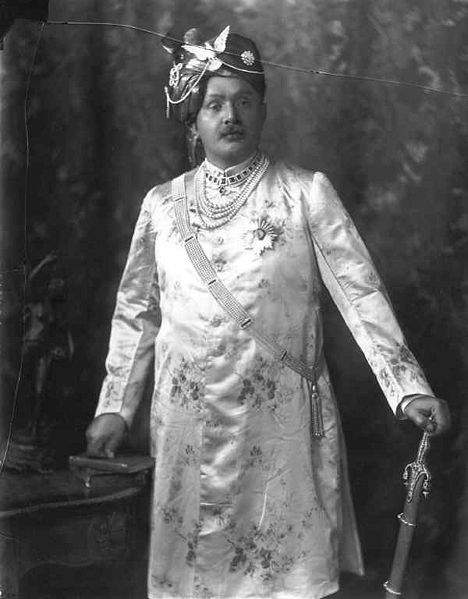
Photographs of the Maharajah show him wearing this emerald collar together with the four-stranded pearl necklace. The green emerald collar provided a striking contrast to the white robes of the Maharajah. In this particular photograph, the Maharajah is seen wearing a black turban surmounted by a diamond-studded sarpech in the form of a flying eagle, and two strings of white pearls radiating from the feet of the flying bird towards the sides of the turban. A circular diamond-studded brooch is pinned to the right side of his turban. The 4-stranded pearl necklace, the emerald choker, and the sarpech on the white turban, together impart an elegant and majestic appearance to the Maharajah.
Shri Kumar Ranjithsinhji Vibhaji Jadeja, the Maharajah Jamsahib of Nawanagar - A short profile
His birth and early education
Kumar Shri Ranjithsinhji an Indian prince, who became a cricketing legend, unofficially known in the cricketing world as the "Black Prince of Cricketers" and fondly referred to by his fans and admirers as "Ranji," was born on September 10, 1872, into the ruling family of Jadegas, in the small village of Sarodar, in the west-central Indian province of Kathiawar, which is in the present day Gujarat state. Kathiawar was part of the princely state of Nawanagar founded in 1540, and its capital was Jamnagar. The state was ruled by a clan of Rajput warriors known as the Jadejas.
Ranjithsinghji proceeds to England to pursue his higher education and develops an interest towards cricket
After receiving his early education in India, at Rajkumar College, Rajkot, Ranjithsinhji proceeded to England to pursue his higher education, where he joined Harrow and later Trinity College, Cambridge. in 1891. While excelling in his studies at College, Ranjithsinhji also developed a liking towards the game of cricket and played first-class cricket for Cambridge University, and was awarded a cricket blue in recognition of his excellent performance.
Highlights of Ranjithsinhji's cricketing career
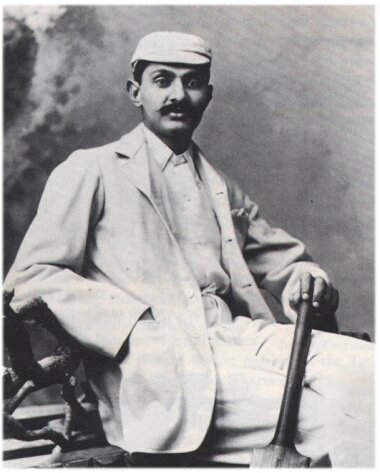
After graduating from Cambridge University in 1895 he joined the Sussex cricket team to play county cricket, and his impressive performance earned him a place in the English Test cricket team for 1896. Thus Ranji acquired the dual honors of being the first Indian to play Test cricket as well as the first Indian to play for the English national team. He also distinguished himself in his maiden test by scoring 154 runs not out in the second innings against Australia at Old Trafford, becoming the second batsman in English test cricket to score a century on the maiden test. His knock of 154 runs also set another record, by becoming the first batsman to score 100 runs before lunch in just 2 hours on day three of the match. Again in his first overseas test for England against Australia in 1897 he scored 175 runs in the first innings, the highest score that had ever been made for England in Test cricket. Thus Ranji became the first English cricketer to achieve the record of scoring centuries in both debut tests home and away, a rare feat that was not repeated by any English player until Andrew Strauss in 2004.
Other highlights of his cricketing career spanning almost 20 years from 1893 to 2012 include :-
1) Passing 1,000 runs in 10 successive domestic seasons.
2) Scoring over 3,000 runs in 1899 and 1900.
3) The first cricketer to score over 3,000 runs in English first class cricket in 1899.
4) Captaining Sussex from 1899 to 1903.
5) Scoring a first-class hundred in each innings on the same day, a feat that has not been repeated by any cricketer up to date.
6) Playing 307 first-class matches.
7) Scoring a total of 24,692 runs, with a batting average of 56.37.
8) Scoring 72 centuries and 109 half-centuries.
9) Achieving a top score of 285 runs.
10) Played 15 test matches for England, between 1896 and 1902, scoring a total of 989 runs with a batting average of 44.95.
Ranjithsinhji ascends the throne as Maharajah Jamsahib of Nawanagar. His contributions to the development of Nawanagar.
In the year 1907, at the age of 35 years, Ranjithsinhji ascended the throne as Maharajah Jamsahib of Nawanagar. His education and life spent in England enabled him to acquire a broader vision for improving the living conditions of his subjects in his domain. Accordingly he embarked on several projects to modernize his state, giving preference to developing the basic infrastructure of his state. Some of the infrastructural projects he completed, included the construction of the modern port at Bedi, a modern network of roads and railways, extensive irrigation schemes, hospitals and dispensaries, rebuilding Jamnagar into a modern capital city, and modernizing all public buildings. Being an enlightened ruler he also set up sanctuaries for birds and animals.
Assignments other than his princely duties
During world war I he served as a British Army Staff Officer in France, and was eventually promoted to the rank of Lieutenant Colonel. He also contributed to the war effort by giving his fleet of cars and trucks to the British Army, and his country house at Staines, England, to be used as an army hospital. He represented the Indian states at the League of Nations, the predecessor of the United Nations, in 1920, and in 1932 he became the Chancellor of the Indian Chamber of Princes. He was knighted by King George V of the United Kingdom, on three occasions in 1917, 1919, and 1923, being awarded the KCSI, GBE and the GCSI respectively.
His death and succession
Maharajah Ranjitsinghji died in the Jamnagar Palace in Nawanagar in 1933 at the age of 61 years, and being unmarried was succeeded by his nephew Shri Kumar Digvijaysinhji.
You are welcome to discuss this post/related topics with Dr Shihaan and other experts from around the world in our FORUMS (forums.internetstones.com)
Related :-
1) The Mackay Emerald Necklace
2) The Spanish Inquisition Necklace
References
1.Going for pounds 1.6m, the cricketing maharaja's emerald necklace - Independent, The (London), Aug 1, 2005 -by Louise Jury.
2.K.S. Ranjithsinhji - From Wikipedia the free encyclopedia.
 Home
Security & Guarantee
How it Works
Technology Partners
Updated Tables
Famous Diamonds
More Famous Diamonds
Famous Pearls
Famous Gemstones
Contact Dr Shihaan Larif
Contact Senior Editor
Famous Jewelry
Reference Database
Forums
Learning Center
Gemstone Gallery
e-mail Notifications
Advertise
Press Release
About Us
Privacy Policy
Contact Us
FAQ'S
Site Map
Staff Mail Login
Staff Documents
Birthstones
History
Minerals
Shows
Live Metal Prices
Jewellery Gallery
News
Marketplace
Marketplace Support
Open Store
Online Auctions
Join Us & Contribute
Directory
Classifieds
List your products
Wholesale Trading
Post Buy Request
Go Green Policy
Site Updates
Upcoming-ToDo List
Latest News
Latest Articles
Latest Blog Updates
Chat Rooms
Job Board
User Gallery
Videos
New Newsletter Archive
Old Newsletter Archive
Jewelry & Mineral Blog
User Blogs & Social Network
Search
Answers (Q & A)
Valuation
Help me find a diamond/jewelry
pin.internetstones.com- Social Pinboard- Sart yours & connect with millions
Invite Friends From Yahoo, Gmail etc-One Click
Home
Security & Guarantee
How it Works
Technology Partners
Updated Tables
Famous Diamonds
More Famous Diamonds
Famous Pearls
Famous Gemstones
Contact Dr Shihaan Larif
Contact Senior Editor
Famous Jewelry
Reference Database
Forums
Learning Center
Gemstone Gallery
e-mail Notifications
Advertise
Press Release
About Us
Privacy Policy
Contact Us
FAQ'S
Site Map
Staff Mail Login
Staff Documents
Birthstones
History
Minerals
Shows
Live Metal Prices
Jewellery Gallery
News
Marketplace
Marketplace Support
Open Store
Online Auctions
Join Us & Contribute
Directory
Classifieds
List your products
Wholesale Trading
Post Buy Request
Go Green Policy
Site Updates
Upcoming-ToDo List
Latest News
Latest Articles
Latest Blog Updates
Chat Rooms
Job Board
User Gallery
Videos
New Newsletter Archive
Old Newsletter Archive
Jewelry & Mineral Blog
User Blogs & Social Network
Search
Answers (Q & A)
Valuation
Help me find a diamond/jewelry
pin.internetstones.com- Social Pinboard- Sart yours & connect with millions
Invite Friends From Yahoo, Gmail etc-One Click




Our Global Jewelry Industry Job Network


Buy & Sell in our Marketplace

Subscribe to our Newsletter

List in our Classifieds

List in our Directory

User Uploaded Gallery

Powered by Ultra Secure
Amazon (USA) Cloud Network

Founder Internet Stones.COM
Register in our Forums

| Featured In
|
|
|
|
|
|
|
|







Blog & Education Feed
Articles Feed
 |
 |
 |

Copyright © .Internet Stones.COM. All rights reserved.