Emerald Unguentarium (Vessel) in the Imperial Treasury in Vienna
Open FREE Unlimited Store Join Our Newsletter
Origin of name
The term unguentarium is derived from the Latin word "unguent" which means a soft greasy or thick substance used as ointment or for lubrication. An unguentarium is a small vessel or container that holds an unguent. Unguentaria of different sizes and shapes made of ceramic or glass had been in use since pre-Christian times, in the regions of the Greek and Roman empires, as shown by archaeological findings. They were used in funerary rituals and hence their frequent occurrence in archaeological excavations of ancient cemeteries. Archaeologists believe that these containers were used for holding perfumed oils, ointments, balsam. jasmine, kohl, honey, mastic, incense, scent powders and cosmetic preparations.

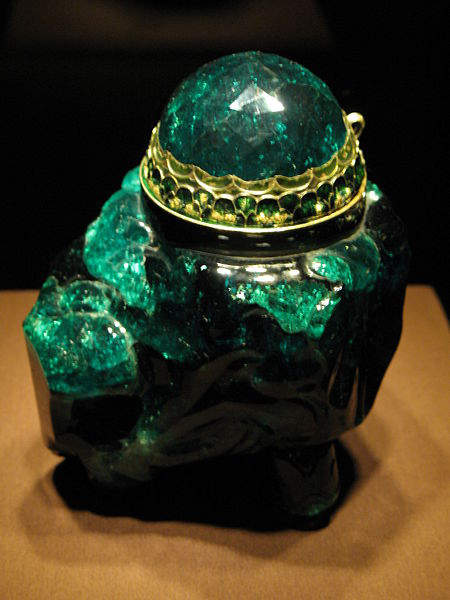
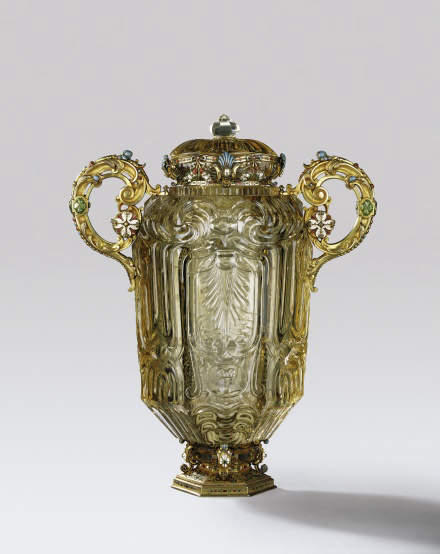
The "Emerald Unguentarium" in the Imperial treasury (Schatzkammer) , in Vienna, was commissioned by the Hapsburg king, Emperor Ferdinand III in 1641, and was carved out of a single large emerald crystal of Colombian origin, probably over 3,000 carats in weight, perhaps the largest emerald crystal discovered in the world at that time. The Emerald Unguentarium is shaped more like a bottle, and appears somewhat irregular in shape, as the cutter of the enormous emerald crystal was perhaps instructed by the king to reduce losses in cutting, to a minimum. The unguentarium had a lid and feet also made of emerald, probably worked from the material scooped out of the vessel.
Characteristics of the emerald
The exact weight of the original massive crystal is not known but after the crystal was hollowed out and transformed into an ointment vessel (unguentarium) it weighed 2,860 carats. The cutter who apparently seemed to have followed the shape of the natural crystal - which was in fact a twin crystal intergrown into one another - in order to minimize losses, eventually ended up with a vessel having a rather irregular shape. The surface of the vessel is engraved with four leaf patterns. The dome-shaped lid of the bottle has enameled gold decoration at its base where it fits on to the mouth of the vessel. The master carver who fashioned the vessel had also created facets of different shapes on the surface of the vessel as well as the lid, which were subsequently polished to bring out the intrinsic beauty of the emerald. The dimensions of the vessel are length-8.5 cm, breadth-7.2 cm, and height-10.9 cm.
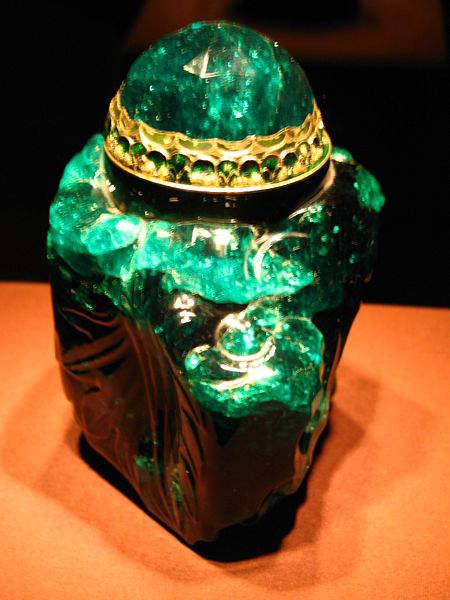
The color of the emerald as appearing on the photograph is a deep vivid green characteristic of emeralds originating in the Muzo mines of Colombia. The clarity and transparency of the emerald as seen from some of the upper facets on the vessel and the lid, seem to be quite exceptional. This is not surprising if the emerald had actually originated from the Muzo mines of Colombia. Judging from the color, clarity and transparency of the upper facets, one can assume that the entire crystal that constitutes the unguentarium, is indeed a superb gem-quality emerald, whose value by market prices now commanded by fine emeralds may reach over a 100 million dollars. In the year 1660, the emerald vessel was estimated to have a value of 300,000 Talers (currency of the Austrian empire).
Characteristics of Muzo Emeralds
1) Muzo emeralds have a deep vivid green (herbal green) color, the most sought after color in emeralds.
2) Generally Muzo emeralds have good clarity and transparency due to the scarce presence of gardens and inclusions.
3) Muzo emeralds have characteristic three-phase inclusions containing gas, fluid and crystals of halite. Other solid inclusions found are crystals of calcite and parisite.
4) Muzo emeralds have a specific gravity of 2.71, higher than the specific gravity of Chivor emeralds which is equal to 2.69.
5) The refractive index of Muzo emeralds are also higher than that of Chivor emeralds. For Muzo emeralds R.I.e = 1.578 and R.I.o = 1.584. For Chivor emeralds R.I.e = 1.571 and R.I.o = 1.577.
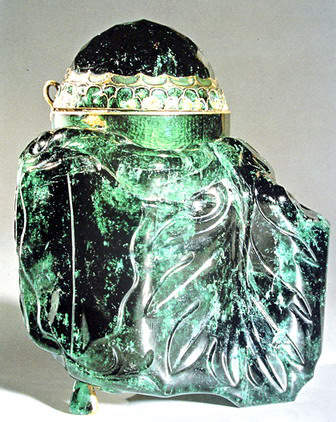
© KHM Vienna
History of the emerald
Discovery of the Chivor (Somondoco) mines - 1537 A.D.
The Spanish Conquistadors who landed in Mexico and Peru in the early 16th century, were amazed by the large and beautiful emeralds possessed by the native Indians, who not only used them as ornaments but also as sacred objects in their temples, and buried them with their dead. Attempts made by the conquistadors to trace the source of the emeralds proved futile until the year 1537, when Gonzalo Jimenez de Quesada conquered and subdued the Chibcha Indians of Colombia, whose chief gifted him nine large emeralds, when he first arrived at the heartland of the Chibcha Indians, the valley of Guacheta. Gonzalo Jimenez's soldier's succeeded in tracing the source of these emeralds after almost an year's search of the Chibchaland, high up in the Andes mountains about 70 km, northeast of Bogota. The area where the mines were found was known as Somondoco (Chivor), but the Spaniards were not able to exploit the mines immediately due to the inhospitable terrain and the inaccessibility of the region. However, exploitation did start in the mid 1550s and continued for more than 100 years under the most cruel and inhuman conditions, that King Charles II of Spain was forced to close down the mines by royal decree in 1675. The mines were then lost and overgrown with jungle for the next 200 years, until re-discovered only in 1896.
Discovery of the Muzo mines - 1594 A.D.
The Spanish who had captured Chibchaland, had heard about another ancient emerald mine in Muzoland about 200 km northwest of the Chivor mines, but attempts to subdue the Muzo Indians failed, as they were a war like tribe and fiercely and successfully resisted Spanish attacks for almost 20 years, and were only partially subdued in the year 1555. Attempts made by the Spanish to locate the ancient Muzo mines proved unsuccessful due to the policy of non-co-operation adopted by the Muzo Indians. However 40 years later, in the year 1594, the Spanish on their own were able to locate the original Indian workings, closer to the present site of the Muzo mines. Production in the Muzo mines started almost immediately and the output was prolific during the first few decades, but later declined rapidly due to the cruel conditions in the mines, long working hours imposed on the workers, and compulsory labor enforced on the neighboring tribes, forcing the people to flee the immediate neighborhood of the mines. In the middle of the 17th century a disastrous fire engulfed the Muzo mines, and mining activity came to a complete standstill. The mines were abandoned and resuscitated only after Colombia gained independence from the Spanish in 1819.
The Unguentarium rough emerald crystal enters the Hapsburg court in the early 17th century
A fifth of the production of emeralds in both the Chivor and Muzo mines went to the Spanish crown, and the occasional spectacular finds from these mines. The remaining emeralds were exported to the monarchies of Europe, and Asia. Substantial quantities of emeralds reached the Ottoman Empire of Turkey, the Persian Empire and the Mughal Empire of Northern India. Among the European monarchies that purchased Colombian emeralds from the Spanish was the Hapsburg rulers of the Austro-Hungarian empire. The Emerald Unguentarium rough twin crystal entered the court of the Hapsburg rulers of the Austrian empire in the early 17th century, during the rule of Rudolf II (1576-1612). However, it was only in 1641 that Emperor Ferdinand III (1637-1657) of Austria, commissioned the famous gem-cutter and carver Dionysio Miseroni of Prague, Bohemia (presently in the Czech republic) to cut the stone into the celebrated unguentarium.
The source of the Emerald Unguentarium
Given the fact that the Emerald Unguentarium rough crystal entered the Hapsburg court in the early 17th century, the only two sources in Colombia, from which the emerald would have possibly originated during this period were the Muzo and Chivor mines, which were in active production around this time. Again, judging by the deep vivid-green color of the emerald, the most probable source of the emerald would be the Muzo mines of Colombia, whose emeralds have the characteristic and highly priced deep vivid-green color. In fact it is on record that the enormous twin crystal that weighed over 3,000 carats, did in fact originate in the famous Muzo mines of Colombia, and was purchased by Rudolph II, in the early 17th century.
Emperor Ferdinand III commissions Dionysio Miseroni to work on the crystal
The enormous twin crystal that remained in the royal treasury during the rules of Emperor Rudolph II (1576-1612), Emperor Matthias (1612-1619) and Emperor Ferdinand II (1619-1637) came to the attention of Emperor Ferdinand III (1637-1657), who upon seeing the massive emerald in 1941, summoned his trusted employee Dionysio Miseroni, who was also a well known gemstone cutter and carver, and discussed the possibility of transforming the crystal into a small vessel. The emperor also made it clear to Dionysio, that wastage of the material of the gemstone should be cut down to a minimum. Dionysio, while accepting the suggestion of the emperor, took it as a challenge and was determined to apply all his knowledge, skills and experience in turning out a product that would be a perfect example of aesthetic beauty and artistic excellence.
Dionysio started work on the intergrown twin crystal in 1941, working at his home "White Rose House" at No. 8, Nerudova Road, which leads from the Mala Strana to the Hradschin Castle, where he also had his workshop. After almost an year's work which involved grinding, carving and polishing, the artistic masterpiece was completed by Dionysio, who presented it to the Emperor, in 1942. The emperor was overjoyed with the results achieved by Dionysio, that he ordered the payment of 8,000 talers to Dionysio, for his workmanship. The value of the rough emerald at the time of purchase was said to be around 65,000 talers. However, after its carving and polishing, the value of the "emerald vessel" was estimated to be around 300,000 talers. Dionysio Miseroni is remembered today for many outstanding carvings done on a variety of semi-precious stones such as citrine, chalcedony, smoky quartz, rock crystal etc. but the greatest highlight of his works was undoubtedly the carving of the twin emerald crystal from the Muzo mines of Colombia.
Attempt to sell the Emerald Unguentarium in 1645 ?
The Emerald Unguentarium, which apparently had no practical value, became a symbol of imperial power and wealth, the normal function performed by crown jewels of any monarchy, in any part of the world. It is said that Emperor Ferdinand III, attempted to sell the Emerald vessel to raise money in Genoa, towards the end of the "Thirty Years War" in 1645. However, the jewelers who saw the enormous emerald piece, it is said, refused to appraise it, because they did not normally trade in such large pieces, and moreover finding a customer for such an enormous piece would in itself become a serious problem. It was also reported that the Russians offered several chest of pearls and the Grand Duke of Tuscany, three tons of gold, in exchange for the enormous emerald.
Dionysio Miseroni - a short biography
Dionysio Miseroni hailed from a renowned family of gemstone and crystal cutters from Milan. His father Ottavio Miseroni, was summoned to Prague, by the Holy Roman Emperor Rudolph II in 1588, who appointed him as royal gem-cutter, with a workshop at Bubenec Mill, in the royal game park. Ottavio Miseroni married Laura di Castello, with whom he had nine children. Out of his male children only Dionysio took a keen interest in the family's profession of gemstone cutting and carving, and young Dionysio became an apprentice under his father, learning and mastering all aspects of this skilled profession at a very young age. Dionysio also assisted his father in the administration and maintenance of the Imperial Art Collection in the Hradschin Palace, an additional responsibility Emperor Rudolph II assigned to Ottavio Miseoroni, besides his work as royal gem cutter.
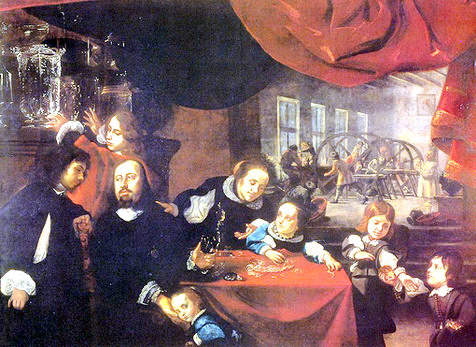
Karel Skréta's (1610 - 1674) Painting of Dionysio Miseroni and family
at the National Gallery,Prague.
When Ottavio Miseroni died in 1624 at the age of 57 years, his young son Dionysio, who was only 17 years old, was appointed the royal gem cutter and assistant administrator of the Imperial Art Collection, and he continued to receive his father's salary of 20 talers as a stone cutter. However the Miseroni workshop was administered by his mother until 1628, when Dinoysio became a major at the age of 21, and was legally able to sign commercial contracts. The family then purchased the "White Rose House" at No. 8, Nerudova Road, where Dinoysio also set up his workshop.
The Holy Roman Emperor during this period was Ferdinand II, who is said to have started the "Thirty Years War" in 1618, when he as the king of Bohemia tried to impose Roman Catholic absolutism on his domains, and was fiercely resisted by the Protestant nobles of both Bohemia and Austria, who rose up in rebellion. Ferdinand II won after a five-year struggle, but this provided the trigger for a series of wars fought all over Europe by different nations for different reasons, including religious, dynastic, territorial and trade rivalries. But, the main battlefield for most of the conflicts was the towns and principalities of Germany, which suffered severely. The war finally ended in 1648, with the signing of the treaty of Westphalia, that completely changed the map of Europe, and the ancient notion of a Roman Catholic empire of Europe, headed spiritually by a Pope and temporally by an emperor, was permanently abandoned.
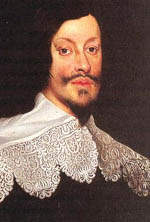
Emperor Ferdinand III
In preparing his son Ferdinand III as successor to the title of Holy Roman Emperor, Ferdinand II, appointed him as Archduke of Austria in 1621, and crowned him king of Hungary in 1625 and of Bohemia in 1627. Ferdinand III became the commander of the Habsburg armies in 1634, and led some of the campaigns of the "Thirty Years War." In 1637, after the death of his father, Ferdinand III succeeded as the Holy Roman Emperor. Ferdinand III who was less a religious fanatic than his father, readily agreed to compromise with Europe's Protestant powers, that led to the signing of the treaty of Westphalia, which ended 30 years of religious strife in Europe.
Ferdinand III was also a patron of the Arts and Sciences, and an accomplished musician and composer. His interests led to a close relationship with the royal gem-cutter Dinoysio Miseroni, and he placed several orders for semiprecious stone objects, that also included the famous emerald vessel. Ferdinand III also appointed Dinoysio to supervise the construction work on the Hradschin Palace, and the artistic decoration of a new chapel at the palace, for which he made a tabernacle with precious stones. In 1934, with the death of the Imperial Treasure Warden, Dinoysio who was serving as his assistant was promoted as the Imperial Treasure Warden, whose duties also entailed that of the Royal Building and Fortifications Supervisor. Ferdinand III also appointed him in 1642 as Royal Valet for which he received an additional salary of 15 talers. In 1643, the royal court also awarded payment of 1,000 talers to Dinoysio for services rendered in supervising construction work at the Hradschin Palace, which was speedily concluded.
Dinoysio married Judith Mayer von Burgried in 1628, from whom he had four boys. After the death of his first wife in 1646, he married Maria Ludmilla Major von Gossenau, by whom he had four children, one boy and three girls. The famous painting by Karel Skreta in 1653, hung in the National Gallery in Prague, shows Dionysio Miseroni with his family, that includes his wife Maria and six surviving children.
Renowned masterpieces created by Dinoysio Miseroni
1) The Maienkrug - a vase to hold spring or may flowers
©Liechtenstein Museum
This is Dinoysio's first documented work, a large vase with cover, executed in smoky quartz for Count Karl-Eusebius of Liechtenstein in 1639. The spectacular piece was created from a single large smoky quartz crystal weighing 18 kg, purchased by Karl Eusebius in 1638, from Martin Dominic Wagner for 800 talers. Dinoysio designed the vase in the shape of a hexagon, following the original hexagonal shape of the rough quartz crystal, in order to maximize the size of the vase, and minimize wastage of material. The exquisitely crafted vase with two handles, has a height of 37 cm and a width of 30 cm across the handles. The vase which bears the emblem of the House of Liechtenstein and the shield of the Duchy of Troppau, was completed by Dinoysio Miseroni in one year, and is a prominent exhibit at the Lichtenstein Museum today.
2) Tulip flower vase
The tulip flower vase is another remarkable creation by Dinoysio Miseroni, executed on a single massive yellow quartz (citrine) crystal in 1647. The vase is also hexagonal in shape, deliberately created to fit into the natural hexagonal shape of the crystal, in order to minimize losses, and create the largest possible vase. The inside of the vase is only partially hollowed out. The vase is 26 cm in height, and together with the tulips has a height of 46 cm. The flowers are fashioned out of Bohemian jasper, agate and rock crystal. The handles of the vase and the flower stalks are made of enameled silver. The work seems to be Dinoysio's private creation on material belonging to the family, and Emperor Ferdinand III after much bargaining had to pay 4,000 talers to acquire it. The Tulip vase is on display today at the KHM (Kunst Historiches Museum) in Vienna.
3) A stemmed cup in citrine (yellow quartz)
The stemmed cup was executed by Dinoysio on yellow quartz or citrine prior to 1650. It has a height of 15 cm and a width of 17 cm. The cup itself has a boat shape. The stemmed cup was among the objects listed as transferred to the court in Vienna on February 22, 1651. The stemmed cup is on display today at the KHM (Kunst Historiches Museum - Art History Museum) in Vienna.
4) The Antonia Minor tea pot in lapis lazuli
The Lapis Lazuli teapot and basin, a work that was completed in 1652, was praised by Dinoysio himself in a remark he made to the Emperor about the masterpiece : Ein extraordinari stuck meaning "an extraordinary piece." The teapot that has a height of 19 cm, a length of 21 cm and depth of 13 cm, was executed on a large rock of Lapis Lazuli which most probably originated in Badakshan, in Afghanistan, the only source of Lapis Lazuli in the world around this time. The material also presented a challenge to Dinoysio, as this was the first time that he was working with this material, which was relatively soft compared to the materials he had been working on previously. (Lapis Lazuli has a hardness of only 5.0 to 5.5 on the Mohs scale).
The work that was completed in 1652, had gilded silver and enamel gold decoration. The handle of the pot is in the form of a siren (half woman and half bird-like form). The head of the siren is an antique piece representing a Roman woman, Antonia Minor, the wife of Drusus the elder, mother of Germanicus and Emperor Claudiius, and grandmother of Emperor Caligula. It is believed that the head might have been carved during the lifetime of Antonia Minor (36 BC - 37 AD). The joint between the old head and the new body on the handle of the jug, is hidden by the double string of pearls worn by the siren. The jug is complimented by a 46 cm long oval basin.
5) Pink chalcedony jug
The unfinished pink chalcedony jug was another artistic creation by Dinoysio, that was acquired by Emperor Ferdinand III in 1652, probably for a sum of 300 talers. The jug has a height of 24 cm and a with of 11 cm, and the entire jug including its short stem and circular base was carved out of a single enormous pink chalcedony crystal. The handle of gilded silver or gold and and the emblem or family crest had not been completed.
6) The Pyramid
The Pyramid, carved out of a rock crystal (quartz) from Switzerland is undoubtedly the most outstanding and prominent of Dinoysio's artistic creations, which is made up of five sections and has a total height of 145 cm.(1.45 meters). The completed pyramid was delivered to Emperor Ferdinand III, personally by Dinoysio himself, in 1653, for which the emperor paid him 2,600 talers. It is said that Emperor Ferdinand III was so taken up with this unique artistic creation, that he went out of his way to show his satisfaction, by giving an extra bonus of 100 talers each for Dinoysio's assistants and a gold chain for each of his sons. The Pyramid was valued at 20,000 talers in the year 1677.
The enormous quartz crystal from which the Pyramid was carved out was discovered in Switzerland in 1651, and was given as a gift to Emperor Ferdinand III in Vienna, by his unofficial agent or representative in the Swiss Confederation, Count Sebastian Peregrin Zwyer von Evibach. The lowest part of the Pyramid is the 42 cm high bottom vase onto which four approximately 25 cm segments are stacked. A tubular drill was used to hollow out the interior of the vase, producing a core of material, that was used to make four cylinders of progressively decreasing diameter, each about 25 cm in height. The cylinders were then mounted in a telescopic fashion with the help of gilded silver and enameled gold rings. The initials DM (Dinoysio Miseroni) and F III CA (Ferdinand III Caesar Augustus) are engraved on the pyramid, which is on display today at the Kunst Historiches Museum (Art History Museum) in Vienna.
7) The Phoenix ewer
The Phoenix ewer, which is a large jug with a wide mouth, carved from a massive rock crystal (quartz) from the Swiss Alps, is perhaps the last piece executed by Dinoysio Miseroni for Emperor Ferdinand III, just before his death on April 2, 1657. Ferdinand III who was a patron and connoisseur of the arts, patronized the work of Dinoysio Miseroni, since his ascension to the throne of the Holy Roman Emperor in 1637, and all the outstanding creations attributed to Dinoysio Miseroni was a result of this royal patronage extended to a creative artist during a period of twenty years. Accordingly after the death of Ferdinand III in 1657, there was a significant decline in production at the Miseroni workshop.
The enormous rock crystal discovered in the Swiss Alps was given as a gift to Emperor Ferdinand III by Count Sebastian Peregrin Zwyer von Evibach. In the execution of this unique carving Dinoysio seems to have followed a new style consisting of large flat areas and straight lines. The height of the jug is 51 cm, width 33 cm and depth 19 cm. The middle part of the jug has an engraved landscape decoration with pastoral scenes, a deer hunter, a ploughing farmer, and a sheep shepherd. The bottom part of the jug is engraved with Tritons and Nereids. The cover of the jug shows a bird, the phoenix rising from the flames. The base, handle and cover of the jug, has gilded silver, enameled gold and rubies incorporated. The finished product turned out to be an exceptionally large and clear crystal vessel.
Dinoysio Miseroni had not been paid for his work at the time of Emperor Ferdinand III's death in 1657, and had to make a special appeal to his successor Leopold I, for the settlement of his claim. In his appeal Dinoysio wrote : "an welichem uber die drey jahre gearbeitet worden, vor welchem wan man die grosse muhe und arbeith betrachten will, 4,000 taler fur meine arbeith whole verdient ware." which translates in English as follows : "....on which more than three years was labored, and if one deigns to consider the great difficulty and work, then 4,000 taler would be well merited for my work." Eventually, Dinoysio billed 3,000 taler for his work, and an additional 483 taler for silver, gold and rubies and workmanship of the goldsmith. The letters F III are engraved on the jug, which stands for Ferdinand III.
The Emerald Unguentarium (vessel) on display at the Schatzkammer (Imperial Treasury) in Vienna.
The 2,680-carat Emerald Unguentarium of Emperor Ferdinand III, is a prominent display among the Habsburg-Lorraine Household Treasures, of the Austrian Crown Jewels, housed in the Schatzkammer (Imperial Treasury), located in the Hofburg Palace in Vienna. The collection which is one of the biggest and most important royal collections in the world, is a record of more than a thousand years of European History, dating from the 10th to the 19th centuries. The Schatzkammer, which is under the administration of the Kunst Historisches Museum (KHM), can be classified into two main sections : 1) The Secular or Worldly Treasury (Weltliche Schatzkammer) and 2) The Spiritual Treasury (Geistliche Schatzkammer).
The Secular Treasury is divided into five main sections :-
1) The insignia of the Austrian hereditary homage.
2) The Empire of Austria.
3) The Habsburg-Lorraine household treasure.
4) The Holy Roman Empire.
5) The Burgundian inheritance and the Order of the Golden Fleece.
The Spiritual Treasury also known as the Ecclesiastical Treasury is undivided.
Some of the most outstanding objects are in the section, The Empire of Austria, and consist of the Imperial Crown, the Imperial Orb and Scepter, the Mantle of the Austrian Empire, and the Coronation Robes of the Kingdom of Lombardy-Venetia. Some of the outstanding pieces among the section, The Holy Roman Empire, are the Imperial Holy Bible, Sword of Charlemagne, the Imperial Crown (a sacred symbol of sovereignty, once moved on Hitler's orders), the Imperial Cross, The Holy Lance (reputedly the lance that pierced Jesus' side) the Imperial Sword, Orb and Scepter, Coronation Mantle Sword, and Vestments.
The Habsburg-Lorraine Household Treasure contain a vast collection of items from the daily life of the Habsburg monarchs. and only a few highlights are featured regularly in the Museum. Among such items are the Cradle of King of Rome (gifted to Napoleon Bonaparte and his wife Marie Louis, by the City of Paris, on the birth of their son Napoleon II, the future Holy Roman Emperor), precious christening table cloths, robes and candles, Golden baptismal ewers and basins from Spain, jewelry and precious stones, and the Emerald Unguentarium commissioned by Emperor Ferdinand III, and created by Dionysio Miseroni in 1641.
Emerald Vase or Emerald Vessel ?
Most of the websites on famous emeralds refer to a 2,205-carat Emerald Vase, in the Viennese treasury, in Vienna, Austria. An extensive search of the world wide web and other sources for such an emerald vase had proved futile. This apparently is a mistaken reference to the renowned 2,680-carat Emerald Vessel or Unguentarium, which is preserved in the Imperial Treasury in Vienna, and was created by the renowned gemstone cutter and carver, Dionysio Miseroni, from a twin emerald crystal of Colombian origin, working in Prague, in 1641, on the orders of the Holy Roman Emperor Ferdinand III. Readers who may have more information on this matter are requested to comment below.
You are welcome to discuss this post/related topics with Dr Shihaan and other experts from around the world in our FORUMS (forums.internetstones.com)
Related :-
References
1.Website of the Kunst Historisches Museum (KHM), Vienna.
2.Austrian Crown Jewels - Wikipedia, the free encyclopedia.
3.Schatzkammer - Wikipedia, the free encyclopedia.
4.Skreta's Family Portrait of Dionysio Miseroni - Blazicek Oldrich J.
5.Website of the Liechtenstein Museum.
6."Friends of Jade" Website.
 Home
Security & Guarantee
How it Works
Technology Partners
Updated Tables
Famous Diamonds
More Famous Diamonds
Famous Pearls
Famous Gemstones
Contact Dr Shihaan Larif
Contact Senior Editor
Famous Jewelry
Reference Database
Forums
Learning Center
Gemstone Gallery
e-mail Notifications
Advertise
Press Release
About Us
Privacy Policy
Contact Us
FAQ'S
Site Map
Staff Mail Login
Staff Documents
Birthstones
History
Minerals
Shows
Live Metal Prices
Jewellery Gallery
News
Marketplace
Marketplace Support
Open Store
Online Auctions
Join Us & Contribute
Directory
Classifieds
List your products
Wholesale Trading
Post Buy Request
Go Green Policy
Site Updates
Upcoming-ToDo List
Latest News
Latest Articles
Latest Blog Updates
Chat Rooms
Job Board
User Gallery
Videos
New Newsletter Archive
Old Newsletter Archive
Jewelry & Mineral Blog
User Blogs & Social Network
Search
Answers (Q & A)
Valuation
Help me find a diamond/jewelry
pin.internetstones.com- Social Pinboard- Sart yours & connect with millions
Invite Friends From Yahoo, Gmail etc-One Click
Home
Security & Guarantee
How it Works
Technology Partners
Updated Tables
Famous Diamonds
More Famous Diamonds
Famous Pearls
Famous Gemstones
Contact Dr Shihaan Larif
Contact Senior Editor
Famous Jewelry
Reference Database
Forums
Learning Center
Gemstone Gallery
e-mail Notifications
Advertise
Press Release
About Us
Privacy Policy
Contact Us
FAQ'S
Site Map
Staff Mail Login
Staff Documents
Birthstones
History
Minerals
Shows
Live Metal Prices
Jewellery Gallery
News
Marketplace
Marketplace Support
Open Store
Online Auctions
Join Us & Contribute
Directory
Classifieds
List your products
Wholesale Trading
Post Buy Request
Go Green Policy
Site Updates
Upcoming-ToDo List
Latest News
Latest Articles
Latest Blog Updates
Chat Rooms
Job Board
User Gallery
Videos
New Newsletter Archive
Old Newsletter Archive
Jewelry & Mineral Blog
User Blogs & Social Network
Search
Answers (Q & A)
Valuation
Help me find a diamond/jewelry
pin.internetstones.com- Social Pinboard- Sart yours & connect with millions
Invite Friends From Yahoo, Gmail etc-One Click




Our Global Jewelry Industry Job Network


Buy & Sell in our Marketplace

Subscribe to our Newsletter

List in our Classifieds

List in our Directory

User Uploaded Gallery

Powered by Ultra Secure
Amazon (USA) Cloud Network

Founder Internet Stones.COM
Register in our Forums

| Featured In
|
|
|
|
|
|
|
|







Blog & Education Feed
Articles Feed
 |
 |
 |

Copyright © .Internet Stones.COM. All rights reserved.