Emeralds of the Programa Royal Collection-Agra Emerald, Corazon Emerald and other smaller emeralds
Open FREE Unlimited Store Join Our Newsletter
The Programa Royal Collections
The Programa Royal Collections based in Madrid, Spain, contains one of the most comprehensive and unique collections of gems and minerals ever assembled, that includes all varieties and classes, besides other collections such as precious metal and gemstone artwork and sculptures both current as well as ancient, a collection of gem-encrusted regal tapestries from Asia and the Near East, and collections of great sculptors of Spanish art including Anton Gaudi, Picasso, Dali, Julio Gonzalez, of the classical period and also several other great contemporary sculptors. The collections were started in 1997 by a business grouping that consisted of institutions specializing in gemology, geology, art, the management of cultural tourism projects, and international trade and communication, and was regulated by the European Union.

Aims and objectives of the Programa Royal Collections
One of the main objectives in starting this collection on gemology, the sciences and the arts was to respond to the new demands of the 21st century culture, tourism and leisure. The project was aimed at popularizing and disseminating knowledge of the earth sciences, natural history and the arts, with a view of inculcating a sense of respect towards nature and its resources and also help cultivate among the general populace a sensibility towards arts and its appreciation. While promoting research and development in these fields, the program also intended to make the initiative a truly international effort, by promoting loans and exchanging cultural and scientific collections, and giving out its various exhibitions on hire at nominal rates to organizations such as museums in different countries and cities around the world.
The Emerald Collection of the Programa Royal Collections
The gemstone collection of the Programa Royal Collections contains over 500,000 carats of gemstones, which is one of the largest collections of faceted gemstones in the world. Out of this the emerald collection constitutes about 6,000 carats, which includes three significantly large emeralds, the Corazon emerald weighing 456.50 carts, the Agra emerald weighing 350 carats and the Jaipur emerald weighing 220 carats. Other emeralds in the collection include over 1,000 smaller emeralds of various cuts, shapes and sizes, with a total weight of over 2,600 carats.
The Agra Emerald
Characteristics of the Agra Emerald
The 350-carat "Agra Emerald" is a masterpiece in the tradition of the engraved Mogul emeralds, a skill that had reached a high stage of perfection and refinement during the period of the great Mogul emperors of India (1526-1707) , as reflected by some of the engraved emeralds of this period existing in various museums and private collections around the world. One of the most outstanding of these engraved emeralds is the 217.80- carat table-cut "Mogul Emerald" originating from the period of Emperor Arranger (1658-1707), which is engraved with a Shia invocation, and is presently exhibited in the museum of Islamic Art of the Independent Emirate of Qatar. Please click here for the separate web page on the "Mogul Emerald."
The "Agra Emerald" as seen in the photograph appears to be a flat table-cut emerald with a roughly square shape with two rectangular extensions on its lateral sides, with provisions for attaching cords, and two slight indentations on the other two opposite sides. The surface of the emerald is engraved with a floral pattern, centered around a floral motif in the middle. The floral motif is somewhat similar to the motif on the reverse side of the engraved "Mogul Emerald." The photograph of the emerald doesn't seem to reflect the exact color and tone of the green emerald, a problem normally encountered in photographing emeralds. The twisted cords on either side indicate that the emerald was probably used as an arm band by the emperor or one of the members of his family.
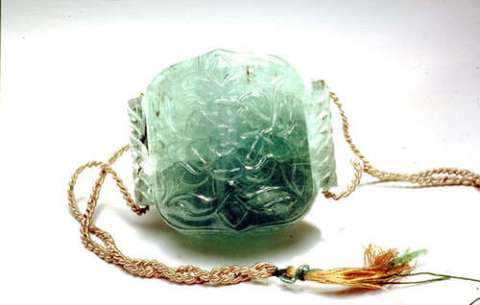
Agra Emerald
© Programa Royal Collections. Agrupación Europea de Interés Económico 2006
History of the Agra Emerald
Modern technique used by Gaston Giuliani et al in tracing the source of an emerald
It would have been very interesting to find the exact country of origin of the Agra Emerald, using the latest oxygen isotopic analysis method. The method developed by a team of research scientists led by Gaston Giuliani of the Petrographic and Geochemical Research Center in Vandoeuvre-les-Nancy, France, makes use of the Oxygen isotope ratio O18/O16 in the molecules of emeralds generated from the surface of the emerald crystal using an ion microprobe, which leaves only a microscopic hole on the surface a few microns in diameter, not visible to he naked eye. Each emerald deposit in the world has its own characteristic O18/O16 ratio. The researches prepared a table of O18/O16 ratios of 62 emerald deposits from 19 countries around the world. To find the source of a given emerald the O18/016 ratio of the emerald is determined using Gaston Giuliani's technique and compared with the reference table of 62 emerald deposits, which identifies the source of the emerald very accurately.
The technique reveals the actual source of the emeralds from the treasury of the Nizam of Hyderabad
The use of the technique had served to identify the actual source of some of the old emeralds previously thought to have originated in the old world. Of particular interest are the four emeralds that previously belonged to the treasury of the Nizams of Hyderabad of India, who ruled the Southern Indian Princely State from 1724 to 1948. According to legend and folklore these emeralds were believed to have originated from the long-lost Indian emerald mines of unknown location. The oxygen isotope analysis revealed that three of these emeralds actually originated from Colombia, each from a different mine in Colombia, and the fourth one from a mine in Afghanistan. Thus the tests reveal that Afghanistan was also a possible source of Old World emeralds, prior to the discovery of emeralds in Colombia.
The technique reveals that Swat Valley in Pakistan and Afghanistan were also ancient sources of emeralds besides Egypt and Habatchal in Austria
Giuliani and his team also studied four ancient emeralds belonging to the National Museum of Natural History in Paris, France. The oldest emerald examined was part of an earring from the Gallo-Roman site of Miribel in France. Another emerald was the 51.5-carat emerald mounted on the Holy Crown of France by the crusading Louis IX in the 13th century. The remaining two emeralds were once the property of the 18th century French mineralogist Abbé Hauy.
Prior to 1537 when the Spanish conquistadors conquered the Chibchan Indian territory, and subsequently discovered the first emerald mines in Southern America, the only source of emeralds in the Old World were thought to be the Egyptian mines, exploited by the Pharos since the 3rd century B.C. and the mines of Habatchal, in Austria, captured by the Celts. The four emeralds of the National Museum of Natural History in Paris, were assumed to have originated either from the Egyptian or the Austrian mines. Testing the emeralds using Giuliani's technique revealed that oldest Gallo Roman emerald actually originated from the Swat Valley in Pakistan and not from Egypt the most ancient source. This was a shocking revelation that revealed another possible source for ancient emeralds. The emeralds from the Swat Valley and Afghanistan would have reached Rome, via the ancient silk route, that passed through the Peshawar, Swat and Kabul valleys.
Tests conducted on the emerald in the Holy Crown of France confirmed the previous gemological work that pointed to its Austrian origin. Likewise one of the emeralds of Abbé Hauy was also shown to be of Austrian origin, and the other from Egypt.
The technique confirms that an emerald recovered from the Atocha wreckage was from a mine in Colombia
The ninth emerald studied by Giuliani and his team, was an emerald recovered from the wreckage of the Spanish Galleon Nuestra Senora de Atocha, and belonging to the Mel Fisher Maritime Heritage Society, in Key West, Florida. The Galleon sank off the coast of Florida in 1622, when it was caught up in a hurricane in the Caribbean, during the peak period of the hurricane season in September. Tests done on this emerald confirmed that it was of Colombian origin, and actually originated from the Tequendama mine in Colombia.
The source of the Agra Emerald
The source of the "Agra Emerald" is stated to be Colombia according to he website of the Programa Royal Collections. However it is not known whether the modern technique of oxygen isotope analysis was performed on the Agra Emerald to confirm its country of origin. Even if such an analysis was not performed, from our updated knowledge of the sources of Old World emeralds, we are now in a position to make a better prediction of the possible sources of the "Agra Emerald." Considering the period in which the emerald first appeared, viz. the great Mogul Period from 1526 to 1707, the possible sources of the "Agra Emerald" would have been Colombia, Afghanistan or the Swat Valley in Pakistan. The period roughly corresponds to the peak period of production of emeralds in the Somondoco (Chivor) and Muzo mines of Colombia. But, emeralds would also have reached the Mogul empire during this period from Afghanistan and the Swat Valley in northwestern India (presently Pakistan).
How emeralds from Colombia reached India ?
The emeralds mined from the two main mines in Colombia, the Muzo and Somondoco (Chivor) mines, together with gold and silver also mined in Colombia were eventually loaded on to the Spanish Galleons at the port city of Cartagena. These galleons then called at the port city of Portobello in Panama to load the enormous quantities of silver and some gold mined in Peru, that arrived by mule train from Panama City on the west coast, where it was off loaded by the Spanish Pacific fleet operating on the west coast of Southern America. The Galleons then sailed to Havana in Cuba, where they waited for other ships bringing cargo bound for Spain from port city of Vera Cruz in the Gulf Coast of Mexico. This cargo included gold and silver from Mexico, and silk and porcelain from China that was brought by the Pacific fleet from China via the Philippines and off loaded at Acapulco on the west coast of Mexico. The goods were then transported from Acapulco to Veracruz by mules. The fleet of Ships then set sail from Havana through the Straits of Florida and across the Atlantic to Spain.
From Spain after the Spanish Royal family had taken their share of emeralds, the remainder was exported to other countries in Europe and Asia. Most of the Colombian emeralds were exported to the three Islamic monarchies in the Middle east and Asia. These were the Ottoman empire, the Persian empire and the Mogul empire in India. Any consignment of emeralds for Turkey would have been sent by ship across the Mediterranean directly to any one of the ports on the Mediterranean coast of Turkey. It was possible that emeralds bound for Iran and India might have also taken this route, by following the land route after off loading in Turkey. The other route by which emeralds from Spain would have reached Iran and India was round the cape, and across the Indian Ocean and the Arabian Sea. A third route by which emeralds from Spain would have reached India, was the western route across the Atlantic, and the Gulf of Mexico to Veracruz, and then overland to Acapulco, and then across the Pacific, via Philippines to India. The emeralds reaching India was purchased by agents of the Mogul emperors using gold or silver bullion as currency. It is on record that when Nadir Shah invaded Mogul India in 1739 he carried away several chests full of loose emeralds, besides other precious stones such as pearls, rubies, diamonds and sapphires. The Peacock Throne of Shah Jahaan, the most splendorous throne, ever made in the history of mankind, and also carried away by Nadir Shah, was said to be incorporated with 116 emeralds, 108 rubies, and innumerable pearls and diamonds.
Processing of emeralds in Mogul India
The emeralds purchased by the Mogul emperors entered the treasury of the Mogul empire in Delhi, and were processed by the craftsmen of the Mogul court. Around that time the common cutting styles adopted for emeralds were the cabochon-cut and the table-cut, simple cutting styles that suited the normally included, somewhat brittle emeralds. Most of the emeralds in the Iranian crown jewels, which originated during this period, both loose and set emeralds, are all cabochon-cut emeralds. The emerald-cut usually employed for emeralds nowadays was not developed during that period.
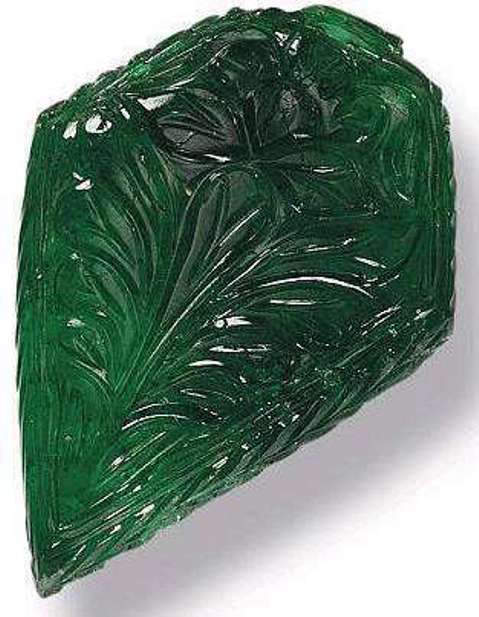
Heavily included emeralds that were opaque but nevertheless of perfect vivid green colors were cut as lasque or table-cut stones and used for engraving with floral patterns and Arabic calligraphy as seen in the Agra and Mogul Emeralds. A 64.99-carat kite-shaped emerald engraved with a floral pattern and undoubtedly belonging to this period is given in the photograph below, but information concerning this emerald and its present owner are not available. Readers who may have more information on this emerald are kindly requested to provide the same as comments to this web page.
Photograph (below) of an unknown 64.99-carat kite shaped engraved emerald. Please provide any information available as comments.
Corazon Emerald
Characteristics of the Corazon Emerald
The 456.50-carat "Corazon Emerald" is the largest faceted emerald in the emerald collection of the Programa Royal Collections. This emerald is a gem- quality stone with good clarity and transparency and perfect grass-green color characteristic of the Muzo emerald mines of Colombia. The perfect heart-shaped cut of the emerald, though unconventional enhances the beauty of the stone.
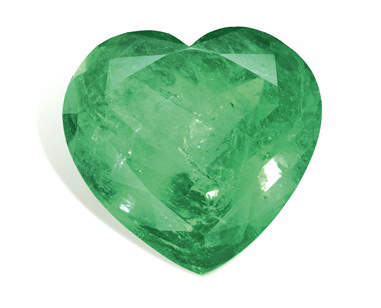
Corazon Emerald
© Programa Royal Collections. Agrupación Europea de Interés Económico 2006
What prompted the unconventional heart-shaped cut for the Corazon Emerald ?
Conventionally emeralds are cut as "emerald-cut" stones, a shape and cut developed particularly for emeralds, because of its decreased toughness due to the presence of inclusions, even though the hardness of emeralds is quite high, being 7.5 to 8.0 on the Mohs scale. The emerald-cut is a rectangular or square shaped step-cut, with beveled corners that not only brings out the intrinsic beauty of the stone but also protects it from mechanical strain, during and after the cutting process. It is not known why a heart-shaped cut was imparted to the "Corazon Emerald." Emerald cutters normally would not take a risk in trying to cut an emerald in a shape other than the conventional "emerald-cut." This is because of the brittleness of the material and the enormous cost of the gemstones. However if the emerald has less inclusions which necessarily means enhanced toughness of the material, shapes and cuts other than the conventional emerald-cut may be tried out. This is exactly what the cutters of Zambian emeralds have resorted to, because Zambian emeralds are normally free of inclusions and has a greater toughness than emeralds from other sources, enabling the cutters to try out all possible cuts and shapes other than the "emerald cut." Likewise, the heart-shaped cut employed for the "Corazon Emerald" was probably prompted because of its relatively inclusion-free status.
History of the Corazon Emerald
The "Corazon Emerald" is of Colombian origin according to the website of the Programa Royal Collections. But, information about its mine of origin, the date of discovery of the rough emerald, the weight of the rough emerald, the original owners of the emerald, the purchase price of the emerald, the name of the cutter or cutters involved in cutting and polishing the emerald etc. are not provided. Readers who may have more information about the "Corazon Emerald" are kindly requested to provide such information as comments to this web page.
The Jaipur Emerald
The "Jaipur Emerald" is listed under the Special Exhibitions Category, which constitutes 20 gemstones of extraordinary size and gemological quality, together with the "Agra Emerald" and the "Corazon Emerald." Some of these gemstones are the world's largest in their category. eg. The 31,000-carat emerald-cut El-Dorado Topaz is the largest faceted topaz in the world. The weight of the "Jaipur Emerald" is given as 220 carats, which is a significant size for a cut and polished emerald. The cut of the Jaipur Emerald is given as old Indian cut. This necessarily means that the emerald had originated somewhere between the 16th and 18th centuries. Apart from the cut and weight of the "Jaipur Emerald" other relevant information concerning the emerald are not available.
Jaipur is the capital city of Rajasthan State in Northwestern India, and was the former capital of the princely state of Jaipur. The city can boast of a gem and jewelry trade that dates back to several centuries. Jaipur is also one of the world's largest centers for gemstone cutting and polishing, and today around 80-85 % of the emeralds worldwide are cut in Jaipur.
Other smaller emeralds
Apart from the three large emeralds dealt with above that are included under the Special Exhibitions, the Programa Royal Collections also has over a thousand smaller emeralds weighing over 2,600 carats. These emeralds are of various shapes and sizes and originating from different emerald producing areas in the world. The six emeralds shown in the photograph are all cabochon cut emeralds belonging to this group. These emeralds have excellent color, clarity and transparency, and are undoubtedly of the highest quality.
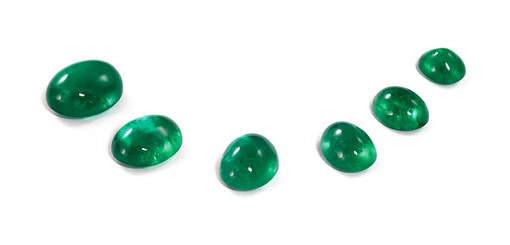
© Programa Royal Collections. Agrupación Europea de Interés Económico 2006
Emeralds are included in all categories of exhibitions of the PRC
The Programa Royal Collections containing over 500,000 carats of gemstones are organized into three categories of Exhibitions.
1) Treasures of the Earth - This is the main collection consisting of 15,000 gems weighing 250,000 carats. This collection is divided into two exhibitions -Gemological Exhibition 1 and Gemological Exhibition 2.
Gemological Exhibition 1 - Consists of 250,000 carats of gemstones derived from both the Treasures of the Earth Collection and the Special Exhibition Gems representing all varieties and categories of gemstones. Under the Emerald category the exhibition includes the Agra Emerald (350 carats) and Corazon Emerald (456 carats) from the Special Exhibition Gems and about 1000 smaller emeralds weighing more than 2,600 carats.
Gemological Exhibition 2 - Consists of 150,000 carats of faceted gemstones derived from both Treasures of the Earth and the Special Exhibition Gems and including all varieties of gems. The gemstones under the emerald category are the Corazon Emerald weighing 456 carats and about 226 emeralds weighing more than 1,400 carats.
2) Special Exhibition Gems - This collection brings together 20 outstanding gems selected mainly for their outstanding sizes and quality. The total weight of the collection is 117,000 carats and includes the 31,000-carat El-Dorado Imperial Topaz and several other enormous gemstones. The Agra Emerald, the Corazon Emerald and the Jaipur Emerald belong to this collection.
3) Single Theme Exhibitions - Single theme collections specialize on a single class or variety of gems, and the PRC has created over 50 such single-theme collections. Some of these collections are "Imperial and Noble" consisting of 58,000 carats of topaz gemstones; "Brilliant Rainbow" consisting of 300 carats of colored diamonds that includes all colors of the rainbow as well as brown, black and grey diamonds; "Water Flames" a collection of opals; "Organic Gems" a collection of gems of organic origin such as pearls, corals, nacre, ivory, amber etc.
Emeralds are included under the heading "Her Highness the Beryl" which includes a collection of beryls such as emeralds, aquamarine, morganite and goshenite.
All the above exhibitions are given out on hire under various terms and conditions set by the PRC, and can be tailor-made to suit the requirement of the hosting organizations, such as available exhibition space, theme requirements, exhibition style, target audience etc.
You are welcome to discuss this post/related topics with Dr Shihaan and other experts from around the world in our FORUMS (forums.internetstones.com)
Related :-
External Links :-
References
1.Website of the Programa Royal Collections.
2.Science Daily - January 31, 2000.
3.Where the gems are - emeralds - Brief Article, Science News, March 11, 2000.
 Home
Security & Guarantee
How it Works
Technology Partners
Updated Tables
Famous Diamonds
More Famous Diamonds
Famous Pearls
Famous Gemstones
Contact Dr Shihaan Larif
Contact Senior Editor
Famous Jewelry
Reference Database
Forums
Learning Center
Gemstone Gallery
e-mail Notifications
Advertise
Press Release
About Us
Privacy Policy
Contact Us
FAQ'S
Site Map
Staff Mail Login
Staff Documents
Birthstones
History
Minerals
Shows
Live Metal Prices
Jewellery Gallery
News
Marketplace
Marketplace Support
Open Store
Online Auctions
Join Us & Contribute
Directory
Classifieds
List your products
Wholesale Trading
Post Buy Request
Go Green Policy
Site Updates
Upcoming-ToDo List
Latest News
Latest Articles
Latest Blog Updates
Chat Rooms
Job Board
User Gallery
Videos
New Newsletter Archive
Old Newsletter Archive
Jewelry & Mineral Blog
User Blogs & Social Network
Search
Answers (Q & A)
Valuation
Help me find a diamond/jewelry
pin.internetstones.com- Social Pinboard- Sart yours & connect with millions
Invite Friends From Yahoo, Gmail etc-One Click
Home
Security & Guarantee
How it Works
Technology Partners
Updated Tables
Famous Diamonds
More Famous Diamonds
Famous Pearls
Famous Gemstones
Contact Dr Shihaan Larif
Contact Senior Editor
Famous Jewelry
Reference Database
Forums
Learning Center
Gemstone Gallery
e-mail Notifications
Advertise
Press Release
About Us
Privacy Policy
Contact Us
FAQ'S
Site Map
Staff Mail Login
Staff Documents
Birthstones
History
Minerals
Shows
Live Metal Prices
Jewellery Gallery
News
Marketplace
Marketplace Support
Open Store
Online Auctions
Join Us & Contribute
Directory
Classifieds
List your products
Wholesale Trading
Post Buy Request
Go Green Policy
Site Updates
Upcoming-ToDo List
Latest News
Latest Articles
Latest Blog Updates
Chat Rooms
Job Board
User Gallery
Videos
New Newsletter Archive
Old Newsletter Archive
Jewelry & Mineral Blog
User Blogs & Social Network
Search
Answers (Q & A)
Valuation
Help me find a diamond/jewelry
pin.internetstones.com- Social Pinboard- Sart yours & connect with millions
Invite Friends From Yahoo, Gmail etc-One Click




Our Global Jewelry Industry Job Network


Buy & Sell in our Marketplace

Subscribe to our Newsletter

List in our Classifieds

List in our Directory

User Uploaded Gallery

Powered by Ultra Secure
Amazon (USA) Cloud Network

Founder Internet Stones.COM
Register in our Forums

| Featured In
|
|
|
|
|
|
|
|







Blog & Education Feed
Articles Feed
 |
 |
 |

Copyright © .Internet Stones.COM. All rights reserved.