Gachala Emerald
Open FREE Unlimited Store Join Our Newsletter
Origin of name
The 858-carat "Gachala Emerald" described as one of the most beautiful emerald gemstones ever known, gets its name from the mining district where the "Vegas de San Juan" mine that produced the renowned gemstone was situated. Though lighter in color the Gachala emeralds were cleaner with less inclusions and more transparent than emeralds produced in other regions of Colombia, such as Muzo, Cosquez, and Chivor. Besides the "Gachala Emerald," the Gachala emerald mines have also produced some spectacular gemstones, such as 7,025-carat "Emilia Emerald" and the massive 16,020-carat "El Monstro Emerald."

The Gachala emerald mining district is situated east of Bogota, the capital city of Colombia, at the southeastern end of the NW-SE emerald belt, in the "Cordillera Oriental" region of the Colombian Andes Mountain. Unlike the Muzo, Chivor and Cosquez mines which have a recorded history dating back to the 16th century, to the Spanish colonization of South America, or according to archaeological evidence perhaps to the 10th century B. C. to the beginnings of one of the earliest human civilizations of the Muisca people, the Gachala emerald mines are of contemporary origin discovered only in 1956.
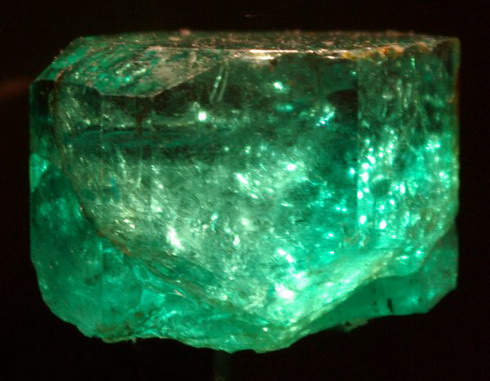
Image above is under creative commons license
Characteristics of the gemstone
One of the largest gem-quality emerald crystals in the world
The "Gachala Emerald" is a hexagonal short prism, conforming to the normal crystal habit of emeralds and having a height of 5 cm and a diameter of almost the same length. The hexagonal shape of the crystal is more evident at upper end of the crystal, but it is not a regular hexagon, with two opposite sides of the hexagon shorter than the other four sides. The six sides of the crystal can be identified even on the sides of the crystal, even though the crystal looks more cubical than hexagonal from the sides. The color of the crystal is a pure deep green, and the crystal appears to be opaque. Unless the crystal is polished we may not be able to say anything about the diaphaneity of the gemstone. But, it is well known that most of the Gachala emeralds have good transparency and shine with increased brilliance. The "Gachala Emerald" is one of the largest gem-quality emerald crystals in the world.
Composition, structure and color of emeralds
Emeralds which are beryls, belong to the sub-class cyclosilicates of the main class of minerals called silicates, the predominant class of minerals found on the earth's surface. In cyclosilicates six tetrahedral silicate ions (SiO4)‾ are linked together, after the elimination of an oxygen atom, to form a regular hexagonal ring [(SiO3)6]‾ with an overall negative charge of 12, which is balanced by the 12 positive charges on two Al3+ ions and three Be2+ ions , that hold the rings together in the crystal structure, giving an overall chemical formula of Be3Al2(SiO3)6 The regular hexagonal shape of the ring is usually reflected in the final crystal habit of emerald, which is also hexagonal.
Pure beryl is colorless, but if some of the aluminum atoms in the crystal are replaced by chromium and/or vanadium atoms, a green color is imparted to the crystals, known as emerald. Chromium atoms alone or when chromium predominates over vanadium a deep vivid green color is produced, as in the case of the Gachala emerald. But if significant quantities of vanadium is also found together with chromium, a bluish green color is produced as the emeralds of the Chivor mines and the Zimbabwean emeralds.
Characteristic features of emeralds
The characteristic features of emeralds include the following :-
1)The presence of inclusions - The presence of cracks, fissures and other inclusions is a characteristic feature of all naturally occurring emeralds, signifying their turbulent genesis, in hydrothermal veins, pegmatites and contact zones of igneous intrusions into the surrounding aluminous schist, shale or limestone. The presence of three phase inclusions, solid, liquid and gaseous, is typical of Colombian emeralds. Some of the solid inclusions found in emeralds are calcite, parisite, pyrite, albite, tremolite, tourmaline and biotite. The type of inclusions seem to vary with the source of the emerald.
The presence of flaws and inclusions had necessitated attempts to reduce their appearance in the crystal, by oil treatment, which is generally accepted in the trade. The oil used should have a refractive index comparable to the emerald, to render the cracks and fissures invisible. Such an oil is cedarwood oil.
2) Fragility of emeralds - In spite of the good hardness of emeralds which is 7.5 to 8.0 on the Mohs scale, emeralds are somewhat fragile - a character imparted by the presence of flaws and inclusions - and therefore difficult to work with. The rectangular or square shaped step-cut with beveled corners, known as the emerald-cut, specially developed for emeralds, reduces the mechanical strain on the crystal, while at the same time bringing out the intrinsic beauty of the stone.
3) Low specific gravity - The specific gravity of emeralds is low and varies between 2.67 to 2.78. The specific gravity seem to vary with the source of the emerald.
4) Low refractive index - The refractive index of emerald is also quite low and varies between 1.565 and 1.599. It also varies with the source of the emerald.
5) Low dispersion - Emeralds have a low dispersion of 0.014. The low dispersion, and refractive index of emerald reduces the "fire" of the stone, but this is compensated to some extent by the vitreous luster, the vivid green color, transparency, and the special emerald-cut of the gemstones.
6) Distinct dichroism - Emeralds have a distinct dichroism, changing from blue-green to yellow-green.
7) Lack of fluorescence in u-v light - Natural emeralds do not fluoresce in ultra-violet light, and sometimes show a very weak orange-red or green fluorescence.
Special features of Gachala emeralds
Gachala emeralds are generally cleaner, with less flaws and inclusions than emeralds from other mines in Colombia, such as Muzo, Coscuez and Chivor. The emeralds are generally "eye clean" with good clarity, transparency and brightness. However, their color is generally pale green. In emeralds color is a crucial factor that determines their value, the darker vivid green colors, in spite of the presence of inclusions, commanding the highest prices as compared to the pale green but much cleaner stones. Unfortunately in emeralds the best green colors seem to be the most included.
History of the Gachala Emerald
Source of the emerald
The source of the "Gachala Emerald" was the "Las Vegas de San Juan" mine, situated in the Gachala mining district, of Cundinimarca Province, of Colombia. The "Gachala Emerald" was discovered in the year 1967.
The Gachala emerald deposits were discovered in the year 1954, when an emerald was discovered in the "Las Vegas de San Juan" area. An immediate rush by illegal prospectors (guaqueros) to the area led to the discovery and disappearance of large quantities of fine stones, before the intervention of the government to open up the area for legal mining.
Almost all the known emerald deposits of Colombia lie in a northwest-southeast (NW-SE) belt running across the Andes mountain range, also known as the "Cordillera Oriental," on the northern and eastern side of the capital city of Bogotá. Muzo, Coscuez and Pena Blanca emerald mines lie at the northwestern end of this belt, and Gachala, Chivor and Guateque lie at the southeastern end. The Nemecon, Chirvaneque, and Raquira-Tinjaca emerald mines, lie almost on a line northeast of Bogotá, somewhere in the middle of the belt. Some geologists refer to the mines situated towards the northwestern end of the belt as the western emerald belt and the mines situated at the southeastern end of the belt as the eastern emerald belt. The western emerald belt is sometimes referred to as the Vasquez-Yacopi mining district and the eastern emerald belt as the Guavio-Guateque mining district.
The mines of the Vasquez-Yacopi mining district are :- the Muzo mine at Muzo, the Cosquez mine at Muzo, La Glorieta mine at Yacopi, Cunas mine at Maripi, and Polveros mine at Maripi.
The mines of the Guavio-Guateque mining district are :- Chivor mine at Chivor, the Gachala mine at Gachala, the Matacana mine at Gachala, and the Macanal mine at Macanal.
In the Guavio-Guateque mining district, where the Chivor and Gachala mines are situated the rocks are mainly shale and sandstone, and emerald crystals are found in veins containing pyrite, quartz and albite. Recent geological and palaeontological studies conducted by the Center for Petrographic and Geochemical Research, in the Gachala region, have shown that the emerald deposits are at least 65 million years old arising from a much older (135 million years) Lower Cretaceous fossiliferous sedimentary bed bearing cavities left by the dissolution of the calcareous shells of fossilized gastropods. The hot mineralizing fluids from the magma flowed into the sedimentary rocks filling the fractures, shear zones, faults and particularly cavities left by the dissolution of the fossilized gastropod shells, which subsequently precipitated to form emerald crystals.
The Gachala Emerald is purchased by Harry Winston
The "Gachala Emerald" that was discovered in 1967 in the "Vegas de San Juan" mine in the Gachala district, was purchased by Harry Winston, the New York based jeweler and diamond dealer, who later donated the rare crystal to the National Museum of Natural History of the Smithsonian Institution. Harry Winston had in November 1958, donated the infamous 45.52-carat, fancy dark grayish blue "Hope Diamond" to the Smithsonian Institution, after owning it for nearly 10 years since be purchased it in 1949. The curse of the "Hope Diamond" that had adversely affected so many previous owners had apparently not affected Harry Winston, even though he held the diamond for almost a decade. In fact his business prospered and expanded after he purchased the "Hope Diamond," and he lived up to the ripe old age of 82 years, and died only in December 1978 of a natural cause, a heart attack. In the year 1963, the Smithsonian Institution had acquired the 127.02-carat, colorless "Portuguese Diamond" from Harry Winston in exchange for 2,400 carats of small diamonds.
Harry Winston, who set up the renowned Harry Winston Diamond Corporation, which operates seven salons in the United States and ten salons in other countries, was not only a "King of Jewelers" but also a "Jeweler to Kings" and royal families around the world. Besides being a skilled jewelry designer, Harry Winston also designed crowns and tiaras for the royalty around the world. Harry Winston was responsible for designing Empress Farah Diba's tiara on the occasion of her marriage to Shah Mohammed Reza Pahlavi held in 1958, and also the "Farah's Favorite Tiara" made out of emeralds and diamonds, which she wore on formal occasions, such as during her husband's official visit to the United States and Canada in 1965.
During his lifetime as a jeweler, around 30 famous diamonds had passed through his hands, which are now found in collections around the world, both museum as well as private collections. Some of these diamonds are the Idol's Eye, the Indore Pears, the Jonker, the Liberator, the Lesotho, the Nassak, the Niarchos etc.
The Gachala Emerald is exhibited at the Smithsonian's NMNH
The "Gachala Emerald" is now exhibited as part of the National Gem Collection, in the Janet, Annenberg Hooker Hall of Geology, Gems and Minerals, of the Smithsonian's National Museum of Natural History, together with other famous emeralds such as the Mackay Emerald Necklace, the Hooker Emerald Brooch, Chalk Emerald Ring, Maximilian Emerald Ring, the Spanish Inquisition Necklace and other more famous exhibits such as the Hope Diamond, the Portuguese Diamond etc.
The Gachala Emerald exhibited at the Tucson Show of February 2003
The "Gachala Emerald" was exhibited at the 49th Tucson Gem & Mineral Society show held in February 2003. The show that was held between February 13th to 17th, opened with an evening reception and talk by Michael Scott, former president of Apple Computer Company, who is also a collector and connoisseur of gemstones and minerals. The theme of the show in 2003, was the "Minerals of the Andes." Several private collectors and museums took part in the show, who exhibited a wonderful selection of specimens of Andes origin, as well as from other sources.
The show was a spectacular success, with the array of exhibits displayed said to be one of the best ever. About two dozen museums took part in the show, and brought out their best exhibits. The Star attraction among the exhibits displayed by the National Museum of Natural History of the Smithsonian Institution, was the 858-carat "Gachala Emerald," of Andean origin, which was exhibited together with the famous Marjorie Merriweather Post emerald necklace, whose 24 baroque polished round emeralds are also of Colombian origin. Among the other mineral specimens of Andean origin exhibited by the Smithsonian Institution, included two proustites, a Bolivian phosphophyllite crystal accompanied by a faceted gem of 26.9 carats, and other rare specimens like franckeite, andorite, helvite, and canfieldite.
Among the private collectors who displayed notable exhibits that received much attention were Michael Scott, Gene and Roz Meieran, Bill Larson, Rock Currier, Steve and Clara Smale and W. R. Danner.
You are welcome to discuss this post/related topics with Dr Shihaan and other experts from around the world in our FORUMS (forums.internetstones.com)
Related :-
2) The Duke of Devonshire Emerald
References
1.Gem by Gem -Beryls - Website of International Colored Gemstone Association.
2.The Green Fire of Emeralds, The Gemstone Forecaster Vol. 14 No. 1 - Part One
3.Gem by Gem - Emerald - Website of International Colored Gemstone Association.
4.Harry Winston - Wikipedia, the free encyclopedia.
5.Show highlights of the 49th TGMS Show - Mineralogical Record 2004
6.The Emerald Deposits of Muzo, Colombia - Joseph E. Pogue, Transactions of the American Institute of Mining Engineers, Vol LV, 1917.
7.Emerald - A Cyclosilicate - Edna B. Anthony, the New Mexico Facetor.
8.GEO 347K GEM NOTES, Beryl - Website of the Department of Geological Sciences, University of Texas, Austin.
 Home
Security & Guarantee
How it Works
Technology Partners
Updated Tables
Famous Diamonds
More Famous Diamonds
Famous Pearls
Famous Gemstones
Contact Dr Shihaan Larif
Contact Senior Editor
Famous Jewelry
Reference Database
Forums
Learning Center
Gemstone Gallery
e-mail Notifications
Advertise
Press Release
About Us
Privacy Policy
Contact Us
FAQ'S
Site Map
Staff Mail Login
Staff Documents
Birthstones
History
Minerals
Shows
Live Metal Prices
Jewellery Gallery
News
Marketplace
Marketplace Support
Open Store
Online Auctions
Join Us & Contribute
Directory
Classifieds
List your products
Wholesale Trading
Post Buy Request
Go Green Policy
Site Updates
Upcoming-ToDo List
Latest News
Latest Articles
Latest Blog Updates
Chat Rooms
Job Board
User Gallery
Videos
New Newsletter Archive
Old Newsletter Archive
Jewelry & Mineral Blog
User Blogs & Social Network
Search
Answers (Q & A)
Valuation
Help me find a diamond/jewelry
pin.internetstones.com- Social Pinboard- Sart yours & connect with millions
Invite Friends From Yahoo, Gmail etc-One Click
Home
Security & Guarantee
How it Works
Technology Partners
Updated Tables
Famous Diamonds
More Famous Diamonds
Famous Pearls
Famous Gemstones
Contact Dr Shihaan Larif
Contact Senior Editor
Famous Jewelry
Reference Database
Forums
Learning Center
Gemstone Gallery
e-mail Notifications
Advertise
Press Release
About Us
Privacy Policy
Contact Us
FAQ'S
Site Map
Staff Mail Login
Staff Documents
Birthstones
History
Minerals
Shows
Live Metal Prices
Jewellery Gallery
News
Marketplace
Marketplace Support
Open Store
Online Auctions
Join Us & Contribute
Directory
Classifieds
List your products
Wholesale Trading
Post Buy Request
Go Green Policy
Site Updates
Upcoming-ToDo List
Latest News
Latest Articles
Latest Blog Updates
Chat Rooms
Job Board
User Gallery
Videos
New Newsletter Archive
Old Newsletter Archive
Jewelry & Mineral Blog
User Blogs & Social Network
Search
Answers (Q & A)
Valuation
Help me find a diamond/jewelry
pin.internetstones.com- Social Pinboard- Sart yours & connect with millions
Invite Friends From Yahoo, Gmail etc-One Click




Our Global Jewelry Industry Job Network


Buy & Sell in our Marketplace

Subscribe to our Newsletter

List in our Classifieds

List in our Directory

User Uploaded Gallery

Powered by Ultra Secure
Amazon (USA) Cloud Network

Founder Internet Stones.COM
Register in our Forums

| Featured In
|
|
|
|
|
|
|
|







Blog & Education Feed
Articles Feed
 |
 |
 |

Copyright © .Internet Stones.COM. All rights reserved.