Gogibus Pearl
Open FREE Unlimited Store Join Our Newsletter
Origin of Name :-
The name refers to a pear-shaped, white pearl of excellent orient, with a weight of not less than 126 carats (504 grains), originating in the New World, and reputed to be the largest pearl in Europe in the early 17th-century, brought to Spain in 1620 from the West Indies by Spanish merchant Francois Gogibus, a native of Calais, who sold it to Philip IV of Spain. Thus the name of the pearl reflects the name of the original owner of the pearl, who purchased it in one of the islands of the West Indies, when he joined one of several fleets of Spanish ships that sailed to the New World, after Christopher Columbus discovered pearls for the first time in Venezuela, during his third voyage in 1498

Characteristics of the Gogibus Pearl
The weight of the pearl
The Gogibus Pearl is a pear-shaped pearl which according to G. F. Kunz weighed no less than 126 carats (504 grains). Thus, the exact weight of the Gogibus Pearl is not known. The minimum range of the pearl's weight is given, but not the maximum range. Thus, a pear-shaped, white, saltwater pearl with an excellent luster and orient believed to be of 17th-century origin, and weighing approximately 143 carats, that appeared recently in the website of Paul Fraser Collectibles, and has been offered for sale might well be the long-lost Gogibus Pearl, as claimed in the website.
The shape of the pearl
The shape of the pearl is pear-shaped according to Kunz's account in the "Book of the Pearl." GIA classifies pearls into three basic shapes :- 1) Spherical 2) Symmetrical and 3) Baroque. Pear-shape comes under the category of symmetrical pearls. These are pearls having a single line of symmetry through which the pearl can be divided into two equal halves. Other shapes that come under symmetrical are oval shape, drop shape and button shape. Being pear-shaped one end of the pearl is broader and the other end narrower. The maximum height and width of a pear-shaped pearl, are two of the dimensions that commonly denote its size. But, these dimensions are not known.
The color and overtones of the pearl
The color of the pearl is white, the most sought-after color in saltwater pearls. The source of saltwater pearls in the Caribbean, is the Atlantic pearl oyster species Pinctada imbricata, which produces three main color grades of pearls - white, yellow and pink. The white color of the pearl is associated with the lack of color-causing pigments, that usually combine with the protein part of nacre, conchiolin. In the absence of pigments, the white color of aragonite platelets (calcium carbonate), the other component of nacre shows through.
It is not known whether the pearl was associated with any overtone colors, such as silver, rose or cream. However, the pearl that is claimed to be the long-lost Gogibus Pearl, has a silvery-white color, in which white represents the body color and silver, the overtone color. Overtones colors, that are overlying colors, appearing to float over the surface of the pearl, are caused by an optical effect like iridescence, due to interference of light as it passes through the alternating layers of aragonite and conchiolin.
The luster and orient of the pearl
Being a saltwater pearl, the luster and orient of the pearl must be exceptional. Kunz described the pearl as having the finest orient. Orient also known as iridescence is an optical property caused by the scattering of light as it passes through alternating layers of aragonite and conchiolin in the nacre. Luster of a pearl is a measurement of the quality and quantity of light that reflects from the surface and just under the surface of the pearl. The luster of a pearl, like its orient and overtones, depend on the thickness of the nacre. Most natural pearls like the Gogibus Pearl, have undergone their full course of development under natural conditions, inside the pearl oyster before they were discovered, and are made up of 100% nacre. Thus, their luster, orient and overtones are usually exceptional.
History of the Gogibus Pearl
What George Frederick Kunz says about the "Gogibus Pearl" in his book "The Book of the Pearl" ?
Chapter 16 : Famous Pearl Collections. Page 461
The Gogibus Pearl - This famous pearl said to have been the largest in Europe, weighed no less than 126 carats (504 grains). It was pear-shaped and of fine orient, and was brought from the West Indies, in 1620, by Francois Gogibus, a native of Calais, who sold it to Philip IV of Spain. As no match could be found for this magnificent gem, it was mounted as a button in the royal cap. (Robert de Berquen, "Les Merveilles des Indes Orientales et Occidentales," Paris, 1661, p. 78)
Chapter 13 : Value & Commerce of Pearls. Page 350
Many times a dealer put nearly all that he possessed into a fine pearl or necklace, frequently without a reward; often gradually buying more and more, hoping for some great patron to relieve him. When the client appears, there is happiness, but when he does not, there is woe. This instance is well illustrated when Philip IV of Spain asked of the merchant Gogibus: "How have you ventured to put all your fortune into such a small object?" "Because I knew there was a king of Spain to buy it of me," was the quick reply. And Philip rewarded the faith of the jeweler by purchasing the pearl.
Discovery of pearls in the New World by Christopher Columbus in 1498.
Pearls were discovered for the first time in the New World in 1498, off the coast of Venezuela, by Christopher Columbus, during his third voyage. But, Columbus had to pay a high price for this discovery, for he was arrested and brought back to Spain in chains, for failing to report the discovery in time to the King of Spain. The news of the discovery had reached the king long before the discovery was reported by Columbus himself, and the king ordered his immediate arrest.
The discovery of pearls was actually accidental, as Columbus reached the Island of Cubagua, off the Caribbean coast of Venezuela. Inquisitive about the fishing activities of a boatload of native fisherman, Columbus sent a team of his own sailors in one his boats to find out. The sailors followed the boat to the shore, and when they approached the boat to have a closer look, a sailor saw a woman with a string of pearls around her neck. The sailor who had carried a dish of Malaga with him, was able to exchange the dish for some strings of pearls, large and white. Columbus who was surprised to see such large white pearls, immediately ordered more sailors to the shore, carrying useful items like needles, scissors, knives, buttons etc. to be bartered for pearls. The second batch of sailors returned with around 48 ounces of pearls, with several good quality pearls among them. Columbus who was surprised to see the pearls, declared to his sailors, "We are in the richest country of the world. Let us give thanks to the Lord." Columbus, then left the Island of Cubagua and reached the shores of mainland Venezuela, where large crowds had gathered to see their sailing craft. He found that most of the native Indian women wore pearl necklaces and bracelets, and when he inquired from them, from where they collected them, they pointed towards the Cubagua Islands.
New Cadiz in the Venezuelan Island of Cubagua established in 1515, was the first Spanish town in the New World, that became the hub of the lucrative pearl trade
After the discovery of pearls in 1498, the king of Spain sent a second expedition in 1499, headed by Pedro Alonso Nino and a team of around 30 sailors, some of whom had accompanied Columbus on his 3rd voyage. This expedition returned to Galicia with 96 pounds of pearls. with many high-quality, round and lustrous pearls of around 5 to 6 carats or more. Nino was also accused of stealing pearls and cheating the king, but the expedition went down in history as the first financially profitable voyage to the New World. Thus, the pearl fishery at Cubagua became famous, and more expeditions were carried out by the Spanish, operating from their base in the Caribbean Islands of Hispaniola, just 900 miles away, that subsequently became Haiti and the Dominican Republic. The Spanish had a resident governor at Hispaniola, who in the early 16th-century was Diego Columbus, the son of the discoverer, Christopher Columbus. In 1508, large numbers of experienced native Indian divers were carried from the Islands of Bahamas and Lucayan, to work in the pearl banks of Cubagua, and this eventually culminated in 1515, in the establishment of the first Spanish town in the New World, called New Cadiz, on the Venezuelan Island of Cubagua. The town became the hub of the Spanish pearl trade in the New World, serving as the center for harvesting pearl oysters, and collecting pearls.
Pearls were the first natural resource exploited by the Europeans in the New World that gave substantial profits, before the discovery of mineral resources like gold, silver and emeralds
The pearl industry was the first and single greatest industry of the European people in the New World for many years, before the discovery of other mineral resources such as gold, silver and emeralds. It has been estimated that between 1513 to 1530 at least 118 million pearls were harvested from the pearl banks near Cubagua Island. In 1527, 1,380 kg of pearls were harvested by the Spanish in Venezuela. These pearls reached Seville in Spain, the principal pearl market for pearls originating in the New World, from where they reached other pearl markets in Europe, such as Venice in Italy, and Lisbon in Portugal. Apart from pearls discovered from the Caribbean coast of Venezuela and Colombia, other important locations where pearls were discovered by the Spanish, include the islands off the Pacific coast of Panama, and the Gulf of California in Mexico. The Spanish also exploited the pearl oyster resources of these locations too. The Gulf of California in Mexico, became famous for its black pearls formed in the pearl oyster species Pinctada margaritifera. Thus black pearls that reached Europe during the 16th and 17th centuries came mainly from the Gulf of California in Mexico.
Depletion of pearl oyster resources of Venezuela and Colombia in the mid-17th century led to the closure of the industry.
The continuous intensive exploitation of pearl oyster resources of Venezuela and Colombia for almost 150 years since their discovery, led to a depletion of these resources and by 1650, oysters became so scarce, that the industry had to be abandoned totally. Even after Colombia and Venezuela gained independence from Spain in 1823 and 1829 respectively, the pearl industry could not be revived, even though the oyster bearing coral reefs had been restored, after being left undisturbed for more than 150 years. This was due to imposition of heavy taxes and frequently changing government regulations that discouraged investors.
Controlled exploitation of pearl oyster resources begin after 1895
However, after 1895, concessions were granted to individuals and private companies for the exploitation of pearl oyster resources in certain defined areas, for limited periods of time, the government taking 10% of the turnover of these companies as royalties. The use of mechanical methods of harvesting that destroyed the oyster beds were totally banned. Only mechanical devices that does not remove all oysters from the bed, but help spread the oysters were permitted
Where was the Gogibus Pearl discovered ?
According to George Frederick Kunz's account of the Gogibus Pearl in his book "The Book of the Pearl," the Gogibus Pearl was brought from the West Indies in 1620, by Francois Gogibus, a native of Calais, who sold it to Philip IV of Spain. The account does not specify where the pearl was discovered. It is important to remember, that the term "West Indies" was a general term used in the 16th and 17th centuries, to refer to the entire newly discovered region by Christopher Columbus. It did not mean the West Indies Federation or the modern day West Indies, as we know it today. Garcilaso de la Vega wrote during the 16th-century, that pearls from the "West Indies" were so abundant in Seville "that they were sold in a heap in the India [custom] house ... just as if they were some kind of seed." Pearls from the "West Indies" in this account actually refer to abundant pearl supplies coming from Venezuela, the richest pearl banks in the New World. Thus, the reference to the Gogibus Pearl being brought from the West Indies in 1620, might well mean that the pearl was actually brought from Venezuela, where it was discovered. The Islands of the West Indies as we know it today, no doubt are also within the geographic range of the Atlantic pearl oyster species Pinctada imbricata. Thus, there is some possibility that the pearl might have been discovered off the coast of one of the islands of the West Indies as we know it today.
However, during the Spanish period, Islands of the Caribbean such as Cuba and Hispaniola were actually used as springboards from which further colonization and exploitation of the Americas were carried out. As pointed out earlier, Hispaniola was the regional administrative center headed by a Spanish governor, from where the exploitation of the pearl resources of Venezuela was launched, by first transferring large numbers of skilled pearl divers from the Bahamas to the Cubagua Islands, where the first Spanish township in the New World was established and came to be known as New Cadiz. By the year 1620, when the Gogibus pearl was discovered, Spain was exploiting pearl oyster resources from at least four different locations in the New World. These were the Cubagua pearl banks of Venezuela, the pearl banks off the Caribbean coast of Columbia, the pearl banks off the Pacific coast of Panama and the Gulf of California in Mexico. The Pacific coast of Panama and the Gulf of Mexico, also in the Pacific, do not fall within the range of the Atlantic pearl oyster, and cannot be the source of the Gogibus Pearl. Thus the possible sources of the Gogibus Pearl could have been the pearl banks of Venezuela or Columbia. Venezuela, was the most likely source given the volume of production of pearls :- 1,380 kg in 1527 and 118 million pearls harvested between 1513 and 1530. Pearl exploitation in Venezuela, continued until the mid-17th century, when it was abandoned due to depletion of resources.
The pearl oyster species that produced the Gogibus Pearl - Pinctada imbricata
Given the characteristics of the Gogibus Pearl, that it is a pear-shaped, white, saltwater pearl of excellent orient, the most probable oyster species in which the pearl must have been produced is the Atlantic pearl oyster Pinctada imbricata, which is closely related to Pinctada radiata (Persian Gulf oyster, Ceylon oyster), Pinctada fucata (Akoya pearl oyster) and Pinctada martensii (Akoya gai pearl oyster). The main geographic range of the Atlantic pearl oyster is the Caribbean Sea, but it can extend beyond the Caribbean Sea, as far north as North Carolina and south up to Brazil. The main pearl oyster beds of this species were situated off the coast of Venezuela and northeastern Columbia. In Venezuela, the pearl beds were situated around the offshore islands of Cubagua, Margarita and Coche. In Columbia, the pearl oyster beds were situated, off the Guajira Peninsula, near the Venezuelan border, almost a 1,000 km west of the Venezuelan pearl oyster beds.
Pinctada imbricata shells can reach a maximum length of 7-8 cm, and pearls produced by these oysters had an average weight of 2 to 5 carats, with a size of around 5 to 8 mm. They also produced seed pearls that are less 2 mm in size. Occasionally, this pearl oyster can also produce pearls of extraordinary sizes, such as the Gogibus pearl, having a weight of not less than 126 carats in weight, and a size of around 50 - 60 mm (5-6 cm) in comparison with the size of the pearl, now claimed to be the lost Gogibus pearl. However, such occurrences are extremely rare. The oyster that can reach a maximum shell length of 70-80 mm, no doubt can accommodate a pearl of size 50-60 mm.
What happened to the Gogibus Pearl after Philip IV's death in 1665 ?
After King Philip IV purchased the Gogibus Pearl he got it mounted on his royal cap or crown, where it possibly remained during his life time. Precise information on what exactly happened to the pearl after his death in 1665, is not exactly known. Perhaps, the pearl would have remained with the royal family as part of the crown jewels, and might have undergone a change of setting at different times, but eventually nothing further was heard about the pearl, believed to have entered some unknown private collection. However, 345 years after Philip IV's death, the Gogibus Pearl appears to have resurfaced again in 2010, in an 18th-century setting, and has been offered for sale at a renowned collectibles website.
The long lost Gogibus Pearl makes its appearance on the website of Paul Frazer Collectibles on January 21, 2010 ?
On Thursday, January 21, 2010, a report appearing on the Paul Frazer Collectibles website, has offered a pear-shaped, silvery white, natural, saltwater pearl, weighing 143 carats and believed to be of 17th-century origin for sale. The website claims the pearl to be the long-lost Gogibus Pearl, that was purchased by Philip IV of Spain in 1620, from the merchant Francois Gogibus, a native of Calas. The pearl was subsequently mounted as a button in the royal cap, as no match could be found for this magnificent gem, according to "The Book of the Pearl" written by G. F. Kunz. The pearl claimed to be the Gogibus pearl has dimensions of 2½ inches (6.35 cm) by 2 inches (5.08 cm), which represents the maximum height and width of the pear-shaped pearl.
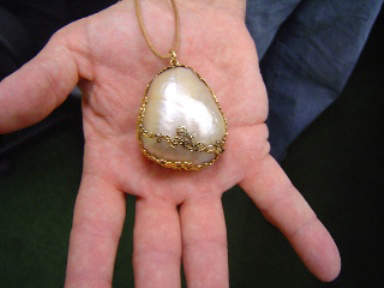
The long lost Gogibus Pearl?
Photo credit: paulfrasercollectibles.com
The pearl has been authenticated as a natural saltwater pearl by Dr. Jack Ogden, the chief executive of the Gemological Association of Great Britain, a leading authority on pearls. According to Dr. Ogden, the pearl shows signs of age, and parts of the present gold mount may date back to the 18th-century. The slight crack at the top of the pearl, extending downwards as seen in the photograph of the pearl, may be a sign of its old age. The pearl is presently mounted on gold as a pendant to a gold necklace. Another interesting feature of the pearl is the presence of a man-made cavity, on the reverse side of the pearl, which is covered with a gold leaf as seen in the photograph.
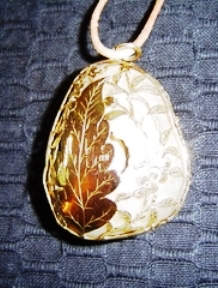
The reverse side of the long lost Gogibus Pearl
Photo credit: paulfrasercollectibles.com
Evidence used to associate the pear-shaped pearl with the long lost Gogibus pearl.
There are many lines of evidence that can be used to strongly associate the pear-shaped pearl with the long-lost Gogibus Pearl.
1) The pearl is a large pear-shaped pearl. The Gogibus Pearl was also a large pear-shaped pearl.
2) The weight of the pearl is approximately 143 carats. The Gogibus pearl according to Dr. George Frederick Kunz was not less than 126 carats, and claimed to be the largest in Europe at that time. Perhaps, Dr. Kunz not knowing the exact weight of the pearl, had given its weight, in comparison with a known pearl, whose weight was known to be 126 carats, and perhaps believed to be the largest pearl in Europe before the discovery of the Gogibus pearl. Thus, the weight of 143 carats for the pearl, agrees with the comparative weight of "not less than 126 carats" for the Gogibus pearl.
3) The pearl is a silvery-white, natural, saltwater pearl with excellent luster and orient, as authenticated by Dr. Jack Ogden of the Gemological Association of Great Britain. The Gogibus Pearl was also a natural saltwater pearl discovered from the Atlantic pearl oyster, of "fine orient" as described by G. F. Kunz, and invariably having the silvery-white color characteristic of Atlantic saltwater pearls, even though Kunz does not specify the color of the pearl in his account.
4) The pearl is believed to be of 17th-century origin. and said to show signs of age according to Dr. Ogden, including a slight crack at the top of the pearl, extending a little downwards. The signs of antiquity on the pearl no doubt provides strong evidence to support the belief that the pearl is most probably the long-lost Gogibus Pearl.
5) Another evidence that points to the antiquity of the piece of jewelry in which the pearl has been set, as a pendant to a gold necklace, also provides support to the belief that the pearl is most probably the long-lost Gogibus Pearl. According to Dr. Ogden parts of the present gold mount of the pearl may date back to the 18th-century. This agrees with the known facts, as the pearl in the 17th-century was actually mounted as a button in the royal cap of Philip IV, which may also mean the crown of the king. It appears that the pearl had been removed subsequently from the crown in the 18th-century, and mounted as the centerpiece of a pendant to a necklace.
6) The final strong and direct evidence that identifies the pearl with the long-lost Gogibus pearl, is the presence of a man-made cavity on the reverse side of the pearl, presently covered by a gold-leaf as seen in the photograph, which suggests that it could be the spot, where the pearl was connected to the royal cap or crown.
Is the price tag of $3.0 million placed on the Gogibus Pearl justified ?
Thus, the above lines of evidence convincingly prove that the pear-shaped pearl offered for sale by Paul Fraser Collectibles is without any doubt the long-lost Gogibus Pearl. In the context of this evidence, which consolidates its ancient historical provenance, the $3 million sale price placed on the pearl is justifiable, given the fact that the drop-shaped, "La Regente Pearl" of early 19-th century provenance, weighing 302.68 grains, fetched a record price of $2.5 million at an auction in November 2005. Likewise the 133.16-grain, pear-shaped "La Pelegrina Pearl" also of 17th-century origin and gifted by Philip IV to his daughter Maria Therese, on the occasion of her marriage to Louis XIV of France, fetched a record sum of $463,800, at a Christies auction in 1989.
The 302.68-grain "La Regente Pearl" with a history dating back to 1811, is the most expensive single pearl in the world today, fetching a record price of $2.5 million, at a magnificent jewels sale, at Christie's in Geneva in November 2005. The "Gogibus Pearl" weighing 504 grains, is heavier than the "La Regente Pearl." Likewise, the historic provenance of the Gogibus Pearl, goes back further than the "La Regente Pearl" to the early 17th-century (1620). Thus, the price of $3.0 million placed on the "Gogibus Pearl" in comparison to the value of the "La Regente Pearl" is more than justified.
Philip IV of Spain
His early life, academic and literary pursuits, patronage of the arts
Philip IV was the king of Spain, Spanish Netherlands, Naples and Sicily from 1621 to 1665, and the king of Portugal from 1621 to 1640. Philip IV born in Valladolid on April 8, 1605, was the eldest son of Philip III and his wife Margaret of Austria. Philip who was academically inclined, learned Latin, Geography, foreign languages that included French, Portuguese and Italian, and astrology. He undertook a translation of Francesco Guicciardini's texts on political history, which he wrote with his own hand, in the course of acquiring a knowledge of political history, as preparation for the task of governance. He also took an interest in literature and poetry and became a keen theatre goer. His interests in the arts and literature, manifested itself during his reign, in the patronage of artists like Diego Velazquez, Rubens and Cano, that led to the building up of the royal collection of paintings, which later became the basis of the Prado Museum. His patronage of dramatists like Calderon de la Barca, Tirso de Molina and Lope de Vega continued the great tradition of Spanish drama during his reign.
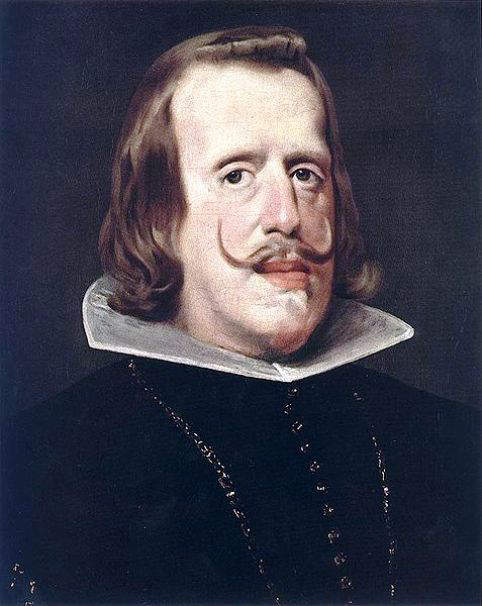
King Philip IV of Spain
Apart from his academic and literary pursuits, Philip also acquired other skills identified with the royalty, such as horse-riding, hunting and bull-fighting. Thus, in keeping with his status as a monarch, Philip became a fine horseman, a keen hunter and a devotee of bull-fighting.
His marriages and children produced
When he ascended his father's throne in 1621 at the age of 16, he had the intellectual capacity to take his own decisions, but instead chose Conde de Olivares, an able and efficient nobleman close to the royal family, as his prime minister, who also became his most trusted adviser. Soon, Philip adopted a relaxed attitude towards the affairs of the state, entrusting all day to day activities to his prime minister, but only taking important policy decisions. Philip married Isabella (Elizabeth) of France in 1615, at the age of ten years. With age and maturity he became a responsible father, and the marriage produced seven children, out of whom six were daughters and only one son. Like most royalties in the past, Philip also took several mistresses, many of whom were actresses, the most famous of these being actress Maria Ines Calderon, who bore him a son Juan Jose in 1629, who was brought up as a royal prince, even though he was legally excluded from any claim to the throne. Ironically, it was in the same year 1629, that Queen Isabella gave birth to his only son Baltasar Carlos, who was brought up with great care by the king, being his only legal successor, but unfortunately died young at the age of 17 years in 1646, of small pox. Queen Isabella, predeceased her son by two years, dying in 1644. The death of the queen and his son was a big blow to the king, yet he decided to re-marry in 1646, hoping for a son by this second marriage. He took as his second wife, Maria Anna of Austria, his niece, and the daughter of Emperor Ferdinand. Maria Anna gave birth to five children of whom only two survived, one of whom was a son, who succeeded him as Charles II of Spain in 1665.
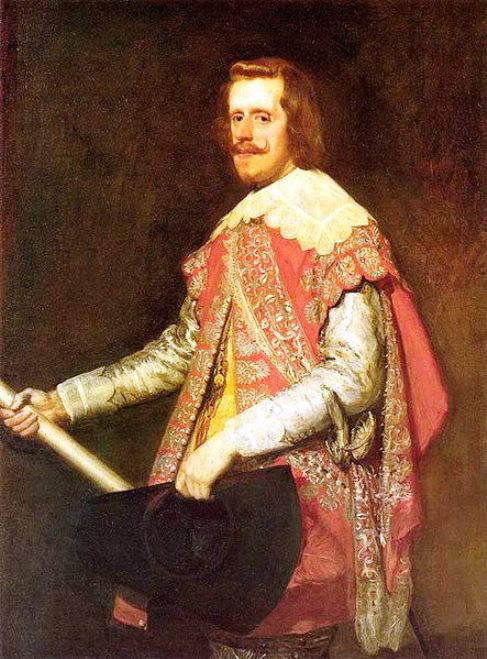
King Philip IV of Spain
The fall from power of Conde de Olivares and the appointment of Luis de Haro as chief minister
The trusted Conde de Olivares remained Philip's confidant and chief minister for nearly twenty years, until his fall from power during the crisis of 1640-43, precipitated by the war with France and the defeat of the Spanish at Rocroi. Conde Olivares was a victim of not only failed policies but also jealousy from the nobles excluded from power. It is believed, that Queen Isabella played a significant role in conspiring with other disgruntled nobles to remove Olivares from the court in 1643. Philip then announced that he would rule alone without a chief minister, and during this period Queen Isabella was able to exert considerable influence over Philip. However, Philip soon reverted back to the old system of ruling through a royal favorite, by appointing Luis de Haro, a nephew of Olivares and his childhood playmate as the chief minister.
Philip IV reluctantly agrees to a more aggressive role for Spain in the "Thirty Years War" and renew hostilities with the Dutch
Philip IV's rule coincided with the challenging period of the "Thirty Years War" that began in 1618 and ended in 1648. Spain actually entered the "Thirty Year War" during the final years of his father, Philip III's rule, who was persuaded to do so by his foreign minister Baltasar de Zuniga. After Philip IV ascended the throne in 1621, Baltasar de Zuniga, who was appointed as principal foreign minister and Conde de Olivares, the prime minister, persuaded the king that Spain should play a more aggressive role in the war in alliance with the Holy Roman Empire. Philip IV, who was a man of peace and well aware of the horrors of war, reluctantly agreed to his ministers' suggestion which led to the renewal of hostilities with the Dutch in 1621, under the "Netherlands first" policy introduced by them. The war with the Dutch went well, but at great expense, with Spain capturing the key city of Breda in 1624. However, by the end of that decade Spain had to choose between the war in Netherlands and its relationship with France, during the War of the Mantuan Succession (1628-31). The Spanish chose to continue the war in Netherlands, antagonizing Louis XIII of France.
The new aggressive policy of Spain precipitates an unpopular war with France, leading to the defeat of the Spanish at Rocroi, and wide-scale revolts across Spanish territories
Subsequently, in spite of Spain's successes in 1634 against the Swedish-led Protestant forces at the Battle of Nordlingen, increased tensions with France made war between the two countries unavoidable. The Spanish-French war started in 1635, and at the beginning went in favor of the Spanish, but later Spain was defeated at Rocroi in 1643 by the French led by the Great Conde. Immediately after the Spanish defeat at Rocroi, there was wide-scale revolts across the Spanish territories in protest against the rising cost of the conflict.
Spain is compelled to sue for peace, that results in the Treaty of Westphalia, ending the war in Netherlands and Germany
In response, Philip IV was compelled to dismiss his prime minister, Olivares, who was replaced subsequently by Luis de Haro. Unable to sustain the war effort, Philip IV abandoned his policy of "Netherlands first" strategy, cutting off funds for the war effort against Netherlands, and concentrating against the French-supported rebels at Catalonia. The king now instructed his ministers and ambassadors, including the newly appointed prime minister, Luis de Haro to seek a peace treaty. The result was the "Peace of Westphalia" that ended the "Eight Years War" in Netherlands, and the wars in Germany, but the conflict in France continued.
The war with France continues until the defeat of the Spanish at Dunkirk in 1658, resulting in the Treaty of Pyrenees, and the marriage of Philip IV's daughter to the young King Louis XIV
King Louis XIII of France died in 1643, and his five-year old son Louis XIV was installed on the throne, with his mother as the regent. Cardinal Mazarin who was serving as the prime minister had a new crisis in his hands, the Fronde rebellions of 1648, and was desperate to seek peace with the Spanish. Philip IV saw this as an opportunity and mounted a fresh and successful offensive against the French in Catalonia in 1651. However, in 1658, the Spanish lost Dunkirk to an Anglo-French force, forcing Philip IV to sue for peace, that resulted in the "Treaty of Pyrenees" in 1659. This treaty and the marriage of Philip's daughter Maria Theresa to the young king Louis XIV, finally brought Philip IV's long-running European wars to an end.
The costs of the Thirty Years War for Spain
The costs of the Thirty Years War for Spain was enormous in terms of territorial loss. In 1940, Spain lost control of Portugal after widespread revolts in that country, precipitated by Spain's preoccupation elsewhere. Spain had to recognize the independence of the United Provinces of Netherlands, at the Peace of Westphalia in 1648. Spain lost Roussillon and part of the Spanish Netherlands to France, in the Treaty of Pyrenees signed in 1659.
The legacy of Philip IV
Philip IV, though well educated and capable of ruling on his own, had to pay a high price for depending on ministers and advisers who had their own agenda to advance and made a mess of his rule. His rule characterized by political and military decay, has been identified as the main cause for the decline of the Spanish Empire. He is remembered for his enormous contribution to the arts, literature and drama, that earned him the nickname "planet king" who built a new palace for the display of his art collections and the rituals of court. The palace included its own theatre, ballroom, galleries, bullring, gardens and artificial lakes, that became the center for artists and dramatists from across Europe. His collection of paintings became the basis of the Prado Museum. Philip is also credited with the development of the Spanish Armada (Navy), started by his predecessors Philip II and Philip III, into a modern and powerful navy in the world, that was able to defend successfully Spain's trade routes to the New World, at a time when the Atlantic and the Caribbean were threatened by the scourge of sea-piracy and also to continue to maintain their hold on their far-eastern possessions, the Philippines, that was colonized in 1565, sustaining the lucrative Manila-Acapulco Galleon Trade. He died in 1665 and was succeeded by his son Charles II, with his wife Mariana as regent.
You are welcome to discuss this post/related topics with Dr Shihaan and other experts from around the world in our FORUMS (forums.internetstones.com)
Related :-
External Links :-
1) Paul Fraser Collectibles - Is this the long lost Gogibus pearl ? www.paulfrasercollectibles.com
References :-
1) The Book of the Pearl - Chapter 16 : Famous Pearl Collections. Page 461 - George Fredrick Kunz
2) Philip IV of Spain - From Wikipedia, the free encyclopedia
3) Philip IV - www.nndb.com
4) Thirty Years War - From Wikipedia, the free encyclopedia
 Home
Security & Guarantee
How it Works
Technology Partners
Updated Tables
Famous Diamonds
More Famous Diamonds
Famous Pearls
Famous Gemstones
Contact Dr Shihaan Larif
Contact Senior Editor
Famous Jewelry
Reference Database
Forums
Learning Center
Gemstone Gallery
e-mail Notifications
Advertise
Press Release
About Us
Privacy Policy
Contact Us
FAQ'S
Site Map
Staff Mail Login
Staff Documents
Birthstones
History
Minerals
Shows
Live Metal Prices
Jewellery Gallery
News
Marketplace
Marketplace Support
Open Store
Online Auctions
Join Us & Contribute
Directory
Classifieds
List your products
Wholesale Trading
Post Buy Request
Go Green Policy
Site Updates
Upcoming-ToDo List
Latest News
Latest Articles
Latest Blog Updates
Chat Rooms
Job Board
User Gallery
Videos
New Newsletter Archive
Old Newsletter Archive
Jewelry & Mineral Blog
User Blogs & Social Network
Search
Answers (Q & A)
Valuation
Help me find a diamond/jewelry
pin.internetstones.com- Social Pinboard- Sart yours & connect with millions
Invite Friends From Yahoo, Gmail etc-One Click
Home
Security & Guarantee
How it Works
Technology Partners
Updated Tables
Famous Diamonds
More Famous Diamonds
Famous Pearls
Famous Gemstones
Contact Dr Shihaan Larif
Contact Senior Editor
Famous Jewelry
Reference Database
Forums
Learning Center
Gemstone Gallery
e-mail Notifications
Advertise
Press Release
About Us
Privacy Policy
Contact Us
FAQ'S
Site Map
Staff Mail Login
Staff Documents
Birthstones
History
Minerals
Shows
Live Metal Prices
Jewellery Gallery
News
Marketplace
Marketplace Support
Open Store
Online Auctions
Join Us & Contribute
Directory
Classifieds
List your products
Wholesale Trading
Post Buy Request
Go Green Policy
Site Updates
Upcoming-ToDo List
Latest News
Latest Articles
Latest Blog Updates
Chat Rooms
Job Board
User Gallery
Videos
New Newsletter Archive
Old Newsletter Archive
Jewelry & Mineral Blog
User Blogs & Social Network
Search
Answers (Q & A)
Valuation
Help me find a diamond/jewelry
pin.internetstones.com- Social Pinboard- Sart yours & connect with millions
Invite Friends From Yahoo, Gmail etc-One Click




Our Global Jewelry Industry Job Network


Buy & Sell in our Marketplace

Subscribe to our Newsletter

List in our Classifieds

List in our Directory

User Uploaded Gallery

Powered by Ultra Secure
Amazon (USA) Cloud Network

Founder Internet Stones.COM
Register in our Forums

| Featured In
|
|
|
|
|
|
|
|







Blog & Education Feed
Articles Feed
 |
 |
 |

Copyright © .Internet Stones.COM. All rights reserved.