Graff Vivid Yellow Diamond
Open FREE Unlimited Store Join Our Newsletter
Lareef A. Samad B.Sc.(Hons)
Origin of name
The diamond gets its name from the unique and rare fancy vivid yellow color of the stone, which in the rough state is said to have mesmerized the "King of Diamonds" Laurence Graff, when he saw the stone for the first time. The unusual hue and color of the stone was so enthralling, radiating orange and yellow colors reminiscent of the golden sun. The cut and polished diamond retained the original colors, fire and brilliance of the rough stone, and came to be known as the "Dream Diamond."
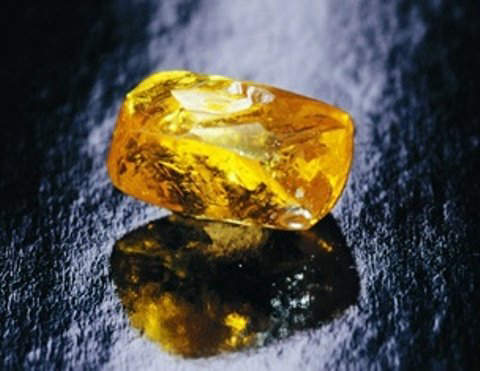
190.72-carat Graff Vivid Yellow rough diamond

Characteristics of the diamond
The diamond is a 100.09-carat, cushion-cut, fancy vivid yellow diamond, with exceptional clarity. The crown of the diamond is about 25mm (one inch) square.
Being a fancy vivid yellow diamond, the Graff vivid yellow is a rare Type Ib diamond, which constitute only about 0.1 % of all naturally occurring diamonds. It is Type I, because it contains nitrogen impurities that impart yellow color to the diamonds. It is Type Ib, because the nitrogen atoms are scattered as single atoms in the crystal structure of the diamond, which absorbs visible light in the blue region of the spectrum, imparting its complementary color yellow to the diamonds. The intense yellow color is associated with the distribution of nitrogen as single atoms. A certain amount of light seems to be absorbed in the green region of the spectrum as well. This accounts for the orange colors radiated by the diamond, as the complementary color of green is orange.
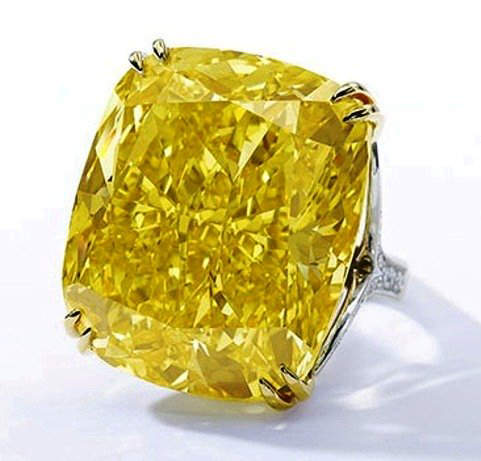
Graff Vivid Yellow diamond in its present ring setting
In the list of famous yellow diamonds greater than 100 carats in weight the Graff vivid yellow occupies the 29th or last position.
List of famous yellow diamonds greater than 100 carats in weight
S/N |
Name | Carat Weight | Shape/Cut | Color |
| 1 | Incomparable | 407.48 | shield shaped | fancy brownish yellow |
| 2 | Oppenheimer-uncut | 253.70 | natural octahedral | yellow |
| 3 | De Beers | 234.65 | cushion | light yellow |
| 4 | Red Cross | 205.07 | cushion | canary yellow |
| 5 | unnamed | 200.87 | pear | yellow |
| 6 | Moon | 183.00 | round | pale yellow |
| 7 | unnamed | 180.85 | briolette | yellow |
| 8 | Star of Peace | 170.49 | pear | brownish yellow |
| 9 | Hope of Africa | 151.91 | cushion | fancy yellow |
| 10 | Unnamed | 150.00 | emerald | yellow |
| 11 | Florentine | 137.27 | double rose cut | light yellow |
| 12 | Algeiba Star/Mahjal | 135.03 | square brilliant | yellow |
| 13 | Sarah | 132.43 | cushion | fancy vivid yellow |
| 14 | Golden Hue | 132.42 | cushion | yellow |
| 15 | Tiffany Yellow | 128.54 | cushion | canary yellow |
| 16 | Stewart | 123.00 | brilliant | yellow |
| 17 | Meister | 118.00 | cushion | yellow |
| 18 | Vainer Briolette | 116.60 | briolette | fancy light yellow |
| 19 | Unnamed | 114.64 | briolette | yellow |
| 20 | Unnamed | 114.03 | cushion | yellow |
| 21 | Mouna | 112.50 | cushion | fancy intense yellow |
| 22 | African Yellow | 112.00 | - | yellow |
| 23 | Anon | 108.04 | emerald | yellow |
| 24 | Rojtman | 107.46 | cushion | yellow |
| 25 | Golden Sun | 105.54 | emerald | yellow |
| 26 | Golden Door | 104.95 | pear | yellow |
| 27 | Alnatt | 101.29 | cushion | fancy vivid yellow |
| 28 | Sunrise | 100.52 | emerald | yellow |
| 29 | Graff vivid yellow | 100.09 | cushion | fancy vivid yellow |
History
The diamond is of South African origin, but the mine of origin is not known. Laurence Graff saw the diamond for the first time in Kimberley, South Africa, and purchased it either towards the end of 2005 or the beginning of 2006. The original owner of the diamond or the purchase price of the diamond are not known.

Laurence Graff - King of Diamonds
The rough diamond weighed 190.72 carats. Laurence Graff was shocked and surprised to see such a magnificent stone radiating orange and yellow hues. The stone appeared to be on fire, spontaneously radiating sensational orange and yellow colors resembling the golden sun. "The King of Diamonds" seem to be mesmerized and enthralled by the appearance of the stone. The color of the rough diamond was so exceptional, something that Graff had never seen before, that it immediately aroused his suspicions as to its authenticity. Only artificially colored diamonds could have such perfect colors. Graff dispatched the diamond to the Gemological Institute of America, for testing and certification. He was gratified by the results of the tests, which showed that the diamond was entirely a natural stone.
The next formidable challenge was the cutting and polishing of the diamond, in order to preserve the extraordinary color of the diamond, and to get a product that exceeds the magical weight of 100 carats, in order to be classified as a truly remarkable diamond. The task of any diamond cutter is very challenging, because it is the cut of the diamond that ultimately brings out the intrinsic beauty of a stone, that has a major bearing on its monetary value. This necessarily entails a detail study of the rough diamond both externally and internally, before deciding on the most appropriate cut that suits the rough stone, keeping in mind the requirements of the owner of the diamond, who may wish to have a final product that preserves certain characteristics of the stone, as in this instance.
The man who was chosen for this challenging assignment was none other than Graff's master cutter, Antonio Bianco who is also known as Nino. It was a great honor for Nino to be chosen for this challenging task, and he rose to the occasion to meet this great challenge, in order to justify the confidence reposed on him. The intricate skills needed to be an accomplished diamond cutter, comes with experience, and the knowledge required to acquire such demanding skills, have usually been passed down from generation to generation, sometimes extending back to several centuries. Antonio Bianco also hails from a family of diamond cutters who had been practicing the art for several generations. He too was introduced into the family's traditional business at an early age in his life. He was just 18 years old when he was initiated into the family vocation as an apprentice in Johannesburg. His two sons are also following in the father's footsteps. Nino had already acquired a reputation in the trade as a top class master-cutter, having handled some of the most famous diamonds in the world, acquired by the King of Diamonds Laurence Graff.
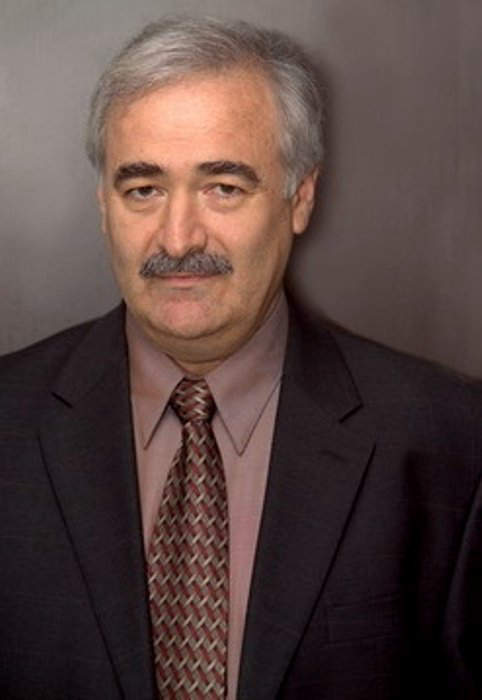
Master Cutter - Antonio Nino Bianco
After a period of extensive study of the rough diamond, Nino started work on this ambitious project. He was totally immersed in this time consuming task for at least nine months, which according to him was a relentless process of total engagement, commitment and endless maneuvering. Eventually the 190.72-carat rough crystal was transformed into a magnificent 100.09 carat, cushion-cut diamond, that was still radiating the orange and yellow colors that imparted the "fire-like" appearance to the original rough stone. The fire and brilliance of the finished stone was indeed unprecedented. The finished diamond was indeed a "Dream Diamond" as the stone came to be characterized by those who had privilege of seeing it.
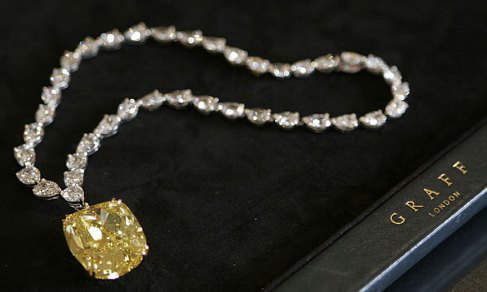
Fancy vivid yellow Dream Diamond set as pendant to a diamond necklace
The "Dream Diamond" was set as a pendent to a magnificent necklace made of pear-shaped smaller white diamonds, and was unveiled to the world in October 2006, by Laurence Graff, at the London's Kensington Palace, after he received the "Queen's Award for Enterprise" in international trade, for the fourth time.
You are welcome to discuss this post/related topics with Dr Shihaan and other experts from around the world in our FORUMS (forums.internetstones.com)
 Home
Security & Guarantee
How it Works
Technology Partners
Updated Tables
Famous Diamonds
More Famous Diamonds
Famous Pearls
Famous Gemstones
Contact Dr Shihaan Larif
Contact Senior Editor
Famous Jewelry
Reference Database
Forums
Learning Center
Gemstone Gallery
e-mail Notifications
Advertise
Press Release
About Us
Privacy Policy
Contact Us
FAQ'S
Site Map
Staff Mail Login
Staff Documents
Birthstones
History
Minerals
Shows
Live Metal Prices
Jewellery Gallery
News
Marketplace
Marketplace Support
Open Store
Online Auctions
Join Us & Contribute
Directory
Classifieds
List your products
Wholesale Trading
Post Buy Request
Go Green Policy
Site Updates
Upcoming-ToDo List
Latest News
Latest Articles
Latest Blog Updates
Chat Rooms
Job Board
User Gallery
Videos
New Newsletter Archive
Old Newsletter Archive
Jewelry & Mineral Blog
User Blogs & Social Network
Search
Answers (Q & A)
Valuation
Help me find a diamond/jewelry
pin.internetstones.com- Social Pinboard- Sart yours & connect with millions
Invite Friends From Yahoo, Gmail etc-One Click
Home
Security & Guarantee
How it Works
Technology Partners
Updated Tables
Famous Diamonds
More Famous Diamonds
Famous Pearls
Famous Gemstones
Contact Dr Shihaan Larif
Contact Senior Editor
Famous Jewelry
Reference Database
Forums
Learning Center
Gemstone Gallery
e-mail Notifications
Advertise
Press Release
About Us
Privacy Policy
Contact Us
FAQ'S
Site Map
Staff Mail Login
Staff Documents
Birthstones
History
Minerals
Shows
Live Metal Prices
Jewellery Gallery
News
Marketplace
Marketplace Support
Open Store
Online Auctions
Join Us & Contribute
Directory
Classifieds
List your products
Wholesale Trading
Post Buy Request
Go Green Policy
Site Updates
Upcoming-ToDo List
Latest News
Latest Articles
Latest Blog Updates
Chat Rooms
Job Board
User Gallery
Videos
New Newsletter Archive
Old Newsletter Archive
Jewelry & Mineral Blog
User Blogs & Social Network
Search
Answers (Q & A)
Valuation
Help me find a diamond/jewelry
pin.internetstones.com- Social Pinboard- Sart yours & connect with millions
Invite Friends From Yahoo, Gmail etc-One Click




Our Global Jewelry Industry Job Network


Buy & Sell in our Marketplace

Subscribe to our Newsletter

List in our Classifieds

List in our Directory

User Uploaded Gallery

Powered by Ultra Secure
Amazon (USA) Cloud Network

Founder Internet Stones.COM
Register in our Forums

| Featured In
|
|
|
|
|
|
|
|







Blog & Education Feed
Articles Feed
 |
 |
 |

Copyright © .Internet Stones.COM. All rights reserved.