Grand Duchess Vladimir Tiara
Open FREE Unlimited Store Join Our Newsletter
Origin of name
The Grand Duchess Vladimir Tiara which belongs to the personal jewelry collection of H.M. Queen Elizabeth II, and was inherited from her grandmother Queen Mary, after her death in 1953, gets its name from Grand Duchess Maria Pavlovna of Russia, wife of the Grand Duke Vladimir Alexandrovich, the third son of Czar Alexander II, and the brother of Czar Alexander III of Russia. Grand Duchess Maria Vladimir Alexandrovich got jewelers and artisans working for the Russian court to design and execute this exquisitely crafted tiara in the year 1890. During the late 19th century, the Russian jewelers and artisans had a penchant for incorporating a combination of diamonds and pearls into their jewelry creations, such as necklaces, earrings, crowns and tiaras, being the trendsetting style in vogue at that time. The Grand Duchess Vladimir Tiara was designed and executed in the tradition of the late 19th century, and consisted of a combination of diamonds and pearls. Following the 1917 Bolshevik Revolution of Russia and the associated upheavals, the Grand Duchess Vladimir escaped with her family to the Caucasus, where she remained till 1920, hoping for an improvement in the situation, and finally escaped to Venice in an Italian ship on February 13, 1920. The Duchess left her renowned collection of jewelry including the Vladimir Tiara, hidden in a vault in the Vladimir Palace in St. Petersburg, at the time of her escape. Subsequently, a member of Britain's Secret Intelligence Service, who was a friend of the Vladimir family, helped them to recover the jewels from the vault, which was then smuggled out of Russia in a diplomatic bag. The Duchess died soon after she settled down in France, in August 1920. The Vladimir Tiara was then purchased by Queen Mary in 1921, from Princess Nicolas of Greece, the daughter of Duchess Maria Vladimir.
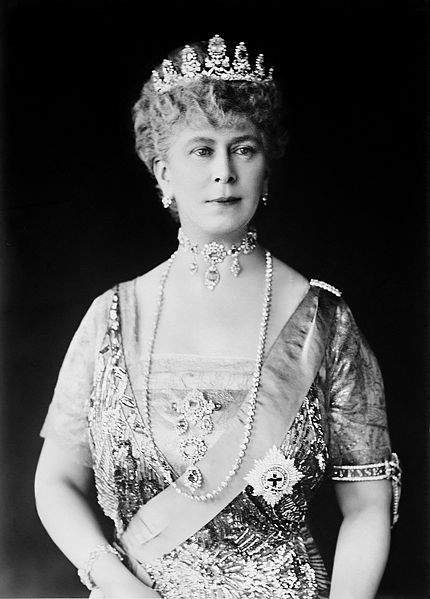
Queen Mary took pride in superbly bejeweling herself for formal occasions
Characteristic features of the Vladimir Tiara
Tiaras are traditionally made of precious metals such as platinum, gold and silver. The precious metal used in the "Vladimir Tiara" appears to be either platinum or silver. The tiara designed by an unknown Russian jewelry craftsman, consists of fifteen interlaced thick metal circles. At the bottom, the overlapping circles are attached to a semi-circular thick band of metal, that forms the circlet of the tiara. At the top the overlapping circles are held together by a wavy snake-like band that intertwines the circles passing in and out of them. The thick circles as well as the upper and lower bands are closely laden with round brilliant-cut diamonds, that impart the brilliant sparkle so characteristic of this tiara. The beauty of the tiara was further enhanced by the swinging oriental pearl drops or pendants with small diamond set mounts, positioned inside each circle, but hanging from the wavy band and not from the circle. This was the original setting of the "Vladimir Tiara" at the time of its purchase in 1921, by Queen Mary.
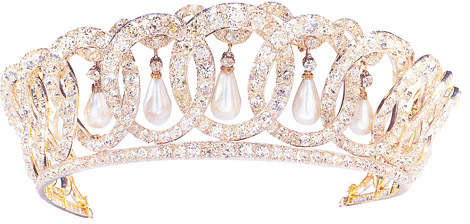
Vladimir Tiara with original pearl setting
© Her Majesty Queen Elizabeth II
Queen Mary, who was renowned for her collection of royal jewels, and took pride in superbly bejeweling herself for formal occasions had an intimate knowledge of jewelry and their designing, and decided that the "Vladimir Tiara" needed modification. Her intention was to make provision for the pearl drops to be interchanged with emerald drops, as and when the need arose. Accordingly she got the court jewelers Garrard & Co. to cut and polish fifteen of her remaining Cambridge emeralds as drop shaped emeralds, and to make provision for their replacement on the tiara whenever it was needed, after removing the pearl drops. As anticipated the replacement of the pearls with the emerald drops further enhanced the beauty of the tiara, which became a favorite tiara for Queen Mary, particularly when she was wearing the matching emerald suite, the Cambridge and Delhi Durbar Parure. Thus the incorporation of the exceptional quality Cambridge emeralds into the "Vladimir Tiara" made it a complementary piece to the Cambridge and Delhi Durbar Parure.
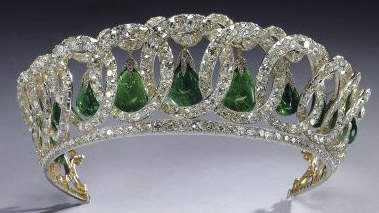
Vladimir Tiara with pearls interchanged with emeralds
© Her Majesty Queen Elizabeth II
Her Majesty Queen Elizabeth II inherits the Vladimir Tiara
The "Vladimir Tiara" that was a favorite piece of Queen Mary, was inherited by Her Majesty Queen Elizabeth II, in 1953, according to the last will left by Queen Mary. Thus the "Vladimir Tiara" entered the personal jewelry collection of Her Majesty the Queen.
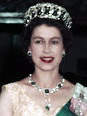
As much as the "Vladimir Tiara" was Queen Mary's favorite, it also became the favorite tiara of Queen Elizabeth II. Her Majesty the Queen, had been wearing this tiara on formal occasions since the time of her coronation in 1953. Photographs of Her Majesty Queen Elizabeth II, appearing below, show Her Majesty during the early years of her reign, wearing the Vladimir Tiara with the emerald drops, together with matching pieces of the Cambridge and Delhi Durbar Parure such as the Delhi Durbar Necklace, and Cambridge emerald earrings.
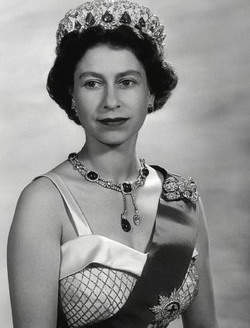
Her Majesty Queen Elizabeth II gave the "Vladimir Tiara" to Princess Diana after her marriage to Prince Charles, the Prince of Wales and heir to British Throne. Soon the "Vladimir Tiara" became one of the most favorite and cherished pieces of the Princess of Wales, who was often seen with the Tiara on formal palace occasions. Thus the legendary "Vladimir Tiara" came to be associated mainly with Princess Diana, during her reign as the Princess of Wales.
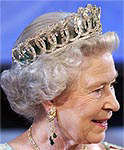
Her Majesty Queen Elizabeth II still uses the "Vladimir Tiara" for formal occasions, and she was seen wearing the Tiara during her official visit to the Vatican for an audience with Pope John Paul II, and also when she received the South African leader Nelson Mandela in the Buckingham Palace. The photograph below shows Her Majesty the Queen, wearing the "Vladimir Tiara" on a recent formal occasion.
Grand Duchess Maria Vladimir Alexandrovich
Grand Duchess Maria Vladimir Alexandrovich was born on May 14, 1854, to the Grand Duke Friedrich Franz II of Mecklenburg-Schwerin and Augusta of Reuss-Kostritz. In 1871, at the age of 17 years she met and fell in love with Grand Duke Vladimir Alexandrovich, the third son of Czar Alexander II (1855-81) of Russia, but the Czar would not give his consent to their marriage, as Maria was a Lutheran and refused to convert to the Russian Orthodox Church. Finally in 1874, three years after they first met, Czar Alexander II gave his consent to the marriage, even though she still remained a Lutheran. The marriage produced five children, four sons, Alexander, Kirill, Boris, and Andrei and a daughter Elena. The eldest son Alexander died in his infancy.
In 1881, after Czar Alexader II was assassinated during an uprising of the revolutionary organization called the "People's Will" his second son ascended the throne as Czar Alexander III and ruled from 1881 to 1894. Czar Alexander III was succeeded by his eldest son Czar Nicholas II, the last of the Romanov emperors, who with his wife Alexandra and their children, were killed by the Bolsheviks after the October 1917 Revolution.
Czar Nicholas II was the nephew of Grand Duchess Maria Vladimir Alexandrovich, and since he ascended the throne, the Grand Duchess harbored a hatred and jealousy towards him and his wife the Czarina, and tried to advance the cause of her own son Kirill Vladimirovich to the throne of Russia. In fact towards the height of his unpopularity in the winter of 1916 to 1917, she along with her sons contemplated a coup, to force the Czar's abdication, and replacement by his son, with the Grand Duke Nicholas Nikolayevich as regent.
When the revolution broke out in 1917, Grand Duchess Maria, escaped with her sons to the Caucasus in her own train, and remained their till 1918, hoping that the situation would calm down and her son Kirill Vladimirovich would still be able to ascend the Russian throne as the Czar. But, the situation worsened, and as the Bolsheviks were approaching the Caucasus. Maria and her children, escaped by a fishing boat to Anapa, in December 1918. She continued to remain in Anapa, refusing several opportunities to leave Russia, partly because of the humiliation she might have to face having lost all her power, prestige and privileges. However, on February 13, 1920, she and her family were reluctantly compelled to leave Russia, after a general of the army warned her that they were losing the battle in the civil war. Grand Duchess Maria and her youngest son Andrei together with his mistress Mathilde and their son Vladimir, boarded an Italian ship headed for Venice. Thus Grand Duchess Maria went down in history, as the last of the Romanovs to escape from revolutionary Russia.
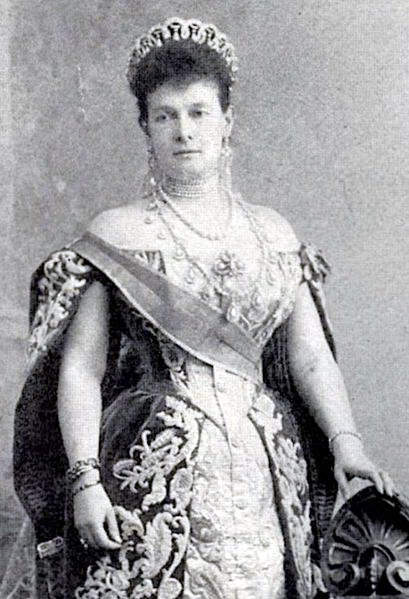
Grand Duchess Maria Vladimir Alexandrovich , wearing the Vladimir Tiara
Having reached Venice safely, Grand Duchess Maria found her way to Switzerland, from where she moved to France and set up permanent residence in Contrexeville with her family, where she purchased a Villa. After reaching France, her health began to fail, partly caused by the anxiety and worry of the past two years, and finally she died on August 24, 1920, surrounded by members of her family.
Grand Duchess Maria, the aunt of the last Czar of Russia, Czar Nicholas II, was a prominent member of the Russian noble families, and had her own palace in St. Petersburg, Russia. She dressed elegantly on all formal occasions and bedecked herself with exquisite jewelry, made by Russian jewelry craftsmen. One of her favorite pieces of jewelry was the "Vladimir Tiara" which she is seen wearing in the photograph appearing above. The photograph also shows her wearing other unidentified pieces of jewelry, which probably includes pearl chokers and necklaces, and what looks like an emerald and diamond necklace, and also earrings, bracelets and a brooch. Her collection of jewelry was one of the most renowned collections among the nobility of Russia.
With the outbreak of the Bolshevik revolution of 1917, the Grand Duchess and her family had to leave St. Petersburg at short notice. She and her family fled in her own train to the Caucuses, but felt unsafe to carry her valuable collection of jewelry. Therefore, she decided to leave her valuable collection, in a secret underground vault in the Vladimir Palace, hoping to return one day after the crisis had passed. But, having finally settled in France, and the situation in Russia changed irreversibly, the Grand Duchess' family sought the assistance of a family friend, a British intelligence officer, to retrieve the hidden jewelry from the underground vault. The operation was carried out successfully, and the jewelry was finally smuggled out of Russia in a diplomatic bag. Pieces of the collection were then disposed of by members of the Grand Duchess' family, and the "Vladimir Tiara" was sold to Queen Mary in 1921, by Princess Nicolas of Greece, the daughter of Duchess Maria Vladimir.
Related :-
Cambridge and Delhi Dunbar Parure
Tiaras of the Iranian Crown Jewels
References
1.Marie of Mecklenburg-Schwerin (Maria Pavlovna of Russia) - From Wikipedia, the free encyclopedia.
2.The Queens Jewels - Vincent Meylan
3.Royal Jewelry by Suzi Menkes.
4.The Queens Jewels- The Personal Collection of Elizabeth II- Leslie Field

 Home
Security & Guarantee
How it Works
Technology Partners
Updated Tables
Famous Diamonds
More Famous Diamonds
Famous Pearls
Famous Gemstones
Contact Dr Shihaan Larif
Contact Senior Editor
Famous Jewelry
Reference Database
Forums
Learning Center
Gemstone Gallery
e-mail Notifications
Advertise
Press Release
About Us
Privacy Policy
Contact Us
FAQ'S
Site Map
Staff Mail Login
Staff Documents
Birthstones
History
Minerals
Shows
Live Metal Prices
Jewellery Gallery
News
Marketplace
Marketplace Support
Open Store
Online Auctions
Join Us & Contribute
Directory
Classifieds
List your products
Wholesale Trading
Post Buy Request
Go Green Policy
Site Updates
Upcoming-ToDo List
Latest News
Latest Articles
Latest Blog Updates
Chat Rooms
Job Board
User Gallery
Videos
New Newsletter Archive
Old Newsletter Archive
Jewelry & Mineral Blog
User Blogs & Social Network
Search
Answers (Q & A)
Valuation
Help me find a diamond/jewelry
pin.internetstones.com- Social Pinboard- Sart yours & connect with millions
Invite Friends From Yahoo, Gmail etc-One Click
Home
Security & Guarantee
How it Works
Technology Partners
Updated Tables
Famous Diamonds
More Famous Diamonds
Famous Pearls
Famous Gemstones
Contact Dr Shihaan Larif
Contact Senior Editor
Famous Jewelry
Reference Database
Forums
Learning Center
Gemstone Gallery
e-mail Notifications
Advertise
Press Release
About Us
Privacy Policy
Contact Us
FAQ'S
Site Map
Staff Mail Login
Staff Documents
Birthstones
History
Minerals
Shows
Live Metal Prices
Jewellery Gallery
News
Marketplace
Marketplace Support
Open Store
Online Auctions
Join Us & Contribute
Directory
Classifieds
List your products
Wholesale Trading
Post Buy Request
Go Green Policy
Site Updates
Upcoming-ToDo List
Latest News
Latest Articles
Latest Blog Updates
Chat Rooms
Job Board
User Gallery
Videos
New Newsletter Archive
Old Newsletter Archive
Jewelry & Mineral Blog
User Blogs & Social Network
Search
Answers (Q & A)
Valuation
Help me find a diamond/jewelry
pin.internetstones.com- Social Pinboard- Sart yours & connect with millions
Invite Friends From Yahoo, Gmail etc-One Click




Our Global Jewelry Industry Job Network


Buy & Sell in our Marketplace

Subscribe to our Newsletter

List in our Classifieds

List in our Directory

User Uploaded Gallery

Powered by Ultra Secure
Amazon (USA) Cloud Network

Founder Internet Stones.COM
Register in our Forums

| Featured In
|
|
|
|
|
|
|
|







Blog & Education Feed
Articles Feed
 |
 |
 |

Copyright © .Internet Stones.COM. All rights reserved.