Hooker Emerald Brooch
Open FREE Unlimited Store Join Our Newsletter
Origin of name
The "Hooker Emerald Brooch" gets its name from the one time owner of the famous piece of jewelry Janet Annenberg Hooker, the renowned philanthropist and principal benefactor of the Smithsonian's National Museum of Natural History, who donated the 75-carat, half-million-dollar emerald brooch set with diamonds, to the Smithsonian Institution, in 1977. The donation of $5 million to the National Museum of Natural History, by the late Mrs. Janet Annenberg Hooker, the publishing heiress, enabled the construction of their modern gem and mineral gallery, which was named the Janet Annenberg Hooker Hall of Geology, Gems and Minerals in her honor, and opened on September 20th, 1997, just three months before her passing away on December 13, 1997, at the ripe old age of 93 years. Mrs. Hooker had also gifted several other spectacular pieces of gems and jewelry to the NMNH, which included a dazzling set of rare yellow diamonds, cut in a starburst pattern, known as the Hooker Starburst Diamonds.

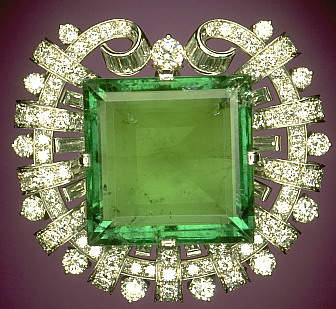
©Smithsonian Institution
Characteristics of the gemstone
The Hooker Emerald is a 75.47-carat, square emerald-cut gemstone with a large table, good color, clarity and transparency. The color of the stone appears to be a deep grass-green color, characteristic of emeralds originating from the Muzo mines of Colombia.
The emerald is presently set as the centerpiece of a brooch, in which it is surrounded by a platinum framework mounded with a total of 109 smaller round brilliant-cut diamonds of different sizes arranged in a symmetrical pattern as seen in the photograph.
History of the gemstone
Source of the Hooker Emerald
The emerald is of Colombian origin, but the exact mine of origin of the emerald is not known. However, given the deep grass-green color of the emerald, and the period the emerald is said to have been owned by Sultan Abdul Hamid II of Turkey - 1876 to 1909 - who is reputed to have mounted it in his belt buckle, the most probable source of the emerald is the historic Muzo mines situated at the northwestern end of the NW-SE emerald belt, in the Andes mountain ranges, also known as the "Cordillera Oriental." The Coscuez emerald mines also situated in the same region may be excluded, as emeralds produced in this region have a characteristic yellowish-green color. The whereabouts of the historic Chivor mines around this time was unknown, and was re-discovered only in 1896, and operations began again only in 1911.
The emerald enters the crown jewels of Turkey
The Hooker emerald was discovered in the Muzo mines of Colombia, probably in the second half of the 19th century, after Colombia gained its Independence in 1815. During this period the Muzo mines were worked probably by state-sponsored companies under the direction and supervision of the state, but production declined due to lack of sound technical and geological advice. However, the Hooker emerald rough that was discovered was cut and polished by an emerald-cutting center in the west, and eventually sold to the ruling family of the Ottoman Empire. It was during the time of Sultan Abdul Hamid II who ruled Turkey between 1876 and 1909, that the Hooker Emerald entered the crown jewels of Turkey. It is said that Sultan Abdul Hamid II, wore the emerald mounted on his belt buckle.
Sultan Abdul Hamid II
Sultan Abdul Hamid II ascended the Ottoman throne on August 31, 1876, after the deposition of his mentally deranged brother Murad V. He promulgated the first Ottoman constitution in December 1876, but suspended it 1878, after a disastrous war with Russia in 1877. He dismissed parliament in 1978, and assumed powers as the absolute dictator of Turkey, a position which he held onto for the next 33 years, ruling from his seclusion at Yildiz Palace, in Istanbul, assisted by his secret police and severe press censorship.
The occupation of parts of the Ottoman Empire by the French (Tunisia in 1881) and the British (Egypt in 1882), led to Abdul Hamid seeking support from the Germans, giving concessions to Germany, such as building of the Baghdad Railway in 1899. Abdul Hamid used pan-Islamism as a political weapon to rally world Muslim opinion towards the Ottoman Empire, which resulted in the construction of the Hijaz Railway, financed by Muslim contributions from around the world.
His achievements included the introduction of educational reforms, the establishment of 18 professional schools, and the Darulfunun, which later became the University of Istanbul, and a network of primary, secondary and military schools throughout his empire. He also developed the railway and telegraph systems. However, Abdul Hamid was eventually deposed in 1909, by a military coup organized by the "young Turks" who were unhappy with his despotic rule, and the military intervention of the Europeans in the Balkans. Abdul Hamid was replaced by his brother Mehmed V, who was proclaimed the new Sultan.
The Hooker Emerald is sold in Paris in 1908
The Hooker Emerald that was owned by Sultan Abdul Hamid II, was probably smuggled out of Turkey to Paris in 1908, by the trusted agents of the Sultan, with his connivance, together with the Hope Diamond and other valuable jewels, with the aim of disposing them, as the Sultan realized that his days were numbered following the uprising of the "Young Turks" a group of young officers in the army. The Sultan believed that the proceeds of the sale would help him in the future if he were to be deposed from the throne. The agents of the Sultan sold the jewels including the Hooker Emerald and the Hope Diamond to Salomon Habib, the jewelry dealer based in Paris. The proceeds of the sale however did not benefit Sultan Abdul Hamid II, as it was seized by his successors in government, who deposed him in April 1909.
The Hooker Emerald re-emerges in New York in 1950
The whereabouts of the Hooker Emerald was not known after it was purchased by Salomon Habib in 1908. But, the Hope Diamond purchased by him was sold to the Paris based jeweler Rosenau, at a tremendous loss, when he was facing difficult financial constraints. Habib also disposed of his entire collection of jewels during this difficult period. Rosenau sold the Hope Diamond to Pierre Cartier, who got it mounted on a platinum and diamond necklace and sold it to the U. S. socialite Evalyn Walsh in 1911. It is not known whether the Hooker Emerald too was purchased by Cartier's of Paris, before it reached the United States. In the year 1950, the Hooker Emerald set in its famous brooch, featured in a Christmas Catalogue of Tiffany's New York. The brooch setting was probably designed and executed by Tiffany's, and remained with the company, until a suitable buyer came along to purchase it. Eventually in 1955, the Hooker Emerald Brooch was sold to the publishing heiress and renowned philanthropist Janet Annenberg Hooker, but the purchase price of the brooch was not disclosed. However, 22 years later, in the year 1977, Mrs. Janet Annenberg Hooker decided to donate the Hooker Emerald Brooch, to the National Museum of Natural History of the Smithsonian Institution. The value of the brooch at the time of its donation was said to be $500,000. This represented her first gift to the NMNH of the Smithsonian, and marked the beginning of a long-lasting support to the Institution as its principal benefactor, that lasted until her death in 1997.
A short biography of Janet Annenberg Hooker
Janet Annenberg was born in Chicago on October 13th, 1904, and was one of the seven daughters of Moses Annenberg, the founder of Triangle Publications, and Sadie Annenberg. She was educated at Kemper Hall, an Episcopal School in Kenosha, Wisconsin. She married L. Stanley Kahn, in 1924, who was a publisher in the Annenberg communications empire. She had two sons by this marriage, Gilbert S. Kahn and Donald P. Kahn, but the marriage eventually ended up in divorce in 1937. Her inclination towards the arts, music and drama was manifested, when after her divorce she began a brief stage career, under the name of Janet Kahn. She acted in a play produced by Lee Shubert, called "Honor Bright" in which she played the part of a school trustee. The play was staged in Detroit and Rhode Island. In 1938, she married Joseph A, Neff, of Lincoln, Nebraska, who had been in the clothing business in the West. Their marriage lasted for three decades until the death of Neff in 1969. Five years later in 1974, she married James Stewart Hooker, who was the head of labor relations for the "Philadelphia Inquirer" a newspaper that was owned by the Knight-Ridder Newspapers Inc. Mr. Hooker died in 1976.
Mrs. Hooker, who was well renowned for her philanthropy supported many worthy causes, but her initial contribution was in the field of music and the decorative arts. A number of musical institutions were recipients of her beneficence, and this included the New York Philharmonic Orchestra, the Musicians Emergency Fund, and various outdoor concert programs. A section of the lobby of the Metropolitan Opera House in Lincoln Center, was donated by her in honor of her mother, Mrs. Moses L. Annenberg.
Mrs. Hooker, who was interested in the decorative arts, actively supported the rebuilding and redecoration of the diplomatic reception rooms of the State Department building in the mid-1980s, a project that cost $8 million and was funded by private donations, a significant part of which was contributed by Mrs. Hooker. She took a keen interest in the White House Preservation Fund that extended through the administration of six American Presidents from John F. Kennedy to Ronald Reagan, and contributed funds for the renovation of the Blue Room in the White House, and the redecoration of the private quarters.
She also contributed to the renovation of the Blair-Lee House, the official state guest house for the President of the United States and the restoration of the house and gardens of the painter Claude Monet in Giverny, France, and donated a suite of Louis XV-style furniture to "The Elms" one of Newport's famed cottages built in 1901.
Perhaps her greatest philanthropic contribution was her support to the National Museum of Natural History of the Smithsonian Institution, which was given in the form of gifts and financial support. In the year 1977 she donated a half-million dollar, 75-carat emerald brooch set with diamonds to the NMNH, which later came to be known as the "Hooker Emerald Brooch" the subject of this webpage. More gifts followed after this, the most spectacular being the Hooker Starburst Diamonds donated in 1994 in honor of her two sons Gilbert and Donald, consisting of a dazzling set of rare yellow diamonds, cut in a starburst pattern, set in a 245-carat necklace with 50 rectangular diamonds, a 61-carat diamond ring, and a pair of earrings, each mounted with a 25-carat yellow diamond surrounded by four pair-shaped and 16 baguette white diamonds. Her greatest financial contribution to the NMNH, was the donation of $5 million, which met almost 50% of the cost of construction of the new gem and mineral gallery that was opened on September 20th, 1997, and was named the Janet Annenberg Hooker Hall of Geology, Gems & Minerals, in her honor. According to her son, Gilbert S. Kahn, Mrs. Hooker's total contribution to the NMNH of the Smithsonian Institution, totaled about $9 million, both in cash and jewelry.
In the year 1988, three of the Annenberg publications, T. V. Guide, The Daily Racing Form, and the Seventeen Magazine, were purchased by Rupert Murdoch for $3 billion. The major beneficiaries of this sale were Mrs. Hooker and two of her sisters, Esther Simon and Lita Hazen, both of whom are now deceased. Two sisters Enid Haupt and Evelyn Hall, had previously cashed in most of their stock, and the other two sisters Pearl Levee and Harriett Ames were deceased. The three surviving sisters, were also reported to have shared in the proceeds of the sale of the General Motors stock valued at $825 million.
Mrs. Hooker had houses in Manhattan, Palm Beach, Florida, and Newport, Rhode Island. She died on December 13th, 1997, at the age of 93 years.
Hooker Emerald Brooch displayed at the Tucson Show in February 1991
The annual Tucson Gem & Mineral Society Show was held between February 13 to 17, 1991, at the new Exhibition Hall at the Tucson Convention Center, and was a tremendous success with an attendance of over 27,000 people. Several museums and private collectors took part in the show and the main highlights of the exhibition were the rare mineral specimens from different regions of the world.
The "Best of Species" choice of the year was Azurite, the lovely blue mineral, which was the subject of a symposium held during the show. In fact the 1991 poster advertising the event, depicted an azurite on smithsonite from Tsumeb, which was part of the Bill Severence Collection, photographed by Van Pelts. But, the most popular azurite specimen on display was the Tsumeb "Bird's Nest," displayed by the American Museum of Natural History, New York City. The popularity of this specimen had not waned in spite of the fact that it had been on display at the Tucson Show in previous years.
The National Museum of Natural History of the Smithsonian Institution, had put out a wonderful display of azurite crystals, acquired from the collection of James Douglas, a giant in the Arizona copper mining industry. They had also displayed a model of their planned new Gem Hall, which was subsequently built and commissioned in the year 1997, bearing the name Janet Annenberg Hooker Hall of Geology, Gems and Minerals. On this occasion the NMNH also brought out one of their popular exhibits, the "Hooker Emerald Brooch" that was donated to the museum in 1977, by Mrs. Janet Annenberg Hooker.
The greatest rival for the "Bird's Nest" azurite that also attracted a lot of visitor attention was a huge slightly smoky quartz crystal (14 x 18 cm) that appeared to be sprinkled with pink fluorite octahedrons, each of about one inch in size, some in clusters, while others occurring singly towards the quartz termination. The rare specimen that was discovered at Mont Blanc in Chamonix, France, was owned by Wayne Thompson, Gene Meieran and Ed Swoboda. This specimen was displayed in a case together with two choice specimens from Pakistan, an aquamarine with a pink apatite and an aquamarine with pink fluorite. Wayne Thompson and his colleagues also put out a wonderful display of gem beryl from Pakistan, that contained some of the finest aquamarines from that country.
Some of the other participants who displayed rare and interesting mineral specimens included the Boston Museum of Science, the Sorbonne University of France, the Natural History Museum of Vienna, the Houston Museum of Natural Science, the Arizona-Sonora Desert Museum, the University of Arizona Museum, Cleveland Museum of Natural History, the Cincinnati Museum, the Harvard Mineralogical Museum, the University of California, the Mineralogical Association of Dallas, the Carnegie Mineral Collection, and the Fersman Museum of Moscow.
Hooker Emerald Brooch displayed at the GIA Museum in September 2006
The Hooker Emerald Brooch together with some of the world's finest gems and jewelry were put on display by the museum of the Gemological Institute of America, at the Carlsberg Headquarters of the Institute in September 2006, at an exhibition titled "Celebrating Excellence in Gems and Jewelry" organized in connection with the GIA's Diamond Anniversary. Most of the gems and jewelry on display were pieces on loan from museums, private collections and design houses from around the world. Two of the renowned pieces that were on loan from the NMNH of the Smithsonian Institution, were the Hooker Emerald Brooch and the Bismarck Sapphire Necklace. A fancy colored diamond floral brooch by Bulgari, manufactured in 1960 was on loan from the Royal Ontario Museum, Toronto, Canada. Other exhibits included a 1908 "Kokoshnik" tiara from Cartier International, a 108-carat D-color flawless diamond, and a Formula One MP4-21 steering wheel, with a diamond-studded Mercedez Benz Logo from Steinmetz, the Balboa Park Carousel Egg on loan from Jim Grahl and Dr. Barry Marfleet, select pieces from the Graff famous diamond replicas, made of cubic zirconia, and highlights from the GIA's recently acquired Gübelin Collection of Gems.
The exhibition that was held from September to November 2006, also included the "Eye for Excellence" photo exhibition, that depicted examples of excellence in gem photography by Harold and Erica Van Pelt, Tino Hammid, and Robert Weldon.
The Janet Annenberg Hooker Hall of Geology, Gems and Minerals
The Janet Annenberg Hooker Hall of Geology, Gems and Minerals that opened on September 20, 1997, presents the past, present and future of the planet earth. The Hall while showcasing the National Gem and Mineral Collection, also explores dynamic earth processes, such as crystal and ore formation, the origins of volcano and earthquakes, plate tectonics and the origins of the solar system. The hall which has a floor area of 20,000 sq. ft. houses some 2,500 minerals and gems, and features natural as well as reconstructed environmental surroundings. Other state-of-the-art features incorporated in the section dealing with dynamic earth processes, include interactive computers, animated graphics, film and video presentations, that provide an insight into these natural processes, and a enlightening educational experience.
The exhibition hall is divided into several sections or galleries such as the Harry Winston Gallery, the Gem Gallery housing the National Gem Collection, the Mineral Gallery, etc.
1) The Harry Winston Gallery
The Harry Winston Gallery features the infamous "Hope Diamond" the world's largest faceted deep blue diamond weighing 45.52 carats, that was believed to be cursed, bringing misfortune or death to its owners and their associates. Harry Winston purchased the diamond in 1949, which remained with him for almost 10 years, but apparently did not bring the misfortune suffered by the previous owners of the diamond. In fact Harry Winston lived up to the ripe old age of 82 years, and died in 1978 a natural death caused by heart attack. Harry Winston donated the "Hope Diamond" to the NMNH of the Smithsonian Institution in 1958, sending it through U. S. mail in a plain brown paper bag. The "Hope Diamond" is displayed on a rotating pedestal, covered by a 3-inch thick bullet-proof glass cylinder. The large and spacious Harry Winston Gallery can accommodate the large crowds that throng the museum to view this infamous exhibit. Besides the "Hope Diamond" the gallery also houses some valuable mineral specimens such as the Tucson Ring Meteorite, a 146-kg sheet of natural copper found in Michigan, a 600-kg quartz crystal from Namibia, and a naturally sculpted sandstone concretion from Fontainebleau, France.
2) The National Gem Collection
The gallery housing the National Gem Collection. contains one of the finest collection of gems and jewelry in the world, that includes the Hooker Emerald, Hooker Starburst diamonds, the "Star of Asia" of Burmese origin, the "Rosser Reeves Star ruby" of Sri Lankan origin, the "Star of Bombay" of Sri Lankan origin, the Logan Blue Sapphire of Sri Lankan origin. the Chalk Emerald Ring, the De Young Red and Pink diamonds, the 22,892.5-carat faceted American Golden Topaz of Brazilian origin, the Napoleon Diamond necklace and the Marie Antoinette diamond rings. The display cases in this section are classified and titled bearing names such as Celebrity Gems, Rubies and Sapphires, Stars and Cat's Eyes, Jade, Emeralds and Aquamarines, Diamonds, and Janet Annenberg Hooker Gems. The two massive topaz crystals, the 32-kg Lindsay Uncut Topaz and the 50.5-kg Freeman Uncut Topaz, are displayed in the center of the room inside a large peninsula-case together with the massive cushion-cut American Golden Topaz weighing 22,892.5-carats and the 12,555-carat Golden Topaz Sphere.
3) The Mineral Gallery
The Mineral Gallery is the largest of all the galleries in the hall, containing around 1,900 select mineral specimens and around 550 gems on display out of a total of 350,000 mineral specimens in the collection of the NMNH, one of the most comprehensive collections of its kind in the world. Approximately 600 species of minerals are represented among the exhibits. At the entrance to this gallery on the left is a large floor to ceiling three-dimensional hologram of the crystal structure of halite, which gives the visitor an insight into the structure of a crystal. There are several display cases explaining to the visitor in simple terms about crystal structure and symmetry.
The display cases in the mineral gallery are arranged in such away as to cater to two categories of visitors, the serious visitors who would like to spend more time on each exhibit and convert their visit to a real learning experience and the casual visitor who would like to rush through the exhibits, occasionally stopping on the way attracted by some special characteristics of a specimen such as the beautiful color, the enormous size and shape of the crystals. Accordingly, the display cases are arranged in order to provide for two tracks, a fast track and a slower track. The fast track occupies the center of the corridor, and focuses on larger more spectacular specimens with little or no text accompanying the exhibits. The slower tracks on the other hand are situated on either side of the corridor, and the exhibits are usually accompanied by short texts.
The display cases on the sides of the hall are arranged according to prominent characters of specimens, such as crystal shapes, mineral colors etc. The crystal shapes can have groupings such as "The Many Faces of Crystals," "One Mineral Many Shapes" etc. Mineral colors can have groupings such as "Mineral Rainbow, Colored by Copper, Colored by Impurities", "One Mineral Different Impurities" and "One Family Many Colors." A section of the display cases on the sides deal with mineral chemistry, displaying specimens representing the main mineral groups, such as 1) silicates, 2) phosphates 3) arsenates, vanadates, sulfates and halides 4) carbonates, borates and oxides 5) sulfides, sulfosalts and native elements.
Other arrangements observed in the Mineral Gallery, are specific mineral groupings, like "Multicolored Minerals" such as trichoic minerals (kunzite variety of spodumene, tanzanite and zoisite), "Amazing Gems" (feldspars, the optical effects in agate and alexandrite), "Stars and Cat's Eyes," "Opals," "Diamonds," "Rare Minerals." Groups of specimens selected to illustrate topics such as "The Minerals of Tsumeb," "The Taprock Minerals of India," "Geodes," "Inclusions in Crystals," "Crystal Growth," "Pegmatite Minerals," and "New Acquisitions" are some of the other arrangements seen in the mineral gallery.
Related :-
1) The Hope Diamond - famous jewelry
4) The Duke of Devonshire Emerald
References
1.The New York Times - December 19, 1997. Classifieds, Paid Notice : Deaths, Hooker Janet Annenberg
2.GIA Museum Celebrates Excellence in Jewelry with Latest Exhibit. September 28, 2006. Professional Jeweler Magazine-1500, Walnut Street, Philadelphia P.A.
3.Show highlights : 1991 - Mineralogical Record 2004.
4.Smithsonian's Janet Annenberg Hooker Hall of Geology, Gems and Minerals - John S. White - The Mineralogical Record, May/June 2000.
5.New Smithsonian Hall Opens - American Federation of Mineralogical Societies, Newsletter, October 1997.
 Home
Security & Guarantee
How it Works
Technology Partners
Updated Tables
Famous Diamonds
More Famous Diamonds
Famous Pearls
Famous Gemstones
Contact Dr Shihaan Larif
Contact Senior Editor
Famous Jewelry
Reference Database
Forums
Learning Center
Gemstone Gallery
e-mail Notifications
Advertise
Press Release
About Us
Privacy Policy
Contact Us
FAQ'S
Site Map
Staff Mail Login
Staff Documents
Birthstones
History
Minerals
Shows
Live Metal Prices
Jewellery Gallery
News
Marketplace
Marketplace Support
Open Store
Online Auctions
Join Us & Contribute
Directory
Classifieds
List your products
Wholesale Trading
Post Buy Request
Go Green Policy
Site Updates
Upcoming-ToDo List
Latest News
Latest Articles
Latest Blog Updates
Chat Rooms
Job Board
User Gallery
Videos
New Newsletter Archive
Old Newsletter Archive
Jewelry & Mineral Blog
User Blogs & Social Network
Search
Answers (Q & A)
Valuation
Help me find a diamond/jewelry
pin.internetstones.com- Social Pinboard- Sart yours & connect with millions
Invite Friends From Yahoo, Gmail etc-One Click
Home
Security & Guarantee
How it Works
Technology Partners
Updated Tables
Famous Diamonds
More Famous Diamonds
Famous Pearls
Famous Gemstones
Contact Dr Shihaan Larif
Contact Senior Editor
Famous Jewelry
Reference Database
Forums
Learning Center
Gemstone Gallery
e-mail Notifications
Advertise
Press Release
About Us
Privacy Policy
Contact Us
FAQ'S
Site Map
Staff Mail Login
Staff Documents
Birthstones
History
Minerals
Shows
Live Metal Prices
Jewellery Gallery
News
Marketplace
Marketplace Support
Open Store
Online Auctions
Join Us & Contribute
Directory
Classifieds
List your products
Wholesale Trading
Post Buy Request
Go Green Policy
Site Updates
Upcoming-ToDo List
Latest News
Latest Articles
Latest Blog Updates
Chat Rooms
Job Board
User Gallery
Videos
New Newsletter Archive
Old Newsletter Archive
Jewelry & Mineral Blog
User Blogs & Social Network
Search
Answers (Q & A)
Valuation
Help me find a diamond/jewelry
pin.internetstones.com- Social Pinboard- Sart yours & connect with millions
Invite Friends From Yahoo, Gmail etc-One Click




Our Global Jewelry Industry Job Network


Buy & Sell in our Marketplace

Subscribe to our Newsletter

List in our Classifieds

List in our Directory

User Uploaded Gallery

Powered by Ultra Secure
Amazon (USA) Cloud Network

Founder Internet Stones.COM
Register in our Forums

| Featured In
|
|
|
|
|
|
|
|







Blog & Education Feed
Articles Feed
 |
 |
 |

Copyright © .Internet Stones.COM. All rights reserved.