June Birthstone-Pearl, Alexandrite or Moonstone
Open FREE Unlimited Store Join Our Newsletter
Pearl
Pearl is a June Birthstone. It is a unique gem stone for two reasons.
Firstly it is the only gem of organic origin, whereas all other gem stones are of inorganic origin. It is a gem that is created by a living thing-The Pearl Oyster-inside it's body.

Secondly pearls require no faceting or polishing like other gem stones
to reveal their natural beauty, and therefore can be set directly on
jewelry. Pearls have been used in jewelry for centuries by the Romans,
the Byzantines, the Arabs, and later by the English. The 16th century
period in England is known as the Pearl Age.
A pearl is created inside an oyster when the mussel secretes Calcium Carbonate which crystallizes in the orthorhombic system, forming layers known as nacre around a foreign object inside the animal. This is a very rare occurrence, as chances of a foreign irritant getting inside the body of the Pearl was very remote. Thus the creation of a pearl was a chance occurrence, and they were as rare as gold and silver. Thus, in ancient times pearls were valuable financial assets like gold and silver as they were extremely rare, and hundreds or thousands of oysters had to be opened to recover just one pearl.
The technique of culturing pearls by the introduction of an irritant was mastered by man in the early 20th century, and since then large scale culturing of pearls had taken place in countries like Japan. Today most of the pearls are obtained by this method. Fresh water pearls are cultured in China and the U.S. Pearls are also cultured in Tahiti in the warm waters of the South Pacific and the larger black pearls are also cultured here.
Factors that affect the quality and value of pearls are:
1.The orient or iridescence formed by the refraction of light by the overlapping layers of nacre.
2.The shine of the surface.
3.The lustre and reflectivity of the surface.
4.The size of the pearl.
5.The color of the pearl.
6.The regularity of its shape.
7.Absence of flaws in the layers of nacre.
Pearl |
|

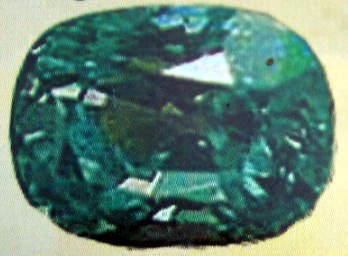
Alexandrite in Day Light |
|
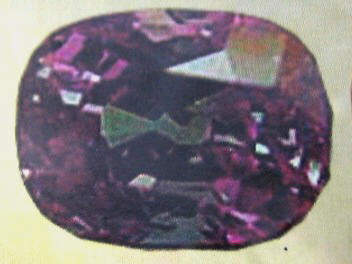
The same Alexandrite in incandescent Light |
|
Alexandrite
Alexandrite is an another June birthstone. The name alexandrite was derived from Czar Alexander 11,during whose reign this stone was discovered in Russia in the Year 1831.The peculiar nature of this stone is it's dual appearance in normal day light and in incandescent light (artificial light). In normal day light the stone appears to have a beautiful green or bluish green color, and in incandescent light the color of the stone changes to red or purplish red.
Alexandrite was the national stone of tsarist Russia as the dual colors of the stone green and red were important colors of imperial Russia.
Alexandrite is one of the rarest gem stones in the world as unique geological conditions were needed for it's formation, and such conditions occurred rarely in the earth's history. Alexandrite is a chrysoberyl containing Iron, Titanium, and Chromium as impurities. The color changing properties of Alexandrite is attributed to the presence of Chromium.
Being rare Alexandrites are hardly ever used in modern jewelry. It is a gem stone for enthusiasts and collectors. The rarity of the stone, the spectacular color change qualities, combined with good hardness(8.5 on the Mohr's scale) make alexandrites one of the most expensive gemstones in the world.
The Original source of alexandrites was the Ural mines in Russia, but now new sources of alexandrites have been discovered around the world. They are Brazil, Sri Lanka, India, Burma, Tanzania, Madagascar, and Zimbabwe. The Brazilian alexandrites have a distinctive color change, but the green color is not as good as the Russian alexandrite. The Sri Lankan. Alexandrite appears green in daylight and brownish red in artificial light, and they are not of the same high quality as the Russian ones.
Moonstone
Moonstone is another alternative birthstone for the month of June. The stone is believed to be associated with one's emotions and feelings of love. It also enhances a person's power of understanding and intuition.
In different cultures the stone is believed to have different mystical powers. In India moonstones are considered to be holy and having magical powers and bringing good luck to the owner. They are also referred to as dream stones, as it was believed that wearing one would lead you to the enchanting world of dreams at night. Among the Arabs the moonstone was a symbol of fertility.
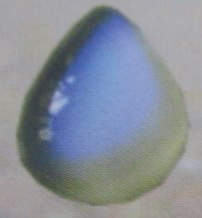
The name moonstone was given by the Romans in ancient times, who believed that the stones appearance changed with the changing phases of the moon.When cut and polished moonstones show a special phenomenon known as Adularescence. This is a special light effect that seemed to change with the change in position of the stone. Sometimes moonstones can display a star of several rays or a cat's eye.
Moonstones can have a variety of colors such as blue, green, champagne, and peach colors. The most valuable moonstones are traditionally of Sri Lankan origin, and have a shimmering pale blue color. Such bluish shimmering stones have also been discovered in countries such as Australia, Myanmar, Brazil, U.S.A., and recently in Madagascar.
Moonstones with colors other than blue such as green, brown, orange, black, champagne, and red have also been discovered in India. All these stones have the shimmering adularescence, and sometimes a cat's eye or a multi-rayed star.
Moonstones are always cut as cabochons. One reason for this is their relative softness, with a hardness of 6 on the Mohr's scale, which makes faceting difficult.
Moonstones belong to the group of minerals known as feldspar. It belongs to a variety of feldspar known as Adularia, found near a group of mountains called Adula, in the Alps range of mountains in Europe. Adularia is a potassium Aluminium Silicate.
Moonstone |
|
Moonstone |
|

You are welcome to discuss this post/related topics with Dr Shihaan and other experts from around the world in our FORUMS (forums.internetstones.com)
 Home
Security & Guarantee
How it Works
Technology Partners
Updated Tables
Famous Diamonds
More Famous Diamonds
Famous Pearls
Famous Gemstones
Contact Dr Shihaan Larif
Contact Senior Editor
Famous Jewelry
Reference Database
Forums
Learning Center
Gemstone Gallery
e-mail Notifications
Advertise
Press Release
About Us
Privacy Policy
Contact Us
FAQ'S
Site Map
Staff Mail Login
Staff Documents
Birthstones
History
Minerals
Shows
Live Metal Prices
Jewellery Gallery
News
Marketplace
Marketplace Support
Open Store
Online Auctions
Join Us & Contribute
Directory
Classifieds
List your products
Wholesale Trading
Post Buy Request
Go Green Policy
Site Updates
Upcoming-ToDo List
Latest News
Latest Articles
Latest Blog Updates
Chat Rooms
Job Board
User Gallery
Videos
New Newsletter Archive
Old Newsletter Archive
Jewelry & Mineral Blog
User Blogs & Social Network
Search
Answers (Q & A)
Valuation
Help me find a diamond/jewelry
pin.internetstones.com- Social Pinboard- Sart yours & connect with millions
Invite Friends From Yahoo, Gmail etc-One Click
Home
Security & Guarantee
How it Works
Technology Partners
Updated Tables
Famous Diamonds
More Famous Diamonds
Famous Pearls
Famous Gemstones
Contact Dr Shihaan Larif
Contact Senior Editor
Famous Jewelry
Reference Database
Forums
Learning Center
Gemstone Gallery
e-mail Notifications
Advertise
Press Release
About Us
Privacy Policy
Contact Us
FAQ'S
Site Map
Staff Mail Login
Staff Documents
Birthstones
History
Minerals
Shows
Live Metal Prices
Jewellery Gallery
News
Marketplace
Marketplace Support
Open Store
Online Auctions
Join Us & Contribute
Directory
Classifieds
List your products
Wholesale Trading
Post Buy Request
Go Green Policy
Site Updates
Upcoming-ToDo List
Latest News
Latest Articles
Latest Blog Updates
Chat Rooms
Job Board
User Gallery
Videos
New Newsletter Archive
Old Newsletter Archive
Jewelry & Mineral Blog
User Blogs & Social Network
Search
Answers (Q & A)
Valuation
Help me find a diamond/jewelry
pin.internetstones.com- Social Pinboard- Sart yours & connect with millions
Invite Friends From Yahoo, Gmail etc-One Click




Our Global Jewelry Industry Job Network


Buy & Sell in our Marketplace

Subscribe to our Newsletter

List in our Classifieds

List in our Directory

User Uploaded Gallery

Powered by Ultra Secure
Amazon (USA) Cloud Network

Founder Internet Stones.COM
Register in our Forums

| Featured In
|
|
|
|
|
|
|
|







Blog & Education Feed
Articles Feed
 |
 |
 |

Copyright © .Internet Stones.COM. All rights reserved.