Keshi Pearls - Non-Nucleated Cultured Pearls Formed Accidentally or Intentionally in Marine Oysters
Open FREE Unlimited Store Join Our Newsletter
Origin of Name :-
The original definition of "keshi"pearl
The word "keshi"in Japanese means "poppy"or "poppy seed"and was first used by Japanese natural pearl harvesters to describe tiny seed pearls sometimes found inside wild Akoya oysters (Pinctada fucata), before Japan began the cultured pearl production. Such pearls were too small to be drilled, and consequently had no apparent use in the trade. Thus, what the Japanese originally referred to as "keshi"pearls were tiny natural pearls harvested from some wild Akoya pearl oysters, which were too small to be drilled.

Kokichi Mikimoto develops a commercially viable method to culture spherical Akoya pearls in 1916
Kokichi Mikimoto successfully developed a commercially viable method to culture spherical Akoya pearls inside the saltwater oyster species Pinctada fucata martensii, in 1916, adopting the Mise-Nishikawa technique, in which a shell nucleus together with a piece of mantle tissue from a sacrificial oyster was inserted into the body or mantle of the oyster, that led to the development of a pearl sac around the nucleus, leading to the deposition of nacre around the nucleus that formed a spherical pearl. A great breakthrough in Japan's pearl industry, the method led to the establishment of several cultured pearl farms in the 1920s, and by 1935 there were 350 pearl farms in Japan, that produced 10 million cultured pearls annually.
Keshi pearls a by product of the Akoya cultured pearl industry
As the cultured pearl industry in Japan developed, pearl farmers engaged in the industry often noticed, that while harvesting their products after the stipulated grow out period, small seed-like pearls had developed in pearl sacs adjacent to the nucleated pearl. Often several of these seed pearls were found in a single oyster. These seed pearls were found to be made of nacre only, and in that respect resembled natural pearls, and had a luster surpassing that of cultured pearls. Such seed pearls made of nacre only and formed as a by product of culturing Akoya pearls came to be known as "keshi"pearls.
Some properties of "keshi"pearls
The size of the pearls
As the name indicates "keshi"pearls are like natural seed pearls, smaller in size, generally having a diameter of less than 2 mm. However, this size range applies only to "keshi"pearls produced by the oyster species Pinctada fucata martensii. "Keshi"pearls produced by other saltwater oyster species, such as Pinctada maxima (silver/gold lipped oyster) and Pinctada margaritifera (black-lipped oyster) have sizes larger than 2 mm, reaching a maximum of over 10 mm. This is because these oysters produce much bigger cultured pearls than Akoya cultured pearls, that range in size from 8 to 20 mm. Pinctada maxima produces the largest cultured pearls in the world.
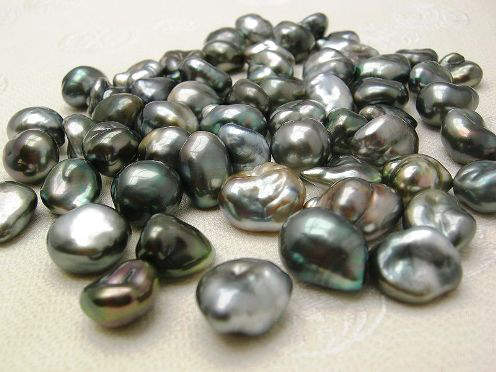
Black Tahiti Keshi Pearls
Photo above, Creative Commons
Shape of the pearls
Keshi pearls occur in a variety of shapes, but are mostly irregular or baroque shaped, unlike bead-nucleated pearls which have regular shapes. In the absence of a bead to guide the final shape of the pearl, "keshi"pearls can assume a variety of shapes, but are mostly irregular or baroque.
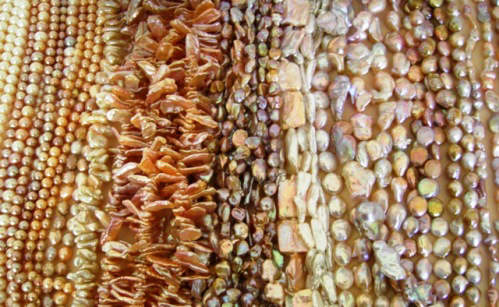
Strands of different kinds of Keshi Pearls
Luster and orient of the pearls
Being composed of almost 100% nacre, "keshi"pearls have a high luster and orient (iridescence) that even exceeds the highest quality cultured pearls. Luster and orient are reflective and refractive properties respectively dependant on the thickness of the nacre. While luster is caused by reflection of light from the surface layers of the nacre, orient or iridescence is caused by refraction and total internal reflection of light as it passes through successive layers of aragonite in the nacre.
Color of the pearls
Keshi pearls are found in a wide range of colors depending on the species from which the pearl originated, and the place of origin of the pearl if they are from the same species. Keshi pearls from Akoya pearl oysters have the colors in which Akoya pearls usually appear, such as white and cream, with overtone colors of rose and silver, but most often the pearls are grayish in color. Those originating from South Sea pearl oyster, the silver-lipped variety Pinctada maxima, can form pearls of colors, such as silver-white, silver-pink, silver-gray, bluish-white, cream and yellow. Golden colored pearls are characteristic of the gold-lipped pearl oyster. Common colors found in Australian keshi pearls are bluish-white and silver-gray, and in Indonesian and Philippine keshi pearls are cream-white and yellow. Keshi pearls formed from the black-lipped pearl oyster, Pinctada margaritifera are usually pure black or gray in color, or black combined with overtone colors such as purple, blue, green and golden or gray combined with overtone colors such as yellow, purple and green.
The popularity of "keshi"pearls
The combined properties of "keshi"pearls being made of nacre only, their extraordinary luster and orient, and the variety of irregular shapes (baroque) and colors in which they occur, have made these pearls popular among jewelry manufacturers, who would like to design something unique and innovative, and the consumers, who would like to wear such new creations.
Scientific research reveals the possible causes of formation of "keshi"pearls
The development of "keshi"pearls inside the Akoya pearl oysters was disadvantageous to the pearl culturists, as the energy of the oysters was expended in forming unwanted seed pearls instead of the intended bead-nucleated pearl. If at all a bead-nucleated pearl was produced it was very small indeed. But, invariably the oyster rejected the implanted bead, and instead developed "keshi"pearls.
Scientific research carried out to determine the various causes of development of "kesh"pearls have identified three possible reasons for the formation of "keshi"pearls.
1) The first possible cause was the tendency of the pearl oyster to reject the implanted bead nucleus, but not the accompanying foreign mantle tissue. The mantle tissue either became the nucleus around which a pearl sac was developed forming a single "keshi"pearl or fragmented into several pieces which lodged in the soft parts of the oyster, developing several pearl sacs, forming many "keshi"pearls.
2) Another possible way was for the bead nucleus to remain intact without rejection, but tiny fragments of the foreign mantle tissue, perhaps even single epithelial cells, detach and move to the other areas in the soft body of the animal, where they develop into pearl sacs forming "keshi"pearls. The bead-nucleated pearl formed will however be very small.
3) A third possible reason for the formation of "keshi"pearls was contamination of the mantle and other interior tissues during the delicate stage of implantation of the freshwater mussel shell bead and a fragment of the foreign mantle tissue. The different contaminants identified are micro- fragments of foreign mantle tissue, and mussel shell bead, and natural micro-organisms such as parasites. Even tiny particles of sand have been suggested as possible contaminants. The irritation caused by these contaminants, lead to the formation of pearl sacs in which "keshi"pearls develop.
An unexpected demand from the Indian pearl jewelry industry helped the Japanese pearl farmers to dispose of the large quantities of unwanted "keshi"pearls
"Keshi"pearls made of nacre only, like natural pearls, became a much sought after pearl, in a world hungry for the rare natural pearls that were becoming scarcer and scarcer. Pearl traders from India, particularly from Hyderabad - "The Pearl City of India,"the center of the pearl industry in India with a history of two centuries of a vibrant pearl culture, under the patronage of the Nizams of Hyderabad - realized that the enormous quantities of "keshi"pearls produced by the pearl farms in Japan, being a 100% nacre-containing product, with its concomitant brilliant luster, would be an ideal substitute for natural pearls, to meet the demand for such pearls, and keep their traditional industry buoyant. Hyderabad had a large workforce of artisans, skilled in sorting, grading, piercing and stringing pearls. The drilling of pearls was a highly skilled manual job done with perfect accuracy in Hyderabad, without damaging the pearls, whose techniques were a jealously guarded family secret, passed down from generation to generation. It is the availability of this skilled manpower, that propelled Hyderabad to the forefront as the main pearl jewelry manufacturing and trading center in the world today. Low labor costs and unmatched craftsmanship were two main factors that attracted pearls to the Hyderabad pearl markets. Thus, the Indian pearl dealers, came to an agreement with the Japanese pearl farmers to supply the Hyderabad pearl industry with the by product of their cultured pearl industry, the "keshi"pearls, that were later set into various pieces of jewelry such as necklaces, bracelets etc., which eventually entered the jewelry markets of the Middle East, where there was a great demand for natural pearls.
Intentionally created "keshi"pearls
When the demand for the "keshi"pearls increased, some pearl farmers began the practice of deliberately inserting only mantle tissue with no nucleus into potential pearl-producing Akoya oysters, that resulted in the production of only keshi pearls. However, these pearls were actually intentionally created "keshi"pearls, unlike other "keshi"pearls that were formed spontaneously. The definition of "keshi"pearls now broadened to include both spontaneously and intentionally created non-nucleated pearls in saltwater oysters
The technique of producing non-nucleated freshwater pearls from freshwater mussels was perfected only in the early 1960s
The Japanese successfully cultured saltwater Akoya pearls in 1916, and by the 1930s there were 350 Akoya pearl farms producing millions of Akoya cultured pearls annually. Attempts to culture freshwater pearls in the freshwater mussel species, Hyriopsis schelegi found in the lakes of Japan, such as the Lake Biwa, was started in 1928, by Dr. Masao Fugita and his colleague Yoshida, using the same techniques developed by Mikimoto, but the results were not so encouraging, despite the fact that research work was carried out until the late 1930s. Seiishiro Udo and Keisaburo Sakiyoshi continued the research work, started by Fugita and Yoshida in 1928, beginning from 1945. Their efforts were successful only in the early 1960s, when Udo and Sakiyoshi perfected the technique of non-nucleated pearl production in freshwater mussels using mantle tissue only. The duo formed the Shinko Pearl Company, the first company that began the commercial production of freshwater pearls, that came to be known as Biwa pearls.
The Japanese referred to non-nucleated freshwater pearls also as "keshi"pearls
Freshwater pearls produced by mussels being non-nucleated and formed around mantle tissue, like "keshi"pearls, were also referred to as "keshi"by the Japanese. Thus, the Japanese definition of "keshi"pearls included all non-nucleated or non-beaded pearls, formed around mantle tissue, either spontaneously or by human intervention, in not only saltwater oysters but also freshwater mussels. Therefore, Biwa pearls are also a kind of "keshi"pearls according to this definition. Biwa pearls like saltwater "keshi"pearls are mostly irregular (baroque) in shape, but can also exist in a variety of different shapes, such as rounded, near-round, button, oval, elongated (dogtooth), flat, grain etc. It was also possible to produce any desired shape, by manipulating the shape of the mantle tissue implants, such as bars, crosses, sticks, triangles, butterflies, dragons, letters of the alphabet etc.
The CIBJO restricts the term "keshi"only to non-nucleated saltwater pearls produced by saltwater oysters.
The freshwater "keshi"pearls from Japan, being all-nacre pearls, had an extraordinary luster and iridescence, but not as high as saltwater "keshi pearls."Thus, after the 1960s, when freshwater "kesh"pearls, from Japan entered the international pearl markets, there was considerable resistance to the product, by pearl importers in consumer countries and their trade associations, who suggested that the term "keshi"be restricted to saltwater pearls only, and the use of the term be banned for freshwater pearls. The CIBJO, the International Jewelry Confederation, accepted this suggestion, and restricted the use of the term "keshi"only to non-nucleated saltwater pearls, produced accidentally or intentionally in saltwater oysters.
The controversy surrounding the nature of "keshi"pearls
Similarities between "keshi"pearls and natural saltwater pearls
Keshi pearls consist of almost 100% nacre, and are therefore similar to natural pearls, which too are made exclusively of nacre. Like natural saltwater pearls, "keshi"pearls have an excellent luster and orient that surpasses even the highest quality cultured pearls. The luster and orient (iridescence) of a pearl is closely related to the amount of nacre deposited in it. Thus, "keshi"pearls being made of nacre only should have the highest luster and iridescence, which no doubt these pearls possess.
Another important fact about "keshi"pearls is that their formation is due to a chance occurrence, like natural pearls. It is not known in advance which of the bead implanted oysters would form "keshi"pearls. The formation of "keshi"pearls is invariably a reaction of the oyster to the implantation of the bead, which is rejected, and the oyster uses only the foreign mantle tissue to form one or more pearl sacs that develop the "keshi"pearls. Other instances such as accidental contamination by the pearl culturist, may still be considered as cultured pearls.
CIBJO definition of "keshi"pearls that considers them as non-beaded cultured pearls
In spite of the fact that "keshi"pearls are all nacre, and mostly produced by a chance occurrence like natural pearls, the CIBJO, the French acronym for Confédération Internationale de la Bijouterie, Joaillerie, Orfèvrerie, des Diamants, Perles et Pierres, which translates as the International Confederation of Jewelry, Silverware, Diamonds, Pearls and Stones (normally shortened to the International Jewelry Confederation), considers "keshi"as cultured pearls, defining it as a non-beaded cultured pearl, formed accidentally or intentionally by human intervention in marine pearl oysters such as the Akoya oyster (Pinctada fucata), Silver/Gold lipped oyster (Pinctada maxima) and Black lipped oyster (Pinctada margaritifera) and is a by-product of the culturing process. The creation results from the formation of a pearl sac either following injury of the mantle rim upon handling;from a partial piece of the inserted (transplanted) mantle tissue;or the whole inserted piece following the rejection of a bead.
Thus, even though "keshi"pearls have all the characteristics of natural pearls, they are still considered as cultured pearls, because they are formed as a by-product of the culturing process from an oyster that has been subjected to human manipulation.
Expert opinion on the true nature of "keshi"pearls is divided
In spite of the CIBJO definition of "keshi"pearls that classifies them as cultured pearls, many gemologists believe that these pearls are still natural pearls because they are produced spontaneously. They feel that calling them cultured pearls does not reflect what actually happens inside the pearl oyster during their formation. Thus expert opinion is divided as to whether "keshi pearls"be classified as natural or cultured pearls.
Even if we accept the position that "keshi"pearls are natural pearls, there is no way of distinguishing a spontaneously formed "keshi"pearl from a "keshi"pearl developed by human intervention by implanting only mantle tissue, as some Akoya pearl culturists did to cater to the Middle Eastern and Indian markets. Perhaps this was one of the reasons that prompted CIBJO to classify all "keshi"pearls as cultured pearls.
Arab and Islamic viewpoint that considers "keshi"as natural pearls
The people of the Arab countries of the Middle East with an ancient history of harvesting, and processing of natural pearls for jewelry, from the Persian Gulf, the hub of the natural pearl industry for several millennia, have a special liking and attachment for natural pearls. Thus, bead-nucleated saltwater oyster pearls and tissue-nucleated freshwater mussel pearls and jewelry items produced with these pearls are not so popular in Arab countries. The idea of wearing pearls that mollusks were forced to grow was revolting in the Arab mind-set, and considered unethical in a society practicing a religion that strongly advocates peace with the natural environment gifted by God. Thus when the existence of "keshi"pearls was brought to the notice of the Arab elite, the opinion was expressed that such pearls produced as a by-product of saltwater pearl culturing were indeed natural pearls, a viewpoint that gained general acceptance. The reasons advanced for such an opinion was that keshi pearls were formed as a result of a chance occurrence as natural pearls in nature, even though they were produced in oysters manipulated by human beings. A second reason advanced to support this viewpoint, was that in most cases "keshis"were produced as a result of the mollusk going against the wishes of man, rejecting the nucleus he had implanted, and instead using only the mantle tissue to form one or more pearl sacs that produce "keshi"pearls. In other words "keshi"pearls are the ultimate result of the oyster taking control of its own god-given abilities, running counter to man's own intentions. A sort of rejection of man's intervention to take control of the oyster's pearl producing mechanism.
China's freshwater pearl industry
The initial production of freshwater pearls in China in the 1970s and 1980s were of low quality known as "rice crispy pearls"
After Japan successfully cultured freshwater pearls from freshwater mussels in the early 1960s, the Chinese too experimented with the techniques of producing freshwater pearls, and took the gem world by surprise in 1968, when they flooded the markets with large amounts of inexpensive cultured freshwater pearls. However, the pearls were of low quality and came to be known as "rice crispy pearls"and were not well received. The species of freshwater mussel used for culturing "rice crispy pearls"was Cristaria plicata, commonly known as the Cockscomb pearl mussel. Chinese pearl culturists performed multiple grafting of up to 50 grafts per mussel shell, which is 25 grafts per valve. After the valve of a 6-12 month old mussel is opened tiny incisions are made on the mantle tissue and 3 mm square pieces of mantle tissue from a donor mussel are introduced into these incisions, twisting the tissue slightly, to round up the edges. When grafting on one side of the mantle tissue is completed, the valve on that side is closed, and the process is repeated on the other side of the mantle tissue. The grafted mollusks are then returned to their natural freshwater environment, where they are tended for 2-6 yeaars. Production of rice crispy pearls continued during the 1970s and 1980s.
Dramatic increase in quality of pearls produced by China, after the introduction of a new mussel species, and reduction in the number of grafts
However, in the 1990s Chinese researches introduced a new freshwater mussel for pearl production, known as Hyriopsis cumingi, commonly known as the triangle shell mussel. Researches also reduced the number of grafts to 12-16 per valve, giving a total of 24-32 grafts for the whole shell. The change in the species of mollusk and the reduction in the number of grafts had a dramatic effect on the quality of the pearls produced. Further improvement in quality and variety of colors of Chinese freshwater pearls were achieved at the turn of the century, by the introduction of hybridized mussels, such as the hybrid of Hyriopsis cumingi with Hyriopsis schlegeli. By the year 2006 China had achieved a total production of 1,500 tons of freshwater pearls annually, thus dominating the freshwater pearl industry in the world. The freshwater pearl industry in China is mainly concentrated in the coastal province of Zhejiang, which is located in the delta of the Yangtse River in Southern China.
The Chinese use the term "keshi"only for second and third generation freshwater pearls
The first harvest of freshwater pearls taken from mantle tissue grafted mussels, after a period of 2-6 years, were plump and full-shaped, as they were products of younger mussels showing vigorous growth, with nacre production at its maximum. Since mussels have a long life span, healthy mussels can be used to obtain a second or even third harvest of cultured pearls. After obtaining the first harvest of pearls, exercising precautions to prevent injuries to the mussel, the valves are closed, and the mussels returned to the freshwater environment for a further grow out period. There is no need for a further implantation of mantle tissue. The mussels can now produce a second and third crop of pearls, without any implantation, but the amount of nacre produced decreases with age, and the pearls produced are flat and thin with concavities and of different shapes. The Chinese refer to the second and third harvest pearls as "keshi"pearls, but do not use this term for the first harvest pearls which are plump and full with the desired shapes. Thus, while the Japanese use the term "keshi"for all non-nucleated pearls irrespective of the generation and environment in which they are produced, the Chinese restrict the term "keshi"only to second and third generation freshwater pearls.
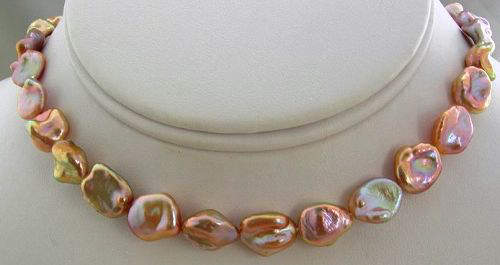
Chinese Freshwater Keshi Pearls
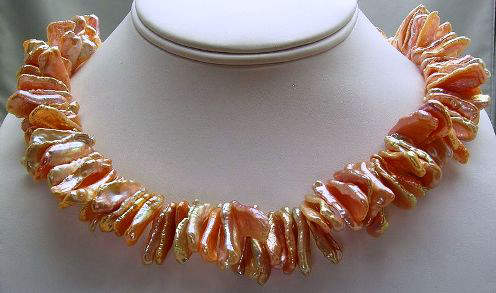
Chinese freshwater flat Keshi Pearls
Why South Sea and Black Tahitian "keshi"pearls are becoming scarcer ?
"Keshi"pearls and jewelry pieces turned out of them, were once very popular and could be purchased at a bargain. However, these pearls are now becoming rarer and rarer. This is mainly because pearl culturists of the South Sea pearl farms such as in Australia, Philippines and Indonesia, and the Tahitian pearl farms of the South Pacific, have now resorted to X-raying the seeded pearl oysters to make sure that the implanted bead nuclei have not been rejected. If the nucleus has been rejected, the oyster is again opened up and re-nucleated, before a keshi pearl is formed. A second attempt in nucleating an oyster is usually successful. In the case of South Sea pearl oysters and Black Tahitian pearl oysters, attempting a second nucleation is advantageous given the long time required for pearl formation which varies from 2 to 4 years, and the much higher prices realized for the bead nucleated cultured pearls than "keshi"pearls. Thus South Sea and Black Tahitian "keshi"pearls are now becoming very scarce. However, X-raying and re-seeding is not practiced for Akoya pearls, which are relatively cheaper, and whose grow out period is a maximum of two years, and the keshi pearls formed have a ready market in India and the Middle East
You are welcome to discuss this post/related topics with Dr Shihaan and other experts from around the world in our FORUMS (forums.internetstones.com)
Related :-
2) Marilyn Monroe Pearl Necklace
References :-
1) Keshi Pearls - www.pearl-guide.com
2) Keshi Pearls - David Federman. www.modernjeweler.com
3) Keshi Pearls - From Wikipedia, the free encyclopedia
4) What are "keshi"pearls - www.galttech.com
5) Keshi and Nucleated Freshwater Pearls - www.pearls.com
6) Keshi Pearls - www.allaboutpearl.com
7) Cultured freshwater pearls - From Wikipedia, the free encyclopedia
8) China's Pearl Industry - Stina Bjorkell, February 13, 2008. www.radio86.co.uk
 Home
Security & Guarantee
How it Works
Technology Partners
Updated Tables
Famous Diamonds
More Famous Diamonds
Famous Pearls
Famous Gemstones
Contact Dr Shihaan Larif
Contact Senior Editor
Famous Jewelry
Reference Database
Forums
Learning Center
Gemstone Gallery
e-mail Notifications
Advertise
Press Release
About Us
Privacy Policy
Contact Us
FAQ'S
Site Map
Staff Mail Login
Staff Documents
Birthstones
History
Minerals
Shows
Live Metal Prices
Jewellery Gallery
News
Marketplace
Marketplace Support
Open Store
Online Auctions
Join Us & Contribute
Directory
Classifieds
List your products
Wholesale Trading
Post Buy Request
Go Green Policy
Site Updates
Upcoming-ToDo List
Latest News
Latest Articles
Latest Blog Updates
Chat Rooms
Job Board
User Gallery
Videos
New Newsletter Archive
Old Newsletter Archive
Jewelry & Mineral Blog
User Blogs & Social Network
Search
Answers (Q & A)
Valuation
Help me find a diamond/jewelry
pin.internetstones.com- Social Pinboard- Sart yours & connect with millions
Invite Friends From Yahoo, Gmail etc-One Click
Home
Security & Guarantee
How it Works
Technology Partners
Updated Tables
Famous Diamonds
More Famous Diamonds
Famous Pearls
Famous Gemstones
Contact Dr Shihaan Larif
Contact Senior Editor
Famous Jewelry
Reference Database
Forums
Learning Center
Gemstone Gallery
e-mail Notifications
Advertise
Press Release
About Us
Privacy Policy
Contact Us
FAQ'S
Site Map
Staff Mail Login
Staff Documents
Birthstones
History
Minerals
Shows
Live Metal Prices
Jewellery Gallery
News
Marketplace
Marketplace Support
Open Store
Online Auctions
Join Us & Contribute
Directory
Classifieds
List your products
Wholesale Trading
Post Buy Request
Go Green Policy
Site Updates
Upcoming-ToDo List
Latest News
Latest Articles
Latest Blog Updates
Chat Rooms
Job Board
User Gallery
Videos
New Newsletter Archive
Old Newsletter Archive
Jewelry & Mineral Blog
User Blogs & Social Network
Search
Answers (Q & A)
Valuation
Help me find a diamond/jewelry
pin.internetstones.com- Social Pinboard- Sart yours & connect with millions
Invite Friends From Yahoo, Gmail etc-One Click




Our Global Jewelry Industry Job Network


Buy & Sell in our Marketplace

Subscribe to our Newsletter

List in our Classifieds

List in our Directory

User Uploaded Gallery

Powered by Ultra Secure
Amazon (USA) Cloud Network

Founder Internet Stones.COM
Register in our Forums

| Featured In
|
|
|
|
|
|
|
|







Blog & Education Feed
Articles Feed
 |
 |
 |

Copyright © .Internet Stones.COM. All rights reserved.