Koh-i-Noor Diamond
Open FREE Unlimited Store Join Our Newsletter
Origin of name
The name by which the Koh-i-Noor diamond was known prior to the capture of Delhi and Agra by Nadir Shah in 1739 is not known. But, there is strong evidence to suggest that this is the same stone referred to in Emperor Babur's memoirs the "Baburnama", which he wrote between 1526 and 1530 A.D. Thus the stone is commonly referred to as the Babur Diamond when referring to it, in the period before 1739. It was Nadir Shah, who is believed to have exclaimed Koh-i Noor ! ( Mountain of Light), when he saw the diamond for the first time after it was surrendered to him by the Mughal Emperor Muhammad Shah.
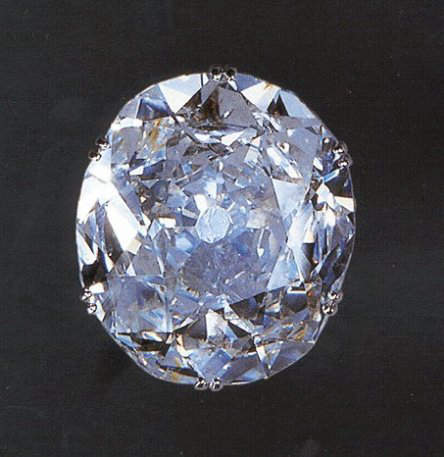
Characteristics of the diamond
The Koh-i-Noor diamond originally weighed 186 carats, when the stone was in India, Persia and Afghanistan, but, subsequently after the stone was surrendered to the British, and became part of the British Crown Jewels, the stone was re-cut to an oval stellar brilliant, weighing 108.93 carats, with a resultant loss of almost 43 % of it's original weight. The diamond is a D-color diamond with exceptionl clarity, characteristic of stones originating from the Indian sub-continent.
Early History
The Koh-i-Noor is perhaps the most famous of all the famous diamonds in the world, which according to legend may be the oldest diamond in the world, with a history dating back to at least 3,000 years B.C. However according to recorded history the Koh-i- Noor diamond dates back to the latter half of the 13th century. The diamond belonged to different rulers from India, Persia, and Afghanistan, who sometimes fought bitterly over it, at various times in history, and seized it as a spoil of war. It eventually became part of the British Crown Jewels, when the stone was surrendered to Queen Victoria in 1851, by the successor to the last owner of the diamond, Maharajah Ranjith Singh, the ruler of Pungab.
Like all other ancient diamonds, the Koh-i-Noor also has many legends associated with it. According to one such legend the stone could bring misfortune or death to any male who wears or owns it, and conversely it could bring good luck to any female who does so. According to another popular legend associated with the diamond the stone bestows superiority to it's owner over his enemies.
The origin of the Koh-i-Noor seems to be shrouded in mystery. One reason for this is that the name Koh-i-Noor was first used to refer to this diamond only in 1739, after it came into the possession of Nadir Shah, when he plundered the wealth of Agra and Delhi. The named used for the diamond prior to 1739, is not known, but there is strong historical evidence linking the Koh-i-Noor with the diamond referred to in the "Baburnama", the memoirs of Babur, written by the Emperor himself, between 1526 and 1530. There are many early stories of great diamonds in Southern India, from where the Koh-i-Noor most probably originated, but one finds it difficult to establish which one of them refers to the Koh-i-Noor.
According to a popular legend, the origins of Koh-i-Noor dates back to over 5,000 years, and is said to be mentioned in ancient Sanskrit Writings under the name "Syamantaka." Popular Hindu beliefs hold that Lord Krishna himself obtained the diamond from Jambavantha, whose daughter Jambavati he later married. The diamond was later stolen from Krishna, as he lay sleeping. According to another source the diamond was discovered in India from a river bed in 3,200 B.C.
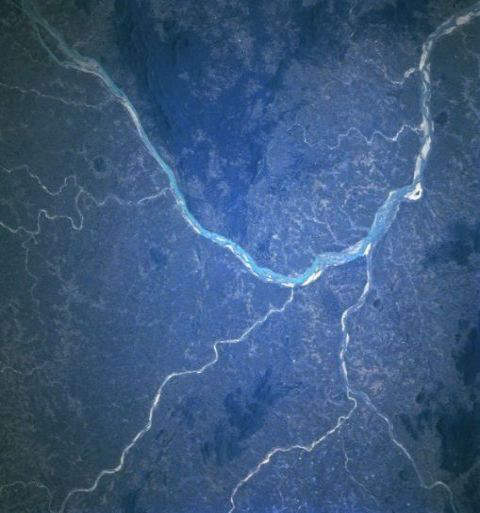
Mahanadi River as seen from space
Being a diamond of the 13th century, the Koh-i-Noor diamond could not have originated in the Kollur mines near Golconda, because the diamantiferous deposits of Kollur were discovered only in the mid 16th century. The next probable source for the diamond would be Sambalpur group of mines situated on the banks of the Mahanadi River, on the eastern side of the Deccan Plateau in the Central Provinces of India. It is well known that most of the diamonds known to ancient Indians came from the alluvial deposits of the Mahanadi River. In fact, the Mahanadi River itself has been identified as the diamond river mentioned by Ptolemy, the Greek writer and historian, in A.D. 60 to 90.
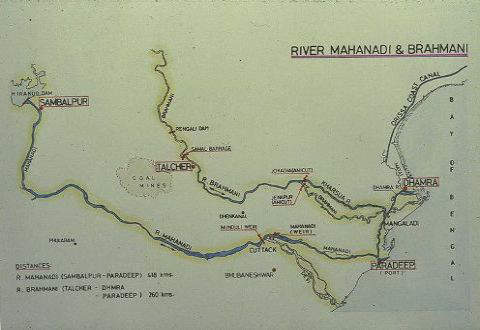
The rivers Mahanadi and Brahmani
Koh-i-Noor with the Delhi Sultanate (1295-1526)
The diamond came into the possession of the rulers of the Delhi Sultanate in the late 13th or early 14th centuries. According to one version, as stated in the Baburnama, Sultan Ala-ud-din Khalji (1296-1316) of the Delhi Sultanate is credited with having acquired the jewel either in the late 13th or early 14th centuries. There are three different versions on how Sultan Ala-ud-din came to be the owner of the diamond. One version says that he took the jewel in 1295, one year before his accession to the throne as Sultan, from the Rajah of Malwa, whose family had owned it for many generations, after having led an expedition to the Deccan, conquering Malwa, and capturing a large amount of booty, which included the Koh-i-Noor diamond. One year after this in 1296, Ala-ud-din murdered his uncle Sultan Jalal-ud-din and assumed power as the new Sultan. This version is as recorded in Baburnama.
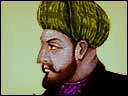
Sultan Ala-ud-din Khalji (1296-1316)
According to a second version, Sultan Ala-ud-din took possession of the Koh-i Noor, one year after his accession to the throne in 1297, when he attacked and subdued the Kingdom of Gujarat, taking a large booty that included the Koh-i-Noor diamond.
Yet another version attributes the acquiring of the diamond to Malik Kafur, the Lieutenant of Sultan Ala-ud-din Khalji, who was sent on a plundering expedition to the south in 1308, which led to the capture of Warangal, the capital of Kakatiya Kings, situated in Northern Andhra Pradesh. Malik Kafur also occupied Madura, in the extreme south, and returned to Delhi in 1311, laden with spoils of war, which may have included the Koh-i-Noor diamond.
A second version of the early history of the diamond gives the credit of acquiring the stone to Ghiyas-ud-din Tughluq Shah I, the Ist Sultan of the Tughluq Dynasty, after the collapse of the Khalji Dynasty in 1320 A.D. It is said that Ghiyas-ud-din sent his son Ulugh Khan in 1323 A.D. to defeat the Kakatiya King Prataparudra based in Warangal. Ulugh Khan succeeded in capturing Warangal in his second attempt, and subsequently looted and plundered the city. Large quantities of gold, diamonds, pearls, and ivory were carried away as spoils of war to Delhi, on elephants and camels. The Koh-i-Noor diamond was believed to be part of the bounty.
Considering the above versions of the early history of the diamond, it appears that the stone came into the possession of the rulers of the Delhi Sultanate in the late 13th or early 14th century. Subsequently the stone had passed through the hands of successive rulers of the Delhi Sultanate for almost 200 years, until finally it came into the possession of Babur, the first Mogul emperor, in 1526, after the defeat of the Lodi dynasty, the last ruling family of the Delhi Sultanate.
Koh-i-Noor with the Mogul Emperors (1526-1540)
According to Historians, the stone acquired by Sultan Ala-ud-din Khalji at least two centuries before, was surrendered to Humayun, the son of Babur, who was the founder of the Mogul dynasty in India, either by the family members of Sultan Ibrahim Lodi or the Rajah of Gwalior, both of whom fought on the same side against the Mogul invaders and were killed by Babur's forces at the battle of Panipat in 1526.
After the defeat of Ibrahim Lodi, the last Sultan of the Lodi dynasty, of the Delhi Sultanate, Humayun was assigned the task of taking possession of all the jewels that had belonged to the slain Sultan. After Humayun's men ransacked the royal treasury and failed to find the diamond, a servant gave the information that it was hidden in the palace. When Humayun entered the palace the women of Ibrahim Lodi's family began to weep. After Humayun assured that their life and honour would be safe in his hands and they would be treated with kindness and in keeping with their status, Ibrahim Lodi's mother went silently into a room, and emerged with a gold box, which with trembling hands he handed over to the young prince. Humayun opened the box and found the diamond.
The other version is that Humayun entered the fort of Agra, and captured the members of the family of the slain Rajah of Gwalior, Vikramaditya. Humayun spared the lives of the captives and treated them with kindness and did not allow them to be plundered. The family members of the Rajah were so overwhelmed by this magnanimous gesture, that they decided to present the royal jewels of the Rajah of Gwalior to Humayun, which included the Koh-i-Noor diamond.
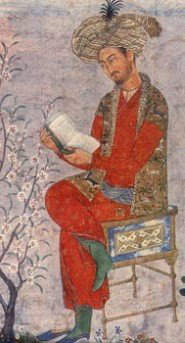
Emperor Barbur,I st Moghul Emperor of India
Babur whose original name was Zahir-ud-din Muhammad, was a descendant of the Mongol conqueror Genghis Khan, and also of Timur (Tamarlane) of Samarqand. He was a military adventurer and soldier of distinction and a poet and diarist of genius, as well as a statesman.
In his memoirs, the Baburnama, he mentions the Koh-i-Noor by an identifiable name, and states that it belonged to an unnamed Rajah of Malwa in 1294. According to Babur the stone at that time had an immense monetary value, that it could have fed the whole world for two days. The Baburnama relates how the Rajah of Malwa was compelled to part with his prized possession to Sultan Ala-ud-din Khalji. It was then owned by a succession of dynasties, that ruled the Delhi Sultanate, finally coming into the possession of Babur himself in 1526, following his victory over the last ruler of that kingdom. However even Babur's version may not be authentic, as sources for his information are unknown, and he may have been just recounting the hearsay of his day. He did not refer to the stone by it's present name, and in spite of the controversy about it's identity, it seems fairly certain that Babur's diamond was the stone which later became known as the Koh-i-Noor.
Babur arrived in Agra on May 4th, 1526, and as mentioned in the Baburnama, was presented with the famous diamond by his son Humayun, but the father later gave it back to his son as a gift.
About 4 years after Babur's crucial victory at Panipat, Humayun fell seriously ill, and doctors had given up all hopes of saving his life, when it was suggested that Babur Sacrifice his dearest possession to save his son. Babur felt that his most precious possession was his own life, and moved around the bed three times praying that Humayun's life be spared and his own life be sacrificed instead. Miraculously Humayun's condition improved after this, but Babur's own health declined and he died in Dec. 1530.
Humayun
Humayun succeeded his father as Emperor of Hindustan, but was unfortunate that his father was not able to consolidate fully his conquests in India, during his short rule of 4 years. Humayun initially ruled for about 10 years from 1530 to 1540, but during this period, instead of consolidating the empire his father had set up, embarked on more adventures, trying to subdue more territories. Initially he appeared to be successful, conquering Malwa and Gujarat, but was not able to hold them. There after he suffered a succession of defeats at the hands of Sher Shah's forces who advanced from Bengal. Humayun retreated from Delhi and Agra to Lahore, then to Sind, and finally sought refuge in Iran. In his hurry to escape he left his only son (Akbar), and daughter and his several wives in India.
Koh-i-Noor leaves India for Persia, for the first time (1540-1547)
The Shah of Iran Thamsap I, received him cordially and granted him exile. Eventually he promised him military aid to regain his kingdom, provided he became a Shiite Muslim, and returned Qandahar to Iran, in the event of it's successful capture from the Afghan rulers.
Humayun waited until the death of Sher Shah (May 1545), and during the period of his successor Islam Shah (1553), he began his military campaign to regain his lost Kingdom. At first he captured Qandahar and Kabul, and in Dec 1554 crossed the Indus and marched to Lahore, which he captured without opposition. In Feb. 1555, he occupied Sirhind and in July 1555, captured Delhi and Agra. He thus regained the throne of Delhi, and was re-united with his family after an interval of 15 years. But, Humayun did not live long to recover the whole of the lost Empire. He died six months later, as a result of an accident, in Jan. 1556. The news of his death was kept a secret for about two weeks, until the peaceful accession of his son Akbar, who was 13 years old and was at the time away in Punjab as it's Governor.
It is said that Humayun carried the large diamond which his father gave him, when he went into exile in Iran. While in Iran, he was so kindly treated by the Shah, that as an expression of gratitude he presented the Babur Diamond and other jewels to Shah Thamsap. This is mentioned in the Akbarnama-Memoirs of Akbar- written by the historian Abdul Fazal, who was later appointed as secretary to the Emperor Akbar. The presentation of the diamond to the Shah was also confirmed by Khur Shah, the Ambassador of Ibrahim Qutb, King of Golconda, at the Persian Court. He said that a diamond of six mishquals, was presented to the Shah, that was worth the expenditure of the whole world for 2½ days, a familiar way of appraising the Babur Diamond. However, he also said that Shah thamsap was not so impressed and later sent it as a gift to Burhan Nizam (1509-1553), the Shah of Ahmednagar. These events took place in 1547.
Koh-i-Noor returns back to India (1547-1600)
Ahmednagar was a town in west-central Maharashtra State, Western India. It lies along the Sina River, 130 miles east of Bombay. It was conquered by Malik Ahmed Nizam Shah, founder of the Ahmednagar dynasty in 1490, who built a formidable fort now known as the Ahmed Nizam Shah's Fort. The Nizam Shahi dynasty was engaged in constant warfare, that led to the expansion of their kingdom. Towards the last years of his rule, the Mogul Emperor, Akbar the Great, attacked and captured Berar in 1596 and Ahmednagar in 1600. Thus Ahmednagar became one of the 15 provinces of the Mogul Empire.
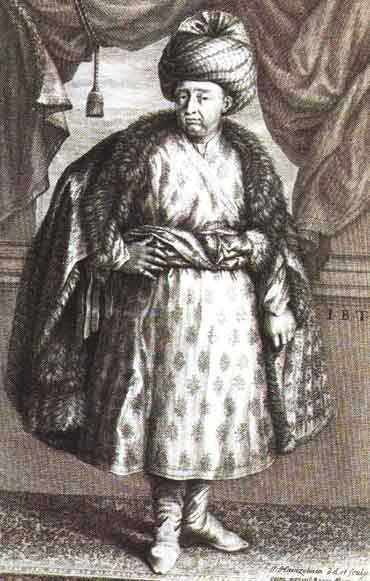
Tavernier, a traveller wearing a Moghul dress.The Six Voyages of Jean-Baptiste Tavernier, published in 1679.
Koh-i-Noor back in the possession of the Mogul Emperors (1600-1739)
The Babur diamond which was gifted to Burhan Nizam in 1547, may have eventually fallen into the hands of the Mogul Emperors, probably during the reign of Jalal-ud-din Muhammad Akbar, when Ahmednagar was subdued, either as a gift to the Emperor or as spoil of war. This may be one of the possible ways the Babur diamond, that was gifted to Shah Tahmasp of Persia, by Humayun, eventually returned to the possession of the Mogul Emperors.
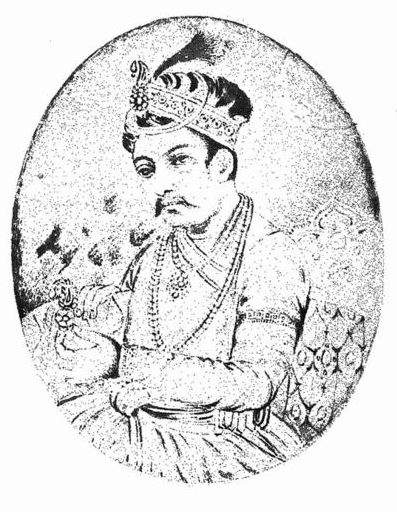
Akbar the Great
Jalal-ud din Muhammad Akbar was the greatest of the Mogul Emperors of India, who ruled from 1556 to 1605. He extended Mogul power over most of the Indian sub-continent, which only a few rulers were able to achieve in the entire history of India. Akbar adopted programs and measures in order to win over the loyalty of the non-Muslim majority of his kingdom, and gradually evolve a non-sectarian state, where all religions were given equal protection, and one could practice freely the religion of his choice. He abolished the Jizya tax imposed on non-Muslims, and banned the forcible conversion of prisoners-of-war to Islam. He appointed Hindus to top positions in the Government, both as advisers and policy makers. He reformed the administration of religious grants, and made them available to learned and pious men of all religions, not just Islam. He took an active interest in other religions, persuading Hindus, Parsis, Christians, as well as Muslims, to engage in religious discussion before him. Even though he himself was illiterate, he encouraged scholars , poets, painters, and musicians, making his court a center of culture. He reformed and strengthened his central administration and centralized his financial system, and re-organized his tax collection process. A detail and exhaustive study of Akbar's 49-year rule, shows that the principles and policies adopted by him in the late 16th century, corresponds with modern principles of statecraft practiced by all secular democracies today.
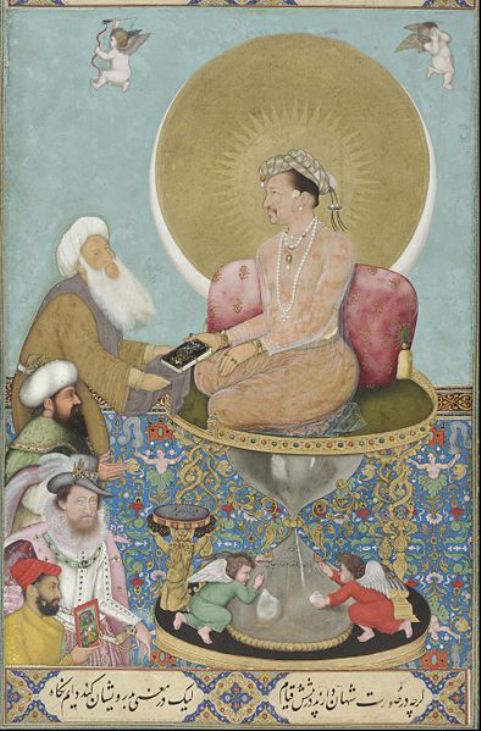
Jahangir Shah Mogul Emperor
The Babur diamond that was added to the Crown Jewels of Akbar the Great, was inherited by his successor Emperor Jahangir and later by Emperor Shah Jahaan, the successor to Jahangir. Shah Jahaan had an insatiable passion for building. At his first capital in Agra, he built two great mosques, the Moti Masjid, and the Jami Masjid, and the world renowned mausoleum in memory of his favorite Queen,. Mumtaz Mahal, known as the Taj Mahal. At his new capital in Delhi , he built a huge fortress-palace complex called the Red Fort, and the Jami Masjid, which is among the finest mosques in India today. Shah Jahaan's reign was a period of great literary activity. The arts of painting and calligraphy was also encouraged. His court was one of great pomp and splendor, and his collection of jewels was probably the most splendid in the world. Shah Jahaan had the Koh-i-Noor diamond placed into his ornate Peacock Throne.
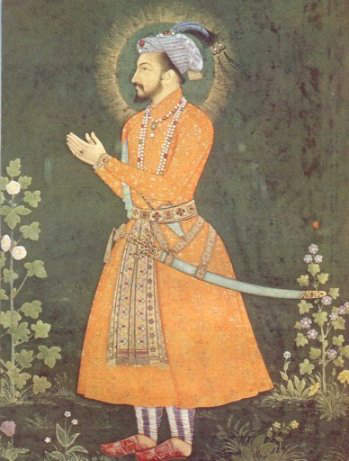
Shah Jahaan,Emperor of India
When Shah Jahaan fell seriously ill in 1657, a war of succession broke out betwen the designated successor Dara Shikoh, his eldest son, and Aurangzeb, his third son by his favourite wife Mumtaz Mahal. Aurangzeb emerged victorious in this war, and placed his father, who had an unexpected recovery from his illness, under house arrest in his own palace at Agra Fort. According to a legend Shah Jahan is reported to have placed the Koh-i-Noor against a window, so that he could look at the stone and see the Taj Mahal reflected in it. The Koh-i-noor remained with Shah Jahaan until his death in 1666. Aurangazeb took possession of the stone together with some other jewels only after Shah Jahaan's death. Perhaps this may be the reason why Jean Baptiste Tavernier did not see a diamond resembling the Koh-i-Noor, when he had the rare privilege of inspecting the Great Emperor Aurangzeb's collection of jewels.
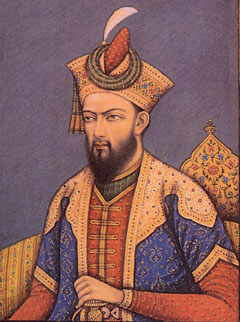
Aurangzeb, Last of the Great Mogul Emperors
Aurangzeb's 49-year rule ended with his death in 1707. He was the last of the Great Mogul Emperors. After his death, Mogul rule in India began a rapid decline with three emperors ruling within a period of twelve years. They are Bahadur Shah (1707-1712), Jahandar Shah (1712-1713), and Farrukh Siyar (1713-1719). Then followed a relatively stable period when Emperor Muhammad Shah ascended the throne. He reigned from 1719 to 1748. Muhammad Shah inherited all the crown jewels of Aurangzeb.
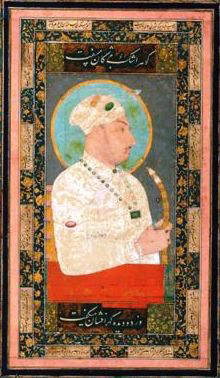
Emperor Muhammed Shah
Koh-i-Noor leaves India for Persia, for the second time (1739-1747)
But unfortunately, during the rule of Muhammad Shah, the mighty conqueror Nadir Shah from neighboring Iran, invaded Delhi and Agra in 1739, and sacked the two cities and plundered their wealth. Nadir carried away Shah Jahaan's Peacock Throne, and all the crown jewels of the Mogul Emperors, which included the Koh-i-Noor, the Darya-i-Noor, Nur-ul-Ain etc. The total value of the loot carried away by Nadir Shah was estimated at 70 Crores (700 million rupees), and it is said that Nadir was able to exempt the Iranian people from taxes for the next three years. It was allegedly Nadir Shah who exclaimed Koh-i-Noor ! when he finally managed to obtain the famous stone, and this is how the stone gained it's name. There is no reference to this name before the year 1739. There is a legend attributed to one of Nadir Shah's consorts, which gives the valuation of the Koh-i-Noor, even though it is an unduly exaggerated estimate. According to this legend the consort is supposed to have said, "If a strong man should take five stones, and throw one north, one south, one east, and one west, and the last straight up into the air, and the space between filled with gold and gems, that would equal the value of the Koh-i-Noor."
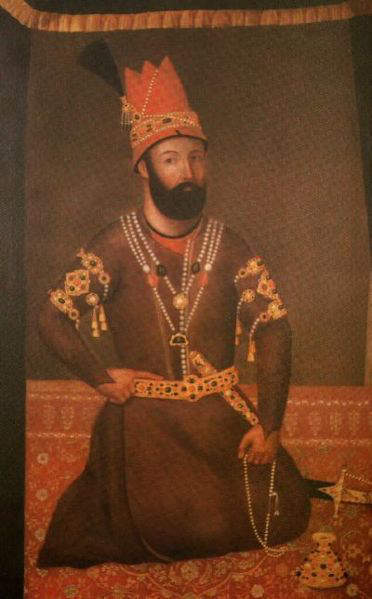
Nadir Shah
Nadir Shah whose original name was Nadir Quli Beg, started life as a brigand chief, who formed and led a band of armed robbers. In 1726, he led a group of 5,000 followers in support of Shah Tahmasp II , who was trying to regain the throne, which his father had lost 4 years earlier to the Afghan ruler Mahmud. Nadir reorganized Iran's military forces, and utterly defeated the Afghans in a series of battles, and restored Thamasp II to the Iranian throne.
He then diverted his attention towards the Ottoman Turks, who had occupied neighboring Azerbaijan and Iraq. He attacked and routed them from these two countries. He later deposed Tahmasp II for signing a peace treaty with the Turks on ignominious terms, having attacked the Turks in his absence, when he was quelling a revolt in Khorasan. He placed Tahmasp's infant son on the throne and declared himself regent. Subsequently he succeeded in driving the Turks completely out of Iran, and also annexed the Russian Caspian Provinces. In 1736, Nadir deposed the young Abbas III (Tahmasp IIs son), and installed himself as the Shah, taking the title Nadir Shah.
Later he built a formidable Navy, that attacked and captured Bahrain and Oman. He then turned towards the east, and in 1739 attacked and captured several cities of the Mogul Empire, including Delhi and Agra. He returned to Iran with a vast amount of loot. later he attacked the Uzbeks near the cities of Bukhara and Khiva, and again attacked and defeated the Turks near Yerevan in Armenia.
As a conqueror, Nadir Shah succeeded in creating an Iranian Empire that stretched from the Indus River to the Caucasus mountains. Nadir was successful as a soldier and general, but he failed miserably as a statesman and administrator. He was harsh and ruthless towards his subjects. He was suspicious of everyone around him, and had people tortured and executed, wherever he went. Tens of thousands of people perished in his never ending military adventures. As a result he became very unpopular among his people, and had to face many revolts against him. Eventually, Nadir Shah was assassinated by his own troops in 1747, while attempting to crush a revolt in Khorasan.
Koh-i-Noor leaves Persia for Afghanistan (1747-1810)
In the immediate aftermath of his assassination generals close to Nadir Shah tried to lay their hands on at least part of the enormous treasures collected by him during his ceaseless military campaigns. The renowned Koh-i-Noor diamond fell into the hands of Ahmad Khan Abdali, who was the commander of Nadir Shah's 4,000 man Afghan bodyguard. Ahmad Khan Abdali returned to his native Qandahar in Afghanistan, and was elected Shah by a tribal council. He adopted the title Durr-i-Durrani (Pearl of Pearls). Ahmed Shah Durrani embarked on a series of conquests and created an empire that extended from Meshhed to Kashmir and Delhi, and from the Amu Darya to the Arabian Sea. The Durrani Empire was the second largest Muslim Empire, in the second half of the 18th century, surpassed only by the Ottoman Empire. Ahmed Shah died in 1772 and was succeeded by his son Timur Shah, who shifted the capital from Qandahar to Kabul in 1776.
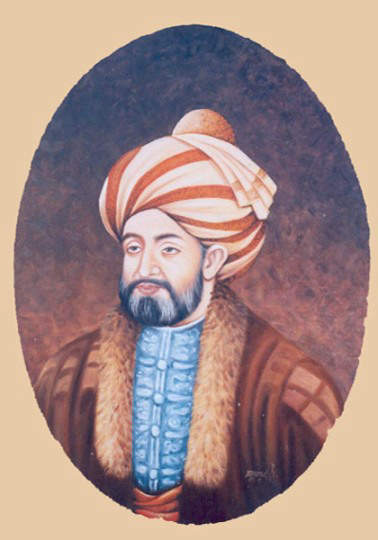
Ahmed Shah Durrani
When Timur Shah died in 1793, his fifth son Zaman, seized power, with the help of Sardar Payenda Khan, a tribal chieftain of the Barakzay tribe. Zaman Shah was deposed in 1800 by Mahmud his brother, who was the Governor of Herat, assisted by Fath Ali Shah of Persia and the British.
Zaman Shah who was blinded by his brother Mahmud Shah, had the Koh-i-Noor diamond in his person, when he was subsequently imprisoned. He hid the diamond on the wall of the prison, and had it embedded in the plaster. Mahmud Shah was later deposed and imprisoned by another brother Sha Shoja in 1803. Sha Shoja, who ruled up to 1809, retrieved the diamond from the wall of the prison, with the help of his brother Zaman Shah, who pointed out the place of hiding. Mahmud Shah who escaped from prison, later regained back his throne in 1810 from Sha Shoja.
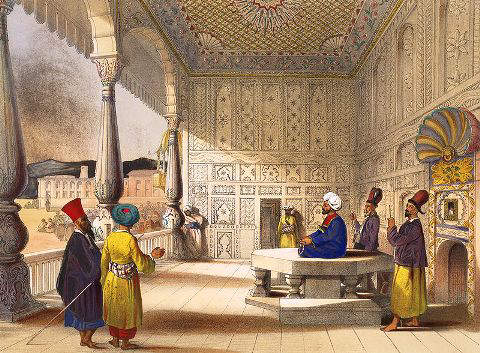
Shah Shuja al Mulk ,sitting at his palace
Koh-i-Noor leaves Afghanistan and enters India for the second time (1810-1849)
The two brothers Sha Shoja and Zaman Sha, escaped to Lahore and sought refuge with the Sikh Maharajah Ranjit Singh, the Lion of Punjab, who was appointed as Governor of Lahore by Zaman Shah himself in 1798, when it was part of the Durrani Empire.
Shah Shoja had carried the Koh-i-Noor with him to Lahore, and Maharaj Ranjit Singh who had heard about the diamond earlier, expressed an interest in owning it. On the assumption that Shah Shoja was holding the Koh-i-Noor diamond, he tried to extort the diamond from him, as a price for giving him and his family sanctuary in Lahore. But, Shah Shoja denied having the diamond with him, giving different reasons at different times to avoid giving the diamond to the Maharajah. On one occasion he said that he had lost the diamond with some other jewels. On another occasion he said that he had pawned the diamond with a money-lender. On a third occasion Shah Shoja dispatched a large white topaz to the Maharajah, claiming that it was the Koh-i-Noor diamond. The King gave the Topaz to the court jewelers asking them to confirm whether it was the diamond. When the results of the court jewelers proved negative the King became furious, and ordered that food supplies to the Shoja household be cut off for two days, and posted a guard outside the house. Finally Sha Shoja relented, and agreed to surrender the Koh-i-Noor to the Maharajah if he calls over personally to receive it.
The Maharajah accepted Shah Shoja's suggestion, and at an appointed time on June 1st 1813, visited his house, to receive the diamond. The two men greeted each other, and after sometime a servant brought a bundle from an adjacent room, and placed it before the King. Ranjit Singh unwrapped the bundle and found the Koh-i-Noor inside. He then left the room with the gem, without saying a word.
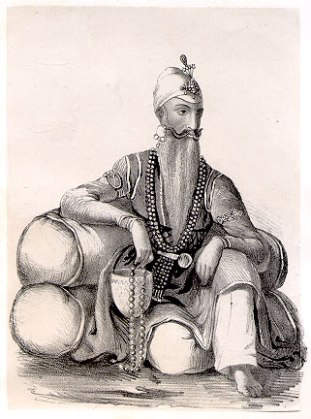
Maharajah Ranjith Singh, the ruler of Pungab.
Ranjit Singh was the first and most powerful of Sikh Kings who ruled Punjab. After his death in 1839, at least three kings succeeded him one after another, and were killed in a struggle for succession. Finally in 1843, Dulip Singh, the last of Ranjit Singh's sons, who was a minor, was proclaimed the King, with his mother Jindan kaur as regent. Two Sikh wars were fought during his reign, leading to the annexation of the Punjab by the British. On March 29th 1849, the British flag was hoisted on the citadel of Lahore and the Punjab was formally proclaimed to be part of the British Empire in India.
Koh-i Noor leaves India for Great Britain (1849-to date)
One of the terms of the Treaty of Lahore, the legal agreement formalizing this occupation, reads as follows :-
"The gem called the Koh-i-Noor which was taken from Sha Shuja-ul-Mulk, by Maharajah Ranjit Singh, shall be surrendered by the Maharajah of Lahore to the Queen of England."
On the side of the British, the Treaty of Lahore was ratified by Lord Dalhousie, the Governor General, who at the age of 35, was the youngest holder of this office, to be sent to India. Dalhousie was chiefly responsible for acquiring the Koh-i-Noor for the British, and he displayed a keen interest in the diamond for the rest of his life. Not long after the signing of the Treaty of Lahore, Dalhousie was severely criticized by the officials of the East India Company, the former Governor General of India, Lord Ellenborough and others, for the manner in which the diamond was acquired for the British. While the East India Company felt that the diamond should have been handed over to them to be presented to the Queen as a gift on a subsequent occasion, Lord Ellenborough was indignant because Dalhousie did not confiscate everything to Her Majesty the Queen. In a letter written to his friend Sir George Cooper in August 1849, Lord Dalhousie Stated as follows:-
"The court (of the East India Company) you say, are ruffled by my having caused the Maharajah to cede to the Queen the Koh-i-Noor, while the Daily News and My Lord Ellenborough, are indignant because I did not confiscate everything to Her Majesty, and censure me for leaving a Roman pearl in the court. I was fully prepared to hear that the court chafed at my not sending the diamond to them, and letting them present it to her Majesty. They ought not to do so. They ought to enter into and cordially approve the sentiment on which I acted thus. The motive was simply this : that it was more for the honor of the Queen that the Koh-i-Noor should be surrendered directly from the hands of the conquered Prince into the hands of the sovereign who was his conqueror, than it should be presented to her as a gift -which is always a favor- by any joint stock company among her subjects. So the court ought to feel. As for their fretting and censuring, that I do not mind, so long as they do not disallow the article. I know I have acted best for the Sovereign, and for their honor too."
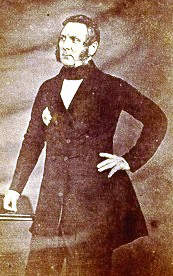
Lord Dalhousie- Governor General of India
Lord Dalhousie, assigned Dr. John Login, the important task of taking the Koh-i-Noor into the safe custody of British Officials in Lahore, from the Toshakhana (the jewel house), whose custodian was the treasurer of the Punjab Government. The crucial task was executed smoothly with the excellent Co-operation extended by the treasurer, who was indeed very happy to be relieved of the responsibility for the diamond. The treasurer further added that the diamond had been the cause of so many unfortunate deaths in his own family, and he never expected to be spared either. The old treasurer also gave some useful advice to Dr Login, as to how the stone should be handled, when showing it to visitors. The first advice was that he should take extra precautions when handling the jewel, and under no circumstances should he allow it to fall out of his hand. The second advice was that he should twist the ribbons that tied it as an armlet, around his fingers.
The second important assignment entrusted to Dr login by Lord Dalhousie, was the guardianship of the young Prince Dulip Singh, the last son and successor to Maharaj Ranjit Singh, who was still a minor.
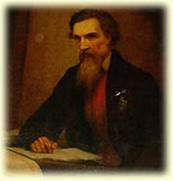
Sir Henry Lawrence
Dr John Login having taken the Koh-i-Noor into his safe custody, formally handed it over to three British Officials of the Punjab Government, which included Sir Henry Lawrence, his younger brother John Lawrence (later Lord Lawrence), and C. C. Mausel. Out of the three officials, two of them decided that John Lawrence be entrusted , with the safe keeping of the diamond, as he was believed to be more practical and business-like in his approach to his duties. but they were proved to be totally wrong in their assessment, when the diamond was nearly lost, while it was in the custody of John Lawrence.
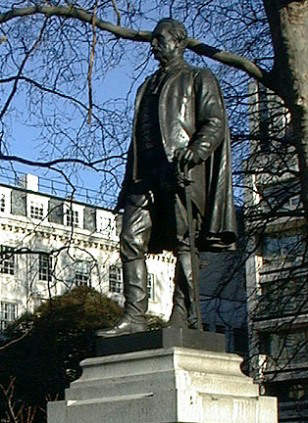
Statue of Lord John Lawrence at Waterloo Palace, London
When the small box containing the diamond was handed over to John Lawrence, he put it into his coat pocket and went about his normal day to day activities. Later in the evening when changing for dinner, he threw his coat aside absent mindedly, completely forgetting that the precious diamond was in one of the pockets. After about six weeks an urgent message was received from Lord Dalhousie, saying that the Queen had ordered the Koh-i-Noor be transmitted to her immediately.
Sir John Lawrence raised the topic at the next board meeting. A chill ran down the spine of John Lawrence, as he suddenly remembered, that the Koh-i-Noor was given to him for safe keeping. He could only remember, having put the small box containing the diamond into his coat pocket. When John Lawrence said quietly, "Send for it at once" his bother replied., "Why? you've got it." John Lawrence managed to preserve his composure, and pretended as if nothing was amiss. He said quietly to himself, "Well this is the worst trouble I have ever got into. "But, said audibly, "Oh yes, of course, I forgot about it." and the meeting went on as if nothing had happened. As soon as he had opportunity to slip away to his private room, he did, with his heart in the mouth; sent for his old servant, and asked him, "Have you seen a small box which was in my waist coat pocket sometime ago?" The man replied "Yes Sahib, I found it and put it in one of your boxes." "Bring it here," replied Lawrence, where upon the old man went over to a tin box and removed the little one from it. "Open it," said Lawrence, "and see what is inside." he watched the old man anxiously, as fold after fold of small rags were taken off and was very relieved when the precious gem appeared. The servant seemed to be unaware of the treasure which he had in his keeping, and remarked, "There is nothing here, Sahib, but a bit of glass."
John Lawrence rushed back to the meeting with the Koh-i-Noor, and displayed it to the members of the board, who then initiated action for it's long journey to England. But the first leg of the journey , was the transport of the diamond from Lahore to Bombay, a route that was one of the most dangerous in India, at the time, swarming with arm bandits and other criminals. Having realized this danger, Lord Dalhousie himself undertook to carry the Koh-i-Noor from Lahore to Bombay. The Governor General carried the stone in his person, double sewn into a belt, secured around his waist, and one end of the belt was fastened to a chain around his neck. He said that it never left him either in the day or night , except on one occasion when he left the stone with Captain Ramsay, locked in a treasure chest. Eventually he was able to deposit the stone at he treasury in Bombay, until the arrival of a ship, to transport it to England. Lord Dalhousie had confessed that he was the happiest person in the world when he was finally able to handover the stone to the safe custody of the Bombay treasury.
The Koh-i-Noor was held up in Bombay for almost two months, until the arrival of a ship, sailing to England. At the time the Koh-i-Noor was deposited in the Government treasury in Bombay, it was put in an iron box, which was again placed in a larger dispatch box. Even the officer in the treasury was not aware of the contents of the box, as it was kept a secret, for security reasons. The dispatch box was loaded into the ship H. M. S. Medea, but the identity of the contents in the box was withheld from it's Captain Commander Lockyer. The only individuals who knew about it were the officers entrusted with the custody of the dispatch, Lieutenant Colonel Mackeson and Captain Ramsay. H. M. S. Medea sailed from Bombay on the 6th of April 1850.
The voyage of the H. M. S. Medea turned out to be a perilous one, which the feeble minded would have attributed to the unwelcome guest aboard the vessel-the Koh-i-Noor. There were two occasions on which disaster was narrowly averted. The first one was when the ship reached the Mauritius Island. Cholera broke out on board the vessel, and the local people refused to sell necessary supplies to the crew, requesting the immediate departure of the ship. When the Medea did not move, they asked their Governor to open fire and destroy the vessel. However, the ship left Mauritius after some days.
A few days later the Medea was caught up in a severe storm, that lasted for about twelve hours, before subsiding finally.
Eventually the H. M. S. Medea reached the port of Plymouth in England, where all the passengers disembarked, and the mail was unloaded except for the box containing the Koh-i-Noor, which was forwarded to Portsmouth. The two officers in charge disembarked at Portsmouth, with the box containing the precious cargo, which was then delivered to the Chairman and Deputy Chairman of the East India Company. Subsequently the Deputy Chairman delivered it to the Queen, at Buckingham Palace on July 3rd 1850.
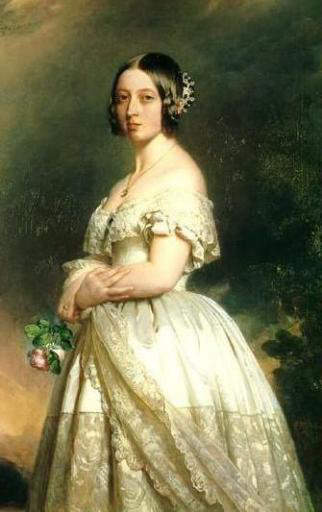
Queen Victoria
The arrival of the Koh-i-Noor in England caused a lot of unease among people who were aware of the superstitions associated with the diamond. Certain unfortunate happenings involving the Queen was attributed to it's arrival, and necessitated Lord Dalhousie's intervention, in reassuring the Queen, that the stories associated with the Koh-i-Noor, that it always brings misfortune to it's possessor were all baseless. On the Contrary, Dalhousie said that the stone could bring good fortune to it's possessor, and grants superiority to the possessor over all his enemies. He quoted the conversation which the owner of the diamond Shah Shoja had with Ranjith Singh at a subsequent occasion, after surrendering the diamond. When asked by Ranjit Singh, as to what was the value of the Koh-i-Noor, Shah Shoja replied, "It's value is good fortune, for whoever possessed it has been superior to all his enemies."
In April 1851, the Director of the British Museum, requested and obtained permission from the Queen to turn out a model of the Koh-i-Noor Diamond. The diamond had to be removed from the setting it was placed in , when it arrived from India. One of those involved in this task, Sebastian Garrard, keeper of he Majesty's Jewels, took this opportunity to find out the exact weight of the stone. The weight of the stone turned out to be 186.10 carats, far short of 279 carats, the weight stated by Tavernier in his publication, giving rise to the unfounded speculation that the Koh-i-Noor diamond must have been substituted by a fictitious one. But, all these doubts were laid to rest, when people acquainted with the diamond, asserted that it was impossible for Dulip Singh, to have substituted the diamond, when the young king's habit of wearing it on state occasions , must have rendered it perfectly familiar to thousands , who would have instantly detected any attempt at substitution. It was said that the more probable explanation for the discrepancy would have been that the weight of the Koh-i-Noor had been somewhat exaggerated.
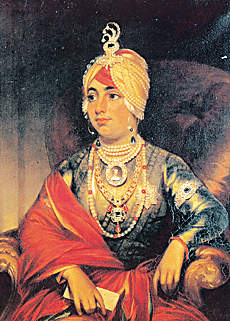
Maharajah Dhulip Singh
In accordance with his original plan, Governor General Dalhousie, arranged for the diamond to be presented by Maharaj Ranjit Singh's successor, Dulip Singh, to Queen Victoria in 1851. Dulip Singh traveled to England, to take part in the official presentation ceremony.
Later in the same year, the British public was given a chance to see the renowned Koh-i-Noor diamond, when the great Exhibition was staged in Hyde Park, London.
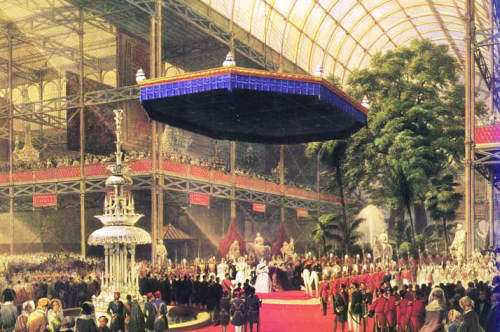
Queen Victoria opening the great exhibition 1851, inside the Crystal Palace.
While the Great Exhibition was on, at the Crystal Palace, a massive structure measuring 1848 ft by 408 ft by 108 ft, built especially for the occasion, a correspondent of the Times newspaper reported as follows :-
"The Koh-i-Noor is at present decidedly the "Lion of the Exhibition." A mysterious interest appears to be attached to it, and now that so many precautions have been resorted to, and so much difficulty attends it's inspection, the crowd is enormously enhanced, and the policemen at either end of the covered entrance have much trouble in restraining the struggling and impatient multitude. For some hours yesterday there were never less than couple of hundred persons waiting their turn of admission, and yet after all , the diamond does not satisfy. Either from the imperfect cutting or the difficulty of placing the lights advantageously, or the immovability of the stone itself, which should be made to revolve on it's axis, few catch any of the brilliant rays, it reflects when viewed at a particular angle."
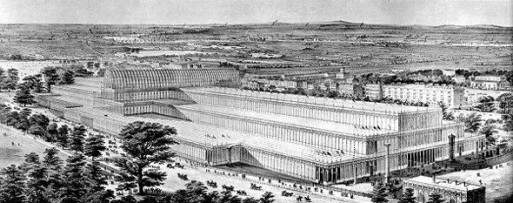
Aerial view of the Crystal Palace, built for the 1851 exhibition, it burned down in 1939.
Even Governor Dalhousie was not impressed by the brilliance of the diamond. In a letter he wrote from Delhi at the time of the exhibition, he says, "The Koh-i-Noor is badly cut. It is rose and not brilliant-cut, and of course won't sparkle like the latter. But, it should not have been shown in a huge space. In the Toshakhana at Lahore, Dr. Login used to show it on a table covered with a black velvet cloth, and relieved by the dark color all round.
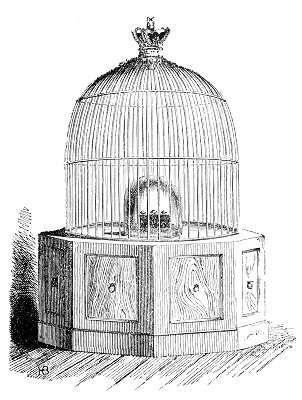
The Koh-i-Noor diamond in the display cage at the exhibtion, 1851
Re-cutting of the Koh-i-Noor
This disappointment in the appearance of the stone was shared by many, including Queen Victoria's consort, Prince Albert. Later the Prince consulted Sir David Brewster, a Physicist, who had specialized in Optics, and was well known for his work on Polarized light. The Prince inquired from him as to how best the diamond could be re-cut, in order to maximize it's brilliance. Brewster examined the stone, and found several small inclusions within the stone, which according to him was caused by the expansive force of condensed gases. Brewster was of opinion that re-cutting the diamond, without a serious reduction in weight, would be a very difficult task. Professor Tennant and Reverend W. Mitchell, Lecturer in Mineralogy, at King's College, London, were also consulted. Both of them were of the opinion, that re-cutting the stone would definitely improve it's brilliance, but expressed fears that any cutting would endanger it's integrity. Finally the Prince decided to seek the advice of practical and experienced diamond cutters. The Crown jewelers, Messrs Garrard, were instructed to get a report from some eminent cutters. They entrusted the job to a famous diamond cutting firm in Amsterdam, Messrs Coster of Amsterdam, who in their report noted the validity of the fears expressed in the Tennant report, but nevertheless were of the opinion that the dangers posed were not so formidable as to prevent the intended re-cutting of the diamond. The Prince lost no time in giving the official approval for the re-cutting to commence, and the delicate task was to be carried out at the Garrard's Jewelry Shop. Two experienced cutters from Messrs. Coster, Mr. Voorzanger and Mr. Fedder arrived in London, to perform the difficult and time-consuming operation.
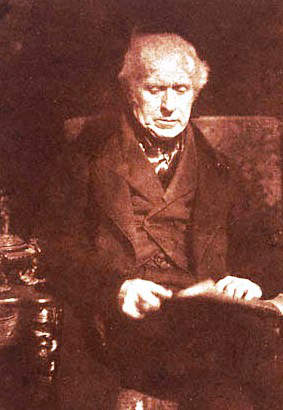
Sir David Brewster
The Duke of Wellington, who had shown a great interest in the proposed re-cutting and attended several preparatory meetings, inaugurated the re-cutting on Friday, July 17th, 1852. The Koh-i-Noor was embedded in Lead, with the exception of a small piece of the stone, that was intended to be the first to be subjected, to the cutting process. A report on the "Times" newspaper reads as follows :-
"His Grace placed the gem upon the scaife, an horizontal wheel revolving with almost incalculable velocity, whereby the exposed angle was removed by friction, and the first facet of the new cutting was affected. The Koh-i-Noor is intended to be converted into an oval brilliant, and the two smaller diamonds which accompany it are to be similarly treated as pendants. The present weight of the principal gem is 186 carats, and the process now in progress will not, it is anticipated diminish in any material degree it's weight, while it will largely increase it's value and develop it's beauties."
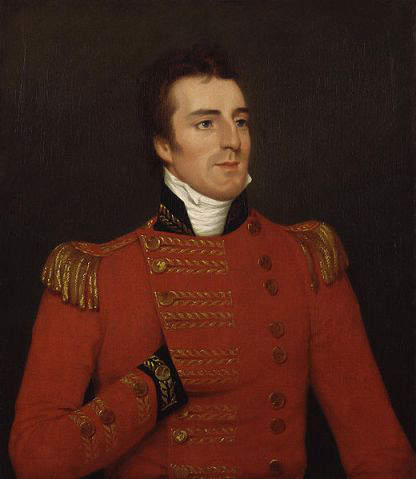
Arthur Wellesley, I st Duke of Wellington
On the 19th of July, the cutters tried to investigate the nature of the flaws in the stone, which according to Tennant and Mitchell, was not natural but deliberately created for the purpose of holding the stone more firmly in it's setting and noted by them, still to have particles of gold adhering to it. By cutting directly into the stone in the region of the flaws, it was revealed that the flaw was a natural inclusion of a yellow tinge. The cutters then proceeded to eliminate this flaw. The re-cutting of the Koh-i-Noor was completed in 38 days, and the whole operation cost £ 8,000 ($ 40,000). As planned originally the stone was converted to an oval brilliant weighing 108.93 carats, resulting in a loss of weight of almost 43 %. Such a drastic loss of weight, came as a disappointment to many, including Prince Albert, and prompted the comment in the press, that the re-cutting of the Koh-i-Noor revealed the painful fact, that the art of diamond cutting was extinct in England. The final form of the Koh-i-Noor was an oval, stellar brilliant-cut, with the crown possessing the regular 33 facets, including the table, while the pavilion had eight more facets than the regular 25, making the total number of facets to 66.
The Koh-i Noor becomes part of the British Crown Jewels
Dulip Singh who was now living in London, under the guardianship of Lady Login, was one of the first persons to be shown the Koh-i-Noor in it's new shape. This was on the initiative of Queen Victoria herself, when the Prince visited the Buckingham Palace, for sittings for a portrait of himself, being made by the palace. But, before doing so, the Queen verified from Lady Login that the Prince had no regrets or worries about the loss of the diamond, and that he would be interested in seeing the stone in it's re-cut form. The Queen herself walked up to the Maharajah who was posing on a Dais, and handed over the Koh-i-Noor to him for his inspection. After he had finished his inspection, Dulip Singh walked across the room, and with a low bow expressed in a few graceful words the pleasure it gave him to have the opportunity of placing the stone in her hands.
However the worries over the supposed bad luck which the Koh-i-Noor would bring to it's owner refused to die down and this led Lord Dalhousie to write his most extended letter refuting the claim.
"The rumor you mention as to the Koh-i-Noor, I have seen in former years in an English Paper, but never anywhere else. It is not only contrary to fact but contrary to native statements also. Did the Koh-i-Noor bring ill luck to the great Akbar, or to his own son or grandson ? or to Aurangzeb, who rose to be the Great Mogul Emperor ? And when that race of emperors fell - not from the ill-fortune of the Koh-i-noor, but from their feeble hand - did it bring ill-fortune to Nadir Shah, who lived and died the the greatest eastern conqueror of modern times ? or to Ahmed Shah Durrani, who got it at Nadir's death, and founded the Afghan Empire ? or did it bring ill fortune to Ranjit Singh, who got it from the Durrani's, and who rose from being a sower on twenty rupees a month at Goojeranwalla to be the Maharajah of the Punjab, swaying the greatest force in India next to ourselves ? And has it brought ill-luck to the Queen ? Especially, representing the Punjab, has it shown that state an enemy to us ? Has it not on the contrary, shown it our fastest friend, by whose aid we have just put down the traitors of our own household. So much for the facts of history as to the Koh-i-Noor. Now for the estimation in which it's former owners hold it. When Ranjit Singh seized it from Shah Shoja, the Durrani Emperor, he was very anxious to ascertain it's value. he sent the diamond to merchants in Amritsar, but they said it's value could not be estimated in money. He then asked Begum Shah, the wife of Shah Shoja, and her answer was thus, "If a strong man should take five stones, and should cast them, one east, one west, one north, and one south, and the last straight up in the air, and if all the space between those points were filled with gold and gems, that would not equal the value of the Koh-i-Noor." Ranjit Singh thought that this was a rather vague estimate, and requested for Shah Shoja's opinion. The old man's answer was :-"The value of the Koh-i-Noor is that whoever holds it is victorious over all his enemies." And so it is. The Koh-i-Noor has been of ill fortune to the few who have lost it. To the long line of Emperors, Conquerors, and Potentates, who through successive centuries have possessed it , it has been the symbol of victory and empire. and sure never more than to our Queen, ever since she wore it, and at this moment. However if her Majesty thinks it brings bad luck to her, let her give it back to me. I will take it and it's ill-luck as speculation."
Queen Victoria seems to have been convinced by this last letter of Lord Dalhousie, that she decided to keep the diamond, and in 1853, ordered the Crown Jewelers, Garrards to mount the gem on a tiara for the Queen, which they did, and turned out a magnificent tiara containing more than two thousand diamonds, with the Koh-i-Noor as the centerpiece. Five years later in 1858, Queen Victoria ordered a new regal circlet for the Koh-i-Noor, which was delivered the following year.
In 1911, Garrards made a new crown for the coronation of Queen Mary, the Queen Consort of King George V. The crown contained only diamonds and the Koh-i-Noor was also included.
Again in 1937, the Koh-i-Noor was incorporated in a new crown made for the Coronation of Queen Elizabeth, the Queen consort of King George VI, which was based on Queen Victoria's regal circlet. the Koh-i-Noor was set in the Maltese Cross at the front of the crown.
The return of the Koh-i-Noor to it's rightful owners
Given the long and sometimes bloody history of the Koh-i-Noor diamond and the great esteem in which the diamond was held by Kings, Emperors, and Conquerors, in the belief that the stone had some supernatural powers, that granted superiority to it's holder over his enemies, and the fact that these rulers belonged to different countries and ethnic groups, had given rise to a multitude of claimants for the diamond. In the modern enlightened era of the 20th and 21st centuries, in which relationship between states are defined by principles of mutual co-operation and co-existence, and not exploitation and domination of one state by another, the continued ownership of the diamond by Great Britain, is now being seriously questioned by these claimants. they feel that the diamond was wrongfully acquired by Great Britain, from the successors of the Maharajah of Punjab, Ranjit Singh, who had willed the Koh-i-Noor diamond to the Jagannath Temple in Orissa, while in his death bed in 1839. They allege that Britain legalized this wrongful acquisition, by deliberately including a clause in the Treaty of Lahore, which formalized the occupation of the Punjab by the British in 1849, to the effect that the gem called Koh-i-Noor which was taken from Shah Shuja-ul-mulk by Maharajah Ranjit Singh shall be surrendered by the Maharajah of Lahore to the Queen of England.
In 1947, the Government of India, asked for the return of the Koh-i-Noor, and the State Government of Orissa claimed that the stone actually belonged to the Jagannath Temple of Orissa. Again in 1953, the year of the Coronation of Queen Elizabeth II, another request was made by India, for the return of the diamond.
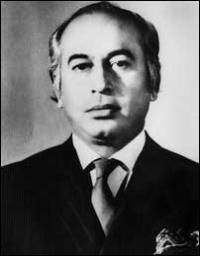
Zulfikar Ali Bhutto (1928-1979)
But, the real debate about the actual ownership of the historical diamond, was initiated in 1976, when the former Prime Minister of Pakistan, Zulfikar Ali Bhutto, in a letter to the British Prime Minister, James Callaghan, submitted a formal request for the return of the diamond to Pakistan. This was refused, but was accompanied by an assurance by Callaghan to Bhutto, that there was no question that Britain would hand it over to any other country, an obvious reference to India. Pakistan's claim to the Koh-i-Noor was disputed by India, which made another formal request for it's restoration.
As the debate on the ownership continued, a major newspaper in Teheran stated that the gem ought to be returned to Iran. Another claimant to the diamond was Afghanistan.
It's worthwhile examining the merits and de-merits of each of the above claims.
The Indian Claim is based on the following indisputable facts of History :-
(1) That the Koh-i-Noor diamond was mined in one of the groups of mines situated in various river basins on the eastern side of the Deccan Plateau in Southern and Central Provinces of India.
(2) That the stone had belonged to several Indian rulers prior to the 13th century, which probably included the Maharajah of Malwa, and the Kakatiya Kings of Warangal which included, Prataparudra.
(3) That the stone belonged to the rulers of the Delhi Sultanate from 1295 to 1526, which included Sultan Ala-ud-din Khalji, and Sultan Ibrahim Lodi.
(4) That the stone was owned by the entire generation of Mogul rulers, Starting from Emperor Zahir-ud-din Muhammad (Babur-1526-30) to Emperor Muhammad Shah (1719 -48), who ruled first from Agra and later from Delhi.
(5) That the stone had been in the possession of Indian Rulers for a period of 444 years from 1295 to 1739, according to recorded history, save for a short period of seven years (1540-47), when Humayun sought refuge in neighboring Persia.
(6) That this period may be more than 500 years if the period of unrecorded history is also taken into account.
(7) That the stone was plundered by Nadir Shah of Iran in 1739.
The Iranian claim is based on the following facts of history :-
(1) That the Koh-i-Noor was acquired by the greatest Iranian ruler of the 18th century, Nadir Shah, in 1739 as a spoil of war, after defeating the Mogul army and capturing the capital city of the Mogul Empire Delhi.
(2) That the name Koh-i-Noor is of Persian origin, meaning "mountain of light", given by Nadir Shah, when he first saw the diamond after it was surrendered by Emperor Muhammad Shah.
(3) That the diamond was carried to Afghanistan illegally, after Nadir Shah's death, by Ahmed Khan Abdali, the commander of Nadir Shah's 4,000 man Afghan bodyguard.
(4) That the Koh-i-Noor remained in Iran as part of the Crown Jewels for a period of 8 years.
The facts on which the Afghan claims are based are as follows :-
(1) That the Koh-i-Noor was acquired by Ahmad Khan Abdali the trusted commander of Nadir Shah's 4,000 man Afghan Bodyguard. After Nadir Shah's death Ahmed Khan Abdali was elected Shah, by a tribal council and assumed the name Ahmed Shah Durrani.
(3) That the Koh-i-Noor remained with the Durrani rulers of Afghanistan for a period of 63 years from 1747 to 1810.
(4) That the grandson of Ahmed Shah Durrani, Sha Shoja, sought refuge in Lahore, the capital city of the Maharajah of Punjab, Ranjit Singh.
(5) That the Maharajah of Punjab, Ranjit Singh, exerted undue pressure on Shah Shoja to extort the diamond from him.
Finally let us consider the historical facts relevant to the claim made by Pakistan for the Koh-i-Noor diamond.
(1) That the Koh-i-Noor was acquired in 1810 by Ranjit Singh, the Maharajah of Punjab, whose capital city was Lahore, from the deposed ruler of Afghanistan, Sha Shoja, who sought political asylum in Lahore, after he was deposed by his brother Mahmud Shah.
(2) That the Koh-i-Noor diamond was acquired by Ranjit Singh, in return for the political asylum granted to Sha Shoja and his family .
(3) That the Koh-i-Noor diamond remained in the Punjab for a period of 39 years.
(4) That the Koh-i-Noor diamond remained as a property of the Ranjit Singh family up to March 29th 1849, the day Punjab was formally annexed to the British Empire of India.
(5) That the city of Lahore, from where the diamond was confiscated and later taken to England, now lies in Pakistan, after the partition of India in 1947.
(6) That Lahore is still the capital of the Punjab Province of Pakistan.
Having laid down the merits of each of the main claimants for the ownership of the historical diamond Koh-i-Noor, i. e. India, Iran, Afghanistan, and Pakistan, we leave it to the intelligence of the reader, to make the necessary conclusions as to the most valid and sustainable claim.
In the light of all these claims and counter-claims it is interesting to find out the official British position in respect of this controversy. The British Government seems to think that it has a clear title to the diamond, in that it was not seized in war , but formally presented to Queen Victoria, by the last successor to Maharajah Ranjit Singh, his youngest son Dulip Singh. In other words the British Government seems to think that the Koh-i-Noor rightfully belongs to them, and they may not part with the diamond under any circumstances. The Government also seems to take cover under the confused historical status of the Koh-i-Noor diamond, which can be interpreted to mean that since the history of the diamond is confused, no one has the right to claim it except the present owners of the diamond.
Unfortunately, both lines of argument adopted by the British are highly untenable. In the first place historical records clearly show, that the Koh-i- Noor was confiscated as a spoil of war by the British, as stated in writing in the treaty of Lahore, which reads as follows :- "that the gem called Koh-i-Noor which was taken from Shah Shuja-ul-Mulk, by Maharajah Ranjit Singh, shall be SURRENDERED by the Maharajah of Lahore to the Queen of England." Moreover Queen Victoria was so impatient after the confiscation of the diamond in Lahore, that she ordered it's quick transfer to England from India, which her obedient servant the Governor General Lord Dalhousie, did in July 1850, barely one year after it's confiscation. The so called presentation ceremony, in which Dulip Singh "PRESENTS" the diamond to Queen Victoria takes place much later in 1851, after Dulip Singh had arrived in England. That the so called "PRESENTATION" of the diamond is not actually a presentation but a "SURRENDERING" of a spoil of war is proved beyond any doubt by the letter written to Sir George Cooper in August 1849, by his friend the Governor General of India, Lord Dalhousie. The relevant portion of that letter reads, "The motive was simply this, that it was more for the honor of the Queen, that the Koh-i-Noor should be "SURRENDERED" directly from the hand of the conquered Prince into the hands of the Sovereign, who was his conqueror, than it should be presented as a gift by any, joint stock company among her subjects. "(East India Company).
However in spite of all the political and historical debate the Koh-i-Noor had generated in respect of it's rightful ownership, the gem still remains a property of the British Royal Family, and is on display with other Crown Jewels in the Tower of London.
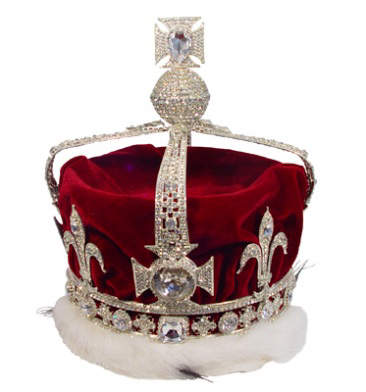
The Queen mother's crown with the Koh-i-noor diamond
©Her majesty ,The Queen of England
The accurate weight of the diamond determined by a modern electronic balance was published in 1992, and was given as 105.602 carats, and it's dimensions are 36.00 x 31.90 x 13.04 mm. The stone is set in the Maltese Cross at the front of the Crown, made for Queen Elizabeth, the Queen consort of King George VI, and the mother of Queen ELizabeth II. In the year 2002, when the Queen Mother died at the ripe old age of 102 years, the Crown with the Koh-i-Noor, was placed atop her coffin as she lay in state.
You are welcome to discuss this post/related topics with Dr Shihaan and other experts from around the world in our FORUMS (forums.internetstones.com)

 Home
Security & Guarantee
How it Works
Technology Partners
Updated Tables
Famous Diamonds
More Famous Diamonds
Famous Pearls
Famous Gemstones
Contact Dr Shihaan Larif
Contact Senior Editor
Famous Jewelry
Reference Database
Forums
Learning Center
Gemstone Gallery
e-mail Notifications
Advertise
Press Release
About Us
Privacy Policy
Contact Us
FAQ'S
Site Map
Staff Mail Login
Staff Documents
Birthstones
History
Minerals
Shows
Live Metal Prices
Jewellery Gallery
News
Marketplace
Marketplace Support
Open Store
Online Auctions
Join Us & Contribute
Directory
Classifieds
List your products
Wholesale Trading
Post Buy Request
Go Green Policy
Site Updates
Upcoming-ToDo List
Latest News
Latest Articles
Latest Blog Updates
Chat Rooms
Job Board
User Gallery
Videos
New Newsletter Archive
Old Newsletter Archive
Jewelry & Mineral Blog
User Blogs & Social Network
Search
Answers (Q & A)
Valuation
Help me find a diamond/jewelry
pin.internetstones.com- Social Pinboard- Sart yours & connect with millions
Invite Friends From Yahoo, Gmail etc-One Click
Home
Security & Guarantee
How it Works
Technology Partners
Updated Tables
Famous Diamonds
More Famous Diamonds
Famous Pearls
Famous Gemstones
Contact Dr Shihaan Larif
Contact Senior Editor
Famous Jewelry
Reference Database
Forums
Learning Center
Gemstone Gallery
e-mail Notifications
Advertise
Press Release
About Us
Privacy Policy
Contact Us
FAQ'S
Site Map
Staff Mail Login
Staff Documents
Birthstones
History
Minerals
Shows
Live Metal Prices
Jewellery Gallery
News
Marketplace
Marketplace Support
Open Store
Online Auctions
Join Us & Contribute
Directory
Classifieds
List your products
Wholesale Trading
Post Buy Request
Go Green Policy
Site Updates
Upcoming-ToDo List
Latest News
Latest Articles
Latest Blog Updates
Chat Rooms
Job Board
User Gallery
Videos
New Newsletter Archive
Old Newsletter Archive
Jewelry & Mineral Blog
User Blogs & Social Network
Search
Answers (Q & A)
Valuation
Help me find a diamond/jewelry
pin.internetstones.com- Social Pinboard- Sart yours & connect with millions
Invite Friends From Yahoo, Gmail etc-One Click




Our Global Jewelry Industry Job Network


Buy & Sell in our Marketplace

Subscribe to our Newsletter

List in our Classifieds

List in our Directory

User Uploaded Gallery

Powered by Ultra Secure
Amazon (USA) Cloud Network

Founder Internet Stones.COM
Register in our Forums

| Featured In
|
|
|
|
|
|
|
|







Blog & Education Feed
Articles Feed
 |
 |
 |

Copyright © .Internet Stones.COM. All rights reserved.