"Lua de Maraba" Topaz
Open FREE Unlimited Store Join Our Newsletter
Origin of name
"Lua de Maraba" in the Portuguese language means "The Moon of Maraba." Maraba is one of the biggest cities in the State of Para, the second largest state area wise situated in the northern region of Brazil in the lower Amazon basin. Maraba, whose name is derived from the Tupi language, spoken by Tupi Indians of Brazil, is situated by the Tocantins River one of the three main tributaries that join the mighty Amazon River on its right bank before it joins the Atlantic. The Tocantins from Maraba downstream is fairly navigable, and therefore a new river port has been constructed at Maraba mainly for the use of smaller boats.

"Para" which in the Indian language means "river" is mostly covered by the tropical rain forests of the Amazon, and the state is still very underpopulated. But the state is very rich in mineral resources, and other resources of the forests such as timber. Exploitation of the resources of the state had led to conflicts between Ecologists and the Indians on the one hand and Government and Private agencies, both legal and illegal, on the other. Today more than 50% of the rain forests of Para are protected either in Government or indigenous Indian reservations. The rich mineral resources of the state include iron, copper, manganese, nickel, aluminum, tin, gold and gems and minerals. The types of gemstones found in Para include the following :- diamond, emerald, aquamarine, tourmalated aquamarine, chromin, chrysoberyl, citrine, topaz, amethyst, opal and helvite. Except for diamond about which details of reserves are available information concerning other gemstones are not available.
Minas Gerais had been the main source of imperial and precious topaz in the world, but small deposits of low grade topaz have also been found in the Northern Brazilian State of Para. Thus the "Lua de Maraba" most probably originated either in Maraba or in an area closer to the city of Maraba, and hence was named the "Moon of Maraba" in order to reflect the origin of the gemstone.
Characteristics of the gemstone
The original weight of the rough stone is not known, but when cut and polished the finished gemstone had an enormous weight of 25,250 carats, making it the second largest faceted topaz, as well as the second largest faceted gemstone in the world. Please click here to see the list of famous faceted topaz greater than 1,000 carats in weight, arranged in descending order of weights.
The cut of the stone is a perfect octagonal-cut, with dimensions of 18 x 15 x 10 cm. The stone is of perfect flawless clarity, and its color is a rare gray color, making it perhaps the only one of its color and size in the world.
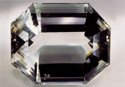
© Programa Royal Collections. Agrupación Europea de Interés Económico 2006
Color in topaz
Topaz occurs in a variety of colors such as colorless, gray, yellow, brown, yellowish-brown, pale blue, light green, orange, pink and red. The commonest colors in topaz occurring naturally are colorless, yellow, yellow-brown, and pale blue and the rarest colors are pink and red. Except in pink and red topaz where trace quantities of chromium act as a chromophore absorbing light at a specific frequency and imparting color, all other colors in topaz is caused by color centers. But, even for the formation of color centers trace quantities of some impurities such as iron, must be present. The iron atoms form an unstable species in the crystal, which can absorb a visible photon of light and jump to an excited state. The return of the unstable species from the excited state to the ground state emits light in different regions of the visible spectrum, depending on its frequency and wavelength. Such unstable species created are known as color centers.
The presence of color centers in topaz make it ideal for color change either by irradiation or heating. Pink and red topaz can be obtained by the heat treatment of brown, yellow or orange topaz that contains trace amounts of chromium or iron as impurity. Dark blue shades of topaz are produced by irradiation followed by heating of colorless, pale blue, and yellowish brown, and greenish-brown crystals. Smokey-grey, cinnamon-brown and yellow-orange colors can also be produced by irradiation by controlling the time of exposure to radiation. The "Lua de Maraba" however appears to be a naturally formed enormous grey topaz as there are no reports to the contrary.
History of the "Lua de Maraba" topaz
Origin of the topaz and its processing
The "Lua de Maraba" topaz was probably discovered in one of the topaz mines in the northern Brazilian State of Para, in and around the city of Maraba. The date of discovery, the weight of the rough stone and other details are not known. The rough stone was cut into a perfect octagonal-cut, flawless, gray-colored topaz weighing 25,250 carats, the second largest faceted topaz and perhaps the second largest faceted gemstone in the world.
The topaz enters the Special Exhibition Gems Collection of the Programa Royal Collections
After the Programa Royal Collections was inaugurated in Madrid, Spain in 1997, as an initiative of an European Economic Interest Grouping, and regulated by the European Union, the "Lua de Maraba" topaz was purchased by the PRC, and entered the Special Exhibitions Gems Collection, which consists of 20 outstanding gems, brought together mainly because of their extraordinary size, and exceptional quality. This collection has a total weight of 117,000 carats, inclusive of the weight of the "Lua de Maraba" which weighs 25,250 carats.
"Lua de Maraba" sometimes included in the "Imperial & Noble" Monographic Exhibition
The "Lua de Maraba" while being a permanent part of the Special Exhibitions Gem Collection, is sometimes included in the the Single Theme Exhibitions under the category "Imperial & Noble" if a specific request is made by the organizers for such a monographic exhibition. The "Imperial and Noble" is a topaz collection under the Programa Royal Collections and perhaps the largest and most comprehensive collection of topaz in the world. The collection consists of 54 gemstones of all sizes, cut and colors, with a total weight of over 90,000 carats. The collection also includes eight enormous topazes of more than 1,000 carats in weight, varying in weight from 1,800 carats to 31,000 carats. The eight topazes in descending order of weights are 1) El-Dorado-31,000 carats, 2) Lua de Maraba-25,250 carats, 3) Topaz Amarelo-9,600 carats, 4) Topaz Azuli-8,225 carats, 5) Unnamed-4,202 carats 6) Unnamed-2,915 carats 7) Unnamed-1,833 carats 8) Unnamed-1,800 carats. The "Imperial & Noble" single theme exhibition is accompanied by educational display panels containing a wealth of information about the origin and sources of topaz in the world, their chemical, physical and optical properties, the different color varieties of topaz and their abundance in nature, treatment of topaz to obtain rare color varieties such as intense blue, pink and red, various uses of topaz throughout history, and information on the background of each of the main gems in the collection.
You are welcome to discuss this post/related topics with Dr Shihaan and other experts from around the world in our FORUMS (forums.internetstones.com)
References
1. Website of the Programa Royal Collections.
2. Topaz - A Neosilicate - Edna B, Anthony - The New Mexico Facetor.
3. Gem & Crystal Treasures - Peter Bancroft.
External Links
Website of Programa Royal Collections
 Home
Security & Guarantee
How it Works
Technology Partners
Updated Tables
Famous Diamonds
More Famous Diamonds
Famous Pearls
Famous Gemstones
Contact Dr Shihaan Larif
Contact Senior Editor
Famous Jewelry
Reference Database
Forums
Learning Center
Gemstone Gallery
e-mail Notifications
Advertise
Press Release
About Us
Privacy Policy
Contact Us
FAQ'S
Site Map
Staff Mail Login
Staff Documents
Birthstones
History
Minerals
Shows
Live Metal Prices
Jewellery Gallery
News
Marketplace
Marketplace Support
Open Store
Online Auctions
Join Us & Contribute
Directory
Classifieds
List your products
Wholesale Trading
Post Buy Request
Go Green Policy
Site Updates
Upcoming-ToDo List
Latest News
Latest Articles
Latest Blog Updates
Chat Rooms
Job Board
User Gallery
Videos
New Newsletter Archive
Old Newsletter Archive
Jewelry & Mineral Blog
User Blogs & Social Network
Search
Answers (Q & A)
Valuation
Help me find a diamond/jewelry
pin.internetstones.com- Social Pinboard- Sart yours & connect with millions
Invite Friends From Yahoo, Gmail etc-One Click
Home
Security & Guarantee
How it Works
Technology Partners
Updated Tables
Famous Diamonds
More Famous Diamonds
Famous Pearls
Famous Gemstones
Contact Dr Shihaan Larif
Contact Senior Editor
Famous Jewelry
Reference Database
Forums
Learning Center
Gemstone Gallery
e-mail Notifications
Advertise
Press Release
About Us
Privacy Policy
Contact Us
FAQ'S
Site Map
Staff Mail Login
Staff Documents
Birthstones
History
Minerals
Shows
Live Metal Prices
Jewellery Gallery
News
Marketplace
Marketplace Support
Open Store
Online Auctions
Join Us & Contribute
Directory
Classifieds
List your products
Wholesale Trading
Post Buy Request
Go Green Policy
Site Updates
Upcoming-ToDo List
Latest News
Latest Articles
Latest Blog Updates
Chat Rooms
Job Board
User Gallery
Videos
New Newsletter Archive
Old Newsletter Archive
Jewelry & Mineral Blog
User Blogs & Social Network
Search
Answers (Q & A)
Valuation
Help me find a diamond/jewelry
pin.internetstones.com- Social Pinboard- Sart yours & connect with millions
Invite Friends From Yahoo, Gmail etc-One Click




Our Global Jewelry Industry Job Network


Buy & Sell in our Marketplace

Subscribe to our Newsletter

List in our Classifieds

List in our Directory

User Uploaded Gallery

Powered by Ultra Secure
Amazon (USA) Cloud Network

Founder Internet Stones.COM
Register in our Forums

| Featured In
|
|
|
|
|
|
|
|







Blog & Education Feed
Articles Feed
 |
 |
 |

Copyright © .Internet Stones.COM. All rights reserved.