The Marie Mancini Pearls
Open FREE Unlimited Store Join Our Newsletter
Origin of Name
The Marie Mancini Pearls refer to a pair of apparently identical drop-shaped white nacreous pearls, weighing approximately 200 grains each, with an ancient historical provenance, that once belonged to Marie Mancini, the niece of Cardinal Mazarin, the chief minister of France from 1642 until his death in 1661. The young Louis XIV, who was captivated by the beauty of Marie Mancini fell in love with her, and she reciprocated his advances. A close romantic relationship developed between the two, and King Louis XIV, was determined to marry her. However, the amorous relationship was broken off by the intervention of Cardinal Mazarin and Queen Anne, the mother of Louis XIV, who did not approve of the marriage. It is believed that the Mancini Pearls were actually given as a gift to Marie Mancini by King Louis XIV, to symbolize his great affection for her, during the period of their close relationship.

The portrait of Marie Mancini appearing below, show her wearing a pair of drop-shaped pearls, apart from a pearl choker. It is not known whether the drop-shaped pearls worn by Marie Mancini are the same pearls that are now referred to as Marie Mancini Pearls. If it is so, it is quite possible that pearl choker too was a gift by King Louis XIV, as it is difficult to imagine that a king of the status of Louis XIV, would have just given a single pair of pearl earrings to his most beloved girlfriend, whom he was planning to marry in the near future.
Characteristics of the Mancini Pearls
The Marie Mancini Pearls are an almost identical pair of white, nacreous, drop-shaped pearls, whose dimensions and individual weights are not known. However, according to David Bennet, the two pearls together weighed approximately 400 grains (100 carats), and given the fact that the two pearls have almost identical shapes and dimensions, we can assume that each pearl has an approximate weight of 200 grains (50 carats).
One of the drop-shaped pearls (pearl on the left in the photograph) has a perfect drop-shape, and can be listed among the most perfect drop-shaped pearls known, such as the "Drexel Pearl." The second drop-shaped pearl is slightly distorted, with one side bulging out a little more than the other. The color of the pearls are white, with a slightly pinkish overtone. The luster of the pearls are also quite good, given the fact that the pearls are almost 500 years old. The pearls also appear to have a good surface quality and seem to be blemish-free.
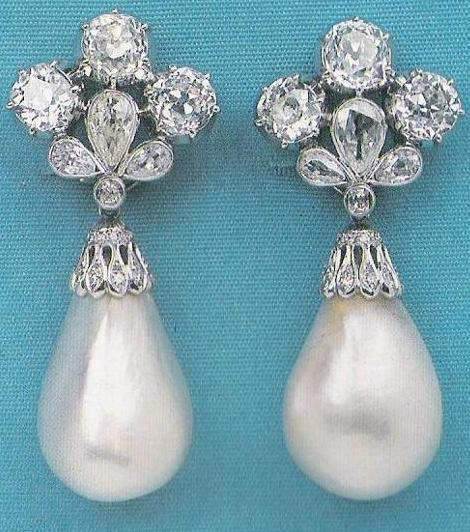
Mancini Pearls Pendant Earrings
The two pearls have been set as the centerpiece of two almost identical pearl and diamond pendant earrings, the pearls forming the dangling pendants, suspended from the diamond-set ear-studs, by a bell cap arrangement also studded with diamonds. The design on the ear-studs is a quatrefoil and three circles. The quatrefoil is an ornamental design of four leaves, resembling a clover leaf; the central largest leaf being covered on one side by three large circles. The three pear-shaped leaves of the quatrefoil are set with pear-cut diamonds, and the fourth rounded leaf below is set with a round-shaped diamond. The three circles are occupied by round brilliant-cut diamonds.
History of the Mancini Pearls
The possible sources of the Mancini Pearls
The Mancini Pearls are believed to have belonged originally to the Medici family of Florence, a business oriented family of Europe, who acquired power, prestige and aristocratic status, through the accumulation of enormous wealth. The family whose power and influence extended from the mid-14th century to the mid-18th century, produced three popes, many rulers of Florence and Tuscany, and two queens of France, Catherine de Medici (1547-1559) and Marie de Medici (1600-1610), the queen consorts of Kings Henry II and Henry IV of France respectively, through whom other members of the royalty of France, Spain and England descended. The Mancini Pearls entered France in 1600 through Marie de Medici, the queen consort of Henry IV from 1600 to 1610, and after Henry IV's assassination the regent for her son King Louis XIII until 1617. It is not known for how long the Mancini Pearls remained with the Medici family prior to its entry into France through Marie de Medici in 1600. However, if the pearls had entered the Medici family after 1498, the year pearls were discovered for the first time in the New World, in Venezuela by Christopher Columbus, the possible sources of the pearl could have been Venezuela, Colombia or Panama, apart from the traditional sources of the Persian Gulf, the Red Sea and the Gulf of Mannar.
A short history of the Medici family
The Medici family who originated from the agricultural region north of Florence, rose into prominence in the early 14th century when they were involved in the lucrative wool trade with France and Spain, that brought them wealth and political influence. By the latter part of that century Salvestro de Medici became the de facto ruler of Florence, after leading the common people in the revolt of the ciompi - the small artisans. However by the year 1382, Salvestro de Medici became very unpopular, and was banished from the city. The fortunes of the family again increased only in the early 15th century, when Giovanni di Bicci de Medici set up the Medici Bank, one of the most prosperous and respected institutions in Europe, and the Medici family became one of the wealthiest families in Italy and Europe. Giovanni then became the virtual ruler of Florence from 1421 to 1429. The two major branches of the family originated from the two sons of Giovanni, Cosimo, the eldest son, originating the "senior branch" and Lorenzo, the younger son, originating the "junior branch." The Medici family produced the dukes and grand dukes of Florence and Tuscany, until the end of the dynasty in 1737.
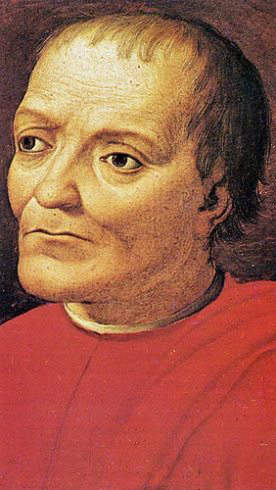
Giovanni de Medici, founder of the Medici Bank
The Medici family were great patrons of the arts, architecture and literature
The Medici Family were great patrons of the arts, architecture and literature, and under their rule Florence became the cultural center of Europe, where Renaissance art and architecture originated. Some of the great artists who received the patronage of the family include, Michelangelo, Leonardo da Vinci, Boticelli, Ficino, Giovanni Pico della Mirandola etc. In the field of architecture, the Medici family are renowned for some of the notable features of Florence, such as the Palazzo Medici, the Belvedere, the Boboli Gardens and the Uffizi Gallery. The Medici family also patronized the great scientist Galileo Galilee, who was the tutor for several generations of Medici children, and gave the scientist a safe haven, when he was accused by the church of heresy.
The Mancini Pearl pendant earrings were possibly crafted in Florence
The art of jewelry crafting was also patronized by the Medicis, and Renaissance jewelry crafting reached an advanced stage of perfection during their rule. Florence became a great center of jewelry crafting, where renowned goldsmiths and sculptors such as Benvenuto Cellini practiced their trade. Numerous Renaissance pendants incorporating baroque pearls to produce shapes of mythical figures, dragons, monsters, animals and birds, crafted in Florence and found in the museums of several countries, is a testimony of the skill of the jewelry craftsmen of this period. It is possible that even the pair of Mancini Pearl pendant earrings, could have been crafted by the skilled craftsmen of 16th century Florence.
The Mancini Pearls enter France in 1600
Marie de Medici who was born on April 26, 1575, was one of two surviving children of Francesco I de Medici, Grand Duke of Tuscany and his wife Johanna, Archduchess of Austria. In October 1600, she married King Henry IV of France, after the king divorced his first wife Marguerite de Valois. As it was the tradition at the time, she brought as part of her dowry 600,000 crowns, and enormous quantities of jewels and jewelry. The Mancini Pearl pendant earrings was possibly a part of that jewelry.
The marriage produced five children, of whom the eldest succeeded his father as King Louis XIII. The second child was a daughter Elizabeth, who became the Queen of Spain after her marriage to the future King Philip IV of Spain. The fifth and the last child was Henrietta Maria, who became the Queen of England and Scotland in 1625, after her marriage to King Charles I of England and Scotland.
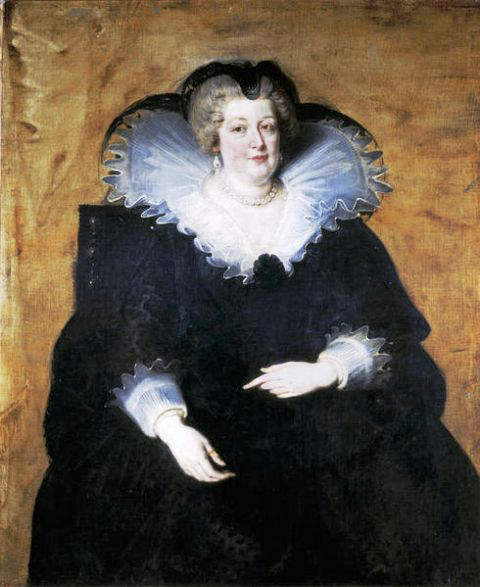
Marie de Medici- Queen consort of Henry IV of France
In 1610, when King Henry IV was assassinated, Marie de Medici was appointed as regent to her eldest nine-year old son King Louis XIII, who succeeded his father. Her period of rule as regent was a disaster due to the pro-Habsburg and pro-Spain policies she adopted, that eventually led to her exile to the Chateau de Blois in 1617, by her own son, Louis XIII, who asserted his authority after attaining legal majority. After reconciling with her son in 1621, through the mediation of Richelieu, she again antagonized him in November 1630, by attempting to oust Richelieu, and was exiled for the second time to Compiegne in 1630, from where she escaped to Brussels in 1831, and later moved to Amsterdam in 1638, and finally ended up in Cologne, where she died in 1642.
The Mancini Pearls enter England in 1625
It was probably at the time of Henrietta Maria's marriage to King Charles I in 1625, that the Mancini Pearl pendant earrings was given as a gift by Marie de Medici, to her youngest daughter. Thus, the Mancini Pearl pendant earrings entered England from France in 1625, as part of Henrietta Maria's personal jewelry collection.
After initial difficulties in her marriage due to her refusal to give up her Catholic faith, Henrietta Maria eventually forged deep bonds of love and affection towards her husband in 1628, particularly after the death of her husband's favorite, the first duke of Buckingham. Their first child was born in March 1629, followed by eight other children until the year 1644, of whom only five children survived into adulthood. Two of her sons, Charles II and James II, became Kings of England and Scotland. Charles I's firm belief in royal absolutism and the divine right of kings, as propounded by his father James I, in his book the "True Law of Free Monarchies," brought him into open conflict with parliament, that worsened in due course, and led to confrontation between the parliament and the monarchy.
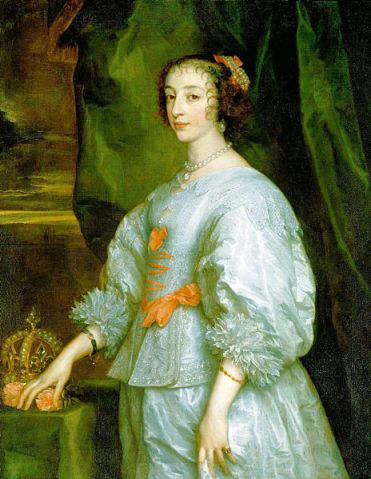
Henrietta Maria- Queen consort of King Charles I
Charles left London in 1641 and moved toward the north of England, where he set up court in Oxford, and began raising an army against parliament. He sent his Queen Henrietta Maria abroad in February 1642, to raise funds and arms for his war efforts. Henrietta Maria carried with her most of the crown jewels and personal jewelry, that included the famous Sancy Diamond, to raise funds by pawning. She also sought the help of France and Pope Urban VIII. Eventually she purchased a ship load of arms and landed in Yorkshire, in the royalist controlled area of northern England in February 1643, and subsequently joined her husband in Oxford. It was possible that the Mancini Pearl pendant earrings was among the jewelry items she sold in France to raise funds for her husband's cause.
Henrietta Maria escaped to France with her children in July 1644. The civil war that broke out on October 26, 1942, continued up to the end of 1948, resulting in the triumph of the parliamentary forces led by Oliver Cromwell. King Charles I was captured, charged for treason, found guilty and executed on January 30, 1649. Oliver Cromwell's efforts to abolish the monarchy and introduce a republican form of government was short-lived and came to an end soon after his death. The monarchy was restored again in 1660, and King Charles I's eldest son ascended the throne of England, Ireland and Scotland as King Charles II. Henrietta Maria returned to England in 1660 and lived in the Somerset House in London until 1665, when she returned permanently to France. She died in France in 1669 at Chateau de Colombes, and was buried in the royal tombs at Saint Denis Basilica near Paris.
The Mancini Pearls are brought back to France again. Louis XIV presents the Mancini Pearl pendant earrings to his first love Marie Mancini.
The Mancini Pearl pendant earrings again entered France either when Henrietta Maria sold some of her jewels in France to raise funds for her husband's cause, or as it is believed when she sold the pearls to her nephew King Louis XIV around the year 1657. In the year 1657, the young and beautiful Marie Mancini, a niece of Cardinal Jules Mazarin, the chief minister of France during the minority of Louis XIV, entered into a romantic relationship with the young king Louis XIV. She was 18 years of age and King Louis XIV was 19. Initially Jules Mazarin and Anne of Austria, the kings mother, approved of the relationship. It was during this period that Louis XIV, presented the Mancini Pearl pendant earrings to Marie Mancini his beloved sweet heart. The name Mancini Pearls originated only after the pair of almost identical pearls became the property of Marie Mancini, and perhaps identified in her portraits painted during this period.
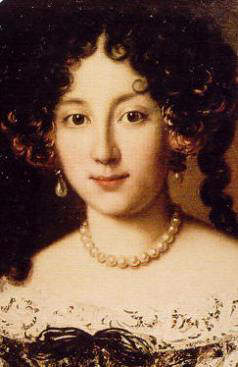
Marie Mancini
Marie Mancini's forceful separation from her lover Louis XIV, and her marriage to an Italian nobleman
Unfortunately the relationship of the young couple was short lived, as Anne and Jules Mazarin had other marriage plans for the young Louis XIV. It was difficult to understand the change of attitude of Anne and Mazarin towards the young lovers, as Mazarin himself was responsible for bringing his five nieces from Italy to France in order to enhance their marriage prospects. Possibly it was something to do with the superstitious belief of Marie Mancini's own mother, who was told in a horoscope that Marie would cause trouble in the future, and expressed a wish on her death bed that Cardinal Mazarin should shut Marie up in a convent and keep her there. Perhaps it might have been due to her birth, not being of royal descent, But in all probability it might have been due to Anne's desire to get Louis XIV married to his cousin, Infanta Maria Theresa, daughter of Philip IV of Spain. In 1659, while negotiations for the marriage of King Louis XIV to Infanta Maria Theresa were taking place, Mazarin forcefully removed Marie Mancini from the court and had her sequestered with two of her sisters in the remote fortress of Brouage. Thus the young couple was almost forcefully separated and their romantic relationship came to an end. After Louis XIV married Infanta Maria Theresa of Spain in 1660, Mazarin arranged Marie Mancini's marriage to Lorenzo Onofrio Colonna, grand constable of Naples and head of the most powerful noble family in Rome, which took place in 1661. Thus Marie Mancini settled in Rome with her husband.
Marie Mancini's separation from her husband Lorenzo O. Colonna, and her eventual resettlement in Spain
The marriage produced three children, all sons. After the birth of her third son Carlo in 1665, their marriage ran into problems, and Marie Mancini separated from her husband. Eventually in 1672, fearing that her husband was planning to kill her, she escaped from Rome with her sister Hortense, and took refuge in southern France, where initially she received the protection of King Louis the XIV, which was subsequently withdrawn possibly after her husband's intervention. She then moved to Chambery, where she was received at the court of the Duke of Savoy for a brief period, and then to Flanders, where she was incarcerated by the Flemish agents of her husband, who demanded her return to Rome. While at Flanders she was able to convince the authorities to release her, and then she set sail to Spain, where she entered a convent in Madrid, which partially fulfilled her mother's death wish that she be confined to a convent.
Marie Mancini publishes her memoirs in 1677
In 1677, in response to an earlier publication entitled "Memoires de M.L.P.M.M. Colonne," purported to be her own life story in her own words, Marie Mancini published her own memoirs entitled La Vérité dans son jour, ou les véritables mémoires de M. Mancini, connétable Colonne (Truth in its day, the real memory of Marie Mancini connetable Colonne). In response to this the original writer Sébastien Brémond published a revised edition in 1678, titled Apologie ou les véritables mémoires de Madame la Connétable Colonna, Maria Mancini, écrits par elle-même (Apology or real memories of Madam Connétable Colonna, Maria Mancini, written by herself). Apart from her memoirs, which incidentally was one of the first ever published by a woman of the elite in France, Marie Mancini also published several astrological almanacs, which shows her familiarity with medieval Arabic works in Astrology translated into Latin, and the works of Kepler and Cardano. It appears that, the way she lived her life in isolation, cut off from her husband and children, partially substantiated what her horoscope predicted that she would cause trouble in the future for the person who married her, for which her mother instructed Cardinal Mazarin that she should enter a convent.
Marie Mancini returns to Italy in 1689
Marie Mancini continued to reside in Madrid, Spain, and only after the death of her former husband in 1689, did she decide to return to Italy. She remained in Italy for the rest of her life looking after the interests of her three sons, and died in Pisa on May 8, 1715, and was buried in the church of the Holy Sepulcher.
The fate of the Marie Mancini Pearls after 1715
The fate of the Marie Mancini Pearls after her death in 1715 is not known. Perhaps she disposed of the pearls before her death while she was still living in Madrid, or after she settled again in Italy. Perhaps the pearls were given as a gift to one of her sons or their spouses or her grandchildren, while she was living in Italy. Whatever might have been the fate of the pearls after 1715, it was only after 264 years in October 1979, that pearl reappeared again at a public auction at Christie's in New York, where the pearls fetched a price of $253,000.
You are welcome to discuss this post/related topics with Dr Shihaan and other experts from around the world in our FORUMS (forums.internetstones.com)
Back to Famous Pearls
Related :-
2) Sculptural Pendants in the State Hermitage Museum, St. Petersberg
External Links :-
References :-
1) Famous Pearls - Paul M. Mikkelsen, Ph.D., Curator of Malacology, AMNH New York.
2) Christie's Jewelry Collecting Guide, Famous Collections - www.christies.com
3) Henrietta Maria of France - From Wikipedia, the free encyclopedia.
4) Marie Mancini - From Wikipedia, the free encyclopedia.
5) Marie de Medici - From Wikipedia, the free encyclopedia.
6) History of the Medici Family - www.tuscany-toscana.info
7) The Strong Auction Market for Natural Pearls - David Bennet, World Pearl Forum, Dubai 2009.
 Home
Security & Guarantee
How it Works
Technology Partners
Updated Tables
Famous Diamonds
More Famous Diamonds
Famous Pearls
Famous Gemstones
Contact Dr Shihaan Larif
Contact Senior Editor
Famous Jewelry
Reference Database
Forums
Learning Center
Gemstone Gallery
e-mail Notifications
Advertise
Press Release
About Us
Privacy Policy
Contact Us
FAQ'S
Site Map
Staff Mail Login
Staff Documents
Birthstones
History
Minerals
Shows
Live Metal Prices
Jewellery Gallery
News
Marketplace
Marketplace Support
Open Store
Online Auctions
Join Us & Contribute
Directory
Classifieds
List your products
Wholesale Trading
Post Buy Request
Go Green Policy
Site Updates
Upcoming-ToDo List
Latest News
Latest Articles
Latest Blog Updates
Chat Rooms
Job Board
User Gallery
Videos
New Newsletter Archive
Old Newsletter Archive
Jewelry & Mineral Blog
User Blogs & Social Network
Search
Answers (Q & A)
Valuation
Help me find a diamond/jewelry
pin.internetstones.com- Social Pinboard- Sart yours & connect with millions
Invite Friends From Yahoo, Gmail etc-One Click
Home
Security & Guarantee
How it Works
Technology Partners
Updated Tables
Famous Diamonds
More Famous Diamonds
Famous Pearls
Famous Gemstones
Contact Dr Shihaan Larif
Contact Senior Editor
Famous Jewelry
Reference Database
Forums
Learning Center
Gemstone Gallery
e-mail Notifications
Advertise
Press Release
About Us
Privacy Policy
Contact Us
FAQ'S
Site Map
Staff Mail Login
Staff Documents
Birthstones
History
Minerals
Shows
Live Metal Prices
Jewellery Gallery
News
Marketplace
Marketplace Support
Open Store
Online Auctions
Join Us & Contribute
Directory
Classifieds
List your products
Wholesale Trading
Post Buy Request
Go Green Policy
Site Updates
Upcoming-ToDo List
Latest News
Latest Articles
Latest Blog Updates
Chat Rooms
Job Board
User Gallery
Videos
New Newsletter Archive
Old Newsletter Archive
Jewelry & Mineral Blog
User Blogs & Social Network
Search
Answers (Q & A)
Valuation
Help me find a diamond/jewelry
pin.internetstones.com- Social Pinboard- Sart yours & connect with millions
Invite Friends From Yahoo, Gmail etc-One Click




Our Global Jewelry Industry Job Network


Buy & Sell in our Marketplace

Subscribe to our Newsletter

List in our Classifieds

List in our Directory

User Uploaded Gallery

Powered by Ultra Secure
Amazon (USA) Cloud Network

Founder Internet Stones.COM
Register in our Forums

| Featured In
|
|
|
|
|
|
|
|







Blog & Education Feed
Articles Feed
 |
 |
 |

Copyright © .Internet Stones.COM. All rights reserved.