Marie-Therese, Duchesse d'Angouleme Emerald and Diamond Tiara
Origin of name
This exquisitely crafted early 19th century emerald and diamond tiara was commissioned by Louis-Antoine, the duc d'Angouleme (1775-1844) in 1819, for his wife the Duchesse d'Angouleme Marie-Therese (1778-1851), the eldest daughter of Emperor Louis XVI and his Queen Consort Marie Antoinette, who were executed by guillotine in 1793 during the upheavals of the French Revolution. After the restoration of the House of Bourbon to the French throne following the defeat of Napoleon I, at Waterloo, on June 18, 1815, the eldest surviving brother of Louis XVI was proclaimed as the King of France, as Louis XVIII, but he was childless. When Louis XVIII died on September 16, 1824, he was succeeded by his younger brother, the Comte d'Artois as Charles X, whose son Louis-Antoine, the duc d'Angouleme now became the heir to the throne, also known as the Dauphine of France. With her husband as the Dauphine of France, Marie-Therese was now addressed as Madame la Dauphine, a title which she held until she chose to go into exile in Britain in 1830, together with her husband and her uncle and father-in-law Charles X, who was ousted as the King by Louis Philippe, the duc d'Orleans.
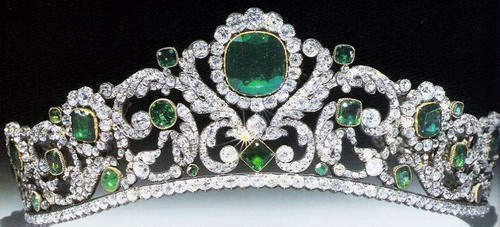
Features of the emerald and diamond tiara
The tiara which was designed and executed by the French Royal Jewelers Evrard and Frederic Bapst in 1819, was a masterpiece of the French jewelry craftsmanship of the early 19th century. The design of the tiara was a symmetrical design of scrolling foliage, mounted with over a thousand diamonds set in silver, and 40 emeralds set in gold. The silver and gold lines of the settings are clearly visible in the photograph of the tiara. The diamond-studded semi-circular band of the tiara, is curved upwards towards the center, in order to fit into the contour of the wearer's head. The scrolling foliage of the tiara arises from the curved band, and the design is perfectly symmetrical with respect to the median line. Two emeralds are placed along the median line of the tiara, a lower small square-shaped emerald touching the lower curved band, with its opposite vertices along the median line, and an upper larger cushion-shaped emerald as the centerpiece of the tiara, surrounded by 18 brilliant-cut diamonds. Twelve other larger emeralds are also placed in symmetrical positions, six on each side of the median line of the tiara.
History of the Marie-Therese emerald and diamond tiara
The tiara was commissioned for the use of Marie-Therese and designed and executed by Bapst
Bernard Morel in his book "Les Joyaux de la Couronne de France" (The Crown Jewels of France), says that the emerald and diamond tiara was commissioned in 1819, for the use of Marie-Therese, the daughter of King Louis XVI and Marie Antoinette, and the wife of Louis-Antoine, the duc d'Angouleme, who in 1924, became the Dauphine of France (heir to the throne of France) after the accession of his father as King Charles X. The royal jewelers who were assigned the task of designing and crafting the tiara were the Bapst brothers, Evrard and Frederic, who executed the order between September 1819 and July 1820. They used 14 of the largest emeralds from the crown collection, that had remained unmounted during the period of the first empire. They also added 26 other smaller emeralds to the tiara, making a total of 79.12 metric carats of emeralds.
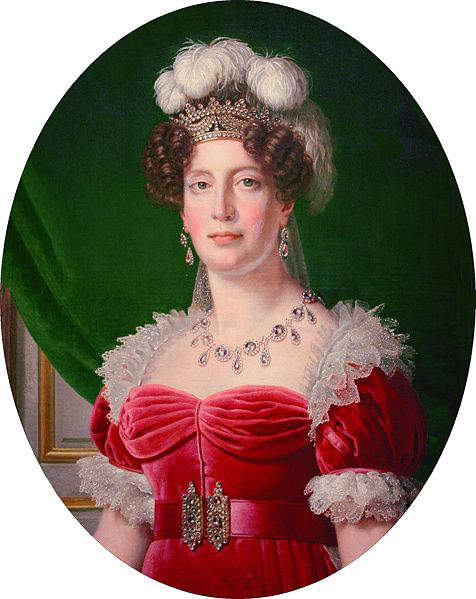
Marie-Therese, Duchesse d'Angouleme
The tiara was part of the French crown jewels
Being executed with materials provided by the state treasury, such as gold, silver, diamonds and emeralds, the finished tiara though used by the Duchesse d'Angouleme, still remained the property of the French State. Marie-Therese used the tiara until the year 1830, when she decided to go into exile in Britain, with her husband and her uncle and father-in-law Charles X, who was forced to abdicate by a plot hatched out by Louis Philippe, the duc d'Orleans. Before her departure to Britain she returned the emerald and diamond tiara to the French state treasury.
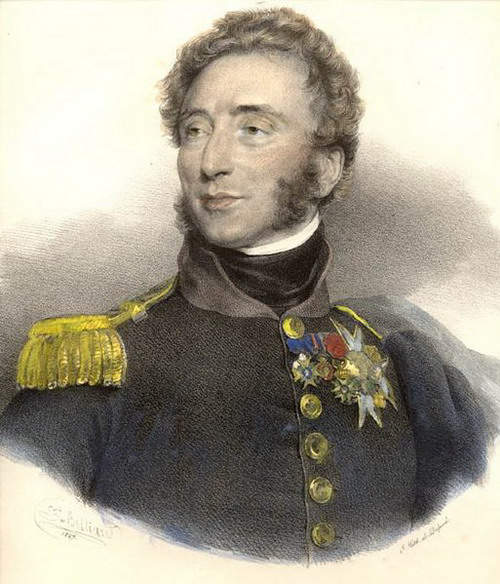
Duc-d-Angouleme Louis Antoine
Proposal to dispose of the French crown jewels in 1848
The celebrated tiara remained in the French state treasury until 1848, when their was a proposal to dispose of all the crown jewels of France, in the immediate aftermath of the revolution of 1848, and the overthrow of the constitutional monarchy led by Louis Philippe, and the proclamation of the second republic. However the proposal, never materialized and the crown jewels including the Marie-Therese emerald and diamond tiara remained in the safe custody of the treasury.
Napoleon III rules France first as President and later as Emperor from 1852 to 1870
In December 1848, Louis Napoleon the son of Louis Bonaparte, who was the brother of Napoleon Bonaparte, was elected the President of France by polling a massive 5.5 million votes. Napoleon ruled France as the President of the second republic for almost 4 years until 1852. During this period he gradually undermined the authority of the National Assembly, and appointed his supporters to key positions in the administration and the army. He also appointed a cabinet that was more favorable towards him than the National Assembly. He then dissolved the National Assembly and decreed a new constitution, that was approved by a plebiscite. He then held another plebiscite in November 1852, and was confirmed as the absolute ruler and Emperor of the second empire in France. Emperor Napoleon III married countess Eugenie de Montijo, the daughter of a Spanish nobleman, who became his Empress consort, in January 1853. For the next two decades Napoleon III gave France two decades of prosperity under a stable authoritarian government.
The tiara becomes a favorite piece of jewelry of Empress Eugenie, Empress consort of Napoleon III
During the brilliant court life of the second empire, Marie-Therese's emerald and diamond tiara, came once again into prominence, as Empress Eugenie wore it frequently at formal occasions, being very fond of emeralds, as she believed they suited her fair skin and red hair. The emerald and diamond tiara thus became one of her most favorite pieces of jewelry. She was also the owner of a beautiful diamond necklace, the centerpiece of which was the famous 51-carat, D-color, oval shaped brilliant, that came to be known as the "Eugenie Diamond."
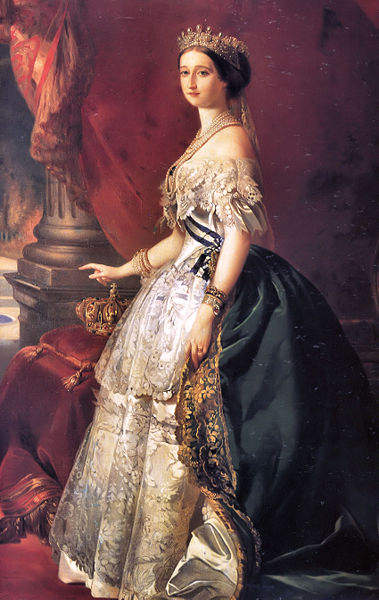
Empress Eugenie
Empress Eugenie and her son escape to England after the fall of Napoleon III. France proclaims the third republic.
Emperor Napoleon III made an official trip to Great Britain, the country that gave him asylum when he was living in exile, together with his Empress Consort Eugenie. The trip marked the beginning of a close and friendly relationship between Empress Eugenie and Queen Victoria. In the 1870-71 disastrous Franco-German war Napoleon III was defeated and surrendered to the Germans. He was deposed and France proclaimed the third republic. With the fall of the second French Empire, Empress Eugenie and her son escaped to Britain, where she was given asylum by Queen Victoria. Later, after Napoleon III was released by the Germans, he also joined Empress Eugenie and his son in England.
The crown jewels moved to Brest during the Prussian invasion
During the Prussian invasion of France in 1870, the crown jewels were moved to Brest for safe keeping. Brest was an important sea port and naval base situated in northwestern France, located in a sheltered position not far from the western tip of the Breton peninsula. The crown jewels remained in Brest until 1872, and were subsequently moved to the vaults of the Ministry of Finance in Paris. However, when Empress Eugenie escaped to Britain with her son it is believed that she carried away her personal jewelry with her, and this did not include the "Marie-Therese Emerald and Diamond Tiara."
The crown jewels are exhibited at the Paris World Fair in 1878
In the year 1878, the crown jewels of France were put out on display at the the third Paris World Fair, known as "Exposition Universelle." that was held from May 1, 1878 to November 10, 1878. The exhibition was actually held to showcase to the world, France's rapid recovery after its crushing defeat in the 1870 Franco-Prussian war. Large crowds, both local and foreign thronged to see the display of the fabulous collection of crown jewels accumulated by the Bourbon monarchs, and Emperors Napoleon I and III, during their periods of rule, and are truly amazed by their splendor
Other highlights of the 1878 Paris Exhibition
The Paris Exhibition of 1878, was one of the largest exhibitions ever held in any part of the world at that time, and the exhibition ground covered an area of over 66 acres. All the countries in Europe (except Germany) and the far-flung colonies of the United Kingdom, such as Canada, British India, Victoria, New South Wales, Queensland, South Australia, Cape Colony and some of the British crown colonies in Asia and Africa took part in the exhibition. The exhibition of new machinery and the fine arts were on a very large and comprehensive scale, hitherto not seen in any part of the world. Several new inventions from the United States of America was also displayed, such as Alexander Graham Bell's telephone, and the electric light bulb, megaphone and phonograph by the master inventor Thomas Alva Edison. Edison also installed electric lighting along the main avenues of the exhibition grounds which was lit by the operation of a switch. The display of 400 indigenous people in a "human zoo" called a "negro village" was a very popular feature of the exhibition, but in retrospect was uncivilized behavior by the organizers according to modern standards of human ethics and behavior. What the organizers of the exhibition fail to realize at that time was how 400 white people would have felt if they were placed under similar circumstances either in their own home country, or in the heartlands of black Africa. The Paris Exhibition was a tremendous success and was attended by over 13 million people.
The crown jewels displayed again at the Louvre Museum
In the year 1884, the crown jewels of France were displayed again at a special exhibition held in the Louvre Museum, in aid of the "Ecole des Arts Industriels" (School of Industrial Arts). This exhibition was also quite popular and helped to generate substantial funds for the intended purpose.
The French National Assembly decides to dispose of the crown jewels
The crown jewels of France represented a powerful symbol of the deposed monarchy of France, both the Royalists and the Bonapartists, and the resurgence of the monarchists after the first and second republics were remotely associated with these powerful symbols of authority. The republican National Assembly the highest body that exercised the sovereignty of the people, was uncomfortable with the existence of these decadent royal symbols, that might possibly be used by an aspiring monarchist in the future. Thus, the National Assembly was of the unanimous opinion that all the crown jewels of France should be either dismantled or disposed of. Francois Paul Jules Grevy a President of the third republic, during whose tenure the matter was discussed and approved by the National Assembly, bowed down to its wishes, and ordered the sale of all the crown jewels of France and the proceeds to be credited to the government funds. But, provision was also made for the preservation of any article of cultural and historic value. The proposal came under severe criticism by the Parisian jewelers, who were well aware of the historic and artistic significance of the collection. Nevertheless the sale went ahead despite all the well-founded criticisms.
The auction of the French crown jewels
The auction that was held in May 1887, attracted international attention, and several leading jewelry houses in the world, such as Tiffany's, Van Cleef & Arpels and the Parisian jewelers Frederic Boucheron and Paul Bapst, took part in the auctions. The sale was held in the "Pavilion de Flore" a part of the palace of the Tuileries, on May 12, 1887. The jewels were divided into 69 lots, and Tiffany's of New York, successfully bid for 24 of these lots which they purchased for $480,000, a sum that was greater than the combined purchases of the next nine largest buyers. Among the jewelry purchased by Tiffany's were Empress Eugenie's diamond necklace, a diamond comb, pieces from Empress Eugenie's great girdle, and a currant-leaf corsage ornament. Van Cleef & Arpels purchased the Empress Josephine Diamond Tiara. The total proceeds realized from the sale of the crown jewels was said to be 6 million francs.
Only a few items of the crown jewels were retained and later exhibited at the Louvre Museum. These included the crowns of Louis XV and Napoleon Bonaparte, but their gems were removed and replaced with colored glass, obviously to depreciate its significance. Other items included the historic Hortensia and the Regent diamonds. Some of the royal and imperial coronation regalia were also retained.
The sale of Marie-Therese Emerald and Diamond Tiara
The "Marie-Therese Emerald and Diamond Tiara" was also sold at this auction, but the jeweler who purchased it is not known. In all probability the jeweler who purchased the celebrated tiara was a British national, as it surfaced in Britain, and was once owned by Wartski's jewelry firm, situated in Grafton Street, Mayfair, London, a firm that had held appointments as jewelers to H.M. the Queen, and H.R.H. the Prince of Wales. According to Geoffrey Munn, the Managing Director of Wartski, who also wrote his famous work "Tiaras, a History of Splendor" the "Marie-Therese Emerald and Diamond Tiara" was in the safe of the Wartski's jewelry firm, at the time he joined the firm more than 30 years ago. No one in the firm was aware of the historical credentials of the celebrated tiara. It was just known as an "Emerald and Diamond Tiara" and contained 1,021 diamonds and 44 emeralds.
The Marie-Therese Emerald and Diamond Tiara on display at the Victoria and Albert Museum
The Duchess of Angouleme Tiara was placed on display at the Victoria Albert Museum by its owner in 1982, and remained in the Museum until the year 2002. During this period the tiara became a piece of first choice for exhibitions surveying the history of this type of jewelry. The tiara has a great historic and artistic value, as it is just one of the few pieces of jewelry of this period that has not been broken up. The tiara still remains in its original state, a living example of the perfection and refinement achieved in jewelry crafting during the early 19th century.
The owner of the historic tiara decides to dispose of it, but the Arts Minister places a temporary export bar on the tiara
The owner of the "Marie-Therese Emerald and Diamond Tiara" decided to dispose of his valuable possession in the year 2002, and the value of the tiara was placed at £700,000. However on a recommendation made by the Reviewing Committee on the Export of Works of Art, the Minister of State for the Arts, Tessa Blackstone placed a temporary bar on the export of the tiara, to provide a chance to interested parties to raise the required money, to keep the tiara in the United Kingdom, as the committee was convinced of the outstanding aesthetic importance and the technical skills evident in the tiara, which still retains its original form. The bar was said to last until April 15, 2002, and was to be extended by another 3 months if serious attempts were made to raise such funds.
The export bar placed on the tiara expires and the "Marie-Therese Emerald and Diamond Tiara" is acquired by the Louvre Museum of France
The bar on the export of the tiara expired on April 15, without any attempt being made to raise funds for the purchase of the tiara. The owner of the tiara was thus free to do whatever he wanted with his valuable possession. The Victoria Albert Museum which displayed the tiara for twenty years, thus lost an opportunity to hold on to one of its choicest exhibits for the want of a benefactor to purchase the valuable piece of jewelry for them. The loss of the Victoria Albert Museum, became the gain of the Louvre Museum in France. The owner of the celebrated tiara successfully negotiated a deal with the Louvre Museum, that brought him the returns he expected. Thus the emerald and diamond tiara of the Duchess d'Angouleme, Marie Therese Charlotte, the only child of Louis XVI and Marie Antoinette to survive the French revolution, finally became the property of the Louvre Museum, where it is displayed today.
Related :-
Grand Duchess of Vladimir Tiara
Queen Victorias Emerald and Diamond Tiara
External Links :-
www.culture.gov.uk/reference-library/media-releases
References
1.Arts Minister Places Temporary Export Bar on an Emerald and Diamond Tiara by Bapst of Paris - website of the Department for Culture, Media and Sports.
2.Tiaras - Antiques and the Arts on Line, www.antiqueandthearts.com
3.Encyclopedia Britannica - 2006
4.Exposition Universelle -1878 - From Wikipedia, the free encyclopedia

 Home
Security & Guarantee
How it Works
Technology Partners
Updated Tables
Famous Diamonds
More Famous Diamonds
Famous Pearls
Famous Gemstones
Contact Dr Shihaan Larif
Contact Senior Editor
Famous Jewelry
Reference Database
Forums
Learning Center
Gemstone Gallery
e-mail Notifications
Advertise
Press Release
About Us
Privacy Policy
Contact Us
FAQ'S
Site Map
Staff Mail Login
Staff Documents
Birthstones
History
Minerals
Shows
Live Metal Prices
Jewellery Gallery
News
Marketplace
Marketplace Support
Open Store
Online Auctions
Join Us & Contribute
Directory
Classifieds
List your products
Wholesale Trading
Post Buy Request
Go Green Policy
Site Updates
Upcoming-ToDo List
Latest News
Latest Articles
Latest Blog Updates
Chat Rooms
Job Board
User Gallery
Videos
New Newsletter Archive
Old Newsletter Archive
Jewelry & Mineral Blog
User Blogs & Social Network
Search
Answers (Q & A)
Valuation
Help me find a diamond/jewelry
pin.internetstones.com- Social Pinboard- Sart yours & connect with millions
Invite Friends From Yahoo, Gmail etc-One Click
Home
Security & Guarantee
How it Works
Technology Partners
Updated Tables
Famous Diamonds
More Famous Diamonds
Famous Pearls
Famous Gemstones
Contact Dr Shihaan Larif
Contact Senior Editor
Famous Jewelry
Reference Database
Forums
Learning Center
Gemstone Gallery
e-mail Notifications
Advertise
Press Release
About Us
Privacy Policy
Contact Us
FAQ'S
Site Map
Staff Mail Login
Staff Documents
Birthstones
History
Minerals
Shows
Live Metal Prices
Jewellery Gallery
News
Marketplace
Marketplace Support
Open Store
Online Auctions
Join Us & Contribute
Directory
Classifieds
List your products
Wholesale Trading
Post Buy Request
Go Green Policy
Site Updates
Upcoming-ToDo List
Latest News
Latest Articles
Latest Blog Updates
Chat Rooms
Job Board
User Gallery
Videos
New Newsletter Archive
Old Newsletter Archive
Jewelry & Mineral Blog
User Blogs & Social Network
Search
Answers (Q & A)
Valuation
Help me find a diamond/jewelry
pin.internetstones.com- Social Pinboard- Sart yours & connect with millions
Invite Friends From Yahoo, Gmail etc-One Click




Our Global Jewelry Industry Job Network


Buy & Sell in our Marketplace

Subscribe to our Newsletter

List in our Classifieds

List in our Directory

User Uploaded Gallery

Powered by Ultra Secure
Amazon (USA) Cloud Network

Founder Internet Stones.COM
Register in our Forums

| Featured In
|
|
|
|
|
|
|
|







Blog & Education Feed
Articles Feed
 |
 |
 |

Copyright © .Internet Stones.COM. All rights reserved.