Maximilian Emerald Ring
Open FREE Unlimited Store Join Our Newsletter
Origin of name
The "Maximilian Emerald Ring" gets its name from its one time owner, Ferdinand Maximilian Joseph, the archduke of Austria and the younger brother of Emperor Francis Joseph (1848-1916), who was installed as the Emperor of Mexico in 1864 by Napoleon III, whose forces captured Mexico City in 1863, with a view of occupying Mexico and colonizing it. Initially the invasion of Mexico was carried out by the French, British and Spain under the pretext of safeguarding their investments, from a government controlled by Liberals, who even suspended the payment of all foreign debts. But, later the British and the Spanish withdrew their forces after learning of Napoleon's plan to colonize the country. During this period the United States was in the midst of a devastating civil war (1861 -1865). But, soon after the end of the civil war in 1865, the U. S. demanded the withdrawal of the French troops from Mexico, as it violated the Monroe Doctrine, and amassed troops at the Mexican border. The French withdrew their forces, but Emperor Maximilian decided to stay on supported by a group of staunch Conservatives. Eventually, the Liberal forces headed by Benito Suarez captured Mexico City, and Emperor Maximilian surrendered to the forces of Benito Suarez on May 15, 1867. Subsequently, Emperor Maximilian and two of his top-ranking generals, were court martialled found guilty and sentenced to death by firing squad, on June 19, 1867.
Characteristics of the gemstone
The Maximilian Emerald is a 21.04-carat, emerald-cut, deep grass-green stone, with good clarity and transparency, and like all natural emeralds contains some inclusions.
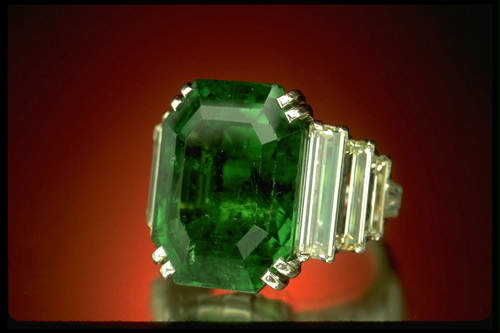
© Smithsonian Institution
The emerald was set on a ring for Emperor Maximilian Joseph, but after his death changed hands and eventually came into the possession of Marjorie Merriweather Post, the cereal heiress, who got the ring reset by Cartier incorporating diamonds and subsequently donated it to the National Museum of Natural History of the Smithsonian Institution.
History of the Emerald
Source of the Emerald
The emerald belonged to Cuauhtemoc the last king of the Aztecs
According to legend the Emperor Maximilian Emerald is believed to have belonged to Cuauhtemoc, the last king of the Aztec Empire, with its capital based at Tenochtitlan ( present day Mexico City), who was martyred trying to defend his homeland from the Spanish in the 1525. Cuauhtemoc was captured by the Spanish Conquistadors in 1521, while crossing lake Texcoco in disguise, during the 80-day siege of Tenochtitlan, and tortured on the orders of Hernan Cortes, to make him reveal the whereabouts of hidden treasures, which he did not possess. Cuauhtemoc was executed by the Spaniards on charges of treason in 1525. Today, Cuauhtemoc is one of the most revered figures in Mexican History, considered as a symbol of bravery and courage against the cruelty of the Spanish Conquistadors.
If the emerald did indeed belong to Cuauhtemoc, the last king of the Aztecs, its source must be undoubtedly one of the three ancient emerald mines of Colombia, Muzo, Coscuez and Chivor, the only source of emeralds in South America during that period, and were mined and traded by the Chibchan and Muzo Indians. Large quantities of these emeralds eventually found their way to neighboring Peru and Mexico, where emeralds were considered as sacred stones and the indigenous Indian tribes used them as ornaments, offered them to their Gods in the temple, or buried them together with their dead. In fact the Spanish Conquistadors saw emeralds for the first time in South America, when they landed in Peru and Mexico, and attempts made by them to located the source of these emeralds in Peru and Mexico, proved fruitless, simply because there were no emerald mines in these countries. Thus the Spaniards resorted to desecrating the temples and the graveyards of the indigenous people stripping them of their emeralds and exporting large quantities of these emeralds back to Spain. It was not until 1537, the Spaniards came to know the actual source of the emeralds, when Gonzalo Jimenez de Quesada captured Colombia, and on entering the valley of Guacheta, the heart of the Chibcha domain, was warmly received by the Chibcha Indian Chief, who also gifted him with nine large emeralds.
The emerald was purchased by Ferdinand Maximilian Joseph during his trip to Brazil in 1860
Another possibility is that the emerald actually belonged to Emperor Maximilian, like the "Emperor Maximilian Diamond" and the "Princess Carlota Diamond" which was purchased by him in 1860, when he made a trip to the Brazilian rain forests in pursuance of his Botanical studies, a subject that had fascinated him since his childhood. It is quite possible that Ferdinand Maximilian Joseph also purchased the Maximilian emerald during his trip to the Amazon rain forests of Brazil, and later got it cut and mounted on a ring. It is well known that soon after the execution of the Emperor by firing squad, it was discovered that he had been wearing the 41.94-carat diamond in a small satchel tied around his neck. After his execution the Emperor's body was returned to his family in Vienna, and the diamond given to his widow Princess Carlota. If we accept this version as correct, the source of the emerald is either the Muzo or Cosquez mines, as around the period 1860 the Chivor mines were still lost and not rediscovered after its closure in 1675, by royal decree issued by King Charles II, due to the cruel and brutal conditions under which the mines were being exploited.
Let us now examine the characteristics of emeralds originating from Muzo, Coscuez and Chivor mines.
Characteristics of emeralds originating from Muzo
The emeralds are deep herbal-green in color.
They have good transparency.
The clarity is also good due to scarce presence of gardens and inclusions.
The specific gravity is 2.71 and the refractive index 1.578.
Contains three-phase inclusions and crystals of halite, calcite and parisite.
Characteristics of Coscuez emeralds
The emeralds have a typical yellowish-green color.
Good transparency and brightness.
Good clarity with diffused gardens and inclusions.
Characteristics of Chivor emeralds
The emeralds are typically bluish-green.
Some stone have excellent clarity and transparency.
Others contain inclusions, micro-fractures and cavities that are difficult to hide.
Chivor emeralds have a slightly lower specific gravity and refractive index than the Muzo emeralds. The specific gravity is 2.69 and the refractive index 1.571.
Contain three-phase inclusions and also pyrite and albite.
Possible mine of origin of the Maximilian emerald
Comparing the characteristics of the Maximilian emerald with the characteristics listed above, and considering only the color, clarity and transparency, it appears that the Maximilian emerald probably originated in the Muzo emerald mines of Colombia. This could have been confirmed if the specific gravity and the refractive index of the emerald was determined.
Ferdinand Maximilian Joseph - A short biography
Ferdinand Maximilian Joseph who was the second son of Archduke Francis Charles of Austria and his wife Sophia, was born on July 6th, 1832. His elder brother Francis Joseph ascended the throne as Emperor of Austria in 1848 and ruled until 1916. Maximilian Joseph showed an inclination towards the Natural Sciences, particularly towards the Science of Botany, at an early age in life. In 1851, at a relatively young age of 19, he joined his brother's armed forces as a lieutenant in the Austrian Navy, and eventually became its Commander-in-Chief. Subsequently, he also served for a short time as the governor of the Lombardo-Venetian kingdom. Later, he retired to a private life, with his young bride, Princess Carlota, the daughter of King Leopold I of Belgium. During his retirement he continued his studies in the Natural Sciences, and undertook a trip to the tropical rain forests of the Amazon basin in Brazil, in 1860, in pursuance of his studies in Botany. It was during this trip he purchased two of the famous diamonds of Brazilian origin, the 41.94-carat, near colorless "Emperor Maximilian Diamond" and the 33-carat greenish-yellow diamond the Carlota Diamond. It might also have been possible that during this trip he also purchased the 21.04-carat Maximilian emerald of Colombian origin, that reached the gem and jewelry markets of Brazil. Maximilian Joseph made these purchases of diamonds and emeralds, purely as a natural scientist interested in the marvels of nature, and not to enhance his status as an aristocrat.
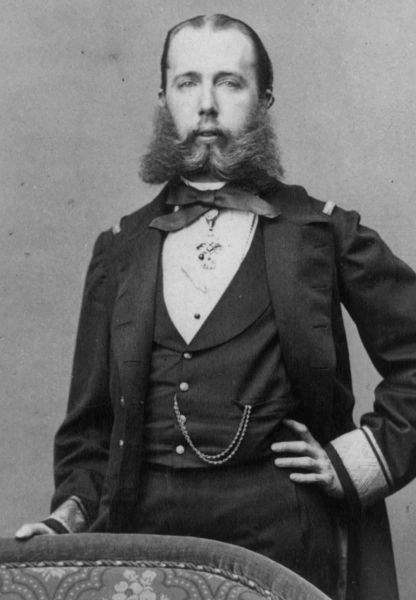
The turning point in his quiet way of life came, when in 1863, Napoleon III exerted undue pressure on him to take over the throne of Mexico as its Emperor, after the French forces captured and occupied Mexico City, the capital of Mexico. Napoleon's main intention was to colonize Mexico and he intended to use Maximilian Joseph to achieve his colonial ambitions. The frustrated conservative Mexican exiles living in Europe, who had lost their property and privileges under a liberal government, also pleaded with Maximilian Joseph to become their Emperor, thinking that they would be able to regain some of their lost privileges. The Roman Catholic hierarchy including the Vatican, favored the installation of Maximilian Joseph as the Emperor of Mexico, in order to regain the vast Church holdings confiscated by Benito Juarezm, the Liberal leader. Unfortunately, young Maximilian Joseph and his wife Princess Carlota, were not aware of the ulterior motives of the French, the conservative politicians, and the Roman Catholic clergy. Thus Maximilian Joseph became a willing pawn in an international power game that finally led to serious consequences for him and his family.
Maximilian Joseph was installed as Emperor of Mexico on June 10, 1864. Being a natural scientist and a great humanist, Maximilian Joseph, planned to rule his domain with great benevolence, giving priority to the upliftment and emancipation of the Indian peasants in the country. When Benito Juarez's sweeping political and land reforms came up for review, Emperor Maximilian upheld these reforms, much to the indignation of the clergy, the landed proprietors and other vested interests. He refused to restore vast church holdings confiscated by Juarez, and thereby antagonized the hierarchy of the Roman Catholic Church. Thus, Emperor Maximilian Joseph, disappointed his original sponsors, by refusing to accede to their unjust demands. His honesty and integrity as a great leader was clearly demonstrated, when the Emperor refused to make use of the state resources for the up keep of his family and the palace. Instead he made use of his own inherited income for this purpose. All these good deeds of Emperor Maximilian Joseph, go to prove beyond any doubt, that he was indeed a benevolent ruler, whose achievements were on par with Benito Juarez, the elected president of the Mexican people.
During the tumultuous events of Mexico, neighboring United States was in the midst of a devastating civil war, and as such the U. S. was not able to influence the course of events in Mexico. However, after the civil war ended in 1865, the U. S. demanded the immediate withdrawal of the French troops from Mexico, as their presence contravened the Monroe Doctrine, and ordered troop movements towards the Mexican border. In March 1867, the French forces withdrew from Mexico, but unfortunately, Emperor Maximilian Joseph, refused to leave with his masters who installed him. The Emperor had come to love his people whom he served to the best of his abilities, and his adopted country, and felt that he could not abandon his people. He was also supported by some conservatives and the army. However, within a matter of days, Benito Juarez and his army was back in Mexico City. Emperor Maximilian refused to abdicate and was supported by a group of die hard conservatives. Finally, on May 15, 1867, he surrendered to the forces of Benito Juarez.
Maximilian Joseph and two of his highest ranking generals were then court martialled, found guilty and sentenced to death by firing squad. Appeals for clemency by international figures, political leaders and Heads-of-State went unheeded, and on June 19, 1867, 35-year old Maximilian Joseph and his two generals were executed by firing squad. The death of her beloved husband in Mexico was something Princes Carlota could not bear up, and led to her permanent mental derangement, which lasted until her death in 1927.
Marjorie Merriweather Post
The "Maximillian Emerald" eventually came into the possession of the cereal heiress, Marjorie Merriweather Post, America's first businesswoman and a great collector and connoisseur of artworks, who got the emerald remounted in a ring by Cartier, incorporating baguette diamonds.
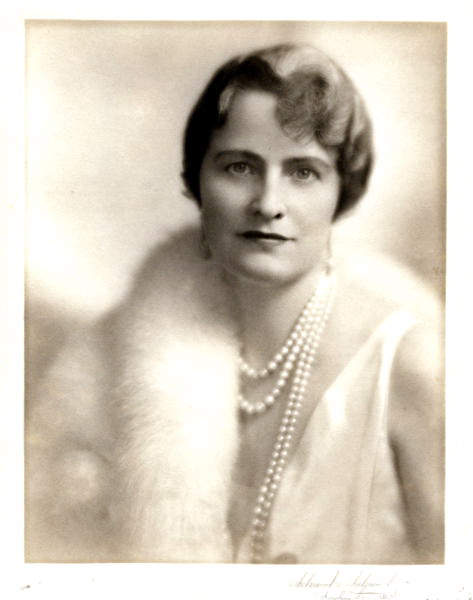
Marjorie Merriweather Post was born on March 15, 1887, in Springfield, Illinois, and was the only child of Charles William Post and his wife Ella Leticia Merriweather. C. W. Post founded the Postum Cereal Company after his invention of the coffee substitute Postum, Grape-Nuts, and Post Toasties cereals, which expanded rapidly to become one of the largest food-manufacturing empires in early twentieth century. Being his only child, C. W. Post trained his daughter in all aspects of the company's workings, preparing the groundwork for his daughter to takeover the rapidly expanding family business at anytime in the future. Marjorie who also accompanied her father on his business trips abroad, was exposed to the appreciation of art and imbibed her father's interests as a connoisseur and collector of artworks. The death of C. W. Post in 1914, thrust upon her the responsibility of running the rapidly growing family business, a role which she assumed with great ease given the training she received from her father before his death. At a time when women in America were seldom more than secretaries in a business world, dominated by men, Marjorie Merriweather Post became the first woman President of a company, going down in history as one of America's first businesswomen.
Mrs. Post married four times. Her first marriage was in 1905, to investment banker Edward Bennett Close, of Greenwich, Connecticut, by whom she had two daughters. However, the marriage ended up in divorce in 1919. Her second marriage was in 1920, to Wall Street financier Edward Francis Hutton. This marriage was a perfect match, both being handsome, wealthy and similar inclinations towards business. The business acumen of Hutton coupled with the experience of Mrs. Post, led to a rapid expansion of the business. Hutton became the Chairman of the Board of the Postum Cereal Company, which diversified into the prepared and frozen food products with great success, and the name of the company changed to the General Foods Corporation. Post and Hutton were divorced in 1935, and had one child by their marriage. Marjorie married her third husband Joseph E. Davies, a Washington lawyer in 1935, and accompanied him to the Soviet Union, where he served as the American ambassador from 1937 to 1938, and was one of those who witnessed Stalin's reign of terror first hand. It was also in the Soviet Union, that Marjorie began acquiring Russian imperial art treasures which were sold with the approval of the government of the Soviet Union. Among the items of Russian art acquired by her, included Russian icons, textiles, porcelains, silver and Faberge art objects. Her collection of Russian art, today is the most important collection of Russian imperial art outside Russia, and is displayed at the Hillwood Museum, her former residence in Washington D.C. Marjorie's marriage to Davies also came to an end in 1955. Her fourth marriage occurred in 1958 to Herbert A. May, a wealthy Pittsburg businessman, a marriage that lasted only until 1964.
Besides being a successful businesswoman, Marjorie was also a well known art collector, a philanthropist and socialite. As pointed out earlier she inherited her passion for the arts from her father C. W. Post, but her collection began to expand significantly only after she moved to New York in the early 20th century. While at New York she came under the influence of the wealthy collectors of the New York high society. To learn more about art she enrolled in classes at the Metropolitan Museum of Art and came under the influence of the renowned art dealer Sir Joseph Duveen, who instilled a life long passion for the arts in Marjorie.
During the 1920s she acquired decorative art objects for her New York home, and French furnishings for her grand apartment in New York, her estate Mar-A-Lago in Palm Beach, Florida, Camp Hutridge in the Adirondacks and her yacht Sea Cloud. She also acquired fine Sevres porcelain and 18th century French gold boxes. She put together her Russian collection of art during her third husbands assignment as American ambassador in 1937-38. She continued collecting throughout her life, and in 1958 hired Marvin Ross, a Harvard trained art historian to catalogue and organize her collections and implement standard museum practices at Hillwood. In 1973, after her death, Hillwood, her last estate in Washington D. C. was bequeathed to the public as a museum, where her magnificent French and Russian collections are on display. This was her final and most important philanthropic gesture.
Marjorie Merriweather Post involved herself in lot of charitable activities during the great depression of the 1930s, and supported many philanthropic causes throughout her life. She supported the Salvation Army, the American Red Cross, and during World War I donated funds for the construction of field hospitals in France, a gesture that was recognized by the French Government, who awarded her the Legion of Honor. In 1971, she was the recipient of the Silver Fawn Award presented by the Boy Scouts of America.
Marjorie Merriweather Post donates her jewelry to the NMNH of the Smithsonian Institution.
Marjorie Merriweather Post donated some of her jewelry of historical value to the National Museum of Natural History of the Smithsonian Institution in the 1960s, where these are exhibited today at the Janet Annenberg Hooker Hall of Geology, Gems and Minerals. The famous pieces of jewelry donated by her include the following :-
1) A pair of 20-carat diamond earrings belonging to Marie Antoinette
2) 275 carat diamond and turquoise necklace and tiara given by Napoleon I to his wife Empress Marie Louise.
3) The 30.82-carat "Blue Heart" diamond ring, containing the "Blue Heart" diamond of South African origin.
4) Emerald and diamond necklace and ring belonging to the Mexican Emperor Maximilian Joseph.
The Maximilian Emerald Ring is exhibited in the Museo Alameda, San Antonio, Texas.
The Museo Alameda del Smithsonian nicknamed the MAS by the Latinos, meaning "more" in Spanish, was opened on April 13, 2007, in San Antonio's Market Square, as part of the Alameda National Center for Latino Arts and Culture. The museum that has drawn national attention for its striking architecture, cost approximately $15 million, and with an exhibition space of 20,000 sq. ft. and 11 galleries, is the largest Latino museum in the United States, and became the first official affiliate of the Smithsonian Institution, in Washington D. C. According to Henry R. Munoz III, the founding chairman of the Alameda National Center for Latino Arts and Culture, the non-profit organization behind the construction of the museum, the MAS is the first museum in the country that tells the story of the Latino experience in America, as seen through the eyes of the Latino. The funds for the project were raised through corporate contributions, the biggest contribution of $5.5 million coming from the Ford Motor Company, followed by $3 million from AT&T and $1 million from Anheuser-Busch Company.
According to the affiliation agreement signed between the Smithsonian and Museo Alameda, the Smithsonian has agreed to loan treasures pertaining to Latino culture as well as other exhibits, from its vast Washington holdings, to be exhibited in a special gallery of the museum reserved for this purpose, for agreed periods of time. For the inaugural exhibition the Smithsonian lent around 50 exhibits, which included the 21.04-carat "Maximilian Emerald Ring" that was once owned by Emperor Ferdinand Maximilian Joseph, who was placed on the Mexican throne in 1864, but executed three years later in 1867. Other items loaned by the Smithsonian Institution included, a 1958 pioneer space satellite known as the Vanguard, whose size was equivalent to that of a basket ball and belonging to NASA, Incan vessels from Peru, Paloma Picasso Jewelry, and Luis Jimenez's sculpture "Man of Fire," and photographs of conjunto greats by John Dyer. The Smithsonian gallery will change several times in a year as old exhibits are returned and new ones are brought in. The aim of the Alameda National Center for Latino Arts and Culture is to make the Museo Alameda a national destination, not only for Latino art and culture but also as a teaching museum of world class Latino scholarship, in association with the Smithsonian Institution and the Kennedy Center for the Performing Arts in Washington D.C.
Related :-
6) The Duke of Devonshire Emerald
References
1.The National Gem Collection - Jeffrey Post
2.Lets Talk Gemstones- Edna B. Anthony, The New Mexico Facetor
3.Emperor Maximilian Diamond - Internet Stones.Com
4.Plan a Memorable and Culturally Aware Vacation - Hispanic PR Wire.
5.Museum Honors Hispanic Culture - New York Times - Apri 14, 2007.
6.Marjorie Merriweather Post - Hillwood Museum website.
7.GEO347K GEM NOTES - Beryl, Department of Geology, University of Texas, Austin.

 Home
Security & Guarantee
How it Works
Technology Partners
Updated Tables
Famous Diamonds
More Famous Diamonds
Famous Pearls
Famous Gemstones
Contact Dr Shihaan Larif
Contact Senior Editor
Famous Jewelry
Reference Database
Forums
Learning Center
Gemstone Gallery
e-mail Notifications
Advertise
Press Release
About Us
Privacy Policy
Contact Us
FAQ'S
Site Map
Staff Mail Login
Staff Documents
Birthstones
History
Minerals
Shows
Live Metal Prices
Jewellery Gallery
News
Marketplace
Marketplace Support
Open Store
Online Auctions
Join Us & Contribute
Directory
Classifieds
List your products
Wholesale Trading
Post Buy Request
Go Green Policy
Site Updates
Upcoming-ToDo List
Latest News
Latest Articles
Latest Blog Updates
Chat Rooms
Job Board
User Gallery
Videos
New Newsletter Archive
Old Newsletter Archive
Jewelry & Mineral Blog
User Blogs & Social Network
Search
Answers (Q & A)
Valuation
Help me find a diamond/jewelry
pin.internetstones.com- Social Pinboard- Sart yours & connect with millions
Invite Friends From Yahoo, Gmail etc-One Click
Home
Security & Guarantee
How it Works
Technology Partners
Updated Tables
Famous Diamonds
More Famous Diamonds
Famous Pearls
Famous Gemstones
Contact Dr Shihaan Larif
Contact Senior Editor
Famous Jewelry
Reference Database
Forums
Learning Center
Gemstone Gallery
e-mail Notifications
Advertise
Press Release
About Us
Privacy Policy
Contact Us
FAQ'S
Site Map
Staff Mail Login
Staff Documents
Birthstones
History
Minerals
Shows
Live Metal Prices
Jewellery Gallery
News
Marketplace
Marketplace Support
Open Store
Online Auctions
Join Us & Contribute
Directory
Classifieds
List your products
Wholesale Trading
Post Buy Request
Go Green Policy
Site Updates
Upcoming-ToDo List
Latest News
Latest Articles
Latest Blog Updates
Chat Rooms
Job Board
User Gallery
Videos
New Newsletter Archive
Old Newsletter Archive
Jewelry & Mineral Blog
User Blogs & Social Network
Search
Answers (Q & A)
Valuation
Help me find a diamond/jewelry
pin.internetstones.com- Social Pinboard- Sart yours & connect with millions
Invite Friends From Yahoo, Gmail etc-One Click




Our Global Jewelry Industry Job Network


Buy & Sell in our Marketplace

Subscribe to our Newsletter

List in our Classifieds

List in our Directory

User Uploaded Gallery

Powered by Ultra Secure
Amazon (USA) Cloud Network

Founder Internet Stones.COM
Register in our Forums

| Featured In
|
|
|
|
|
|
|
|







Blog & Education Feed
Articles Feed
 |
 |
 |

Copyright © .Internet Stones.COM. All rights reserved.