Michael Jackson's Victory Tour Pearl and Swarovski Crystal Studded Costume Shirt
Open FREE Unlimited Store Join Our Newsletter
Origin of Name :-
The name refers to a custom-made long-sleeve shirt, with white spandex lining and completely studded with a combination of seed-pearls and Swarovski crystals on its left-half (left-side of the wearer), and seed-pearls only on the right-half, created by the renowned celebrity costume designer Bill Whitten for Michael Jackson in 1984, and subsequently became part of the collection of music producer and promoter David Gest, former husband of Liza Minelli, and Jackson family friend and business partner, who consigned the celebrated shirt together with 21 other items associated with the career and personal life of the legendary singer to Julien's Auctions, to be included in their annual Summer Sale, taking place at the Planet Hollywood, Las Vegas, that was by a quirk of fate, scheduled to be held on Friday, June 26, 2009, just one day after Jackson's sudden death.

The celebrated shirt was worn by the legendary singing sensation and "King of Pop," Michael Jackson, during the successful "Victory Tour" of 1984, the biggest and the final concert tour of the United States and Canada by the re-united Jackson brothers, held between July 6 and December 9, that included 100 concerts, attracting an audience of approximately 2 million, and grossing a record $75 million. The Victory Tour, was the final occasion in which the five Jackson brothers, Michael, Tito, Jermaine, Marlon, and Randy performed together. Michael Jackson's philanthropic and humanitarian traits were clearly manifested soon after the conclusion of this tour, when he decided to donate his entire share of the proceeds that amounted to approximately $5 million to three important charities, the T.J. Martell Foundation for Leukaemia and Cancer Research, The United Negro College Fund, and The Ronald McDonald Camp for Good Times, following a controversy with the way tickets were sold for the concert, that made it difficult for some of the poorer fans to buy tickets.
Characteristics of the Pearl and Swarovski Crystal Studded Shirt
The collarless long sleeve shirt, with a sleeve length of 24 inches, has a hook and eye closure at the hip. The shirt has a white spandex lining and its left-half (left-side of the wearer) is covered completely with seed-pearls and Swarovski crystals, which shine and dazzle under the glare of the search lights. The seed-pearls are beaded and strung together to form long strands which are stitched onto the shirt forming a geometric pattern. The longest strand of pearls run from the right end of the shoulder, and almost vertically downwards along the middle of the shirt. Another strand runs along the collarless neck of the shirt. Parallel strands of seed-pearls run diagonally from the vertical strand towards the neck strand, as well as around the left-hand edge of the shirt, going behind and probably joining another vertical strand of pearls behind the shirt. The space between the parallel diagonal strands of pearls are filled with dazzling Swarovski crystals, that gives the shimmering effect of the costume. The right-half of the shirt are set with seed-pearls only, and does not show the dramatic dazzling effect displayed by the left-half.

Michael Jackson's Victory Tour Pearl and Swarovski Crystal Studded Costume Shirt.
©Julien's Auctions
History of the Pearl and Swarovsky Crystal Studded Shirt
Source of the Pearls
The traditional source of seed-pearls in the world, and the species of oyster producing them
Seed pearls are usually produced by the species of pearl oyster known as Pinctada radiata, whose natural habitat has been the Persian Gulf, the Red Sea and the Gulf of Mannar, between India and Sri Lanka, the hub of the international pearl trade since ancient times. Pinctada radiata is a medium sized oyster reaching a maximum size of about 7-8 cm in length. The shells are pale yellow in color, but the lip of the shell is slightly pinkish. around 7-8 brownish radial bands are found on the surface of the shell. The oyster has a life span of about 8 years. The color of the nacre is usually white, but sometimes cream or light-pink. Thus the pearls produced are usually white in color, but sometimes cream or yellow colored pearls, and light-pink colored pearls are also produced. Seed-pearls are usually produced in aggregates, that sometimes exceed over a hundred pearls, in each oyster. Pinctada radiata also produces single medium-sized pearls, and occasionally pearls of unusually large size. Seed-pearls are defined as pearls having a diameter of less than 2 mm or a weight of less than 0.25 grains.
Seed pearl jewelry reached the height of their popularity in Britain and the United States in the mid-19th century
Seed-pearls have had a variety of uses in the past, such as the studding of royal paraphernalia, like crowns, tiaras, thrones, royal robes, carpets, jewelry etc. Prior to the onset of the 20th-century, when natural pearl production almost came to a halt after the perfection of the process of producing cultured pearls by the Japanese, most of the seed pearls produced in the Persian Gulf, the Red Sea and the Gulf of Mannar, reached the lucrative pearl markets of India, such as Bombay and Hyderabad, where they fetched very high prices due to the patronage of the Indian maharajahs. Substantial quantities of pearls also reached the London and Paris pearl markets, and from there the pearl markets of the United States. In the United Kingdom seed pearl jewelry became popular in the early-Victorian period also known as the Romantic period, that extends from the beginning of Queen Victoria's reign until the death of her beloved husband Prince Albert in 1861. Romantic symbolism was reflected in the jewelry of the period, and seed-pearl jewelry was the epitome of this romantic sentiment, reaching its height of popularity between 1840 and 1850 in England and the United States. Seed pearl jewelry was associated with pureness and innocence, and was often gifted to a girl on her 18th-birthday, as her first formal piece of jewelry, or to a bride before her wedding.
Did the seed-pearls used in Michael Jackson's Victory Tour pearl and crystal studded costume shirt also reach the United States in the mid-19th century ?
The seed-pearls used in Michael Jackson's Victory Tour pearl and crystal studded costume shirt, might also have originated in the traditional pearl-fishing grounds of the Persian Gulf and the seas of the South-Asian region; in which case, the pearls would have reached the shores of America in the 19th century, when large quantities of these pearls reached the western markets at the height of their popularity in the mid-19th century.
Some instances of the historical use of seed pearls in royal apparels
Seed pearls being lighter in weight were used for the studding of royal robes and garments of kings, emperors and maharajahs and their wives. One of earliest uses of pearls in royal garments can be seen in 16-th century England, by Queen Elizabeth I (1533-1603), a lover of pearls, who is reported to have owned over 3,000 pearl-embroidered dresses. The famous Armada Portrait of Queen Elizabeth I, shows the extent to which pearls had been used in adorning the person of the monarch. Her grandiose pearl-embroidered dress shows pearls studded all over, but particularly in the elaborate collar surrounding her neck, that appears to be studded mainly with seed pearls. Over her pearl-embroidered dress she is wearing her usual seven-stranded long pearl necklace. She is also wearing matching drop-shaped pearl ear pendants, and 10 pairs of matching drop-shaped pearls, mounted on the surface of her elaborate hairdo.
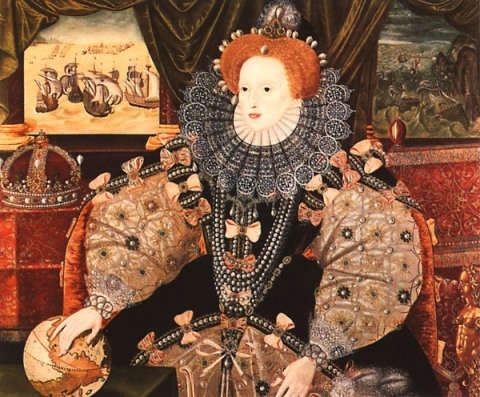
Armada Portrait of Queen Elizabeth the I
The portrait of Mary, Queen of Scots (1542-1587), is another example of the use of pearls by the monarchy, to enhance their personality. In this portrait the Queen is wearing a seed-pearl studded dress. A large number of drop-shaped pearls are suspended from the two arches arising from her shoulders and fixed below her elaborate hairdo. Two smaller arches surrounding the hairdo, and arising from the base of the hairdo to its center above, also carry suspended drop-shaped pearls. The centerpiece of her hairdo also carries three drop-shaped pearls at the center of her forehead.
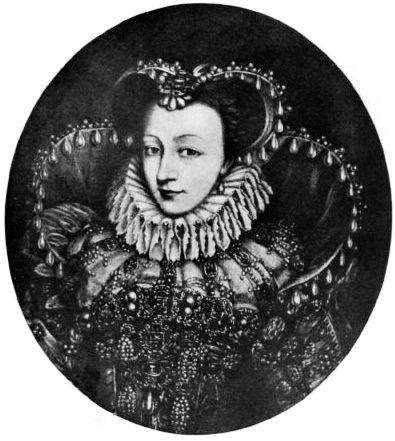
Mary, Queen of Scots
In India jewel-encrusted apparels were worn mainly during the period of rule of the Mughal emperors, reaching a climax during the period of Emperor Shah Jahaan, who was renowned for the pomp and pageantry of his court. In Safavid Iran, Fath Ali Shah was well known for the extraordinary brilliance of his court. The portrait of Fath Ali Shah below show him seated on a jewel-studded carpet, wearing a royal apparel studded with pearls and other jewels on the collar and two zones on the upper arm. He is also wearing a pearl studded belt, and a "Sarpech" on the turban lined with pearls, and four strands of pearls radiating from the "Sarpech" over the turban. Fath Ali Shah wearing jewel-encrusted robes, seated on his jewel-encrusted throne, wearing his famous seed-pearl encrusted crown, created a composite picture of grandiose-ness, surpassed only by a few monarchs in the history of mankind.
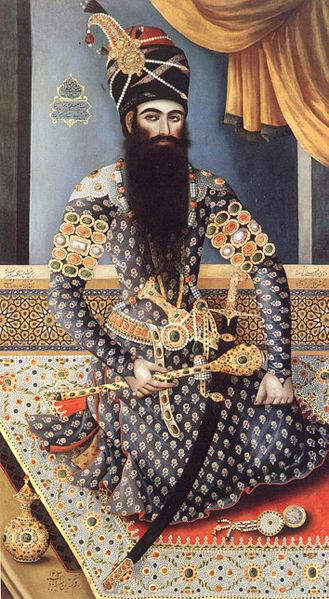
Fath Ali Shah- Safavid Emperor of Iran
What are Swarovski crystals ?
Swarovski crystals were first produced in 1892, after Daniel Swarovski invented a precisio softn electric cutting machine
Swarovski crystals are high-quality Austrian cut-glass crystals that are expertly faceted and polished to produce the finest quality crystals. These high quality crystals were first produced in 1892, by Daniel Swarovski (1862-1956), who invented and patented a precision electric cutting machine, that facilitated the production of lead crystal glass. The quality of the Swarovski crystals produced by Daniel Swarovski's Company, was determined by two important factors : 1) the composition of the lead containing glass. 2) the quality of cutting and polishing.
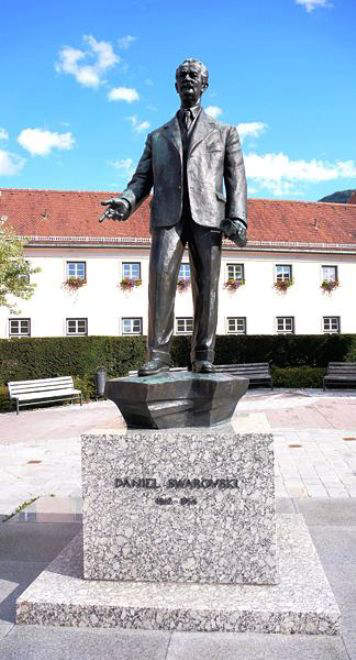
Daniel Swarovski -Founder of Swarovski crystals
The difference between ordinary soft glass and lead-glass
Common soft glass, of which bottles are made is a mixture of sodium and calcium silicates, prepared by heating together sand (silicon dioxide), soda ash (sodium carbonate) and chalk or limestone (calcium carbonate). Some broken glass and coke (carbon) are also added to the mixture before heating. If a small quantity of red lead (trilead tetraoxide) or massicot (lead II oxide) is added to the ordinary glass mixture before heating, the product formed will contain small quantities of lead silicate, apart from sodium silicate and calcium silicate. The presence of lead silicate gives a brilliant appearance to the glass, which is known as lead-glass, and is used in the production of crystal glass.
The difference between Daniel Swarovski's lead-glass and the lead-glass produced by others
Thus, Swarovski rhinestone crystals are made up of lead-glass, that has a brilliance of its own, which is enhanced by faceting and polishing. The difference between Daniel Swarovski's lead-glass and the lead-glass produced by other companies, lie in the composition of the glass, the percentage of sodium, calcium and lead found in the glass. Swarovski crystals are said to be created by a special secret recipe of Daniel Swarovski, that has been jealously guarded by the company for over a 100 years. Today, the company has gone a step further, to create crystals that allow light to refract in a rainbow spectrum, by coating their crystals, with special metallic chemical coatings. One of the most popular coatings is "Aurora Borealis" (AB for short), that gives the surface a rainbow oil slick appearance. Other coatings include "Crystal Transmission," "Volcano," "Aurum," and "Dorado."
The precision cutting machine invented by Daniel Swarovski in the 1890s, allows each brilliant rhinestone crystal more faceted cuts, that can be repeated with exact precision for other rhinestone crystals, giving a uniform product in terms of size and number of facets.
Some styles in which Swarovski rhinestone crystals are produced
Swarovski rhinestone crystals are produced in a variety of styles such as, Swarovski flatback rhinestones (style 2028), Swarovski hot fix rhinestones, Swarovsky round crystal beads (style 5000), Swarovsky bicone beads (style 5301), Swarovsky tear-drop pendants (style 6000), Swarovsky pearls etc.
The use of Swarovski crystals in the entertainment and fashion world and the household
Today the fiery brilliance and sparkle of Swarovski rhinestone crystals have pervaded the entire entertainment and fashion industry. In the entertainment world Swarovski crystals are routinely employed on the stage to enhance the visual effects of laser beams that sparkle as they fall on the dancer's costumes encrusted with these crystals. Michael Jackson's Victory Tour Pearl and Swarovski Crystal Studded Costume Shirt, which is the subject of this webpage is a good example of the use of Swarovski crystals in the entertainment industry.
In the fashion world, Swarovski crystals are used to adorn wedding dresses, head pieces and formal gowns, party dresses, belts, purses, hair ornaments, hats, gloves and shoes, and latest fashion trends show the increase use of these crystal beads in everything from denim to sophisticated and flamboyant outfits. In the fashion industry, apart from couture, Swarovski crystals have also been employed in costume jewelry.
In the household the Swarovski crystal range includes crystal sculptures and miniatures, and home decor and chandeliers. The largest Swarovski crystal chandelier ever made is in the Sultanate of Oman, which is over 3 stories tall and contains over 600,000 crystals.
Swarovski AG's crystal cutting factory in Wattens, Tyrol, Austria, established in 1895, by Daniel Swarovski and his financiers Armand Kosman and Franz Weiz, today employs over 22,500 workers.
A short biography of Bill Whitten, the costume designer who created Michael Jackson's Victory Tour Costume Shirt
His early life
The Michael Jackson Victory Tour, Pearl and Swarovski Crystal Studded, Costume Shirt was designed by the renowned celebrity costume designer, Bill Whitten, who was perhaps the greatest costume designer in the entertainment industry, designing costumes for performers like Michael Jackson, Elton John, Neil Diamond, Lionel Ritchie, Siegfried & Roy, Chicago, Fleatwood Mac and Earth Wind & Fire. Bill Whitten was born on September 4, 1944, in Bessemer, Alabama, to Annie Cunningham Cross Whitten and her husband Mose Whitten. Annie Whitten was a seamstress, from whom the young Bill seems to have derived the inspiration to choose a career in costume designing. His father Mose Whitten was a coal miner, who died when Bill was still a young child. Bill had his education at Carver High School, in Bessemer, Alabama.
His relocation to Los Angeles where he set up a custom shirt business, whose first customer co-incidentally was pop star Neil Diamond, who gave him the much-needed breakthrough
Having opted for a career in fashion designing he eventually moved to Los Angeles, where he set up a custom shirt business called "Workroom 27" in 1974. The tiny shop was located on the second floor of a building on Santa Monica Boulevard in West Hollywood, and was virtually invisible. The shop was opened for six months before the first customer walked through the door. Co-incidentally his fist customer was none other than one of the most enduring and successful pop music performers, Neil Leslie Diamond, a contemporary of the legendary Elvis Presley, who remained his faithful customer throughout his life until his death in 2006. Thus the designing career of Bill Whitten was closely associated with the successful singing career of Neil Diamond. The colorful sequin-adorned shirts worn by Neil Diamond at concerts, were all designed by Bill Whitten. Each of these shirts cost approximately $5,000 each.
The news of Bill Whitten's talents spread from performer to performer like a domino effect, swelling his customer base, and within an year and a half he became one of the most sought after fashion designers.
Neil Diamond not only became, Bill Whitten's lifelong customer and friend, but also helped to spread the word about Bill's talents, setting the stage for a stream of popular performers to find their way to workroom 27. Bill's next customer was Doc Severinsen, who in turn brought the members of the Band Chicago. Then came Jim Brown, who returned with Hugh Hefner. This domino effect swelled his customer base, and within an year and a half, Bill Whitten had established himself as one of the most sought after fashion designers, for the most popular musical performers on stage. Whitten's earnings rose dramatically, and within a short period of time, he became the owner of the entire building, where previously he was able only to rent only a small room.
Bill Whitten's clientele included top-rung performers such as Michael Jackson, Lionel Ritchie, Elton John and Neil Diamond
At the height of his career as the leading fashion designer for the entertainment world, he had a factory that employed 50 people turning out stage clothes for at least 20 groups of performers, such as the Commodores, the Jacksons, Edgar Winter, Steppenwolf and others, as well as the stars on the Redd Foxx and Richard Pryor television shows. Bill Whitten perhaps became the only designer in the entertainment world, whose services became almost indispensable for outfitting the singers and their bands. He was the only designer who could provide a personalized stage style in keeping with the demands and interests of each band or group. Eventually the demand for his services were too great, that he was compelled to scale down his clientele to include only the top-rung performers, such as Michael Jackson, Lionel Ritchie, Elton John, the magicians Siegfried & Roy and of course his old friend and first customer who started everything Neil Diamond. However in spite of his efforts to scale down his business, he accommodated the fashion demands of the wives and friends, of some of his top clients, such as Brenda Ritchie, wife of Lionel Ritchie.
As Michael Jackson's fashion designer, the creation of some unique pieces such as the single rhinestone glove, and rhinestone studded costume shirts shot him into international fame as a fashion designer
The working relationship he established with Michael Jackson, the "King of Pop" as his chief designer, gave him fame and popularity which he richly deserved. Whitten was famous for his hand-beaded clothing, using Swarovski rhinestone crystals. The hand-beaded stage clothes containing Swarovski rhinestones, such as the single rhinestone glove, the rhinestone-studded costume shirts, and jackets, custom-made for Michael Jackson, were all designed by Bill Whitten. Some of the Bill Whitten designs on display at the Michael Jackson Exhibit at the Rock and Roll Hall of Fame and Museum include : Michael Jackson of the Jackson 5 Outfit, designed in 1971, Michael Jackson Jacket designed by Bill Whitten in 1984, and worn by him for the 1984 Grammy Award ceremony, in which he won a record eight Grammy Awards for his album the "Thriller", Michael Jackson Glove designed by Bill Whitten in 1992, and worn by Michael Jackson during performances of Billie Jean on his "Dangerous" tour. Another example of Bill Whitten's classic creations was Elton John's feathered gorilla suit, and boots that lit up with electric lights. "The Rock World is one of the few areas where you can use your fantasy," said Bill Whitten, when asked about this creation. Bill Whitten was responsible for introducing Stevie Wonder in African print caftans, and taking Neil Diamond out of flower embroidered shirts, into bugle beads.
Bill Whitten's talents as costume designer went unrecognized in spite of over three decades contribution to the glamour of the entertainment world
Over the years, Bill Whitten had designed costumes for more Grammy Award Winners than he could count. But, unfortunately the talents of the "King of Costume Designers" Bill Whitten went unrecognized, in spite of the fact, that he had contributed to the glamour of the entertainment world in the field of music, by designing the beaded and spangled stage clothes worn by the performers on the stage, for over three decades. This was because the organizers of the Grammy Awards had never thought it fit to create an award category for costume designing, even though the annual prestigious event has over 60 award categories, which according to Gaile Robinson, a regular contributor to the Los Angeles Times, includes categories as esoteric as album notes. Talking about the Grammy always disturbed Bill Whitten, who was reported to have said once, "I'm just as much a part of the music industry as Michael Jackson."
Bill Whitten enters the competitive couture business in 1990
Following his success as a costume designer for the entertainment world, Bill Whitten decided to enter the competitive couture business, by opening a store called "Bill Whitten" on Melrose Avenue, on March 4, 1990. The store sold everything from pajamas to evening wear for men and women. The broad range of apparel and accessories available at the store, was priced at the high end of the spectrum, starting with T-shirts at $50, and with some of the evening gowns priced as high as $20,000. However, the clothes he sold at the store were meant for normal day to day living, and were not as outlandish as some of his stage costumes.
Bill Whitten died on Saturday, April 8, 2006 in Los Angeles, California.
A short biography of David Gest, to whose collection the Victory Tour Costume Shirt belonged, and who consigned the celebrated shirt to Julien's Auctions Summer Sale
The Jackson brothers become his childhood friends, and he shot into fame as a successful music promoter at the age of 27
David Gest was a successful music producer and promoter who was closely associated with the Jackson brothers, particularly with Michael Jackson, and later became a popular media personality, with prime-time shows on TV, loved by millions of fans for his wacky sense of humor, and mobbed by fans in the street. He also became famous for his marriage to Liza Minelli, the popular Academy Award winning Hollywood actress, which unfortunately ended in divorce, partly blamed on Minneli's persistent alcoholism.
Gest who was born in Los Angeles, California, on May 11, 1953, grew up in Southern California, where the five Jackson brothers became his childhood friends, an association that persists into their adulthood. The phenomenal success of the Jackson brothers as singers, in the 1970s, and the emergence of David Gest as a successful music promoter, seem to have taken place simultaneously. In 1980, at the age of 27, David Gest seemed to have made it to the top, with a luxury Los Angles lifestyle, and a reputation as one of the world's most successful music promoters, with many superstars as friends, that included Michael Jackson, Whitney Houston and Bette Davies. The greatest production in his career was the Michael Jackson tribute concert extravaganza which was acclaimed as the highest rated music special in the history of television.
His psychological problems about his looks and appearances that led to a series of plastic surgeries in 1981
In spite of his success in life as a music promoter, David Gest had deep psychological problems, about his physical looks and appearances, not being able to reconcile himself with what God had gifted him with. Unable to bear the psychological trauma any more, David Gest opted for a series of plastic surgeries in 1981, taking a cue from his close friend Michael Jackson, who had just undergone a successful nose thinning operation. He consulted the same plastic surgeon who operated on Michael Jackson, Dr. Steven Hoefflin, and decided to undergo a complete face lift operation, instead of just a nose straightening. After the operation he spent days at home, with Michael Jackson looking after him. When the healing process was complete and bruises gone, he and his friends felt his looks had improved. In spite of the rumors created by people that he was in and out of the operating room all the time, he had never had a plastic surgery since then, except for a hair transplant in 1990 to cover up his baldness.
His marriage to Liza Minelli in 2001, that eventually ended up in divorce one of the most acrimonious in Hollywood history
David remained unmarried until the year 2001, when he met Liza Minelli, having booked her to sing at Michael Jackson's Madison Square Garden galas in 2001. David was 50 and unmarried and Liza Minelli was 57, and already married thrice and divorced. Six months later, on March 16, 2002, they were married in New York, in a grand ceremony, that included hundreds of celebrity guests, with Michael Jackson as the best-man, and Elizabeth Taylor as the matron-of-honor. Initially, the marriage appeared to be successful, as David Gest himself had said in his autobiography, "I was absolutely in love with her, and our first six months were unbelievable." The singer-actress Liza Minelli also credited her new husband, with driving her to slim down, and go on a brief successful tour. Eventually, after just 16 months of marriage, the couple were divorced. Their divorce became one of the most acrimonious in Hollywood history, but in spite of this, David Gest appears to be very gracious in his comments about her in his autobiography. "She is a very intelligent woman, a brilliant live performer, and has more talent in her little finger than most people have in their entire hand. There's no doubt that she is a legend."I only wish her well now. I hope she finds happiness and that she is one day free of her problem with alcoholism."
His fame as a TV host in the United Kingdom
David Gest shot to fame on TV, after his appearance on the 2006 series of "I'm a Celebrity, Get Me out of Here!" on ITV in the UK. He proved to be popular with his stories and the "Get me outta here song" with fellow contestant Toby Anstis. In January, 2007, Gest signed a one-year contract with ITV, to appear in his own reality series entitled "This is David Gest." The show began in April 2007. During one of his shows he took the cameras for a rare glimpse of the Jackson family house, in Encino, California, where he met Tito and his children, as well as matriarch Katherine Jackson. He was one of the four judges on ITV1's entertainment series "Grease Is The Word." However, before he could complete his contract with ITV, he got a release from the company, and was signed in by Channel 4 to host "The Friday Night Project."
Auction of David Gest's collection of Jackson memorabilia was planned much in advance of Michael Jackson's sudden death on Thursday, June 25, 2009
David Gest's collection of Jackson memorabilia consisted of 21 items related to the career of Jackson 5 and Michael Jackson, that included vintage photos of Jackson from the 1970s, early concert posters, and Jackson-worn costumes. It appears that he was able to put together this collection, during his long period of association with the illustrious family from California, first as a childhood friend of the Jackson brothers, and later as a renowned music producer and promoter. It is not known why David Gest decided to dispose of the memorabilia, but he had consigned the items to Julien's auction house, that specializes in high-profile entertainment auctions, to be included in their summer sales, that was to take place on June 26-27, 2009, on the mezzanine floor of Planet Hollywood Resort & Casino in Las Vegas, which by coincidence turned out to be just one day after Michael Jackson's sudden death by cardiac arrest on Thursday, June 25, 2009. The auction was planned much in advance of Jackson's sudden death, yet the auction house had contemplated pulling the lots after his death, not to give the impression that they were taking advantage of the situation. However, a fan told the auction house, what was needed was celebration of Michael's life, and thus it was decided for the auction to go ahead as scheduled. The 21 items that constituted the Jackson memorabilia, was actually part of a larger auction consisting of 928 items, that also included Elvis Presley, the King of Rock and Roll's collectibles and movie memorabilia and items from Bob Hope, Marilyn Monroe and Anne Miller.
The results of the Julien's Auction House summer sales relevant to the Jackson memorabilia held on June 26 & 27, 2009, on the mezzanine floor of Planet Hollywood Resort & Casino in Las Vegas
List of 21 items of Jackson memorabilia sold at the Julien's auction summer sale held on June 26, 2009, just one day after Michael Jackson's sudden death, giving pre-sale estimates and the actual prices realized at the auction
| S/N | Lot No. | Description of Item |
Pre-sale estimate | Price realized at auction |
| 1 | 315 | An original cardboard promotional display for a 1973 Jackson 5 Mowtown album "Get It Together" | $400 to $600 | $640 |
| 2 | 316 | Copy of Motown Records LP produced to coincide with the Jackson 5's September 1971 "Goin Back to Indiana" prime-time ABC-TV special, signed in black permanent ink by all the Jackson brothers featured on the cover. | $400 to $600 | $34,560 |
| 3 | 317 | Jackson 5 original promotional display | $300 to $500 | $625 |
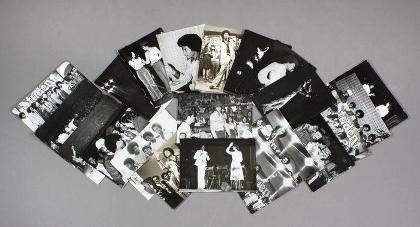
| 4 | 318 | A collection of 39 black and white vintage photographs featuring Jackson 5 at various appearances and concerts during the early 1970s, including their appearance in Philippines in October 1974. | $400 to $600 | $2,048 |
| 5 | 319 | An original concert poster advertising the September 1, 1975, Jackson 5 show in Mount Vernon, New York. | $300 to $500 | $2,000 |
| 6 | 320 | Six vintage photographs of Michael Jackson from the 1970s, including one with boxer Muhammed Ali | $100 to $150 | $2,750 |
| 7 | 321 | A copy of the Jackson's "Triumph" album released in the summer of 1980 signed by Michael Jackson on the inside jacket sleeve | $200 to $300 | $3,437.50 |
| 8 | 322 | The Jackson's Triumph tour concert poster advertising the September 8, 1981 event at Kemper Arena, Kansas City. | $300 to $500 | $2,812.50 |
| 9 | 323 | Victory tour white custom long-sleeve shirt studded with pearls and Swarowski crystals | $1,000 to $1,500 | $52,500 |
| 10 | 324 | Michael Jackson's handwritten letter on a single sheet of paper from the Pan Am in-flight duty free shop, addressed to Greg. | $200 to $300 | $18,750 |
| 11 | 325 | Michael Jackson RIAA platinum record award presented to Steve Manning in appreciation of his contribution in making "Thriller" the biggest album in music history that entered the Guinness Book of World Records. | $300 to $500 | $4,375 |
| 12 | 326 | Art print, signed, featuring four portraits of Michael from various moments in his life, by Brien Stymest | $200 t $300 | $8,000 |
| 13 | 327 | Costume piece and signed CD case from the album "Bad," forearm cuff with six leather straps, worn as part of his "Bad" costume | $600 to $800 | $10,240 |
| 14 | 328 | Single sheet of paper with handwritten lyrics for the 1987 hit song bad | $500 to $700 | $13,440 |
| 15 | 329 | Michael Jackson black leather belt with silver metal buckles and studs signed by him in red paint. | $400 to $600 | $5,937.50 |
| 16 | 330 | Tribute Program Proof, from two concerts held at Madison Square Garden in 2001 | $200 to $300 | $9,375 |
| 17 | 331 | The signature page of a contract between World Events LLC and the Jacksons signed in blue ink, by Michael Jackson and David Gest, and counter signed in black ink by Jackie Jackson, Tito Jackson, Marlon Jackson, Jermaine Jackson, and Randy Jackson, signed June 27, 2001. This is a historic contract that reunited the original Jackson 5, as well as Randy Jackson, for their first performance together in 17 years. | $400 to $600 | $3,750 |
| 18 | 332 | A color laser copy of an Art Deco New York poster signed in black permanent pen by Michael Jackson, Edwin Starr, Beyonce, Michelle and Kelly of Destiny's Child, Gloria Gaynor, Denis Williams, and others. The poster advertises two evening concerts held at New York's Madison Square Garden in 2001 to celebrate the 30th Anniversary of Michael's solo career. | $200 to $300 | $8,320 |
| 19 | 333 | Signed promotional concert poster for September 7, 2001, Madison Square Garden performance, to celebrate the 30th Anniversary of Michael Jackson's solo career. The concert was titled, "Michael Jackson-30th Anniversary Celebration, The Solo Years." | $200 to $300 | $3,520 |
| 20 | 334 | A pencil drawing by Michael Jackson of an adolescent boy in the style of Peter Pan. The drawing shows quite advanced technique and artistry in its representation of the boy, accompanied by a color photograph showing Jackson actively working on the piece, using a polaroid image as the basis of the drawing. | $1,500 to $2,000 | $20,480 |
| 21 | 335 | Original acrylic on cardboard painting by Michael Jackson of the Walt Disney Co. character, Mickey Mouse conducting Pluto singing, his name signed in black and white at the bottom right corner | $1,000 to $1,500 | $25,000 |
| Total proceeds realized by sale of Jackson memorabilia | $9,100 to $13,450 | $232,560.50 |
Some important information that can be gathered from the above table
1) The total pre-sale estimate of the 21 items was between $9,100 and $13,450.
2) Total amount realized for the 21 items at the sale $232,560.50.
3) The total amount realized from the sale is 17 times the upper total pre-sale estimate, and 25 times the lower total pre-sale estimate.
4) The item which fetched the highest price was Lot No. 323, the Victory tour white custom long-sleeved shirt, studded with pearls and Swarovski crystals (the subject of this webpage) that fetched a price of $52,500, which was 35 times the upper estimate for this item.
5)The item that fetched the second highest price was Lot No.316, a copy of the Motown Records LP produced to coincide with the Jackson 5's hour-long "Goin Back to Indiana" prime time ABC-TV special in September of 1971, and signed in black permanent ink by the Jackson brothers, who are featured on the cover of the album. The price realized was $34,560, which was 58 times the upper estimate of $600 for this item.
6) The item that fetched the 3rd highest price was Lot No. 335, Michael Jackson's painting of the Walt Disney character "Mickey Mouse" conducting Pluto singing, that fetched a price of $25,000, which was 17 times its upper estimate of $1,500.
7) Lot Nos. 334 and 335 representing a genuine effort by the superstar towards artistic expression, the pencil sketch of the adolescent boy and the Mickey Mouse, fetched significantly higher prices, than most other items.
8) The tendency for a somewhat lengthy handwritten text, by the legendary singer, such as the lyrics of a song (Lot No.328, lyrics for the 1987 hit song "Bad"), or a personal letter written to a friend (Lot No. 324, handwritten letter on a sheet of paper addressed to Greg), fetching significantly higher prices was greater, than just a mere signature by him. Lot Nos. 324 and 328 fetched $18,750 and $13,440 respectively.
9) Lot Nos. 318 and 320 that consisted of vintage black and white photographs of Jackson 5 and Michael Jackson at various appearances, including the appearance of Jackson 5 at the Philippines in 1974 and Michael Jackson appearing with boxer Muhammad Ali, surprisingly fetched lower prices ($2,048 and $2,750), in spite of their historical value, because of the possibility of the existence of copies of the photographs elsewhere, in someone's photo album or the photo gallery of a museum.
10) Concert posters and promotional displays fetched the lowest prices, the lowest for the 21 items being Lot Nos. 315 and 317, for two promotional displays, that fetched $640 and $625 respectively, almost equal to the upper pre-sale estimate.
11) Only two items did not show the general tendency for an enhanced price realization, fetching almost the same price as the pre-sale estimate. These items were Lot Nos. 315 and 317.
12) The highest amount paid for a poster was Lot No. 332, a color laser copy of an Art Deco New York poster, that fetched $8320.
13) Personal effects such as the custom-made long-sleeved shirt (Lot No. 323) the leather belt (Lot No. 329) and forearm cuff with six leather straps (Lot No. 327) realized significantly higher prices.
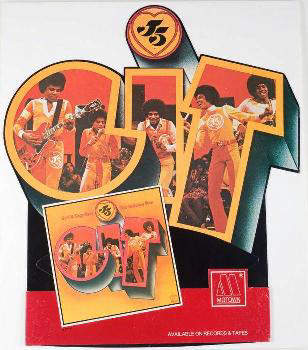
Lot No:315: Jackson 5- Original promotional display-1973 Motown album "Get It Together.
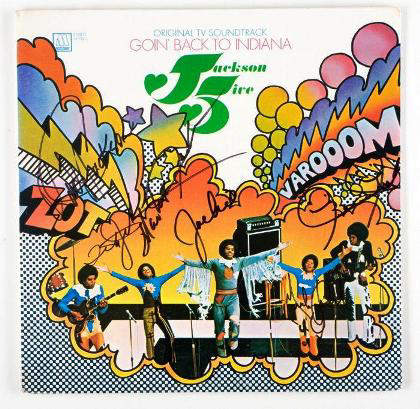
Lot No:316 Copy of Motown Records signed LP album "Goin Back to Indiana"
©Julien's Auctions
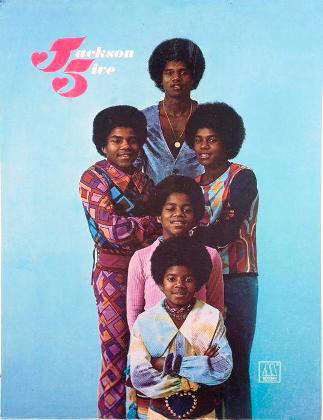
Lot No:317- Jackson 5 Original Promotional Display
©Julien's Auctions
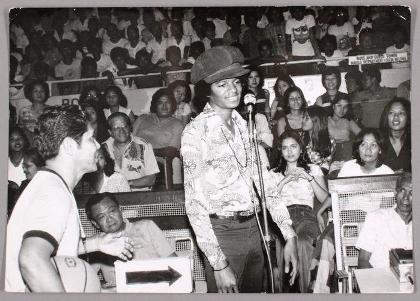
Lot No: 318: 39 vintage black and white photographs of the Jackson 5
©Julien's Auctions
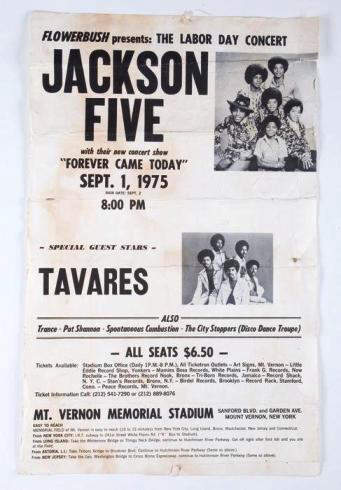
Lot No: 319: Jackson 5 early concert poster 1975
©Julien's Auctions
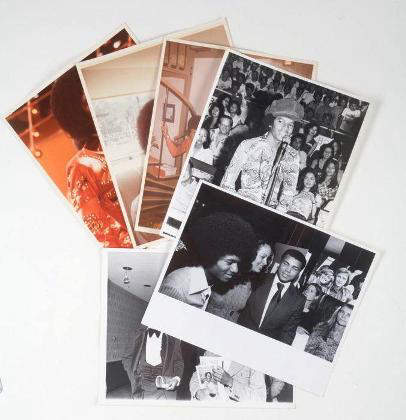
Lot 320: A group of six vintage photos featuring Michael Jackson
©Julien's Auctions
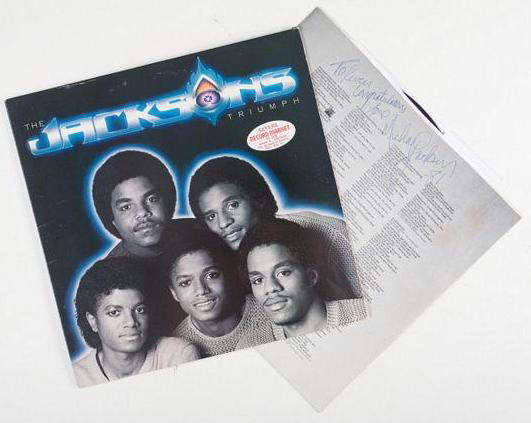
Lot 321: Copy of Michael Jackson signed "Triumph" album
©Julien's Auctions
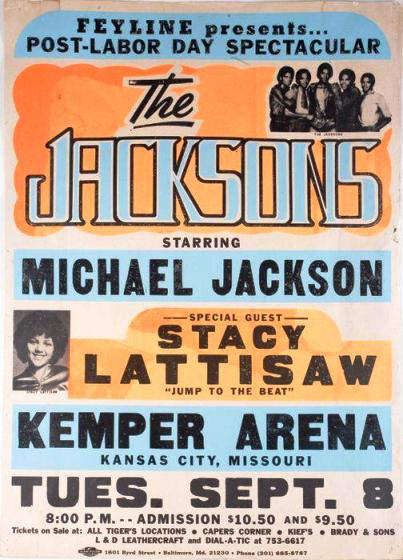
Lot No 322:The Jackson's Triumph tour concert poster- 1981
©Julien's Auctions
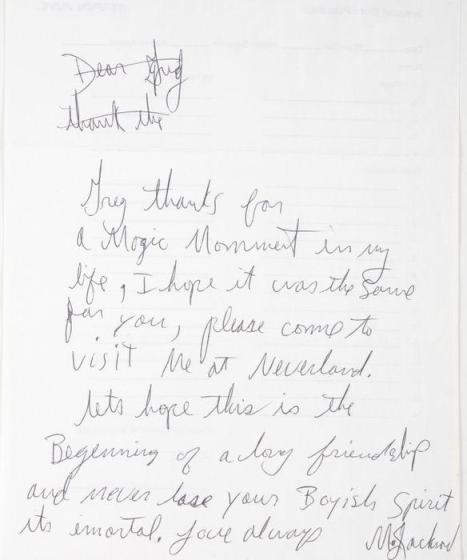
Lot No. 324: Michael Jacksons hand written letter
©Julien's Auctions
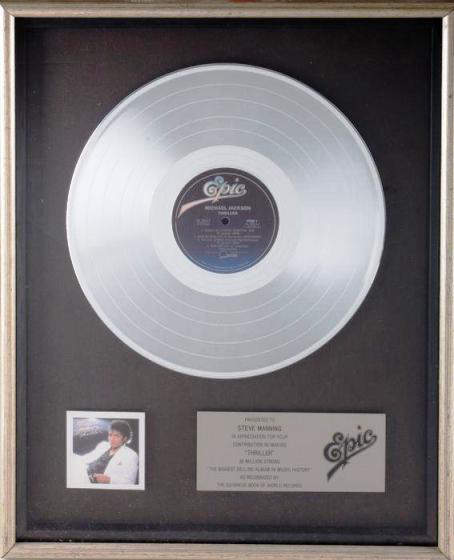
Lot No. 325: Michael Jackson RIAA Record Award
©Julien's Auctions
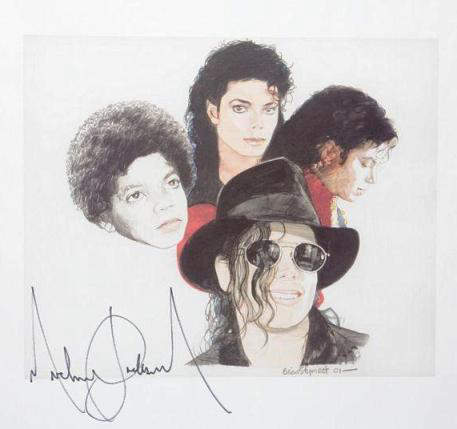
Lot No. 326: Michael Jackson Signed Art Print
©Julien's Auctions
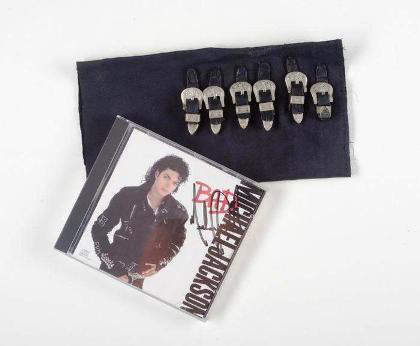
Lot No. 327: Michael Jackson Bad costume piece and signed CD
©Julien's Auctions
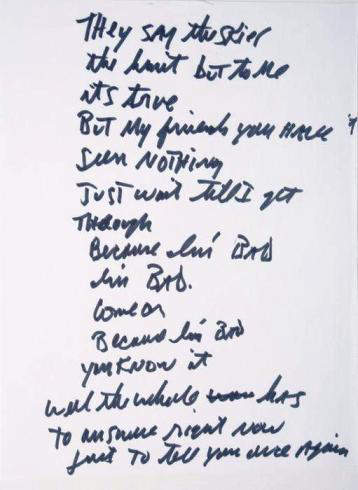
Lot No. 328: Michael Jackson hand written Bad lyrics
©Julien's Auctions
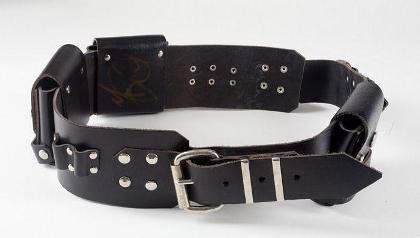
Lot No. 329: Michael Jackson signed belt
©Julien's Auctions
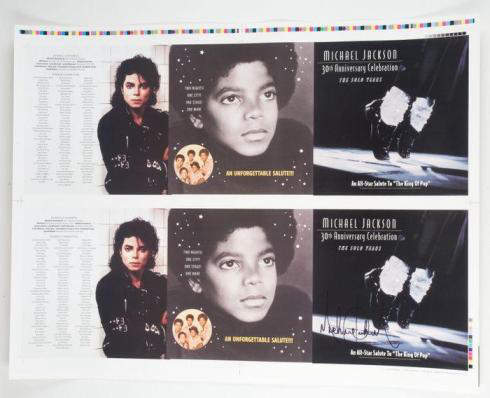
Lot No. 330: Michael Jackson signed tribute program proof
©Julien's Auctions
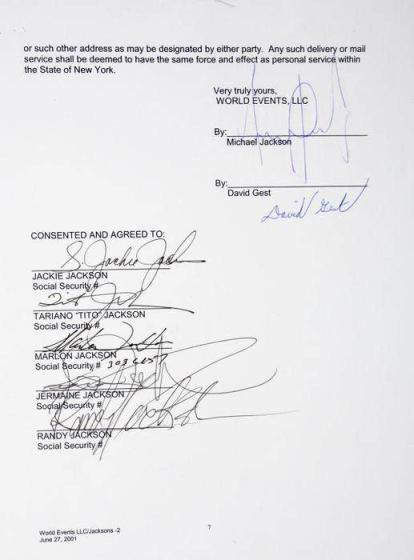
Lot No.331: Jackson contract signature page
©Julien's Auctions
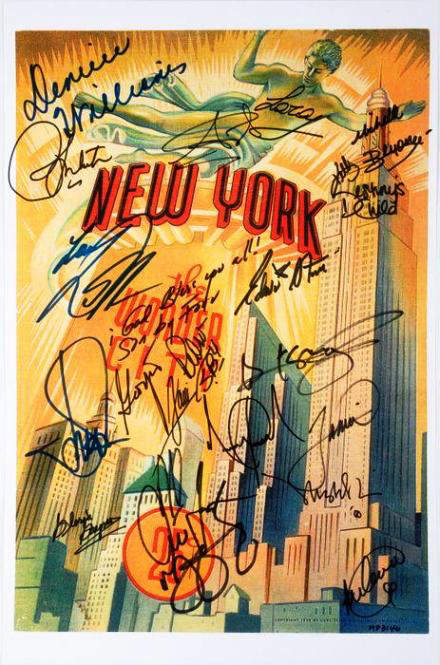
Lot No.332: Michael Jackson Signed Poster
©Julien's Auctions
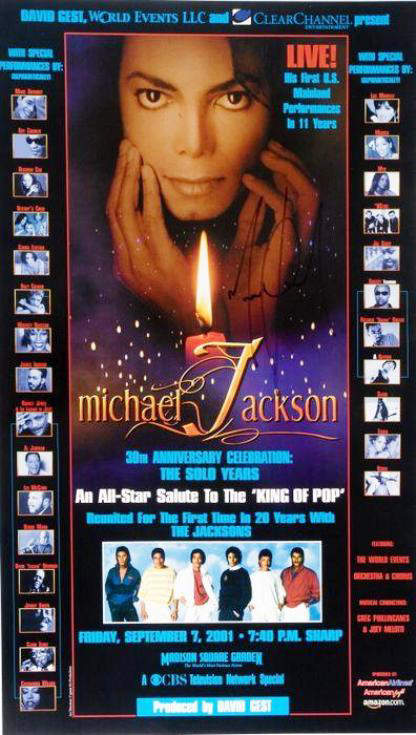
Lot No. 333: Michael Jackson signed concert poster
©Julien's Auctions
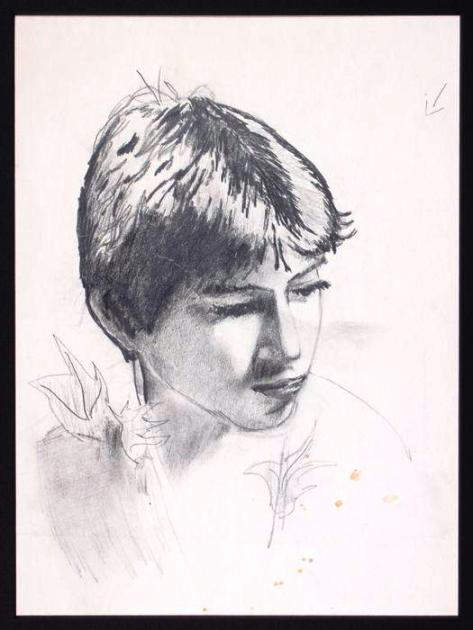
Lot No. 334: Michael Jackson original drawing of a boy in the style of Peter Pan
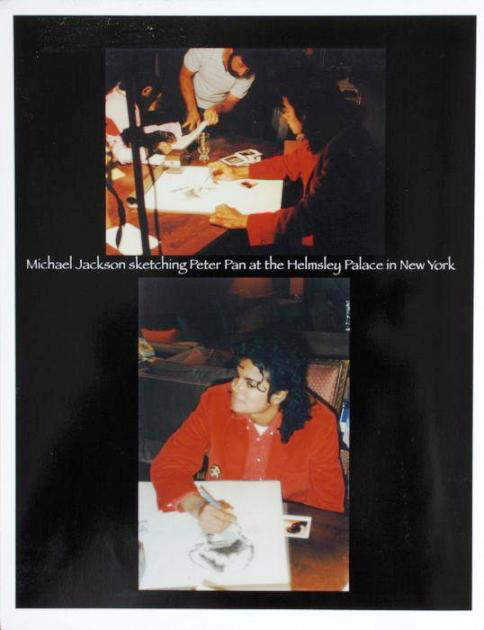
©Julien's Auctions
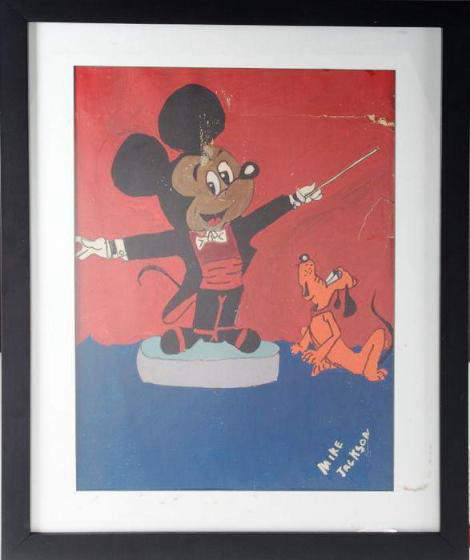
Lot No.335: Michael Jackson Original Painting of Mickey Mouse
©Julien's Auctions
An explanation for the enhanced prices realized at the auction of Jackson memorabilia
The phenomenal enhancement of prices recorded at the auction of Michael Jackson memorabilia, held just one day after his sudden death, showing an average 17 times increase over the pre-sale estimates, was undoubtedly caused by the sudden demise of the legendary singer, "the King of Pop" and the heart throb of the younger generation, who had a truly international following, that transcended all national boundaries. The whole world seemed to come to a standstill with the news of his sudden demise, that jammed some of the servers of the world wide web, caused by desperate fans trying to gather information on the fate of their hero, silently praying that the news may not be true. The whole world respected him as the master singer and entertainer to have ever set foot on this planet, and were prepared to forgive him for any failings in his personal life. After all he too was human despite the fact that he attained the status of a demigod. The worldwide audience that followed his funeral proceedings, broadcast live on TV was estimated to be over one billion, reminiscent of the funeral of the people's princess, Diana, the Princess of Wales, held over a decade ago in September 1997, which also attracted a similar worldwide audience. The great demand for his memorabilia after his death, was responsible for the sharp increase in the prices realized at the auction. This was a clear indication of the great respect and reverence in which he was held by the people of the world. By owning something that was associated with the life of the great singer, the people were actually trying to perpetuate and keep alive his memory, and the moments of happiness he imparted into their lives by his sensational singing, dance and music. They were prepared to pay any price to gain the ownership of his memorabilia.
Michael Jackson's Victory Tour Pearl and Swarovski Crystal Studded Costume Shirt sold for a record price of $52,500
Michael Jackson's Victory tour, white, long-sleeved shirt, studded with pearls and Swarovski crystals, designed by Bill Whitten, fetched a record price of $52,500, at the auctions, which was 35 times the upper presale estimate of $1,500. The price realized was the highest for the 21 items of Jackson memorabilia that came under the hammer, and gives a clear indication of the potential of other similar items from the Jackson memorabilia yet to come up for auction.
Another planned auction of Jackson memorabilia by Julien's Auction House that was to be held from April 22 to 25, 2009, two months before the singer's death, was suspended after Michael Jackson's own intervention
In September 2008, in the face of continuing financial difficulties, Michael Jackson, accepted a suggestion by his adviser, to agree to an auction of his enormous collection of memorabilia numbering over 2,000 items, preserved in the Neverland Ranch. Michael Jackson has been an enthusiastic and avid collector of everything from exquisite antiques to prized entertainment and popular culture memorabilia. Over the years Neverland had become an awe inspiring wonderland, containing larger-than-life statutes of superheroes, such as batman, a custom-made horse-drawn carriage, antique automobile replicas, 19th-century paintings and sculpture, exquisite furniture and fine art, renowned international awards, and Michael Jackson's iconic concert costumes. Having obtained Michael's consent for the sale, his advisers invited representatives of Julien's Auction House, the leading auction house in Los Angeles dealing with celebrity memorabilia, to Neverland Ranch, to prepare an inventory of the collection, and carry the items to their offices, in order to make preparations for the auction. The auction house prepared five separate catalogues for the auction, which was scheduled to take place in Beverly Hills, form April 22 to 25, both days inclusive. Prior to the auction, Julien's Auction House organized "The Michael Jackson Public Exhibition" at the Beverly Hilton Hotel in Los Angeles, where most of the items in the memorabilia was exhibited. The auction house estimated an overall turnover of around $12 million from the sales, which could have provided some relief to the financially hard pressed pop icon.
However, long before the auction could take place, around the end of March 2009, Michael Jackson seem to have had second thoughts about auctioning his Neverland memorabilia. The change of heart seem to have taken place, particularly after the prospects of his financial situation improving, following the proposed 50-date concert, a major comeback concert titled "This Is It " to be held in London's O2 Arena, from July 13, 2009 to March 6, 2010. A total of over one million people were expected to attend the series of concerts, the first major series since the HIStory World Tour concluded in 1997. The concerts were expected to be one of the most important musical events for the year 2009, and perhaps his last before his final retirement, his "final curtain call" to use his own words.
Michael Jackson's lawyers requested the auction house Julien's auction, to cancel the auction and return the collection of memorabilia to Michael Jackson, as the "King of Pop" was planning to house them in a museum for the sake of posterity. However, Michael Jackson had signed a legal contract with the auction house for the disposal of the items, and accordingly Julien's auctions decided to go ahead with the auctions. Jackson now claimed that he never authorized the sale, and that he was conned and lied to by Darren Julien. Michael Jackson's lawyers filed a lawsuit against Julien's Auction to stop the auction, but Los Angeles Superior Court Judge Brett Klein ruled in favor of Julien's Auctions, effectively preventing Michael Jackson from claiming his personal property. Julien's Auctions claimed to have already spent $2 million in organizing the sale. A second motion and hearing before a different Superior Court Judge, was fixed for April 15, before the auction dates of April 22 to 25. However, before the second hearing could take place, lawyers from both parties had come to an out-of-court settlement, under which Michael Jackson was given possession of all his approximately 2,000 personal items, thus effectively canceling the auction. The terms of the settlement were not publicized. Thus, the Michael Jackson's memorabilia never went under the hammer, and has now become part of his estate, whose future will be decided by the courts.
Michael Jackson's Sequin Glove sold at a Bonhams and Goodman auction in Australia for a record sum of 57,600 Australian Dollars (USD 48,400)
Another Michael Jackson memorabilia, a white sequin glove that was tossed by the legendary singer to an Australian fan more than a decade ago, was sold at a Bonhams and Goodman auction at Melbourne, Australia, on Sunday, September 5, 2009 for a record sum of 57,600 Australian Dollars, equivalent to $48,400. The pre-sale estimate of the glove was AU$30,000. Thus the price realized was almost double the presale estimated value, and was consistent with the prices realized for other Jackson memorabilia, that went under the hammer elsewhere in the world.
Jackson visited Australia in 1996 as part of his HIStory world tour. During his stay in Australia, he visited Sydney, where he attended the Australian Premier for the film "Ghosts" in which he had a starring role. At the end of the screening he tossed the single glove he was wearing at the audience, and a lucky Jackson fan by the name of Bill Hibble, picked it up, and became its proud owner. Bill Hibble had since died, and his heirs who inherited the glove put it up for auction, after the successful auction of some Jackson memorabilia, immediately after his death on June 25, 2009, that fetched highly enhanced prices.
According to the auction house Bonhams & Goodman, this was the first time a Michael Jackson glove, a hallmark of the legendary singer, came up for auction, since his sudden death on June 25, 2009. The buyer of this historic piece of Jackson memorabilia was Warwick Stone, an agent for the Hard Rock Hotel and Casino in Las Vegas, who vied successfully with five other bidders for this historic piece.
Another Michael Jackson shirt worn by him in 1971 for live performances and publicity photos sold for $9,440, by an online auction website icollector.com on October 9, 2009
Another Michael Jackson stage-worn Boyd Clopton design stylized cherry blossom floral shirt from 1971, was sold on line for $9,440 on October 9, 2009, by the online auction website, icollector.com, specializing on the online sale of collectibles, memorabilia, antique. coins, art etc. The shirt was worn by Michael Jackson for various live performances and publicity photos in 1971. A significant occasion in which he was seen wearing the shirt, was Diana Ross' first solo TV Special, the 1971 ABC-TV Special called "Diana," aired on April 18, while performing the song "The Love You Save On." Michael Jackson wearing this shirt, can also be seen gracing he cover of the 1971 Picture Sleeve single for Mama's Pearl, which reached No. 2 on the U.S. charts, and the Jackson 5 Anthology CD.
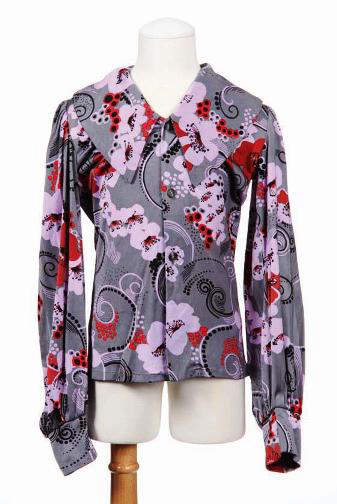
Michael Jackson stage-worn Boyd Clopton design stylized cherry blossom floral shirt from 1971
© iCollector Technologies Inc.
Michael Jackson's Victory Tour white lighted glove sold for staggering $66,000 on October 19, 2009, at the "Profiles in History" auction in Calabasas, Los Angeles
Michael Jackson's Victory Tour white glove fitted with 50 tiny light bulbs powered by a 9-volt battery in the cuff and wired on separate circuits, making them twinkle at random, and emblazoned with shining bugle beads and Swarovski crystal rhinestones, was sold for a staggering $66,000 equivalent to£44,000, at the "Profiles in History" auction in Calabasas, Los Angeles, held on October 12, 2009, that also featured other Jackson memorabilia, and items from the King of Rock and Roll, Elvis Presely, as well as a huge array of props and costumes from film sets. This was the second Jackson glove to go under the hammer, after the one sold in Australia, on September 5, 2009, for $48,400, showing the continuing trend in demand for memorabilia of the iconic and legendary singer.
The glove was one of two designed by Ted Shell for the superstar in 1984, for his successful Victory Tour of the United States and Canada, the last by the reunited Jackson brothers. Ted Shell was part of the technical team that accompanied the Jackson brothers on the 55-date tour, whose specific task was the maintenance of the complicated glove. After the end of the tour, Jackson gave one of the gloves to Ted Shell, and retained the other. It is not known whether the glove that went under the hammer, was the one presented to Ted Shell or the one that was retained by the singer. Profiles in History president Joe Maddalena commented :"Michael Jackson was the undisputed King of Pop, and this glove, used at the zenith of his career, is the most symbolic piece of his on-stage legacy."
Other Jackson memorabilia that was sold at the auction included a red V-necked jumper encrusted with deep-red rhinestones, and white Fedora hat, worn by Jackson at the 1981 American Music Awards, that sold for $44,250; a yellow tie & dye shirt worn by the young 13-year old Michael, as he sang "I'll be there" on the first episode of Diana Ross' own TV show in 1971 on ABC-TV, that sold for $16,500. .
Michael Jackson's Victory Tour of 1984, during which he wore the Pearl and Swarovski Crystal Studded Long-Sleeved Costume Shirt
The Victory Tour of 1984 was the biggest and final concert tour by the reunited Jackson brothers
Michael Jackson's Victory Tour of 1984, at the age of 26 years represented a major landmark in his colorful career and was also the biggest and final concert tour of the United States and Canada by the reunited Jackson brothers. It was the last time Michael, Tito, Germaine, Marlon and Randy performed together. It was during the last show of this tour held at the Dodger Stadium in Los Angeles, Michael announced his final split from the Jackson brothers, and his intention to go solo thereafter.
The Victory Tour was named after the newly released Jacksons' album "Victory"
The Victory Tour was named after the newly released Jackson's album "Victory" but surprisingly none of the songs from this album was on the tour's set list of 15 songs. Songs included in the set list were from the Jacksons' albums "Destiny" and "Triumph," Michael Jackson's albums "Off the Wall" and "Thriller" and songs from Michael's and Jermaine's solo careers.
The Victory Tour consisted of 47 concerts in the United States and 8 concerts in Canada
The tour that included the major cities of the United States and Canada, began in Kansas City, Arrowhead Stadium, on July 6, 1984 and ended in the Dodger Stadium, Los Angeles, on December 9, 1984. The tour consisted of 55 concerts held in 16 cities across the United States and 3 cities in Canada. 47 concerts were held in the United States. The cities in the United States where the concert was held were : Kansas City, Missouri (3 concerts) Dallas, Texas (3 concerts), Jackonsville, Florida (3 concerts), New York City/East Rutherford, New Jersey (3 concerts), New York City, New York (2 concerts), Knoxville, Tennessee (3 Concerts), Detroit, Michigan (3 concerts), Buffalo, New York (2 concerts), Philadelphia, Pennsylvania (4 concerts), Denver, Colorado (2 concerts), Washington D.C. (2 concerts), Chicago, Illinois (3 concerts), Cleveland, Ohio (2 concerts), Atlanta, Georgia (2 concerts), Miami, Florida (2 concerts), Houston, Texas (2 concerts), Los Angeles, California (6 concerts).
Cities in Canada, where the concert was held were : Montreal. Quebec (2 concerts) Toronto, Ontario (3 concerts), Vancouver, British Columbia (3 concerts). The number of concerts held in Canada were 8. Thus, the total number of concerts of the Victory Tour held in the United States and Canada were 47 + 8 = 55.
Total attendance and total earnings generated by the tour
The total attendance at the 56 concerts, held in the United States and Canada were approximately 2 million. The total earnings generated by the tour was $75 million, the largest ever earnings recorded for a musical entertainment tour.
Controversy over the mode of selling tickets for the Victory Tour
A controversy arose with the way tickets were sold for the concert, that required the block purchase of four tickets, costing $30 each. with a limit of one block per address, and payment to be made with US Post Office money order. This effectively shut out the poorer fans who could not afford to find $120 to purchase tickets for the show. Because of the heavy demand for tickets, most of the post offices ran short of money orders, and some fans were not able to buy tickets even though they had purchased the money orders. Michael Jackson was totally opposed to this method of selling tickets, but was perhaps overruled by his brothers. Then, just one day before the scheduled start of the tour, on July 6, 1984, at the Kansas City Arrowhead Stadium, Michael Jackson received a letter from an 11-year old fan Ladonna Jones in which she accused the Jacksons and the promoters of being "selfish and just out for money." Immediately after receiving the letter Michael Jackson held a major press conference to announce changes in the tour's organization, the mode of selling tickets, and most importantly to announce that his entire share of the proceeds from the tour will be donated to charity. Subsequently, Jones was given VIP treatment, at the concert held in Dallas, Texas, on July 13, 1984.
Michael Jackson decides to donate his entire share of approximately $5 million to charity
Michael Jackson received approximately $5 million as his share of the proceeds, which he donated to three charities, that included the T. J. Martell Foundation for Leukemia and Cancer Research, The United Negro College Fund, and the Ronald McDonald Camp for Good Times."For me, that was what the "Victory Tour" was all about - giving back!" said Michael Jackson. His actions clearly manifested his philanthropic and humanitarian traits, unprecedented in the history of the entertainment industry. traits that prevailed throughout his life, and helped to raise millions of dollars to support 39 charities and his own "Heal the World Foundation."
An analysis of his unprecedented philanthropic and humanitarian gesture
However, let us for a moment reflect on his unprecedented humanitarian gesture to donate $5 million for charity soon after the end of the successful "Victory Tour." Placed in a similar situation and assuming that the resources were available, how many of us would agree to emulate Michael Jackson's worthy example? The simple answer to this question is "none." Who would dare to part with $5 million with no guarantee of recouping this money in the future? But, the fact that Michael Jackson did it in 1984, when he was just 26 years old, and was about to embark on a solo career, shows the level of confidence he had in himself that he could generate much more than that in his future career. He had total confidence in his own potentials and capabilities and it was with this same confidence that he finally decided to embark on his last 50-dates tour, christened "This Is It" at the London O2 Arena, that was to commence in July 2009 and end in March 2010, but never materialized due to his untimely death, three weeks before the tour was due to commence, at the age of 50 years, on June 25, 2009.
The success and popularity of the show helped Pepsi-Cola, the sponsors of the show to boost their sales over their arch-rivals Cocal-Cola
The Victory Tour was sponsored by Pepsi Cola, and thanks to Michael Jackson and his brothers, after the successful Victory Tour, Pepsi-Cola were able to overtake their arch-rivals Coca-Cola for the first time. This was a clear indication of the success and popularity of the show.
Some other interesting facts about the Victory Tour
There are other interesting facts concerning the successful Victory Tour. Some of these facts are :-
Jermaine, the third of the Jackson brothers, was reunited with his other brothers on stage for the first time in 8 years. Jackie Jackson was the only brother not able to participate in the tour due to a knee injury, but joined his brothers on stage, during the final show at Dodgers Stadium in Los Angeles, after making a full recovery. Michael invented four new dance moves for the tour - Moonwalk, Magic Moonwalk, Sidewalk and Forward Moonwalk. Michael announced his split from the Jacksons at the final show at the Dodgers Stadium in Los Angeles, during the last song of the performance "Shake your body - down to the ground" His speech announcing the split was unexpected by the Jackson brothers and all those in the audience. It was said that there was a plan to extend the Victory Tour as a World tour, but Michael Jackson's exit from the group scuttled the plans for such a tour.
Michael Jackson - King of Pop - A short biography
His birth and family background
Michael Jackson, one of the most commercially successful and influential entertainers the world had ever known, was born on August 29, 1958, in Gary, Indiana, to an African-American working class family. He was the seventh of nine children, six boys and three girls, born to Joseph Walter Jackson and Catherine Esther Scruse. His five brothers were Jackie (May14, 1951), Tito (October 15, 1953), Germaine (December 11, 1954), Marlon (March 12, 1957) and Randy (October 29, 1961) and his three sisters Rebbie (May 29, 1950), La Toya (May 29, 1956), and Janet (May 16,1966). Rebbie Jackson was the eldest of the nine children, and Janet Jackson, the youngest. Joseph Jackson was a talented guitarist but took up a permanent job as a steel mill worker in order to provide for his family, while performing part-time with an R & B band called the "Falcons."
Joseph Jackson deserves full credit for his singular contribution in discovering the hidden talents of his children which he brought out to the full by rigorous training and discipline
Thanks to Joseph Jackson's training as a musician, he was able to discover the hidden musical talents of his young children, and realize their potentialities and capabilities if they worked together as a group. Thus, while pursuing his permanent job as a steel worker, Joseph Jackson provided his children with all the incentives and encouragement necessary to pursue a career in music and entertainment. At first the three elder children Tito, Jermaine and Jackie were given instrument and vocal training, and by the early 1960s, he had molded them into a musical group known as the "Jackson Brothers." In 1964, Michael and Marlon joined the "Jackson Brothers" as back-up musicians playing congas and tambourine. Michael was then only six years old. From musician, Michael was chosen for back-up vocals and dancing, and in 1966, at the age of eight, Michael joined his brother Germaine as a lead vocal, and the name of the group was changed to "The Jackson 5." Joseph Jackson assumed the role of the group's manager, and was active behind the scenes pushing his sons towards success. His enthusiasm as the father and founder of the group was so great, that he forced his children to spend endless hours rehearsing and polishing up their act, sometimes being very harsh on them for mistakes committed. Michael too was at the receiving end of his father's harsh treatment, such as whippings and name calling, yet Michael attributed his phenomenal success to the training and discipline he received from his father, calling him a "genius" in a television interview, broadcast in February 1993. Thus, in spite of all the allegations about physically and emotionally abusing his children, Joseph Jackson deserves the singular credit for not only discovering the hidden talents of his children, but also developing these talents by rigorous training and discipline, under his guidance, until they were brought to fruition, and particularly bringing out the vocal and dancing talents of his most gifted son Michael Jackson, and thereby gifting to the world of music and entertainment a worthy son, the like of which may not set foot on this world for many more years to come. In this context Joseph Jackson's violent behavior towards his children can only be seen as an overenthusiastic reaction of a devoted father in developing his children's inborn talents and thereby shaping their future destinies.
"The Jackson 5" are signed to the Motown label in 1968
"The Jackson 5" toured the Midwest extensively between 1966 and 1968, performing at black night clubs, and recorded several songs including "Big Boy" for the local record label Steeltown in 1967, but these initial attempts failed to generate much interest. They then moved on to working an opening act for R&B artists like Gladys Knight, James Brown and Sam & Dave, performers who were already signed to the famous Motown record label. It was Gladys Knight who introduced "The Jackson 5" to Motown founder Berry Gordy, who impressed by their performance signed them to the Motown label in 1968, a major breakthrough for the Jackson brothers.
"The Jackson 5" relocate to Los Angeles, California, where they produced their first album that hit the Billboard charts in January 1970. sMichael Jackson emerge as the group's lead vocalist.
Immediately after this "The Jackson 5" relocated to Los Angeles, California, where they were initially hosted by Berry Gordy and Supremes singer Diana Ross until they were able to find alternative accommodation. The group started work in earnest trying to improve on their music and dancing techniques, with their father still as manager. Later in August 1969, "The Jackson Five" were first introduced to the music industry, at a special event held in Los Angeles. Diana Ross then used the group's services for the opening act of the Supremes. Subsequently, "The Jackson Five" produced their first album, appropriately titled "Diana Ross Presents the Jackson 5" which hit the charts in December 1969. The group's first single "I Want You Back" hit No. 1 on the Billboard Hot 100 chart in January 1970, followed by other singles that peaked at No. 1, such as "ABC," "The Love You Save" and "I'll Be There." Michael Jackson now emerged as the group's lead vocalist, whose voice showed remarkable depth and range, with the ability to convey complex emotions, in spite of his relatively young age. Rolling Stone magazine described young Michael as "a prodigy with overwhelming musical gifts, who quickly emerged as the lead singer and main draw of the group."
Michael Jackson embarks on a solo career in 1971 at the age of 13. Breaking of the partnership with Motown in 1975.
In 1971, at the age of 13, Michael embarked on a solo career, while still continuing to work as an active member of the group. In 1971, his single "Got to Be There" from the album of the same name made to the top of the charts. In 1972, his second solo album "Ben" hit the charts, becoming Michael's first solo No.1 single. Since the release of their first album in December 1969, "The Jackson Five" maintained a busy tour and recording schedule, under the supervision of Berry Gordy, who also wrote most of the songs recorded by the group, and by Michael Jackson as a solo artist. However, the partnership of the group with the Motown label was placed under increased strain, due to the refusal of the company to give them more creative control over their recordings. Tensions also arose between Berry Gordy and Joseph Jackson, the manager of the group, over the same issue, that led to the final breakup with Motown in 1975. Only Jermaine Jackson decided to remain with Motown and pursue a solo career.
Tours both local and foreign undertaken by "The Jackson Five"
"The Jackson 5" since their relocation to California after signing a contract with Motown label, maintained a busy tour and recording schedule. They undertook their First National Tour on October 9, 1970, visiting several cities across the United States, such as Boston, Cincinnati, Tennessee and New York City, and returning to their home city Indiana on January 31, 1971, for the first time since moving to California in 1968. In the summer of 1971, "The Jackson Five" embarked on their Second National Tour, holding 40 concerts across cities in the United States, that included Milwaukee, Philadelphia, and New York City, and ending in Honolulu on September 12, 1971. Again in late 1971, they toured the U.S. performing in 50 cities.
They embarked on their First International Tour in October 1972, holding concerts in Munich, Germany and Paris, France. In Britain they performed in 4 cities, that included Liverpool, where they broke the Liverpool Empire attendance records previously held by the Beatles. They also performed the Royal Command Performance in the presence of the Queen Mother. The 1973 tours of "The Jackson 5" included two foreign tours, one to Japan between April 22 and May 3, 1973, and the other to Australia and New Zealand, from late June 1973 to early July 1973. The gaps January to April, May to June and late July to early September of 1973, were filled with local tours of cities in the U.S. The tours of 1974 also included four foreign tours, one to Africa for one week starting from January 29, 1974; a second to Europe in May 1974; a third to South America from September 4, 1974 to October 1, 1974, that included concerts in Panama, Venezuela and Brazil; and the fourth to the Far East from October 7, 1974, to November 1, 1974, that included concerts in Hong Kong, Japan, Australia and the Philippines. The gaps in between the foreign tours were filled with local tours. In January of 1975, "The Jackson 5" embarked on a tour of the West Indies and again in mid-February, 1975, toured Britain, which was their last tour under the name "The Jackson 5."
"The Jackson 5" renamed as "The Jacksons" release their "Destiny" album towards the end of 1978, and undertake a national and international tour in 1979 to promote the album.
After the breakup with Motown, "The Jackson 5" renamed themselves as "The Jacksons" and signed a new contract with CBS Records in June 1975, joining the Philadelphia International Records Division, that later became Epic Records. During the period 1976 to 1984, "The Jacksons" produced three important albums, "Destiny" in 1978, "Triumph" in 1981 and "Victory" in 1984. Michael Jackson pursuing his solo career further released two solo albums, "Off the Wall" in 1979 and "Thriller" in 1982. With the album "Destiny" the Jackson brothers emerged as talented song writers, with Michael Jackson assuming the role as the lead songwriter. Soon after the release of the "Destiny" album, "The Jacksons" undertook a world tour to promote the album, starting on January 22, 1979, with their opening concert being held in Bremen, Germany. Other countries visited on this tour included Britain, Holland, France and Kenya. After the end of the international tour, "The Jacksons" undertook a tour of US cities to promote the album, that began on April 14, 1979, in Cleveland, Ohio and ended after visiting 80 US cities, in Washington D.C.
Michael Jackson's solo album "Off the Wall" released in 1979 sold over 20 million copies, and earned the Pop star several awards in 1980, that included the American Music Awards, the Billboard Music Awards and the Grammy Awards.
In 1978, Michael Jackson teamed up with music director Quincy Jones to produce his next solo album, "Off the Wall" for which songs were written by Stevie Wonder, Paul McCartney, Rod Temperton and Michael Jackson himself. "Off the Wall" released in 1979, became the first album to generate four U.S. top 10 hits, that included the singles "Don't Stop 'til You Get Enough" and "Rock With You" that topped the charts. The album sold over 20 million copies worldwide, and at the American Music Awards held in 1980, Michael Jackson received three awards for the album :- Favorite Soul/R&B Album, Favorite Male Soul/R&B Artist, and Favorite Soul/R&B Single, for "Don't Stop 'til You Get Enough." Further recognition came in the same year when Michael Jackson won the award for the "Top Black Artist" and "Top Black Album" at the Billboard Music Awards, and a Grammy Award for the Best Male R&B Vocal Performance, also for the single "Don't Stop 'til You Get Enough." By the year 1980, Michael Jackson's popularity had soared so high, that he secured the highest royalty rate in the music industry, 37% of the wholesale album profit.
"The Jacksons" next album "Triumph" was released in 1980, and was promoted by a national tour of 39 US cities
"The Jacksons" released their next album "Triumph" in 1980, and the sale of the album was to some extent boosted by the tremendous success recorded by Michael's own solo album "Off the Wall," released in 1979. However, "The Jacksons" undertook an extensive national tour in 1981, that covered 39 US cities for the promotion of their album. The Triumph Tour of 1981, began in Memphis, Tennessee and ended in Los Angeles. The concert held at Madison Square Garden was attended by Katherine Hepburn, a close friend of Michael Jackson. The album sold more than one million copies.
Michael Jackson's "Thriller" released in 1982 achieved the rare distinction as the largest selling album worldwide in the history of the recording industry
Michael Jackson's next significant contribution was in 1982, when he sang "Someone in the Dark" for the film "Extra-Terrestrial" (E.T.), and the record won a Grammy Award for the "Best Album for Children." In the same year Michael Jackson released his next solo album "Thriller" which became the most commercially successful album of all time, entering the Guinness Book of World Records as the "Biggest Selling Album of All Time." The "Thriller" album was and still currently remains, the best-selling album of all time, with 110 million copies sold worldwide. Apart from achieving the rare distinction as the largest selling album worldwide in the history of the recording industry, "Thriller" remained in the top 10 of the Billboard 200 for 80 consecutive weeks, out of which 37 was at the peak position. "Thriller" also became the first album to have 7 top 10 singles in the Billboard Hot 100. "Thriller" also achieved "Double Diamond" status in the US, after being certified for 28 million shipments, by the Recording Industry Association of America. Thriller earned 12 Grammy Award nominations, and won eight of those awards. Unlike later albums, "Thriller" achieved its distinction without an official tour to promote it. According to biographer Taraborelli, "Thriller" started selling like a household staple, and not anymore like a leisure item. Referring to Michael Jackson's popularity at that time as the undisputed "King of Pop" the New York Times wrote that, "In the world of pop music, there is Michael Jackson and there is everybody else." The Time magazine described his influence at that time as "A one-man rescue team for the music business."
Michael Jackson's Motown 25 performance of 1983 lip-syncing to his pre-recorded voice was the origin of the modern music video
Michael Jackson's live performance on the Motown 25 "Yesterday, Today, Forever" television special on March 25, 1983, was watched by 47 million viewers, during which Michael wearing a distinctive sequined glove debuted his signature dance move, "the moonwalk." The performance according to Ian Inglis, marked a turning point in the history of popular music, in which there was a shift of emphasis from musical performance to visual presentation. Jackson's Motown 25 performance, in which he performed to a pre-recorded soundtrack, lip-syncing to his multi-layered pre-recorded voice, started the visual re-enactment of music video imagery. The music video originated from Jackson's Motown 25 performance, and became the primary source through which artists promote popular music.
Michael Jackson suffers an accident leading to second-degree burns to his scalp on January 27, 1984.
On January 27, 1984, while Michael Jackson and his brothers were filming a Pepsi Cola commercial in the presence of executive Philip Dusenberry, at the Shrine Auditorium in Los Angeles, in front of a full house of fans, the pyrotechnics used during a simulated concert, accidentally set fire to Jackson's hair, leading to second-degree burns to his scalp. Jackson underwent treatment to hide the scars, and Pepsi gave $1.5 million as compensation for his injuries, which the superstar promptly donated to the Brotman Medical Center in Culver City, California, demonstrating his philanthropic and humanitarian traits, that subsequently was manifested to the full during his career as the world's greatest entertainer. Brotman Medical Center has named its burn center as "Michael Jackson Burn Center" in honor of his donation.
Jackson receives the greatest recognition of his career, a special award from President Ronald Reagan
Jackson's greatest recognition came on May 14, 1984, when he was invited to the White House to receive a special award from President Ronald Reagan, one of his ardent fans, for his support of charities in general and particularly those that helped people overcome alcohol and drug abuse. The event represented one of the greatest highlights of his career.
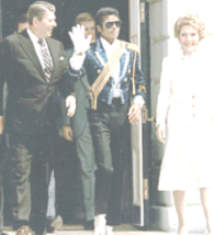
Michael Jackson at the White House with President Ronald Reagan and First Lady Nancy Reagn
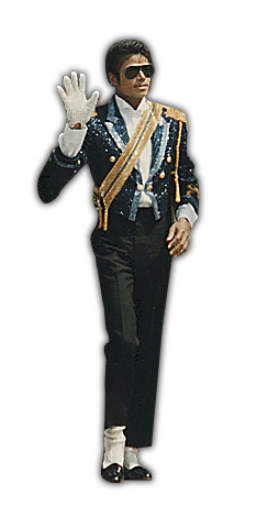
Michael Jackson at the White House with his signature white glove
The Victory Tour of 1984, that promoted the album of the same name was the last tour in which the Jackson brothers appeared together.
"The Jacksons" Victory album was released in 1984, and Michael Jackson embarked on his final tour with his brothers to support the album. The tour of U.S.A. and Canada from July 6, 1984 to December 9, 1984, included 55 concerts, attended by over 2 million people and grossing $75 million. Even though the tour was meant to promote the Victory album, none of the songs in the set list came from this album. Jackson donated his share of $5 million to three charities.
Michael Jackson co-wrote the charity single "We Are the World" in 1985, that generated millions of dollars for famine relief in Africa
In 1985, Michael's concern for humanitarian causes was brought to the fore again, when he co-wrote the charity single "We Are the World" with Lionel Ritchie, which was released worldwide to aid the poor in the U.S. and Africa. Apart from Michael Jackson, other prominent music stars who participated in the project, included Lionel Ritchie, Ray Charles, Bob Dylan, Willie Nelson, Bruce Springsteen and Tina Turner. The charity single became one of the best selling singles of all time, selling 20 million copies, and millions of dollars donated to famine relief in Africa.
Jackson purchases Beatles music catalogue in 1985 for $47.5 million
In 1985, ATV Music, a publishing company that owned the copyrights for the Beatles catalogue, that included the Lenon/McCartney compositions, put it up for sale. Two of the contenders who were interested in purchasing the rights to the catalogue were Michael Jackson and Paul McCartney. McCartney later withdrew his bid, and Michael Jackson eventually purchased the catalogue for $47.5 million.
Michael Jackson releases "Bad" album in 1987, followed by a record-breaking, 16-months, world-wide solo tour to promote the album
In 1987, five years after his record-breaking "Thriller" album, Michael Jackson released his next album "Bad," which was highly anticipated, both by the industry and his fans, after the long interval. Michael Jackson undertook his first solo tour to promote this album. The "Bad Tour" began in Japan, with 14 sell out concerts at the Korakuen Stadium, Yokohama, on September 12, 1987. The U.S.A. leg of the "Bad Tour" began in Kansas City, with two sell out concerts in Kemper Arena. The European leg of the tour started with two concerts at Flaminio Stadium, Rome, while in London, 7 sell out concerts in the Wembley Stadium, with an attendance of 504,000 people was a new record for the venue. The final show of the "Bad Tour" which was the 123rd, took place in Los Angeles, on January 24, 1989, at the Sports Arena. The 123 concerts of the "Bad Tour" held during a period of 16 months, attracted an audience of 4.4 million people, grossing over $125 million, which was a new record for a solo tour, and entered the Guinness Book of World Records. His altruistic tendencies were again demonstrated during this tour, when he invited underprivileged children to watch for free, and gave donations to hospitals, orphanages and other charities. In spite of the impressive records created by the "Bad Tour" the Bad album itself had lower sales than "Thriller" but was still considered a substantial commercial success. The album had sold 30 million copies worldwide by the year 2008. The album had 7 hit singles in the U.S., five of which reached No.1 on the Billboard Hot 100 charts.
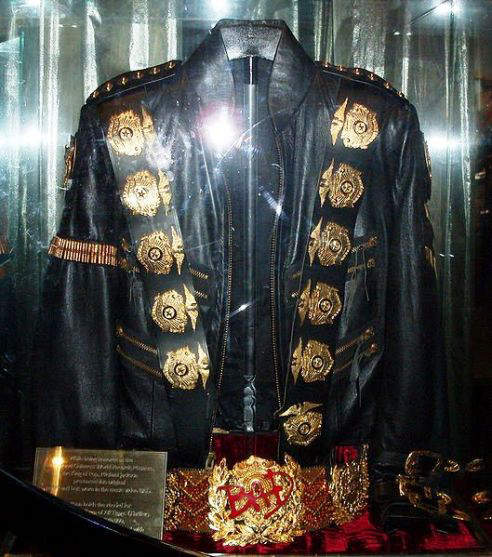
Michael Jackson's original Jacket and Belt worn in the music video "Bad". The jacket and belt are emblazoned with 12 pounds of 24-karat gold and crystal decorations.
Michael Jackson releases his autobiography in 1988, and writes about the rhinoplastic surgeries he had undergone
Michael Jackson wrote his autobiography titled "Moonwalk" which took four years to complete and was released in 1988. The book sold 200,000 copies, reaching the top position on The New York Times best sellers list. In his book he dealt with his childhood, The Jackson 5 and the abuse he had suffered as a child. Writing about his facial appearance he said he had two rhinoplastic surgeries, following an injury to his nose in 1979, during a complex dance routine. The first rhinoplastic surgery was not so successful, leading to breathing difficulties. A second rhinoplastic surgery was performed by Dr. Steven Hoefflin that provided relief. He also had a dimple created in his chin by plastic surgery. Writing about the change in the structure of his face, he attributed it to several causes, such as puberty, weight loss, a strict vegetarian diet, a change in hair style, and overexposure to stage lighting. However, several surgeons speculated that he had undergone multiple nasal surgeries, a forehead lift, thinned lips and cheekbone surgery.
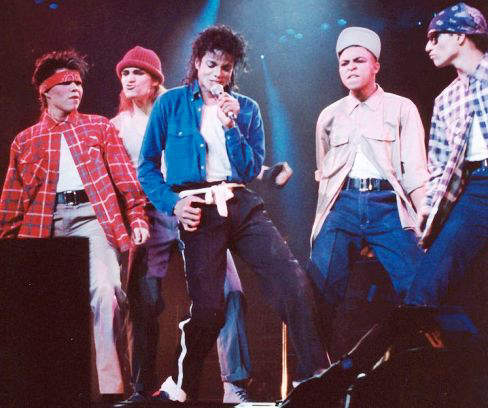
Michael Jackson performing the song-The way you make me feel- in 1988
Michael does not talk about the change in tone of his skin in his autobiography, but Taraborelli's biography attributed it to two rare diseases, Vitiligo and Lupus, which was confirmed by his dermatologist after his death
Even though Michael does not talk about the change in tone of his skin since the mid-1980s in his autobiography, Taraborelli's biography published in 1986, attributed the condition to two rare diseases, Vitiligo and Lupus, that Michael was diagnosed to be suffering from. Both illnesses made his skin sensitive to light. The treatment he received for the condition further lightened his skin tone.This was confirmed by his Dermatologist Dr. Arnold Klein on "Larry King Live" after his death. His tendency to wear gloves for his shows, usually a single glove, was to camouflage his skin condition, "Vitiligo," which normally appeared first on the hands, before spreading to the entire body. This was confirmed by his clothing designer Bill Whitten, when Cicely Tyson saw Bill Whitten working on a glove and questioned him about its purpose. Michael himself confirmed that he suffered from the rare skin condition known as "Vitiligo" that affects about 1% of the World's population, in his 90-minute television interview with Oprah Winfrey, in February 1993, that was watched by an American audience of 90 million. This interview laid to rest the speculations created by the press, that he was bleaching his skin, and raised awareness among the public, of the relatively unknown condition known as "Vitiligo."
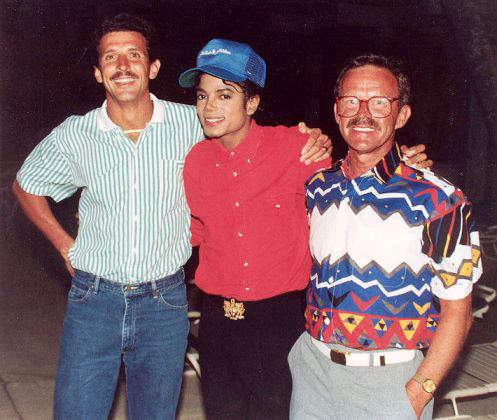
Michael Jackson with two of his fans at the Kahala Hilton Hotel in late January 1988 two years after he was diagnosed with vitiligo
Jackson purchases a 2,700-acre property in California, which he converts to the Neverland Ranch
In March 1988 Jackson purchased a 2,700-acre (11 km²)property near Santa Ynez, in central California's wine counry, for $17 million, which he converted to a ranch, he christened Neverland Ranch, after Peter Pan's magical island whose youthful inhabitants never grow up. On this ranch he created his own fantasy retreat. He built a menagerie on a section of the ranch, where he kept exotic pets, including the chimpanzee named "Bubbles." He also installed his own amusement rides, including Ferris Wheels, and also built a movie theatre on the ranch. The buildings in the ranch housed his exquisite collection of antiques, antique automobile replicas, 19th-century paintings and sculpture, exquisite collection of furniture and fine art, his concert costumes including crystal gloves, a unique peacock brooch known as the "Moonwalker Peacock Brooch," international rewards received by the world renowned artist, a custom-made horse-drawn carriage, and his unique collection of larger-than-life models of superheroes such as Batman, Superman, life-size replica of Star Wars Robot R2-D2 from Lucasfilm Ltd., Star Wars Racer, and a plastic model of E.T. Other life-size replicas included
He employed a large security staff of around 40 personnel to patrol the extensive ranch. Sometimes he opened up the ranch for children's events. In the year 2003, the value of the extensive property was estimated to be around $100 million.
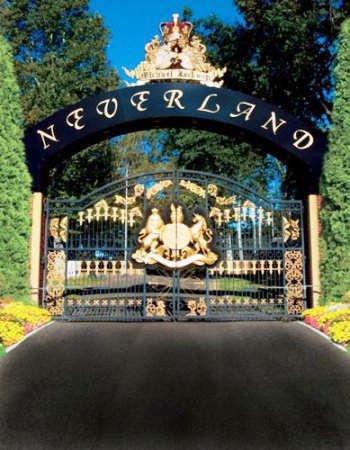
Neverland Ranch Gates
©Julien's Auctions
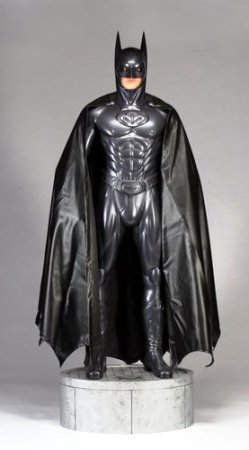
Batman Statue from the Neverland Ranch Collection
©Julien's Auctions
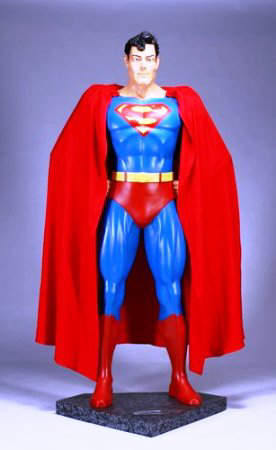
Superman Statue from the Neverland Ranch Collection
©Julien's Auctions
Moonwalker Peacock Brooch from the Neverland Ranch Collection
©Julien's Auctions
R2 D2 Star Wars Robot- Life size model from the Neverland Ranch Collection
©Julien's Auctions
Elizabeth Taylor proclaims Michael Jackson "The True King of Pop, Rock and Soul."
In the year 1989, Michael Jackson's annual earnings was estimated at $125 million, generated from album sales, endorsements and concerts. The level of income generated was unprecedented in the history of the entertainment industry, earning Michael Jackson the nickname "King of Pop" which was popularized by Elizabeth Taylor, who proclaimed him "The True King of Pop, Rock and Soul" while presenting him with the "Soul Train Heritage Award" in 1989.
Jackson's "Dangerous" World Tour that not only popularized the "Dangerous" album, but also helped to generate funds for his newly formed charity organization, "Heal the World."
The year 1991 marked two significant events in Jackson's life, the renewal of his contract with Sony Entertainments for a record-breaking $65 million and the release of his eighth album "Dangerous." The "Dangerous" album was also a substantial commercial success, selling 32 million copies worldwide as of 2008. The album's first single "Black or White" was a big hit in the United States, reaching No.1 on the Billboard Hot 100 charts, and remaining there for seven weeks. The album's second single "Remember the Time" peaked at No.3 on the Billboard Hot 100 singles chart. The single "Heal the World" from the album, became the biggest hit in the UK and Europe, selling 450,000 copies in the UK, and spending five weeks at No.2, in 1992.
In 1992, Jackson founded the charity organization "Heal the World Foundation" whose main objective was to help children around the World, who were affected by war and disease. In the United States, the organization gave underprivileged children a chance to visit Jackson's Neverland Ranch, to enjoy the theme park rides installed in the ranch. Jackson then embarked on his "Dangerous" international tour, that lasted 17 months from June 27, 1992 to November 11, 1993,serving a dual purpose of not only popularizing his latest album "Dangerous" but also helping to generate funds for his newly established charity organization "Heal the World Foundation." The tour began in the Olympic Stadium, Munich, Germany, on June 27, 1992, at which Michael performed 18 numbers, 4 from the Dangerous album, to a sell out crowd of 72,000. The second-leg of the tour that began in August 1993, ended with 5 sold-out concerts in Mexico City, attracting an audience of 500,000. The latter part of the tour was cancelled due to sickness. The tour consisted of 67 concerts, attracting 3.5 million people, and all income generated from the concerts went to the "Heal the World Foundation" The broadcast rights for the "Dangerous" world tour, was sold to HBO for $20 million. Jackson once again demonstrated his humanitarian and philanthropic qualities during this tour, as he had done previously with his "Victory" and "Bad" tours, by donating all income generated from the tour to a worthy charitable organization, that benefited children around the world.
Jackson's first marriage to Lisa Marie Presley
Jackson married Lisa Marie Presley, singer and songwriter and the daughter of the legendary Elvis Presley, the "King of Rock & Roll" in May 1994. Jackson was 36 at the time of his marriage. Jackson had first met Lisa at a function in 1975 at the MGM Grand Hotel and Casino, and their acquaintance was renewed in 1993, through a mutual friend. Michael and Lisa remained in constant contact over the telephone. This was a difficult period in Jackson's life, following child molestation charges brought against the singer, sequel to a complaint made by a Dentist, Evan Chandler, that Jackson sexually abused his 13-year old son, Jordan Chandler. It later transpired that Evan Chandler was more interested in Jackson's money than the welfare of his son, Jordan Chandler, as revealed by a secret tape recording in which Evan discusses his intention to pursue charges. Jordan's mother was insistent that there was no wrongdoing on Jackson's part, at the official investigation. Other children who had visited the ranch, and family members came out strongly in favor of Michael, and denied that he had any pedophilic tendencies. Even Lisa Presley said, "I believe he didn't do anything wrong, and that he was wrongly accused." Lisa gave Michael all the emotional support that was needed during the most difficult period of his life, that caused a lot of emotional stress and addiction to drugs. It was Lisa who persuaded Michael to go in for a settlement out of court with Evan Chandler, to save the mental agony to which he had been subjected to. Eventually the two of them were so close to each other, that it was only a matter of time before, Michael proposed to Lisa and she accepted. The marriage took place in secrecy in the Dominican Republic, and secrecy was maintained for two months afterwards. The marriage unfortunately did not last long and they were divorced less than two years later, but remaining friendly thereafter.
Lisa Marie Presley- Jackson's first wife
The release of the HIStory album in 1995, followed by the HIStory tour in 1996
1995 saw two significant events in Michael's life, the merger of his ATV Music catalogue with Sony, creating the Sony/ATV Music Publishing, in which he retained 50% ownership, and the release of the double album "HIStory, Past, Present and Future." The first disc, "HIStory Begins" was a 15-track greatest hits album, and the second disc "HIStory Continues" contained 15 new songs. The album became the best-selling multiple-disc album of all-time, selling 20 million copies worldwide. Two singles released from the album, "Scream" a duet with Jackson's youngest sister Janet and "You Are Not Alone" debuted at No.5 and No.1 respectively on the Billboard Hot 100 Chart. "Scream" received a Grammy nomination for "Best Pop Collaboration with Vocals" and "You Are Not Alone" entered the Guinness Book of World Records, for the "First Song Ever to Debut at No.1," and receiving a Grammy nomination for "Best Pop Vocal Performance." Overall "HIStory" received a Grammy nomination for "Best Album." Another single released from "HIStory" "Earth Song" not only topped the UK singles chart for six weeks, but also sold a million copies, making it the most popular Jackson single in the UK.
Jackson's "HIStory" World tour to promote the sale of the album, began on September 7, 1996 and ended on October 15, 1997. The first-leg of the tour, began in Prague in the Czech Republic on September 7, 1996 and ended in Honolulu, Hawaii, at Aloha Stadium on January 4, 1997. The second-leg of the tour began in Bremen, Germany, on May 31, 1997 and ended in Durban, South Africa, on October 15, 1997. The "HIStory" tour was the most successful of all Jackson tours, that visited 35 countries spread across all 5 continents of the world, that included 82 concerts in 58 cities, attracting an audience of 4.5 million, the highest ever audience figures recorded for a Jackson's tour.
Michael's second marriage to dermatology nurse Deborah Jeanne Rowe, who gave him his first two children, a son and a daughter
Apart from the artistic and commercial success of the "HIStory" tour, another significant event that took place during the first-leg of the tour in Australia, in November 1996, was Michael's change of civil status from single to married again. This time Michael married dermatology nurse Deborah Jeanne Rowe on November 14, 1996, at a ceremony held in Sydney. Jackson met Rowe in the mid-1980s, after he was diagnosed with Vitiligo, and Rowe provided nursing care and emotional support to Michael Jackson. The two became close friends, which eventually ended up in romance. Rowe became pregnant while they were still unmarried, and Jackson's mother persuaded them to formalize their relationship. Rowe gave birth to two of Jackson's children, a son and a daughter. He named his son Michael Joseph Jr. (Prince) that combined both his name and his father's name. Thus in naming his son he honored his father, that clearly showed his love and respect for him, in spite of allegations of child abuse he directed towards him. His daughter was named Paris-Michael Catherine, honoring his mother Catherine Esther Scruse. This marriage too ended in divorce in 1999, and Rowe gave full custody of the children to Michael.
Jackson's efforts in mid-1997 to raise funds for several charities such as the "War Child," the Red Cross, the UNESCO and the "Nelson Mandela Children's Fund."
In 1997, Jackson released a remix album, "HIStory in the remix" that incorporated remixes of hit singles from HIStory, and five new songs. The album turned out to be the best selling remix album ever released, selling 6 million copies worldwide by the year 2007. The album did very well in the UK, reaching the No.1 position, but in the US, the album reached only No.24.
In mid-1999, as had been his most distinguishing character as an entertainer, Michael Jackson was involved in an effort to raise funds for several charities, such as the "War Child," Nelson Mandela's Children's Fund, the Red Cross and the UNESCO. At first he joined hands with Luciano Pavarotti, organizing a concert in benefit of the Non-Governmental Organization "War Child" held in Modena, Italy, that realized a million dollars for the refugees of Kosovo and the children of Guatemala. Later he teamed up with other famous artists from around the world to organize a series of benefit concerts in Germany and South Korea, presented by "Michael Jackson & Friends." The proceeds of these concerts went to the "Nelson Mandela Children's Fund, the Red Cross and the UNESCO. Among the other artists who joined hands with Michael Jackson for this project were Slash, The Scorpions, Boyz II Men, Luther Vandross, Mariah Carey, A. R. Rahman, Prabhu Deva. Shobana Chandrakumar, Andrea Bocelli and Luciano Pavarotti.
The release of his last album "Invincible" in October 2001, preceded by a special 30th-Anniversary Concert at Madison Square Garden, to mark Michael's 30th year as solo artist, that brought together all Jackson brothers for the first time since 1984
Jackson released his first album in six years, "Invincible" in October 2001, that also fatefully turned out to be his last album containing new songs, before he died in 2009. However, before the album could be released a dispute broke out between Jackson and his record label, Sony Music Entertainment, characterized as a conflict of interests, that led to Jackson breaking off the partnership with Sony, leading to the cancellation of all single releases, video shootings and promotions, concerning the "Invincible" album. The release of the album was preceded by a special 30th-Anniversary Celebration, to mark Michael's 30th year as a solo artist, that was held at the Madison Square Garden in September 2001, and brought all Jackson brothers together for the first time since the Victory Tour of 1984. The show also featured several other prominent artists, such as Whitney Houston, Luther Vandross, Monica, Slash and others. During the Nation's hour of need, soon after the September 11, 2001, attacks on the World Trade Center, Jackson helped to mobilize dozens of artists, in organizing the "United We Stand" benefit concert at the RFK Stadium in Washington D.C. at which the finale was Jackson's performance of his song "What More Can I Give."
In spite of the uncertain conditions created by the dispute with Sony, "Invincible" was released on schedule in October 2001. The album proved to be a hit in many countries, reaching the top of the charts in 13 countries, and selling 13 million copies worlwide. The significant drop in sales compared to previous Michael Jackson releases, was attributed to several causes, such as lack of promotion, absence of a supporting World tour, the label dispute and a bad time for the music industry in general
Jackson's third child from a surrogate mother, Prince Michael Jackson II, sees the light of day in 2002
Jackson's third child Prince Michael Jackson II, nicknamed "Blanket," was born to a surrogate mother in the year 2002. The mother's identity was not revealed, but Jackson had said that the child was the result of artificial insemination of an unidentified surrogate mother, with his own sperm cells. In November of 2002, Jackson was severely criticized for bringing his new-born son Prince Michael Jackson II, to the balcony of his room, at Adlon Hotel, in Berlin, Germany, holding him in his right arm, and briefly extending him over the railing, four stories above ground level, in response to requests by fans down below, who wanted to see his child. Jackson later apologized for the incident, saying that he was only doing something out of innocence, just to satisfy the curiosity of his fans.
Jackson is cleared of all charges in his second child molestation trial, and temporarily relocates to Bahrain in the Persian Gulf.
In the year 2003, a series of interviews given by Michael Jackson to the British journalist Martin Bashir, titled "Living with Michael Jackson" was aired over TV channels in the US and other countries. During these interviews he strongly drove home the point that his love of children and their relationship with them, was a natural brotherly or fatherly love, that had no sexual connotations. His opening of the Neverland Ranch, and its amusement rides to underprivileged children clearly demonstrated his love and concern for children, a love that was denied to him by an overenthusiastic father, who concentrated his efforts in bringing out the hidden talents of his children. Macaulay Culkin who testified in favor of Michael Jackson, at his second child molestation trial in 2005, confirmed Jackson's healthy relationship with innocent kids. Macaulay said that he had been friends with Jackson as a young teen, and had stayed over at Neverland Ranch on many occasions, but Jackson never tried to molest him. Michael was eventually cleared of all child molestation charges leveled against him, after his trial that lasted from January 31, 2005 to June 13, 2005, a trial that was more of a media circus, with fans, detractors and camera crews surrounding the courthouse. The two-year period between the filing of charges and the trial, was a period of extreme stress and pain-of-mind for Michael Jackson, who became increasingly dependant on drugs like Pethidine, and resulted in loss of weight. After the trial, Jackson stayed at Neverland only for a short time, and then moved to Bahrain in the Persian Gulf, as a guest of his friend Sheik Abdulla, a son of the Emir of Bahrain.
Jackson returns to the US towards the end of year 2006, after the death of James Brown
Jackson stayed in Bahrain until the end of 2006. On November 15, 2006, Jackson was presented the Diamond Award at the World Music Awards for selling over 100 million albums. He returned to the US after the death of James Brown and paid tribute to Brown during his public funeral on December 30, 2006. After returning to the US, Jackson agreed to share joint custody of his first two children with ex-wife Debbie Rowe. The 25th anniversary of the "Thriller" album, the largest selling album worldwide in the history of the recording industry, was marked in the year 2007, by the release of the album "Thriller 25" recorded in Ireland, featuring previously unreleased song "For All Time" and other re-mixes. In three months "Thriller 25" sold more than 3 million copies worldwide. In the year 2008, Sony BMG released a series of compilation albums called "King of Pop" to celebrate Michael Jackson's 50th birthday.
Jackson's financial problems that led to the ownership of the Neverland Ranch being transferred to Sycamore Valley Ranch Company.
Since the year 2006, Jackson appeared to be facing serious financial problems, despite his publishing partnership with Sony that brought him $75 million a year. The main house at Neverland Ranch was closed apparently as a cost-cutting measure. One of the main causes of his financial woes was a $270 million loan secured from the Bank of America, against his music publishing holdings. After delayed repayments on the loan, a refinancing package shifted the loans from the Bank of America, to debt specialists Fortress Investments, with Neverland Ranch as collateral. After the repayment of the debt was further delayed, Fortress Investments, threatened to foreclose on Neverland Ranch. However, subsequently Fortress sold Jackson's debts to Colony Capital LLC. In November 2007 Jackson transferred the title to Neverland Ranch to Sycamore Valley Ranch Company LLC, a joint venture between Jackson and Colony Capital LLC. The deal cleared Jackson's debt, and helped him to earn an extra $35 million from the venture. Jackson held a stake in the Neverland/Sycamore Valley, even at the time of his death.
The sale of Jackson memorabilia that was later cancelled by Jackson''s intervention, due to the prospect of his financial situation improving after the London "This Is It Tour."
In September 2008, continuing financial problems caused Jackson to enter into negotiations with Julien's Auction House, to display and sell by auction a large collection of memorabilia numbering over 2000 items, from his Neverland Ranch. The auction was to take place between April 22 to 25, 2009, and an exhibition of the lots opened at 9900 Wilshire Blvd on April 14, 2009. However, the auction was eventually cancelled after a court case, and out of court settlement. The reason for the cancellation of the sale was undoubtedly the prospect of Jackson's financial situation improving, following his decision to hold a 50 dates major comeback concert at the London's O2 Arena, christened the "This Is It Tour," commencing on July 13, 2009 and ending on March 6, 2010, the "final curtain call" as Jackson himself described it, suggesting possible retirement after the shows. The auction memorabilia that were spared from the auction hammer, were eventually to be housed in a Museum, and preserved for posterity, for the future generations.
Jackson rehearsed as the London tour approached, but the cruel hand of fate struck, on Thursday June 25, 2009
Jackson rehearsed in Los Angeles, as the tour approached under the direction of choreographer/director Kenny Ortega. The show was undoubtedly going to be a major come back for Michael Jackson, eagerly anticipated by his multitude of fans around the world, as indicated by the ticket sales, which were completely sold out for all concerts. But, unfortunately less than 3 weeks before the first show was to take place in London, the cruel hand of fate struck and the "King of Pop" was no more. Michael Jackson breathed his last after a cardiac arrest, on Thursday, June 25, 2009.
Events that followed the untimely death of the legendary singer
The last moments of the legendary singer as revealed at the inquest
According to witnesses who were at the Staples Center where Jackson rehearsed for his "This Is It Tour" the singer appeared to be in great shape at the time he arrived for rehearsals at the center the previous day, Wednesday, June 24, around 6.30 p.m. in the evening. However he actually began rehearsing only at 9.00 p.m. as he was complaining of an attack of laryngitis, and the rehearsals continued well past midnight. At the inquest, Jackson's personal physician Dr. Conrad Murray, a cardiologist, stated that he spent the night on Wednesday, June 24, at Jackson's rented mansion at 100 North Carolwood Drive, in the Holmby Hills District of Los Angeles, at the singer's own request. The next morning Jackson did not come out of his bedroom, and he assumed that he would get up late as he slept well past midnight. However, when he did not get up by noon, he entered Jackson's bedroom, and found Jackson still in bed, apparently not breathing. But there was a weak pulse and his body was still warm. He then tried to revive Jackson by administering CPR (cardio-pulmonary resuscitation) for about 5 to 10 minutes. Failing to revive him he decided to call for assistance, but unfortunately there was no landline in the house, and he could not use his mobile phone to call 911 as he could not give them the exact address. He phoned Michael's security staff at the gate but their was no response. He then ran downstairs are shouted for help, instructing the chef in the kitchen to get the security up to the room. Eventually when the security called 911 almost 30 minutes had passed. It was also reported that the emergency services were contacted by the security only after Jackson's father was informed of his son's condition, and that Jackson's 12-year old son Prince Michael Jackson Jr. was present during the resuscitation attempts of his father.
Ronald Reagn UCLA Medical Center
An official of the Los Angeles Fire Department (LAFD) said that the 911 call from Michael Jackson's residence came in at 12:21:04 p.m., and paramedics were dispatched immediately, reaching Jackson's house at 12:26 p.m. The paramedics found that Jackson was not breathing, and performed CPR for 42 minutes in the house. Doctors at the UCLA (University of California, Los Angeles, Medical Center) who were in contact with Dr. Murray, instructed the rescuers to inject ephinephrine (adrenaline) directly into Jackson's heart. According to Dr. Murray, Jackson continued to have a pulse, when he was carried to the ambulance to be taken to hospital. However, an LAFD official said that the paramedics found Jackson in "full cardiac arrest" and did not observe any change in his status on the way to the hospital. Jackson was admitted to the Ronald Reagan UCLA Medical Center at 1.14 pm, and a team of medical personnel attempted to resuscitate him for more than one hour. They were unsuccessful, and Jackson was pronounced dead at 2.26 p.m. on Thursday, June 25, 2009.
Autopsy report and the cause of death
A three-hour autopsy was performed on Jackson's body on June 26, 2009, at the Los Angeles Coroners Offices, by the chief medical examiner Dr. Lakshmanan Sathyavagiswaran. After the completion of the preliminary autopsy, the Coroner's office announced that there was no evidence of trauma or foul play, however a final verdict by the LA County Coroner was withheld until a complete toxicology report was made available. The complete toxicology report was made available to the coroner on August 28, 2009, two months after the autopsy. Based on this report, the LA County Coroner, made an official statement, that Jackson died from a combination of drugs in his body, with anesthetic propofol (Diprivan) and sedative lorazepam (Ativan) playing the largest role and classifying Jackson's death as a homicide. Other less significant drugs found in Jackson's body were midazolam, diazepam, lidocaine and ephedrine.
Investigations of Jackson's death by the Los Angeles Police Department (LAPD) and the Drug Enforcement Administration (DEA)
Even before the August 28 verdict by the LA County Coroner, the Drug Enforcement Administration (DEA) had joined the Los Angeles Police Department LAPD in the investigation of Jackson's death. The LAPD subpoenaed medical records from doctors who had treated Jackson, and were focusing on the possibility of homicide or accidental overdose in their investigations, while awaiting the full toxicology reports from the coroner's office. However, according to the Los Angeles Times, that quoted a senior law enforcement source, the view had been expressed that even if the coroner declared a case of homicide, given Jackson's well-documented drug abuse, prosecution of a homicide charge would become very difficult. Thus if charges were filed, they would most likely vary from improper prescribing by doctors, to the more serious charge of involuntary manslaughter, particularly if it were determined that Jackson's death was caused by the anesthetic Propofol found in his home. According to the Los Angeles Times the DEA was investigating at least five doctors who prescribed drugs to Jackson, to determine the extent of relationship with Jackson as a patient, and whether they had made legally-required diagnoses, before prescribing any drugs.
The rapid spread of the news of Jackson's death online caused the crash of some websites from user overload
The first reports of Jackson's death by cardiac arrest came from a Los Angeles- based celebrity news website, TMZ.com at 2.44 p.m. just 18 minutes after he was pronounced dead by doctors at Ronald Reagan UCLA Medical Center at 2.26 p.m. The news was later confirmed by the Los Angeles Times website at 2.51 p.m. The news spread rapidly online worldwide, before the global electronic and print media could report it, thus proving to the world that the internet is the top media of the 21st-century. The rapid spread of the news online caused some websites to slow down or crash from user overload. Both TMZ.com and Los Angeles Times website were affected. The sudden upsurge in the use of the search word "Michael Jackson" by internet browsers worldwide, led Google to suspect initially that their search engine was under attack. Other sites that reported crashes were Wikipedia and Twitter. Wikipedia reported record-breaking visits in a one-hour period to any article in Wikipedia's history, nearly a million visitors to Jackson's biography page. AOL Instant Messenger collapsed for 40 minutes. Overall web traffic surged from 11-20% higher than normal.
The news of Jackson's death was also given prominence in the print and electronic media
Most of the TV stations around the world aired special programs on Jackson's life and music. Jackson's music videos were aired continuously by MTV and Black Entertainment Television (BET). The evening newscasts of three major U.S. networks, ABC World News, CBS Evening News and NBC Nightly News devoted almost 34% of their broadcast time to Michael Jackson, during the two-week period after his death. The print media worldwide also gave front-page coverage to the news, with the British tabloid "The Sun" making Jackson the topic of every front-page headline for about two weeks following his death. The TIME magazine published a commemorative edition.
The worldwide outpouring of grief triggered by Jackson's sudden death
Jackson's sudden death triggered a worldwide outpouring of grief, unprecedented in the history of the entertainment industry. In the United States people left offices and factories to watch the breaking news on television. Jackson fans gathered at places associated with his life, such as his childhood home in Gary, Indiana, the Neverland Ranch, the Holmby Hills home, the Jackson family home in Encino, the Apollo Theater in New York, the old Motown headquarters in Detroit, where Jackson's career first began, as well as where Jackson finally passed away, the Ronal Reagan UCLA Medical Center. Fans around the world held their own memorial gatherings, such as in Odessa, Ukraine; Brussels, Belgium; Tokyo, Japan; Bucharest, Rumania and Baku, Azerbaijan.
Heads-of-State and other prominent leaders around the world expressed shock and grief and issued condolence messages. U.S. President Barack Obama, stated that "Jackson will go down in history as one of our greatest entertainers." He sent a letter of condolence to the Jackson family. Nelson Mandela, the former South African President, issuing a statement said that Jackson's loss would be felt worldwide. Mandela's statement about Jackson was later read out at the public memorial service in Los Angeles. The statement read, "We became fond of him and he became a close member of our family. We had great admiration for his talent, and that he was able to triumph over tragedy on many occasions in his life." British Prime Minister Gordon Brown issuing a statement on the singer's death, said that "This is very sad news for the millions of Michael Jackson fans in Britain and around the world." The Conservative leader David Cameron also issued a statement, "I know Michael Jackson's fans in Britain and around the world will be sad today. Despite the controversies, he was a legendary entertainer." Elizabeth Taylor, a longtime friend of Michael Jackson, who popularized the nickname "King of Pop" said, "I can't imagine life without him." In Japan, where Jackson had record-breaking crowds during his concerts, several government ministers expressed their condolences. Internal Affairs and Communications Minister Tsutomu Sato said, "I feel sad, as I had watched him since he was a member of Jackson Five." Health Minister Yoichi Masuzoe said, "He was a superstar. It is an extremely tragic loss. But it is fantastic he was able to give so many dreams and so much hope to the people of the world" Defense Minister Yasukazu Hamada credited Michael Jackson with building a generation with his music.
Skyrocketing album sales after Jackson's death, surpassed those of Elvis Presley and John Lennon after their sudden deaths
In the immediate aftermath of Jackson's death the sale of his albums skyrocketed beyond imagination, surpassing those of Elvis Presley and John Lennon after their sudden deaths; almost 80-fold according to HMV. Amazon.com's website sold out all Jackson and Jackson 5 CDs, within minutes of the news of his death. In the U.S. his solo albums sold 422,000 copies in the week following his death; 800,000 copies in the next week and 1.1 million copies in the week following his memorial service. Jackson also became the first artist to sell over one million online digital single downloads in a week. By August 5, Jackson had sold nearly 3.8 million albums and 7.6 million tracks in the U.S. In the week following his death the top nine positions on the Billboard's Top Pop Catalogue Albums was occupied by Jackson's albums. The best selling album was "Number Ones" followed by "The Essential Michael Jackson" in 2nd position, followed by the following albums "Thriller" (3), "Off the Wall" (4), Jackson 5's "Ultimate Collection" (5), "Bad" (6), "Dangerous" (7), HIStory Past, Present and Future - Vol. I (8), and Jackson's "Ultimate Collection" (9), occupying the positions indicated within brackets.
In the UK, by August 3 Jackson had sold 2 million records and spent 6 consecutive weeks at the top of the album charts. On the Sunday following his death, his albums occupied 14 of the top 20 places, on the Amazon.co.uk sales chart, with "Off the Wall" at the top position. "Number Ones" reached the top of the UK Album Chart, and six of his songs charted in the top 40. On the following Sunday 13 of his songs charted in the top 40, that included "Man in the Mirror' which reached the No.2 spot. After two weeks "The Essential Michael Jackson" topped the album charts, a position which it retained in the weeks that followed. The enhanced trend in album sales, and albums and singles reaching top of the charts, was repeated in Japan, Australia, New Zealand and the European countries.
Public memorial service for Jackson at the Staples Center in Los Angeles on July 7, 2009
A private family service was held on July 7, 2009, at Forest Lawn Memorial Park's Hall of Liberty in the Hollywood Hills Cemetery in Los Angeles, which was followed by a public memorial service, at the Staples Center in Los Angeles, where Jackson had rehearsed for his "This is It" tour, even on the day prior to his death. The service was broadcast live around the world, and was believed to have been watched by a worldwide audience of over one billion people. The U.S. audience was estimated to be around 31.1 million, comparable to the 35.1 million audience for the 2004 burial of President Ronald Reagan and 33.1 million audience for the 1997 funeral of Princess Diana. Jackson's solid bronze casket was wheeled to a position in front of the stage. His five brothers, Jackie, Tito, Germaine, Marlon and Randy, each wore a single white, sparkling glove, reminiscent of the single rhinestone glove that became Jackson's hallmark, during his public performances. Among the renowned singers who performed at the service include, Stevie Wonder, Lionel Ritchie, Maria Carey, John Meyer, Jennifer Hudson, Usher, Germaine Jackson, and Shaheen Jafargholi. While Berry Gordy and Smokey Robinson eulogized their friend Michael, Queen Latifah read a poem "We had him" written for the occasion by Maya Angelou, at the request of Katherine Jackson. The Reverend Al Sharpton received a standing ovation, when at the end of his eulogy, he told Jackson's children, "Wasn't nothing strange about your Daddy. It was strange what your Daddy had to deal with. But, he dealt with it anyway." The most touching moment of the memorial service that brought tears to the eyes of those present, was when Jackson's 11-year old daughter, Paris Katherine cried, as she told the crowd, "Ever since I was born, Daddy has been the best father you could ever imagine.....I just wanted to say I love him.......so much."
Staples Center- Venue of Jackson's Public Memorial Service
Michael Jackson's burial on September 3, 2009, at the Forest Lawn Memorial Park in Glendale, California
Michael Jackson's burial was originally scheduled to take place on August 29, 2009, the day of his 51st birthday. However, the burial was eventually held, five days later on September 3, 2009, almost 10 weeks after his death. The burial was held at the Forest Lawn Cemetery of Glendale. Jackson was interred in the Holly Terrace section in the Great Mausoleum, a secure facility not accessible to the general public or the media, except on a limited basis. This explains the delay in holding his burial as members of the family considered the pros and cons of several alternative sites, including Jackson's Neverland Ranch. The primary consideration in selecting a burial site appears to have been security. The burial was attended by his first wife Lisa Marie Presley, and Jackson's old friends that included Elizabeth Taylor, Macaulay Culkin and others. The service began after Jackson's three children placed a golden crown each on his casket.
According to an interview given by Jackson's sister, La Toya Jackson to journalist Barbara Walters on September 12, 2009, to be aired later on ABC TV, Michael Jackson was buried with one of his iconic white gloves, sunglasses, and dressed with pearl beads and a large gold belt. "He was dressed in all white pearl beads going across, draped across, and a beautiful big gold belt..... like a belt that you win being a boxer," said La Toya Jackson. "Apart from full make-up, he was also buried with one of his iconic white gloves," La Toya Jackson said. She described him as a man with a great heart. "He wasn't God, but he was certainly God-like. He was the closest thing to a God that I knew." She told Barbara Walters.
Michael Jackson's last will that allocated 20% of his fortune as well as 20% of any income after his death to unspecified charities
Michael Jackson's will signed July 7, 2002 was filed at the Los Angeles County courthouse on July 1, 2009, by attorney John Branca. The will specified attorney John Branca and accountant John McClain as executors, which was confirmed by a Los Angeles judge on July 6, 2009. According to the will all his assets are given to the Michael Jackson Family Trust, the details of which have not been made public. According to press reports, in the year 2007, Jackson's net worth was $236.6 million, with assets that included Neverland Ranch, Beatles' back-catalogue, and Jackson's share of Sony/ATV Music Publishing totaling $567.6 million, and total debts of $331 million. The will assigns the guardianship of his children to his mother Katherine Jackson, and in case she is unable or unwilling to take the responsibility, to singer Diana Ross. A significant statement in the will is the allocation of 20% of his fortune as well as 20% of any income made after his death to unspecified charities. This of course is not surprising given Jackson's previous record of donating generously towards charities, and his efforts towards raising millions of dollars towards charity, through his concerts, that supported 39 charities including his own Heal the World Foundation.
Michael Jackson's singular achievements, honors and awards received
In the year 1984, Michael Jackson was inducted into the Hollywood Walk of Fame. During his long career he received numerous honors and awards, the most significant of which were, the World Music Awards' "Best-Selling Pop Male Artist of the Millennium," the American Music Awards' "Artist of the Century Award," and the Bambi "Pop Artist of the Millennium Award." He was one of a handful of artists to be inducted twice into the Rock and Roll Hall of Fame, once as a member of the Jackson 5, in 1979 and later as a solo artist in 2001. He was also inducted into the Songwriters Hall of Fame in the year 2002. Guinness Book of World Records recognized Jackson, as the Most Successful Entertainer of All Time, and "Thriller" as the Biggest Selling Album of All Time. Jackson won 13 Grammy Awards, 22 American Music Awards. During his extraordinary career, he sold an estimated 350 to 750 million records worldwide, making him the World's best selling male solo pop artist of all time. He achieved 13 No.1 singles in his solo career, more than any other male artist in the Hot 100 charts.
Michael Jackson, the most beloved entertainer the world has ever known
Michael Jackson was undoubtedly one of most beloved entertainers the world has ever known, with a worldwide following, that broke all natural and man-made barriers, such as nationality, language, ethnicity, religion, caste, tribe, color, etc. etc. and united the whole world into a global village, through the internationally understood language of music. He was a profoundly influential artist of all-time, leaving an indelible imprint on popular music and culture. No matter what one may think of Michael's life off stage, no one could deny his extraordinary talent on stage. When Michael sang and danced his character transformed into an entirely different being: a less tormented individual and a master of showmanship. Indeed, Michael Jackson was born to entertain! Commenting on his work and its future influence, in late 2007, the legendary singer said, "Music has been my outlet, my gift to all lovers of music in this world. Through it, I know I will live forever." A prophetic statement indeed. Jackson has now joined the great music legends of all time, such as Elvis Presley, Jim Reeves, John Lennon, etc. and his music will continue to inspire the future generations yet unborn.
You are welcome to discuss this post/related topics with Dr Shihaan and other experts from around the world in our FORUMS (forums.internetstones.com)
External Links :-
1) Swarovski - Crystal. www.swarovski.com
2) Michael Jackson's official website, www.michaeljackson.com
References :-
1) Julien's Summer Sale - Friday, June 26 and Saturday, June 27, 2009. Lot Information. Lot : 323, Title : Michael Jackson Victory Tour Costume Shirt. Julien's Auctions - www.julienslive.com
2) Swarovski - From Wikipedia, the free encyclopedia
3) Swarovski Crystals have been Dazzling People for over 100 years - Home page, www.crystals2love.com
4) Bill Whitten from Bessemer - www.passedfaces.com
5) Whitten Time - Fashion: For a long time Bill Whitten designed in obscurity while his rock music creations stole the spotlight, but no more. - by Gaile Robinson. Los Angeles Times, Article Collections.
6) Pinctada radiata - www.pearl-guide.com
7) David Gest : My Story - Part I
8) David Gest - From Wikipedia, the free encyclopedia
9) Who'd Have Gest? Liza Minelli and David Gest are splitsville - By Gary Susman. www.ew.com
10) Inside Michael Jackson Auction - www.nydailynews.com
11) Michael Jackson's Sequin Glove Sold at Auction - www.lipstickalley.com
12) Michael Jackson's light glove sells for £44,000 - 12, Oct. 2009. www.telegraph.co.uk
13) Julien's Auctions "The Collection of Michael Jackson" Sale Event Cancelled; Items to be returned. April 14, 2009 by Jason DeBord. www.originalprop.com
14) Julien's Auctions Claims Victory in Court hearing; Michael Jackson Denied Return of Personal Property. - April 3, 2009 by Jason DeBord. www.originalprop.com
15) Auction House Controversies in the News - Julien's Auctions and Michael Jackson : Lawsuit Over Neverland Memorabilia Sale. March 5, 2009. Jason DeBord. www.originalprop.com
16) All Michael Jackson Tours and Concerts -www.allmichaeljackson.com
17) Victory Tour - From Wikipedia, the free encyclopedia
18) Live Auction Talk - The King of Pop - www.acn.liveauctioneers.com
19) Michael Jackson Biography - www,biography.com
20) Michael Jackson - From Wikipedia, the free encyclopedia
21) Jackson buried with gloves, pearls and shades - Russian News. www.new.rin.ru
 Home
Security & Guarantee
How it Works
Technology Partners
Updated Tables
Famous Diamonds
More Famous Diamonds
Famous Pearls
Famous Gemstones
Contact Dr Shihaan Larif
Contact Senior Editor
Famous Jewelry
Reference Database
Forums
Learning Center
Gemstone Gallery
e-mail Notifications
Advertise
Press Release
About Us
Privacy Policy
Contact Us
FAQ'S
Site Map
Staff Mail Login
Staff Documents
Birthstones
History
Minerals
Shows
Live Metal Prices
Jewellery Gallery
News
Marketplace
Marketplace Support
Open Store
Online Auctions
Join Us & Contribute
Directory
Classifieds
List your products
Wholesale Trading
Post Buy Request
Go Green Policy
Site Updates
Upcoming-ToDo List
Latest News
Latest Articles
Latest Blog Updates
Chat Rooms
Job Board
User Gallery
Videos
New Newsletter Archive
Old Newsletter Archive
Jewelry & Mineral Blog
User Blogs & Social Network
Search
Answers (Q & A)
Valuation
Help me find a diamond/jewelry
pin.internetstones.com- Social Pinboard- Sart yours & connect with millions
Invite Friends From Yahoo, Gmail etc-One Click
Home
Security & Guarantee
How it Works
Technology Partners
Updated Tables
Famous Diamonds
More Famous Diamonds
Famous Pearls
Famous Gemstones
Contact Dr Shihaan Larif
Contact Senior Editor
Famous Jewelry
Reference Database
Forums
Learning Center
Gemstone Gallery
e-mail Notifications
Advertise
Press Release
About Us
Privacy Policy
Contact Us
FAQ'S
Site Map
Staff Mail Login
Staff Documents
Birthstones
History
Minerals
Shows
Live Metal Prices
Jewellery Gallery
News
Marketplace
Marketplace Support
Open Store
Online Auctions
Join Us & Contribute
Directory
Classifieds
List your products
Wholesale Trading
Post Buy Request
Go Green Policy
Site Updates
Upcoming-ToDo List
Latest News
Latest Articles
Latest Blog Updates
Chat Rooms
Job Board
User Gallery
Videos
New Newsletter Archive
Old Newsletter Archive
Jewelry & Mineral Blog
User Blogs & Social Network
Search
Answers (Q & A)
Valuation
Help me find a diamond/jewelry
pin.internetstones.com- Social Pinboard- Sart yours & connect with millions
Invite Friends From Yahoo, Gmail etc-One Click



Our Global Jewelry Industry Job Network


Buy & Sell in our Marketplace

Subscribe to our Newsletter

List in our Classifieds

List in our Directory

User Uploaded Gallery
Powered by Ultra Secure
Amazon (USA) Cloud Network
Founder Internet Stones.COM
Register in our Forums

| Featured In
|
|
|
|
|
|
|
|







Blog & Education Feed
Articles Feed
 |
 |
 |

Copyright © .Internet Stones.COM. All rights reserved.