Moghul (Mogul)Emerald-The Largest Engraved Emerald
Open FREE Unlimited Store Join Our Newsletter
Origin of name
The Mughal emerald is a magnificent historic carved emerald, belonging to the period of the last of the four great Mughal Emperors of India, Aurangzeb who reigned between 1658 and 1707. The table-cut emerald, with two rectangular flat faces, with dimensions of 5.2 cm by 4.0 cm, and a thickness of 1.2 cm, is a symbol of the greatest cultural, literary and artistic achievements attained by India, during one of the golden periods in its history, the Mughal period, which also gave us the architectural marvels such as the internationally renowned mausoleum, the Taj Mahal, and other architectural master pieces such as the giant fortress cum palace complex, the Lal Kila or the Red Fort of Delhi, and the Great Mosque of Delhi also known as the Jami Masjid. The art of engraving on emeralds and other precious stones seem to have been perfected to a high degree during this period. This is not surprising as the Mughal craftsmen had also learnt the much more difficult task of engraving on diamonds, which in modern days is done either by using a fullerite pen or by laser technology. The Mughal craftsman had used a material harder than diamond to achieve this rare feat, but modern-day researches have not been able to uncover the precise material used for this purpose. Some examples of diamonds engraved with Arabic inscriptions are the Shah Diamond, the Akbar-shah/Jehangir Shah diamond, and the Taj Mahal Diamond.
It must be emphasized that even though the origin of the emerald dates back to the period of Emperor Aurangzeb as revealed by the date inscribed on it - 1107 A.H. equivalent to 1695-96 A.D.- the Emperor's name has not been mentioned anywhere on the inscribed text. Thus, the Mughal Emerald cannot be directly associated with Emperor Aurangzeb, as we ascribe the Shah Diamond or the Taj Mahal Diamond to Shah Jahān (1627-1658) and the Akbar Shah Diamond to Emperor Akbar the Great (1556-1605) or his son Emperor Jehangir Shah (1605-1627), whose names and dates are clearly inscribed on the diamonds. Please click here for more details on the Shah Diamond and the Akbar Shah/Jehangir Shah Diamond.
Characteristics of the gemstone
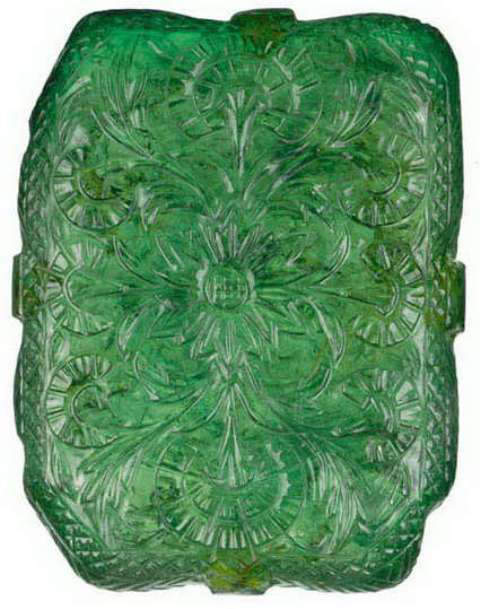
The Mughal Emerald which undoubtedly is of Colombian origin is a dark green emerald weighing 217.80 carats. The emerald has been deliberately cut by the Indian cutters and polishers of the period, as a table-cut, rectangular shaped gemstone, with two parallel flat rectangular faces, enabling the master gem carvers to take over and convert it into a masterpiece in gem carving with intricate floral designs on one side and beautiful Arabic calligraphy in the Naksh script on the other. The dimensions of the emerald are 52 x 40 x 12 mm, and the mid-point of each of the four sides of the rectangle has been drilled for attachments, so that the gemstone could be mounted and worn as a talisman, with the Arabic inscriptions facing outwards.
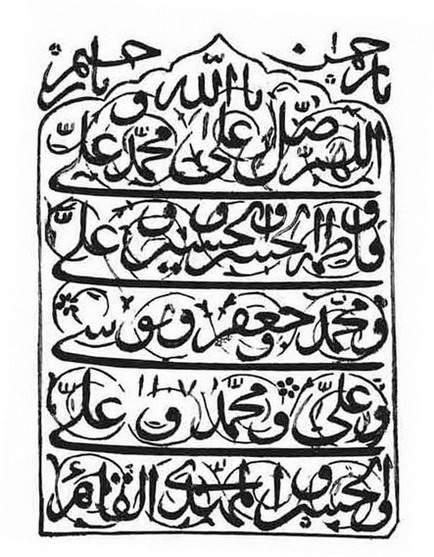
The inscriptions in the Arabic Naksh script is a perfect example of ancient Arabic calligraphy laid out symmetrically in five rows, with the upper introductory row being a little wider than the remaining four rows of equal width. The edges of the rectangle are carved with cross pattern incisions and herringbone pattern decorations. The inscription represents an invocation of the Shia sect of Islam invoking the blessings of Almighty God, the most merciful and the most compassionate, on the Holy Prophet Muhammad (peace be upon him) and the twelve Imams that followed after him. The Mughal emerald is the largest of the inscribed emeralds known to exist in different collections.
Transforming the Hijra year to the Gregorian calendar
The date of the inscription is given as 1107 A.H., which when transformed to the Gregorian calendar using Hodgson's formula, works out to 1695-1696 A.D. The mathematics of this conversion is as follows :-
G = H - H/33 + 622 where G represents the Gregorian year and H the Hijra year.
Substituting for G and H in the above formula, we have :-
G = 1107 - 1107/33 + 622
G = 1107 - 33.5 +622
G = 1695.5 A.D. which is taken as 1695-96 A.D.
1695-96 A.D. corresponds to the period of rule of Emperor Aurangzeb who assumed power after his father Shah Jahān was placed under house arrest, and reigned from 1658 to 1707.
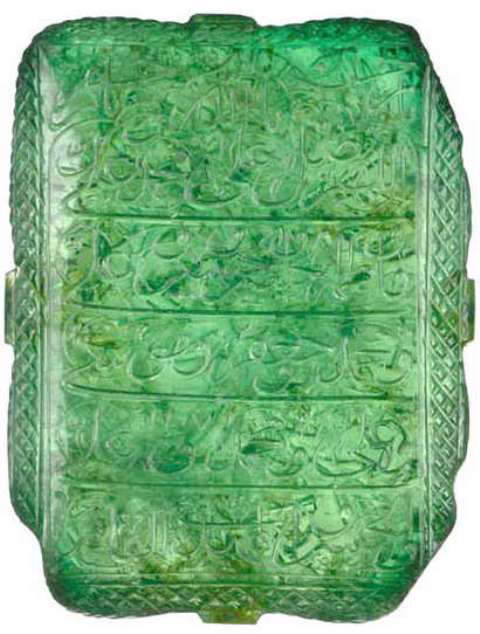
© Christie's
© Christie's
A detail analysis of the Arabic inscription
The translation of the Arabic invocation into English reads as follows :-
Line 1 - Yah Rahman - Oh merciful one ! Yah Raheem - Oh compassionate one !
Yah Allah - Oh God !
Allah-humma salli ala Muhammad wa Ali - God bless Muhammad and Ali
Line 2 - Wa Fathima wa al-Hassan wa Hussain wa Ali - and Fatimah and al-Hassan and al-Hussain and Ali
Line 3 - Wa Muhammad wa Ja'far wa Musa - and Muhammad and Ja'far and Musa
Line 4 - 11.V - 1107, Wa Ali wa Muhammad wa Ali - and Ali and Muhammad and Ali
Line 5 - Wal Hussain wal Mahdi al ka'hirah - and al-Hussain and the steadfast Mahdi
The 12 Imams (Leaders of the faith) of Shia Islam after the death of Prophet Muhammad are :-
1) Imam Ali Ibn Abu Ta'lib (4th Caliph of Islam) 2) Imam Hassan (son of Ali) 3) Imam Hussein (son of Ali) 4) Imam Ali Zain-al-abdeen 5) Imam Muhammad al-Baqir 6) Imam Ja'far as-Sādiq 7) Imam Mūsa al-Kazim 8) Imam Ali al-Ridā 9) Imam Muhammad al-Jawād 10) Imam Ali al-Hādi 11) Imam Hassan al-Askari 12) Muhammad al-Mahdi al-Hujjah.
The names given in bold characters are the names of the 12 Imams appearing on the invocation carved on the emerald. A comparison of the names appearing on the invocation with the names on the list of 12 Imams, show that the names of the Imams in the invocation appear in the chronological order in which they succeeded one another. Please note that the invocation bears only the first name of each Imam, except for the 12th Imam Muhammad al-Mahdi al-Hujjah, whose name appears as Mahdi, which in Arabic means the "divinely guided one." Muhammad al-Mahdi al-Hujjah is also known as Muhammad al-Muntazar, the hidden Imam, as the Shia Muslims believe, that in the year 878 A.D. the Imam disappeared without any trace. His material body is believed to have transformed into the spiritual world and shall remain hidden until a few years before the day of judgment, when he will re-appear as a messianic deliverer known as the Mahdi, who will fill the earth with justice and equity, restore true religion, and usher in a short golden age lasting about seven years before the end of the world.
© Christie's
Description of the floral pattern on the reverse side of the emerald-tablet
The reverse side of the emerald-tablet is carved with floral and foliate decorations, typical of the naturalistic decoration of the period, reflecting the Mughal love of nature. The decoration consists of a central rosette, with a single large poppy flower with basal foliage leaves on either side, situated above and below, with a line of three smaller poppy flowers with basal foliage leaves, on either side. The edges of the rectangular faces are carved right round with cross pattern incisions.
Emeralds - their chemical composition and structure
Emeralds belong to the group of minerals called beryl, which belong to a broader class of minerals called silicates, the most abundant class of minerals found on the surface of the earth. Beryl belong to a sub-class of silicates known as Cyclosilicates, in which six tetrahedral silicate ions (SiO4))‾ are linked together to form a hexagonal shaped ring, whose symmetry is reflected in the final crystal form, which are hexagonal shaped crystals. As the six (SiO4)‾ ions link together one oxygen atom is eliminated resulting in the structure [(SiO3)6]‾. The negative charges on the rings are balanced by the positive charges on the metal ions of aluminum (Al3+) and beryllium (Be3+), which hold the rings together in the crystal structure. The overall chemical formula of beryl is Be3Al2(SiO3)6, which is known as Beryllium Aluminum Silicate. Two other minerals that have a similar structure to beryl, but different chemical composition are tourmaline and cordierite.
What causes the green color of emerald ?
Pure beryl is colorless and known as Goshenite. The presence of trace quantities of the atoms of a transition element in the crystal structure can induce different colors to beryl, producing its different varieties, such as emeralds (chromium/vanadium-green), aquamarine (iron-light blue), morganite (manganese-pink), heliodor (iron/uranium-greenish-yellow/ golden)) and green beryl (vanadium-pale-green), bixbite (manganese-red), golden-beryl (uranium-golden/yellow). In emeralds the brilliant "emerald-green" color is produced by traces of chromium and/or vanadium atoms associated with the crystal. Some believe that the deep-green color of emerald is actually caused by chromium. The pale-green colors caused by vanadium, is simply known as green beryl.
The deep-green color is the best known variety of emerald, but emeralds also have various other shades of green. The world renowned emerald mines of Colombia produces different tones of green, which are almost characteristic of the mine in which they are found. The emeralds produced in the Muzo emerald mines are a deep herbal-green color, and those produced in the Coscuez and Penas Bancas mines are a typical yellowish-green color. Emeralds of the Chivor mines are bluish-green in color, and those of the Gachala mines are pale-green in color. The color of an emerald is of paramount importance in deciding its value. Generally, the deeper and more vivid the green color the more valuable is the emerald, but stones that are too light or too dark in color are generally less valuable. The top colors in emeralds are the deep vivid-green, the slightly bluish-green and the slightly yellowish-green colors. All these favorable colors are produced in the emerald mines of Colombia and hence the premier source of top-quality emeralds in the world is Colombia.
Presence of inclusions - jardin - is a characteristic feature of emeralds
The presence of flaws and inclusions is a hallmark of most natural emeralds, and unfortunately the best colored stones are sometimes the most included. The types of flaws found are cracks and fissures and the inclusions can be solid, liquid and gaseous. The Colombian emeralds originating from the Muzo and Chivor mines have the typical three-phase inclusions containing gas, fluid and crystals of halite. Muzo emeralds also contain calcite and yellow-brown needles of the mineral parisite. In the Chivor emeralds the characteristic inclusions are pyrite and albite. The Zimbabwean emeralds have inclusions of acicular tremolite. The Zambian emeralds have tourmaline and biotite inclusions.
The presence of flaws and inclusions in emeralds is probably a symbol of its turbulent genesis. The flaws seem to have been produced due to the tension involved in creating the necessary geological conditions conducive to their formation. Gem beryl is almost found exclusively in hydrothermal veins, pegmatites, and at the contact zones of large igneous intrusions that invade aluminous schist, shale or impure limestone. Beryllium is provided by the volatile fraction of the vein liquid or magma, and aluminum is provided by the host rock. The turbulent genesis of the emerald impedes the undisturbed formation of large flawless crystals. Thus it is extremely rare to have a large emerald with good color, clarity and transparency. If it occurs, it is an exception rather than the general rule. Gemologists refer to the inclusions, cracks and fissures commonly found in emeralds as "Jardin" which in the French language means "Garden." In other words the inclusions are compared metaphorically to tender little green plants in the pure green emerald garden. Emeralds had been held in high esteem and regard and highly valued since ancient times, in spite of their inclusions. In fact the presence of inclusions in natural emeralds confirms the authenticity of the gemstone. Synthetic emeralds too have inclusions but they are fewer and entirely different in nature.
In spite of their inclusions emeralds rank among the five elite gemstones in the world, which are diamond, ruby, emerald, sapphire and pearls. Due to their extreme rarity the price of a top-quality emerald may sometimes be higher than that of a diamond of the same weight.
Why the emerald-cut was developed for emeralds ?
The presence of inclusions in emeralds have imparted some disadvantages to the gemstone. The hardness of emeralds is 7.5 to 8.0 on the Mohs scale, which is quite high, but in spite of its hardness, the toughness of emerald is low. This is because the presence of inclusions have made emeralds somewhat brittle. Again for the same reason cutting of emeralds is a very difficult task even for the most skilled gem-cutter, and presents a special challenge, not only because of the high value of the raw crystals, but also because of the frequent flaws and inclusions. The emerald-cut which is a rectangular or square shaped step-cut with beveled corners was specially developed by gem cutters not only to bring out the intrinsic beauty of the gemstone, but also to protect it from mechanical strain. While emeralds are also cut in other classical shapes, if the stone is heavily included, it is usually cut as a rounded cabochon.
Oil treatment of emeralds an accepted trade practice
Natural emeralds are treated with oils, a form of treatment generally accepted in the trade. Oil treatment fills the cracks and cavities in the stone. If the oil used has a refractive index very close to that of the emerald the cracks and fissures become invisible. Some of the traditional oils that had been used for this purpose are Canada balsam and cedar wood oil, but several other crack filling substances have been developed for this purpose. It is because of this treatment that an ultrasonic bath cannot be used for cleaning emeralds, and it is advised that one should remove his or her emerald rings before handling soaps and detergents. In any case oil treatment is not permanent, and can decrepitate with time or form "sweats" in strong sunlight.
Some physical and optical properties of emeralds
Emeralds crystallize in the hexagonal crystal system, giving rise to well formed hexagonal prisms. The hardness of emerald is 7.5 to 8.0 on the Mohs scale. This hardness is sufficient not to cause scratches on emeralds set in jewelry, but the toughness of the gemstone is quite low, because of the presence of inclusions. The specific gravity of emerald is quite low and varies between 2.67 to 2.78. The refractive index is also quite low, varying between 1.565 and 1.599. The refractive index seem to vary with the place of origin of the emerald.
The birefringence is low varying between 0.005 and 0.009, and so is the dispersion equal to 0.014. The low dispersion and refractive index reduces the fire and brilliance of the stone, but this is somewhat compensated by the vitreous luster of the stone, its deep-green color, transparency and the emerald-cut of the stone which seems to increase its dispersion. Some emeralds are opaque and may not be of gem-quality. The Mughal Emerald, which is the subject of this web page is actually an opaque emerald, which is more suitable for carving than to be used as a gemstone. Dichroism in emeralds is quite distinct, changing from blue-green to yellow-green. Natural emeralds do not fluoresce in ultra-violet light, but synthetic emeralds may show a dull-red fluorescence. The low specific gravity, and refractive index combined with the distinct dichroism and the lack of fluorescence in u-v light are the distinguishing properties of natural emeralds. Synthetic emeralds also have a slightly lower refractive index and specific gravity than the natural emeralds.
History of the Mogul Emerald
The source of the emerald
The inscription on the Moghul Emerald is dated as 1695-96, which corresponds to the period of rule of the great Mughal Emperor Aurangzeb (1658-1707). In fact this emerald is the only known carved and dated emerald of the classic Mughal period, and has become a sort of standard for dating all other Indian carved emeralds. The only known source of fine large emeralds during this period was Colombia, as all other ancient sources of the gemstone, such as Egypt, Austria and Swat in Pakistan had been exhausted. Emeralds were discovered in Colombia by the Spanish Conquistadors in 1537, although they had known about their existence in neighboring Peru and Mexico prior to this, even though they were not successful in tracing their actual natural source. In Peru and Mexico the Spaniards obtained the beautiful green stones only from the treasures stored up in the graves and temples of the ancient Peruvians and Mexicans. Mining for emeralds in Colombia began around the mid-sixteenth century after the forceful subjugation of the local Indian tribes such as Mayans, Aztecs, Totecs, Incas, and the Chibchas.
The ultimate destination of the Colombian emeralds in the 16th - 18th centuries
The emeralds mined in Colombia eventually reached the markets in Europe, but subsequently the brilliant green stones eventually ended up in one of the three great Islamic empires of the period, in the Middle East and Asia, the Ottoman Turkish Empire (1299-1923), the Safavid Persian Empire (1501-1722) and the Mughal Empire of India (classic period-1556 to 1707), where there was a great demand for the green stones especially among the ruling classes. The enormous Mogul emerald might also have reached the Mogul Empire from Colombia, via Spain together with other emeralds, as goods of trade, as the Spanish had found that the Mogul Empire was a very lucrative market for their valuable merchandise, given the enormous riches concentrated in the hands of the Mogul Emperors.
The original owners of the Mogul Emerald
The Mogul Emerald having reached India, in the late 17th century, was entrusted to the skilled Indian gem cutters, polishers and carvers of the period by the owner of the gemstone, who incidentally happened to be a Shi'ite Muslim, going by the Shi'ite prayers invoking the blessings of God Almighty, on the Holy Prophet Muhammad and the twelve Shi'ite Imams. This invocation clearly excludes the Mogul Emperors and particularly Emperor Aurangzeb from being the initiator and sponsor of this historic gem-carving, because the Mogul Emperors were devout Sunni Muslims. Thus it is quite possible that the gemstone belonged either to one of the Shi'ite Officers of the Emperor of Persian origin, or from one of the Shi'ite Deccan Sultanates that were subjugated by Aurangzeb. It might also be possible that the carvings actually originated in one of the Shi'ite Deccan Sultanates, such as Golconda or Bijapur whose rulers were Shi'ite Muslims. Aurnagzeb conquered Golconda and Bigapur in the years 1686-87.
Alan Caplan acquires the Mogul Emerald
There is no evidence to show that the Mogul Emerald ever entered the treasury of the Mogul Emperor Aurangzeb, even though the gemstone originated during this period. Several large chests in the treasury were full of these precious green gemstones that originated in Colombia, that were plundered almost three decades later by Nadir Shah, the mighty conqueror of Iran, in the year 1739, when he invaded Delhi and Agra. Most of the emeralds in the Aurnagzeb's collection eventually ended up in the treasury of the Iranian Shahs of the Qajar dynasty, and were used in the settings of the crown jewels of Iran, that included crowns, tiaras, jewel-studded swords and shields, utility items, ornaments, special settings like the jewel-studded globe, or just left as loose unmounted emeralds. Had the Mogul Emerald been part of Aurangzeb's collection, it would undoubtedly have ended up in the treasury of the Qajar Shahs of Iran.
Thus after the Mogul period, the gemstone most probably would have entered the private collection of a connoisseur of gemstones in India, in whose family it remained, until Alan Caplan, acquired the renowned gemstone during one of his many trips to India and Burma. Alan Caplan who was born in 1913 in New York or New Jersey, claimed to be of Jewish origin. The young Alan Caplan was interested in the natural sciences from early childhood, and mineralogy became his special field of interest since his days in the high school. He followed a course in Geology and Mineralogy at the University of Colorado beginning in the year 1934 and graduated in 1937. He did an additional one year from 1937-38, following an advanced course in Mineralogy at the Colorado School of Mines. While at college, Alan Caplan began collecting mineral specimens found in and around the Colorado area, and began selling them, by running small ads in the magazines Rocks & Minerals and The Mineralogist. After passing out of college in 1938 he decided to take a trip to Brazil in search of minerals. This initial trip was highly successful, and this was followed by at least 10 more trips, before the onset of World War II. After these trips he supplied the Natural History Museums of the Smithsonian, Harvard and New York AMNH with some fabulous mineral specimens. After a short period of service in the army from 1943 to 1945 during World War II, when he served in Italy, he again returned to Brazil and purchased more rare mineral specimens which he brought to his New York office, from where they were disposed of. He made another dozen trips to Brazil after the war, but by 1958, his interest shifted from minerals to gemstones. This time he made regular trips to Colombia looking for emeralds, and later he also made several trips to Burma to purchase rubies. It is during one of these trips to Burma after 1958, he also happened to visit India, where the Mogul Emerald was offered for sale, and he acquired the renowned gemstone.
While the Mogul Emerald was in the possession of Alan Caplan, he was gracious enough to have lent the gemstone for exhibitions in several museums around the United States. Some of the Museums where the gemstone was exhibited, with the dates of the exhibition, are as follows :-
1) Los Angeles County Museum of Natural History, California - July 4 to September 6, 1981.
2) American Museum of Natural History, New York - October 14, 1983 to January 13, 1984.
3) Metropolitan Museum of Art, New York - September 14, 1985 to January 5, 1986.
4) National Museum of Natural History, Smithsonian Institution - July to December 1995.
The sale of the Mogul Emerald at a Christie's auction in New York
In 1988, one of Alan Caplan's rubies weighing 16-carats, which he acquired from Mogok, Burma, sold for a record-breaking sum of $ 3.6 million, achieving the highest ever price for a ruby sold at an auction. However the Mogul Emerald remained with him until his death in 1998, and was sold by his heirs only in the year 2001, when the stone was entrusted to Christie's of New York for the sale. The gemstone fetched a record price of 2.2 million dollars at this auction, and was sold to an anonymous buyer. It is reported that the gemstone is now in the museum of Islamic Art of the independent emirate of Qatar.
Other known inscribed emeralds
Several other inscribed emeralds of the Moghul period are known to exist in different private collections. Two inscribed emeralds were known to have existed in the collection of jewels of HRH Sir Sultan Muhammad Shah III, the 3rd Agha Khan, the spiritual leader of the Nizari Ismaili sect of Shi'ite Muslims, who achieved greatness as an international statesman and diplomat, and was appointed the President of the League of Nations in 1937. Sir Sultan Muhammad Shah Agha Khan III died in 1957, at the age of 80 years, and was succeeded by his grandson Prince Karim Agha Khan IV, the present spiritual leader. In 1988 the two inscribed emeralds of the late Agha Khan III was entrusted to Christie's for sale, and was sold on May 12, 1988. One of the emeralds weighed 142.20 carats, while the other weighed 76.00 carats. Both emeralds were inscribed with text from the Holy Qur'an.
Three other inscribed emeralds belong to the Al-Sabah Collection in Kuwait. Two of these emeralds are inscribed with text from the Holy Qur'an, one of which is a rectangular-cut stone of 85.60 carats and the other a hexagonal-cut stone of 73.20 carats. A third emerald in this collection is a 59.60-carat cut and polished emerald, with only a short inscription, bearing the name of Nadir Shah and dated 1153 A.H., which is equivalent to 1740 A.D. This is just one year after the mighty Nadir Shah conquered Delhi and Agra, and plundered their wealth. In all probability this emerald was one that was brought to Iran during this expedition.
You are welcome to discuss this post/related topics with Dr Shihaan and other experts from around the world in our FORUMS (forums.internetstones.com)
Related
Jewel Studded Ornaments in the Iranian Crown Jewels
Loose Precious and Semi Presious Stones in the Iranian Crown Jewels
Jewel Studded Special Settings among the Iranian Crown Jewels
Utility Items among the Iranian Crown Jewels
Swords, Daggers and Sheilds of the Iranian Crown Jewels
Tiaras of the Iranian Crown Jewels
The Three Crowns of the Iranian Crown Jewels
References
1. Web page on the Moghul Emerald - Columbia. edu
2. Gems & Gemology - The Quarterly Journal of GIA, 1981, Vol 17
3. Allan Caplan, The Mineralogical Record, Biographical Archive.
4. Emerald, Gem by Gem - International Colored Gemstone Association.
5. Beryl, Gem by Gem - International Colored Gemstone Association.
6. GEO347K GEM NOTES - Beryl, Department of Geology, University of Texas, Austin.
7. Beryl, Wikipedia, the free encyclopedia.
8. Emerald, Wikipedia, the free encyclopedia.
9. Beryl, GO 340 Gemstones and Gemology - Emporia State University.
10. The Cyclosilicate sub-class - Galleries.com
11. Precious Stones - Emeralds - minelinks.com

 Home
Security & Guarantee
How it Works
Technology Partners
Updated Tables
Famous Diamonds
More Famous Diamonds
Famous Pearls
Famous Gemstones
Contact Dr Shihaan Larif
Contact Senior Editor
Famous Jewelry
Reference Database
Forums
Learning Center
Gemstone Gallery
e-mail Notifications
Advertise
Press Release
About Us
Privacy Policy
Contact Us
FAQ'S
Site Map
Staff Mail Login
Staff Documents
Birthstones
History
Minerals
Shows
Live Metal Prices
Jewellery Gallery
News
Marketplace
Marketplace Support
Open Store
Online Auctions
Join Us & Contribute
Directory
Classifieds
List your products
Wholesale Trading
Post Buy Request
Go Green Policy
Site Updates
Upcoming-ToDo List
Latest News
Latest Articles
Latest Blog Updates
Chat Rooms
Job Board
User Gallery
Videos
New Newsletter Archive
Old Newsletter Archive
Jewelry & Mineral Blog
User Blogs & Social Network
Search
Answers (Q & A)
Valuation
Help me find a diamond/jewelry
pin.internetstones.com- Social Pinboard- Sart yours & connect with millions
Invite Friends From Yahoo, Gmail etc-One Click
Home
Security & Guarantee
How it Works
Technology Partners
Updated Tables
Famous Diamonds
More Famous Diamonds
Famous Pearls
Famous Gemstones
Contact Dr Shihaan Larif
Contact Senior Editor
Famous Jewelry
Reference Database
Forums
Learning Center
Gemstone Gallery
e-mail Notifications
Advertise
Press Release
About Us
Privacy Policy
Contact Us
FAQ'S
Site Map
Staff Mail Login
Staff Documents
Birthstones
History
Minerals
Shows
Live Metal Prices
Jewellery Gallery
News
Marketplace
Marketplace Support
Open Store
Online Auctions
Join Us & Contribute
Directory
Classifieds
List your products
Wholesale Trading
Post Buy Request
Go Green Policy
Site Updates
Upcoming-ToDo List
Latest News
Latest Articles
Latest Blog Updates
Chat Rooms
Job Board
User Gallery
Videos
New Newsletter Archive
Old Newsletter Archive
Jewelry & Mineral Blog
User Blogs & Social Network
Search
Answers (Q & A)
Valuation
Help me find a diamond/jewelry
pin.internetstones.com- Social Pinboard- Sart yours & connect with millions
Invite Friends From Yahoo, Gmail etc-One Click




Our Global Jewelry Industry Job Network


Buy & Sell in our Marketplace

Subscribe to our Newsletter

List in our Classifieds

List in our Directory

User Uploaded Gallery

Powered by Ultra Secure
Amazon (USA) Cloud Network

Founder Internet Stones.COM
Register in our Forums

| Featured In
|
|
|
|
|
|
|
|







Blog & Education Feed
Articles Feed
 |
 |
 |

Copyright © .Internet Stones.COM. All rights reserved.