An Attractive Natural Black Pearl Ring
Open FREE Unlimited Store Join Our Newsletter
Origin of Name :-
Lot No. 149, described as "An Attractive Natural Black Pearl Ring" was one out of 15 pieces of pearl jewelry, that appeared at the Christie's Contemporary Jewelry and Watches Sale, No. 7664, held at the Jumeirah Emirates Towers Hotel, Dubai, in the United Arab Emirates, on April 29, 2008. The piece registered a price of $43,000 at the auction, even though the pre-sale estimate of the piece was placed between $50,000 and $70,000. Perhaps, this was only piece of pearl jewelry at the auction that sold below the lower estimated price. Yet, the price of $43,000 can be considered as significant, given that the weight of the pearl is only 5.84 carats, equivalent to 23.36 grains. This gives a price per carat value of $7,363 for the pearl. In comparison the price per carat realized at the same auction for another black pearl, incorporated as a pendant, in the Belle Epoque Natural Grey/Brown pearl pendent necklace, weighing 56.81 carats, was $13,536.

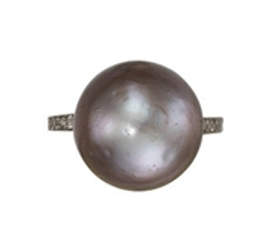
An attractive natural black pearl ring
Please click here for an enlarged image (External Link)
© Christie's
Characteristics of the natural black pearl ring
The shape and weight of the pearl
The natural black pearl incorporated in the ring, is a perfectly spherical pearl, with a diameter of 13.7 mm and weighing 5.84 carats, equivalent to 23.36 grains. A perfectly spherical pearl can have the same diameter all round, and therefore a variation in diameter of 0%, or a slight variation in diameter of up to 2%. Thus, even if the pearl had a short and long diameter of 13.4 mm and 13.7 mm or a short and long diameter of 13.7 mm and 14.0 mm, yet the pearl would be perfectly spherical, as seen from the following calculation :-
1) Variation in diameter = (1 - shortest diameter/longest diameter) x 100%
= (1- 13.4/13.7) x 100 = (1 - 0.98) x 100%
= 0.02 x 100 = 2%
Therefore the variation in diameter = 2%
2) Variation in diameter = (1 - shortest diameter/longest diameter) x 100%
= (1 - 13.7/14.0) x 100% = (1 - 0.98) x 100%
= 0.02 x 100 = 2%
Therefore the variation in diameter = 2%
Thus even if the long and short diameters of the pearl was 13.7 ± 0.3 mm, the pearl would still be considered perfectly spherical. Perhaps, this variation in diameter of 2% has been allowed, as finding a perfectly spherical pearl with 0% variation in diameter, is a very difficult proposition.
The color, overtones and luster of the pearl
The color of the pearl is a silvery-black or silvery-grey color, where the black or grey color is the main body color of the pearl, and the silver color an overtone color. The black color of the pearl is due to melanin pigments associated with the conchiolin part of the nacre. Overtones colors are caused by an optical effect as light passes through successive layers of nacre. In black pearls apart from silver color, a variety of overtone colors such as gold, purple, blue, green, yellow, reddish-purple and rainbow, can cause a combination of colors such as Tahitian gold (golden black), cherry (purplish-black), lavender (bluish-black), peacock (greenish-black), pistachio (greenish-grey), champagne (yellowish-grey), aubergine (reddish-purple and black), rainbow (rainbow of colors and black) etc. Peacock and pistachio are the most popular and much sought-after colors in black pearls.
The luster of the pearl caused by the reflection of light from the surface of the pearl and just below the surface, is in keeping with the saltwater origin of the pearl. Saltwater pearls usually have a luster greater than that of freshwater pearls.
Design of the ring
The metal used in the ring and the ring size are not known. But, perhaps it could be silver, platinum or white gold. The shoulders of the ring are set with single-cut diamonds.
History of the natural black pearl ring
Can the ring be a pre-20th century piece ?
Nothing is known about the previous owner, or the historical provenance of the natural black pearl ring. The only feature in the ring that may perhaps point to its antiquity is the use of single-cut diamonds on its shoulders. But, the evidence is not conclusive. Perhaps the metal used in the ring may give an indication as to the antiquity of the ring. If the metal used in the ring is platinum or white gold, the origin of the ring is the 20th-century, as platinum was first introduced in the Belle Époque period between 1901 and 1915, and white-gold was first introduced in the 1920s. On the other hand if the metal used on the ring is silver or gold, the origin of the ring, could be pre-20th century, as these were the main metals used in rings at that time. A combination of silver or gold and single-cut diamonds on the shoulder, may indicate the antiquity of the ring.
The possible sources of the natural black pearl
The geographic range of the black-lipped pearl oyster
Black pearls are usually produced in the black-lipped pearl oyster Pinctada margaritifera, which has a wide geographical distribution, in the tropical Indo-Pacific waters from the Persian Gulf in the Indian Ocean, through the South Sea, to the Gulf of California, in Mexico, in the Pacific Ocean; and in the Pacific Ocean from Japan in the northern Pacific to the southern Pacific Islands of the French Polynesia.
Persian Gulf was the first source of natural black pearls, followed by Baja California, in the 16th to 18th centuries.
In ancient times the first source of black pearls was the Persian Gulf, where Pinctada margaritifera co-existed with the more dominant species of pearl oysters, Pinctada radiata. In the 16-th century, after the Spanish discovered rich pearl oyster resources in Venezuela, they also discovered additional pearl resources in the Gulf of California, in Mexico, and off the Pacific coast of Panama. The oyster species discovered in the Gulf of California, was Pinctada margaritifera that produced black pearls. Baja California, now became the main source of black pearls, and significant quantities of these black pearls entered the European markets, through Spain in the 16th to 18th centuries. The black pearls in Empress Catherine the Great's (1729-1796) famous black pearl necklace, comprising 30 black pearls, the largest of which was 78 grains, were believed to have originated from Baja California. In the 18th-century, the Austrian Crown of the Habsburg dynasty, was set with 30 black pearls, also believed to have originated in Baja California.
The southern Pacific Islands became the main source of natural black pearls in the 19th and early 20th centuries
In the 19th-century, the main source of natural black pearls in the world was the southern Pacific Islands, which became a French protectorate in 1842. Touamotu archipelago was the main source of the black Tahitian natural pearls, which was actually a by product of the pearl shell collection industry that persisted from 1820 to 1880. The black pearls in Empress Eugenie de Montijo's (empress consort of Napoleon III) black pearl necklace are believed to have originated in the French Polynesia, which remained a source of natural black Tahitian pearls even in the early 20th-century, even though pearls were becoming scarcer due to over exploitation.
An alternative source of natural black pearls was northern Australia in the late 19th and early 20th centuries
Significant quantities of natural black pearls also entered the markets from Australia, in the late 19th and early 20th centuries, where the black-lipped pearl oyster was exploited in the northern coast of Australia, from Champion Bay in Western Australia to Moreton Bay in Queensland. Thus, if the natural black pearl in the ring originated in the 19th-century or early 20th-century, the most probable sources of the pearl were the French Polynesia or northern Australia.
Laboratory report issued by the Gem Testing Laboratory of Great Britain
The natural black pearl ring which was Lot No. 149 at the Christie's auction, was accompanied by a laboratory report bearing No.0127905, dated February 18, 2008, issued by the Gem Testing Laboratory of Great Britain, authenticating that the pearl is natural and free of any treatment.
The sale of the natural black pearl ring
The natural black pearl ring was sold for $43,000 at the Christie's Contemporary Jewelry and Watches Sale, No. 7664, held on April 29, 2008, in Dubai. The price realized was below the lower pre-sale estimate of $50,000, and was one of two pieces of pearl jewelry offered at the auction that sold below the estimated price. Out of the 15 lots of pearl jewelry offered at the auction, 7 lots sold for prices much above the upper pre-sale estimate. The remaining 6 lots sold within the pre-sale estimated range. The highest price realized was for Lot No. 178, a superb four-row natural pearl and diamond necklace that sold for $1,743,400, which was slightly below the pre-sale estimated range of $1,800,000 to $2,200,000. See table below.
Table of the 15 lots of pearl jewelry that appeared at the Christie's auction in Dubai on April 29, 2008, giving the pre-sale estimates and final prices realized
| S/N | Lot No. | Lot Description |
Pre-Sale Estimate | Price Realized |
| 1 | 147 |
An imposing antique Indian natural pearl nine-row necklace that belonged to Umm Kulthum, the legendary Egyptian singer | $80,000-$120,000 | $1,385,000 |
| 2 | 148 | A fine pair of natural pearl and diamond ear pendants | $60,000-$80,000 | $157,000 |
| 3 | 149 | An attractive natural black pearl ring | $50,000-$70,000 | $43,000 |
| 4 | 154 | An attractive antique natural pearl and diamond pendent brooch | $60,000-$80,000 | $97,000 |
| 5 | 155 | A natural pearl and diamond pendent necklace | $25,000-$35,000 | $43,000 |
| 6 | 156 | A natural pearl and diamond necklace | $150,000-$180,000 | $205,000 |
| 7 | 158 | A pair of natural pearl earrings | $20,000-$30,000 | $29,800 |
| 8 | 159 | A pretty group of natural pearl and diamond jewelry | $35,000-$45,000 | $73,000 |
| 9 | 160 | An attractive pair of antique natural pearl and diamond ear pendants | $180,000-$250,000 | $217,000 |
| 10 | 162 | A natural pearl, diamond and ruby pendent necklace | $45,000-$50,000 | $94,600 |
| 11 | 163 | A four-row natural pearl necklace | $50,000-$80,000 | $61,000 |
| 12 | 166 | A highly important orange natural pearl | $600,000-$800,000 | $713,000 |
| 13 | 172 | An important pearl and diamond suite, by Gerard | $400,000-$600,000 | $481,000 |
| 14 | 174 | An exceptional belle époque natural grey/brown pearl pendant necklace | $700,000-$1,000,000 | $769,000 |
| 15 | 178 | A superb four-row natural pearl and diamond necklace | $1,800,000 -$2,200,000 | $1,743,400 |
You are welcome to discuss this post/related topics with Dr Shihaan and other experts from around the world in our FORUMS (forums.internetstones.com)
Related :-
1) Drexel Pearl
2) Birk's Black Tahitian Double Row Pearl Necklace
3) Three Strand Nina Dyer Black Pearl Necklace
4) Belle epoque Natural Grey/Brown Pearl Pendent Necklace
External Links :-
References :-
1) An Attractive Natural Black Pearl Ring - Christie's Contemporary Jewelry and Watches Sale, Auction Catalogue. Sale No. 7664, Lot No.149. www.christies.com
 Home
Security & Guarantee
How it Works
Technology Partners
Updated Tables
Famous Diamonds
More Famous Diamonds
Famous Pearls
Famous Gemstones
Contact Dr Shihaan Larif
Contact Senior Editor
Famous Jewelry
Reference Database
Forums
Learning Center
Gemstone Gallery
e-mail Notifications
Advertise
Press Release
About Us
Privacy Policy
Contact Us
FAQ'S
Site Map
Staff Mail Login
Staff Documents
Birthstones
History
Minerals
Shows
Live Metal Prices
Jewellery Gallery
News
Marketplace
Marketplace Support
Open Store
Online Auctions
Join Us & Contribute
Directory
Classifieds
List your products
Wholesale Trading
Post Buy Request
Go Green Policy
Site Updates
Upcoming-ToDo List
Latest News
Latest Articles
Latest Blog Updates
Chat Rooms
Job Board
User Gallery
Videos
New Newsletter Archive
Old Newsletter Archive
Jewelry & Mineral Blog
User Blogs & Social Network
Search
Answers (Q & A)
Valuation
Help me find a diamond/jewelry
pin.internetstones.com- Social Pinboard- Sart yours & connect with millions
Invite Friends From Yahoo, Gmail etc-One Click
Home
Security & Guarantee
How it Works
Technology Partners
Updated Tables
Famous Diamonds
More Famous Diamonds
Famous Pearls
Famous Gemstones
Contact Dr Shihaan Larif
Contact Senior Editor
Famous Jewelry
Reference Database
Forums
Learning Center
Gemstone Gallery
e-mail Notifications
Advertise
Press Release
About Us
Privacy Policy
Contact Us
FAQ'S
Site Map
Staff Mail Login
Staff Documents
Birthstones
History
Minerals
Shows
Live Metal Prices
Jewellery Gallery
News
Marketplace
Marketplace Support
Open Store
Online Auctions
Join Us & Contribute
Directory
Classifieds
List your products
Wholesale Trading
Post Buy Request
Go Green Policy
Site Updates
Upcoming-ToDo List
Latest News
Latest Articles
Latest Blog Updates
Chat Rooms
Job Board
User Gallery
Videos
New Newsletter Archive
Old Newsletter Archive
Jewelry & Mineral Blog
User Blogs & Social Network
Search
Answers (Q & A)
Valuation
Help me find a diamond/jewelry
pin.internetstones.com- Social Pinboard- Sart yours & connect with millions
Invite Friends From Yahoo, Gmail etc-One Click




Our Global Jewelry Industry Job Network


Buy & Sell in our Marketplace

Subscribe to our Newsletter

List in our Classifieds

List in our Directory

User Uploaded Gallery

Powered by Ultra Secure
Amazon (USA) Cloud Network

Founder Internet Stones.COM
Register in our Forums

| Featured In
|
|
|
|
|
|
|
|







Blog & Education Feed
Articles Feed
 |
 |
 |

Copyright © .Internet Stones.COM. All rights reserved.