Natural Pearl Jewelry in Princess Margaret's Collection - Freshwater Pearl & Diamond Brooch, Enamel & Seed Pearl Ring, Garnet & Seed Pearl Brooch
Open FREE Unlimited Store Join Our Newsletter
Princess Margaret's Collection of Natural Pearl Jewelry
Out of around 25 pieces of pearl jewelry in Princess Margaret's jewelry collection, around 15 pieces were incorporated with cultured pearls. The remaining 10 pieces were incorporated with natural pearls. The following is a list of the 10 pieces of natural pearl jewelry in the collection.

1) A FRESHWATER PEARL AND DIAMOND BROOCH, BY JOHN DONALD - Lot 48.
2) AN ANTIQUE ENAMEL AND SEED PEARL RING - Lot 88
3) AN ANTIQUE GARNET AND SEED PEARL BROOCH - Lot 89
4) A PEARL AND GEM-SET RING - Lot 91
5) A SEED PEARL AND RUBY RING - Lot 96
6) A PEARL AND DIAMOND NECKLACE - Lot 161
7) GEORGE III SEED PEARL AND DIAMOND RING - Lot 162
8) A PAIR OF ANTIQUE CORAL, SEED PEARL AND DIAMOND EARCLIPS - Lot 165
9) A PEARL BROOCH/PENDANT - Lot 170
10) A DIAMOND, PEARL AND GEM-SET BRACELET - Lot 175
1) A Freshwater Pearl and Diamond Brooch - by John Donald - Lot 48
Features of the John Donald Brooch
The design of the Freshwater Pearl and Diamond Brooch is an abstract design, characteristic of the novel design features introduced by John Donald, who revolutionized traditional British jewelry designing in the 1960s and 1970s. The center of the brooch is occupied by an openwork cluster of freshwater pearls and brilliant-cut diamonds. There are 20 freshwater pearls and 10 brilliant-cut diamonds in the cluster. The cluster of pearls and diamonds is surrounded by an 18-carat gold, textured border radiating square tubes. The brooch that was designed around the year 1970, carries English hallmarks for 18-carat gold.
Designer John Donald who had the privilege of receiving royal patronage for his novel jewelry creations in the 1960s, invited Lord Snowdon and his wife H.R.H. Princess Margaret for the opening ceremony of his new John Donald shop, a joint venture with Tecla Pearls, known as "John Donald with Tecla" on Old Bond Street in 1970. On this occasion Lord Snowdon declared open the shop, and John Donald presented this freshwater pearl and diamond brooch, as a gift to H.R.H. Princess Margaret, in appreciation of her kind gesture in gracing the occasion.
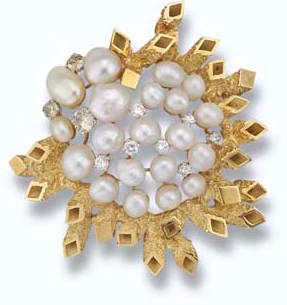
Freshwater Pearl and Diamond Brooch by John Donald
© Christie's
Features of the freshwater pearls in the brooch
The 20 freshwater pearls on the brooch are natural pearls that originated in freshwater mussels. The pearls are of varying sizes and shapes. Three pearls are large, four are medium-sized and the remaining 13 are small pearls. The shape of the pearls are round, near-round, button, oval and baroque. There is no pattern in the arrangement of the pearls. The arrangement is haphazard. This type of haphazard arrangement is characteristic of the designs created by John Donald. The color of the pearls is silvery-white. The luster and orient of the pearls is also characteristic of freshwater pearls, which is not as high as saltwater pearls.
The probable source of the freshwater pearls
The most probable source of the freshwater pearls in the brooch, is the United Kingdom itself, Scotland, being the most ancient source of freshwater pearls in the world, that tempted Julius Caesar to invade Britain in the year 55 B.C. The pearls originated in the freshwater mussel Margaritifera margaritifera, that usually inhabited the fast flowing rivers and streams of Scotland, and also to some extent England, Wales and Ireland. The River Tay, the longest river in Scotland, was one of the main habitats of the freshwater mussel, that produced large quantities of freshwater pearls over the centuries. The mussels lie buried or partially buried in coarse sand and fine gravel, with their siphons exposed. Such fast-flowing rivers provide abundant supplies of oxygen and suspended food particles for the successful growth of the mussels. These mussels that live for over a hundred years, can grow to a maximum length of 12-15 cm, reaching maturity after 10-15 years, when the length reaches 6-7 cm. For the successful completion of their life cycles, these mussels need a fish host, which is usually the Atlantic salmon, the brown trout or sea trout.
The history of exploitation of freshwater mussels in Britain, and the probable period in which the pearls in John Donald's brooch were discovered
The history of exploitation of the freshwater mussel Margaritifera margaritifera dates back to the pre-Roman period over 2,000 years ago. As mentioned earlier, during the Roman period, Julius Caesar invaded Britain in 55 B.C. mainly to take control of the trade in Scottish freshwater pearls, as in the Roman empire, gold together with pearls, underpinned the Roman monetary system. During the medieval period, in the 12th-century, Scottish freshwater pearls appeared in large quantities in the pearl markets of Europe, where there was a great demand for such pearls. In the 16th-century the commercial exploitation of freshwater mussels turned into a major industry in Britain, with mussels being exploited not only in Scotland, but also England, Wales and Ireland. During this period the government appointed River Bailiffs to supervise the exploitation, and to make sure that all valuable pearls reached the King's treasury. Thus, during this period Scottish pearls of exceptional quality entered the crown jewels of both England and Scotland. The commercial exploitation of freshwater mussels continued until the 19th-century, but soon overexploitation made the fishery unsustainable and was totally abandoned. However, small scale pearl fishery, by individual pearl divers, and gypsies in Britain and Ireland, continued well into the 20th-century, until a total ban was imposed on pearl fishing in 1998. It appears that most of the freshwater pearls in John Donald's brooch were most probably discovered in Scotland during this period of small scale pearl fishery, that lasted until 1998.
Sale of the John Donald Brooch
The John Donald Brooch, which was Lot No.48, at the Christie's historic London sale of June 13, 2006 - in which nearly 200 pieces of jewelry and Faberge from the collection of H.R.H. Princess Margaret was put up for sale by her children - sold for £15,600 ($28,704), which was almost 20 times higher than the upper pre-sale estimate of £800. The enhanced price realized was in keeping with the skyrocketing trend shown at the auction, beginning right from Lot No.1, attributed to what was known as the "Princess' Premium" generated by her popularity, as well as royal provenance.
2) An Antique Enamel and Seed Pearl Ring - Lot 88
Features of the Enamel and Seed Pearl Ring
The antique ring made of 18-carat gold, has a ring size "M" which is equivalent to USA size 6, with a diameter of 16.51 mm and circumference of 51.5 mm. Birmingham hallmarks for 18-carat gold and the year 1891, the year of hallmarking, and probably the year of designing the ring, appears on the inside of the ring. Thus, the ring had been designed in the late Victorian period (1890-1901) or the Art Nouveau period in France (1890-1915).The surface of the ring is bezel-set with seed pearls, surrounded by a rim of metal, and the gaps coated with black enamel. There are nine seed pearls mounted on the ring. Except for the central seed pearl which is slightly larger, all other seed pearls are small. The seed pearls are white in color and have the luster and orient of natural saltwater pearls. The enamel and seed pearl ring is accompanied by a black leather case, stamped with the crest of the Girl Guides. Princess Margaret acquired membership of both the Brownies and Girl Guides, and in 1965 became the President of the Girl Guides Association. Thus, in all probability the Enamel and Seed Pearl Ring, was a gift given by the Girl Guides Association, to honor one of their presidents. It was because of this reason it was stated in the auction catalogue, that proceeds from this lot will be donated to charity.
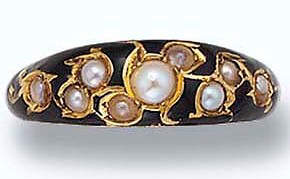
An Antique Enamel and Seed Pearl Ring
© Christie's
Source of the seed pearls
The Enamel and Seed Pearl Ring was designed in 1891. Around this period the main natural pearl sources in the world was the Persian Gulf and the Gulf of Mannar, the natural habitat of Pinctada radiata, the most prolific pearl producing oyster in the world. This species of pearl oyster also produced significant quantities of seed pearls, that usually occurred in clusters inside the pearl oysters. The millions of seed pearls incorporated in the renowned Pearl Carpet of Baroda, are all believed to have originated in the Persian Gulf. Large quantities of seed pearls were also produced in the Gulf of Mannar. Thus, the seed pearls incorporated on the ring could have originated either in the Persian Gulf or the Gulf of Mannar.
Sale of the Enamel and Seed Pearl Ring
The Antique Enamel and Seed Pearl Ring, was Lot No.88 at the Christie's London Sale of Princess Margaret's collection of jewelry and Faberge, held on June 13, 2006. A pre-sale estimate of £100 to £150 was placed on the ring. However, in keeping with the enhanced prices recorded for the lots of the auction, the ring sold for £6,600 ($12,144), forty-four times higher than the upper pre-sale estimate. The proceeds from this lot was donated to charity, as stated in the catalogue.
3) An Antique Garnet and Seed Pearl Brooch - Lot 89
When was the Antique Garnet and Seed Pearl Brooch designed ?
The Antique Garnet and Seed Pearl Brooch was designed around the year 1860. However, the use of the deep-red garnets on the brooch, show clearly that it belongs to the mid-Victorian Period (1861-1890), that was marked by a double tragedy, the death of Queen Victoria's mother, followed by the death of her husband Prince Albert in the year 1861, that thrust the Queen and the entire nation into a state of mourning. During the first year of mourning in 1862, full mourning black clothing and black jewelry were worn by the mourners. After the first year of mourning, in 1863, half-mourning colors such as grey, mauve and purples were used for clothing, and dark stones, such as onyx, jet, vulcanite, amethyst and deep-red garnets were used in mourning jewelry. Thus, the Antique Garnet and Seed Pearl Brooch, is a piece of half-mourning jewelry, designed in 1863 or afterwards, in the mid-Victorian period.
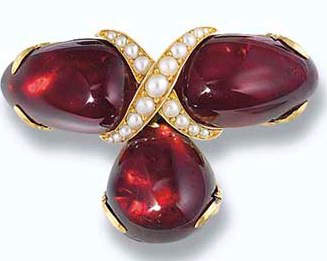
An Antique Garnet and Seed Pearl Brooch
© Christie's
Features of the Antique Garnet and Seed Pearl Brooch - A half-mourning piece of jewelry
There are three deep-red cabochon-cut garnets on the brooch. Two of these garnets that lie horizontally are oval-shaped, and almost of the same size. They are held together by a crossover seed pearl motif at the base, and two claws at the other end. The X-shaped motif has a large, round, white, seed pearl at the intersection, and four progressively smaller, round, white, seed pearls on the four arms, making a total of 17 seed pearls. The third cabochon-cut, deep-red garnet, is pear-shaped or drop-shaped, and suspended as a pendant from below the crossover seed pearl motif. The brooch has a width of 4.2 cm. There is a locket compartment on the reverse of the brooch, a feature common in pieces of jewelry of this period, such as pendants, and brooches.
The source of the seed pearls
The Garnet and Seed Pearl Brooch was designed in the year 1863 or afterwards, in the mid-Victorian period. Around this time the only source of seed pearls in the world was the Persian Gulf and the Gulf of Mannar, produced by the saltwater oyster, Pinctada radiata, a prolific pearl producer of not only medium sized pearls, varying in size from 2 to 8 mm, but also significant quantities of seed pearls that were less than 2 mm in diameter. The use of seed pearls in jewelry became very popular during the early-Victorian period, also known as the Romantic Period, that extended from 1837 to 1860, covering the period of Queen Victoria's youth, courtship, marriage, and early family life, until the death of her beloved husband, Prince Albert in 1861. The seed pearls used in jewelry of this period came from either the Persian Gulf, the Red Sea or the Gulf of Mannar.
The sale of the Antique Garnet and Seed Pearl Brooch
The Antique Garnet and Seed Pearl Brooch, was Lot No.89, at the Christie's London sale of Princess Margaret's collection of jewelry and Faberge, held on June 13, 2006. A pre-sale estimate of £500 to £700 was placed on the brooch. However, the brooch recorded an enhanced price of £9,600 ($17,664), in keeping with the record high prices realized for the other lots in the auctions. This was almost 14 times higher than the upper pre-sale estimate of £700.
You are welcome to discuss this post/related topics with Dr Shihaan and other experts from around the world in our FORUMS (forums.internetstones.com)
Related :-
1) Cultured Pearl Necklace and Earclips from Princess Margaret's collection
2) Princess Margaret's Five Row Art Deco Pearl And Diamond Necklace
3) Cultured Pearl Jabot-Pin & Coral and Cultured Pearl Bracelet, Princess Margaret's Jewelry Collection
4) Cultured Pearl Necklace and Ear clips from Princess Margaret's Collection
5) Grey Cultured Pearl Bermuda Cedar Brooch
6) Cultured Pearl , Turquoise and Diamond Earclips
External Links :-
1) Christie's Sale 7335 - Sale Catalogue, Lot No.48 - A Freshwater Pearl And Diamond Brooch, By John Donald. www.christies.com/lotfinder
References :-
1) Christie's Sale 7335 - Sale Catalogue, Lot No.48 - A Freshwater Pearl And Diamond Brooch, By John Donald. www.christies.com/lotfinder
2) Christie's Sale 7335 - Sale Catalogue, Lot No.88 - An Antique Enamel And Seed Pearl Ring. www.christies.com/lotfinder
3) Christie's Sale 7335 - Sale Catalogue, Lot No.89 - An Antique Garnet And Seed Pearl Brooch. www.christies.com/lotfinder
4) History of the usage of plant and animal motifs in jewelry designs - Tarantula Brooch. www.internetstones.com
 Home
Security & Guarantee
How it Works
Technology Partners
Updated Tables
Famous Diamonds
More Famous Diamonds
Famous Pearls
Famous Gemstones
Contact Dr Shihaan Larif
Contact Senior Editor
Famous Jewelry
Reference Database
Forums
Learning Center
Gemstone Gallery
e-mail Notifications
Advertise
Press Release
About Us
Privacy Policy
Contact Us
FAQ'S
Site Map
Staff Mail Login
Staff Documents
Birthstones
History
Minerals
Shows
Live Metal Prices
Jewellery Gallery
News
Marketplace
Marketplace Support
Open Store
Online Auctions
Join Us & Contribute
Directory
Classifieds
List your products
Wholesale Trading
Post Buy Request
Go Green Policy
Site Updates
Upcoming-ToDo List
Latest News
Latest Articles
Latest Blog Updates
Chat Rooms
Job Board
User Gallery
Videos
New Newsletter Archive
Old Newsletter Archive
Jewelry & Mineral Blog
User Blogs & Social Network
Search
Answers (Q & A)
Valuation
Help me find a diamond/jewelry
pin.internetstones.com- Social Pinboard- Sart yours & connect with millions
Invite Friends From Yahoo, Gmail etc-One Click
Home
Security & Guarantee
How it Works
Technology Partners
Updated Tables
Famous Diamonds
More Famous Diamonds
Famous Pearls
Famous Gemstones
Contact Dr Shihaan Larif
Contact Senior Editor
Famous Jewelry
Reference Database
Forums
Learning Center
Gemstone Gallery
e-mail Notifications
Advertise
Press Release
About Us
Privacy Policy
Contact Us
FAQ'S
Site Map
Staff Mail Login
Staff Documents
Birthstones
History
Minerals
Shows
Live Metal Prices
Jewellery Gallery
News
Marketplace
Marketplace Support
Open Store
Online Auctions
Join Us & Contribute
Directory
Classifieds
List your products
Wholesale Trading
Post Buy Request
Go Green Policy
Site Updates
Upcoming-ToDo List
Latest News
Latest Articles
Latest Blog Updates
Chat Rooms
Job Board
User Gallery
Videos
New Newsletter Archive
Old Newsletter Archive
Jewelry & Mineral Blog
User Blogs & Social Network
Search
Answers (Q & A)
Valuation
Help me find a diamond/jewelry
pin.internetstones.com- Social Pinboard- Sart yours & connect with millions
Invite Friends From Yahoo, Gmail etc-One Click




Our Global Jewelry Industry Job Network


Buy & Sell in our Marketplace

Subscribe to our Newsletter

List in our Classifieds

List in our Directory

User Uploaded Gallery

Powered by Ultra Secure
Amazon (USA) Cloud Network

Founder Internet Stones.COM
Register in our Forums

| Featured In
|
|
|
|
|
|
|
|







Blog & Education Feed
Articles Feed
 |
 |
 |

Copyright © .Internet Stones.COM. All rights reserved.