Some Pieces of Natural Pearl Jewelry that appeared at the Sotheby's Magnificent Jewels Auction held April 17, 2008
Open FREE Unlimited Store Join Our Newsletter
Introduction:-
Sotheby's Magnificent Jewels Sale N0. 8430 was held in New York, on Thursday, April 17, 2008. Some rare and antique pieces of natural pearl jewelry appeared at this auction. This webpage is dedicated to three such pieces of natural pearl jewelry, that appeared at this auction :-
1) A Pair of Diamond and Pearl Pendant Earclips.
2) A Pair of Diamond and Seed Pearl Lattice-work Earrings.
3) A Seed Pearl and Diamond Choker Necklace.

1) A Pair of Diamond and Pearl Pendant Earclips
The description of the pendant earclips
The diamond and pearl pendant ear-clips are designed as clusters of grapes and leaves motif, a naturalistic theme common during the 19th and early 20th centuries. The trifoliate top of the ear-clips are set with old European-cut diamonds The pendant portion begins with a large near-spherical or button-shaped beaded pearl, through which is suspended four tiers or whorls of leaves and grapes, represented by baroque pearls. Each whorl has three leaves, also set with old European-cut diamonds. Six baroque pearls representing grapes are suspended from below each of the whorls. One of these pearls is beaded, through which the connecting wire passes. The size of the whorls decrease gradually from top to bottom. Each of the pendants end with a large drop-shaped pearl. There are altogether 26 pearls in each pendant - 24 baroque pearls in the four whorls, a single button-shaped pearl at the top and a single drop-shaped pearl at the bottom. The total weight of the diamonds in both pendant ear-clips is approximately 7.00 carats. The total weight of the pearls are not known. The metals used in the ear-clips are white and yellow gold.
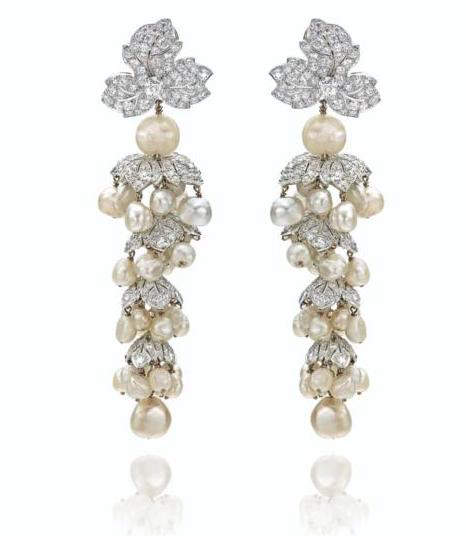
A pair of diamond and pearl pendant earclips
©Sotheby's
The use of old European-cut diamonds on the piece points to its possible 19th-century provenance
The pendant ear-clips are without any doubt antique jewelry pieces, but the period of origin is not known. However, the design features and the type of materials used in the pendant may perhaps give an indication as the possible period of origin. The use of only old European-cut diamonds on the pieces, points to their possible 19th-century provenance, a period during which the cut was introduced and became very popular. The old European-cut that was the forerunner of the modern brilliant-cut has a circular girdle like the latter, but has a heavy crown with a very small table, and a very tall overall depth. Some of the diamond cuts and the periods in which they were introduced and became popular are as follows :- Point-cut - early 1300s; Single-cut - Late 1300s; Rose-cut & Briolette-cut - 1500s; Old mine-cut - 1700s; Old European-cut - 1800s and Modern round brilliant-cut - 1900s. However, it must be remembered that the introduction of a new cut did not mean that all previous cuts were totally forgotten. The Single-cut, first introduced in the early 1300s was prevalent even in the 1900s and persisted well into the 20th-century.
The overall naturalistic theme points to the possible period of origin of the piece - early-Victorian, late-Victorian or Art Nouveau periods
The overall design of the pendant ear-clips, may give an indication as to which period in the 1800s the piece was created. The naturalistic theme of the design, the cluster of grapes and leaves motif, may perhaps indicate that the piece originated in the early-Victorian or Romantic Period, between 1837 to 1860, or during the late-Victorian (1890-1901) and Belle Époque (1901 - 1915) periods. The combination of late-Victorian and Belle Époque periods was known in France as the Art Nouveau period, that originated somewhere around 1890 and ended in 1915. Popular plant motifs during the early-Victorian period were flowers, bouquets of flowers, branches, leaves, grapes and berries. Animal motifs included the snake and serpent motifs, love and song birds and insects. During the late-Victorian period (1890-1901), the Darwinian controversy and new botanical discoveries, once again popularized jewelry motifs, based on natural themes, such as plants and animals. Some of the popular designs included gem-set butterflies, enameled beetles and gold houseflies. During the Art Nouveau period the plant motifs included undulating vines, leaves, ferns and a variety of flowers such as orchids, irises, water lilies, poppies, ivy etc. Animal motifs included insects such as butterflies, dragonflies and bees; birds such as peacocks and swans; and reptiles such as snakes.
The use of pearls in jewelry apart from other gemstones such as colored stones and diamond, is common for the early-Victorian, late-Victorian and Art Nouveau periods. However, during the early-Victorian the use of seed pearls n jewelry became very fashionable.
Metals used in the Diamond and Pearl Pendant Earclips, and their significance
The metals used in the pendant ear-clips are white and yellow gold. The use of yellow gold was common for early-Victorian, late-Victorian and Art Nouveau periods. However, white gold was first introduced only in the 1920s, as an alternative to platinum. White gold is made by mixing pure gold with other metals, such as silver, nickel, palladium, zinc etc. White gold was a cheaper alternative to platinum, and a stronger alternative to silver. White gold is used to enhance diamonds and colored gemstones. The trifoliate top of the pendant ear-clips and the three leaves in each whorl appear to be made of white gold, that enhances the old European-cut diamonds set on them. Yellow gold appears to have been used in this design for the hooks used in the suspension of the baroque pearls, the drop-shaped pearls as well as the entire pendant to the trifoliate top.
The use of white gold on the piece indicates the possible period of origin as Art Deco period
Thus, unless there was a re-setting of the old European-cut diamonds on white gold at a later date, the use of white gold on the piece clearly indicates the possible origin of the piece as the 1920s or thereafter, which is contrary to what other evidences had revealed previously. The period 1920 to 1935 was known as the Art Deco Period. During this period, long earrings were popular, along with diamond watches, pearls, beads, and cocktail rings. Emeralds, sapphires and rubies became the gems of choice in Art Deco jewelry. Thus, it appears that the Diamond and Pearl Pendant Ear Clips originated during the Art Deco period, even though the diamonds used on the pieces were old European-cut diamonds.
The sale of the Pair of Diamond and Pearl Pendant Earclips
The pair of diamond and pearl pendant earclips, was Lot No. 197, at the Sotheby's Magnificent Jewels Sale, No. 8430, held in New York, on Thursday, April 17, 2008. The pre-sale estimate placed on the lot was between USD 20,000 to 25,000. The lot was sold for USD 25,000, equal to the upper pre-sale estimate.
2) A Pair of Diamond and Seed Pearl Lattice-work Earrings
Description of the Diamond and Seed Pearl Earrings
The pair of diamond and seed pearl earrings are designed as lozenge-shaped or rhomboidal plaques with a lattice motif, common during the Art Deco period, from 1920 to 1935. The framework of the lattice is made up of platinum wire and so are the mountings placed on the lattice. The lattice is made up of five parallel wires in two directions. Old European-cut diamonds with round girdles are placed at the intersections of these parallel wires, including the four vertices. There are 25 intersections, including the vertices, carrying 25 old European-cut diamonds. There are 16 smaller rhomboids within the large rhombus, and at the center of each of these rhomboids, a large old European-cut diamond is suspended, by a short platinum wire and mounting, fixed to the upper vertex of the rhomboid. The vertical suspension of the rhomboidal plaque is attached to one of the vertices along the long diagonal of the rhombus. Four old European-cut diamonds are placed along this suspension, with the largest being placed at the edge, where the hook for the suspension is attached. Thus, altogether there are 25 + 16 + 4 = 45 old European-cut diamonds on the lattice work of each earring.
Small spherical seed pearls, smaller in size than the old European-cut diamonds, are mounted in-between the diamonds. Thus, there are 28 seed pearls on the lattice work of each earring. Thus, in both pairs of earrings there are 90 old European-cut diamonds and 56 seed pearls. The total weight of the diamonds is 6.65 carats. The weight of the seed pearls are unknown.
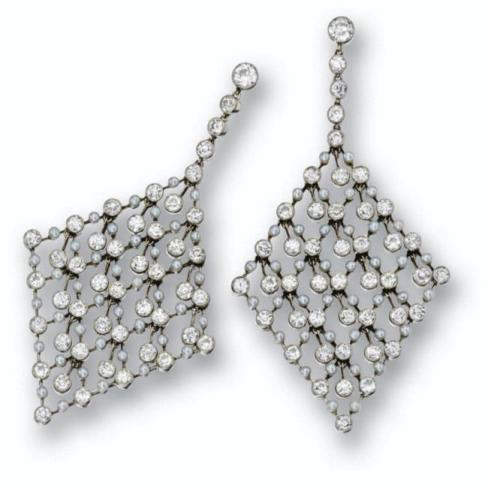
A pair of diamonds and seed pearl earrings
©Sotheby's
The Provenance of the Diamond and Seed Pearl Earrings
Unlike the diamond and pearl pendant earclips considered previously, whose origins were debatable based on different lines of evidence, the pair of diamond and seed pearl earrings has a clear-cut provenance based on its lattice work design, which was popular only during the Art Deco period, that extended from 1920 to 1935. Thus, the diamond and seed pearl earrings with its lattice work design belong to the Art Deco period. Art Deco was a style revolution of straight lines and angles over curved and fluid lines, and bold colors over soft and muted ones. Art Deco was inspired by a combination of influences, such as, Asian, Islamic and Indian Art; African and Egyptian Art; Cubism in the art world and architecture. Some of the designs of this period are the lattice motif (Islamic), pagoda (Indian), dragons (Chinese), sphinx and falcon (Egyptian) etc. Precious metals used for the jewelry were platinum, white gold and tricolor gold. Gemstones used were diamonds, pearls, emeralds, rubies and sapphire. Some of the popular pieces of jewelry were, the diamond straight-line bracelet, long earrings, diamond watches, cocktail rings etc. Bakelite, an early plastic was used as a material for costume jewelry, such as pins, earrings, necklaces and pendants, in geometric, floral and fruit designs. The lattice motif combined with the length of the earrings, provide incontrovertible evidence for the Art Deco provenance of the earrings, despite the use of old European-cut diamonds and seed pearls that were more popular in the 19th-century.
The Sale of the Diamond and Seed Pearl Lattice-work Earrings
The pair of diamond and seed pearl lattice-work earrings was allotted Lot No. 215, at the Sotheby's Magnificent Jewels Sale, held on Thursday, April 17, 2008. A pre-sale estimate of USD 15,000 to 20,000 was placed on the item. However, the lot remained unsold at the auction.
3) A Seed Pearl and Diamond Choker Necklace
Description of the Seed Pearl and Diamond Choker Necklace
The length of the necklace is 13 inches, which falls under the category of choker. The necklace is a seed pearl mesh necklace, consisting of horizontal and vertical rows of pearls. There are seven horizontal rows of pearls. After every 10 vertical rows of pearls, is a vertical bar set with 13 old European-cut diamonds. There are six vertical bars in the necklace, making a total of 78 old European-cut diamonds, weighing approximately 4.25 carats. The diamonds are mounted in gold and silver. Nothing can be said about the clasp of the necklace as the photograph does not reveal the clasp.
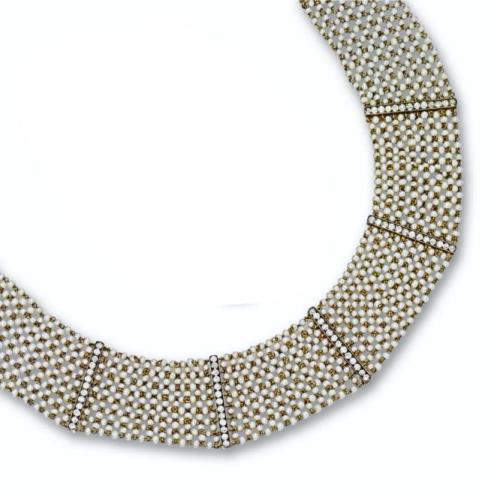
Diamond and Seed Pearl Choker
©Sotheby's
The Provenance of the Seed Pearl and Diamond Choker
The origin of the necklace is said to be approximately 1900. This falls within the late-Victorian period (1890-1901) and Belle Epoque period (1901-1915). The two periods together from 1890-1915 was known as the Art Nouveau period in France. Seed pearl jewelry reached the height of its popularity during the early-Victorian period between 1837 to 1860. After the mid-Victorian mourning period (860-1890), jewelry designing again reached its full expression in diverse designs, a period known as the Aesthetic or late-Victorian period (1890-1901). Princess Alexandra, Queen Victoria's daughter-in-law became the royal trend-setter. Among the jewelry designs popularized by Princess Alexandra were the star and crescent motif, and the dog-collar design known as the choker, encrusted with diamonds, pearls, corals, sapphires and turquoise. The origin of the seed pearl and diamond choker above may also be related to this period, when the popularity of the choker was at its peak.
Sale of the Seed Pearl and Diamond Choker
The seed pearl and diamond choker necklace was listed as Lot No. 217 in the catalogue published by Sotheby's for the April 17, 2008, Magnificent Jewels auction, held in New York. The pre-sale estimate of the necklace was placed between USD 10,000 to 15,000. However, the necklace remained unsold at the end of the auction.
You are welcome to discuss this post/related topics with Dr Shihaan and other experts from around the world in our FORUMS (forums.internetstones.com
References :-
1) Lot 197 - Pair of Diamond and Pearl Pendant Earclips - Sotheby's auction catalogue for Magnificent Jewels Sale, Thursday, April 17, 2008. www.sothebys.com
2) Lot 215 - Pair of Diamond and Seed Pearl Earrings - Sotheby's auction catalogue for Magnificent Jewels Sale, Thursday, April 17, 2008. www.sothebys.com
3) Lot 217 - Seed Pearl and Diamond Choker-Necklace, Circa 1900 - Sotheby's auction catalogue for Magnificent Jewels Sale, Thursday, April 17, 2008. www.sothebys.com
4) Jewelry Periods - Bijoux inspired jewels - www.bijouxjewels.com
5) A History of Antique Jewelry - www.topazery.com
 Home
Security & Guarantee
How it Works
Technology Partners
Updated Tables
Famous Diamonds
More Famous Diamonds
Famous Pearls
Famous Gemstones
Contact Dr Shihaan Larif
Contact Senior Editor
Famous Jewelry
Reference Database
Forums
Learning Center
Gemstone Gallery
e-mail Notifications
Advertise
Press Release
About Us
Privacy Policy
Contact Us
FAQ'S
Site Map
Staff Mail Login
Staff Documents
Birthstones
History
Minerals
Shows
Live Metal Prices
Jewellery Gallery
News
Marketplace
Marketplace Support
Open Store
Online Auctions
Join Us & Contribute
Directory
Classifieds
List your products
Wholesale Trading
Post Buy Request
Go Green Policy
Site Updates
Upcoming-ToDo List
Latest News
Latest Articles
Latest Blog Updates
Chat Rooms
Job Board
User Gallery
Videos
New Newsletter Archive
Old Newsletter Archive
Jewelry & Mineral Blog
User Blogs & Social Network
Search
Answers (Q & A)
Valuation
Help me find a diamond/jewelry
pin.internetstones.com- Social Pinboard- Sart yours & connect with millions
Invite Friends From Yahoo, Gmail etc-One Click
Home
Security & Guarantee
How it Works
Technology Partners
Updated Tables
Famous Diamonds
More Famous Diamonds
Famous Pearls
Famous Gemstones
Contact Dr Shihaan Larif
Contact Senior Editor
Famous Jewelry
Reference Database
Forums
Learning Center
Gemstone Gallery
e-mail Notifications
Advertise
Press Release
About Us
Privacy Policy
Contact Us
FAQ'S
Site Map
Staff Mail Login
Staff Documents
Birthstones
History
Minerals
Shows
Live Metal Prices
Jewellery Gallery
News
Marketplace
Marketplace Support
Open Store
Online Auctions
Join Us & Contribute
Directory
Classifieds
List your products
Wholesale Trading
Post Buy Request
Go Green Policy
Site Updates
Upcoming-ToDo List
Latest News
Latest Articles
Latest Blog Updates
Chat Rooms
Job Board
User Gallery
Videos
New Newsletter Archive
Old Newsletter Archive
Jewelry & Mineral Blog
User Blogs & Social Network
Search
Answers (Q & A)
Valuation
Help me find a diamond/jewelry
pin.internetstones.com- Social Pinboard- Sart yours & connect with millions
Invite Friends From Yahoo, Gmail etc-One Click




Our Global Jewelry Industry Job Network


Buy & Sell in our Marketplace

Subscribe to our Newsletter

List in our Classifieds

List in our Directory

User Uploaded Gallery

Powered by Ultra Secure
Amazon (USA) Cloud Network

Founder Internet Stones.COM
Register in our Forums

| Featured In
|
|
|
|
|
|
|
|







Blog & Education Feed
Articles Feed
 |
 |
 |

Copyright © .Internet Stones.COM. All rights reserved.