Nizam of Hyderabad "Satlada" Pearl Necklace
Open FREE Unlimited Store Join Our Newsletter
Origin of Name :-
The necklace which is a masterpiece of pearl jewelry created by the artisans of Hyderabad in the 19th century is part of the fabulous collection of jewelry consisting of 173 pieces that once belonged to the Nizams of Hyderabad but later acquired by the Government of India, and is today kept in the vaults of the Reserve Bank of India in Mumbai. Thus the necklace gets its name from its internationally renowned, fabulously rich owners, the Nizams of Hyderabad, who ruled the kingdom situated in South-Central India for over 200 years until its forceful annexation to the Indian Union in 1948.

The name "Satlada Haar" refers to a seven-strand necklace in the local language, a five-strand necklace being known as "Panchlada Haar." Some of the other technical terms used by the Hyderabadi pearl jewelers include, "Nizam's jugnil" - two or more strands of pearls linked with a single central ruby-studded gold pendant; "Jadawi Lachcha" - choker with polki and other precious stones laced with a string of pearls; "Kundan Ranihar" - pearl sets with enamel kundan work; "Nagaram" - an elaborate pendant made of kundan work; "Gulubund chokers" - pearl chokers of five strings interspersed with three gold pendants set with rubies and emeralds, and usually worn with "Cholaphool earrings"; "Karanphool and Cholaphool earrings" - set with uncut diamonds and pearls; "Hath phool - finger and wrist ornaments; "Vaddenam" - waist belt; "Chatai" - a mat type chain, earrings and rings; "Chand bali" - a moon-shaped earring; "Rassi" - a chain set in the form of a rope.
Characteristics of the necklace
The necklace similar in design to the seven-strand tri-colored Ceylon Pearl Necklace and the 10-strand Umm Kulthum seed pearl necklace , is made up of seven strands of graded Basra pearls. The common features of these necklaces are 1) They are without a clasp, and the strands are attached at either end to two terminals that are triangular-shaped, bell-cap shaped, or bar-shaped, and usually made of gold. Provision has been made for the attachment of the terminals to tough silk threads, that are used to secure the necklace around the neck of the wearer. This type of arrangement makes sure that all pearls in the necklace are displayed in the front, on the chest, without any being hidden behind the neck. 2) The length of the strands in the necklace decrease gradually from the outer strand to the inner strand, so that all strands appear to be closer to one another, with a minimum gap between two strands. In the case of the Umm Khulthum 10-strand pearl necklace and the Ceylon Pearl Necklace, there are also cross bands to keep the strands separate from one another.
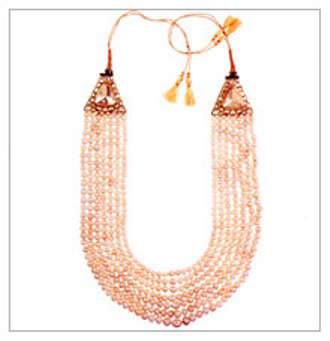
Nizam of Hyderabad Satlada Pearl Necklace
The terminals in the Satlada Pearl Neckace are triangular shaped, made of brilliant enameled gold, each set with a triangular-shaped flat diamond, also surrounded by tiny pearls. In each strand, the larger pearls are situated at the center, and the smaller pearls towards the ends of the necklace. The total number of Basra pearls in the necklace is said to be 465. The size of the pearls in the necklace are not known, but appear to be partly medium-sized and partly seed pearls from photographs of the necklace. The nearly 2 million Basra pearls on the Pearl Carpet of Baroda, commissioned by Maharajah Khande Rao Gaekwar in 1865, are mostly made up of seed pearls.
The color of the Basra pearls in the necklace appear to be light pink in the photograph of the "Satlada Necklace" appearing on the webpage titled Nizam's Jewelry, a press release by the National Museum of India, New Delhi. However, the U-tube video of the Nizam's jewelry uploaded recently, shows the pearls in the "Satlada Necklace" are actually white in color. This is more in conformity with the natural color of Basra pearls, which is mostly white, though other colors such as light-pink, cream, yellow and golden also do sometimes occur. These are some of the colors found in the pearls produced by the pearl oyster Pinctada radiata, the species of oyster that produces the Basra pearls, more commonly known as Persian Gulf pearls. Though the total number of pearls in the necklace is known, the average size of the pearls, and the total weight of the pearls in the necklace are not known.
History of the "Satlada Pearl Necklace"
The source of the pearls
The description of the pearls in the necklace, by the National Museum of India website, as "graded Basra pearls" leaves no doubt as to their origin. The name "Basra pearls" may mean that pearls possibly originated in the waters of the Persian Gulf in the northwestern region of the Gulf, off the coastline of Basra in Iraq. But the most prolific pearl banks in the Persian Gulf were found on the Arabian side of the Gulf, particularly off the coast of Bahrain, Kuwait, Abu Dhabi, Oman, and off the coast of Lavan-Kish island group on the Persian side of the Gulf. Basra was a regional center for the marketing of Persian Gulf pearls; hence all pearls produced in the Persian Gulf irrespective of their country of origin came to be known as Basra pearls. It was from Basra, that the Persian Gulf pearls eventually reached markets in India, such as Bombay and Hyderabad, and the pearl markets of Europe, such as London and Paris. Thus in the pearl markets of these cities, the Persian Gulf pearls, were normally referred to as Basra pearls, though in fact the pearls might have originated elsewhere in the Gulf region, such as Bahrain, Kuwait, Abu Dhabi, Oman etc. The main species of oyster around which the pearl industry of the Persian Gulf had been based since ancient times was Pinctada radiata (Gulf pearl oyster), and to a lesser extent around the species Pinctada margaritifera (Black-lip pearl oyster).
Pinctada radiata, the species of oyster around which the Gulf pearl industry was based
Pinctada radiata is a marine bivalve mollusk, coming under the family Pteridae, that can grow to a maximum size of 7 to 8 cm, and has a maximum lifespan of about 8 years. The shell which is pale yellow in color has 7 to 8 brownish radial bands, and has a lip which is slightly pinkish in color. The nacre is silvery-white in color, producing pearls that are usually silvery-white, but are sometimes cream, light-pink, yellow and golden. Pearls produced by Pinctada radiata are mainly seed pearls, which can occur in aggregates or singly. Seed pearls by definition are pearls less than 2 mm in diameter or less than 0.25 grains in weight. However, Pinctada radiata also produces substantial quantities of pearls that are greater than this size and weight, and can be categorized as small or medium-sized pearls, as well as the extremely rare large sized pearls.
The jewelry collection of the Nizams of Hyderabad
Mir Usman Ali Khan's fabulous collection of jewels were mostly inherited from his predecessors.
The seventh and the last Nizam of Hyderabad, Mir Usman Ali Khan had one of the largest and most fabulous collections of jewels and jewelry, ever put together by a royal family in India, after the end of the classic period of the Mughal empire following the death of Emperor Aurangzeb in 1707. These jewels that included the state regalia and personal heritage of the former Nizams of Hyderabad, were inherited by him from six of his great predecessors, who ruled Hyderabad, since the formation of the Asaf Jah dynasty in 1724. Mir Usman Ali Khan himself may have commissioned some of the pieces during his period of rule between 1911 to 1948. However, most of the pieces in the collection were actually inherited from his predecessors.
The types of jewelry in the collection and the type of gemstones used in their settings
The jewelry that consisted of 173 pieces, were crafted in gold and silver, and some pieces were also embellished with enameling. Gemstones used on the jewelry settings included emeralds from Colombia, diamonds from the Golconda mines and also perhaps from Brazil and South Africa, rubies and spinels from Burma and Afghanistan, and pearls from the Persian Gulf and the Gulf of Mannar. It has been estimated that the entire collection of jewels include over 25,000 diamonds weighing over 12,000 carats, 2,000 emeralds weighing over 10,000 carats, and pearls weighing more than 40,000 chows. ( A chow is an Arabian unit of weight equivalent to .....). The type of jewelry that constitute the collection can be categorized as follows :- 1) Armbands 2) Anklets (Paizeb) 3) Bangles and bracelets 4) Belts and buckles 5) Cuff-links and buttons 6) Earrings 7) Finger rings 8) Gemstones (loose) 9) Necklaces and pendants 10) Nose rings 11) Pocket watches and watch chains 12) Sarpechs (turban ornaments) 13) Toe rings.
Some of the outstanding pieces in the jewelry collection
The most outstanding piece among the collection, is the 184.75-carat, cushion-cut, colorless diamond, of South African origin, the 8th largest colorless diamond in the world, known as the Imperial diamond or the Victoria-Jacob diamond, which by today's estimates is said to cost around $ 70 million, which is almost equivalent to the total price paid for the entire collection by the Government of India in 1995. Please click here to go to our special webpage on the Victoria-Jacob diamond under the section dedicated to famous diamonds. Among the other loose gemstones are 22 emeralds of exceptional quality from Colombia weighing a total of 414.25 carats, the largest emerald having a weight of 60 carats. This is apart from an exceptionally large variety of other cut emeralds, emerald drops and emerald beads, also from the same source. Some of the outstanding pieces of jewelry include, the seven-stranded "Satlada Pearl Necklace" made of 465 Basra pearls, the subject of this webpage; an armband with fine Deccan workmanship, made of enameled silver with openwork foliate design, consisting of three hinged segments and set with foiled table-cut diamonds; a belt buckle, also made in three segments hinged together, showing exquisite Deccan craftsmanship with 146 diamonds weighing over 55 carats, foil set in Kundan setting, the central 5 diamonds weighing approximately 30 carats; a pair of anklets of Mughal design set with old-cut Golconda diamonds, with a crest of pearls along the upper edge and pear-shaped drops, set with foiled diamonds forming a fringe along the lower edge.
Another notable piece of jewelry is a ring, set with an unusually large Alexandrite from Russia, believed to be a gift by Emperor Aurangzeb, to his able commander-in-chief in the Deccan, Mir Qamar-ud-din, who was given the titles Fateh Jung and Asaf Jah, and subsequently became the first Nizam of Hyderabad in 1724, after declaring his region independent of the Mughal empire. A 640-carat diamond encrusted belt made in France by Oscar Massi Pieres is another important piece in the collection. The turban ornaments or sarpechs in the collection, a piece of jewelry designed to be worn on the turban as a replacement for the traditional crown, that was banned by royal injunction during the reign of Queen Victoria, are also striking pieces in the collection. A sarpech consists of a central band made up of five hinged segments, known as a "sarpatti" and a vertical piece curved towards one side, arising from the central segment known as "kalgha." The center of each segment in one of the sarpechs is occupied by a pearl, surrounded by diamonds. The curved "kalgha" is also set with diamonds. Drop-shaped emerald pendants arise from below the "sarpatti" and a single drop-shaped emerald pendant from the end of the curved "kalgha."
How the Nizam's jewelry collection came to be acquired by the Government of India ?
The jewels of the Nizams are placed in two trusts created by Mir Usman Ali Khan, the 7th Nizam of Hyderabad
After the annexation of Hyderabad to the Indian Union in 1948, and the forceful abdication of Mir Usman Ali Khan, the 7th and the last Nizam of Hyderabad, all items in the Nizam's enormous collection housed in the royal treasury were inventoried. Mir Usman Ali Khan then divided the jewels into two lots, and placed them in two trusts, one known as the "H. E. H. Nizam Jewelry Trust" and the other as "H. E. H. Nizam Supplemental Jewelry Trust," with the stipulation that the jewels should not be sold during the lifetime of his eldest son Azam Jah. He further insisted that the jewels of the two trusts be placed in the safe vaults of the Flora Fountain Branch of the Hong and Shanghai Banking Corporation in Mumbai. The Government of India did not interfere with this arrangement, because as a matter of policy it had allowed all former Maharajahs of Princely States to dispose of their jewelry collections as they pleased, whether personal or those belonging to the crown.
The Government of India obtains stay order from the Supreme Court suspending the auction of the Nizams' jewels in the early 1970s
Mir Usman Ali Khan died in 1967 followed by his eldest son Azam Jah in 1970. The trustees then decided to sell part of the jewels by an internationally publicized auction in order to meet the staggering tax liabilities of the family. Buyers from all over the world flocked to Bombay, where the auction was to be held, but just before the auction could take place, Dr Laxmi Prasad Sihare, the Head of the National Gallery of Arts of India arrived with a stay order from the Supreme Court suspending the auctions, on the grounds that the jewels were part of the National Heritage of India and hence should be preserved in the country. The jewels were then returned to the vaults of the HSBC. However, the Government of India's position could not be justified, as it had allowed all other Maharajahs to dispose of their jewels without any government intervention. Some of the renowned pieces of inestimable value that were forever lost by the country included the famous "Patiala diamond necklace" designed by Cartier that incorporated the 234.65-carat De Beers diamond as its centerpiece, and the "Pearl Carpet of Baroda" commissioned by Gaekwar Khande Rao in 1865, the most extravagant carpet ever made incorporating over 2 million Basra pearls.
Protracted legal battle over the jewels, that results in the Government of India purchasing the collection for $71 million
The trustees then filed action in the Supreme Court in 1979 seeking permission for the disposal of the jewels, in order to meet the pressing financial commitments of the family, that led to a long drawn out legal battle that lasted 16 years. Eventually, the Government of India decided in 1993 to purchase the entire collection from the descendants of the late Nizam, after independent evaluation by renowned auction houses such as Sotheby's and Christies, who placed a value of $162 million and $135 million respectively on the collection. Further negotiations were held to decide on a price mutually acceptable to both parties, and finally the GOI decided to purchase the entire collection for a sum of Rs. 218 crores, equivalent to about $71 million. Yet, the transaction could not be concluded as the GOI said that payment could be effected only in six installments, which was rejected by the trustees. The matter went up to the Supreme Court again, which decided in favor of the trustees, and the Government was ordered to pay up in full, failing which the trustees were granted permission to invite foreign buyers to sell the collection. The GOI requested more time to effect full payment, which was granted, and the Supreme Court set January 16, 1995 as the last date to conclude the deal, after which the deal lapsed and the trustees would be free to sell the collection as they pleased. The government then got the approval of both Houses of Parliament, the Lokh Sabah and the Rajya Sabah, and the deal was finally concluded on January 12, 1995. After the conclusion of the deal the entire collection was moved from the vaults of the Flora Fountain Branch of the HSBC to the Reserve Bank of India, where the collection is still housed until the GOI decides on a permanent venue to exhibit the renowned jewels.
The jewels of the Nizams of Hyderabad go on display in Delhi and Hyderabad in 2001 and 2007
The fabulous collection of jewels of the Nizams of Hyderabad, went on public display for the first time in August 2001, six years after it was acquired by the Government of India. The exhibition was held under tight security conditions at the National Museum in Delhi for six weeks. The exhibition that generated much public enthusiasm in Delhi was a tremendous success, and was later moved to the Salar Jung Museum, Hyderabad, Andhra Pradesh, the State of origin of the renowned collection, in order to give the people of the state an opportunity to view and acquaint themselves with a part of their proud heritage, for which their ancestors had contributed in no small measure. After the Salar Jung exhibition, the jewel collection was again moved back to the vaults of the Reserve Bank of India in Bombay. Six years afterwards in September 2007, the collection again went on display for about two months, in a special vault at the National Museum in Delhi, where provision was made for stringent electronic surveillance. The exhibition that was manned by over 100 Central Industrial Security Force (CISF) personnel besides the museum's own security guards, was opened on Wednesday, September 26, 2007, by Dr. Karan Singh, President, Indian Council for Cultural Relations. As part of the stringent security measures enforced, visitors were not allowed to carry mobile phones and cameras, and were admitted to the exhibition hall in batches of 50, for a period of only 30 minutes. The jewels were displayed in 29 show cases in the exhibition hall where special lighting arrangements had been put in place. After the Delhi exhibition the jewels were again moved to the Salar Jung Museum in Hyderabad, for a second exposition, and then returned to the vaults of the RBI in Bombay. The present market value of the jewel collection is estimated to be over US $6 billion.
Hyderabad - the capital city of the Golconda kingdom under the Qutb Shahi rulers, and the Hyderabad kingdom under the Asaf Jah Nizam rulers
Golconda city, the first capital of the Golconda kingdom under the Qutb Shahi rulers
The kingdom of Golconda, in the southeastern part of the Deccan region of India, was one of the five successor states of the former Bahmani kingdom (1347-1518), and was founded by Quli Qutb Shah, a Turkish governor of the Bahmani eastern region, who declared independence in 1518 and set up his capital in Golconda. The Qutb Shahi rulers converted Golconda into a fortified city, with a fortress 5 km in circumference, built of concentric masonry-block walls. Palaces, mosques, towers, minarets, and administrative buildings were built inside the fortress, and parks and gardens were also created. The fortress had 87 semi-circular bastions, eight gateways and four drawbridges.
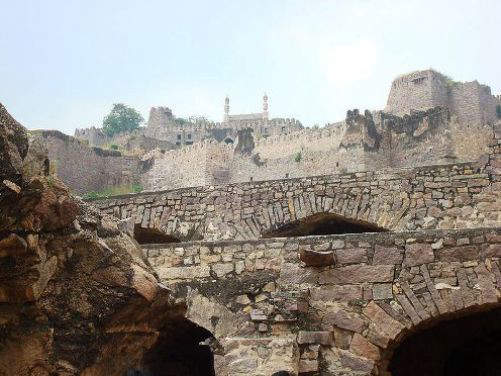
Golconda Fort
A new capital city named Hyderabad was built in 1590 by Muhammad Quli Qutb Shahi
The fortress city of Golconda remained the capital of the Golconda kingdom until 1590, when it was realized, that the area covered by the fortress was hardly adequate to accommodate a fast growing capital. Besides there was a serious water shortage within the fortress, as sources of water was scarce. The 5th Qutb Shahi king, Muhammad Quli Qutb Shahi who studied the problems encountered in Golconda city, finally decided to build a new capital city, 11 km east of Golconda, on the east bank of the Musi River, which he named Hyderabad. The king's architects and city planners first built an imposing structure that dominated the skyline of the city, known as the Charminar, incorporating Indo-Saracenic architecture, with open arches and four minarets. This architectural marvel, considered as the greatest architectural achievement of the Qutb Shahi period, became the centerpiece around which the new city of Hyderabad was planned. Another architectural masterpiece of the period is the famous "Mecca Mosque" that can accommodate 10,000 worshippers. The Qutb Shahi rulers converted Hyderabad into one of the most beautiful and affluent cities in the sub-continent during this period. Another engineering marvel of this period is the "Purana Pul" bridge, spanning the Musi River, with its 22 arches. The entire structure which is over 400 years old, had stood the test of time, withstanding many devastating floods over the centuries, and was compared by Tavernier to the Pont Neuf in Paris. From the bridge a broad roadway was built running into the heart of the city, and terminating at the Charminar. Muhammad Quli's court chronicler writes, "when the lay out of the new city was complete, the sultan ordered 14,000 shops, schools, caravanserais, mosques and baths to be built on both sides of the road." Today, this street is known as the Lad Bazaar.
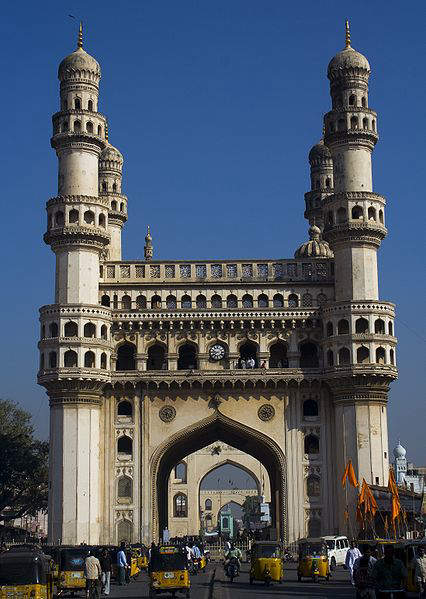
Charminar Hyderabad
Jean de Thevenot, another French traveler, who visited Hyderabad in 1666 during the Qutb Shahi period, wrote that he found "many rich merchants, bankers, jewelers and vast numbers of very skilful artisans in the city," and goes on to describe a fine piece of jewelry worn on the Sultan's turban, "a jewel almost a foot long, said to be of inestimable value. It is a rose of great diamonds which has as its end a lovely long pearl shaped like a pear, and makes an exceeding rare show."
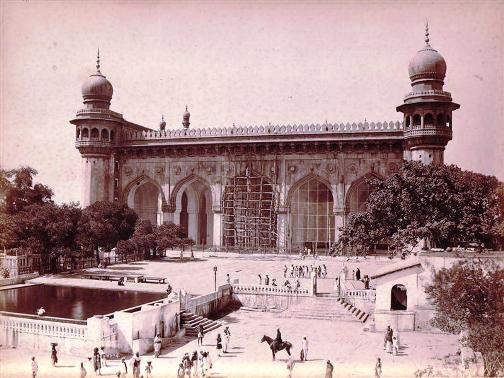
Mecca Masjid, Hyderabad India
Another tribute to the beauty of Hyderabad was made by none other than its conqueror the mighty Mughal emperor Aurangzeb, whose chronicler Muhammad Saqi described the city after its capture in 1687, "It gives solace to the human heart and body..... the flowers of this land may be compared with the glitter and color of its emeralds and rubies."
Golconda kingdom becomes part of the Mughal empire in 1687, and in 1724 becomes an independent kingdom under the Asaf Jah dynasty
The Golconda kingdom was ruled by the Qutb Shahi rulers until 1687, when the kingdom was captured by Emperor Aurangzeb, who annexed it to the Mughal empire. The region remained under Mughal rule until 1724, when the viceroy of the Mughals for the Deccan region, Mir Qamar-ud-Din, taking advantage of the decline in Mughal power after the death of Aurangzeb in 1707, declared independence and founded the kingdom of Hyderabad. Mir Qamar-ud-Din became the first Nizam of Hyderabad, and was known as the Nizam-ul-Mulk. The kingdom of Hyderabad became a British Protectorate in 1798, under the second Nizam of Hyderabad, Nizam Ali Khan, and maintained its status quo, until the British granted independence to India in 1947. During the 19th century, the Nizams of Hyderabad embarked on a program of rebuilding the city, expanding to the north of the old city across the Musi river. Further north, Secunderabad grew rapidly as a British cantonment. Secunderabad was connected to Hyderabad by a mile-long bund on the Husain Sagar Lake. Today, the bund serves as a promenade and has become the pride of the city. The Nizam rulers also constructed many new structures, whose architecture reflected a synthesis of Hindu and Islamic styles. Almost all the public buildings currently used by the State Government of Andhra Pradesh, was built by the former Nizams of Hyderabad. Some of these buildings are the Osmania University, Osmania Arts College, Osmania Medical College, the Osmania General Hospital, the Asafiya Library now known as the Central State Library, the Andhra Pradesh High Court, Hyderabad Museum, the Town Hall, the Jubilee Hall, and other buildings in the Public Garden. In 1947, the kingdom of Hyderabad refused to join either India or Pakistan during the partition, and chose to remain as a independent state in its own right. However, in 1948 the Indian army moved in and captured the kingdom forcing the last Nizam of Hyderabad to abdicate.
Exploitation of the Golconda diamond mines during the Qutb Shahi period, Mughal period and the Asaf Jah period
The Qutb Shahi rulers obtained the maximum benefit out of the Golconda diamond mines from around 1540 to 1687
The Golconda kingdom became internationally renowned not only as a source of gold, but also as the only source of diamonds in the world during the 16th and 17th centuries. The Kollur diamond mines situated about 40 km southeast of Golconda fortress, on the right bank of the Kistna River, west of Chintapilly, were discovered in the mid-16th century (1540 to 1560) and became one of the most prolific diamond mines in the eastern Deccan plateau. The mine was in active production for about 200 years, until the end of the 18th century. When Tavernier visited Golconda in 1642, more than 20 mines were being exploited, employing over 60,000 people. Peak production period in the Golconda mines was during the 17th century. Production began declining during the 18th century, and was almost exhausted by the end of that century. The peak production period of the Golconda mines fall within the period of rule of the Qutb Shahi kings, who ruled Golconda for 169 years from 1518 to 1687. Thus the Qutb Shahi rulers obtained the maximum benefit out of the Golconda mines. Part of the diamonds produced in the mines entered the courts of the Qutb Shahi kings. Significant quantities of diamonds might also have ended up in the courts of the Mughal emperors, after they were purchased by their agents in Hyderabad. Diamonds from the Golconda mines might also have ended up in the courts of the Shahs of Persia, with whom the Qutb Shahis had close diplomatic and religious ties. Finally enterprising European travelers and diamond dealers like Tavernier also purchased significant quantities of diamonds, which ended up in the courts of the European monarchies.
The Golconda mines directly benefited the Mughal rulers for 37 years from 1687 to 1724
The period of Mughal rule in Golconda lasted for 37 years, from 1687, when the kingdom was captured by Emperor Aurangzeb and annexed to the Mughal empire, until 1724 when the region was declared an independent kingdom by Asaf Jah, Mir Qamar-ud-Din, who became the Nizam-ul-Mulk, the first Nizam of Hyderabad. During this period too there was substantial production of diamonds from the Golconda mines, which directly benefited the Mughal empire.
The Nizams of Hyderabad benefited the least from the Golconda diamond mines due to decline in production
The period of rule of the Nizams of Hyderabad of the Asaf Jah dynasty from 1724 onwards, corresponds with a decline in production of the Golconda mines, which eventually comes to a standstill by the end of the 18th century. Thus, the Nizams of Hyderabad benefited the least from the Golconda diamond mines, yet the diamonds produced during a period of about 75 years from 1724 to 1800, had entered the courts of the Nizams of Hyderabad, and were used in the designing of some of the fabulous pieces of diamond jewelry found in the collection of the Nizam's jewels. It might also be possible that just as emeralds from Colombia, rubies from Burma and pearls from Basra and Ceylon reached the Nizams court, diamonds from Brazil and South Africa would have also reached the court, after their discoveries in the early 18th and late 19th centuries respectively. The Victoria-Jacob diamond of South African origin entered the Nizam's court during the rule of Mir Mahboob Ali Khan, the 6th Nizam of Hyderabad, between 1869 and 1911.
Hyderabad - the Pearl City of India
Pearls, though not a product of Hyderabad left a lasting impression on trade and commerce in Hyderabad
The Qutb Shahi rulers of the Golconda kingdom and the Asaf Jah rulers of the Hyderabad kingdom were great patrons of the arts, literature, architecture, culture, jewelry designing and rich food. The 169-year rule of the Qutb Shahi dynasty followed by the 224-year rule of the Asaf Jah dynasty laid a solid foundation for the jewelry industry of Hyderabad which thrives up to this day. The imperial patronage extended to the jewelry industry led to the creation of a workforce skilled in jewelry designing and crafting based partly on Mughal craftsmanship and partly on Southern Deccan craftsmanship acquired from the "Vijayanagar" kingdom. The gemstones used in the jewelry settings of this period were mainly diamonds, pearls, emeralds and rubies, as seen from the Nizams' jewelry collection. Hyderabad was the main supplier of diamonds to the entire world for about two and a half centuries from around 1550 to around 1800, originating from the famous Golconda mines. Diamonds from Golconda were renowned for their highest quality, transparency, whiteness and purity, referred to in the international diamond trade as "diamonds of purest water." Some of the other descriptive terms applied for Golconda diamonds were "purest of the pure," "whiter than white," and "brighter than bright." However, in spite of Hyderabad's international fame as the main source of diamonds for over two and a half centuries, it was pearls from the Gulf of Mannar and the Persian Gulf that have over time left the boldest mark on Hyderabadi culture and trade, that today, Hyderabad has become the largest center for pearl trading not only in India but also the entire world, selling about 40-50 thousand kilograms of pearls each year. If in Hyderabad there once was a jewelry industry based on the cutting and polishing of rough diamonds and their subsequent setting on pieces of jewelry, such traditions appeared to have disappeared with the exhaustion of its rich diamond sources.
How Hyderabad became the world's largest trading center for pearls despite the fact the city was landlocked with the ocean more than 300 km away ?
What amazes everybody is how Hyderabad achieved the status of the top pearl trading center in the world, a landlocked city, with the ocean more than 300 km away. The answer lies in the city's history. Two centuries of a vibrant pearl culture with imperial patronage of the Nizams of Hyderabad had given rise to artisans skilled in their trade. The patronage of the Nizams attracted many craftsmen from distant parts of the world, especially the Persian Gulf, the most ancient source of natural pearls in the world. Arab traders of the Persian Gulf not only preferred to sell their pearls to the Nizams of Hyderabad because of the attractive prices paid by them, but also encouraged Arab artisans who were skilled in sorting, grading and piercing pearls to settle down in Hyderabad and work for the Nizams. This resulted in the technological transfer needed to sustain a pearl jewelry industry in Hyderabad. Some of the skills of the pearl industry such as drilling, was a jealously guarded family secret, passed down from generation to generation. Drilling is a highly skilled job, still done by hand, and carried out to perfection in Hyderabad. Thus, the availability of skilled manpower was one of the main factors that was responsible for sustaining a jewelry industry based on pearls in Hyderabad for generations, and making Hyderabad the top pearl trading center in the world today. It is said that nine out of every ten pearls in the world pass through Hyderabad in India, at a certain stage for finishing, piercing and stringing. Unmatched craftsmanship and amazingly low labor cost are two factors that attracted pearls to the Hyderabad pearl market. The artisans of Hyderabad are skilled in piercing and stringing pearls without damaging them.
The sources of pearls that reached the Hyderabad pearl market in the past
The main sources of pearls that reached the Hyderabad pearl market in the past was the Gulf of Mannar in Sri Lanka (Ceylon), and the Persian Gulf, the source of Basra pearls. Pearls from Ceylon reached Hyderabad via the city of Madurai in South India, and those from the Persian Gulf, through the Portuguese controlled port of Goa on the west coast of India. Pearls from Ceylon were regarded as the finest quality, as they were mostly uniformly white. Ibn Batuta who visited Sri Lanka in 1344, writes in his travelogue about a meeting with the king of Ceylon, "One day I went to him while there lay about a large number of pearls. His men were busy sorting and classifying the best. "Have you seen any pearl fishing in the countries you come from ?" he asked. "Yes, on the islands of Gays and Kish (in the Persian Gulf)," I said. Then he picked up a few and asked, "Are their pearls like these ?" "They are inferior" I replied. He was delighted and said, "These pearls are yours. Don't be shy, you can demand of me as many as you desire."
Cultured pearls from China and Japan have replaced the natural pearls from Ceylon and the Persian Gulf
Today, the famous Ceylon pearls are unheard of in Hyderabad, but the slightly yellowish pearls from the Persian Gulf, known as Basra pearls are readily available, mainly as newly restrung necklaces and in precious old settings. After the death of the natural pearl industry in the Persian Gulf in the 1930s following the flooding of the international pearl markets with Japanese cultured pearls, the Hyderabad pearl industry too adapted itself to newly available cultured products. Today, dealers in Hyderabad import raw pearls from China and Japan, and Hyderabad has become the nerve center of India's pearl trade.
Traditional pearl jewelry designs survive side by side with modern western designs
In the Hyderabad's pearl jewelry industry it is interesting to find that the traditional designs survive side by side with modern western designs. Pearl jewelry designers in the past had combined pearls with the glitter of gold, rubies and emeralds. Among the traditional pearl jewelry designs still produced are the "Satlada and Panchlada Haar" the seven and five-stringed pearl necklaces, interspersed with emerald or onyx beads set in nine-carat gold. Earrings such as the "Karanphool" and "Cholaphool" set with uncut diamonds and pearls, are popular jewelry items among the ladies of the city. Another popular traditional pearl jewelry item that is normally worn with the "Cholaphool" earrings, is the "Gulubund" choker made up of five strings of pearls, interspersed with three gold pendants set with rubies and emeralds. Another item that is popularly worn with the "Panchlada Haar" the five-stringed pearl necklace, is the "Nagaram," an elaborate pendant made of Kundan work. Cultured pearls are studded in gold and silver jewelry whose exquisite designs show modern western influences. The city is also famous for the soft, rounded, luminescent, tear-drop pearl, apart from the precious Basra pearl available in select stores.
The name Hyderabad is synonymous with pearls of high quality
Today, the city of Hyderabad has become almost inseparable with the mention of pearls. The name Hyderabad is synonymous with pearls of high quality. The city is undoubtedly the largest trading center for pearls in India, and perhaps also one of the largest in the world. The center of the pearl trade in Hyderabad are Patther Gatti and Lad Bazaar. Patther Gatti is an entire street lined with shops specializing mainly on the sale of pearls and pearl jewelry, apart from some semi-precious jewelry set with garnets, topaz, jade and corals. Some of the pearl stores situated on this street are more than a century old with ownership running into the third or fourth generation.
The processing of raw pearls in Chandampet near Hyderabad. The drilling of pearls by "barnalgaru"
Raw pearls that are imported in bulk into Hyderabad are mainly Chinese freshwater pearls. These raw pearls are processed mainly in a village by the name of Chandampet near Hyderabad, where around 500 families with special skills in the drilling and processing of pearls, a knowledge that has been passed down faithfully for generations live. The first step in the processing is the drilling of a hole in the pearl, by the drillmaster known as "barnalgaru." The art of drilling pearls is an exacting job second only to diamond cutting. Just a small slip of the drill can disqualify even the most lustrous specimen from ever adorning a neck or ear. Drilling is done manually usually with a hand-powered bow drill. The driller examines each pearl carefully to select the best possible pathway for drilling a hole whose diameter measures just a fraction of a millimeter. The drilling is done while the pearl is fixed to a wooden vise on the workbench. As the drilling proceeds steadily, the driller dips his little finger into a water dish and flicks a drop onto the pearl, which wets the pearl dust that mounds around the hole, that prevents binding up the bit before it exists cleanly from the bottom of the pearl. The workroom of a drillmaster smells like a dentist's surgery, with the same high-pitched sound of a drill and the same acrid odor of burnt calcium, the chemical composition of nacre and enamel being almost identical.
Sorting of pearls according to color, size and shape and stringing by "patwas"
After drilling the pearls are sorted according to color, such as pink, peach, white and gray and then according to shades of the same color, such as light pink from dark pink, milk white from cream white etc. Pearls with a muddy color are processed by boiling in water for four to five days before being put into airtight glass bottles and treated with hydrogen peroxide, ether, water and alcohol. The bottles are then placed in the sun for four to five days that removes impurities. After bleaching the pearls acquire a whitish or creamish sheen. The pearls are then sorted according to size and shapes. Shapes can be symmetrical, such as round, near-round, button with one flat side, oval and drop-shaped or asymmetrical such as flower, potato, rice, seed and baroque. The pearls are finally strung by skilled stringers known as "Patwas" who use soft silken strings or gold wire, so as not to damage the delicate pearls.
In Hyderabad the primary jewelry market is for pearl jewelry
In Hyderabad buying and selling pearl jewelry is part of the 400-year old tradition of the city. The use of pearl jewelry is becoming increasingly popular among the women folk of the city, as well as Andhra Pradesh State and the country as a whole. Pearls are now becoming an important part of the brides trousseau in India. Jewelers combine pearls with semi-precious stones, diamonds and kundan in designing exquisite pieces of jewelry, and without any doubt the primary jewelry market in Hyderabad is very clearly for pearls. The popularity of pearl jewelry in India in general and Hyderabad in particular is a continuation of the deep-seated traditions set by the former Nizams of Hyderabad, a tradition that turned out exquisite pieces of jewelry found in the Nizams' fabulous collection of jewels, including the famous "Satlada Pearl Necklace" the subject of this webpage.
You are welcome to discuss this post/related topics with Dr Shihaan and other experts from around the world in our FORUMS (forums.internetstones.com)
Related :-
External Links :-
1) Nizam's Jewelry - Press release, by the National Museum, New Delhi. Ministry of Culture, Government of India
References :-
1) Jewels of the Nizam - From Wikipedia, the free encyclopedia.
2) Jewels of the Hyderabad Nizams to dazzle Delhi from today - Puneet Nicholas Yadav. www.dnaindia.com
3) Nizam's jewels bedazzle Delhi - India News, Sept. 26, 2007.
4) Nizam's Jewelry - Press release, by the National Museum, New Delhi. Ministry of Culture, Government of India.
5) Diamonds were the Nizam's best friend - Luke Harding, www.guardian.co.uk/world/2001/aug/27/worlddispatch.lukeharding
6) India's City of Pearls - by Shanti Mahadevan, published January 25, 2006. www.writerstoyou.com
7) City of Pearls - Louis Wemer. Article published in "Saudi Aramco World." www.saudiaramcoworld.com
 Home
Security & Guarantee
How it Works
Technology Partners
Updated Tables
Famous Diamonds
More Famous Diamonds
Famous Pearls
Famous Gemstones
Contact Dr Shihaan Larif
Contact Senior Editor
Famous Jewelry
Reference Database
Forums
Learning Center
Gemstone Gallery
e-mail Notifications
Advertise
Press Release
About Us
Privacy Policy
Contact Us
FAQ'S
Site Map
Staff Mail Login
Staff Documents
Birthstones
History
Minerals
Shows
Live Metal Prices
Jewellery Gallery
News
Marketplace
Marketplace Support
Open Store
Online Auctions
Join Us & Contribute
Directory
Classifieds
List your products
Wholesale Trading
Post Buy Request
Go Green Policy
Site Updates
Upcoming-ToDo List
Latest News
Latest Articles
Latest Blog Updates
Chat Rooms
Job Board
User Gallery
Videos
New Newsletter Archive
Old Newsletter Archive
Jewelry & Mineral Blog
User Blogs & Social Network
Search
Answers (Q & A)
Valuation
Help me find a diamond/jewelry
pin.internetstones.com- Social Pinboard- Sart yours & connect with millions
Invite Friends From Yahoo, Gmail etc-One Click
Home
Security & Guarantee
How it Works
Technology Partners
Updated Tables
Famous Diamonds
More Famous Diamonds
Famous Pearls
Famous Gemstones
Contact Dr Shihaan Larif
Contact Senior Editor
Famous Jewelry
Reference Database
Forums
Learning Center
Gemstone Gallery
e-mail Notifications
Advertise
Press Release
About Us
Privacy Policy
Contact Us
FAQ'S
Site Map
Staff Mail Login
Staff Documents
Birthstones
History
Minerals
Shows
Live Metal Prices
Jewellery Gallery
News
Marketplace
Marketplace Support
Open Store
Online Auctions
Join Us & Contribute
Directory
Classifieds
List your products
Wholesale Trading
Post Buy Request
Go Green Policy
Site Updates
Upcoming-ToDo List
Latest News
Latest Articles
Latest Blog Updates
Chat Rooms
Job Board
User Gallery
Videos
New Newsletter Archive
Old Newsletter Archive
Jewelry & Mineral Blog
User Blogs & Social Network
Search
Answers (Q & A)
Valuation
Help me find a diamond/jewelry
pin.internetstones.com- Social Pinboard- Sart yours & connect with millions
Invite Friends From Yahoo, Gmail etc-One Click




Our Global Jewelry Industry Job Network


Buy & Sell in our Marketplace

Subscribe to our Newsletter

List in our Classifieds

List in our Directory

User Uploaded Gallery

Powered by Ultra Secure
Amazon (USA) Cloud Network

Founder Internet Stones.COM
Register in our Forums

| Featured In
|
|
|
|
|
|
|
|







Blog & Education Feed
Articles Feed
 |
 |
 |

Copyright © .Internet Stones.COM. All rights reserved.