A Pair of Antique Natural Pearl and Diamond Ear Pendants
Open FREE Unlimited Store Join Our Newsletter
Origin of Name :-
The name refers to an attractive pair of antique natural pearl and diamond ear pendants that was Lot No. 160 at Christie's Contemporary Jewelry and Watches Sale, No. 7664, held at Jumeirah Emirates Towers Hotel in Dubai, on April 29, 2008. The antique ear pendants believed to have originated around the year 1880, fetched a selling price of $217,000, a record, for a pair of ear pendants of this nature, and was within the pre-sale estimated range of $180,000 to $250,000.

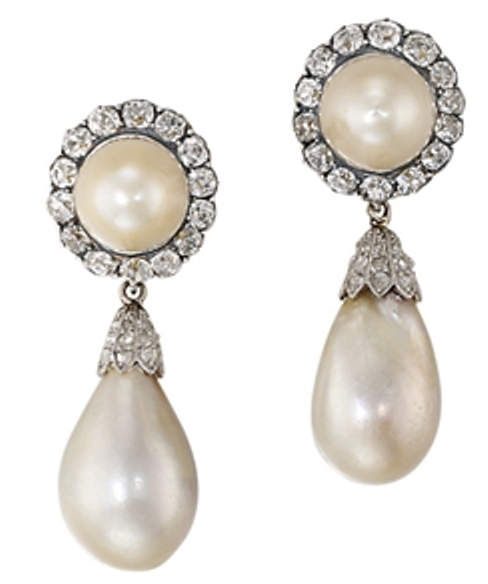
Pair of antique pearl and diamond ear pendant
©Christie's
Characteristics of the pair of natural pearl and diamond ear pendants
Each of the ear pendants that has a length of 5.2 cm, consists of two parts :- the ear stud and the pendant suspended from it. The centerpiece of the ear stud is a button-shaped pearl, surrounded by a layer of old-cut diamonds. The drop-shaped pearl that forms the pendant is suspended from the ear stud, by a bell cap arrangement mounted on top of the pearl. The metal used in the ear pendants appears to be either silver or gold.
Characteristics of the pearls in one ear pendant
The dimensions, weight and shape of the pearls
The button-shaped pearl in one pendant has a long and short diameter of 11.83 mm and 10.94 mm, which gives a variation in diameter of (1 - 10.94/11.83) x 100% = (1 - 0.92) x 100% = 0.08 x 100 = 8%. The variation in diameter of 8% is consistent with that of a near-spherical pearl. Thus, the pearl described as button-shape, is in fact a near-spherical pearl.
The weight of this pearl is 10.23 carats which is equivalent to 10.23 x 4 = 40.92 grains.
The drop-shaped pearl in this ear pendant has a maximum length and width of 21.10 mm and 14.30 mm respectively and a weight of 26.86 carats (107.44 grains). The pearl is not a perfect drop-shaped pearl, like the Drexel Pearl or the perfect drop-shaped pearl in the Belle Époque natural grey/brown pearl pendant necklace that appeared under Lot No. 174 in the same auction. One side of the drop-shaped pearl bulges out more than the other side.
The color, overtones, luster and orient of the pearls
The color, overtones, luster and orient of the two pearls in this ear pendant are consistent with their saltwater origins. The color of the pearls are white, the most sought after color in pearls. Both pearls have a distinct pink overtone that appears to float over the surface of the pearl. The white color of the pearl is actually the color of aragonite that shows through in the absence of colored pigments in the conchiolin part of the nacre. The overtone colors are caused by an optical effect as light passes through successive layers of aragonite. Luster and orient of the pearls are also optical effects caused by reflection and refraction of light respectively. All the four properties, color, overtones, luster and orient depend on the thickness of the nacre, which is at optimum level in these pearls, being natural pearls made entirely of nacre.
Characteristics of the pearls on the other ear pendant
The dimensions, weight and shape of the pearls
The button-shaped pearl on the other pendant has the longest and shortest diameter of 11.75 mm and 10.92 mm. This works out to a variation in diameter of (1 - 10.92/11.75) x 100% = (1 - 0.93) x 100 = 0.07 x 100 = 7%. A variation in diameter of 7% according to the definition falls within near-spherical pearls, whose variation in diameter ranges from 2% to 20%. Only when the variation in diameter exceeds 20%, does the pearl become a button pearl. Thus, like the pearl in the previous ear pendant, this pearl is also a near-spherical pearl. The weight of this near-spherical pearl is 9.99 carats, which is equivalent to 39.96 grains.
The drop-shaped pearl in this ear pendant has dimensions of 21.18 mm and 13.45 mm, which represent the greatest length and width of the pearl. The weight of this pearl is 22.82 carats, equivalent to 91.28 grains. This pearl is a more perfect drop-shaped pearl than the drop-shaped pearl in the other ear pendant, but still has some slight irregularities.
The color, overtones, luster and orient of the pearls
The color and overtones of these pearls perfectly matches the color an overtones of the pearls in the other ear pendant. The body color of the pearls are white, and the overtone color pink. The luster and orient of the pearls are also comparable to the luster and orient of the pearls in the other ear pendant.
Difficulties faced by the unknown designer of the ear pendants in matching for shape, size and weight
Thus, the pearls in the two ear pendants, match perfectly for their color, overtones, luster and orient. They also match to some extent for their dimensions and shapes, but not so much for their weights. The two near spherical pearls have weights of 10.23 carats and 9.99 carats, the difference being only 0.24 carats. Thus, the two near-spherical pearls are almost perfectly matched. The two drop-shaped pearls on the other hand, have weights of 26.86 carats and 22.82 carats, the difference being 4.04 carats, which is quite significant, and are therefore not perfectly matched. However, given the fact that these are natural pearls which are extremely rare, matching for shape, size and weight can be an extremely difficult task, facing the jewelry designer. Given the difficulties and constraints that the unknown designer of these attractive pair of ear pendants, had to contend with, it can be said that he has accomplished an excellent job, exhibiting his handcrafting skills under the most difficult circumstances.
History of the pair of natural pearl and diamond ear pendants
The year of origin of the ear pendants correspond with the mid-Victorian period
Nothing is known of the historical provenance of the ear pendants, except for the fact that it originated around the year 1880. This corresponds with the mid-Victorian period (1860-1890), also known as the Grand Period in the history of jewel crafting. The beginning of this period was associated with mourning jewelry to mark the death of Queen Victoria's mother and her husband, Prince Albert. But, during the latter part of this period extensive use was made of gold discovered in America and Australia, and Silver discovered in America in jewelry production. Some of the gemstones used during this period included diamonds, pearls, rubies, emeralds, sapphires, amethysts, garnets, opal, onyx, black glass, jet ivory etc.
Short history of earrings and ear-pendants
The history of earrings and ear pendants date back to 2,500 B.C.E. in Sumeria, where the oldest earrings discovered so far was found in a grave, in the Sumerian city of Ur, home of the Biblical patriarch Abraham. In Egypt earrings taking the form of dangling gold hoops were common in the period 1500 B.C.E. In India too the practice had been prevalent since 1500 B.C.E. The ancient Greeks wore pendant earrings shaped like sacred birds or demigods. In ancient Rome earrings mounted with gemstones were worn by women. In Europe, earrings and ear pendants for women fell from fashion between the 4th and 16th centuries, as styles of clothing and hair adopted by women, tended to obscure the ears. However, after the 16th-century, earrings again came back into vogue in Italy, Spain, England and France, as new hairstyles exposed the ears.
One of the well-known pair of ear-pendants, the Marie Mancini pearl and diamond ear-pendants
One of the well-known pair of ear pendants are Marie Mancini pearl and diamond ear pendants, believed to have originated in Italy in the 16th-century and entered France in 1600 when Marie de Medici married King Henry IV of France. Marie de Medici gave the pearls to her fifth and last child Henrietta Maria, when she married King Charles I of England and Scotland in in 1625. Henrietta Maria probably sold the ear pendants together with other crown jewels of England to raise money for her husband's cause, to purchase weapons. The ear-pendants came into the possession of Henrietta's nephew, King Louis XIV, around 1657. King Louis XIV who was just 19 years old, fell in love with the 18-year old Marie Mancini, a niece of Cardinal Jules Mazarin. King Louis XIV then presented the pair of ear pendants to his first love Marie Mancini, and portraits of her painted during this period show her wearing these ear pendants. Luois XIV's affair with Marie Mancini was later broken off, due to disapproval of the king's mother and Cardinal Jules Mazarin, who arranged for the king's marriage to Infanta Maria Theresa, daughter of Philip IV of Spain.
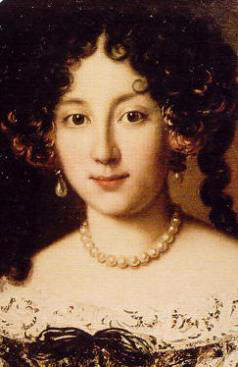
Marie Mancini
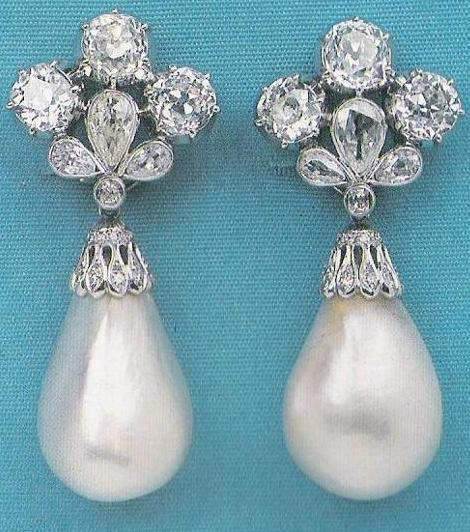
Mancini Pearl Ear Pendants
Pearl drop ear-pendant worn by the mystery girl in the painting known as "The Dutch Mona Lisa."
Another well known pair of ear pendants, which perhaps was not real, was the one worn by a mystery girl, the subject of a famous painting by Baroque Dutch artist Johannes Vermeer. The famous portrait believed to have been executed around year 1665, depicts the close up of a beautiful young lady wearing a headdress and a large pearl drop ear-pendant. In this painting the artist seems to have masterfully captured, the beauty and luster of the drop-shaped pearl, hanging from the girl's left ear. The remarkable genre painting later acquired the name "The Dutch Mona Lisa," and became the inspiration for a film that speculated on the identity of the subject.
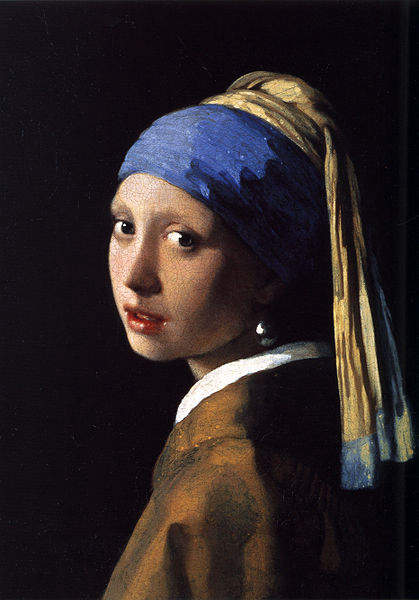
Girl with the pearl earring- By Johannes Vermeer (1632-1675)
The sale of the pair of antique natural pearl and diamond ear-pendants
The pair of antique natural pearl and diamond ear-pendants was put up for sale by its anonymous owner on April 29, 2008, at the Christie's Contemporary Jewelry and Watches Sale, that was held at the Jumeirah Emirates Towers Hotel, in Dubai, the United Arab Emirates. The sale bearing No. 7664, had placed the pair of ear-pendants under Lot No. 160. The pair of ear-pendants was accompanied by a laboratory report bearing No. 0127953, dated February 26, 2008, issued by the Gem Testing Laboratory of Great Britain, authenticating the natural provenance of the pearls mounted on the ear-pendants. A pre-sale estimate of $180,000 to $250,000 was placed on the pair of antique natural pearl and diamond ear-pendants. At the auctions, where there was a strong demand for pieces of jewelry incorporating natural pearls. the pair of antique natural pearl and diamond ear-pendants sold for a record $217,000, one of the highest prices , paid for a pair of natural pearl and diamond ear-pendants.
Comparison of the price realized by the pair of ear-pendants, with the price realized for the pair of Marie Mancini pearl and diamond ear-pendants in October, 1979.
The antique pair of natural pearl and diamond ear pendants, incorporating two near-spherical pearls of weight 10.23 carats and 9.99 carats and two drop-shaped pearls of weight 26.86 carats and 22.82 carats, sold for a record price of $217,000, at the Christies's Dubai auction held on April 29, 2009. A significant portion of the value of these pearls would have been for its antiquity. It is interesting to compare the price realized by these ear pendants with the price realized by a similar pair of ear-pendants, the Marie Mancini pearl and diamond ear-pendants, also at a Christie's auction, held in New York, in October 1979. The Marie Mancini pearl and diamond ear-pendants, incorporating two drop-shaped pearls of approximately 50 carats (200 grains) each, sold only for $253,000, in spite of his historic provenance of over 400 years. However this was nearly three decades ago, when the auction market for natural pearls had not yet picked up. The strong auction market for natural pearls was registered only around the turn of the new millennium, in 1999, with the sale of the Barbara Hutton pearl necklace for $1.47 million. See table below. An examination of the table shows that the double-strand Baroda Pearl Necklace consisting of 68 natural pearls has set the world record as the pearl necklace that fetched the highest price at an auction so far - USD 7.096 million at an auction in April 2007. Out of the single pearls, the 302.68-grain La Regente pearl, has set the world record, as the single pearl that fetched the highest price at an auction, viz. USD 2,483,968, at an auction in November 2005.
Price per carat of the Mancini Pearls sold in 1979 was USD 253,000/100 = USD 2,530.
Price per carat of the antique pearl and diamond ear-pendant = USD 217,000/69.9 = USD 3,104.
Thus after 3 decades the price per carat has appreciated by USD 574.
Given the 400-year historic provenance of the Marie Mancini natural pearl and diamond ear-pendants, and the superior quality of the natural pearls incorporated in them, whenever the Marie Mancini pearls come up for auction again, they would without any doubt sell for over a million dollars, and sometimes even exceed the value of La Regente which has a historical provenance of only around 200 years, dating back to the period of Napoleon Bonaparte.
Table of famous natural pearls/pearl jewelry sold at public auctions showing the increase in demand for these pearls in the 1980s and 1990s, and the strong auction market registered after the onset of the new millennium
| S/N | Name of pearl/pearl jewelry | Probable period of origin | weight |
date of auction | Price realized |
| 1 | La Peregrina | 1513 | 203.84 grains | 1969 | USD 37,000 |
| 2 | Mancini pearls - pair of pearl and diamond ear-pendants | 1500-1600 | 400 grains | Oct.1979 | USD 253,000 |
| 3 | Mona Bismarck 2-strand pearl necklace | 1920-1930 | Double-strand of 70 pearls | May 1986 | USD 410,000 |
| 4 | Duchess of Windsor pearl necklace | 1910-1936 | Single-strand of 28 natural pearls. Total weight 1266.33 grains | April 1987
|
USD 733,333
|
| 5 | Barbara Hutton pearls | 1600-1666 | 44 natural pearls, total weight of 1,816.68 grains | May 1992
|
USD 580,000
|
| 6 | Empress Eugenie tiara | 1853 | 212 pearls, 2,520 grains | Nov 1992 | USD 650,000 |
| 7 | Nina Dyer black pearl necklace | 1950s | 151 natural black pearls | Nov 1997 | USD 913,320 |
| 8 | Barbara Hutton pearls (repeat auction) | 1600-1666 | 44 natural pearls, total weight 1,816.68 grains | Nov 1999 | USD 1,470,000 |
| 9 | Unidentified natural pearl necklace by Cartier | Historical provenance not revealed | Double-strand necklace with 88 natural pearls | Nov 2004 | USD 3,100,000 |
| 10 | La Regente | 1811 | 302.68 grains | Nov 2005 | USD 2,483,968 |
| 11 | Gulf pearl parure designed by Harry Winston | 1932-1978 | Nov 2006 | USD 4,100,000 | |
| 12 | Baroda pearl necklace | 1856-1870 | Double-strand with 68 natural pearls from the original 7-strand necklace | April 2007 | USD 7,096,000 |
| 13 | Duchess of Windsor pearl necklace (repeat auction) | 1910-1936 | Single-strand of 28 natural pearls. Total weight 1266.33 grains | Dec 2007 | 3,625,000 |
| 14 | Umm Kulthum pearl necklace | 1880 | nine-stranded necklace with 1,888 pearls | April 2008 | USD 1,390,000 |
| 15 | Belle Epoque natural grey/brown pearl pendant necklace | 1900 | Single perfectly symmetrical natural grey/brown drop-shaped pearl, weighing 227.24 grains | April 2008 | USD 769,000 |
| 16 | Second largest freshwater pearl | not known | Single, near-spherical, freshwater, yellowish to pinkish-orange, nacreous pearl, weighing 241.44 grains | April 2008 | USD 713,000 |
| 17 | Pearl necklace from an unidentified notable collection | Historical provenance not revealed | Single-strand necklace with 41 natural pearls | Nov 2008 | USD 1,321,110 |
| 18 | Unidentified pearl and diamond festoon necklace | Historical provenance not revealed | Nine-strand pearl and diamond festoon necklace. Length 645mm to 1060mm | Nov 2008 | USD 946,610 |
| 19 | Pearl Carpet of Baroda | 1860 | 1.5-2.0 million natural seed pearls | March 2009 | USD 5,500,000 |
You are welcome to discuss this post/related topics with Dr Shihaan and other experts from around the world in our FORUMS (forums.internetstones.com)
Related :-
External Links :-
1) An Attractive Pair of Antique Natural Pearl and Diamond Ear Pendants - Christie's Contemporary Jewelry and Watches Sale Auction Catalogue. Sale No. 7664, Lot No. 160. www,christies.com
References :-
1) An Attractive Pair of Antique Natural Pearl and Diamond Ear Pendants - Christie's Contemporary Jewelry and Watches Sale Auction Catalogue. Sale No. 7664, Lot No. 160. www,christies.com
2) Body piercing - Ear piercing - From Wikipedia, the free encyclopedia.
3) Marie Mancini Pearls - www.internetstones.com
 Home
Security & Guarantee
How it Works
Technology Partners
Updated Tables
Famous Diamonds
More Famous Diamonds
Famous Pearls
Famous Gemstones
Contact Dr Shihaan Larif
Contact Senior Editor
Famous Jewelry
Reference Database
Forums
Learning Center
Gemstone Gallery
e-mail Notifications
Advertise
Press Release
About Us
Privacy Policy
Contact Us
FAQ'S
Site Map
Staff Mail Login
Staff Documents
Birthstones
History
Minerals
Shows
Live Metal Prices
Jewellery Gallery
News
Marketplace
Marketplace Support
Open Store
Online Auctions
Join Us & Contribute
Directory
Classifieds
List your products
Wholesale Trading
Post Buy Request
Go Green Policy
Site Updates
Upcoming-ToDo List
Latest News
Latest Articles
Latest Blog Updates
Chat Rooms
Job Board
User Gallery
Videos
New Newsletter Archive
Old Newsletter Archive
Jewelry & Mineral Blog
User Blogs & Social Network
Search
Answers (Q & A)
Valuation
Help me find a diamond/jewelry
pin.internetstones.com- Social Pinboard- Sart yours & connect with millions
Invite Friends From Yahoo, Gmail etc-One Click
Home
Security & Guarantee
How it Works
Technology Partners
Updated Tables
Famous Diamonds
More Famous Diamonds
Famous Pearls
Famous Gemstones
Contact Dr Shihaan Larif
Contact Senior Editor
Famous Jewelry
Reference Database
Forums
Learning Center
Gemstone Gallery
e-mail Notifications
Advertise
Press Release
About Us
Privacy Policy
Contact Us
FAQ'S
Site Map
Staff Mail Login
Staff Documents
Birthstones
History
Minerals
Shows
Live Metal Prices
Jewellery Gallery
News
Marketplace
Marketplace Support
Open Store
Online Auctions
Join Us & Contribute
Directory
Classifieds
List your products
Wholesale Trading
Post Buy Request
Go Green Policy
Site Updates
Upcoming-ToDo List
Latest News
Latest Articles
Latest Blog Updates
Chat Rooms
Job Board
User Gallery
Videos
New Newsletter Archive
Old Newsletter Archive
Jewelry & Mineral Blog
User Blogs & Social Network
Search
Answers (Q & A)
Valuation
Help me find a diamond/jewelry
pin.internetstones.com- Social Pinboard- Sart yours & connect with millions
Invite Friends From Yahoo, Gmail etc-One Click




Our Global Jewelry Industry Job Network


Buy & Sell in our Marketplace

Subscribe to our Newsletter

List in our Classifieds

List in our Directory

User Uploaded Gallery

Powered by Ultra Secure
Amazon (USA) Cloud Network

Founder Internet Stones.COM
Register in our Forums

| Featured In
|
|
|
|
|
|
|
|







Blog & Education Feed
Articles Feed
 |
 |
 |

Copyright © .Internet Stones.COM. All rights reserved.