A Pair of Natural Pearl Earrings with a Circular Design
Open FREE Unlimited Store Join Our Newsletter
Origin of Name :-
The pair of natural pearl earrings was Lot No. 158, at the Christie's Contemporary Jewelry and Watches Sale, No. 7664 held in Dubai, at the Jumeirah Emirates Towers Hotel, on April 29, 2008. This all-pearl earring realized a price of $29,800, which was within its pre-sale estimate of $20,000 to $30,000.

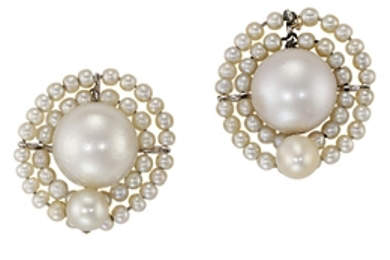
Pair of natural pearl earrings with a circular design
Please click here for an enlarged image (External Link)
© Christie's
Characteristics of the pair of natural pearl earrings
The circular design of the pair of earrings
Each earring has a circular design, with a central, prominent, button-shaped pearl, surrounded by two rows of beaded smaller pearls. A second large spherical pearl, smaller than the central spherical pearl is placed just below it. The metal wires used to support the pearls in the earring appear to be made of silver or platinum. The whole framework of the earring appears to be supported by two main cross wires, one vertical and the other horizontal. The central button-shaped pearl appears to be resting on these cross wires. The two rows of beaded pearls are strung together by wires which are also fixed to the cross wires. The second large spherical pearl is placed over the rows of smaller pearls just below the central pearl and in line with the vertical cross wire.
Are the central large pearls in the earrings actually button-shaped ?
In one earring, the central pearl described as a button-shaped pearl has dimensions of 12.21 mm and 11.24 mm, and a weight of 12.31 carats, equivalent to 49.24 grains. In the other earring, the central button-shaped pearl has dimensions of 12.19 mm and 10.82 mm, and a weight of 11.35 carats, equivalent to 45.40 grains.
In each of these button-shaped pearls we can determine the variation in diameter, and verify whether they are actually button-shaped.
1) Calculating the variation in diameter of the pearl weighing 49.24 grains
Variation in diameter = (1 - shortest diameter/longest diameter) x 100%
= (1 - 11.24/12.21) x 100 = (1 - 0.92) x 100
= 0.08 x 100 = 8%
Variation in diameter of perfectly spherical pearls = 0% to 2%
Variation in diameter of near-spherical pearls = 3% to 19%
Variation in diameter of button-shaped pearls > 20%
Thus the pearl weighing 49.24 grains, with a variation in diameter of 8%, is actually a near-spherical pearl, even though it is described as a button pearl.
2) Calculating the variation in diameter of the pearl weighing 45.40 grains
Variation in diameter = (1 - 10.82/12.19) x 100 = (1 - 0.89) x 100
= 0.11 x 100 = 11%
Thus the pearl weighing 45.40 grains, with a variation in diameter of 11%, is also a near-spherical pearl, even though it is also described as a button pearl.
The shape of the smaller beaded pearls
The small beaded pearls surrounding the central pearl have assorted shapes, but most of them appear to be button-shaped. There are also spherical, near-spherical, and oval-shaped pearls among them.
The color, overtones, luster and orient of the pearls
The most striking feature of the pearls on the earrings, is the similarity in color of all the pearls incorporated in them. The pearls are white with a slightly pinkish overtone. White is the body color of the pearls and pink the overtone color. The luster and orient of the pearls, caused respectively by reflection and refraction of light, are also exceptional, in keeping with their saltwater origins, imparting a spectacular overall beauty to the pair of earrings.
History of the pair of natural pearl earrings
The possible oyster species in which the pearls originated
Nothing is known of the historical provenance of the circular pair of natural pearl earrings. However, the pinkish-white color and the range in size of the pearls seem to suggest that they originated in the prolific pearl oyster species Pinctada radiata, the species around which the international pearl industry was based since very ancient times. White and yellow are common body colors of pearls produced by this species, and pink, silver and cream are common overtone colors produced. Pearls produced are usually medium sized varying from 2 mm to 10 mm. Quite a lot of seed pearls were also produced by this species, apart from the occasional large pearls greater than 10 mm in size. Pearls of both regular and irregular (baroque) shapes were produced. Among the regular shapes produced, were spherical, near-spherical, button, oval, and drop shapes. However, baroque shapes were more common than regular shapes.
The possible source of the pearls
Given that the possible oyster species in which the pearls originated is Pinctada radiata, we could suggest the possible sources of these pearls. The most possible source of the pearls, is the Persian Gulf, the Red Sea or the Gulf of Mannar, the natural home of Pinctada radiata, around which the international pearl trade was based for thousands of years. Another possible source was Venezuela in South America, where pearl oysters related to Pinctada radiata, the Atlantic pearl oyster (Pinctada imbricata) was harvested by the Spanish in the 16th and 17th centuries, but was abandoned in the mid-17th century due to depletion of resources by over exploitation.
Laboratory report issued by the Swiss Gemological Institute
The pair of natural pearl earrings, was accompanied by a laboratory report, bearing No.49188, dated August 15, 2007, issued by the Swiss Gemological Institute, indicating that the four larger pearls in the pair of earrings were natural saltwater pearls.
Sale of the pair of natural pearl earrings with a circular design
A pre-sale estimate of $20,000 to $30,000 was placed on the pair of natural pearl earrings, that was Lot No. 158 at the auction. The lot was sold for $29,800, which was within the estimated range. Out of 15 lots of pearl jewelry offered at the auction, 8 lots sold within the pre-sale estimated range. The remaining 7 lots sold much above the upper estimated range; one piece particularly selling for almost 12 times the upper estimated range of $120,000. This piece was the famous Umm Kulthum Nine-Row Pearl Necklace, which was sold for a staggering $1,385,000. Historical provenance of the pearl necklace was no doubt the main factor that enhanced the value of this necklace. However, the highest price recorded at the sale was Lot No. 178, a Superb Four-Row Natural Pearl and Diamond Necklace, which was sold for $1,743,400, within the pre-sale estimated range of $1,800,000 to $2,200,000
You are welcome to discuss this post/related topics with Dr Shihaan and other experts from around the world in our FORUMS (forums.internetstones.com)
Related :-
1) Pair of Antique Natural Pearl and Diamond Ear Pendants.
2) Fine Pair of Natural Pearl and Diamond Ear Pendants
External Links :-
References :-
1) A Pair of Natural Pearl Earrings - Christie's Contemporary Jewelry and Watches Sale, Auction Catalogue. Sale No. 7664. Lot No. 158. www.christies.com
 Home
Security & Guarantee
How it Works
Technology Partners
Updated Tables
Famous Diamonds
More Famous Diamonds
Famous Pearls
Famous Gemstones
Contact Dr Shihaan Larif
Contact Senior Editor
Famous Jewelry
Reference Database
Forums
Learning Center
Gemstone Gallery
e-mail Notifications
Advertise
Press Release
About Us
Privacy Policy
Contact Us
FAQ'S
Site Map
Staff Mail Login
Staff Documents
Birthstones
History
Minerals
Shows
Live Metal Prices
Jewellery Gallery
News
Marketplace
Marketplace Support
Open Store
Online Auctions
Join Us & Contribute
Directory
Classifieds
List your products
Wholesale Trading
Post Buy Request
Go Green Policy
Site Updates
Upcoming-ToDo List
Latest News
Latest Articles
Latest Blog Updates
Chat Rooms
Job Board
User Gallery
Videos
New Newsletter Archive
Old Newsletter Archive
Jewelry & Mineral Blog
User Blogs & Social Network
Search
Answers (Q & A)
Valuation
Help me find a diamond/jewelry
pin.internetstones.com- Social Pinboard- Sart yours & connect with millions
Invite Friends From Yahoo, Gmail etc-One Click
Home
Security & Guarantee
How it Works
Technology Partners
Updated Tables
Famous Diamonds
More Famous Diamonds
Famous Pearls
Famous Gemstones
Contact Dr Shihaan Larif
Contact Senior Editor
Famous Jewelry
Reference Database
Forums
Learning Center
Gemstone Gallery
e-mail Notifications
Advertise
Press Release
About Us
Privacy Policy
Contact Us
FAQ'S
Site Map
Staff Mail Login
Staff Documents
Birthstones
History
Minerals
Shows
Live Metal Prices
Jewellery Gallery
News
Marketplace
Marketplace Support
Open Store
Online Auctions
Join Us & Contribute
Directory
Classifieds
List your products
Wholesale Trading
Post Buy Request
Go Green Policy
Site Updates
Upcoming-ToDo List
Latest News
Latest Articles
Latest Blog Updates
Chat Rooms
Job Board
User Gallery
Videos
New Newsletter Archive
Old Newsletter Archive
Jewelry & Mineral Blog
User Blogs & Social Network
Search
Answers (Q & A)
Valuation
Help me find a diamond/jewelry
pin.internetstones.com- Social Pinboard- Sart yours & connect with millions
Invite Friends From Yahoo, Gmail etc-One Click




Our Global Jewelry Industry Job Network


Buy & Sell in our Marketplace

Subscribe to our Newsletter

List in our Classifieds

List in our Directory

User Uploaded Gallery

Powered by Ultra Secure
Amazon (USA) Cloud Network

Founder Internet Stones.COM
Register in our Forums

| Featured In
|
|
|
|
|
|
|
|







Blog & Education Feed
Articles Feed
 |
 |
 |

Copyright © .Internet Stones.COM. All rights reserved.